DRBEM Solution of the Double Diffusive Mixed
Convection in a Lid-Driven Square Cavity with a
Square Blockage Placed at the Bottom Wall
Nagehan Alsoy-Akg¨un, M¨unevver Tezer-Sezgin
Abstract—In this paper, the dual reciprocity boundary ele-ment method (DRBEM) is applied to solve the two-dimensional double diffusive mixed convection in a lid-driven square cavity with a square blockage placed at the bottom wall. Stream function-vorticity-temperature-concentration variables are used, and vorticity transport, energy and concentration equations are transformed to modified Helmholtz equations by utilizing forward difference with relaxation parameters for the time derivatives. The resulting modified Helmholtz equations are solved by DRBEM using the fundamental solution 1
2πK0(x) whereas in the stream function Poisson’s equation 1
2πln(x) is made use of. This procedure eliminates the need of another time integration scheme in vorticity transport, energy and concentration equations, and has the advantage of using large time increments. The inhomogeneities are approximated by using coordinate functions f = 1 +r and f = r2lnr in the stream function and vorticity-energy-concentration equations, respectively. Unknown vorticity boundary conditions are also obtained with the help of coordinate matrix F. The solu-tions are obtained for different values of Reynolds number, Richardson number and buoyancy ratio by using constant boundary elements. The solution reaches to steady-state with considerably large time increments and suitable values of relaxation parameters which occur in the argument of Bessel functionK0(x).
Index Terms—DRBEM, mixed convection, thermo-solutal buoyancy forces, lid-driven cavity.
I. INTRODUCTION
C
ONVECTION due to heat and mass transfer buoyancy effects in lid-driven cavities plays an important role in many engineering applications. The presence of ribs or obstructions significantly influences the fluid stratification in the enclosure and hence heat transfer. It is highly essen-tial to understand the interaction between the ineressen-tial and thermosolutal buoyancy forces on heat and mass transfer in these applications. Dual reciprocity boundary element method (DRBEM) is a numerical solution technique which can treat the nonlinearities in the partial differential equations by taking them as right hand side functions [1]. The basic idea of the DRBEM is to approximate the forcing term by a series of radial basis functionsfjwhich are related to a seriesof particular solutions by∇2 b
uj =fj. To obtain a particular
solution analytically for the Laplace operator L =∇2 and
the biharmonic operator L =∇4 can be done by repeated
integrations [1]. For that reason most of the differential equations were restricted to the form∇2=f(x, y, u, u
x, uy)
Manuscript received February 24, 2012.
N. Alsoy-Akg¨un is with the Department of Mathematics, Middle East Technical University, Ankara, 06800 Turkey, e-mail: [email protected]
M. Tezer-Sezgin is with the Department of Mathematics, Middle East Technical University, Ankara, 06800 Turkey, e-mail: [email protected]
when the DRBEM was used [1]. Since this procedure can not be used directly for the Helmholtz-type operator, different methods were experienced. A linear combination of thin plate splines (TPS) was used by Chen and Rashed [2] but systematic derivation was not given. Then Muleskov, Golberg and Chen [3] generalized these results. Also, DRBEM has the advantage of discretizing only the boundary of the problem. In this study, we use stream function-vorticity form of the Navier-stokes equations coupled with the energy and concen-tration equations. By using forward difference for the time derivative with a relaxation parameter at two consecutive time levels, vorticity transport, temperature and concentra-tion equaconcentra-tions are transformed to inhomogeneous modified Helmholtz equations. Thus, DRBEM is carried for these equations, with the fundamental solutionK0(x)of modified Helmholtz equation whereas in the stream function Poisson’s equation the fundamental solutionln(x)of Laplace equation is taken. The radial basis functionsfj =r2jlnrj are used for
the approximation of right hand sides, and the corresponding particular solutions are obtained. The unknown vorticity boundary conditions are obtained by using coordinate matrix in DRBEM. The effect of buoyancy ratio on the convection phenomenon is discussed. DRBEM application to double diffusive mixed convection flow in enclosures and over back-step flow is given in [6].
II. GOVERNING EQUATIONS
The thermo-solutal buoyancy-driven flow is governed by the equations that represent conservation of mass, momen-tum, energy and solutal concentration. In stream function
ψ, vorticity w, temperature T and concentration C the nondimensional equations are
∇2ψ =−w
1
Re∇
2w = ∂w
∂t +u ∂w ∂x +v
∂w ∂y −Ri
∂T
∂x +N ∂C
∂x
1
ReP r∇
2T = ∂T
∂t +u ∂T ∂x +v
∂T ∂y
1
ReSc∇
2C = ∂C
∂t +u ∂C
∂x +v ∂C
∂y
(1)
in which velocity components u, v and vorticity w are defined as
u=∂ψ
∂y, v=− ∂ψ
∂x, w= ∂v ∂x−
Reis the Reynolds number given byRe= U0H
ν whereU0, H andν are characteristic velocity, characteristic length and the kinematic viscosity, respectively. Ri is the Richardson
number given by GrT
Re2 where GrT is the Grashof number
due to the thermal diffusion. N is the buoyancy ratio given
by βC∆C
βT∆T
where βC volumetric solutal concentration
expansion coefficient, βT volumetric thermal expansion
coefficient, ∆C =Ch−Cc (Ch and Cc are high and low
solutal concentrations) and ∆T =Th−Tc (Th are and Tc
high and low temperatures).
First, the time derivatives in the vorticity transport, en-ergy and solutal concentration equations are approximated by using the forward finite difference approximation and writing these unknowns at two consecutive time levels in the Laplacian terms by using relaxation parameters. This results in three modified Helmholtz equations
∇2ψ(n+1)=−w(n)
∇2w(n+1)−λ2
ww
(n+1)=−(1−θw) θw
∇2w(n)−λ2
ww (n)
+Re
θw
∂ψ(n+1) ∂y
∂w(n) ∂x −
∂ψ(n+1) ∂x
∂w(n) ∂y
−ReRi
θw
∂T(n)
∂x +N ∂C(n)
∂x
∇2T(n+1)−λ2
TT
(n+1)=−(1−θT) θT
∇2T(n)−λ2 TT
(n)
+ReP r
θT
∂ψ(n+1)
∂y
∂T(n)
∂x −
∂ψ(n+1)
∂x
∂T(n)
∂y
∇2C(n+1)−λ2
CC
(n+1)=−(1−θC) θC
∇2C(n)−λ2
CC (n)
+ReSc
θC
∂ψ(n+1)
∂y
∂C(n) ∂x −
∂ψ(n+1) ∂x
∂C(n) ∂y
(3)
whereλ2 w=
Re
∆tθw , λ2
T = ReP r
∆tθT
, andλ2 C =
ReSc
∆tθC , andn
indicates iteration number, θis the relaxation parameter.
III. METHOD OF SOLUTION
The DRBEM will be used for stream function, vorticity-transport, temperature and concentration equations in (3) by considering Poisson’s, and modified Helmholtz equations
∇2ψ=b1 (4)
∇2w−λ2
ww=b2 (5)
∇2T−λ2TT =b3 (6)
∇2C−λ2
CC=b4 (7)
where b , b , b , b correspond to previously known right
hand sides, respectively. The right hand side functions are approximated by radial basis functionsfj’s as in [1]
b≈
K+L X
j=1
αjfj
wherefj = 1 +rj inb1,fj=rj2lnrj inb2, b3,andb4,and
αj are coefficients which are initially unknown.KandLare
the numbers of boundary and interior points,rj denotes the
distance between the source and field points. The DRBEM procedure results in matrix-vector equations
Hψ−Gqψ = (HΨb−GQcψ)F−1b1
H0w+G0qw = (H
0
c
W+G0Qcw)F
0−1
b2
H0T+G0qT = (H
0
b
T+G0QcT)F
0−1
b3
H0C+G0qC = (H
0
b
C+G0QdC)F
0−1
b4
(8)
where (K +L) ×(K +L) matrices F and F0 are the coordinate matrices constructed by taking fj = 1 +rj and fj = r2jlnrj as columns, and using rij as the distance
from the point i to j. ψ, w, T, C and qψ, qw, qT, qC
are (K +L)×1 vectors containing discretized values of stream function, vorticity, temperature, concentration and their normal derivatives. Ψb, Qbψ, W ,c Qbw, T ,b QbT and C,b
b
QC are (K+L)×(K+L) matrices formed columnwise
from the particular solutions and their normal derivatives for the equations ∇2
b
ψj = 1 +rj, ∇2wbj −λ 2
wwbj = r 2 jlnrj
∇2
b
Tj−λ2TTbj =r2jlnrj and∇2Cbj−λ2CCbj=rj2lnrj.
The entries of the matricesH, G, H0 andG0 as given as [1], [4]
Hij =ciδij+ 1 2π Z Γj ∂ ∂n ln 1 ri
dΓj, (9)
Gij= 1 2π Z Γj ln 1 ri
dΓj (10)
Hij
0
=ciδij+ 1 2π
Z
Γj
∂K0(λri)
∂n dΓ (11)
Gij
0
=− 1
2π
Z
Γj
K0(λri)dΓ (12)
whereΓjis thej-th boundary element andλrefers toλw, λT
andλCfor vorticity transport, temperature and concentration
equations, respectively.
The system of equations (8) is solved iteratively with ini-tial vorticity and temperature values. First, the stream func-tion equafunc-tion is solved then velocity vectors are computed by using newly obtained stream function values. The vorticity transport, temperature and concentration equations are solved for the next time level using previous vorticity, temperature and concentration values. The solution is obtained at steady-state.
IV. NUMERICAL RESULTS
We solve the thermal-solutal mixed convection flow in a lid-driven square cavity Ω = [0,1×0,1] with a square blockage placed at the bottom wall. The no-slip boundary conditions for velocity are imposed on all the walls of the cavity and the square blockage with the exception of the Proceedings of the World Congress on Engineering 2012 Vol I
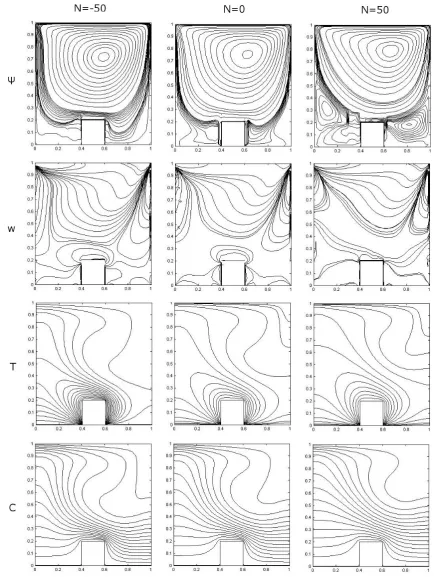
Fig. 1. The effect of the buoyancy forces forRi= 0.01, Re= 100
upper lid which moves with a uniform velocity u= 1. The top lid assumed to be cooled (T = 0) with high solutal concentration (C= 1). The bottom wall of the cavity except the square blockage are cooled (T = 0) with low solutal concentration (C = 0). The adiabatic boundary conditions are imposed on the vertical walls for both temperature and solutal concentration.
Boundary conditions for stream function are taken as zero at the walls due to the no-slip wall conditions of velocities, and the vorticity boundary conditions are obtained from the discretization of w = ∂v∂x −∂u
∂y by using the DRBEM
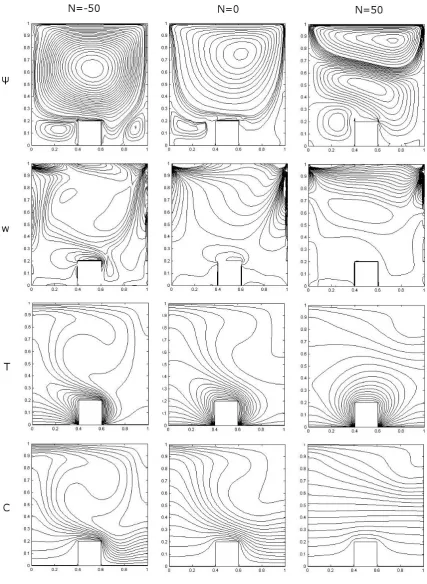
Fig. 2. The effect of the buoyancy forces forRi= 0.1, Re= 100
graphing. The pre-assigned accuracy for reaching steady state is taken as = 10−5. In the numerical solution, relaxation parameters (θw, θT, θC) for vorticity, temperature and solutal
concentration are taken 0.9, which takes less number of iterations for reaching steady-state solution. These values of relaxation parameters indicate that more contribution is used from the newly obtained solutions. The time increment
∆t = 0.05 is used for reaching steady-state which is very large compared to the other time discretization schemes.
First, the effect of the buoyancy ratio is given for Ri= 0.01, Re = 100 andP r =Sc = 1 by using N =−50, 0,
50. From Figure (1) one can see that fluid cores occur in the cavity even around the blockage whenN = 50. When
N decreases from 50 to −50 the center of the fluid core Proceedings of the World Congress on Engineering 2012 Vol I
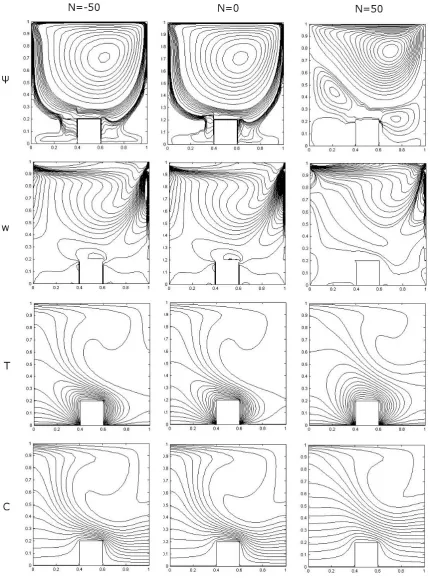
Fig. 3. The effect of the buoyancy forces forRi= 0.01, Re= 200
gets shifted closer to the center of the cavity increasing the fluid convection. The vorticity which is generated by the boundaries gets diffused and convected throughout the cavity for N =−50 and the fluid regime gets divided for
N = 50.These are expected behaviors since for the negative and positive values of N, buoyancy forces aid and oppose each other. We can see that remarkable temperature gradients
ones in [5]. In the second case, the effect of the buoyancy ratio is given forRi= 0.1, Re= 100 andP r=Sc= 1by using N =−50, 0, 50. Figure (2) shows a fluid core at the center of the cavity and secondary cores for N = −50, 0
around the blockage. But whenN = 50there is a secondary fluid cell in the cavity. Vorticity behavior is similar to the first case. When N is increased to N = 0 and N = 50,
boundary layers are more pronounced close to and on the top lid. When we look at temperature and concentration contours we see that for N = −50 and N = 0, the behaviors are almost the same with the previous case. When N = 50
temperature and concentration contours occupie almost all parts of the cavity with smooth variations. Action around the blockage is weakened. In the Figure (3) the effect of increase inReis visualized. WhenReis increased main fluid core is shifted through upper right corner with the movement of the upper lid. This behavior is more pronounced for N = 50.
Vorticity forms strong boundary layers close to the upper lid and at the side walls close to the upper corners. Isotherms and concentration are not effected much with the increase of
Re.
V. CONCLUSION
DRBEM application to the double diffusive mixed con-vection flow in cavity with a square blockage at the bottom wall is presented. DRBEM has the advantage of giving quite good accuracy with considerably small number of elements oriented on the boundary only. When the buoyancy ratio is negative temperature and concentration aid each other while for positive buoyancy ratio they oppose each other.
REFERENCES
[1] P. W. Partridge, C. A. Brebbia, and L. C. Wrobel, “The Dual Reciprocity Boundary Element Method,” inComputational Mechanics Publications and Elsevier Applied Science, 1992.
[2] C. S. Chen and Y. F. Rashed, “Evaluation of Thin Plate Spline Based Particular Solutions for Helmholtz-Type Operators for the DRM,” in
Mechanics Research Communications, 1998, vol. 25, pp. 195-201. [3] A. S. Muleshkov, M. A. Golberg, and C. S. Chen, “Particular
Solu-tions of Helmholtz-Type Operators using Higher Order Polyharmonic Splines,” inComputational Mechanics, 1999, vol. 23, pp. 411-419. [4] M. Tezer-Sezgin, “Boundary Element Method Solution of MHD Flow
in a Rectangular Duct,” inInt. J. for Num. Methods in Fluids, 1994, vol. 18, pp. 937-952.
[5] D. S. Kumar, K. Murugesan, and H. R. Thomas, “Numerical Simulation of Double Diffusive Mixed Convection in a Lid-driven Square Cavity using Velocity-Vorticity Formulation,” inNumerical Heat Transfer, Part A: Applications, 2008, vol. 54, pp. 837-865.
[6] N. Alsoy-Akg¨un, M. Tezer-Sezgin, “DRBEM Solution of the Thermo-Solutal Buoyancy Induced Mixed Convection Flow Problems,” in En-gineering Analysis with Boundary Elements, submitted for publication.