332
©IJRASET: All Rights are Reserved
Design Consideration for Photovoltaic Array of a
Small Building
Aye Aye
Electronic Engineering Department, Technological University (Banmaw), Banmaw, Kachin State, Myanmar
Abstract: This paper provides design idea and calculation to determine the size of solar energy system for a small building. Harnessing the renewable energy is the best solution for protection from environmental pollution. Nowadays, many researchers become more interested to be able to produce enough power from solar energy with both large scale solar farm built in very large area and small scale solar PV installation for a household level. In this paper, literature review of solar energy, design calculation for PV array size and also the size of other components such as charge controller, battery and inverter are developed for a small library.
Keywords: Photovoltaic (PV) Modules, Solar Panel, Library, Charge Controller, Battery Size.
I. INTRODUCTION
[image:1.612.141.482.432.551.2]Solar Cell or Photovoltaic (PV) cell is a device that is made up of semiconductor materials such as silicon, gallium arsenide and cadmium telluride, etc. that converts sunlight directly into electricity. When solar cells absorb sunlight, free electrons and holes are created at positive/negative junctions. If the positive and negative junctions of solar cell are connected to DC electrical equipment, current is delivered to operate the electrical equipment. When sunlight strikes the PV modules, it knocks electrons loose from their atoms, which allows them to flow through the modules and into the PV Circuit Conductors. This flow of electrons, or electricity, is referred to as Direct Current (DC) Power. Once the electricity leaves the modules, it moves through the DC Disconnect and into the DC/AC Inverter. The role of the DC/AC Inverter is to convert DC Power into Alternating Current (AC) Power. Once converted, AC Power exits the DC/AC Inverter through the AC Circuit Conductors and into the AC Disconnect. Finally, the AC Power is ready to use for a building. The block diagram shown in Fig.1 is for operation of solar energy system.
Fig. 1 Block diagram of solar energy system
II. SOLARRADIATIONANDSOLARENERGY
Sunlight, also calledsunshine, solar radiation that is visible at Earth’s surface. The amount of sunlight is dependent on the extent of the daytime cloud cover. Some places on Earth receive more than 4,000 hours per year of sunlight (more than 90 percent of the maximum possible), as in the Sahara; others receive less than 2,000 hours, as in regions of frequent storminess, such as Scotland and Iceland. Over much of the middle-latitude region of the world, the amount of sunlight varies regularly as the day progresses, owing to greater cloud cover in the early morning and during the late afternoon.
An effective absorber of solar radiation is ozone, which forms by a photochemical process at heights of 10–50 km (6–30 miles) and filters out most of the radiation below 0.3 micrometre. Equally important as an absorber in the longer wavelengths is water vapour. A secondary absorber in the infrared range is carbon dioxide. These two filter out much of the solar energy with wavelengths longer than 1 micrometre.[6]
333
©IJRASET: All Rights are Reserved
III.OVERVIEWOFPHOTOVOLTAICMODULE
[image:2.612.212.414.161.285.2]PV ModuleorSolar PV Module is an assembly of photovoltaic (PV) cells, also known as solar cells. To achieve a required voltage and current, a group of PV modules (also called PV panels) are wired into large array that called PV array. A PV module is the essential component of any PV system that converts sunlight directly into direct current (DC) electricity. PV modules can be wired together in series and/or parallel to deliver voltage and current in a particular system requires. The installation of PV module is shown in Fig.2.
Fig. 2 Installation of PV module
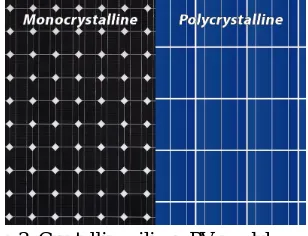
[image:2.612.241.395.369.487.2]Two types of crystalline silicon (c-Si) are used to produce PV modules as shown in Fig.3: single crystalline silicon or known as monocrystalline silicon and multi-crystalline silicon, also called polycrystalline silicon. Thepolycrystalline silicon PV module has lower conversion efficiency than single crystalline silicon PV module but both of them have high conversion efficiencies that average about 10-12%.
Fig. 3 Crystalline silicon PV module
Amorphous silicon (a-Si) PV module or thin-film silicon PV module as shown in Fig.4 absorbs light more effectively than crystalline silicon PV module, so it can be made thinner. It suits for any applications that high efficiency is not required and low cost is important. The typical efficiency of amorphous silicon PV module is around 6%. [8]
[image:2.612.250.371.545.714.2]334
©IJRASET: All Rights are Reserved
IV.CALCULATIONFORSOLARPANELARRAYOFASMALLLIBRARY
The proposed system is to calculate for the number of solar panels. Nowadays, the small buildings are constructed with the installation of PV modules to produce enough power from solar energy instead of using the electricity from the grid. It includes solar panels, charge controller, battery bank and inverter.
A. Estimate of Power Consumption Demands
The first step in designing a solar PV system is to find out the total power and energy consumption of all loads that need to be supplied by the solar PV system as follows:
1) Calculate total Watt-hours per day for each appliance used( Add the Watt-hours needed for all appliances together to get the total Watt-hours per day which must be delivered to the appliances.)
2) Calculate total Watt-hours per day needed from the PV modules
3) Multiply the total appliances Watt-hours per day times 1.3 (the energy lost in the system) to get the total Watt-hours per day which must be provided by the panels.
The system is powered by 12 Vdc, 110 Wp PV module. Table I shows the items used in a library with its power consumption rates.
TABLE I
TOTAL POWER CONSUMPTION OF A LIBRARY
No. Item Quantity Power
Consumption
Hours per Day(estimated)
Total Power Consumption(Wh)
1 Compact fluorescent lamp (CFL)
5 100 5 2500
2 F40 or 34 watt
fluorescent lamp
10 34 5 1700
3 Computer 9 200 6 10800
4 Printer 1 100 6 600
5 Copier 1 1300 4 5200
7 CCTV 6 60 24 8640
8 Aircon 2 1800 24 86400
9 TV 1 150 7 1050
10 DVD/CD/VCD
player
2 15 4 120
11 Audio
Players/Recorders
2 30 7 420
12 Konica Minolta
PS5000 MK II Book Scanner
1 100 3 300
13 Satellite Dish 1 25 6 150
Maximum Total Power Consumption Demand
of all items used in a library(Wh/day)
117880
Total appliance use = 117880 Wh/day
335
©IJRASET: All Rights are Reserved
B. Size of PV Panel
As the second step, the number of PV panels can be calculated as follows. Total Wp of PV panel capacity = 153244/3.4 = 45072 Wp
Number of PV panels needed = 45072/110 = 410 modules
This proposed system should be powered by at least 410 modules of 110 Wp PV module.
C. Size of Inverter
The inverter converts DC voltage to AC power supply voltage for the utility. The size of the inverter can be estimated as follows. Total Watt of all appliances = (power consumption x quantity) + (power consumption x quantity)+…………+……….
= 8365W = 8.4kW
For safety, the inverter should be selected 25-30% bigger size.The inverter size should be about 10kW or greater.
D. Size of Battery
In this proposed system, the battery bank is used to get enough DC voltage with high current.
Total appliances use = (power consumption x hours)+ (power consumption x hours)+ (power consumption x hours)+…..
Nominal battery voltage = 12V
Days of autonomy = 3 days
Battery loss = 0.8
Depth of discharge = 0.6
Battery Capacity (Ah) = Total Watt-hours per day used by appliances x Days of autonomy (0.85 x 0.6 x nominal battery voltage)
The battery bank including the eighty two batteries rated 12 V 600 Ah for 3 day autonomy is used for this system.
E. Size of Charge Controller
The charge controller is used to connect/disconnect the battery with solar panel. The size of the charge controller is estimated as follows.
PV module specification Pm = 110 Wp
Vm = 16.7 Vdc Im = 6.6 A Voc = 20.7 A Isc = 7.5 A
According to standard practice, the sizing of solar charge controller is to take the short circuit current (Isc) of the PV array, and multiply it by 1.3.
Solar charge controller rating = Total short circuit current of PV array x 1.3 Solar charge controller rating = (5 strings x 7.5 A) x 1.3 = 49 A
So, the 84 solar charge controllers for each five strings array should be rated 50 A at 12 V or greater.
V. CONCLUSIONS
The design calculation of solar array installation is successfully completed for a small library. According to the calculation, the number of PV panels is 410 modules. It can be designed to get rooftop installation for future work as the PV installation on the roof can save the large land. The PV modules with high voltage and more power rating should be used in this design to meet the requirements of compact design.
VI.ACKNOWLEDGMENT
336
©IJRASET: All Rights are Reserved
REFERENCES
[1] Quazi K. Hassan, K.Mahmud Rahman, Anis S. Haque, and Ahad Ali, “Solar energy modelling over a residential community in the city of Calgary, Alberta, Canada,” International Journal of Photoenergy, pp. 1–8, Mar.2011.
[2] Wang Xuan and Li Hongyan, “Energy saving and green building design of libraries:the case study of Zhengzhou Library,” Library Society of China & National Library of China, Zhengzhou Library, China, July 20, 2011.
[3] Samuel Babatope Adejuyigbe, Bukola Olalekan Bolaji, Mabel Usunobun Olanipekun, and Michael Rotimi Adu, “ Development of a solar photovoltaic power system to generate electricity for office appliances,” Nigeria, Engineering Journal, vol. 7, pp. 29–39, Jan. 2013.
[4] Mohd Rizwan Sirajuddin Shaikh, Suvarna Labade and Anil Tekale, “A review paper on electricity generation from solar energy,” IJRASET, vol. 5, pp. 1884– 1889, Sept. 2017.
[5] Deepak Purohit, Goverdhan Singh and Udit Mamodiya, “A review paper on solar energy system,” Poornima College of Engineering, Jaipur, IJERGS, vol. 5, pp. 66–70, Sept-Oct.2017.
[6] “Sunlight and solar radiation”, https://www.britannica.com/science/sunlight-solar-radiation. [7] “Solar energy”, https://en.wikipedia.org/wiki/Solar_energy