Evaluating Quality of Open Source Components
Student
Friso Kluitenberg
Supervisors
Dr. A.B.J.M. Wijnhoven Dr. M. Daneva
Date
1
ABSTRACT
Open source components are a great way for small and medium-sized enterprises to deliver product and services to the market faster. However, challenges arise when assessing the quality of these open-source components. While frameworks and models to assess quality of these components do exist, the open source market is neither governed nor regulated. No language specific or framework specific models or automated tools for analyzing open source software quality exist.
This research aims to solve that by selecting quality indicators of for an open source components on GitHub. In addition, a tool has been developed which evaluates open source components and information about these components from other sources. These sources include Stackexchange for external support and the National Vulnerability and Exposure database for security incident history. Feedback on the developed prototype shows that developers are interested in an automated way to check for risks which exists in open source components, a judgement of quality and the same analysis for dependencies of such components.
2
TABLE OF CONTENTS
Abstract ... 1
1 Introduction ... 4
1.1 Background ... 4
1.2 Problem Definition ... 4
1.3 Project goals ... 4
1.4 Scope... 4
1.5 Research Questions ... 5
1.6 Characteristics of Small and Medium Sized Enterprises ... 6
1.7 Knowledge Management ... 7
1.7.1 Knowledge Creation ... 8
1.7.2 Knowledge Storage ... 9
1.7.3 Knowledge Transfer ... 10
1.8 Sources of External Knowledge ... 10
2 Research Methodology ... 12
3 Design Theory and Meta-Requirements ... 15
3.1 OS Quality Methodologies ... 16
3.1.1 ISO/IEC 25010 ... 16
3.1.2 Open Business Readiness Rating (O-BRR)... 18
3.1.3 Navica’s N-OSMM ... 18
3.2 GitHub Available Quality Indicators ... 19
3.2.1 Version Control Meta Data... 19
3.2.2 Platform and Community Meta data... 20
3.2.3 Platform Support & Documentation ... 21
3.3 OS Component Risks and Challenges ... 22
3.3.1 Component Integration ... 22
3.3.2 Risk of having insufficient Quality ... 23
3.3.3 Component operation and Maintenance Risk ... 23
3.3.4 Legal Risk ... 23
3.3.5 Security Risks ... 26
3.4 Summary and Conclusion ... 26
4 Goal & Design Propositions of the quality assessment tool ... 28
4.1 Goal ... 28
3
5 Design Method... 30
5.1 Maturity Criteria for Assessment of Quality ... 30
5.2 Risks Criteria for Assessment of Quality ... 31
5.2.1 Effort Estimation ... 31
5.2.2 Risk of insufficient quality ... 32
5.2.3 Component operation and maintenance ... 32
5.2.4 Legal Risks ... 32
5.3 Conceptual Architecture ... 33
5.4 Prototype Design... 35
5.4.1 Basic Information ... 36
5.4.2 Component Maturity... 37
5.4.3 Risk Analysis ... 39
5.4.4 View Commits ... 39
5.4.5 View Issues ... 40
6 Results... 41
6.1 Participants ... 41
6.2 Data ... 41
7 Conclusions and Future Work ... 42
7.1 Method ... 42
7.2 Participants ... 42
7.3 Review of Solution ... 42
4
1
INTRODUCTION
1.1
Background
Increasingly more small and medium-sized enterprises(SMEs) use open source solutions and components in products and services [1]. An open source component effectively allows SMEs to
decrease time to market since SMEs do not have to develop their own solution from scratch and thereby avoid reinventing the wheel. In addition, a SME can use a component build on a specific development philosophy or ‘opinion’. A development philosophy is a set of structures, rules and guidelines developers can follow to reduce complexity, guarantee quality trough or make best practices easier to follow. In addition, to make use of such components with opinion about best practices development cost can be reduced, helping SMEs serve their customers faster.
1.2
Problem Definition
The explosive growth of open source initiatives results in the available of a wide range of components with different opinions and development philosophies. With this vast amount of available components and solutions to use in a project, risks arise as well. There is no generally accepted market standard within the industry to evaluate component quality. Furthermore, the open source market is neither governed nor regulated. However, even though these structures are not in place, the nature of open source technology allows for transparent comparison and assessment of available solutions.
Therefore, there is a need and a possibility to develop a set of guidelines and an accompanying tool to assess the quality of these components and solutions, find quality indicators and design a tool to evaluate these components. The purpose of this research is to do just that.
1.3
Project goals
As indicated earlier, the master project described in this thesis responds to the need of the software industry for guidelines and tools. More specifically, we set out to achieve the following goals:
1. To develop a methodology for identifying risks for SMEs when using open source components in their development process.
2. To identify suitable indicators for quality evaluation of open source components.
3. To design a tool that supports the quality evaluation of these components, and the associated risk of these components’ adoption by SMEs.
1.4
Scope
Open source components are used by a very broad audience, ranging from hobbyist to developers working in bigger enterprises. This translates to a large set of requirements and general
recommendations posed to open source components. To reduce these set of requirements and recommendations to a manageable level the scope of this research will be set to small software
development companies (SME’s). An has less than 250 employees and a turnover of less than €50m or a balance sheet total less than €43m[2].
5 These open source components are available through multiple platforms, but in this research only GitHub is considered. The reason for this is that GitHub is the largest open source platform, exposes an Application Programming Interface (API) for easy data consumption and provides a variety of meta-data (which will be explored later) about open source component.
1.5
Research Questions
As stated in section 1.3, the objective of this research is improve the ability to assess quality to identify risks associated with OSS. The goal is to improve both the theoretical understanding about quality and risk in open source projects as well as provide the end-user with a tangible tool to automate evaluating the findings in this tool. To aid in reaching that goal, the following main research question is formulated:
RQ1. Can a tool reliably assess the quality of open source software information?
Quality of open source components is a subject which touches many other disciplines and subjects as well. For example, the legal aspect (licensing) is closely tied to the intended use case. If a project requires distribution for example, a viral license is not always suitable; however if a project includes a service a viral license might be perfectly fine. Thus using and selecting open source components is essentially a knowledge management challenge touching on internal knowledge, solution search and problem solving areas.
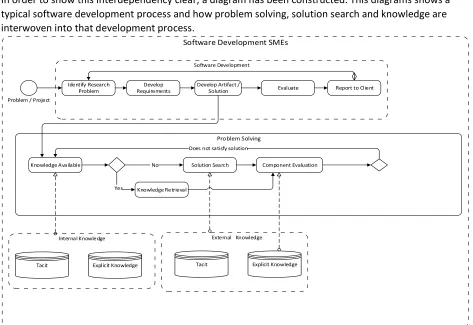
In order to show this interdependency clear, a diagram has been constructed. This diagrams shows a typical software development process and how problem solving, solution search and knowledge are interwoven into that development process.
Software Development SMEs
Software Development
Problem Solving
External Knowledge Internal Knowledge
Problem / Project
Identify Research Problem
Develop Requirements
Develop Artifact /
Solution Evaluate Report to Client
Explicit Knowledge
Tacit Tacit Explicit Knowledge
Solution Search Component Evaluation
Knowledge Available No
Does not satisfy solution
Knowledge Retrieval Yes
[image:6.612.71.544.362.687.2]
6 A software development company may start with either a market need or problem they identified or with a need or problem a client identified. Requirements are established for the solution to that problem or need. This process is visualized in figure 1 In addition, these requirements also take constraints of the resources and knowledge of a SME into account. Companies especially SMEs have constraints on their resources, knowledge and budget. These resources and constraints affect the requirements of the solution and thus apply to components used in the solution.
To explore how this context influences constraints and quality requirements of selecting open source the characteristics of small and medium sized enterprises will be researched trough the following question:
RQ 2. What are constrains and opportunities of software development SMEs?
In the development phase, open source components are often required. An open source component is essentially knowledge crystalized in code. In addition, people who are developing, searching for that component or are using that software generate questions, knowledge, ideas for improvement. These are essentially KM and solution search related activities.
In Figure 1, this is represented by explicit knowledge and tacit knowledge. Explicit knowledge is codebase, documentation and support of the open source component. Undocumented ways to
implement the component, use the component and potential use-cases are regarded as tacit knowledge in this case. Thus selecting and evaluating the right open source components is a knowledge
management problem.
To get a better understanding about how knowledge management influences selecting and evaluating open source components, the following research questions are raised:
RQ 3. How is knowledge created, stored and transferred in SMEs? RQ 4. What km applications exists?
Open source components are regarded as external knowledge, provided that the same SMEs implementing it didn’t develop the component. Open source software is exposed through various platforms, with various characteristics and various online communities discuss about those components, thus providing a valuable source of information.
To explore in which where these open source components and knowledge about these open source components are available, the following research questions are raised
RQ 5. Where do end-users seek information about open source components?
1.6
Characteristics of Small and Medium Sized Enterprises
SMEs differ in numerous ways from larger organizations[3] in both the challenges and the opportunities they face. When looking at the challenge, the following ones can be identified[4]
1. Size related
7 knowledge may exist only in a few key persons of the organization, so it is vital to retain that information or skills and/or these individuals.
2. Insufficient Strategy
SMEs are more concerned with their daily operational processes than with strategy due to the limited amount of human resources they have available. Business development and strategy in smaller firms are often the output of one person. This is a challenge since business development skills are needed to guide software development activities, matching demand with supply and partnership development[5]. All these activities require organizational support, which may be hard to achieve with this resources. In addition, business development skills take long to develop a deep understanding of the business, understanding of the external market and networks. Thus, if these skills leave the organization it would take long to replace[5], and may result in a weaker competitive position.
3. Resources
SMEs often have challenges in raising funds. In addition, allocation of assets and procurement of software licenses for components and development tools have to be done more carefully. Allowing custom solutions and software licenses on a per user basis may hurt the company if it has ambitions to grow, since this results in more overhead managing and maintaining these licenses, updates and operating conditions.
There are also benefits small and medium-sized enterprises have over larger enterprises. The main advantages are[4]:
1. Shorter cycle times
Due to their resource and size constraints, SMEs need to focus the service and products they deliver. They cannot offer a spectrum of products and services that are too broad. This focus results in shorter cycle times.
2. Better client communication
By being less rigid in their organization's structure, SMEs mainly focus on client interaction. This client oriented focus can result in faster, but less deep, organizational learning and delivering solutions which are more in line with the client's wishes, wants and needs.
3. Less Formal
A less formal organizational structure and culture allow for faster turn over. Bureaucratic processes are kept to a minimum in small and medium-sized enterprises.
1.7
Knowledge Management
The existence of each company is dependent on the knowledge available within the various
8 More and more companies run their operations in project structures rather than single departments and the importance of working in projects has an influence on how a company deals with the knowledge generated in such settings. This raises interesting questions, especially in Small and medium-sized enterprises, due to their limited size and resources.
Knowledge management can be categorized[4], [7] into three phases: 1. Knowledge Creation
Knowledge creation entails developing new ideas through socialization, externalization and embedding knowledge in an individual’s ‘tacit knowledge space’. Since knowledge creation is in essence learning, unlearning old skills and knowledge is also part of this[4]. Solution search is part of knowledge creation since solution search processes facilitate the creation of new knowledge based on what is already out there.
2. Knowledge Storage
The process of storing and retrieving all forms of knowledge. Knowledge is dynamic. It enters and leaves the company during the course of its life. To keep a competitive edge, a company must be aware of this and use knowledge storage or knowledge retention strategies and tactics.
3. Knowledge Transfer
The processes of transferring knowledge, skills and information to other processes of the organization. Essentially, knowledge transfer means that existing knowledge gets reused in a similar or different context.
Whilst, it is debatable whether or not knowledge management phases are really separated[8], much of the literature is organized into these three phases and thus should be taken into account.
1.7.1
Knowledge Creation
Ideally, the knowledge creation process can be seen as a cycle with the following phases[9]: 1. Developing understanding
2. Creating alternatives 3. Finalizing an action 4. Raising awareness 5. Exploring complexities
This cycle resembles a problem-solving process since knowledge is created in response to a specific problem. Knowledge creation and knowledge retention subsequently are difficult for SMEs, since they face challenges in each of these five phases. To address these issues, an SME has to mobilize resources in each of these phases and this resource allocation is costly in smaller firms.
Another important view about knowledge creation comes from Nonaka. He states that creating
9
1.7.2
Knowledge Storage
Once knowledge has been created, it needs to be retained. Knowledge storage processes are concerned with this task. In order to be of use, knowledge needs to be retrievable and available at the right time. Knowledge storage does not simply entail storing information onto a wiki, database or note application. Various types of knowledge exist and therefore the requirements for storage is very heterogeneous. Tacit knowledge or skill-based knowledge, for example, may be available as manuals, but it is also stored in human assets. People who possess certain skills can also teach other people (retrieval of knowledge from the perspective of the apprentice). This all needs to be taken into account
Binney[12] researched all these KM applications in the literature and developed a KM spectrum to categorize and group these KM applications. Binney found the following categories, together this can be seen as the Knowledge Management Spectrum:
1. Transactional
In transactional KM, how specific knowledge is used, is codified in the application itself. It can be seen as embedded business logic.
Movie Recommendation systems are an example of a KM Application based on transactional knowledge. The algorithm which determines which movies to recommend based on the database of movies and a user’s conscious or unconscious input can be seen as embedded knowledge.
2. Analytical
Analytical KM translates data into actionable knowledge. Examples of KM Applications are business intelligence systems, data visualization (Tableau). This category of KM based applications is hard to take advantage of for SMEs, since it requires lots of data to create a significant sample size.
3. Asset management
Asset management is the management of explicit knowledge and/or intellectual property. In KM management, the word asset is interpreted as broad as possible. For SMEs, examples of these assets are documents, knowledge and/or Code Repositories (GIT).
4. Process Based
An inefficient process can be a major contributor to information waste. Process based KM is concerned with process improvement and codification of workflows. Process based KM applications are often used when optimizing specific processes.
Examples of process based KM assets are often lessons learned from ‘On-The-Job’ – experience, internal best practices.
5. Developmental
10
6. Innovation / Creation
Innovation / Creation KM applications are concerned with creating a platform for new knowledge to emerge. An example of these types of applications are professional groups like LinkedIn groups. Developers can use these groups to create new knowledge based on feedback.
1.7.3
Knowledge Transfer
Knowledge transfer is defined as sharing of knowledge and skills between individuals, units and
departments of organizations[13]. Knowledge transfer is indispensable for the competitiveness of SMEs. Knowledge transfer can be seen in two different contexts: intra-organizational and inter-organizational, also called external knowledge creation.
Szulanski[14] describes knowledge transfer by four phases[14]. The initiation phase plants a ‘transfer seed’ like a meeting, brainstorm session, interaction with a colleague or ‘On the Job’ training.
The second stage is Implementation stage. This stage starts with the decision to transfer knowledge. This can either be push or pull so it can be initiated by an individual feeling that he or she requires more information or skills or through company-wide training for example.
The third stage, the ramp-up stage consists of the first day of use of new knowledge. This usage spans some time which leads to the next phase, integration of the knowledge in an individual’s skillset or being. This only happens when the results of the new skill or knowledge are perceived as useful or satisfactory.
This process can be visualized by the following diagram:
Initation Implementation Ramp-up Integration
Formation of Transfer Seed
Decision to Transfer
First Day of Use
[image:11.612.74.526.418.497.2]Achievement of Satisf. Performance
Figure 2 Stages of knowledge transfer
The main challenges with knowledge transfer can be referred to as ‘stickiness’ or retention rate [14]. These challenges can be mitigated with strategies like peer mentoring, according to Bryant[15]. Peer mentoring can have a profound effect on organizational learning and knowledge retention[15]. Therefore, peer mentoring may be viable to mitigate the lack of knowledge retention in software companies. Peer mentoring often happens informally in organizations, but having structures, tools and processes in place will result in better retention, knowledge and skills.
1.8
Sources of External Knowledge
This section will explore what kind of data is available for free on open source platforms and other platforms which regularly discuss components on these open source platforms.
11 1. GitHub
GitHub is the leading platform for open source components. Whole eco systems of components tap into GitHub as well. An example of this is a project template generator called Yeoman. This piece of software is installable via GitHub, but the templates it generates are also pulled from GitHub. User can add their own templates to that ecosystem relatively easy.
In addition to the main platform which will be evaluated (GitHub), other platforms which contain external knowledge about GitHub exist. The main platforms identified by the author are:
2. Professional Online Communities
Lot of communities exist online, some are more oriented to professionals and cooperate environments than others. The main difference between this platforms is that discussions are closely moderated and more formal. These professional online communities often provide a base for additional services as well, such as connecting with businesses looking to hire or establish authority in a professional area. In Information Technology, an example of such professional online communities is LinkedIn groups and Stackexchange.com or Medium.com.
Such communities also offer various other functions. LinkedIn, for example, allows companies to find and reach developers searching for jobs. This can be an effective vehicle to onboard new organizational knowledge and open new opportunities.
3. Open Data
Open data is all data which large companies, government agencies or other parties have
collected and provided for free. Sometimes, a richer or premium data set is available for a small or large fee.
The main problem for SMEs is that they lack access, resources or expertise to sift through and find meaning in large amounts of open data. The resource requirements of this task can be alleviated by using third parties to analyze the data or interpret the results.
In order for the information search to be of use, the final objective they try to achieve with the knowledge or intelligence sought after needs to be considered. This main objective is to change action so that better solutions can be provided with lower resources requirements (higher efficiency) for SMEs.
Examples of questions which can be answered with open data in the context of software development SMEs are:
Which server or pre-processor versions should be supported? What are common problems associated with using certain licenses?
Which trends are emerging with regards to cloud computing, software architecture? Often, tools for open data collection and interpretation are available on GitHub as well. Sometimes, even data dumps of open data or interpreted open data are available. 4. Discussion Boards
12 and components found, these discussion board also are ways of customers to form and evaluate buying decisions[16]. Discussion boards exist in all niches you can think off. For example, there are discussion boards with the main focus of evaluating and discussing hosting providers and architecture Webhosting Talk. Numerous forums for entrepreneurs are available as well, Digital Point for example. In addition, for software developers forums like Webmaster Talk exist. The main point is that it is safe to assume that members of an organization consume knowledge from any of this source.
5. SME Network Collaboration
Although not commonly utilized and shared among SMEs, human capital is an important asset. fear to lose internal knowledge and talent, SMEs still tend to be protective of their intellectual property and disregard the advantages of what collaboration and knowledge sharing can offer. However, when this bridge in perception is crossed and appropriate incentives are put in place, massive business gains can be achieved[17]
In an SME network – just with any other external knowledge source - when a solution has been found, it needs to be retrieved in a useable form. Knowledge retrieval processes are concerned with this. Information or knowledge retrieval happens within the organization from the
‘organizational memory’. The organizational memory can be defined as the set of tacit and explicit knowledge available to an organization. Information retrieval methodologies address various challenges in retrieving knowledge from the ‘organizational memory’. De Graaf et al[18] identifies the following six main challenges associated with information retrieval.
1. Document understanding
2. Locating relevant architectural knowledge
3. Support for traceability between different entities 4. Support for change impact analysis
5. Assessment of design maturity 6. Credibility of information
These challenges do apply to searching and evaluating open source projects as well. Open source systems don’t always have clear boundaries in use cases they support. For example, as projects grow larger documentation seems to lack behind as well.
Lots of open platforms and data sources exists online, but few lend them self to easy and accurate parsing within the means of this research. Therefore, in the research data collection is constraint to Open Data and sources which expose an API.
2
RESEARCH METHODOLOGY
In order to allow software developers to assess the quality, challenges and implications of using open source component, tools need to be developed. Therefore, this research will be a design science study. The design science methodology/ consists of six steps[19]:
1. Problem Definition & Motivation 2. Objectives of a solution
13 5. Evaluation
6. Communication
The problem definition and objectives are already covered in the introduction. The rest of this study will be concerned with designing requirements for a tool which measures open source software quality. A search of the literature is performed to identify issues and solution and to provide a solid
understanding of the state-of-the art in solution search processes, IT Quality Frameworks and open source components. Relevant factors indicating software quality and quality categories from the IT Quality literature will be explored and evaluated for relevance and viability. After establishing a solid foundation, the author designs, develops and validates a tool for assessing quality of open-source components. The design science research model will be used for this[19], since the main goal of DSR is to develop and evaluate new IT artifacts through the following six steps are part of this model:
1. Problem Definition & Motivation
The problem definition and motivation has been explored in this chapter 1. The main problem is that SMEs have limited resources and there are no automatic quality evaluation tools available for front-end and PHP – based projects.
2. Objectives of a solution
The objective of the solution – also called requirement are an integral part of any project delivering a software artifact. The proposed tools main purpose is to automatically evaluate software quality and list any ‘red flags’ it encounters. This will be addressed in chapter 4.
3. Design & Development
A tool will be developed according to requirements already explored in this study, the final design and development will be address in chapter 5. The tool should:
1. provide an interface to search GitHub.com
2. Evaluate open source software quality accurately as described in the literature review and for each category the literature review deemed relevant.
3. be able to parse and analyze commit messages 4. be able to parse and analyze the working directory 5. be able to parse and analyze issues on GitHub.com 6. be able to report an quality indication per category
4. Demonstration
The final tool will be available on GitHub as an open source project for anyone to use, analyses and/or improve. Section 5.4 demonstrates the tool, as well as link to a live version and comment on the source code of the developed tool.
5. Evaluation
14
The tool will be evaluated on the following two criteria
1. Does the tool provide information that influences a user’s decision making process by either changing or affirming any preconceptions they might have about a specific component?
2. Does the tool provide the end-user with relevant information?
6. Communication
15
3
DESIGN THEORY AND META-REQUIREMENTS
The purpose of this chapter is to analyze relevant scientific evidence to support the research questions and main problem definition as has been outlined in the beginning of this thesis. This section follows a top down approach, starting by researching abstract quality methodologies to provide insight into the challenges of measuring quality. Next, the knowledge and insight from those abstract models will be applied to find out which metrics are available to assess an open source component on these more general models. Finally, risks and challenges specific to open source components are researched to find out if there may be risks and challenges missed by traditional models but are relevant to open source components
This approach translates into the following categories to be researched:
1. OS Quality Methodologies
Various IT quality methodologies exist. These quality methodologies or elements thereof will be explored and described. Furthermore, an evaluation of their potential use cases and insights they provide for open source solutions will be made.
2. GitHub Available Quality Indicators
Secondly, OS quality indicators will be explored and discovered. These are metrics which open source platforms (in this case in the scope of GitHub) make available. In addition, it will be explored if these indicators can predict problems or advantages described earlier.
3. OS Component Challenges
Open source development brings a number of challenges and advantages by itself. These challenges and advantages directly affect a project or off the shelf product developed by a commercial software development companies.
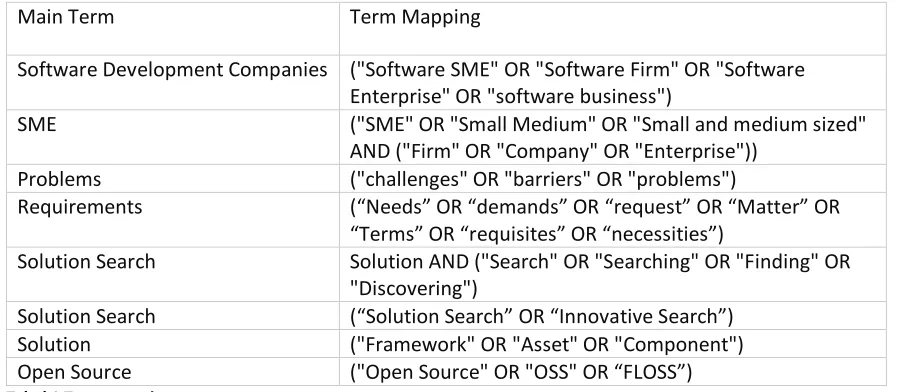
For the purpose of literature search Scopus, Web of Science and Google Scholar are queried. Since not all platforms provide automatic term mapping, the following term mapping has been constructed and is used on all platforms.
Main Term Term Mapping
Software Development Companies ("Software SME" OR "Software Firm" OR "Software Enterprise" OR "software business")
SME ("SME" OR "Small Medium" OR "Small and medium sized" AND ("Firm" OR "Company" OR "Enterprise"))
Problems ("challenges" OR "barriers" OR "problems")
Requirements (“Needs” OR “demands” OR “request” OR “Matter” OR “Terms” OR “requisites” OR “necessities”)
Solution Search Solution AND ("Search" OR "Searching" OR "Finding" OR "Discovering")
[image:16.612.69.527.505.701.2]Solution Search (“Solution Search” OR “Innovative Search”) Solution ("Framework" OR "Asset" OR "Component") Open Source ("Open Source" OR "OSS" OR “FLOSS”)
16 The search process resulted in a big number literature sources. However, to stay pragmatic in our literature review, we chose for inclusion only those that we considered highly relevant for this graduation project. “Relevant” means that a literature source directly addresses the topics on the left column in Table 1.
3.1
OS Quality Methodologies
Adewumi et al [21] identifies the most applicable open source quality frameworks. He checked the literature for quality review models and evaluated them and analyzed them on various characteristics. Strengths, features and potential tool support are taken into account by Adewumi. The following frameworks and methodologies are identified and selected:
1. ISO/IEC 25010
2. Cap Gemini OSMM (C-OSMM)
3. Open Business Readiness Rating (O-BRR) 4. Navica Open Source Maturity Model (N-OSMM)
5. Methodology of Qualification and Selection of Open Source software (Q-SOSS) 6. Open Source Maturity Model (OSMM)
3.1.1
ISO/IEC 25010
ISO/IEC 25010[22] is a standard which offers an up-to-date understanding of quality in systems and software projects. The standard describes various quality categories and which element contribute to it. It identifies eight main categories
1. Functional suitability
This software quality concept how suitable functionality is for specific use cases. Both implied and explicitly stated functionality should match actual functionality. This indicator consists of three criteria: completeness, correctness and appropriateness.
2. Performance efficiency
Efficiency is the reduction of waste and using the available resource effectively. In software quality efficiency consists of three areas: Time Behavior, Resource Utilization and Capacity. Capacity is defined as the limits of a product relative to what is specified in the requirements of the product.
The degree which performance efficiency is required from open source components differs per solution implementing the open source component. For example, one time report generation may be less resource efficient than mission critical SaaS applications consumed by lots of clients.
3. Compatibility
In the software quality context, compatibility is not the ability to work with previous versions of the same software, but how well an open-source component can expose information to other components and systems. Compatibility consists of two areas: Co-existence with other application on the same architecture or system and inter-operability
17
Every component is designed with a specific purpose or use case in mind – either
consciously or subconsciously. Usability is about how well the implementation of this design matches with the expectations of the user. Sub criteria for use ability are the learning curve required to operate the software, aesthetics, error protection and accessibility.
5. Reliability
Reliability is all about how well a software is able to function failure free. Criteria on which reliability can be measured are how available the software is, can it recover well and fast if an error does happen and how mature is it. If we look at the reliability of an open-source components, the architecture which it runs on must be taken into account as well. At the very least it must be factored out when comparing several open-source solutions on this criteria.
6. Security
Security is an important issue in software engineering. It applies even more to open-source web-components. Security is concerned with confidentiality, authentication (user
authenticity) and accountability.
The main advantage of open source, also gives rise to security issues. Whilst the community can review the source code, malicious actors can use this to find security holes as well. The knife really cuts both ways In addition, integrating many open-source components introduce risk for the application as a whole.
7. Maintainability
Maintainability is a very important aspect of open source projects since open-source projects encourage contributions from their users. If a solution is not maintainable, community support will wither, since forking and contributing to project will be a difficult endeavor. Maintainability consists of modularity, reusability, testability and modifiability.
8. Portability
In essence, portability is the ease in which an open-source component can be used in another context. It consists of three factors, ease of installation, adaptability and
replicability. Many open-source web-components are highly portable, since this is the main reason why it has been developed as a component. The most common exceptions are requirements for the architecture it runs on (for example, certain PHP extensions). Luckily, these extensions can be identified easily and installed by the end-use. This should not result in much implementation delay or challenges and is therefore not considered.
Of these eight categories, portability and compatibility will not be considered. Whilst,
compatibility and portability are important subjects in software design and development, it gives only few issues when PHP and front-end components are considered. Most of issues in those two categories are caused by server configuration, the cost in both resources and time to adapt to those issue are low in comparison to the development costs of a solution.
18
the market as fast as possible, therefore if there are performance issues arise, other quicker methods to mitigate these issues can be employed instead. An example is to scale up server architecture and optimize an application at a later stage.
3.1.2
Open Business Readiness Rating (O-BRR)
The open business readiness rating (O-BRR) is an open standard with its main aim to measure the quality of open source software. Contrary to other frameworks it’s focus is concerned with reliability and testing[23].
However, the website of the author has been suspended, the framework is a bit dated(from 2003) and due to the lack of support by the authors of this framework it won’t be considered in the research. In addition, references to the Open BRR white paper are obsolete or broken.
3.1.3
Navica’s N-OSMM
Navicasoft has developed its own open source maturity model in 2004[24]. It’s a very practical and flexible approach to judge open source software quality.
The model consists of three phases. The first phase is a selecting open source software products to evaluate. How this selection is made is left at a user’s own discretion, no support, criteria or guidance is given by the model.
In phase two, a weighting factor is determined based on business needs and in the final phase, a maturity score is calculated with all these factors taken into account. The model describes six categories on which maturity is assessed:
1. Product Software 2. Support
3. Documentation 4. Training
5. Product Integration 6. Professional Services
From these six category, product software, support, documentation and training will be included in the tool’s design developed in this research. Professional services are excluded since these are not
commonly offered with open source components. Professional services are offered with very large open source projects, as is the case with Redhat Linux, for example.
19
3.2
GitHub Available Quality Indicators
The next step is to find indicators which can be used to assess quality in the categories established in section 3.1. The indicators found will be used as a scale. Since SMEs have different priorities when developing products, the weights of these indicators are open for interpretation and will be user defined. A set of templates will be provided in the tool as well for some guidance.
Open Source project consists of various sources of quality indicators. The project and code file itself can be used to establish quality or the projects metadata can be used. Most often, metadata is generated from an open source project’s code base and published. Examples of these are documentation, which is most often generated with PHPDoc or JavaDoc. The following sources can be identified by Kalliamvakou et al[25], Aggarwal et al[26] and the GitHub developer resources[27].
1. Version Control meta data
2. Platform and Community meta data 3. Platform Support & Documentation
3.2.1
Version Control Meta Data
All projects use or should use some form of version control. This enables developers to work together on the same software and keeping track of changes. In version control, extra information used for
collaboration is added to code. In this research, the most popular version control system, Git is evaluated. Git exposes the following information that can be used in order to assess software quality:
Branches
A branch diverts the code base from the original version. This enables a developer to make changes based on the main version. Various branching models and naming conventions exist. These are important to make sure the project remains structured, maintainable and bug-free. Git’s best practices dictate that developers should never push code directly to a master-branch. Instead, a pull-request should be made and other developers should review the code before it gets merged.
In addition, features should have its own branch and prefixed as such. Bug fixes and hot fixes should be labeled in this way as well. Branches should be single purposed with low branching activity[28].
Branching is in essence a way for developers to organize collaboration and provide structure to development activities. Project using a good branching strategy will be highly maintainable, since every change, feature and bug-fix is identifiable and merge-able into the main project[29].
Commits
A commit is a change to the project. A commit consists of lines of changed codes. It is basically the difference between the working directory of the previous commit and the working directory. A commit is a message attached to a commit which can be used to analyze what the change set was about.
20
example, ‘added a function’ is not a helpful commit message, ‘Added function
validateTransaction’ for example is a better, more descriptive alternative.
Analyzing commit messages will provide insight into the maintainability category of quality due to exposing the main type of activity a project is current concerned with. Examples of these activities are re-engineering activities, development activities or documentation activities[30].
Tags
A tag is a bookmark for a specific commit. It can represent a release version for example. Tagging exposes some information about the project. For example, how the tag is structured is an important aspect for the package manager.
A recommended tagging system is Semantic versioning for example. Semantic versioning divides a version number up in API-breaking changes, major changes and minor changes like bug-fixes. Changes in one of these three values can be used to detect how well a project is maintained or how likely it is to introduce API-breaking changes.
Tagging is important tool to make a distinction between various milestones and versions of a project. Therefore, a good tagging system will contribute to the maintainability category of quality identified in section 3.1. In addition, the use of semantic versioning will improve the ease of integration, since a developer can anticipate when an upgrade may break how existing code works.
3.2.2
Platform and Community Meta data
In addition to the data a version control system exposes, the website the repository is hosted on provides us with meta-data it collects from its users and developers. In some ways, the website providing the repositories, in this case, GitHub, benefits by ranking high-quality solutions higher in the search results. This will ensure that the developers and users of the website have a better experience as well. Therefore, GitHub collects and tries to predict various factors. In addition, GitHub visualizes data such as a projects ‘pulse’. A metric that indicates how active it is.
Popularity ratings are one of the indicators GitHub provides. Other indicators are:
1. Stars
The number of times developers mark the repository as favorite. The number of stars of a repository is also correlated with how often a component is integrated into an application, according to Borges et al[31], thus an important metric to check popularity and an indicator for the usability category.
2. Watchers
People who wish to get notified about updates. The reasons why people ‘watch’ a repository are most often to receive updates about future functionality or bug fixes. According to Sheoran et al[32], ‘watchers’ are likely to become contributors in the future as well. These contributions are not limited to just providing code, therefore this metric contributes to the support and
21
providing documentation for open source components as well, there for the amount of watchers can be used as a metric for documentation aswell.
3. Traffic
The number of times users visit a repository. This is a measure of overall popularity, but does not conclusively give indications about the quality of an open-source component. The source of the traffic (referrer) however, may indicate the demographics of users of the open source component.
4. Clones
The number of times users clone or download the content of the repository. A higher number of clones does not indicate a higher number of users per se. It is an indicator of interest in a certain repository, since a user can clone the repository but decide not to use it in the end.
5. Opinions
Software components need to make choices and assumptions about various topics. If a software is opinionated it forces or strongly suggest a certain way to use the open-source component. This is the result of the software developers’ personal opinion about how their software should function. These so called ‘opinions’ are not always clear to assess, however these opinions are why people like or dislike certain frameworks, so they match closely to peoples personal opinions
3.2.3
Platform Support & Documentation
Support and contribution are another feature that GitHub provides. Open Source project allows third parties to support other users, provide bug-fixes or indicate issues. Repository owners and contributors are marked as such in conversations, pull-requests, and issues, so they carry a higher authority.
Documentation is essential for a project to be reusable by other developers, so these facilities are provided as well. Good support and documentation are not a given for every open source project, therefore it is important to evaluate the amount and depth of documentation and support provided. Therefore, the depth and amount of support and documentation provided will be evaluated trough the ways GitHub Provides. The ways GitHub provides for a developer to expose documentation and for the community to support an open source component are:
1. Link to demos to demonstrate various use cases.
This helps developers getting started and seeing the benefits of using a certain library. Most often this increases the ease of implanting a library and seeing the benefits. In addition, it helps shorten the learning curve.
2. A Readme.md file in markdown syntax
22
3. A wiki
Wikis may be used for larger components to convey more use cases and information regarding the component.
4. GitHub pages using Jekyll CMS
A GitHub page conveys the same information as a Wiki, but its input is Markdown syntax. Its content is stored under version control (git) as well.
5. The presence of a Package.json file
A, package.json file is essentially a file with meta-data to the repository. It includes build scripts, dependencies and licensing information. In addition, test scripts are also listed in this file.
3.3
OS Component Risks and Challenges
Through a systematic literature review Moradini et al. [33] identifies various categories of risks associated with Open Source Component Selection. These risks are:
1. Risk of having insufficient quality 2. Component Integration
3. Component operation and maintenance risk 4. Legal Risks
5. Security Risks
The developed tool will identify and evaluate factors contributing to the above risks.
3.3.1
Component Integration
Various risks arise when trying to incorporate open source components in a solution. SMEs need to judge how much effort and resources are required to integrate a component into an existing solution. Misjudging this factors can result in missed deadlines. The ease in which a component can be integrated can be evaluated by the documentation a component exposes.
The following available documents are good indicators that a component lends itself for easy integration with the final product:
1. Well thought of use-cases and example with working demos
This shows that a developer has put himself in a developer shoes and has a clear understanding of how his component fits into the bigger picture.
2. API – Documentation
A very specific and systemic API documentation allows for easy integration. In addition, it reduces the learning curve and helps to evaluate a user if the component is useable for his or her specific use cases.
23
If the component doesn’t need any custom work or adaptation before being used, this build step shouldn’t pose any problems. This is often the case since front-end and PHP-backend components often fulfill only one purpose are relatively small. Deployment issues, therefore, are not considered.
However, the following statement do result in an easy component integration. 1. The project contains test cases
2. The projects uses continuous integration
3.3.2
Risk of having insufficient Quality
Another issue is that the final product won’t be of sufficient quality. How is sufficient quality defined? Sufficient quality is defined by the requirements of the final deliverable. If selecting a specific
component results in these requirements not being met, then the components cannot be used in the final product.
This includes the risk that the component does not meet the criteria for the use case of the
implementing solution. In addition, open source components are ever evolving so a component which is a good fit, might not be in the future. Thus it is important to find indicators to establish if the
aforementioned change is in progress or if that risk exists.
3.3.3
Component operation and Maintenance Risk
When a component is put in operation, maintenance is needed. As no software is free of bugs and when implementing a component. Lack of support from either the author or from the community will result in a component that is being abandoned and not kept up to date. This is a security risk for the final
deliverable.
Another pitfall is technological debt [34], [35]. Technological debt (or code debt) is a situation which occurs when a component or solution has very low entry barriers or implementation barriers, but other challenges arise down the road. For example, if the API of a solution isn’t well defined, but the solution is easily integrated. If this is the case and features need to be added, it will be costly for the
organization. Technological debt exists when a best practice or a better solution is disregarded in favor of the one which is easier to implement, given time and resource constraints.
The debt usually occurs as problematic when new features or maintenance is required. At some point in time, these changes need to happen and can no longer be avoided. Like any kind of debt, it is just a tool. Just like financial debt can be used to accelerate the growth of a company, technological debt can be used to quickly create working prototypes to ascertain the validity of a market idea. However, it must be paid off in the end. To developers, this translates to refactoring of the system architecture and re-engineering of critical application components.
3.3.4
Legal Risk
The main legal risks of using OS components are in the domain of Intellectual Property (IP). The main concern of enterprise users of open source software is licensing. To better understand these concerns, challenges and requirements with regards to licensing, common licensing models are evaluated [36] [37]. Licenses operate in two ways, by restricting what a user is allowed to do and by requiring what a user must do
24 1. Reduce liability or protect the author
By specifying explicitly that software is delivered as-is and no responsibility for use is accepted, authors try to reduce the potential for litigation. When software doesn’t function the way it needs to in specific environments, the open source author cannot be held accountable.
2. Commercial Exploitation
By specifying conditions of use this type of license makes sure that only clients who purchased the software can use it. Without commercial licensing, users are free to buy the software and share it.
3. Intellectual Property and attribution
Licenses provide open source authors the tools to protect their intellectual property and or require attribution when using their libraries.
This practice is very common for creating creative materials such as images, vectors or banners.
4. Brand Protection
Another important aspect of licensing is that provides the tools to protect the reputation of the brand. Some brand or people are more reserved than others, which means that certain licenses place restrictions on how a solution may be attributed or referred to. This allows the author to enforce the removal of perceived association with software or product of a questionable nature. Open source projects consist of creative content – images, icons and vectors– and code. These two types of components often have different licenses. The most commonly used licenses will be researched and the intention or philosophy behind the licenses explored .
1. GNU Public License (GPL) and Derivatives
Versions of the GPL license can be considered a viral license. This entails that if a library uses a GPL licensed software, the whole project must be licensed under a GPL compatible license as well. When distributing a GPL-licensed binary, it requires that the source code is available in a non-encrypted form as well. In addition, a user has the freedom – rights explicitly stated by the GPL – that he or she is free to modify or share the product. As imaginable, this requirement is problematic for commercial software as an only one user needs to purchase the software and then he can make it available for free.
However, these commercial challenges of viral licenses can be circumvented by offering a solution as service. This way, the application itself is not distributed but access is provided via the web.
2. MIT License
The MIT license is generally considered a copy-left license. This means that there are as few restrictions as possible placed on the use of the software.
The MIT license only places restrictions on liability. The licenser cannot be held responsible for actions of the licensee. If the software is used as-is – which means that it is not a derivative – the MIT license must be included in the distribution and a copyright notice must be distributed as well
25
1. Modify the software 2. Use it commercially
3. Sublicense it under a more restrictive license 4. Use it privately.
3. BSD Style Licenses
These set of licenses are the licenses used in Berkeley Software Distribution, a derivative of the Unix operating system. BSD style licenses come in similar but slightly different flavors. Various clauses are included or excluded based on which BSD License an author uses. However, in each of these flavors, liability is restricted. In addition, it restricts using trade names. The BSD License – with the exception of FreeBSD 0 – Clause- aims to restrict associated with a code author with any other solution. Effectively, the BSD license is a way to protect one's good name or good brand name.
4. Creative Commons
The GPL and MIT style licenses are mainly used for solutions and components containing code. Whilst they can be used for creative content, creative commons licenses are used more frequently for this matter. A software solution frequently contains creative content such as images, vectors, icons and buttons as well.
The creative commons license aims to give authors control of their products in four different layers:
1. Attribution
An author is allowed to specific if, when and how they want users of their product to give credit back. This could be with a link back, an included document or even a sound fragment.
2. Sharing
Specify if, when, how and under which condition a user is allowed to share an author’s work. In addition, the right to modify is specified
3. Commercial usage
Since this license frequently used for works of art, the author can specify whether or not a user of the product may reuse it commercially. This allows an author more control and a tool to enforce the context of the created works.
4. Derivatives
In addition to commercial use, derivatives works may not always be wanted by the author. This degree of control allows an author to restrict derivate for either commercial and/or non-commercial use.
5. Creative Commons - CC0
26
automatically granted. The CC0 allows an author to waive all rights they have by using a license. Essentially, the CC0 license does not impose any restrictions on the end-user but only on the copyright holder. The copyright holder still retains copyright, however an agreement by means of a license is made that he waives his rights.
License violations can occur in various ways. Developers may copy code from professional communities such as LinkedIn Groups or Stack Exchange. Copyright can be violated since it is not clear how this code is licensed or if the individual contributing the solution is the author of the copyright. Contributions by either pull request (code contribution by 3rd parties) or online
suggestions can include code from these sources. In addition, these pull requests can be added with malicious intent. However, violating code can easily be removed and replaced if a version control system is used.
3.3.5
Security Risks
In addition to legal risk, security threats are also an important topic in open source software
development and usage [38]. The open-source components evaluated in this research are most often integrated in web applications, so they are exposed to the same risks as these web applications. However, due to the nature of open source, risks related to the collaborative aspect and the open aspect of open-source components are added. These three aspects will be touched individually where relevant:
1. Web-Facing Application Risks
The open-source components in the scope of this research will most likely be accessible via the internet or via the local intranet. Therefore, we need to take these security issues into account. These issue range from Cross-Site-Scripting to SQL Injection attacks.
2. Collaborative Aspect
Malicious third parties can use – and are using[39] – the collaborative aspect of free open software to spread malware and gain unauthorized access to information systems. For example, an advisory can introduce bugs deliberately or even try to commit a backdoor to the repository.
3. Open Aspect
Open-source software gives an advisory more insight into possible attack vectors by eposing the source code. The knife cuts both ways since the community can review the code aswell and detect possible security issues.
3.4
Summary and Conclusion
Knowledge management is a very broad topic and it is easy to get lost in all theories the literature presents. This study identified, evaluated and applied theories from knowledge management, software quality and SME business characteristics in the context of open source component selection.
1. Knowledge Management and Solution Search in software development SMEs
27
open source solution selection and evaluation is the problem definition and the objectives for a solution. Issues with requirements such as poor stakeholder identification and poor
understanding of complex requirement are often a source of failed projects.
2. Software SME Business Characteristics
SMEs have a lot of advantages when compared to larger firms. Less rigid organizational structures result in an agile and flexible organization. In turn, this allows for a shorter time to market and the ability to change strategic course. However, challenges for a small software company are also numerous. Size related and resource related challenges are inherent to small organizations. In addition, there is not enough human resources to be concerned with
organizational strategy. In small companies often only one person is concerned with strategy and the strategy is not always clear for every individual in the organization
3. OS Quality Methodologies
Research has been conducted to see which quality methodologies are available and applicable to open source solutions. The researched frameworks differ on strictness and application area. Navica's Open Source Maturity Model, for example, includes professional services. Training and product software. These practices are more common in larger enterprise.
In contrast, there is also an overlap of categories which the frameworks evaluate. Overall, the categories defined by ISO/IEC25010 seems to be most relevant. Various categories are excluded because there is not much difference due to the scope set. An example of this is portability, front-end code is by nature highly portable so comparing solutions on this aspect is an exercise in futility.
4. OS Component Problems and Advantages
Using open source code is not without risk. Generally, four risks can be identified. Components need to integrate into larger solutions. The risk of a misfit exists. In addition, a component may introduce bugs or performance issues. These issues all add up, especially in larger projects. Therefore, a component has maintenance and operation risks associated with it which must be assessed. The open source community must be able to address these issues when they arise or else this will affect the quality of the end product. In the end, open source is a
Another issue with open source components is legal risk of using components. Code and creative content such as images are intellectual property and is owned by the individuals which produce it. This protection is assigned by default in most countries as stated in the law.
Therefore, we need to have licenses which restrict or allow use of this intellectual property. Failure to do so can result in litigation.
5. Open Source Quality Indicators
Open source solutions have multiple sources of information which a tool can process to evaluate the quality of an OS component.
28 system used and working directory files will be processed by the tool. Various OS quality frameworks have been identified and evaluated. The following categories from current quality control
methodologies have been deemed relevant and will be evaluated with the help of the tool: A.Maintainability
For maintainability the following indicators are used: 1. Empty commit messages
2. Branching Models
3. The presence of a package.json file 4. Parsing Package.json for build scripts
B.Security
Security issues are being analyzed by the following indicators: 1. Security incident history of the software is analyzed
C. Support
How well a solution is supported by the community can be estimated by checking: 1. How many contributors there are
2. The number of issues opened, closed and the average issue life time 3. Presence of a Wiki
D. Documentation
The depth of documentation available will be evaluated by: 1. Parsing the readme file
2. The presence of demo use cases.
4
GOAL & DESIGN PROPOSITIONS OF THE QUALITY ASSESSMENT TOOL
4.1
Goal
Open-source components are a great way to shorten the time to market. However, open- source components do have risks and challenges. This tool’s main objective is to help companies in selecting open-source components, taking those risks into account. In addition, the match with a SMEs business requirements will be taken into account.
Moreover, by evaluating all open-source components a user or company produces, expectations can be established in case a company wants to hire that specific developer. The goal of this tool will be to expose useful information about a component with regards to its maturity and risks.
This tool will be designed in such a way that other sources can be added in the future. In this research those ‘other sources’ will be constraint to public GitHub repository meta data exposed via the website. Example of this are clones, forks and downloads (open source Meta Data).
The tool will process the following types of input: 1. Open Source Component Inputs
29 us to use. However, to make use of that data, it needs to be interpreted. If we take a closer look at this data it can be separated into various types:
2. Natural Language
Commit messages, Readme’s and documentation are all available as natural language. This makes it hard to interpret it in an automatic fashion, however, it is possible to perform pattern and natural language processing models onto this data. This type of processing will be used for any natural (English) language encountered.
3. Structured Data Files
In addition to natural language, there are also structured data files available in a repository. Structured data in this context is data which can be interpreted by machines in an exact way. Examples are build scripts and dependencies. These types of data are much easier to process since there available in structured formats (like json or xml) and can be good indicators of quality. When encountering this type of data, a combination of available research and empirical data will be used to evaluate the consequence of this data.
4. Open Source Meta Data
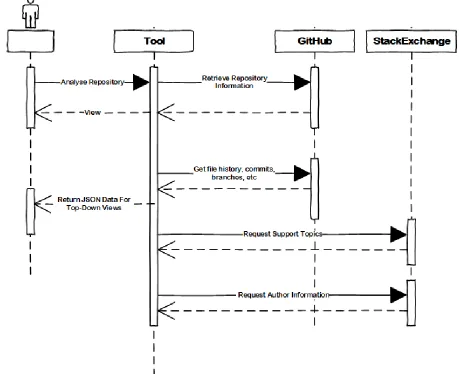
In addition to data which software developers directly produce, third parties and consumers also generate data indicative of quality. Therefore, these will also be used as an input for the tool. This metadata has been explored in section 4.2. The third party data sources which the tool will consume are support topics on stackexchange.com, security data from the Common Vulnerability and Exposure database and meta-data from GitHub.
4.2
Design Propositions
Considering section 1, the quality of open source components can be an issue in small and medium sized organizations. The first hypothesis will establish if users experience this. The following hypothesis will evaluate that:
P1: Users are interested in a tool which automatically reviews open source components on risk and quality.
The tool uses a variety of metrics and communicate this to the user to support their decision making about whether to use a specific open source component. The tool assumes that users of the prototype have a certain technical background. To test this the following hypothesis are established:
P2: Users are able to interpret the quality metrics of an open source component
P3: Users gather new insight by using a tool which automatically reviews open source component quality.
P4: Users change their perception and decision whether or not to use the component after viewing the metrics provided by the prototype.
30
5
DESIGN METHOD
This section develops a methodology and requirements to evaluate the risks and challenges identified in section 3.3, categorizes them according to section 3.1, based on the quality indicators explored in section 3.2 and section 3.3.
The tool will be developed according the Action Research methodology. An action research process is of a cyclical nature, consisting of three phases: input (planning), Transformation (Action) and output (results).
In the first step the problem is evaluated and theorized and a hypotheses is established. This can also be done on the basis of results of the previous cycle. The main output of this step is action planning. In the second phase the action planning is executed. In the last step the data form the previous step is
gathered and changes in behavior are measured.
The main hypothesis in our action research process is that we can accurately measure software quality by the input-to-output mapping provided in this section. This mapping or method will consolidate functional
requirements with the inputs that an open source component provides. The resulting output will be an evaluation of maturity criteria on each of the in section 4 defined categories. In addition, potential risks defined in section 4 will also be evaluated and brought to the user’s attention if the risk is high.
It is important to note that the resulting output of the tool is not a final judgement call for a developer on selecting open source components. The tool will not decide for a user which component is the best in each situation. Rather, it is the goal of this tool to complement the knowledge that the user already has and draw his/her attention to potential issues, pitfalls and establish validity of claims made by the author. Were possible, the tool will link to other sources so that a decision maker or developer can get more information about a potential issue.
5.1
Maturity Criteria for Assessment of Quality
Open source component quality will be assessed on the before mentioned categories, with the following statements:
1. Maintainability
In order to check maintainability we ascertain the following statements. - The OSS Project does not contain empty commit messages
- The OSS Project contains descriptive commit messages. - The OSS project contains a valid Package.json file.
- The OSS Project contains build scripts (grunt, gulp, phing or other)
2. Security
Static test of source code files for possible security incidents are hard to perform. There are tools which can test security, they require components to be build and present in a live environment these tools are called ‘Fuzzers or security testers. This depth of security tested is outside the scope of this paper and tool. The tool will use other metrics:
1. The tool will check security incident security incident data from the National Vulnerability Database to check any history of security vulnerabilities or exposures.