Master thesis
The struggles of accepting a new logic from a micro level
institutional change perspective.
Tim Bethlehem (s1526243)
Master Business Administration
1st supervisor: Dr. R.P.A. Loohuis
2th supervisor: Dr. A.M. von Raesfeld Meijer
University of Twente
Summary
Table of content
1. Introduction 4
1.1 Background 4
1.2 Literature 4
1.3 Research gap and research question 5
1.4 Theoretical and practical contribution 5
2. Literature review 7
2.1 introduction to institutional change literature 7
2.2 Institutional logics 7
2.3 Micro institutional change 7
2.4 Institutional entrepreneurs 8
2.4.1 Rhetorical strategies 9
2.4.2 Cultural toolkit approaches 9
2.4.3 Story telling 9
2.5 Structural overlap 10
2.6 Competing logics 10
2.7 Introduction dialectical model 11
2.8 Conceptual model 11
3. Methods 13
3.1 Data collection 13
3.1.1 Operationalization institutional contradictions 15
3.2 Data analysis 16
4. Results 18
4.1 Description of the new logic 18
4.2 Description of the dominant logic 19
4.3 Description and analysis of the experienced tensions 21
4.3.1 Inefficiencies 24
4.3.2 Adaption 27
4.3.3 Divergent interests 28
4.4 How tensions manifest 32
5. Discussion 34
5.1 Theoretical contribution 34
5.2 Implication for institutional entrepreneurs 36
5.3 Practical implication 37
5.4 Limitations 38
6. Conclusion 40
7. References 41
Appendixes I Interview protocols 44
1. Introduction
1.1 Background
In the Netherlands, care is in reform. The government adopted a law in which a shift needs to be made from care that is fully organized by the government to care where participation from citizens is more required. The former way of organizing was established for many years and the current reform is a drastic change. These changes require community members to come with initiatives to organize informal care overcoming the established ways of thinking about care.
1.2 Literature
entrepreneurs are defined as actors with sufficient resources who see an opportunity to realize an interest they value highly (Dorado, 2005). Institutional entrepreneurs can use several mechanisms to manipulate the cultural symbols and practices, for example story telling (Zilber, 2006), rhetorical strategies (Suddaby & Greenwood 2005), and tool kit approaches (Swidler 1986). Thus, institutional entrepreneurs who understand which tensions exist and how they can manipulate cultural symbols and practices are expected to be better able to achieve institutional change.
1.3 Research gap and research question
However, how institutional entrepreneurs can strategically perform this remains vague, because so far we do know little about why the tensions produced by a clash of new and dominant logics enable or constrain institutional change from a micro level perspective (Lounsbury & Crumley, 2007). Understanding the nature of these tensions and effects on institutional change is mainly important for those who like to induce change in a certain field, because these dominant logics persistently prevail in the early stage of institutional change (Furnari, 2014). In conclusion, the current literature lacks an understanding why some tensions lead to the acceptance of the new logic and why some lead to the reinforcement of existing ones.
The purpose of this study is to contribute to the understanding of the nature of tensions, produced by a clash of contradicting logics in the early-stage of an initiative to change an established field, from a micro level institutional change perspective. As this is perceived as a first step to better understand why some tensions lead to the acceptance of the new logic and why some lead to the reinforcement of existing ones. Evolving in the following research question:
How do tensions produced by a confrontation between dominant and new arising logics manifest in micro institutional change processes?
With the following sub questions:
- Which tensions are produced by a confrontation between the dominant and the new logic?
- What are the different characteristics of tensions from a micro level institutional change perspective?
1.4 Theoretical and practical contribution
2. Literature review
2.1 introduction to institutional change literature
The term “institution” broadly refers to the formal rules sets, ex ante agreements, less formal shared interaction sequences, and taken-for-granted assumptions that organizations and individuals are expected to follow (Bruton et. al., 2010). These assumptions are derived from rules such as regulatory structures, governmental agencies, laws, courts, professions, and scripts and other societal and cultural practices that exert conformance pressures (Powell & DiMaggio, 1991). Institutional arrangements function to reduce uncertainty and to mitigate opportunistic behavior such that transaction costs associated with negotiating, monitoring and enforcing contracts between boundedly rational actors are reduced (Garud et. al., 2007).
The process of changing formal and informal institutions is called institutional change. Institutional change can positively influence the development of entrepreneurship when it removes or lowers barriers to market entry and/or exit, thus creating opportunity fields for entrepreneurs. However, since informal institutions are embedded in society, they tend to change more slowly than formal institutions (Welter & Smallbone, 2011). Informal institutions are constituted on logics of multiple actors. These logics enable actors to make sense of their ambiguous world by prescribing and proscribing action. Subsequently, action re-enacts institutional logics and makes them durable, explaining why informal institutions are embedded in society (Suddaby & Greenwood, 2005).
2.2 Institutional logics
Institutional logics are important to understand institutional change, because a change in the field’s dominant logic is fundamental to conceptualizations of institutional change (Reay & Hinings, 2009). Institutional logics provide the “master principles of society” and guide social action. They are taken-for granted resilient social prescriptions that enable actors to make sense of their situation by providing “assumptions and values, usually implicit, about how to interpret organizational reality, what constitutes appropriate behaviour, and how to succeed” (Thornton, 2004). Thus, institutional logics underpin the appropriateness of organizational practices in given settings and at particular historical moments. Failure to use practices legitimated by an extant logic can have adverse consequences (Greenwood et. al., 2012), which explains why these become so taken for granted in the institutional field.
2.3 Micro institutional change
perspectives of Meyer and Rowan (1977) and DiMaggio and Powell (1983) and Zucker’s more micro process approaches. This link required institutional logics to provide a plausible explanation for what might be at the source of institutional conflict and to provide insights in how arrangements are formed and how they come to change over time (Cloutier & Langley, 2013).
Most cited Institutional change and institutional logics literature is focused on the enabling conditions for institutional change (Dorado, 2005 ; Battilana et. al., 2009 ; Di Maggio, 1988). Contrary to this perspective, recent institutional theory focuses on the real change processes. Greenwood et. al. (2012) describe that former literature in institutional change over-emphasizing on field-level shocks or contradictions, and on strategically motivated entrepreneurship has limited our understanding of where and how field-level institutional change can originate and how it might unfold. Practice-driven institutional change differs from existing field-level accounts in terms of its initial locus, its mechanisms, and its unfolding. Since it is in micro-level practices that field-level logics are enacted, and that it is in their collision that institutional contradictions are experienced and problematized. Thus, the introduction of logics in institutional change literature might give new insights for its focus on change processes, rather than outcomes (Khavul et. al., 2013 ; Suddaby et al., 2010). Instead of focusing on temporary outcomes, underlying processes are teased in order to create new logics (Khavul et. al., 2013).
Change in the field’s dominant logic exposes and exploits the inherent tensions contained in the contradiction between the ‘’core values’’ and the ‘’commercial interests’’. Historically, those already existing tensions have been suppressed in the discourse of professionalism (Suddaby & Greenwood, 2005). Several studies highlight the considerable time and energy investment required for micro-level action to result in macro-level change. This can also be a cumulative result, by continual persistent actions build on each other. Although the change process may be slow, overall change can be significant and important (Reay & Hinings, 2009). Thornton and Ocasio (2008) describe that institutional logics literature has found the following concepts to be important for change in institutional logics: institutional entrepreneurs, structural overlap and competing logics. To understand the implications of this research these concepts are discussed in the following parts.
2.4 Institutional entrepreneurs
entrepreneurs can use several mechanism to manipulate the cultural symbols and practices, which are story telling (Zilber, 2006), rhetorical strategies (Suddaby and Greenwood 2005), and cultural toolkit approaches (Swidler 1986). These mechanisms are explained below.
2.4.1 Rhetorical strategies
Rhetorical strategies are the ways in which the meaning systems that underpin institutions are manipulated, which combines two elements: institutional vocabularies and theorizations of change. Institutional vocabularies, understood as shaping perception of an abstraction through language selection, common metaphors, and the use of common referents, is a key component in challenging the taken-for-granted nature of an existing institutional order. Theorizations of change, by contrast, are linguistic devices by which actors manipulate the degree of uncertainty implied by an innovation. By using language to connect prevailing and potential alternatives to broader cultural templates, theorizations of change make new forms comprehensible by “naturalizing” some contradictions and suppressing others. In combination, institutional vocabularies make comprehensible the need for change, while theorizations make change itself comprehensible (Suddaby & Greenwood, 2005). The primary insight, however, is that the fundamental elements of institutional agency, conflict, and power are embedded in the rhetoric used to create, maintain, and alter the meaning systems that underpin institutions (Suddaby & Greenwood, 2005).
2.4.2 Cultural toolkit approaches
Culture contains toolkits of symbols, stories, rituals and world-views, which people may use in varying configurations to solve different kinds of problems. Culture provides cultural components that are used to construct strategies of action. These strategies of action are symbolic experiences, mythic lore or ritual practices of a society that create moods and motivations, ways of organizing experience and evaluating reality, modes of regulating conduct and ways of forming social bonds. (Swidler, 1986). Although, Swidler (1986) perceived that in established institutional fields culture becomes so common sense that alternative ways of organizing action seem unimaginable, these strategies of action still are expected to contain mechanisms for institutional entrepreneurs to manipulate cultural symbols and practices.
2.4.3 Story telling
contains different meaning systems from which its members can borrow, mold, and recreate specific rational myths. For theorization or translation to be successful in fostering the diffusion of structures and practices, it must rest upon some vision of the modern (Zilber, 2006). Thus, one might say meanings are not replaced, but rather selected, reshaped, and appropriated. Although Zilber’s (2006) study added more insight in the mechanisms and strategies institutional entrepreneurs could use, the actual acts of translations or the role of agency stays unclear.
2.5 Structural overlap
Structural overlap occurs when individual roles and organizational structures and functions that were previously distinct are forced into association (Thornton, 2004). They argue that contact with institutional logics in multiple and different organizational fields increases the awareness of and experiences with contradiction in logics, which lowers constraints and embeddedness of actors and enables central actors to become institutional entrepreneurs (Thornton & Ocasio, 2008).
2.6 Competing logics
reality reshapes the consciousness of institutional inhabitants, and they, in some circumstances, act to fundamentally transform the present social arrangements and themselves (praxis). This reasoning explains how micro level institutional change might occur from the perspective of institutional contradictory, which they elaborated in their dialectical model.
2.7 Introduction dialectical model
Seo and Creed's (2002) dialectical model introduces that the variance of institutional contradictions explains to what degree meaning system potentially give rise to tensions and contestation over the legitimacy of the particular institutional arrangements targeted for change. By the following four sources of contradictions that can arise over the long term as b-products of the processes of institutionalization: (1) legitimacy that undermines functional inefficiency, (2) adaptation that undermines adaptability, (3) intra-institutional conformity that creates interinstitutional incompatibilities and (4) isomorphism that conflicts with divergent interests. Institutional contradictions may not only trigger the shift in actors' collective consciousness but also may provide alternative logics of action and psychological and physical resources to be mobilized, appropriated, and transposed in the process of institutional change. A major assumption for application of this model is that the current institutional arrangements in the researched context are already established enough to embed their inhabitants.
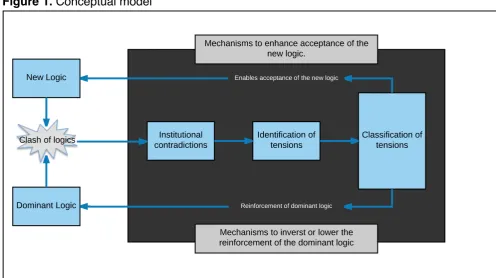
2.8 Conceptual model
3. Methods
This thesis draws on a case study to examine tensions that arise from a confrontation between the dominant and the new logic and to identify characteristics of these tensions. The context of the case study is the early stage of an arising initiative to organize informal care differently by voluntary citizen participation in the region Saasveld. Related to insights from the literature part of this research can be explained why this setting is suited. The change in regulatory structures by the government can be perceived as change in formal institutions. Alongside with these regulatory changes the government decided to cut back on expenses on informal care. According to items in the Dutch public media this has caused great concern about the quality of informal care in the whole society (NOS, 2015), leading to social upheaval. As explained in the literature part, this social upheavel functions as one of the enabling conditions for institutional change (Battilana et. al., 2009). Although these new logics arose, it certainly is not embedded in society. Findings presented in the Dutch media (NOS, 2015) showed that a major part of the society sees the new way of organizing as not a proper development. These findings explain that the dominant logic differ from the new logic of the initiative and this is expected to lead to a confrontation, making this case study relevant to examine tensions. In addition, based on the assumption that the current institutional arrangements in this case study are already established enough to embed their inhabitants this setting is suited to apply the dialectical model.
The researcher adheres to an interpretive philosophy (Burrel & Morgan, 1979) and took an ethnographic strategy to examine and understand the different perspectives. Since an interpretive study is mainly subjective and logics are not easy to count it is grounded to collect the data by using qualitative data methods. Semi structured open interviews are performed, because the direction and general concepts are clear.
3.1 Data collection
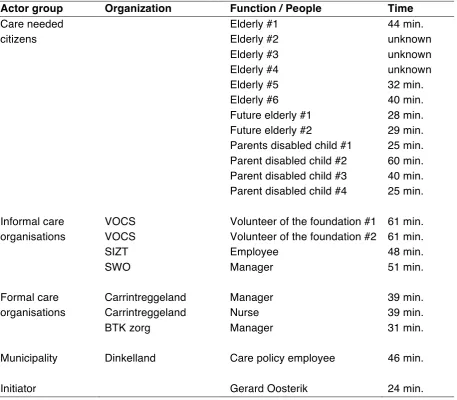
sample that at least represents differences in ages, partner situations and level of participation in society. Since there is only one initiator only one interview could be held under this actor group. Also for the municipality was chosen to only interview the employee responsible for the informal care policy. In the other actor groups three or four cases were selected, based on the current participating organisations in the region Saasveld. Managers, nurses and other care workers were selected, based on expected differences in feelings assumed from the discussions in the project meetings. In table 1the description of the data collection is presented.
Table 1. Description data collection
Actor group Organization Function / People Time
Care needed Elderly #1 44 min.
citizens Elderly #2 unknown
Elderly #3 unknown
Elderly #4 unknown
Elderly #5 32 min.
Elderly #6 40 min.
Future elderly #1 28 min.
Future elderly #2 29 min.
Parents disabled child #1 25 min.
Parent disabled child #2 60 min.
Parent disabled child #3 40 min.
Parent disabled child #4 25 min.
Informal care VOCS Volunteer of the foundation #1 61 min.
organisations VOCS Volunteer of the foundation #2 61 min.
SIZT Employee 48 min.
SWO Manager 51 min.
Formal care Carrintreggeland Manager 39 min.
organisations Carrintreggeland Nurse 39 min.
BTK zorg Manager 31 min.
Municipality Dinkelland Care policy employee 46 min.
Initiator Gerard Oosterik 24 min.
practiced the interviews with a professor of the University of Twente. Three of the elderly did not want to participate with recording the interviews. Instead, the members of the project team made notes and later elaborated these interviews related to the questions in the interview protocol. The researcher, who has no incentive to put the interviewee in a certain direction, interviewed the other actor groups. He tried to make clear that it is just his role to observe and analyse during the process instead of making decisions or advice about the direction of the initiative. All interviews are held during the identification phase of the organizing of the initiative. They were recorded and thereafter transcribed within a week.
The interviews were mainly focused to identify the existing tensions. In addition, it was also focused to give insights into the dominant logic and general perceived new logic. In the beginning of the case study the new logic is not clear, therefore different scenarios were described based on the discussions of the project meetings. All the interviews started with a small introduction were different scenarios were explained. However, slightly different per actor group, questions like the following were asked: ‘’what are your feelings per scenario in light of the activities of your organisation?’’, what do you think that is required to succeed?’’, ‘’do you have concerns about the current changes in health care?’’ and ‘’could the society benefit from initiatives like this?’’. The complete interview protocols are represented in appendixes I.
3.1.1 Operationalization institutional contradictions
As explained in the conceptual model the dialectical view (Seo & Creed, 2002) is used to be able to understand which tensions exist. As this information is required to be obtained during the interviews, this model was incorporated into the interview protocols. As no operationalization of the dialectical view model was found the researcher has operationalized this below.
1. Legitimacy that undermines functional inefficiency
Legitimacy that undermines functional inefficiency can be explained as inefficiency that exist and is experienced by conforming to institutional arrangements. This can be operationalized as follows:
- To what extent are actors expected to follow the new policies?
- To what extent do the actors perceive the current policies as unnecessary? - To what extent do current policies and decisions constrain actors in their
goals/actions?
2. Adaption that undermines adaptability
- To what extent do actors believe they are psychologically attached to the current dominant logic?
- To what extent do actors believe they are economically dependent to the current dominant logic?
3. Intra-institutional conformity that creates inter-institutional incompatibilities
Individuals and organizations are increasingly exposed to multiple and contradictory, yet interconnected, institutional arrangements and prescriptions-all of which are the inevitable by-products of the ongoing social construction of those institutions. Thus, conformity to certain institutional arrangements within a particular level or sector may cause conflicts or inconsistencies with the institutional arrangements of different levels or sectors. This can be operationalized as follows:
- To what extent are current prescriptions in the institutional field inconsistent? - To what extent are the current institutional arrangements layered on another
rather than distinctive transformed?
4. Isomorphism that conflicts with divergent interests
The formation and reproduction of social arrangements are basically political processes involving various participants who have divergent interests and unequal power. Proponents of dialectical view place a special emphasis on this source of contradictions: the fundamental misalignment between a particular form of social arrangement and the interests of diverse actors who enact, inhabit, and reproduce that social arrangement. This can be operationalized as follows:
- To what extent does different interest exist between the multiple actors? - To what extent are different interests expected from the new logic?
- To what extent there is a difference in power between the multiple actors?
3.2 Data analysis
the analysis of the interviews the position of the person who executed the interview was held in consideration. The eventually used coding scheme is displayed in appendixes II.
4. Results
In this chapter, the results of this study are presented. The new and dominant logic are described in the first part. Thereafter are the experienced tensions in the case study described, elaborated on the basis of the four sources of institutional contradictions. At last, is described how the different types of tensions manifest in order to answer the research question
4.1 Description of the new logic
The new logic in the case originated from a meeting by the village council where some civilians voiced concerns about the quality of informal care. Inspired by these concerns the initiator, one of the village council members, constituted a project team to discuss about these concerns and possible solutions. The initiator explains his vision on the desired changes as follows:
‘’There are chances to organize the informal care differently, performed by initiatives organized by villages themselves. Mainly focused on the prevention of loneliness. Other activities can be domestic/household help since this has become minimalized, to arrange transport, doing groceries and to organize daytime activities’’.
He also remarked that:
‘’I think it is important to collaborate with the current organisations that perform informal care. It would be convenient that the current performed activities are connected and reinforced with the possible new activities.
The employee of the municipality, also a member of the project team complements this vision:
‘’I expect the focus will be on to strengthen the wellbeing of the society in the village and that this initiative engages the different care providers with for example exchange of information’’.
‘’I see this initiative from the perspective to lay back the opportunities for civilians to sit behind the wheel again’’.
‘’A free accessible place to visit would be beautiful. That this place is open for some days in the week and that volunteers are present, just to have a small talk or to drink some coffee or tea. Since you regularly see a lot of people just standing to talk. That need really exist. We have also noticed people who are scared to go outside, for example because they have fallen. A group of volunteers could take them outside once in a while to have a little walk. Or to arrange some childcare for the parents with a disabled child, so they have time to go out’’.
This quote also makes clear that the general focus from the participants of the initiative is to organize the activities voluntary. However, the initiator also mentions the possibility to hire employees:
‘’Suppose it evolves to a care cooperation, then intervention with the major formal care organisations would be possible, to cooperate were necessary. Although I have seen care cooperation’s with own employees who provide care. I do not say that we should do that, but it could be a possibility’’.
The difference stems from the perspective of the width of the role of the initiative since the initiator suggest it as an opportunity when nursing and caring, ‘’the real care’’, will be performed. However, this is not expected regarding the project meetings and the following quote by the employee of the municipality.
‘’In some countries there are care cooperation’s created by civilians and they purchase care and take control of the care, the role of the formal care organisations. But that kind of activities I really don’t see to happen’’.
To conclude, the general new logic that has arisen in the project team is to arrange informal care by volunteers. It is important to consider that this new logic is currently in transition, particularly on the width of applicability of the activities that can be performed by volunteers. However, based on the latest project meetings the initiative is expected to focus on a coordinating role between the current informal and formal care organisations and on executing informal care activities such as creating ‘’social moments’’, arranging transport and doing household chores. They decided this after an examination of the needs and wishes under elderly, future elderly and parents with a disabled child.
4.2 Description of the dominant logic
The general dominant logic builds around the perspective of being taken care of instead of the participating new arising logic whereas participation of the society is required. The employee of the municipality explains this as follows:
‘’We used to be a welfare state and the role of the government used to be: we take care of the solutions for the civilians. People take for granted that they get what they expect to get based on their rights, even when they not need it. Also from the government it has become natural that we came op with the solutions and that this solution will be the way to do it without contradiction’’.
Also from the interviews with the formal care organisations becomes clear that before the change in regulation people were used to take for granted that care would be arranged and paid for them.
‘’Previously one could see that everything would be taken care of and everything would be taken over, but now I sometimes experience the that people want to pay for certain care services, as long as no subscription is affiliated’’.
‘’In the Netherlands we are taken care of from birth to the grave, everything is organized. And that is precisely why everybody has become so spoiled and now this is turning and then it is so hard for everyone’’.
From these quotes it can be outlined that these feelings already changed, but the introduction of the results already showed this is not the case in general. The following quotes from the informal care organisation SWO supports this.
‘’We notice that if we enhance prices with a few ‘’kwartjes’’ that people quit with meal services, whether they have enough money or not. We just offered to enhance the price a little bit and people shifted from 5 to 3 meals a week’’.
This is also supported by one of the interviewed elderly:
‘’Actually I do not think it is a task for a village, I think it must be arranged by the government. In the end you are dependent on regulation and the government''.
Complementary, also from the following quote from the manager of Carintreggeland can be determined that the dominant logic for the major part of the society is that informal care should be arranged and paid by the government:
Another major aspect of the new logic, as explained in the section before, is that volunteers should organize informal care. However, many quotes were found that underpin that people in general perceive that it is hard to arrange by volunteers and therefore does not seem realistic.
From the statement of BTK zorg for example can be outlined that voluntary work will not be done structural, perceived as the major requirement for informal care:
‘’I think that people have less and less time for their parents. And thereby that people who want to do voluntary work still want to do this, but not structural‘’.
Also from the interviews with care needed citizens can be understood that more voluntary work for informal care is perceived as inappropriate. The following quotes make clear that mainly the deployment of volunteers will become critical.
‘’Yes it could be possible that volunteers help with informal care, but I don’t think that we must assume that that will happen. I do not think it will run so fast’’.
‘’There will always be volunteers who would participate, but also a very large group of people who will not. Often it are the same people who participate and they same people who do not participate’’.
‘’Voluntary work is also a real challenge. Everyone wants paid jobs, but those volunteers need to do everything for nothing. Sometimes I think it will not sustain’’.
In addition, the following quote from the interview with SIZT makes clear that replacing informal care by volunteers is not taken for granted at all:
‘’Deployment of volunteers on household chores is bread robbery. I experience that this is slightly happening, but I would not do it’’.
In conclusion, these quotes make clear that only a small part of the society, or otherwise stated the institutional field, perceive the new logic as suited. Based on the data from this case study it is reasonable to state that the major part of the field constitutes to the logic that informal care should by organized and subsidized by the government with little effort of volunteers.
4.3 Description and analysis of the experienced tensions
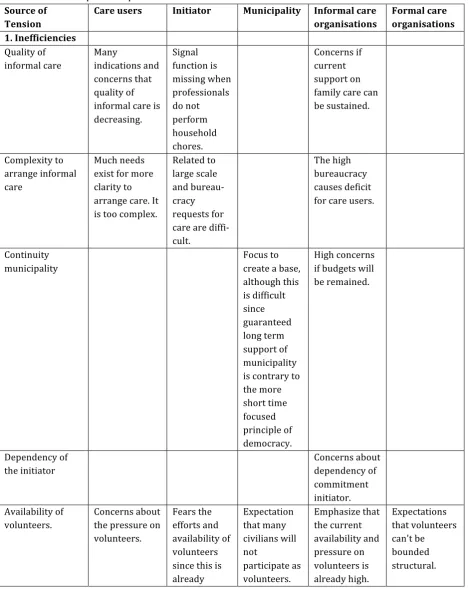
a ''sketch'' of the new logic, and therefore need to be perceived as ''change tensions''. However, it must be understood that these tensions could also be related to the dominant logic in order to achieve greater understanding of the deeper underlying actor's institutional logics. Also these tensions can be perceived as ''change tensions'' since these could enable or constrain the new logic.
Table 2. Description experienced tensions Source of
Tension
Care users Initiator Municipality Informal care organisations Formal care organisations 1. Inefficiencies Quality of informal care Many indications and concerns that quality of informal care is decreasing. Signal function is missing when professionals do not perform household chores. Concerns if current support on family care can be sustained.
Complexity to arrange informal care
Much needs exist for more clarity to arrange care. It is too complex.
Related to large scale and bureau- cracy requests for care are diffi- cult.
The high bureaucracy causes deficit for care users.
Continuity municipality
Focus to create a base, although this is difficult since guaranteed long term support of municipality is contrary to the more short time focused principle of democracy. High concerns if budgets will be remained. Dependency of the initiator Concerns about dependency of commitment initiator. Availability of volunteers. Concerns about the pressure on volunteers.
critical. Knowledge of volunteers. They worry about this, mainly when volunteers need to take care of disabled children. Worries about how volunteers handle difficult situations to keep activities accessible for everyone. Worries if volunteers are capable enough to handle difficult situations and signal. 2. Adaptation Psychological attachment to former way by formal care organisations
Although discontent exists they also value the quality of care.
Much discontent exists about how formal organisations previously arranged it. Psychological
attachment to be taken care off.
In general most do see it is as necessary that volunteers do participate more.
Since this has been taken for granted for so long this seems quite hard to change. Economically dependent on paid informal care. Attached and dependent to financial subsidies to arrange (informal) care. Expectations that it is hard to change this for many care users.
Much resistance expected, but a slight change is perceived. They think it is necessary.
3.Divergent interest
The role of the initiative as a coordinator. Expects resistance from informal care organisations . Resistance is expected since some organisations see this as their major right to existence. Also resistance from formal organisations expected on accepting information, mainly based on time issues.
They want to participate also expect to have limited time and resources and do not prefer to communicate all the time.
The role of the initiative as operator of social moments and
Current activities and mutual
communication
activities. with the different informal parties perceived as good. an opportunity for their own. However, would be possible to cooperate. The role of the
initiative as operator of household chores Actor wishes to happen, but expect much resistance from other actors. High resistance when current activities of other parties are taken over by the
initiative. The role of the
initiative as family care supporter.
Resistance is expected since some
organisations see this as their major right to existence.
4.3.1 Inefficiencies
Quality of informal care
Related to the introduction of the new logics concerns arose if the quality of informal care could be maintained. This can be explained by the following quote of one of the informal care organizations:
''I do worry about that. In the sense of if the current support to family care can be sustained and if problems will be sufficiently recognized''.
This tension is broadly discussed by the different actors and accepted as one of the major shortcomings of the current way of organizing. Related to the description of the new logic this is an important aspect to improve. However, opinions on how to execute this differ, which might lead to conflicts.
Complexity to arrange informal care
From the perspective of the old logic many concerns exist about the complexity of arranging care. For example stated by one of the elderly:
''Requests for care has become so complicated''.
Dependency initiative by support of the municipality
Mainly from the informal care organizations high concerns exist about the degree of continuity the municipality can guarantee. Mentioned as follows:
''But what if from the initiative things are required. Than I wonder if the municipality still supports. They can now allow budgets to set up such initiatives, but what when the initiative is developed and a clear plan exists. How is the continuity of support by the municipality guaranteed? This is off course really related to who is in the management at that moment, but this could change the next year''.
This tension arises from the introduction of the new logic and probably plays up when budgets of (informal) care organisations will decrease. The tension is complex since changing this requires adjustments to the principle of democracy, which is strongly embedded in the Dutch cultural values.
Dependency initiative of initiator
Also concerns were mentioned about the dependency on the initiator:
''Such a same issue exist for the initiator who is very important. But how long does he want to do this? Or can he do this? And is then someone available to take over? Thus, how do you structural embed this in the society that you become less person dependent?''.
This tension is highly related to inefficiency of the new logic and in conflict with the current policy in which informal care organisations embedded the continuity for a long time. The tension probably will become viable when there are indications that the initiative is not organized well.
Availability of volunteers
The availability of volunteers was the only one concern that was mentioned by all actor groups. This tension is clearly explained by one of the employees of the formal care organizations:
The characteristic of this tension is that it is highly acknowledged by all actor groups for being a problem for organizing informal care. Since the new logic hangs stronger to the availability of volunteers this tension arises earlier by the introduction of the new logic. This tension also has links to the institutional contradiction source adaptation, because it is in high conflict with the current values of the society.
Knowledge of volunteers
The more knowledge is required the more pressure is expected on volunteers. This is explained by a quote from one of the formal care organizations.
''I think informal care could be cached up quiet easy. Yet, focused on sociability. Having a small talk or drinking some coffee. More complex tasks requires more, by performing care tasks certain knowledge must be obtained. However, I think a lot of people can handle a lot of situations. They must chose for their self eventually if they are willing to take this up''.
However, were here is stated that many volunteers are expected to handle a lot of care tasks other people quite differ on this opinion. For example from the informal care organizations:
''There are limits to the tasks a volunteer can do. When volunteers for example need to provide colostomy care you are doing wrong''.
The knowledge of volunteers can also be associated with the problem of the availability of volunteers. It might be that when pressure on volunteers is higher this could lead to fewer volunteers.
Although from these quotes cannot be outlined to what extent the tasks of volunteers can range it can be interpret that mutual opinions differ on this topic and probably will cause a major field of struggling. In addition, it is mutually understood by the actors and is originated from the introduction of the new logic.
Analysis inefficiency
logic form a basis for arguments that actors who propose against the perspectives of the new logic can use. Contrary, one tensions also shows characteristics of adaption institutional contradictions. It could be that some inefficiency tensions explain or complement adaption tensions.
4.3.2 Adaption
Psychological attachment former way of organizing
From the society is expected that high discontent exist about how the bigger formal organizations organized care before. Since feeling exist that they focus more on the bureaucracy than the quality of care. This is expressed as follows by the initiator:
''I notice in the village a call to small-scale organizations. This morning I read an article in the newspaper that a lot of care farms arise to arrange day care. As counterpart to the bigger guys. It would not surprise me if that would happen in other parts of care. That people would chose for something smaller, trusted and with a familiar image''.
Contrary, none of the actor groups showed satisfaction with the old bureaucratic way of organizing. From this can be interpret that the psychological attachment to this part of the dominant logic is low expressing a widely expressed wish for change. However, from the underlying wish to be taken care off by the government high psychological attachment is expected. Explained by the municipality:
‘’From the discussions many people reacted by: I prefer to pay extra taxation rather than participating with such initiatives, so please arrange it as it used to’’.
This perspective also pressures again on the availability of volunteers. This need is also contrary to the social developments as can be interpret from one of the interviews with the elderly:
''I worry about what people nowadays want to do for each other, they take everything for granted''.
Economically dependency on paid informal care
Coherent with the reasoning of the tension before is the economical attachment of many people in the society. It is not expected and the goal of the initiative to fully catch up informal care by volunteers, thus contribution of the care users is needed. As explained earlier this is contradictive to the dominant logic. However, own contribution of informal care leads to tension as can be outlined from the following quote from the manager of one of the informal care organizations:
‘’We notice that if we enhance prices with a few ‘’kwartjes’’ that people quit with meal services, whether they have enough money or not. We just offered to enhance the price a little bit and people shifted from 5 to 3 meals a week’’.
Also expected from the introduction of the new logic is the economical dependency. This is particular the case for parents with disabled childs, explained by the following quote:
''For example, an sleeping weekend on the farm costs €250,-. We just can't pay that without grants. Thus, when the PGB quits we really got a major problem. And not only for us, but also for a lot of other people''.
This tension is characterized by a high conformity about the problem of this tension among the actors. Conflict with the society is expected to be high since the solution of the new logic is contrary to the long established cultural values. Also with this tension can be inferred from the interviews that it is critical to overcome in order to successfully implement the new logic. However, by power means there seem to be possibilities to push these changes through.
Analysis adaption
It seems that these tensions are characterized by a high criticalness to overcome in order to make the new logic a success. In addition, they seem highly contrary to established cultural values of the society. Another remarkable characteristic is that there is high conformity under the actors that change is necessary, but that it is hard to change. This is in line with Seo & Creed (2002) reasoning that it is expected to be unresponsiveness for changes. There might be a difference in these tensions that some solutions can be pushed through and that some cannot. An interesting finding is that it seems that inefficiency tensions combined with adaption tensions can enhance the power of each other, which also is somehow mentioned with the analysis of the inefficiency tensions.
4.3.3 Divergent interests
expected role of the initiative will be outlined again: a coordinating role between the current informal and formal care organisations and executing informal care activities such as creating ‘’social moments’’, arranging transport and doing household chores.
The role of the initiative as a coordinator
Around the role as coordinating party different interest exist between the multiple actors resulting in a tension. Although, the formal care organisations state that they stand open for communication and coordination between the lines can be interpret that probably some other feelings exist:
''I think we are in principle willing to communicate. It is not that we do not want to invest, but I think that it at least should serve a clear goal and they must be aware that our voluntary participation is limited''.
From the informal parties this role leads to conflicting interest since some see this as their major right of existence:
''We expect to gain a coordinating role between the formal and informal care organizations. So that we can link the volunteers, initiatives and professional care organizations''.
However, high resistance is not expected according to the following quote of the same interview:
''We are not gonna fight for that coordinating role. We are not searching for competition and that is a change we are making as an organisation, since we had that role in all the societies. But we notice that we should joint the initiatives, because these are supported by the municipalities''.
This tension arises around the organization of the new logic in which the activities related to this tension play around a low institutionalized field. The tension is characterized by major differences in vision on how to organize the activities. However, all actors agree that the activities are important. Although, the major difference in vision the attitude is quite open for discussion and collaboration.
The role of the initiative as operator of social moments and activities
Also around the role of the initiative as operator of social moments and activities different interest exist for both the informal and formal care organizations. One of the formal organizations also plans to focus on offering informal care services:
the society of Saasveld could not offer this voluntary then we are prepared to jump in that gap. I really think there are opportunities for both of us''.
Currently, the informal organizations offer the informal social moments and activities. And performing these activities mainly comes into the activities of the small elderly associations from Saasveld. Although they stand open for collaboration it probably will lead to some tension:
''The current quality of our activities and collaboration with SWO is perceived as good. Somewhere, we also want to remain independent as our association''.
This tension also plays up around the organization of the new logic in which it is unclear how to unfold, related to the low institutionalized field. It is a complex tension that is characterized by a battle between actors how used to perform this and actors who also want to execute these activities. Although there are indications for a high conflict, currently the actors have an open attitude for discussion and collaboration
The role of the initiative as operator of household chores
Between the exploitation of household chores opinions among the different actors of the informal organizations are very conflicting. One sees this as a major gap for the initiative to fulfil:
Interviewer: ''what if household tasks will be deployed by the initiative''?
''That seems fine. For example doing groceries or gardens of homes of elderly, that kind of tasks. Or clean gutters''.
While others look completely different to this:
‘’Deployment of volunteers on household chores is bread robbery. I experience that this is slightly happening, but I would not do it. I would focus on prevention of loneliness, transportation, eating together and that kind of stuff ’’.
These quotes indicate that this tension is characterized by a high conflict around the vision on who should perform these activities. An interesting finding is that an argument is used based on adaption reasoning.
The role of the initiative as family care supporter
''I would have resistance if they decide to set up a family care providers cafe or to approach all family care providers if they can mean something for them, without evolving my organisation. Then they participate in mine professional channel''.
Since only one actor has discussed this role it might indicate that this tension is not broadly accepted as very important. Yet, one party addresses it as very important and the conflict might be high expressed by low intentions for discussion. Indicated from own interpretation from the interview these feelings probably come forth from the fear of losing their own jobs. Also interesting is that the argumentation is based on inefficiency reasons.
Analysis divergent interests tensions
4.4 How tensions manifest
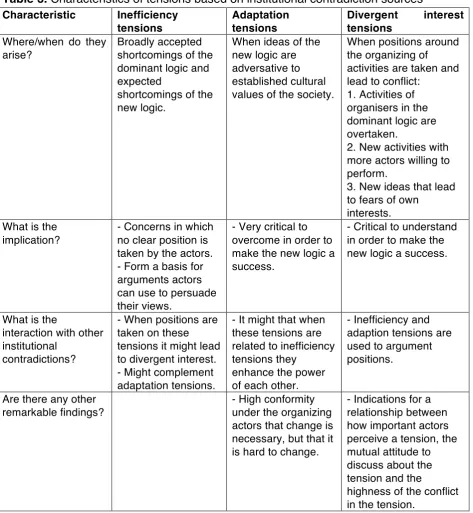
[image:32.595.69.543.185.699.2]In this part the answer to the research question is given. From the analysis made in the chapter before some insights are found to better understand the nature of tensions, presented in table 3.
Table 3. Characteristics of tensions based on institutional contradiction sources
Characteristic Inefficiency
tensions
Adaptation tensions
Divergent interest
tensions Where/when do they
arise?
Broadly accepted shortcomings of the dominant logic and expected
shortcomings of the new logic.
When ideas of the new logic are adversative to established cultural values of the society.
When positions around the organizing of activities are taken and lead to conflict:
1. Activities of organisers in the dominant logic are overtaken.
2. New activities with more actors willing to perform.
3. New ideas that lead to fears of own
interests. What is the
implication?
- Concerns in which no clear position is taken by the actors. - Form a basis for arguments actors can use to persuade their views.
- Very critical to overcome in order to make the new logic a success.
- Critical to understand in order to make the new logic a success.
What is the
interaction with other institutional
contradictions?
- When positions are taken on these tensions it might lead to divergent interest. - Might complement adaptation tensions.
- It might that when these tensions are related to inefficiency tensions they
enhance the power of each other.
- Inefficiency and adaption tensions are used to argument positions.
Are there any other remarkable findings?
- High conformity under the organizing actors that change is necessary, but that it is hard to change.
- Indications for a relationship between how important actors perceive a tension, the mutual attitude to discuss about the tension and the
highness of the conflict in the tension.
5. Discussion
The greater purpose of this research is to contribute to the understanding of the nature of tensions in order to require better insights in how institutional entrepreneurs can strategically act. In this chapter are the results linked to this purpose and discussed. At first, the theoretical contribution of the research is discussed. Second, the implication and contribution for institutional entrepreneurs are discussed. Thereafter, a description of the practical implication for the project team of the case study is given and the chapter will end with the limitations of the research.
5.1 Theoretical contribution
The research contributed to the literature by demonstrating that it is possible to define and analyse tensions based on a dialectical view. In the current literature a model to study informal logics is missing. The developed operationalization of the dialectical view can be perceived as suitable to study this. However, further research can supplement this operationalization by adding the specific found characteristics to this operationalization. The study also made clear that it is possible to divide tensions into different institutional contradiction sources and contributes by explaining the specific characteristics of these sources. The major contribution of the understanding of the nature of tensions is that this view is way more complex since tensions from other institutional contradictions sources are more intertwined than expected. In the analysis the four sources of institutional contradictions are explained as solid independent sources. However, Seo & Creed (2002) already mentioned that they do not suggest that these are separate sources. They state that human praxis acts as a mediator to create institutional change. In addition, they explain that nonadaptability may create an environment in which efficiency gaps or interinstitutional incompatibilities are unrecognized and perpetuated explaining relationships between the sources of institutional contradictions. The results of this research extend this view by finding and explaining more relationships.
During the analysis of the data none tension could be found to the incompatibilities institutional contradiction. This in line with the following reasoning: ''we are not suggesting that all institutions always and immediately produce all four sources of contradictions. Instead, we suggest that as certain social relationships and actions become institutionalized over a long period of time, they are likely to produce one or a combination of these four sources of contradictions. From a dialectical point of view, these contradictions are the impetus that drives, enables, and constrains further institutional change'' (Seo & Creed, 2002).
coherence and non-consistent views among the different actors. In settled culture it is expected that it is harder to enhance new logics (Swidler, 1986). The context of the case study could be perceived as an unsettled culture, related to the background in the introduction. This might explain the existence of the many inefficiency and divergent interest tensions. This indicates that the amount of inefficiency tensions is related to the degree of settled culture, because when views are coherent and consistent fewer intentions arise to discuss about the shortcomings of new and dominant logic from which inefficiency tensions arise. This reasoning is also in line with the perspective of the dialectical view to see conflicting logics as the determinant of institutional change.
An interesting finding of the research is the use of inefficiency and adaptation tensions as arguments for divergent interest positions. Overall perceived is that to acquire legitimacy it is critical that new ideas can be connected to established cultural accounts. When tensions show opportunities to fit into established cultural accounts greater chance of enabling is expected. Yet, when these opportunities do not exist it might lead to reinforcement of the dominant logic. This can be explained from the perspective that institutional logics are difficult to dislodge and that efforts to do so are enhanced if insurgent logics are connected through the core values within the institutional field (Suddaby & Greenwood, 2005). This would implicate that inefficiency and adaptation tensions that can be related to established cultural values would enhance the power of these arguments. In addition, this might also explain why the findings state that adaptation tension in general are hard to overcome, because these arise when ideas of the new logic are adversative to established cultural values of the society.
determine the intensity of a conflict for micro institutional change to fully open the black box.
The adaptation tensions are perceived as very critical to overcome related to the insights from this case study. According to the following reasoning this might be explained by differences in power: ''the formation an reproduction of social arrangements are basically political processes involving various participants who have divergent interest and unequal power, those who benefit the least are often the less powerful'' (Seo & Creed, 2002). This would indicate that power is one of the major factors for at least explaining the failure of institutional change initiatives. However, with the current knowledge one cannot determine if this is also decisive for the success of institutional change initiatives. Another characteristic found for tensions is the degree of openness for collaboration. Reay and Hinings (2009) propose that institutional change may occur when actors develop mechanisms of collaboration that support the co-existence of competing logics.
Although, we now better understand the different roles tensions can play from a micro institutional perspective a full understanding is not acquired. When do inefficiencies really become divergent interest tensions? Which factors are decisive and in which settings? Can collaboration for example neutralize the effects of conflicts? And which role do institutional compatibilities tensions play? These are examples of question further research should address.
5.2 Implication for institutional entrepreneurs
In this part the implication for how institutional entrepreneurs can use these results are described. Since better insights in the characteristics of tensions and the roles they play are obtained, institutional entrepreneurs can detect a more clear sight about the existing tensions. Based on this knowledge strategically actions can be determined.
Nonadaption has a great influence on the micro institutional change process since it can lead to the unrecognizing of inefficiency problems and is hard to overcome. In general, this is related to a settled culture and tensions that are not in line with established cultural values. When institutional entrepreneurs understand in which reasoning nonadaption exist they can focus on these tensions. At first, when they think there is anyway to find connection to established cultural values they can use story telling or rhetorical strategy mechanisms. When this does not lead to any shift or when they cannot find connection they need to challenge the taken for granted nature of an existing institutional order (Suddaby & Greenwood, 2005). Cultural toolkit approaches might then be suitable since these try to obtain a shift in very strong strategies of action embedded in culture (Swidler, 1986). Related to institutional change literature social upheavel might create a ''shock'' in order to create less consistent views (Battilana et. al., 2009). Further research should address in which situation which mechanisms are suited and how social upheavel for example can be created.
Institutional entrepreneurs who are capable to deal with conflict are expected to better able to implement the new logic. When they understand how the conflict in divergent interest is constructed they should be better able to strategically act. With the insights from the results a deeper understanding of these tensions can be obtained. A strategic analysis of which inefficiency and adaptation tensions can be used for argumentation seems valuable. Understanding which actors has the most power and if there are possibilities to collaborate should also be integrated in the strategic analysis. However, which mechanisms can be used in which situation cannot be determined from the results of this research. Further research is required to obtain deeper insights. In addition, institutional entrepreneurs should also understand that some inefficiency might lead to divergent interest tensions. With this understanding they might use mechanisms to prevent or to stimulate this process in order to lower the reinforcement of the dominant logic or enhance the acceptance of the new logic.
5.3 Practical implication
even more critical when support of the municipality and organizing actors will decrease and the complexity of tasks they need to perform will be higher. It is expected that the more complex these care tasks are the more conflict between the organizing actors will arise, because this will lead to more change in the activities of the current operating organisations.
5.4 Limitations
This research has focused on tensions from institutional change theory literature. The researcher understands that there are different insights on the classification of tensions in other theories, which might be perceived as a limitation. However, not including these other theories can be substantiated by a focus on an institutional change perspective.
An arising question is what these results mean for other similar initiatives, because such initiatives are expected to arise more and more in the Netherlands the coming years. As described in the results the focus of the institutional field was constituted from the whole society, meaning the whole society in the Netherlands. However, the data is gained from the eastern part of the Netherlands with a focus on village people. During the interviews many indications are given that there are major differences between villages and cities, mainly about the attitude of people to do things for other people. From this perspective it might be assumed that in different areas results could be different. From logical reasoning can be inferred that more individual behaviour would enhance the difficulties to structural bind volunteers. With the current information cannot be concluded whether in other initiatives the same tensions arise. However, since the institutional field in this research is broad one can assume that forthcoming results are corresponding. Comparable initiatives should at least consider the found tensions. In addition, one can also not determine the implications of these results for other settings than informal care initiatives.
6. Conclusion
7. References
Battilana, J., Leca, B., & Boxenbaum, E. (2009). 2 how actors change institutions: towards a theory of institutional entrepreneurship. The academy of management annals, 3(1), 65-107.
Bruton, G. D., Ahlstrom, D., & Li, H. L. (2010). Institutional theory and entrepreneurship: where are we now and where do we need to move in the future?. Entrepreneurship theory and practice, 34(3), 421-440.
Burrell, G., & Morgan, G. (1979). Sociological paradigms and organisational analysis. London: Heinemann.
Cloutier, C., & Langley, A. (2013). The logic of institutional logics insights from French pragmatist sociology. Journal of Management Inquiry, 22(4), 360-380.
Currie, W. L., & Guah, M. W. (2007). Conflicting institutional logics: a national programme for IT in the organisational field of healthcare. Journal of Information Technology, 22(3), 235-247.
DiMaggio, P. J. (1988). Interest and agency in institutional theory. Institutional patterns and organizations: Culture and environment, 1, 3-22.
Dorado, S. (2005). Institutional entrepreneurship, partaking, and convening. Organization studies, 26(3), 385-414.
Friedland, R., & Alford, R. R. (1991). Bringing society back in: Symbols, practices and institutional contradictions.
Furnari, S. (2014). Interstitial spaces: Microinteraction settings and the genesis of new practices between institutional fields.Academy of management review, 39(4), 439-462.
Greenwood, R., Morris, T. I. M., & Smets, M. (2012). From practice to field: A multilevel model of practice-driven institutional change. Academy of Management Journal, 55(4), 877-904.
Khavul, S., Chavez, H., & Bruton, G. D. (2013). When institutional change outruns the change agent: The contested terrain of entrepreneurial microfinance for those in poverty. Journal of Business Venturing, 28(1), 30-50.
Langley, A. (1999). Strategies for theorizing from process data. Academy of Management review, 24(4), 691-710.
Lewis, M. W., & Smith, W. K. (2014). Paradox as a metatheoretical perspective: Sharpening the focus and widening the scope. The journal of applied behavioral science, 0021886314522322.
Lounsbury, M. (2008). Institutional rationality and practice variation: New directions in the institutional analysis of practice. Accounting, Organizations and Society, 33(4), 349-361.
Lounsbury, M., & Crumley, E. T. (2007). New practice creation: An institutional perspective on innovation.Organization studies, 28(7), 993-1012.
Marquis, C., & Lounsbury, M. (2007). Vive la résistance: Competing logics and the consolidation of US community banking. Academy of Management Journal, 50(4), 799-820.
Powell, W. W., & DiMaggio, P. J. (Eds.). (1991). The new institutionalism in organizational analysis. University of Chicago Press.
Reay, T., & Hinings, C. R. (2009). Managing the rivalry of competing institutional logics. Organization studies, 30(6), 629-652.
Seo, M. G., & Creed, W. D. (2002). Institutional contradictions, praxis, and institutional change: A dialectical perspective. Academy of management review, 27(2), 222-247.
Suddaby, Roy, and Royston Greenwood. 2005. ‘Rhetorical Strategies of Legitimacy,’
Administrative Science Quarterly 50: 35–67.
and culture back in: Introduction to the special research forum. Academy of Management Journal, 53(6), 1234-1240.
Swidler, Ann. 1986. ‘Culture in Action: Symbols and Strategies,’ American Sociological Review 51: 273–286.
Thornton, P. 2004. Markets from Culture: Institutional Logics and Organizational Decisions in Higher Education Publishing. Stanford, CA: Stanford University Press.
Thornton, P. H., & Ocasio, W. (2008). Institutional logics. The Sage handbook of organizational institutionalism, 840, 99-128.
Van de Ven, A. H. (2007). Engaged scholarship: A guide for organizational and social research. Oxford University Press on Demand.
Vleugels, A. (2015, 13 april), Ouderen krijgen thuis te weinig zorg. NOS. Retrieved from http://nos.nl/artikel/2029952-ouderen-krijgen-thuis-te-weinig-zorg.html
Welter, F., & Smallbone, D. (2011). Institutional perspectives on entrepreneurial behavior in challenging environments. Journal of Small Business Management, 49(1), 107-125.