University of Warwick institutional repository: http://go.warwick.ac.uk/wrap
A Thesis Submitted for the Degree of PhD at the University of Warwick
http://go.warwick.ac.uk/wrap/63881
This thesis is made available online and is protected by original copyright. Please scroll down to view the document itself.
Onto
usi
and S
A thesis
W
ology
ng Se
Statis
s submitt
D
Warwick M
Engin
emant
stical
ted in par
Doctor of P
Manufactu
neerin
tic Re
Socia
by
Xiao
rtial fulfillm
Degre
Philosop
uring Gro
March
ng for
elation
al Netw
y
MA
ment of th
ee of
hy in Eng
oup, Univ
2011
r ICT S
nship
work
he requir
gineering
versity of
Syste
Minin
Analy
rements f
Warwick
ems
ng
ysis
Table of Content
March 2011 WMG, University of Warwick P a g e | i
TABLE OF CONTENT
Acknowledgements ... iv
Declaration………. ... v
Forward………..…. ... vi
Abstract……… ... vii
Abbreviations ... viii
List of Figures ... x
List of Tables ... xii
Chapter 1: Introduction ... 1
1.1 Research Motivation ... 1
1.2 Problem Description ... 9
1.3 Research Question and Objectives ... 15
1.4 Structure of this work ... 16
Chapter 2: The Ontology field ... 18
2.1 Medical Sector Case Study ... 18
2.1.1 TMG ... 19
2.1.2 GALEN ... 24
2.1.3 SNOMED CT ... 26
2.1.4 UMLS ... 31
2.1.5 Medical ontology Summary ... 32
2.2 Engineering sector Case Study ... 35
2.2.1 UNSPSC and SIC ... 36
2.2.2 WMCCM ... 40
2.2.3 Engineering ontology summary ... 46
2.3 Linguistic Ontology ... 49
2.3.1 WordNet ... 49
2.3.2 The Mikrokosmos ontology ... 50
2.3.3 SENSUS ... 51
2.3.4 Linguistic ontology summary ... 53
2.4 Methodologies for Ontology Engineering ... 54
2.4.1 Cyc methodology ... 54
2.4.2 TOVE methodology ... 56
2.4.3 On-To-Knowledge and KACTUS methodology ... 58
2.4.4 METHONTOLOGY methodology ... 60
2.4.5 SENSUS Methodology ... 61
2.5 Research Objectives Specification ... 65
Chapter 3: Ontology Engineering ... 67
3.1 Ontology building process configuration ... 67
3.1.1 Source selection ... 67
3.1.2 Seeding words Selection ... 72
Table of Content
March 2011 WMG, University of Warwick P a g e | ii
3.1.4 Experiment Environment Configuration ... 78
3.2 Corpus Construction ... 100
3.2.1 The 1st round experiment ... 100
3.2.2 The 2nd round experiment ... 101
3.2.3 The 3rd round experiment ... 103
3.3 Ontological Analysis ... 104
3.3.1 Centrality Analysis ... 104
3.3.2 Closeness and Betweenness ... 111
3.3.3 Boundary analysis ... 117
3.4 summary ... 124
Chapter 4: Ontology Evaluation ... 125
4.1 Structural evaluation ... 127
4.1.1 Ontology Verification ... 127
4.1.2 Ontology Validation ... 133
4.2 Content Evaluation ... 137
4.2.1 Completeness ... 138
4.2.2 Conciseness ... 144
4.2.3 Consistency ... 145
4.3 Practical Evaluation ... 155
4.4 Summary ... 161
Chapter 5: Methodology Generalisation and formalisation ... 162
5.1 Generalisibility on ontology engineering results ... 163
5.1.1 Hospitability ... 164
5.1.2 Flexibility ... 166
5.1.3 Reusability ... 168
5.2 Generalisability for ontology Builders ... 172
5.3 Ontology engineering methodology generalisation ... 174
5.3.1 Development Process and Detailed Techniques ... 178
5.3.2 Pre-development processes ... 187
5.3.3 Post development process – Ontology Implementation ... 189
5.3.4 Ontology Evaluation ... 190
5.3.5 Life cycle and project management ... 191
5.4 Summary ... 195
Chapter 6: Further Discussions ... 196
6.1 “Plus” Findings ... 197
6.1.1 Ontology definition ... 197
6.1.2 A “Statistical Network Analysis” approach ... 201
6.1.3 Bridging reusability and usability of knowledge ... 202
6.1.4 Semantic Tagging ... 205
6.1.5 Knowledge discovery ... 206
6.1.6 IT system architecture design ... 209
Table of Content
March 2011 WMG, University of Warwick P a g e | iii
6.3 Minus Findings ... 213
6.3.1 SEA representativeness ... 213
6.3.2 Reliance on Internet information ... 213
6.3.3 Complexity of ontology output ... 215
6.4 Interesting Findings ... 215
6.4.1 Configuration variability ... 215
6.4.2 Network structure analysis ... 216
6.4.3 Knowledge discovery methods ... 217
6.4.4 Connection zone member re-focusing ... 217
Chapter 7: Conclusions ... 219
References……… ... 221
Bibliography ... 237
Acknowledgements
March 2011 WMG, University of Warwick P a g e | iv
ACKNOWLEDGEMENTS
I would like to express my thanks to the Engineering and Physical Sciences Research
Council (EPSRC) for providing the funding via the Warwick Innovative
Manufacturing Research Centre (WIMRC) to make this research possible, and the
Taj Medical Group for kindly partially sponsoring me to conduct this research.
I would like to thank all those who have supported me in their unique ways during
this doctoral research:
1. My academic supervisor Dr. Jay Bal, who gives me endless patience, guidance
and advice on the research, and shares his wisdom and experience on research
life.
2. My industry supervisor Dr. Jagdish Jethwa for his guidance, advice and
friendship.
3. The West Midlands Collaborative Commerce Market Place and the Taj Medical
Group for generously offering their operational details and ontology related
information.
4. Dr. Joseph Darlington and Mr. Ahmad Issa for their support on the research and
thesis proofreading.
5. My parents CuiZhen Meng and YongSheng Ma for their support and
encouragement during all these years that I have been away from them.
6. My wife Yu Yang for her endless support, encouragement during my doctoral
research.
7. Dr. Mark Swift, Dr. Nikolas Armoutis, Rob McGongle, Tuhin Ahmed, Marios
Mofatas, Xin Wang and Honghong Dai for individual support, academic advice
and their great companionship.
8. Many others of my family, friends and staff at the University of Warwick whose
Declaration
March 2011 WMG, University of Warwick P a g e | v
DECLARATION
I, Xiao MA declare that except where acknowledged, the material contained in this
thesis is my own work and that is has neither been previously published nor
Forward
March 2011 WMG, University of Warwick P a g e | vi
FORWARD
This work was funded by WIMRC to investigate self-help systems for improving
medical processes. Early work with the Taj Medical Group to investigate free(er)
market medical processes in healthcare tourism identified good ontology as key to
Abstract
March 2011 WMG, University of Warwick P a g e | vii
ABSTRACT
In information science, ontology is a formal representation of knowledge as a set of concepts within a domain, and the relationships between those concepts. It is used to reason about the entities within that domain, and may be used to describe the domain. (Wikipedia, 2011)
This research takes two case study ICT applications in engineering and medicine, and evaluates the applications and supporting ontology to identify the main requirements for ontology in ICT systems. A study of existing ontology engineering methodology revealed difficulties in generating sufficient breadth and depth in domain concepts that contain rich internal relationships. These restrictions usually arise because of a heavy dependence on human experts in these methodologies.
This research has developed a novel ontology engineering methodology – SEA, which economically, quickly and reliably generates ontology for domains that can provide the breadth and depth of coverage required for automated ICT systems. Normally SEA only requires three pairs of keywords from a domain expert. Through an automated snowballing mechanism that retrieves semantically related terms from the Internet, ontology can be generated relatively quickly. This mechanism also enhances and enriches the binary relationships in the generated ontology to form a network structure, rather than a traditional hierarchy structure. The network structure can then be analysed through a series of statistical network analysis methods. These enable concept investigation to be undertaken from multiple perspectives, with fuzzy matching and enhanced reasoning through directional weight-specified relationships.
The SEA methodology was used to derive medical and engineering ontology for two existing ICT applications. The derived ontology was quicker to generate, relied less on expert contribution, and provided richer internal relationships. The methodology potentially has the flexibility and utility to be of benefit in a wide range of applications.
Abbreviations
March 2011 WMG, University of Warwick P a g e | viii
ABBREVIATIONS
CAP: College of American Pathologists
CTV3: Clinical Terms Version 3
DOGMA: Developing Ontology-Grounded Methods and Applications
EDI: Electronic Data Interchange
GB: GigaByte
HBS: Harvard Business School
HTML: Hyper Text Mark-up Language
ICT: Information Communication Technology
IHTSDO: International Health Terminology Standards Development Organisation
MAS: Manufacturing Advisory Service
MeSH: Medical Subject Headings
NACE: Statistical Classification of Economic Activities in the European Community
NHS: National Health Service of the United Kingdom
NPD: New Product Development
OWL: Web Ontology Language
Abbreviations
March 2011 WMG, University of Warwick P a g e | ix
SEA: Semantic (S) relatedness oriented ontology engineering via retrieving
information from the search Engine (E) index with assistance from social network
analysis (A). It is the new ontology engineering methodology developed by this
research.
SIC: Standard Industry Code (UK)
SLA: Service Level Agreement
SNA: Social Network Analysis
SNOMED CT: Systematized Nomenclature of Medicine-Clinical Terms
SNOP: Systematized Nomenclature of Pathology
TB: TeraByte. 1 TB = 1,024 GB
TMG: the Taj Medical Group
UMLS: Unified Medical Language System
UN: the United Nations
UNSPSC: the United Nations Standard Products and Services Code
W3C: the World Wide Web Consortium
WMCCM: West Midlands Collaborative Commerce Marketplace
WWW: World Wide Web
List of Figures
March 2011 WMG, University of Warwick P a g e | x
LIST OF FIGURES
Figure 1.1: Example of fuzzy area in ontology ... 5
Figure 1.2: Example of tender matching in WMCCM system via processes .... 10
Figure 1.3: Example of company matching in WMCCM system via processes 10 Figure 1.4: WMCCM Ontology ... 12
Figure 1.5: Structure of the research ... 17
Figure 2.1: Illustration of TMG’s business process cycle... 19
Figure 2.2: Illustration of TMG’s ontology structure ... 21
Figure 2.3: Example of GALEN on plastic surgery ... 24
Figure 2.4: Illustration of SNOMED structure with example of TMG cosmetic surgery ... 27
Figure 2.5: Illustration of UNSPSC structure with “welding” example ... 37
Figure 2.6: Illustration of SIC structure with “welding” example ... 38
Figure 2.7: Illustration of WMCCM structure with “welding” example ... 41
Figure 2.8: Approach to developing the Cyc ontology ... 54
Figure 2.9: Approach to developing TOVE Ontology ... 57
Figure 2.10: Approach to developing “On-To-Knowledge” Ontology ... 58
Figure 2.11: Approach to developing METHONTOLOGY ontology ... 60
Figure 2.12: Approach to developing a SENSUS ontology ... 61
Figure 3.1: Approach to developing SENSUS ontology ... 67
Figure 3.2: Illustration of seeding words selection ... 73
Figure 3.3: The Google Sets platform ... 78
Figure 3.4: Relationship between the number of predictions and the number of inputs ... 83
Figure 3.5: Illustration of paired seeding words search space ... 86
Figure 3.6: Cosmetic breast surgery network domain focus ... 92
Figure 3.7: Illustration of Multiple rounds of experiment ... 93
Figure 3.8: Misleading paired seeding words ... 97
Figure 3.9: Complete prediction separation of two pairs of seeding words... 97
Figure 3.10: Illustration of one fault pair in three pair seeding terms scenario . 98 Figure 3.11: Example of Centrality Analysis ... 105
Figure 3.12: Tri-sectional trend of centrality distribution ... 108
Figure 3.13: Illustration of Poisson distribution ... 109
Figure 3.14: Example of closeness analysis ... 112
Figure 3.15: Example of “Betweenness” analysis ... 115
Figure 3.16: Example of Peripheral Players ... 118
Figure 3.17: Network reach illustration ... 120
Figure 4.1: Ontology Evaluation ... 126
Figure 4.2: Illustration of three zones defined in this research ... 134
Figure 4.3: Illustration of conciseness alternation ... 145
List of Figures
March 2011 WMG, University of Warwick P a g e | xi
Figure 4.5: Centralities Frequency in the medical top two zones ... 146
Figure 4.6: Centrality trend of the top zone members ... 150
Figure 4.7: Centrality trend of gradient change zone members ... 151
Figure 4.8: Centrality increment trend of long tail zone members ... 152
Figure 4.9: Centrality increment analysis for medical ontology ... 153
Figure 4.10: Centrality increment analysis for engineering ontology... 153
Figure 4.11: Tri-sectional trend of centrality distribution ... 154
Figure 4.12: The ontology application environment ... 156
Figure 4.13: The filter mechanism ... 157
Figure 4.14: Illustration of practical evaluation on new engineering ontology158 Figure 4.15: Illustration of practical evaluation on new medical ontology ... 159
Figure 5.1: Sample facets information from engineering ontology ... 169
Figure 5.2: IEEE software development methodology ... 176
Figure 5.3: Normal SENSUS Approach ... 178
Figure 5.4: Detailed techniques for seeding words extraction ... 180
Figure 5.5: Linking seeding words to the knowledge base ... 181
Figure 5.6: Illustration of detailed technique in corpus construction ... 182
Figure 5.7: Detailed techniques for linking seeding words to the knowledge base ... 183
Figure 5.8: Details of the Techniques ... 186
Figure 5.9: Pre-development stage techniques... 188
Figure 5.10: ontology implementation methods ... 189
Figure 5.11: Ontology Evaluation during the Observation stage ... 190
Figure 5.12: The Reflection Stage tasks ... 192
Figure 6.1: Research findings organisation as PMI ... 196
Figure 6.2: Ontology formalisation scale ... 198
Figure 6.3: Examples of internal structure in SNOMED CT and SEA ontology ... 199
Figure 6.4: Illustration of centrality distribution ... 201
Figure 6.5: Matrix of ontology usability and reusability ... 203
Figure 6.6: DOGMA approach vs. SEA approach ... 204
Figure 6.7: An illustration of galaxies in the Universe ... 206
Figure 6.8: Illustration of steps discovering new knowledge ... 207
Figure 6.9: Examples of WMCCM ontology ... 210
List of Tables
March 2011 WMG, University of Warwick P a g e | xii
LIST OF TABLES
Table 3.1: The feedback from small set and large set ... 79
Table 3.2: A Comparison between the Results from Large and Small Sets ... 80
Table 3.3: Results from the Single word experiment ... 88
Table 3.4: Results from the Paired words Experiment ... 88
Table 3.5: Seeding words of the order experiment ... 94
Table 3.6: The third round experiment formula collection ... 103
Table 3.7: Example of betweenness in the engineering experiment ... 116
Table 3.8: Example of relevant distance in the engineering experiment ... 123
Table 4.1: Weight Specified Relationship ... 132
Table 4.2: Definition zone members in the engineering experiment ... 139
Table 4.3: Extra definition zone members in the engineering experiment ... 141
Table 4.4: Definition zone members in the medical experiment ... 141
Table 4.5: Extra top zone members in the medical experiment ... 142
Table 5.1: Sample fuzzy ontology from engineering ontology... 172
Chapter 1: Introduction
March 2011 WMG, University of Warwick P a g e | 1
CHAPTER 1: INTRODUCTION
Ontology describe the common entities and the relationships associated with a
knowledge domain or a task. They are thus important when discussing concepts,
activities and collaborations pertaining to that domain. ICT systems designed to
handle processes and tasks can benefit hugely from suitable ontology that aids
structure and decision making. ICT systems that lack suitable ontology behind them
can suffer from issues such as an over reliance on domain experts, a large number of
data gathering and refining steps, poor ability to infer new information and poor
ability to address multi-disciplinary issues. This research explores how ontology for
ICT systems can be created that are quick to generate, reliable in interpretation and
require less input from domain experts. The exploration is conducted through a
detailed analysis of two case study applications and their problems followed by a
discussion as to the general applicability of the methodology derived.
1.1 RESEARCH MOTIVATION
The Semantic Web is a group of methods and technologies to allow machines to
understand the meaning - or "semantics" - of information on the World Wide Web.
Ontology are the “engine” of semantic web because they aid in the “understand the
meaning” process by defining the relationships between different entities – an
Chapter 1: Introduction
March 2011 WMG, University of Warwick P a g e | 2
A family of knowledge representation language for authoring ontology is established
as the Web Ontology Language (OWL) (Dean and Schreiber, 2003). These
languages are characterised by formal semantics and Resource Description
Framework (RDF) / Extensible Markup Language (XML) - based serializations for
the Semantic Web. OWL is endorsed by the World Wide Web Consortium (W3C)
and has attracted academic, medical and commercial interest.
The ability to semantically model knowledge has turned ontology into useful tools
for business use. The Yahoo index uses ontology to categorise web sites into a large
taxonomy for web search purposes, while Amazon has built its product catalogue
according to ontology on products and their features. Many other disciplines have
recognised the value of ontology. For example, in healthcare, the Systematised
Nomenclature of Medicine Clinical Terms (SNOMED CT) has been an attempt to
standardise a “systematically organized computer processable collection of medical
terminology” for use across health information systems, in order to solve the
problem of poor communication between healthcare practitioners and patients
(IHTSDO, 2009).
SNOMED Clinical Terms (SNOMED CT) is a comprehensive clinical
terminology that provides clinical content and expressivity for clinical
documentation and reporting. It can be used to code, retrieve, and analyze
clinical data. SNOMED CT resulted from the merger of SNOMED Reference
Terminology (SNOMED RT) developed by the College of American Pathologists
Chapter 1: Introduction
March 2011 WMG, University of Warwick P a g e | 3
Service (NHS) of the United Kingdom. The terminology is comprised of concepts,
terms and relationships with the objective of precisely representing clinical
information across the scope of health care.
SNOMED CT provides the core general terminology for the electronic health
record (EHR) and contains more than 311,000 active concepts with unique
meanings and formal logic-based definitions organized into
hierarchies. SNOMED CT is considered to be the most comprehensive,
multilingual clinical healthcare terminology in the world.
Today, SNOMED CT is available in US English, UK English, Spanish and
Danish. Translations into French, Swedish, Lithuanian, and several other
languages are currently taking place. (IHTSDO, 2009)
SNOMED CT demonstrated that ontology can be built in multiple languages.
Multilingual ontology may not be a simple translation of ontology from one
language to others: as stated by SNOMED CT, “term-to-term translations may
yield literal expressions that are often meaningless”(IHTSDO, 2009). Therefore in
practice, ontology should firstly require a specific understanding of lexicons and
semantics around terms in any individual language in order to be multilingual
(Espinoza et al., 2008). For example, when Google entered the Indonesia market, its
customised ads which match against web content failed to compete with similar
ads from a local company “Sitii”, because Google’s matching mechanism was based
on keyword relevant ontology in English, while Sitti collected terms and their
relationships based on the Indonesian local language (Lacy, 2010). This shows that
Chapter 1: Introduction
March 2011 WMG, University of Warwick P a g e | 4
building perspectives. For instance, a domain ontology may require domain specified
terms and relationships, or an application dependant ontology should define
application specified terms and relationships.
Ontology such as SNOMED CT are normally built to the classic ontology definition
– “explicit formal specifications of the terms in the domain and relations among
them” (Gruber, 1993). The ontology derived thus often lacks the broad coverage
required to bridge the terminology gap between professionals and general users.
There are parallels with expert systems that relentlessly focus on specific domains
when a simpler answer exists from another domain. Secondly, the resources required
to build such ontology (time and human expertise) are normally only affordable by
large organisations. Thirdly, “explicit and formal” denies the fuzzy understanding
that can exist between experts in different domains, and even within the same
domain. A requirement that the whole area of Fuzzy Systems was developed to
address. The need to address fuzziness at the edges of a domain becomes very
important when trying to work across multiple disciplines. Systems that can deal
with multi-domain knowledge will thus have a fuzzy area that links the different
domains.
Figure 1.1 shows examples of the key joining terms between different concepts or
domains: in this case “plastic surgery” is the fuzzy area that connects cosmetic
March 2011 increasing and appro addressed For exam “multi-sec (Granada_ committee ontology.
g need for m
oaches to ge
the issues.
Fi
mple, the U
ctor standar
_Research,
es found it
Sometimes
W
multi-discip
enerating th
igure 1.1: E
United Nat
d for efficie
2001). How
t hard to re
, individual
WMG, Universit
plinary syste
he ontology
Example of f
tions (UN)
ent, accurat
wever when
e-use the U
l countries p
ty of Warwick
ems, and it
required b
fuzzy area i
) has prov
te classifica
n it was imp
UN version
proposed th
appears tha
y such syst
in ontology
vided ontol
ation of prod
plemented in
n, so they
heir own ont
Chapter 1: In
P at existing r
tems have n
logy to su
ducts and s
n practice,
proposed d
tology: for e
ntroduction
Chapter 1: Introduction
March 2011 WMG, University of Warwick P a g e | 6
“The North American Industry Classification System” or the “Standard Industrial
Classification (UK)” to ensure clarity due to cultural or language issues, and a lack
of sufficient detail in the original definitions.
It appears that current methods of ontology engineering do not generate multi
domain ontology that meets real needs. Swartout and colleagues conclude that
researchers in this area have not been successful in building up-to-date ontology,
reducing domain expert involvement and providing the breadth of coverage to enable
multi-disciplinary applications (Swartout et al., 1997). Ontology are often a key tool
in the analysis and translation of specialist language, and are essential in building
systems for multi-disciplinary working, or ones that allow non-specialists to access
them. They are widely used in artificial intelligence, the Semantic Web, systems
engineering, software engineering, biomedical informatics, library science,
enterprise information systems and information architecture, as a form of knowledge
representation about the world or some part of it. Examples of work in this area are:
In water management, traditional system modelling initiatives follow textbook
approaches in a single domain. A lack of mutual understanding among modelling
teams undermines the reproducibility of modelling work. Multi-disciplinary
ontology was introduced to link the generic part of modelling with various water
management domains for different types of users and different levels of
Chapter 1: Introduction
March 2011 WMG, University of Warwick P a g e | 7
In collaborative engineering design, ontology-based modelling via the Semantic
Web is proposed, to enable communication and knowledge reuse among
multi-disciplinary organisations. Original domain specified (engineering)
knowledge representation was reconfigured as a new multi-agent distributed
design ontology, and this ontology facilitates semantic access and information
retrieval across different disciplines. (Zhang and Yin, 2008)
The Web 2.0 has also created a massive increase in user generated content. Davies
and colleagues have pointed out that people need techniques to enable them to make
sense of the huge volumes of information with speed and reliability (Davies et al.,
2006). These technique for structured information representation in a given
application environment assist the user in the sense making process. To be specific,
people require the ability to select relevant content, and to filter out any irrelevances,
as well as to summarise and extract the essence of numerous articles and to clarify
the relationships between such pieces of information. This requires the “Semantic
Web” to provide a framework that enables data sharing and re-use across
applications, and to describe (or tag), manage and process information semantically
(Berners-Lee, 2000). Using the output from the semantic web, systems can
“understand” the meaning (semantics) of natural language, so as to assist the
decision making processes. At the heart of the Semantic Web is the use of “Ontology”
that establish human oriented terminologies, summarise concepts and reason from
Chapter 1: Introduction
March 2011 WMG, University of Warwick P a g e | 8
This research seeks methods to derive multi-disciplinary ontology for any sector or
specialism quickly, reliably and economically compared with current methods. The
methods developed are derived from an analysis of the knowledge processing needs
for two sectors, medical tourism from The Taj Medical Group, and virtual
organisation formation (opportunity finding and partner selection) in the engineering
sector from the West Midlands Collaborative Commerce Marketplace.
The Taj Medical Group is a medical tourism agency that helps organise travel
and treatment options for patients. They partner with a range of hospitals,
specialist and clinics. At the time of the research the Taj Medical Group was the
largest provider of medical tourism to India. A problem they had was that
because of the amount of time and resources required to match each individual
patient with the best provider, the business was not very profitable. They
required help in reducing the experts’ workload in matching patient needs with
providers’ capabilities.
The West Midlands Collaborative Commerce Marketplace (WMCCM) is an
ontology driven marketplace for engineering businesses. The system
automatically matches tender opportunities with company competency, so as to
provide focused opportunities. It does this through a semantic analysis of tender
content to classify tenders against a general engineering ontology that was
custom created for the system. Company competencies for the 400+ profiled
Chapter 1: Introduction
March 2011 WMG, University of Warwick P a g e | 9
needs of a tender can be matched against the company(s) that can provide them,
and an appropriate partnership suggested. The WMCCM ontology was built
partly top down and partly bottom up by domain experts.
These case studies are described in more detail in chapter two.
1.2 PROBLEM DESCRIPTION
The creation or identification of a suitable ontology for any sector or field is thus
important in aiding communication, enhancing collaboration and automating
processes. Ontology engineering, as a subject, is an existing area of research in
knowledge management. However, creating or arriving at a suitable ontology
(ontology engineering) for an industry remains a major problem, and an increasingly
important area of research.
For instance, SNOMED CT still suffers many drawbacks, such as unclear
identification from different healthcare aspects, top level ontology alignment with
other widely accepted ontology, and ambiguous relationships towards non-expert
terminology, etc. (Schulz et al., 2009)
In taking the West Midlands Collaborative Commerce Marketplace (WMCCM) as
an example, first hand experience with WMCCM has revealed insights on certain
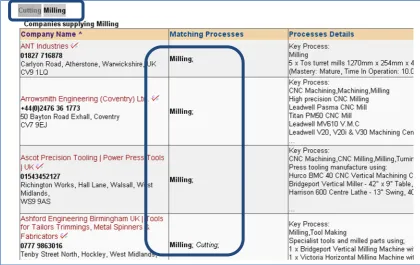
problems. WMCCM matches tender opportunities with company competency, by
Chapter 1: Introduction
March 2011 WMG, University of Warwick P a g e | 10
ontology covering the engineering sector and associated activities. Poor
categorisation results in wasted tender scrutiny and poor partnership possibility
suggestions.
[image:24.595.141.508.183.397.2]
Figure 1.2: Example of tender matching in WMCCM system via processes
[image:24.595.114.535.463.728.2]Chapter 1: Introduction
March 2011 WMG, University of Warwick P a g e | 11
A key factor in this and other ontology matching within WMCCM is the quality
(coverage of the domain and internal relationship) of the ontology. For WMCCM, its
ontology was generated experimentally, following a mixture of top down derivation
and bottom up synthesis. WMCCM expert staff collected first hand data from
professionals – namely academic and industry experts. The data was the words that
companies actually used when discussing their capabilities, and unified these terms
with those derived from standards (sourced from books or government
classifications). Figure 1.4 shows part of the Ontology structure adopted by
March 2011
1 It is a thre
ee level structu
W
Figure
ure, only the r
WMG, Universit
e 1.4: WMC
renewable ene
ty of Warwick
CCM Ontolo
ergy and surfa ogy1
ce treatment s
Chapter 1: In
P sections are ex
ntroduction
Chapter 1: Introduction
March 2011 WMG, University of Warwick P a g e | 13
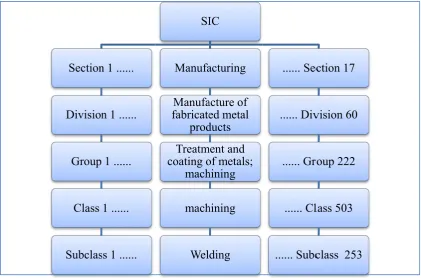
Currently, there exists a range of ontology for the engineering sector. In the UK, the
SIC (Standard Industrial classification) has been available for many years and is
regularly updated. The current version dates from January 2008, and has been
aligned with NACE (Statistical Classification of Economic Activities in the
European Community) (National Statistics, 2010). At the same time, a higher level
ontology also facilitates the engineering sector’s trading activities – the United
Nations Standard Products and Services Code (UNSPSC).
However, there are problems in using the SIC type of ontology in practice since they
rarely meet the full needs of the application environment and revisions arise so as to
reflect changes in the world economy, industry and business change, and so,
logically, the need to categorize its activities. The biggest changes in recent years are
mainly due to the growth and development of new services in the area of ICT
(Information and Communications Technology). Thus, the coverage of fast changing
sectors such as Engineering or Medicine can be patchy, and there can be many gaps
in the newer technologies and processes. This, in automated systems, can lead to
poor categorisation of information and an inadequate level of performance from the
“smart” systems using the ontology.
Secondly, existing ontology are structured according to their application
Chapter 1: Introduction
March 2011 WMG, University of Warwick P a g e | 14
it is not a wise option to select and modify an existing ontology. Thus efficiency
improvement in the application of ontology through reuse is not a sensible option.
SNOMED CT has included different collections from a variety of clinical
information. In order to make use of such information, current health information
systems link such collections to clinical knowledge bases for information retrieval,
exchange, etc. However, a lack of satisfactory foundation ontology would not only
reduce the effectiveness of these functions, but could be a threat to patient safety if
the exchange of clinical information is not aligned.
In a similar way, Electronic Data Interchange (EDI) standards have developed many
variants for different sectors as a result of terminology differences in different
industries (Sommer, 2003). However, many of these ontology variations do not work
with each other, as they are developed from different viewpoints and thus not aligned
with each other. With the increasing level of multi-disciplinary and inter sectional
working, it is desirable to merge existing sectorial or discipline based ontology to
enable cross disciplinary collaboration. Noy and Musen identify this as an important
research interest: to incorporate ontology, so as to reuse information from each of
them (Noy and Musen, 1999). Thus more research is required on methods for
building new cross disciplinary ontology that incorporate information from disparate
Chapter 1: Introduction
March 2011 WMG, University of Warwick P a g e | 15
It is also apparent that researchers in this area have not been successful in building
ontology that (Swartout et al., 1997):
is based on up-to-date information;
reduces the demands on the domain experts;
provides enough coverage to enable multi-disciplinary usage;
is broad enough for translation between specialist and non-specialist
knowledge understanding.
This work sets out to address these issues. The approach selected (described in-depth
in chapters 3 and 5) is to use the Google search engine index as a data source to
directly extract ontological information. There are very few studies in ontology
engineering based on a search engine index (discussed in section 3.1). The work
undertaken contributes new techniques that reduce some of the problems and issues
identified in the ontology engineering methodology review conducted in chapter
two.
1.3 RESEARCH QUESTION AND OBJECTIVES
From the issues discussed above, the research question posed is as follow:
“Is it possible to quickly, reliably and economically generate ontology for a
specific area or areas that can provide the breadth and depth of coverage required
Chapter 1: Introduction
March 2011 WMG, University of Warwick P a g e | 16
The approach chosen to address this question is one of creating a methodology. To
generate such a methodology, several objectives have been identified:
To examine and discuss current ontology engineering problems in medical and
engineering sector, accompanied by the first hand data collected from TMG and
WMCCM.
To devise methods to quickly, reliably and economically create ontology for
these domains and evaluate them.
To discuss how general the approaches are and to create a generalisable ontology
engineering methodology
1.4 STRUCTURE OF THIS WORK
March 2011 Contri
Gene
Genera en Stru Ontolo Review on ontolo Resbution to know
eralisation
alisability on on ngineering resul
[image:31.595.115.533.69.624.2]uctural Evaluati ogy building pr configuration
Review o
n medical ogies search Motivati W Figure 1 wledgen of this re
ntology lts
O
ionBuilding
rocesson Ontolo
Review on engieneering ontologies ion WMG, Universit 1.5: StructurConcl
Summary oFurther D
Limiation of
esearch's o
Generalisabilit builOntology E
Content Eg ontologie
Ontology corpogies and t
Revie lingu ontol
Introd
Problem
ty of Warwick
re of the res
lusion
of the study
Discussion
the research
ontology en
ty for ontology
ders
Evaluation
Evaluation
es for this
us construction
their build
ew on uistic logies oduction
Statement searchn
Future re
ngineering
G methn
Presearch
n Onding metho
Review on ontology buildin methodologies RChapter 1: In
P
esearch recomm
g methodo
Generalisability
hodological app
Practical Evaluti ntological analy
odologies
ng s Res Hypo Research Questi ntroductiona g e | 17
Chapter 2: The Ontology Field
March 2011 WMG, University of Warwick P a g e | 18
CHAPTER 2: THE ONTOLOGY FIELD
The goal of this research was to explore methods to generate ontology for use in ICT
systems that were quick and reliable to generate and required less of a contribution
from domain experts than current approaches. The research approach chosen was to
look at two problem domains, devise approaches to meet their needs and then
explore the generalisability of the approaches devised. This chapter starts by
describing the two problem domains and then discusses some of the current ontology
engineering approaches suggested in the literature.
2.1 MEDICAL SECTOR CASE STUDY
Ontology in the medical sector are built to enable healthcare information (such as
patient data, diagnosis and care regimes) share, reuse and transfer in medical
information systems. They normally contain detailed medical terminology (clearly
defined medical domain concepts) and related terms around them.
Healthcare ontology deal with both types of users: healthcare professionals who are
expert in the field and patients who are non-specialists. Such ontology are expected
to bridge the gaps between these two user groups. A case study of the Taj Medial
Group (TMG) was used to explore the communication between experts and
March 2011
2.1.1
The Taj M
arranged t
other coun
for the pro
[image:33.595.127.511.356.635.2]medical tr the resour paying pat Figure 2.1 finalising TMG Medical Gr
treatment fo
ntries. A ma
ocess of ma
reatment pro rces require tients. Figure 1 illustrates a medica Formin tourism quo D W roup (TMG
for over eig
ajor problem
atching their
oviders. The
d for each
2.1: Illustra
s TMG’s bu
al tourism ng medical m plan and
otation Discussing
with pati
WMG, Universit
G) is a lead
ght hundred
m faced by
r patients’ e
e business s
enquiry but
ation of TM
usiness pro contract. Match treatem against s provid capab the plan ients
ty of Warwick
ding medica
d internation
TMG was
enquiries w
suffered fro
t a low con
MG’s busine ocess cycle Advertising Rece enquiries revi en hing ment service ders' ility Chapter
al tourism f
nal patients
the level of
ith the capa
m low effic
nversion rate
ess process c
from receiv
g generated iving s (new or
sed)
Categorisin nquires to li
treatmen
r 2: The Onto
P facilitator,
s from the
f resources
abilities of d
ciency as a
e from enqu
cycle
ving an en
d many c ing
ikely nt
ology Field
Chapter 2: The Ontology Field
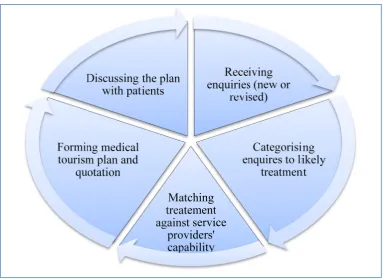
March 2011 WMG, University of Warwick P a g e | 20
enquiries, which needed to be manually categorised and matched to likely treatment
procedure. Following this, the available service providers were manually matched
against the enquiries based on their treatment profile and capability. Finally the
recommended medical tourism solution and quotation were fed back to the initial
enquirer. The whole cycle may be repeated as many times as required to get the
patients’ agreement on the treatment plan proposed by TMG.
This whole process required expert company resources, and made the business
fundamentally unprofitable in the eyes of the author. Amazingly at the same time,
many new businesses were entering this market with a similar business model.
To enhance the process, TMG proposed a grouping of their service providers and the
customer enquiries against the same ontology, so that smart automatic matching
could be achieved. TMG’s services were divided into eleven main groups, as Figure
2.2 shows (top level ontology): General Surgery (abdominal surgery), Cardiology
(Cardiac Surgery), Neurology (neurosurgery), Dentistry (Dental Care),
ophthalmology, Cosmetic Surgery, orthopaedics (orthopaedic surgery),
Comprehensive Health Checks, Otolaryngology (head and neck surgery),
March 2011
It is notice
their prop
surgery”, a
of non-exp
in order to
Within eac structured
TMG
Ca
te
go
ries
Figued that TMG
posed conc
and “otolary
pert terms r
o connect ge
ch category
d (50 catego
Gene (abdom Cardio S Ne (neu Dentistry ophtha Cosm (Plast orth (orthop Compreh C otolaryn and n Paediatr
s vascu
W
re 2.2: Illus
G also used
cepts. For
yngology” i
reflects TM
eneric terms
y, more deta
ories in lowe
eral Surgery
minal surgery) logy (Cardiac
urgery) eurology
urosurgery) y (Dental Care
almology (Eye
Care) etic Surgery
tic Surgery) hopaedics
aedic surgery hensive Healt Checks ngology (head
eck surgery) rics (paediatri
urgery) ular surgery
WMG, Universit
stration of T
d alternative
instance, “
is also name
MG’s efforts
s to their me
ailed inform
er level ont
e) Breast Fa C y) th d c
ty of Warwick
TMG’s onto
e description
“dentistry”
ed “head an
to present
edical speci
mation relati
tology). For
t Surgery & Bo Surgery
acial Surgery osmetic Skin
Treatment
Chapter
ology structu
ns (thesauru
is also de
nd neck surg
“patient frie
ialist terms.
ng to the m
r example in
ody
Li
r 2: The Onto
P ure
us in most c
escribed as
gery”. The in
endly termi
medical proc
n Figure 2.
Rhinoplasty
Blepharoplas
Rhytidectom
Otoplasty
ip Augmentat
ology Field
Chapter 2: The Ontology Field
March 2011 WMG, University of Warwick P a g e | 22
the category of “Cosmetic Surgery”, TMG present their services provided within this
category, including: Breast Surgery & Body Surgery, Facial Surgery and Cosmetic
Skin Treatment. Additionally, typical procedures (instances) within each of these
categories are listed as third level categories (240 instances in total). For instance,
Facial surgery is further divided into Rhinoplasty, Blepharoplasty, Rhytidectomy,
Otoplasty and Lip Augmentation. As in the higher level, TMG also utilised
non-expert terminology to describe the categories at this level. Once again taking the
‘Facial Surgery’ category as an example, the procedures involved are associated with
their natural language descriptions as:
Rhinoplasty - Nose Re-shaping
Blepharoplasty - Upper / Lower Eyelid Surgery)
Rhytidectomy - Face & Neck Lift
Otoplasty - Ear Pinning Surgery
For each of these sections, detailed explanations of surgeries and related treatments
were also translated into non-professional language so that patients can be better
informed before they take any action. For example, Otoplasty was described as:
“Otoplasty is a procedure used to modify the size and shape of the ears. In most
cases is carried out to set prominent ears back closer to the head or to reduce
the size of large ears. Protruding ears are often a family characteristic; in some
cases one ear is more prominent than the other and many people feel
self-conscious about them. During ear pinning your surgeon makes a cut behind
your ear, close to the groove between your ear and your head. Adjustments are
Chapter 2: The Ontology Field
March 2011 WMG, University of Warwick P a g e | 23
your ear is especially large you may choose to have a small procedure to reduce
its size. Ear pinning is most often performed during childhood (after the age of
five), but can also be performed on adolescents and adults. …”(TMG, 2009)
A similar approach has been adopted by the National Health Service (NHS) to
provide services to patients for self-help health checks (NHS, 2010).
However, a study that analysed TMG’s customer enquiries over a four year period
revealed that their current categorisation was able to match less than 50% of the
terms that appeared in the enquiries, although TMG has tried to collect terms that
were used by patients. The TMG ontology covered most health providers’ capabilities,
but the function of bridging the professional terminology and non-expert vocabulary
still failed. It was surmised that a lack of a broad coverage on non-expert
terminologies led to such a failure.
There were also many occasions when enquiries were not fully interpreted, and
hence, they were not allocated to all necessary categories, sometimes even to the
wrong categories. For example, spinal surgery enquires generally involve a cardiac
check; however, TMG’s service ontology did not provide such a connection. It
appeared that a lack of internal links among entries led to insufficient reasoning.
Such issues were not unique to the TMG’s ontology, GALEN (Rector et al., 1995)
was another example of medical terminology ontology lacking rich internal
March 2011
2.1.2
GALEN (
coding sy
categorisa
The outpu
shown in F
Th “pl Th for De Co (pl GALEN (Rector et
stem to help
ation. GALE
Figu
ut of GAL
Figure 2.3:
he high lev
lastic surge
he Common
r “plastic su
etailed exten omposite ex lastic surger OrganismState W N al., 1995)
p in categor
EN also prop
ure 2.3: Exa
EN compri
vel ontology
ry”)
n Reference
urgery”)
nsions to de
xtensions to
ry)
Body Posit Level of Hea
... Clinical
Speciality Grade of experienc
WMG, Universit
was imple
rising inform
posed the s
ample of GA
ised 4 laye
y to prese
Model to p
escribe sub c
o provide r
ion alth y M Lab S R Pub f ce
ty of Warwick
mented to
mation, in m
ame hierarc
ALEN on pl
ers, as in th
nt major c
present sub categories ( relationship Medicine Medicine ... Surgery esearch blic health
Chapter
serve as a
much the sa
chy structur
lastic surger
he “plastic
categories (
categories (
(Surgery for
s between
neurosurg ... Plastic Sur
... vascula
surgery
r 2: The Onto
P a classificat
ame way as
re.
ry
surgery” e
(OrganismS
(Clinical Sp
r “plastic su
category m
gery
rgery
ar
ry
ology Field
Chapter 2: The Ontology Field
March 2011 WMG, University of Warwick P a g e | 25
It was observed that GALEN provided insufficient terminology in the medical area,
the terms were so concise that even thesaurus of the main concepts were excluded.
For example, “cosmetic surgery” was not a concept in the GALEN terminology.
Although there seemed to be clearly defined layers in the GALEN ontology, a key
statement by the GALEN team was that clear boundaries do not exist between these
levels, because there were no restricted logical criteria to separate them. However,
GALEN still applied such a hierarchy structure due to its advantage in automated
systems.
GALEN’s emphasis on unclear boundaries highlighted that there should be much
richer internal relationship in the hierarchy structure. GALEN recognised the
importance of rich internal relationships. This requires a network of relationships
which not only strictly specify theoretically axiomatic ties vertically from a concept
to its instances, but also to horizontally link concepts from practical perspectives.
However GALEN itself did not provide such rich internal relationship. For example,
in the GALEN ontology, “orthopaedic surgery” only directly links to its upper
category “surgery”, the same gap as was left in the TMG ontology.
The SNOMED CT project attempted to provide much richer internal relationships in
Chapter 2: The Ontology Field
March 2011 WMG, University of Warwick P a g e | 26
2.1.3 SNOMED CT
SNOMED CT itself was founded as early as 1965 as SNOP - Systematized
Nomenclature of Pathology. To enrich the internal relationships, SNOMED CT
(IHTSDO, 2009) spent more than ten years (“SNOMED CT” was rebranded and
officially launched in 1999) consulting with thousands of medical professionals from
six countries, and identified nearly one and half million relationships between its
concepts. These relationships organised the concepts from different perspectives and
understood them in multiple ways, such as through various descriptions or
connections with other concepts. This “relationship sea” greatly improved the
number of internal links, and even provided some links to other domains. The great
number of internal relationships changed its structure to a network form containing:
Concepts and Concept Descriptions (the terms or names assigned to a concept).
This simple concept–description structure reinforced the vague boundary proposal
from the GALEN project, by filling gaps between concepts with shared descriptive
terms. In this structure, concepts can mutually define each other, and this addresses
the shortage of internal links experienced by TMG and GALEN.
For instance, SNOMED CT allows a child node to have multiple parents to enrich the
vertical structure, as well as horizontal connections among concepts in the same level
to link the same level concepts. If such a structure were applied to the TMG’s example
on cosmetic surgery (Figure 2.4: original TMG relationships were illustrated in blue),
Chapter 2: The Ontology Field
March 2011 WMG, University of Warwick P a g e | 27
relationships are highlighted in red; and added horizontal relationships are highlighted
[image:41.595.115.530.159.369.2]in green).
Figure 2.4: Illustration of SNOMED structure with example of TMG cosmetic surgery
In theory, SNOMED CT could be the optimum ontology that can be reused to
provide ontology for applications such as in TMG’s case. However, in practice
SNOMED CT was difficult to reuse for the following reasons:
1. Size
With 1.5 million links, SNOMED CT has captured more than 311,000 unique
concepts and more than 800,000 descriptions. It has become one of the largest
medical ontology that organisations can reuse. However, Heiner and Michel argued
that it might have grown too large to be effectively used or maintained (Heiner and
Chapter 2: The Ontology Field
March 2011 WMG, University of Warwick P a g e | 28
and traversing 1.5 million relationships for reasoning reduced computable efficiency
and thus it may need high performance IT infrastructure.
Considering the current facilitators in the medical tourism industry are mainly SMEs
like TMG, it is unlikely that such organisations would directly apply the whole
SNOMED CT ontology. Customising SNOMED CT into smaller scale may be an
alternative approach, which is also recommended by IHTSDO for smaller
organisation application.
2. Customisation
SNOMED CT does not directly provide any “light” version, although it claimed to
be scalable and flexible. It relies on the individual organisation (who tries to reuse
SNOMED) to develop its own “appropriate” subsets/segments. There have been
developments in automated ontology segmentation methods that could limit the need
for large ontology. For example, a subset of ontology can be created by mining all
linked concepts and relationships to a given concept or relationship representing the
subset (Noy and Musen, 2001); or a segment could be highlighted by only exploring
concepts and relationships “atomically” describing a given concept, without
considering the descriptions’ further reach (Seidenberg and Rector, 2006).
These methods proposed the traversal of all related ontology structure for a target
ontology. When a large ontology like SNOMED CT is the target, computational
Chapter 2: The Ontology Field
March 2011 WMG, University of Warwick P a g e | 29
subsets for their particular needs (Patrick et al., 2008). Additionally, these methods
are intended to extract some “relevant parts” of ontology from the perspective of a
given domain, but they do not necessarily provide the “matching” subset/segment
from the application environment perspective. To reform a subset or segment, the
practical needs in the real-life application may also play an important part in
providing application oriented concepts collection and relationships among concepts.
In fact, matching ontological structure between domain viewpoint and application
viewpoint has been emphasised as a fundamental problem (Jarrar and Meersman,
2009) while developing ontology for practical applications.
Furthermore, SNOMED suffered drawbacks such as an unclear identification from
different healthcare aspects and was out of alignment with other widely accepted
ontology claimed some critics (Schulz et al., 2009). Reusing SNOMED for TMG’s
business application would require reconfiguration (or reconstruction of a subset),
but reconfiguration would be unrealistic due to the effort required to customise
SNOMED CT and align it with practical usage in the TMG scenario (and further
alignment to its suppliers’ ontology). Therefore, it may be difficult for TMG to
directly apply the SNOMED ontology in practice.
3. Non-specialist terminology
SNOMED CT was designed to facilitate diagnosis for professionals, not for
improving natural language information categorisation. Although the number of
Chapter 2: The Ontology Field
March 2011 WMG, University of Warwick P a g e | 30
domain ontology, they were still not sufficient to cover broader general terms and
relationships. For example, “Otoplasty” neither linked to “Cosmetic surgery”, nor to
“ear pinning”. In fact, “ear pinning” is not even included in SNOMED ontology.
SNOMED CT appeared to have coverage of the understanding of a large group of
healthcare experts, but it is questionable whether it accurately represents the
terminology of non-specialists. Schulz and colleagues highlighted that SNOMED CT
had the weakness of an insufficient number of connections to non-specialist terms, as
well as limited ambiguous relationships towards them (Schulz et al., 2009).
Although ambiguous relationships toward non-professional terms may encourage
fuzzy matching to the professional terms, the limited coverage of the relationship to
the non-expert terms still undermined SNOMED CT’s ability to meet this research’s
requirement on broad conceptual coverage and bridging gaps between specialist and
non-specialist terms.
4. Maturity
Although it has taken doctors and nurses from six countries more than ten years to
reach the current stage of progress (by the end of 2010), SNOMED was still a
working draft and abstract model. SNOMED CT seems immature compared with
those ontology that have been established and adopted in more practical applications
(such as SIC (National_Statistics, 2008) or UNSPSC (Granada_Research, 2001)for
Chapter 2: The Ontology Field
March 2011 WMG, University of Warwick P a g e | 31
Research in the Unified Medical Language System – UMLS (UMLS, 2010) project
believed that directly collecting information from first hand sources such as
healthcare professionals was the cause of issues discussed above. Therefore, they
preferred to reuse published sources or existing ontology as source to build UMLS.
2.1.4 UMLS
UMLS (UMLS, 2010) was established by the United States National Library of
Medicine as a database and applied as a large biomedical terminology. It expanded
its vocabulary by considering an integration of several large sources of medical
terminology including SNOMED CT, MeSH2, etc. These sources were called
“Metathesaurus” - a larger scale mapping of over 100 source vocabularies, which
supplied concepts and their relationships for UMLS. Then “The Semantic Network”,
made up of semantic types (categories) and semantic relationships (relationships
between categories), incorporated multiple sources by connecting their concepts
based on the relationship specified in the semantic network. Additionally, the
“SPECIALIST” lexicon provided extra natural language lexical information (UMLS,
2010).
UMLS brought linguistic factors into the ontology by reusing existing sources to
cover the general public side terminology, and further linking them to specialist
Chapter 2: The Ontology Field
March 2011 WMG, University of Warwick P a g e | 32
medical lexicons through the semantic network. This research identified that
relationships from linguistic sources could be used for ontology building to collect
non-professional terminology.
Although reusing existing sources certainly accelerates the ontology building process
resulting in lower cost, such sources are updated relatively slowly (if at all!) than
direct up-to-date information collection from humans such as that by SNOMED CT.
For example, an emerging breast enhancement medicine “b2up” was included, and
linked to the relevant category in the TMG ontology a few months after its
appearance in the market (August 2009) due to popular patient enquiries. It was not
included in any of the medical ontology described by December 2010.
A survey of TMG’s healthcare providers (appendix 2.1) also revealed the need to
obtain up-to-date treatment information: most of these healthcare organisations in the
survey were involved in medical tourism, and they needed to react quickly to new
treatments being made available elsewhere. New services are appearing in the
market frequently, and it is not easy for these organisations to capture such changes
and update their service menu in a complete or timely manner.
2.1.5 Medical ontology Summary
The review of TMG’s needs and the other medical ontology derived highlighted the
practical service issues in applying them. The discussion revealed some target
Chapter 2: The Ontology Field
March 2011 WMG, University of Warwick P a g e | 33
1. Richness of internal relationship
Medical domain ontology have already proposed rich internal relationship to
enhance reasoning among concepts. Ontology targeting a wide application area
should incorporate a networked structure such as SNOMED CT’s “relationship sea”.
Domain specific relationships should be linked from different perspectives (such as
application oriented) to form such a “relationship sea”.
2. Use of semantic relationship:
Where linguistic relationships (via semantic relationships) have been brought into
ontology (UMLS and TMG), ontology have shown an ability to provide
relationships between specialist and non-specialist terms. When generating and
applying ontology for multi-disciplinary work, linking between specialist domains
will require a rich non-specialist language interface. This is a key goal of this
research.
3. Lightweight
Ontology may be described as “lightweight” if they have relatively flexible
definition on concepts and their relationships. If some axioms and constraints were
added to a lightweight ontology, to strictly restrain the concepts and relationships
definition, the restriction added ontology would be treated as a “heavyweight”
ontology (Uschold and Gruninger, 1996). For example, ontology may have a
Chapter 2: The Ontology Field
March 2011 WMG, University of Warwick P a g e | 34
“broad” relationship without heavy axiomisation. If a second ontology has been
tightened to a combination of “ color pple ” and
“red colour”, through which concepts and properties (or concept
descriptions) have been rigorously defined, the first ontology can be treated as a
lightweight ontology.
The medical ontology discussed are expected to be a bridge between
non-professionals and domain experts. They allows concepts to describe each other
(not strictly prohibiting mixed use of concepts and concepts descriptions), and try to
cover the non-professional area with semantic relationships (not forcing rigorous
axiomatically relationship). These “lightweight” characteristics indicate that it is
important to accept relatively flexible concepts and relationships’ definitions, while
richer internal relationships and broader concept coverage are required. (Further
discussion on ontology weight specification is provided in Appendix 2.2)
4. Source reuse
Medical domain ontology have demonstrated that reusing existing sources could
help reduce the reliance on domain experts, and speed up the ontology building
process. Although there are concerns that require addressing, such as incorporation
of the latest developments in the domain(s), as illustrated in UMLS, source reuse
Chapter 2: The Ontology Field
March 2011 WMG, University of Warwick P a g e | 35
5. Up-to-date information
TMG’s case showed that the ability to respond to rapid changes in the related subject
areas is an important function of ontology. Existing ontology appear to have failed to
address this important area due to the difficulties in collecting, structuring and
inserting new information: it is too expensive to incorporate direct information
updates from domain experts, and difficult to find other indirect sources that provide
this capability.
Besides these issues, medical ontology do not readily address multi-disciplinary
usage due largely to the way they are derived. In parts of the engineering sector,
ontology have been more widely accepted, are more mature in their development,
and are maintained by accredited international bodies. The next section explores
engineering ontology via a case study of a Collaborative Engineering Marketplace,
the West Midlands Collaborative Commerce Marketplace (WMCCM). Engineering
ontology emerged soon after the emergence of online business applications, and have
expanded rapidly since (Fensel et al., 2000, Berners-Lee, 2000).
2.2 ENGINEERING SECTOR CASE STUDY
The increasing need for information exchange and communication stimulated the
generation of ontology (van Heijst et al., 1997, Mizoguchi et al., 1995), and
engineering was among the earliest sectors to benefit. Ontology in this sector are