Meritxell Riquelme,*
,1Michael P. Challen,
†Lorna A. Casselton*
,2and Andrew J. Brown
‡*Department of Plant Sciences, University of Oxford, Oxford OX1 3RB, United Kingdom,†Warwick HRI, University of Warwick, Wellesbourne, Warwick CV35 9EF, United Kingdom and‡Assay Development and Compound Profiling, Discovery Research,
GlaxoSmithKline, New Frontiers Science Park, Harlow, Essex CM19 5AW, United Kingdom Manuscript received January 12, 2005
Accepted for publication March 17, 2005
ABSTRACT
Mushrooms, such as Coprinus cinereus, possess large families of pheromones and G-protein-coupled receptors that are sequestered at theBmating-type locus and whose function is to confer vast numbers of different mating types. This ability results from complex patterns of cognate and noncognate pheromone/ receptor pairings, which potentially offer a unique insight into the molecular interaction between receptor and ligand. In this study we have identified many more members of these families by molecular analysis of strains collected worldwide. There are three groups of genes at eachBlocus. We have identified two alleles of group 1, five alleles of group 2, and seven alleles of group 3, encoding in total 14 different receptors and 29 different pheromones. The specificity of many newly identified alleles was determined by transformation analysis. One striking finding was that receptors fall into groups based on sequence homology but these do not correspond to the groups defined by position, indicating that complex evolutionary processes gave rise to theBloci. While additional allelic versions may occur in nature, the number ofBspecificities possible by combination of the alleles that we describe is 70, close to previous estimates based on population analysis.
T
HE role of pheromone signaling in fungal mating and receptors were first identified as mating-type deter-has largely been elucidated from studies of the bud- minants and map to what has been designated the Bding yeastSaccharomyces cerevisiae. This fungus has just mating-type locus. A second mating-type locus,A, en-two mating types and pheromones are secreted to act codes the subunits of a transcription factor belonging as chemoattractants for identifying compatible mating to the homeodomain family (Ku¨ eset al.1994a) that is partners. Binding of a pheromone to an appropriate necessary, together with pheromone signaling, to pro-receptor on the cell surface triggers an intracellular mote the initial stages of sexual development. Compati-G-protein-linked MAP kinase cascade that results in ble Agenes encode versions of the proteins that can changes in growth direction to permit cell fusion, which heterodimerize following cell fusion, an interaction that is then followed immediately by nuclear fusion (re- is analogous to that between the MATa1 and MAT␣2 viewed byKurjan1993). Once cells are diploid, phero- mating-type proteins in mated cells of S. cerevisiae
(re-mone signaling ceases. viewed by Johnson1995).
Pheromone signaling also plays an essential role in In contrast to S. cerevisiae, compatible cell fusion in mating in basidiomycete fungi (reviewed byCasselton C. cinereusis not followed immediately by nuclear fusion,
andOlesnicky1998), but in mushroom species such as but by an extended vegetative phase in which the nuclei
Coprinus cinereus, unlikeS. cerevisiae, there is no evidence from each mate remain paired in each cell, a phase
that pheromones have a role in mate attraction (Oles- known as the dikaryophase or dikaryon. TheB
mating-nickyet al.1999). Cell fusion is mating type indepen- type genes have long been known to regulate critical
dent, and pheromone signaling is activated only after steps in the initiation and maintenance of the dikaryo-cells with compatible mating types fuse. The recognition
phase (SwiezynskiandDay1960), steps that we now of a compatible mating depends on acquisition of a
recognize as being dependent on pheromone signaling. complement of genes that encode pheromones that
Initially, compatibleBgenes promote nuclear exchange activate receptors in the same cellular compartment.
and migration following compatible cell fusion; subse-For this reason, the genes that encode the pheromones
quently, they act together with theAgenes to regulate a complex tip cell division, which involves the formation of a structure known as the clamp connection.
1Present address:Department of Microbiology, Center for Scientific
Research and Higher Education of Ensenada (CICESE), Room 107, The chance of random cell fusion resulting in mating Carretera Tijuana-Ensenada, 22860 Ensenada, Baja California, Mexico.
is enhanced by the fact that the mating-type genes of
2Corresponding author:Department of Plant Sciences, South Parks
C. cinereusare multiallelic and allelic variation is suffi-Rd., University of Oxford, Oxford OX1 3RB, United Kingdom.
E-mail: [email protected] cient to generate some 12,000 different mating
(Redheadet al.2001). Genomic DNAs were isolated from the ities (Raper1966), most of which would be
cross-com-following strains: 68 (A2B1), LCO12 (A2B3 trp-3), TC4 (A5B5), patible. There are an estimated 79 versions of the B
H5 (A5B6), S337 (A7B8), D5-12 (A12 B12), ZBW601 locus, the subject of this report. We have shown pre- (A40B40), JV6 (A42B42), OK130 (A43B43 ade-8), ScotF2 viously that each B locus is complex and contains a (A44B44), ScotF1 (A45B45), ScotE11 (A47B47), and KF2#1 (A91B92). Host strains for transformation were: 218 (A3B1 tandem array of three groups of paralogous genes
trp-1.1:1.6), LCO12 (A2B3 trp-3), HT8 (A5B5 trp-1.2), RS74
(O’Sheaet al.1998;Halsallet al.2000). Each group
(A5B6 trp-1.1:1.6), LN118 (A42 B42 trp-1.1:1.6), AT8 (A43 B43 of genes comprises one or more pheromone genes and
trp-3 ade-8), and NL1 (A44B44 trp-1.1:1.6). Strains used in a single receptor gene. Variation in only one group of mating assays were: 68 (A2B1), PR94226 (A6B3 ade-5 cho-1), alleles between two mating partners generates different TC10 (A6B5), J6.5-5 (A43B42), J6.5-4 (A42B43), JL58 (A6B42), and NL1R (A43B44). These strains have a worldwide origin:
Bmating specificities. Thus the large numbers of
differ-B1, B3, B5, B6, B44,B45, andB47come from United Kingdom ent versions of theBlocus derive from different allelic
collections;B8, B12, B43, andB92come from Japanese collec-combinations of the three groups of genes.
tions;B40is from Czechoslovakia; andB42is from Java. All
C. cinereuspheromone receptors are traditionally clas- cultures were grown at 37⬚. Cultures for genomic DNA
extrac-sified under the rhodopsin-like superfamily of seven- tion were grown in liquid yeast, malt, glucose medium (Rao andNiederpruem1969) in petri dishes for 5 days, and DNA transmembrane domain G-protein coupled-receptors
was isolated by the method ofDellaportaet al.(1983). For (GPCRs). Fungal GPCRs constitute the class D
subfam-general culture and mating tests the complete medium of ily, andC. cinereus GPCRs specifically belong to the S.
Lewis (1961) was used, supplemented with 100 mg/liter
cerevisiae Ste3p-like receptor subgroup (http://www.gpcr. l-tryptophan. Transformation was based on the method of
org/7tm/). The lipopeptide pheromones belong to the Casseltonandde la Fuente(1989). Plasmids or PCR prod-ucts containing pheromone genes were cotransformed with same family as theS. cerevisiaea-factor, which are
distin-either plasmid pCc1001 containing theC. cinereus trp-1gene guished by having precursors with a C-terminal CaaX
(Binningeret al.1987) or plasmids pDB3 or pDB6 containing motif, where C is cysteine, a is aliphatic, and X is one
theC. cinereus trp-3gene (Burrows1991).trp⫹transformants of several amino acids (Caldwell et al. 1995). Post- were isolated to minimal medium (ShahriariandCasselton translational processing includes farnesylation of the 1974). Receptor activation was assessed by the method of cysteine residue, removal of the three terminal amino O’Sheaet al.(1998). This involved crossing a minimum of 25 transformants to a tester strain having a differentAmating acids, carboxymethylation of the resulting
carboxy-ter-specificity but the sameBmating specificity as the host strain. minal cysteine, and removal of the amino-terminal
pre-If the introduced pheromone gene activated the pheromone cursor region (Chenet al.1997). response pathway in the host, this resulted in a compatible Although GPCRs have evolved different specificities mating interaction with the formation of the characteristic to respond to a variety of ligands and have very different dikaryotic mycelium.
Isolation of newBalleles:Cosmid libraries constructed from primary structure, they are believed to have similar
ter-genomic DNA of strains OK130 (A43B43 ade-8, May et al. tiary structure. In mushroom species, like C. cinereus,
1991) and E117.9 (A6m-1B5 ade-8,Ku¨ eset al.1994b) yielded evolution has created a family of functionally redundant
the complete set of genes comprising theB43andB5 specifici-receptors and corresponding ligands but sequence vari- ties, respectively. The libraries were screened for clones hy-ation permits them to display highly specific interac- bridizing to sequences flanking theBlocus either in our own laboratory (B5) or in that of M. E. Zolan (B43). To amplify tions. A single receptor may be activated by several
dif-long fragments of DNA containing unknown alleles flanked ferent pheromones and each pheromone may activate
by known sequences, long range (LR)-PCR (Herculase poly-several different receptors. However, previous data
indi-merase, Stratagene, La Jolla, CA) was used according to manu-cate that only pheromones and receptors encoded by facturer’s instructions. The amplified PCR products were puri-genes within the same group can activate each other fied by agarose gel electrophoresis (QIAquick gel extraction
(Halsallet al.2000). At present we do not understand kit, QIAGEN, Chatsworth, CA) and cloned into pGEM-T Easy
vectors (Promega, Madison, WI). DNA sequencing was carried how the specificity of receptor-ligand recognition is
out on an ABI 3730 DNA Analyzer (Applied Biosystems, Foster achieved but by analyzing the diversity of naturally
oc-City, CA) by the Department of Biochemistry, University of curring worldwide strains of C. cinereus this study has Oxford. Plasmid subclones containing small fragments of DNA aimed to (1) isolate sufficient pheromone and phero- were first end sequenced with universal primers and com-mone receptor genes to account for the predicted num- pleted by primer walking. Long fragments of isolated and subcloned DNA ofB43were sequenced using the transposon bers ofBspecificities; (2) identify putative key residues
insertion-based method GPS-LS linker scanning system (New involved in a compatible interaction; and (3)
under-England BioLabs, Hitchin, Herts, UK).
stand the evolutionary process that has generated such Southern blot analyses:These were carried out using stan-a complex redundstan-ant fstan-amily of proteins. dard procedures (Sambrooket al. 1989) Probes derived from B3, B6, and B42 were described by Halsall et al. (2000). Additional probes were derived from B1(rcb2), B44 (rcb2), B43(rcb2andrcb3),B45(rcb3), andB47(rcb3) using primers MATERIALS AND METHODS
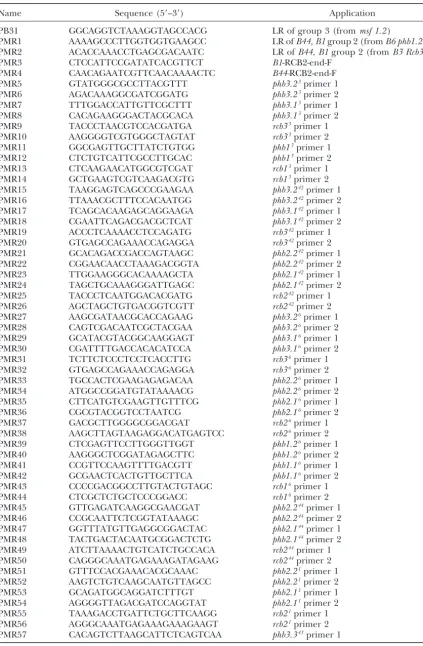
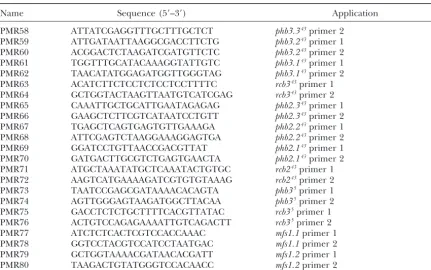
listed in Table 1 to amplify the appropriate sequences.
Plasmid and PCR strategies:Routine cloning was in pBlue-C. cinereusstrains and growth conditions:We have continued
to use the name C. cinereus in this report since this is the script II, pBC SK⫹, Litmus 28, and plasmid amplification was in Escherichia coli strain DH5␣. To amplify pheromone and name by which this model species is best known, but recent
polymer-PB31 GGCAGGTCTAAAGGTAGCCACG LR of group 3 (frommsf 1.2)
PMR1 AAAAGCCCTTGGTGGTGAAGCC LR ofB44, B1group 2 (fromB6 phb1.2R)
PMR2 ACACCAAACCTGAGCGACAATC LR ofB44, B1group 2 (fromB3 Rcb3F)
PMR3 CTCCATTCCGATATCACGTTCT B1-RCB2-end-F
PMR4 CAACAGAATCGTTCAACAAAACTC B44-RCB2-end-F
PMR5 GTATGGGCGCCTTACGTTT phb3.23primer 1
PMR6 AGACAAAGGCGATCGGATG phb3.23primer 2
PMR7 TTTGGACCATTGTTCGCTTT phb3.13primer 1
PMR8 CACAGAAGGGACTACGCACA phb3.13primer 2
PMR9 TACCCTAACGTCCACGATGA rcb33primer 1
PMR10 AAGGGGTCGTGGGCTAGTAT rcb33primer 2
PMR11 GGCGAGTTGCTTATCTGTGG phb13primer 1
PMR12 CTCTGTCATTCGCCTTGCAC phb13primer 2
PMR13 CTCAAGAACATGGCGTCGAT rcb13primer 1
PMR14 GCTGAAGTCGTCAAGACGTG rcb13primer 2
PMR15 TAAGGAGTCAGCCCGAAGAA phb3.242primer 1
PMR16 TTAAACGCTTTCCACAATGG phb3.242primer 2
PMR17 TCAGCACAAGAGCAGGAAGA phb3.142primer 1
PMR18 CGAATTCAGACGACGCTCAT phb3.142primer 2
PMR19 ACCCTCAAAACCTCCAGATG rcb342primer 1
PMR20 GTGAGCCAGAAACCAGAGGA rcb342primer 2
PMR21 GCACAGACCGACCAGTAAGC phb2.242primer 1
PMR22 CGGAACAACCTAAAGACGGTA phb2.242primer 2
PMR23 TTGGAAGGGCACAAAAGCTA phb2.142primer 1
PMR24 TAGCTGCAAAGGGATTGAGC phb2.142primer 2
PMR25 TACCCTCAATGGACACGATG rcb242primer 1
PMR26 AGCTAGCTGTGACGGTCGTT rcb242primer 2
PMR27 AAGCGATAACGCACCAGAAG phb3.26primer 1
PMR28 CAGTCGACAATCGCTACGAA phb3.26primer 2
PMR29 GCATACGTACGGCAAGGAGT phb3.16primer 1
PMR30 CGATTTTGACCACACATCCA phb3.16primer 2
PMR31 TCTTCTCCCTCCTCACCTTG rcb36primer 1
PMR32 GTGAGCCAGAAACCAGAGGA rcb36primer 2
PMR33 TGCCACTCGAAGAGAGACAA phb2.26primer 1
PMR34 ATGGCCGGATGTATAAAACG phb2.26primer 2
PMR35 CTTCATGTCGAAGTTGTTTCG phb2.16primer 1
PMR36 CGCGTACGGTCCTAATCG phb2.16primer 2
PMR37 GACGCTTGGGGCGGACGAT rcb26primer 1
PMR38 AAGCTTAGTAAGAGGACATGAGTCC rcb26primer 2
PMR39 CTCGAGTTCCTTGGGTTGGT phb1.26primer 1
PMR40 AAGGGCTCGGATAGAGCTTC phb1.26primer 2
PMR41 CCGTTCCAAGTTTTGACGTT phb1.16primer 1
PMR42 GCGAACTCACTGTTGCTTCA phb1.16primer 2
PMR43 CCCCGACGGCCTTGTACTGTAGC rcb16primer 1
PMR44 CTCGCTCTGCTCCCGGACC rcb16primer 2
PMR45 GTTGAGATCAAGGCGAACGAT phb2.244primer 1
PMR46 CCGCAATTCTCGGTATAAAGC phb2.244primer 2
PMR47 GGTTTATGTTGAGGCGGACTAC phb2.144primer 1
PMR48 TACTGACTACAATGCGGACTCTG phb2.144primer 2
PMR49 ATCTTAAAACTGTCATCTGCCACA rcb244primer 1
PMR50 CAGGGCAAATGAGAAAGATAGAAG rcb244primer 2
PMR51 GTTTCCACGAAACACGCAAAC phb2.21primer 1
PMR52 AAGTCTGTCAAGCAATGTTAGCC phb2.21primer 2
PMR53 GCAGATGGCAGGATCTTTGT phb2.11primer 1
PMR54 AGGGGTTAGACGATCCAGGTAT phb2.11primer 2
PMR55 TAAAGACCTGATTCTGCTTCAAGG rcb21primer 1
PMR56 AGGGCAAATGAGAAAGAAAGAAGT rcb21primer 2
PMR57 CACAGTCTTAAGCATTCTCAGTCAA phb3.343primer 1
TABLE 1 (Continued)
Name Sequence (5⬘–3⬘) Application
PMR58 ATTATCGAGGTTTGCTTTGCTCT phb3.343primer 2
PMR59 ATTGATAATTAAGGCGACCTTCTG phb3.243primer 1
PMR60 ACGGACTCTAAGATCGATGTTCTC phb3.243primer 2
PMR61 TGGTTTGCATACAAAGGTATTGTC phb3.143primer 1
PMR62 TAACATATGGAGATGGTTGGGTAG phb3.143primer 2
PMR63 ACATCTTCTCCTCTCCTCCTTTTC rcb343primer 1
PMR64 GCTGGTACTAAGTTAATGTCATCGAG rcb343primer 2
PMR65 CAAATTGCTGCATTGAATAGAGAG phb2.343primer 1
PMR66 GAAGCTCTTCGTCATAATCCTGTT phb2.343primer 2
PMR67 TGAGCTCAGTGAGTGTTGAAAGA phb2.243primer 1
PMR68 ATTCGAGTCTAAGGAAAGGAGTGA phb2.243primer 2
PMR69 GGATCCTGTTAACCGACGTTAT phb2.143primer 1
PMR70 GATGACTTGCGTCTGAGTGAACTA phb2.143primer 2
PMR71 ATGCTAAATATGCTCAAATACTGTGC rcb243primer 1
PMR72 AAGTCATGAAAAGATCGTGTGTAAAG rcb243primer 2
PMR73 TAATCCGAGCGATAAAACACAGTA phb35primer 1
PMR74 AGTTGGGAGTAAGATGGCTTACAA phb35primer 2
PMR75 GACCTCTCTGCTTTTCACGTTATAC rcb35primer 1
PMR76 ACTGTCCAGAGAAAATTGTCAGACTT rcb35primer 2
PMR77 ATCTCTCACTCGTCCACCAAAC mfs1.1primer 1
PMR78 GGTCCTACGTCCATCCTAATGAC mfs1.1primer 2
PMR79 GCTGGTAAAACGATAACACGATT mfs1.2primer 1
PMR80 TAAGACTGTATGGGTCCACAACC mfs1.2primer 2
ase or the TaqPlus Precision PCR system (Stratagene). Oligo- for peptide analysis or HKY (Hasegawaet al.1985) for nucleic nucleotides were synthesized to order by GIBCO (Gaithers- acids. Outgroup peptides composed S. cerevisiae Ste3p burg, MD), Life Technologies (Paisley, Scotland), or MWG- (P06783) alone or together with proteins from other basidio-BIOTECH AG (Germany). The oligonucleotides used in this mycete species:Ustilago maydisPra1, Pra2 (P31302, P31303); study for PCR amplification are described in Table 1. Schizophyllum commune Bar1, Bbr1, Bbr2 (P87022, P78741,
Bioinformatic tools:Sequence analysis was performed with AF148501); andPleurotus djamorSte3.3 (AAS46748). The C. the Staden package software (v2002.2). Sequence assembly cinereus Rcb26, Rcb36, Rcb142, Rcb242, and Rcb342 have been
was obtained with the programs Pregap4 and Gap4. GPCR- deposited previously (Y11081, Y11080, AF186383, AF186384, encoding sequences were identified by BLASTx searches in AF186385).
the National Center for Biotechnology Information database, Sequence data accession numbers:GenBank accession num-and potential pheromone genes were identified by the signa- bers forC. cinereusgenes are as follows:rcb13AY172107;phb13
ture terminal CaaX motif in predicted open reading frames AY172109;rcb33AY172108;phb3.13AY172110;phb3.23
AY172-(Gene Jockey, Taylor 1996). Introns were predicted by a 111; rcb244AY393904;phb2.244AY393913;phb2.144AY393912;
combination of BLAST search and visual identification of the rcb21 AY393903; phb2.21 AY393911; phb2.11 AY393910; rcb343
conserved splice junctions. Initial multiple alignments of nu- AY393906; phb3.343 AY393919; phb3.243 AY393918; phb3.143
cleotide or protein sequences were performed with ClustalX AY393917;rcb243AY393905;phb2.343AY393916;phb2.243
AY393-1.81 (Thompsonet al.1994), with the following default align- 915;phb2.143AY393914;phb35AY393920;rcb35AY393907;rcb347
ment parameters: Gonnet series protein weight matrix, 10 gap AY393909; phb3.347 AY393925; phb3.247 AY393924; phb3.147
opening, and 0.20 gap extension. Alignments were manually AY393923; rcb345AY393908; phb3.245AY393922; and phb3.145
edited with the Sequence Alignment Editor Se-Al (v2.0a11; AY393921. The peptide multiple sequence file used in phylo-Rambaut, A; http://evolve.zoo.ox.ac.uk/) and formatted in genetic analyses is available as the EMBL-Align database
acces-MacBoxshade. sion ALIGN000818.
Phylogeny analysis:Multiple sequence alignments were pro-duced using ClustalW (Thompsonet al.1994) or ALIEN via the Multiple Alignment General Interface (MAGI) at the UK
RESULTS Human Genome Mapping Project Bioinformatics Resource
Centre (HGMP-RC;Rysavyet al.1992). Peptide alignments
Identifying allelic variation in uncharacterizedBloci: were optimized through MAGI using RASCAL (Thompsonet
We have previously characterized three variants of the al.2003). Resulting GPCR genomic DNA and peptide data sets
Blocus,B3, B6, andB42(O’Sheaet al.1998;Halsall
were evaluated by a range of phylogeny algorithms: “distance”
using the Phylogeny Interface Environment at HGMP-RC and et al. 2000; Milner 2000), each of which derives its DNAdist or PROTdist (Felsenstein1993); “parsimony” using unique specificity from a particular combination of al-PAUP* (v 4.0b10; Swofford 2000); and “maximum
likeli-leles of three tandemly arranged groups of genes, which hood” using TreePuzzle (v5.0;Schmidtet al.2000) at
HGMP-we refer to as groups 1, 2, and 3. This organization is RC with quartet puzzling (Strimmer and Von Haeseler
Figure 1.—Allele constitution of 13Bmating specificities ofC. cinereus. The different alleles of the three groups of genes together with allele-specific flanking sequences are differ-entiated by color. Pheromone genes are represented by short boxes and receptor genes by long boxes.mfs1.1 andmfs1.2are alternative alleles of a conserved gene flanking theBlocus. Arrows indicate the direction of pher-omone and receptor gene transcrip-tion.
are compared with 10 other loci that we have character- were used to confirm our previous data and to screen the new strains for homoalleles of genes inB3, B6, and ized in this study. We found thatB6andB42are
homo-allelic for the group 1 genes andB3andB42are homo- B42(Table 2). Also we performed PCR on a panel of genomic DNAs derived from all strains using primers allelic for the group 2 genes, and all three loci are
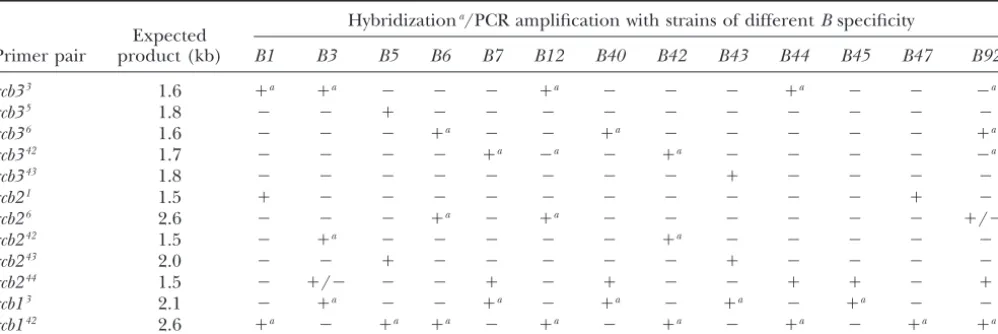
heteroallelic for group 3 genes. Importantly, we found designed to amplify known receptor genes. Where prod-uct of expected length was obtained, end sequencing that sequence variation between alleles and the
se-quences within which the genes are embedded is such confirmed correct allele assignment (Table 2). As new alleles were identified by DNA sequencing (rcb2 from that they failed to cross-hybridize in Southern analyses.
Positive hybridization has thus been used to identify B1, B43, and B44 and rcb3 from B43, B45, and B47), Southern analyses and PCR/end sequencing were used homoalleles in uncharacterized B loci. This approach
was used for a preliminary analysis of six strains in our to identify other loci that shared them.
Each group of genes comprises a receptor gene and collection that exhibited differentBmating specificities
(B1,B5, B40, B41, B43, andB44) and identified shared one to three pheromone genes and we have adopted
the following conventions to assign designations. The alleles in all of them (Halsallet al.2000). This screen
indicated that there were likely to be only two alleles of receptor genes are designatedrcb1, rcb2, orrcb3, which indicates that they derive from group 1, group 2, and the group 1 genes, both of which we had sequenced.
Since classical population studies had predicted that group 3, respectively. Pheromone genes are similarly designated phb1, phb2, andphb3to indicate the group, there are some 79 different B mating specificities in
nature, we assumed that there must be many more al- followed by 1, 2, or 3 to distinguish the individual gene (see Figure 2). All genes are given a superscript number leles of group 2 and group 3 genes.
In this study we set out to identify more of the se- to indicate the B specificity from which they were iso-lated.
quence diversity ofC. cinereus pheromones and
recep-tors by completing the analysis of the six partially charac- Group 1 contains the minimum allelic diversity with only two alleles:The Southern analyses summarized in terized strains described byHalsallet al.(2000) and
by acquiring five new strains from Japan and the United Table 2 clearly indicated that there were only two allelic variants of the group 1 genes in the 13 genomic DNAs Kingdom that exhibited otherBspecificities (B7, B12,
45, B47, and B92) and potentially had new B alleles. tested. Primers designed torcb13amplified a fragment
with the expected sequence fromB3, B7,B40, B43, and The designation of the B mating specificity has been
arbitrary in different wild collections so we confirmed B45and primers designed torcb16amplified a fragment with the expected sequence fromB1,B5, B12, B42,B44,
differences by mating tests with our standard strains.
In doing this, we noted that, contrary to our previous B47, andB92. Hence among the strains that we have looked at, group 1, with just two alleles, contains the classification,B40andB41have the same specificity, so
we eliminatedB41 from this current analysis. We have minimum allelic diversity possible.
TABLE 2
PCR and Southern blot analyses used to identify sharedrcballeles in 13 strains ofC. cinereuswith differentBspecificities
Hybridizationa/PCR amplification with strains of differentBspecificity
Expected
Primer pair product (kb) B1 B3 B5 B6 B7 B12 B40 B42 B43 B44 B45 B47 B92
rcb33 1.6 ⫹a ⫹a ⫺ ⫺ ⫺ ⫹a ⫺ ⫺ ⫺ ⫹a ⫺ ⫺ ⫺a
rcb35 1.8 ⫺ ⫺ ⫹ ⫺ ⫺ ⫺ ⫺ ⫺ ⫺ ⫺ ⫺ ⫺ ⫺
rcb36 1.6 ⫺ ⫺ ⫺ ⫹a ⫺ ⫺ ⫹a ⫺ ⫺ ⫺ ⫺ ⫺ ⫹a
rcb342 1.7 ⫺ ⫺ ⫺ ⫺ ⫹a ⫺a ⫺ ⫹a ⫺ ⫺ ⫺ ⫺ ⫺a
rcb343 1.8 ⫺ ⫺ ⫺ ⫺ ⫺ ⫺ ⫺ ⫺ ⫹ ⫺ ⫺ ⫺ ⫺
rcb21 1.5 ⫹ ⫺ ⫺ ⫺ ⫺ ⫺ ⫺ ⫺ ⫺ ⫺ ⫺ ⫹ ⫺
rcb26 2.6 ⫺ ⫺ ⫺ ⫹a ⫺ ⫹a ⫺ ⫺ ⫺ ⫺ ⫺ ⫺ ⫹/⫺a
rcb242 1.5 ⫺ ⫹a ⫺ ⫺ ⫺ ⫺ ⫺ ⫹a ⫺ ⫺ ⫺ ⫺ ⫺
rcb243 2.0 ⫺ ⫺ ⫹ ⫺ ⫺ ⫺ ⫺ ⫺ ⫹ ⫺ ⫺ ⫺ ⫺
rcb244 1.5 ⫺ ⫹/⫺ ⫺ ⫺ ⫹ ⫺ ⫹ ⫺ ⫺ ⫹ ⫹ ⫺ ⫹
rcb13 2.1 ⫺ ⫹a ⫺ ⫺ ⫹a ⫺ ⫹a ⫺ ⫹a ⫺ ⫹a ⫺ ⫺
rcb142 2.6 ⫹a ⫺ ⫹a ⫹a ⫺ ⫹a ⫺ ⫹a ⫺ ⫹a ⫺ ⫹a ⫹a
⫹, PCR amplification of a fragment of expected size confirmed asrcbby end sequencing; ⫺, no PCR amplification; ⫹/⫺, PCR amplification of a fragment of expected size but confirmed as notrcbby end sequencing.
aHybridization in Southern blot analyses.
analysis identified two group 2 alleles and three group designed primers to the group 2 sequence close to the group 3/group 2 boundary (from pheromone or recep-3 alleles. Southern analysis and PCR/end sequencing
unambiguously identified the homoallele ofrcb26in
B12 tor, depending on the orientation) and to the mfs-1
gene that flanks theBlocus, which encodes a member of andrcb242in
B3. In the analysis of group 3, the primers
designed to rcb33 amplified additional products to the the major facilitator superfamily of putative membrane transporters. Two alleles of the mfs-1 gene encode al-expected 1.6-kb fragment fromB1, B12, andB44
geno-mic DNA but in each case the 1.6-kb fragment was con- most identical proteins but have very different DNA sequences (Halsallet al.2000). By using appropriate firmed as the homoallele of rcb33 by sequencing. Also
Southern data for two of the new strains were ambiguous primers we were able to show which allele was present in each of our 13 strains and to design primers accordingly. with respect to the group 3 alleles present inB12and
B92 since hybridization was to more than one probe We amplified fragments of 9.5 and 7.5 kb, respec-tively, fromB1andB44and, by sequencing, identified (Table 2). The reasons for this were unclear but could
relate to some of the normally allele-specific flanking two new group 2 alleles (Figure 2). These each com-prised a receptor gene and two pheromone genes. Prim-sequences included in the probe rather than to the
genes themselves. PCR/end sequencing, however, ers toB1 rcb21identified a homoallele inB47, whereas primers toB44 rcb244identified homoalleles inB7,B40, showed thatB92contained the homoallele ofrcb36and
B12 contained the homoallele ofrcb33(Table 2). B45, andB92 (Table 2). Using primers designed from the 5⬘-end ofmfs-1.2 and the 3⬘-end ofrcb244or rcb21, To identify new alleles of group 2 and group 3 genes,
we adopted two cloning strategies; the first is a strategy we amplified a 6.85-kb fragment fromB45and a 7.44-kb fragment from B47, respectively, and sequencing based on LR-PCR that we had previously shown to be
able to isolate long fragments spanning just a single identified new group 3 alleles in both. We were able to characterize the remaining unidentified alleles, the group of unknown genes (Halsallet al.2000) and the
second is isolation of clones from cosmid libraries. Once group 2 and group 3 alleles from B5 and B43, by se-quencing clones containing the entire B5or B43 loci a new allele was identified, the PCR/end sequencing
technique was used to test whether homoalleles of this isolated from cosmid libraries (see materials and
methods). Both loci were homoallelic for the group 2
new allele were present in any of the other partially
uncharacterizedBloci. genes but had different alleles of the group 3 genes. Figure 2 summarizes the new sequences obtained in LR-PCR was used to amplify the group 2 genes ofB1
and B44 since their group 1 and group 3 genes were this study, which are indicated by the restriction maps above the diagram of the genes.
homoallelic to known alleles. To minimize the size of
the fragment to be amplified, primers were designed Our completed analysis of 13Bspecificities identified five alleles of the group 2 genes, seven alleles of the to the group 1 pheromone genephb1.2, which is close
to the group 1/group 2 boundary, and to the 3⬘-end of group 3 genes, and two alleles of the group 1 genes. The allele combinations found in the 13Bspecificities the group 3rcb33receptor, which is close to the group
Figure 2.—Identification of new group 3 and group 2 alleles. New alleles of the group 2 and group 3 genes at the B mating-type locus ofC. cinereusare differ-entiated by colors; previously se-quenced genes are presented in black and white motifs. Restriction sites are represented by A,AflII; B,BamHI; E,EcoRI; K,KpnI; N, NcoI; Nd, NdeI; Nt, NotI; and S, SacI.
the three groups of genes are indeed functionally inde- three subgroups of receptor genes have evolved inde-pendently: this is key to understanding how receptor/ pendent and that all allele combinations can be
gener-ated in nature, this level of allelic variation is sufficient pheromone specificity is determined. Are the members of each group derived from an early duplication event to generate 70 uniqueBmating specificities.
The number of pheromone genes within any one with subsequent diversification giving rise to subfamilies of closely related genes and proteins, or has there been group ranges from one to three (Figure 1), far fewer
than found in the corresponding groups in the only shuffling of genes between groups with appropriate se-quence changes occurring to enable group specificity? other mushroom species for which data are available,
S. commune, where there may be as many as eight We have approached this question by comparing the
predicted amino acid sequences of the receptors. Table
(Fowler et al. 2004). The orientations of the genes
differ from one allele to another. Remarkably,phb3.247 3 gives the percentage identity (top half of table) and similarity (bottom half of table) of the proteins. Se-is identical in sequence to phb3.343. We checked the
promoter region and could find no differences in se- quence identity ranges from 18 to 81% and, signifi-cantly, we see this range between proteins within the quence that would indicate that it is a pseudogene in
either background. This is the only instance where we same group as well as between proteins in different groups. Although six very similar proteins are encoded have found different alleles containing identical genes.
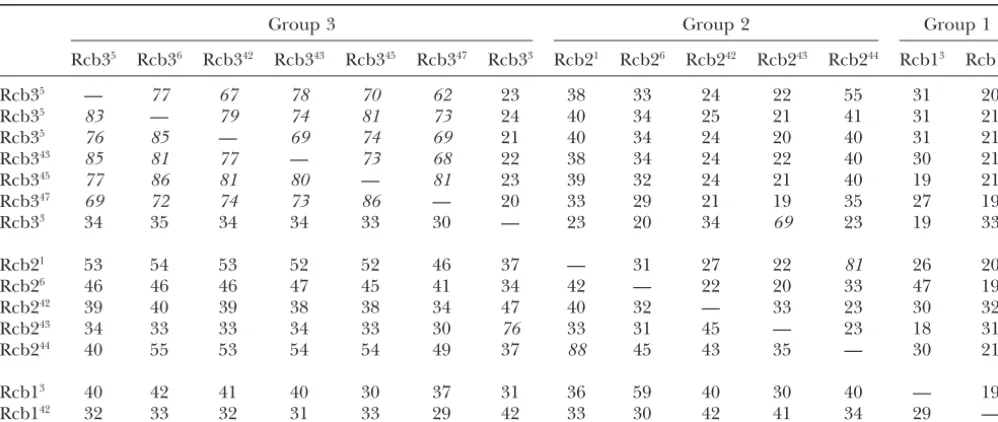
Receptors within the three groups have a complex by the group 3 alleles present inB5, B6,B42, B43,B45, andB47, all having⬎60% identity with each other, these origin:A question of considerable interest with respect
TABLE 3
Comparison of group 1, group 2, and group 3 receptor protein sequences
Group 3 Group 2 Group 1
Rcb35 Rcb36 Rcb342 Rcb343 Rcb345 Rcb347 Rcb33 Rcb21 Rcb26 Rcb242 Rcb243 Rcb244 Rcb13 Rcb142
Rcb35 — 77 67 78 70 62 23 38 33 24 22 55 31 20
Rcb35 83 — 79 74 81 73 24 40 34 25 21 41 31 21
Rcb35 76 85 — 69 74 69 21 40 34 24 20 40 31 21
Rcb343 85 81 77 — 73 68 22 38 34 24 22 40 30 21
Rcb345 77 86 81 80 — 81 23 39 32 24 21 40 19 21
Rcb347 69 72 74 73 86 — 20 33 29 21 19 35 27 19
Rcb33 34 35 34 34 33 30 — 23 20 34 69 23 19 33
Rcb21 53 54 53 52 52 46 37 — 31 27 22 81 26 20
Rcb26 46 46 46 47 45 41 34 42 — 22 20 33 47 19
Rcb242 39 40 39 38 38 34 47 40 32 — 33 23 30 32
Rcb243 34 33 33 34 33 30 76 33 31 45 — 23 18 31
Rcb244 40 55 53 54 54 49 37 88 45 43 35 — 30 21
Rcb13 40 42 41 40 30 37 31 36 59 40 30 40 — 19
Rcb142 32 33 32 31 33 29 42 33 30 42 41 34 29 —
Matrix summarizes percentage identity (upper diagonal) and percentage similarity (lower diagonal). Matrix diagonals are separated by dashes. Values⬎60% are shown in italics.
group present inB3. This latter receptor is most similar functionally different by their position within theBlocus can be found in each of the two major clusters seen in in sequence to a group 2 receptor present inB43, the
two sharing 68% identity. Of the five group 2 receptors, the phylogenetic tree. Although there is obviously a common origin for six of the group 3 receptor genes only two, found in B1 and B44, show ⬎45% identity.
The two group 1 receptors are also very dissimilar, only in cluster IIb, reflected by the similar amino acid se-quences of their predicted proteins, the third member 18% identity, and each resembles more closely receptors
in the other groups. of this subfamily, Rcb33, is found in cluster I, and its predicted protein most closely resembles receptors in The phylogenetic analysis (presented in Figure 3),
strongly supported by all tree-building algorithms (dis- group 1 and group 2. We conclude, therefore, that gene shuffling has played a major role in the evolution of tance, parsimony, and maximum likelihood), revealed
two major clusters that were distinct from the basal the present functional groups. Although only three S.
commune receptors were used in this analysis, it would
outgroup species (S. cerevisaeSte3p,U. maydisPra1 and
Pra2). Four of theC. cinereusreceptors (Rcb243, Rcb33, appear that similar events have occurred in the evolu-tion of theB␣ andBfamilies. AvailableB␣receptor Rcb242, Rcb142) group in cluster I, together with the
orthologousS. communeBbr1 (B) andP. djamorSte3.3 sequences are very similar and group together in any phylogenetic analysis (Jameset al.2004) and thus resem-proteins, whereas the other 10 C. cinereus receptors
group in cluster II, together withS. communeBar1 (B␣) ble the subgroup of similar Rcb3 proteins found inC. cinereus, but the twoBproteins are found in different and Bbr2 (B) proteins. These two major clusters and
their subgroups proved robust, independent of basidio- clusters with Bbr2 being much closer in sequence to theB␣proteins.
mycete outgroup inclusion, and were revealed by all
analyses. Four C. cinereussubgroups were also evident: Predicted pheromone sequences:We have identified and sequenced 17 new pheromone genes, which, to-Ia (Rcb243, Rcb33; 99% support), IIa (Rcb244, Rcb21;
99%), IIb (Rcb35, Rcb342, Rcb343, Rcb36, Rcb347, Rcb345; gether with those described previously, constitute 29 sequences: 3 from group 1, 11 from group 2, and 14 99%), and IIc (Rcb26, Rcb13; 73%). These phylogenetic
subgroups were also evident in gDNA tree topologies from group 3 (Figure 4). The new genes were identified by searching for open reading frames adjacent to recep-(data not presented).
Our analysis suggests that an early duplication and tors with the characteristic C-terminal CaaX motif. The full precursor sequences are compared in Figure 4 and diversification of the progenitor of theC. cinereusfamily
resulted in at least two evolutionary groups. Two major are arranged according to the group from which the alleles derive. There is considerable length variation of clusters and four subgroups indicate that the paralogous
C. cinereus rcbgenes are polyphyletic and diverge through the precursors, ranging from 48 to 85 amino acids, but
in all we see a conserved two-residue charged motif several lineages. Significantly, members of all three of
Figure 3.—Quartet puzzling tree with maximum-likelihood branch lengths forC. cinereus re-ceptor proteins. Branch lengths were calculated using the JTT model for substitution with uni-form rate heterogeneity (log L, ⫺17850.83). Bar indicates the number of substitutions per site. Branch support values (percent-ages) for 25,000 puzzling steps are shown in italics. Nominated out-group wasS. cerevisiaeSte3p.
others), which we previously predicted to be at the tion to the conserved dipeptide, a proline that is often present at position⫺4 and/or an aspartate/asparagine amino terminus of the mature peptide pheromone
(Casselton and Olesnicky 1998; Olesnicky et al. at position⫺2 relative to the putative cleavage site
(Fig-ure 4). 1999). In Figure 4 the predicted mature pheromone
sequences are shown in larger type and range in length The pheromone-receptor interaction is highly spe-cific because it ensures that B-regulated development from 12 to 15 amino acids.
The amino-terminal regions of the pheromone pre- can be activated only by the complement brought to-gether by compatible mating partners. We have assumed cursors that are removed during maturation are highly
divergent even when the mature peptide sequence is that the genes within each of the three groups at theB
locus are functionally independent (O’Sheaet al.1998; identical, as in the case of the two group 2 pheromones
present inB1, Phb2.11 and Phb2.21. Hence alignment Halsallet al.2000); thus we predict that pheromones must be able to distinguish among the different recep-is not greatly informative of pheromone origin except
in the case of Phb3.247and Phb3.343, which apparently tors encoded by alleles within the same group as well as those encoded by genes in other groups. We have derive from a recent shuffling event. The processing
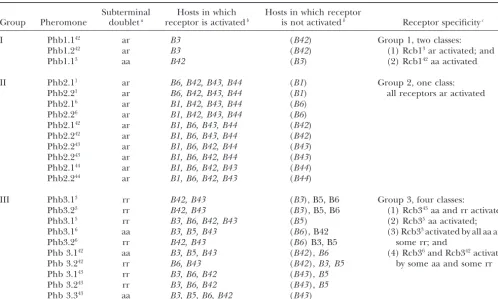
addi-Figure4.—Alignment of pheromone precursor sequences. The conserved ER/ED/ QR doublet considered to be at the N terminus of the mature pheromone is in boldface type as is a doublet of amino acids preceding the terminal cysteine residue. The C-terminal CaaX motif is underlined and the amino acids removed by C-terminal processing are shown in smaller type. Sequences obtained fromO’Sheaet al. (1998),Halsallet al.(2000), andMilner(2002) are indicated by (*). Pheromones are classified according to the pair of amino acids found at positions⫺1 and⫺2 with respect to the carboxy-terminal cysteine residue (the subterminal doublet); rr, both are aromatic; ar, an aliphatic and aromatic pair; aa, both are aliphatic.
indicated that the subterminal doublet adjacent to the alleles of the group 1 genes encode pheromones that are quite unrelated to each other; Phb1.142and Phb1.242 C-terminal cysteine residue plays a role in specificity
determination; by reversing the order of these two resemble group 2 pheromones in having the aliphatic/ aromatic AF C-terminal doublet whereas Phb1.13 resem-amino acids we were able to switch the allele specificity
of a group 3 pheromone (Olesnickyet al.1999). More- bles a group 3 pheromone in having a TA aliphatic/ aliphatic doublet. The C-terminal doublet cannot be an over, the identity of the subterminal doublet in the
pheromones ofS. communewas one of the defining fea- indicator of group specificity for these three phero-mones but more likely reflects the fact that the receptors tures in the grouping presented byFowleret al.(2004).
In C. cinereus, as in S. commune, this doublet is often that they activate have a common origin with those in
either group 2 or group 3, respectively. common between several pheromones within the same
group, so it cannot be the only determinant of allelic Functional analysis of pheromone specificity: In S.
commune, aB-null stain in which the entireB␣andB
specificity but could have a more critical role in
de-termining group specificity. As can be seen in Table 4, gene complexes have been deleted by mutation has been identified (Fowler et al. 2001), enabling single group 2 pheromones represent a homogenous group
in which the C-terminal doublet is always an aliphatic/ pairs of receptors and pheromones to be testedin vivo
for compatibility. Unfortunately, no such B-null strain aromatic (ar) pair and, in all but two instances, this is AF.
Group 3 pheromones fall into two distinct subgroups; exists inC. cinereus; instead, compatibility can be tested only in host strains of known receptor constitution. To all seven alleles encode pheromones with a C-terminal
aromatic (rr) pair (FW, WF, or WW), but four of the do this, pheromone genes were amplified by PCR and introduced into hosts of different specificity by cotrans-alleles also encode a quite different pheromone with
iso-Group Pheromone doubleta receptor is activatedb is not activatedb Receptor specificityc
I Phb1.142 ar B3 (B42) Group 1, two classes:
Phb1.242 ar B3 (B42) (1) Rcb13ar activated; and
Phb1.13 aa B42 (B3) (2) Rcb142aa activated
II Phb2.11 ar B6, B42, B43, B44 (B1) Group 2, one class:
Phb2.21 ar B6, B42, B43, B44 (B1) all receptors ar activated
Phb2.16 ar B1, B42, B43, B44 (B6)
Phb2.26 ar B1, B42, B43, B44 (B6)
Phb2.142 ar B1, B6, B43, B44 (B42)
Phb2.242 ar B1, B6, B43, B44 (B42)
Phb2.243 ar B1, B6, B42, B44 (B43)
Phb2.243 ar B1, B6, B42, B44 (B43)
Phb2.144 ar B1, B6, B42, B43 (B44)
Phb2.244 ar B1, B6, B42, B43 (B44)
III Phb3.13 rr B42, B43 (B3), B5, B6 Group 3, four classes:
Phb3.23 rr B42, B43 (B3), B5, B6 (1) Rcb343aa and rr activated;
Phb3.15 rr B3, B6, B42, B43 (B5) (2) Rcb35aa activated;
Phb3.16 aa B3, B5, B43 (B6), B42 (3) Rcb33activated by all aa and
Phb3.26 rr B42, B43 (B6) B3, B5 some rr; and
Phb 3.142 aa B3, B5, B43 (B42),B6 (4) Rcb36and Rcb342activated
Phb 3.242 rr B6, B43 (B42),B3, B5 by some aa and some rr
Phb 3.143 rr B3, B6, B42 (B43),B5
Phb 3.243 rr B3, B6, B42 (B43),B5
Phb 3.343 aa B3, B5, B6, B42 (B43)
aPheromones are classified on the basis of a subterminal doublet comprising an aliphatic amino acid pair (aa), an aromatic
amino acid pair (rr), or an aliphatic aromatic pair (ar).
bPheromone genes were tested by transformation for ability to activate the pheromone response in hosts with different allelic
versions of the receptor genes.Bspecificities in parentheses are the self-hosts from which the pheromone gene was isolated.
cReceptors are classified according to the subterminal doublet of the pheromone that activates them. It is assumed that
receptors can be activated only by pheromones from the same group.
lated and crossed to tester strains carrying the sameB on the basis of their aa or aromatic (rr) subterminal doublets, since these residues are known from mutagen-specificity as the transformation host and different A
specificity. When the pheromone activated a compatible esis to determine receptor specificity in at least one case
(Olesnickyet al.1999). We were therefore interested
receptor in the host, this resulted in a successful mating
as indicated by formation of a dikaryon (seematerials to observe whether group 3 receptors fell into classes according to whether they interacted with aa or with
and methods). We performed this analysis for a range
of pheromones, introducing them into host strains that rr pheromones. Again following the assumption that pheromones activate only same-class receptors, our contained receptors that we predicted they would
acti-vate. All the group 2 pheromones activated mating in transformation suggested this was true only for Rcb35, which was activated only by aa pheromones. The other the non-self hosts tested; therefore, on the basis of the
assumption that pheromones activate only receptors group 3 specificities tested were activated by both aa and rr pheromones.
within the same group, all group 2 pheromones can activate all non-self group 2 receptors. In contrast, sev-eral group 3 pheromones failed to activate mating in
DISCUSSION non-self hosts but, in all but one of the cases tested, the
full allelic complement of pheromones was sufficient to Organization of the B locus: In this study we have made a molecular analysis of 10 previously uncharacter-activate the other specificity; for example, Phb3.242fails
to activate B3 and B5 but activates B6, and Phb3.142 ized loci ofC. cinereus that confer different B mating specificities. The organization of each locus is similar activatesB3andB5but notB6. This resembles the
situa-tion inS. communewhere pheromones activate only sub- with three groups of multiallelic genes encoding a pher-omone receptor and one to three pherpher-omones. Our sets of non-self receptors (seeFowleret al.2004). Above
phero-mones that we have identified, are consistent with these ficities. Early attempts to detect recombination between
Bgenes ofC. cinereuswere unsuccessful (Haylock1978; three groups of genes being functionally independent,
such that pheromones activate only receptors within the P. Day, personal communication) but these experi-ments were carried out withB5 andB6 strains, which same group.
The complexity of the homobasidiomycete B locus share group 1 genes, making recombination undetect-able, and between B3and B6 strains, which share no and the role of functionally redundant genes in
generat-ing large numbers of matgenerat-ing specificities was first evi- genes, making recombination impossible.
Evolution of the complexBlocus:The homobasidio-dent from classical recombination studies with the
mushroom S. commune. Here it was found that the B mycetes are unique among fungi in having evolved large families of receptors and pheromones for mate recogni-genes resided at two closely linked loci designated B␣
andB(seeRaper1966). Nine different alleles of each tion. Although the pheromones and receptors play a
similar role in mating-type determination in hemi-basid-locus were identified in world samples, sufficient to
gen-erate 81 unique ␣ combinations and thus B mating iomycetes such asU. maydis, there are only two versions of the corresponding mating-type locus. Pheromone sig-specificities in nature (Raper et al. 1960; Parag and
Koltin1971;StambergandKoltin1973). In fact the naling is essential for mate chemoattraction and
recog-nition and induces the formation of mating filaments number is⬍81 because not all␣combinations can be
generated by recombination (KoltinandRaper1967; that promote compatible cell fusions. After cell fusion, as in homobasidiomycetes, pheromone signaling
con-Fowleret al.2004). Each locus contains a pheromone
receptor and from three to eight pheromone genes tinues to be important for maintenance of the dikaryo-phase (Hartmannet al.1996;Urbanet al.1996;Mu¨ ller
(Wendland et al. 1995; Vaillancourt et al. 1997;
Fowleret al.2001, 2004); thus each locus is equivalent et al.2003). Without mate attraction, it is obviously
ad-vantageous in homobasidiomycetes to have large num-to one of the three groups of genes at theBlocus ofC.
cinereus. The complexBlocus ofC. cinereusis essentially bers of mating types to increase the chances of a random
hyphal fusion leading to dikaryosis and sexual reproduc-equivalent to three tightly linked loci that have no
ho-mologous sequences separating them. During evolu- tion. Twenty mating specificities for each of Aand B
would be sufficient for 90% outbreeding potential in tion, however, these groups of genes have been
recom-bined to generate different allele combinations that the population (Koltinet al.1972). Remarkably, gene diversification and locus duplication have led to far generate the differentBmating specificities in the
popu-lation. By having three groups of functionally redundant higher numbers than these, and in many homobasidio-mycetes outbreeding potential approaches 100%. genes rather than two, large numbers of specificities
can be generated from relatively few alleles.C. cinereus Our phylogeny analysis based on receptor sequence suggests a complex origin for the three groups of C.
and S. commune have predicted similar numbers of B
mating specificities, but preliminary studies onP. djamor cinereusreceptor genes and their cognate pheromones.
TheC. cinereus genes can be separated into two major
suggest that this fungus may have as many as 231. Like
C. cinereus,P. djamorhas three groups ofBgenes and, clusters indicative of an early duplication of an ancestral
gene and subsequent sequence diversification.
Signifi-likeS. commune, on the basis of recombination analysis
at least two reside at separable loci (Jameset al.2004). cantly, each cluster contains representative members of all three groups of genes, indicating that they have not In total we have identified seven alleles of the group
3 genes, five alleles of the group 2 genes, and two alleles evolved independently and that recombination events have moved receptors of different lineage between of the group 1 genes, sufficient to generate 70 of the
79 predicted specificities. There may be more alleles in groups. To maintain group specificity, this would have required sequence changes that prevented a receptor the wild that remain to be identified. C. cinereus is a
saprophytic fungus of horse dung and our finding of from being activated by pheromones from another group and from acquiring responsiveness to phero-so many shared alleles in strains iphero-solated from widely
separate locations such as England and Japan may be mones within the new group.Fowleret al.(2001) have proposed a simple mutation model for the generation attributed to the movement of domesticated animals, a
point made byMayet al.(1999) when analyzingAlocus of new receptor specificities and Kothe et al. (2003) have proposed that they arise by recombination. What-variation.
Although we can detect no homologous sequence ever the origin, there has been subsequent strong selec-tion for sequence diversificaselec-tion because the integrity that would permit recombination between the groups
of genes, recombination within the B locus may play of theBlocus is maintained by the very dissimilar DNA sequences of both homologous and paralogous genes some role in maintaining variability in nature. Where
twoBloci share alleles of the group 2 genes, as in the and the sequences within which they are embedded. The sequence identity between receptors ranges be-case of B3 and B42 or B44 and B45 (Figure 1), this
shared sequence of some 7 kb would permit a low fre- tween 18 and 81%, and this similarity is unlinked to pheromone specificity; for example, Rcb26 and Rcb243 quency of recombination of different group 1 and group
non-cation of the whole receptor sequence and is consistent ring ability of phb2.342to activate Rcb36.Fowleret al. (2004) similarly compared mature sequences of twoS.
with only a small group of residues in the receptor
forming the pocket of interaction with the pheromone. communepheromones, Bbp2(7) and Bbp2(4), which dif-fer at the same positions (⫺4 and⫺6) but which activate The selective pressure on the remainder of the receptor
is presumably to maintain overall signaling function (3D different receptors (3 and 9, or ␣8 and , respec-tively). The authors showed by mutagenesis that the structure, interaction with G-protein, etc.), and
there-fore the similarity between receptors can be related amino acid at position⫺4 confers this receptor selectiv-ity, being aliphatic [glycine in Bbp2(7)] or aromatic to time since diversification from a common ancestor.
There is a striking pattern of receptors with⬎60% iden- [phenylalanine in Bbp2(4)]. The twoC. cinereus phero-mones at position⫺4 also have either aliphatic or aro-tity, which presumably derives from the most recent
duplication events. Group 3 shows evidence of recent matic residues: proline in Phb3.23 and leucine in Phb3.242. This is an important observation, because it expansion, with six of seven receptors⬎60% identical.
In contrast, receptors of groups 1 and 2 are ⬍40% suggests that pheromone identity might be encoded at common positions in the mature sequence and by identical with the exception of Rcb21and Rcb244(81%
identical). Rcb243is characterized by similarity to Rcb33, common mechanisms often involving aromatic residues across the homobasidiomycete family. Other examples perhaps as a result of the most recent intergroup
gene-shuffling event. are Phb2.143and Phb2.242, which differ at only a single position (⫺7, alanine and serine, respectively) but dis-Pheromone specificity determinants—multiple
se-quence positions within mature pheromones dictate re- criminate appropriately between Rcb242and Rcb243. The sequence information on this large and interdependent ceptor specificity:Our working model for the structural
basis of pheromone-receptor interaction is that all are family of receptors and ligands, combined with the spec-ificity relationships that we have presented in this study, variations on a theme, having in common a primary
mode of interaction that involves recognition of struc- will be a powerful resource in combination with future modeling and mutagenesis studies in elucidating the tural features common to all pheromones. These may be
obvious, such as the ER motif or the terminal modified molecular details of the receptor-ligand interaction. Many of our conclusions about receptor/pheromone cysteine, or may be secondary structural features not
immediately apparent from the primary sequence. This specificity depend on the assumption of functional inde-pendence of the groups,i.e., that pheromones activate idea is supported by the relatedness of all the receptors
to Ste3p ofS. cerevisiaeand by observed common features only receptors in the same group. However,Fowleret al.(2004) have recently shown that in particular speci-within the pheromones. In addition, we envisage a
sec-ondary recognition process, involving residues pre- ficities ofS. commune, pheromones fromBcan activate receptors in the other group,B␣. To prevent recombi-sented by the primary interaction into a variable binding
site within the receptor that is able to differentiate nation from generating self-compatible receptor/pher-omone combinations in the same haploid individual, amino acids at multiple different positions of the
phero-mone. This may define whether the pheromone is able theB␣-Bintervening region is short and contains se-quence features that prevent homologous recombina-to bind or, alternatively, whether binding and activation
of the receptor may be separable;i.e., there may be a tion. If the analogous situation occurs in C. cinereus, presumably in one of the combinations of group 2 and wide spectrum of pheromones able to bind a receptor,
only a subset of which activates it. Whether pheromones 3 that does not occur in any of the strains analyzed (it seems even less likely to be true for group 1 with only are able to bind but not activate receptors has not been
tested so far. two alleles), this would complicate the interpretation of pheromone/receptor specificity from the transforma-Multiple positions within mature pheromone
se-quences are likely to dictate receptor specificity. The tion analyses. We believe this situation in C. cinereusis less likely due to the smaller number of pheromones data presented in this study and elsewhere are consistent
with this conclusion (Olesnicky et al. 1999, 2000; associated with each receptor. In S. commune, phero-mones have evolved to have limited range of activity
Fowleret al.2001;GolaandKothe(2003). We
pre-viously highlighted Phb3.242, which contains the se- toward different receptors, whereas inC. cinereus, there appears to have been greater selection for cross-speci-quence WF as the subterminal doublet (i.e., positions
⫺1 and⫺2 relative to the terminal cysteine) (Brown ficity in each group, to maximize potential for non-self recognition. In the only example inS. communewhere
and Casselton 2001). The specificity of this
phero-mone can be switched to be similar to Phb3.26 (i.e., the sequences of the cross-group receptors are known, Bar8 and Bbr1, these show 88% identity (Fowleret al.
able to activate Rcb36) by mutagenesis, reversing the