Predicting network effectiveness?
An analysis of local collaborative networks to prevent and counter radicalization
University of Twente
Faculty of Behavioural, Management and Social Sciences
MSc. Public Administration
Public Safety
2
Mike Kuipers
S1756648
Submitted in partial fulfillment of the requirements for the degree of Master of Science,
program Public Administration, University of Twente
2017
Supervisors:
Dr. M. R. R. (Ringo) Ossewaarde, Department of Public Administration
3
Abstract
This project offers new insights in the understanding of network effectiveness, especially with regard to the applicability and appropriateness of existing literature. Extended case method is used to the study network effectiveness as it examines theories in order to understand what to expect and thereby it seeks to build on existing theory. Policy documents and guidelines were the basis for examining the approaches that were taken by the three local collaborative networks that seek to prevent and counter radicalization. Additional semi-structured interviews provided in-depth understanding in the functioning of, and the services provided by, the collaborative networks. Besides focusing on the contextual-, structural- and functional characteristics of the collaborative networks, this thesis assesses the comprehensiveness of the services provided. This thesis observed that the theory was limited appropriate for the concerned collaborative networks, which resulted in certain side notes that have to be considered prior to assessment of network effectiveness. The key message of this thesis is that, even though a comprehensive set of services is provided and the network functions well, the desired effect is not fully achieved. This thesis argues that the capabilities in de-radicalizing an individual are limited, which ought to be considered in the approach taken; preventive supersedes repressive. Network effectiveness is a construct with a plurality of interpretations and features, which has to be explicitly alluded. Collaborative networks could be effective as in efficient, stable and encounter low levels of conflict, yet still achieve low scores on goal attainment. Indicating that effectiveness on the network-level does not guarantee effectiveness on the community-level. This thesis seeks to stimulate research in order to increase goal attainment in the field of radicalization prevention and counter-radicalization as well as additional research on the different dimensions of network effectiveness.
4
List of Abbreviations
AIVD Algemene Inlichtingen- en Veiligheidsdienst General Intelligence and Security Service AZC Asielzoekerscentrum
Asylum center
CBS Centraal Bureau voor de Statistiek Central Bureau of Statistics EC European Commission
EU European Union
ESS Expertise-unit Sociale Stabiliteit Expertise unit Social Stability IS Islamic State
MDO Multi-disciplinair overleg Multi-disciplinary consultation NAO Network Administrative Organization
NCTV Nationaal Coördinator Terrorismebestrijding en Veiligheid National Coordinator for Security and Counterterrorism RAN Radicalization Awareness Network
5
Table of Contents
1 Introduction ... 6
1.1 Background information ... 6
1.2 Research Problem ... 8
1.3 Approach ... 10
2 Theoretic chapter ... 12
2.1 Determinants of Radicalization ... 12
2.2 Networks to Prevent and counter radicalization ... 16
2.3 Network effectiveness ... 17
2.4 Network effectiveness – approaches for assessment ... 21
2.5 Conclusion ... 22
3 Methods ... 24
3.1 Method of data collection ... 24
3.2 Method of data analysis... 25
3.2.1 Counter-radicalization ... 26
3.2.2 Collaborative networks ... 28
3.3 Conclusion ... 30
4 Case selection ... 31
5 Results ... 33
5.1 Network age and friction ... 33
5.2 Stability ... 36
5.3 Resource munificence ... 40
5.4 Structure / integration ... 42
5.5 Mode of governance ... 45
5.6 The comprehensiveness of the local networks and improvements ... 48
6. Conclusion and discussion... 54
References ... 61
Appendices ... 68
Appendix A: Recent terror attacks in EU countries driven by Islamic radicalism ... 68
Appendix B: Overview of the analyzed documents ... 69
6
1 Introduction
This thesis seeks to assess the collaborative networks that are established in order to prevent and counter radicalization and thereby it seeks to add to literature on collaborative network effectiveness. The assessment will be done by examination of existing literature on both radicalization and collaborative networks. There exist many different kinds of radical worldviews, which is not limited to a certain ethnicity or religion. Yet, in this thesis the aim lies on Islamic radicalization and the networks that attempt to prevent and counter radicalization in the Netherlands. The ultimate goal of this thesis is to add to theories on network effectiveness and to provide a conclusion on the assumed effectiveness of the established collaborative networks on the local level.
1.1 Background information
Modern terrorism is not new to European society. Rapoport (2004) argued that we are currently experiencing a fourth wave of modern terrorism, i.e. religious terrorism. The year 1979 is an important year with regard to the events that have led to the appearance of religious motivated international terrorism. Grand Ayatollah, and leader of the Iranian revolution, Ruhollah Khomeini declared that the Middle East should embrace, and unite in, Islam instead of opting for the western capitalists or the eastern communists. In addition, the Soviet Union invaded Afghanistan in 1979, which led to the call for jihad by Abdullah Y. Azziz in order to fight the Soviet invaders. After the Soviet Union was forced to withdraw from Afghanistan, Bin Laden advocated that the jihad should be targeted at enemies both near and far (Graaf, 2016). Al-Qaida was the first terrorist organization that recruited individuals from multiple countries instead of merely one nation (Rapoport, 2004). However, following the Arab Spring and the civil war in Syria, a new terrorist organization arose i.e. the IS. This new organization excelled Al-Qaida on three crucial points as De Graaf (2016) agued, i.e. the proclamation of a Caliphate by Abu Bakr al-Baghdadi in 2014; the establishment of a well-functioning and supported police state; powerful propaganda strategies (Graaf, 2016).
7 “countering terrorist propaganda and illegal hate speech online (1); addressing radicalization in prisons (2); promoting inclusive education and EU common values (3); promoting an inclusive, open and resilient society and reaching out to young people (4); strengthening the international cooperation (5); boosting research, evidence building, monitoring and networks (6); focusing on the security dimension (7) (European Commission, 2016, p. 1)”. Member States, along with local, regional and national actors, are primarily responsible for the prevention and countering of radicalization. Meaning that effective cooperation and sharing of information between national and local actors is necessary (NCTV, 2014). Both the EU and the Dutch national governmental actors provide guidelines, trainings, knowledge and financial aid, as they acknowledge the key role of local actors. The European Commission has established the RAN, an umbrella network that seeks to enhance the establishment of networks, the sharing of expertize and experiences, cooperation and overall effectiveness (European Commission, 2012).
The policy and guidelines provided by both the EU and the Dutch national government enable the municipalities to structure the approach taken to their needs. Consequently, the larger Dutch municipalities have developed their own preventative projects and approaches with distinct characteristics (Vidino, 2008). There exists a strong feeling of responsibility among the larger municipalities with regard to the prevention of radicalization. However, the municipalities are not capable of resolving complex problems as radicalization on their own. Cooperation with a clear distribution of tasks and responsibilities between the national partners and the municipalities is of interest (VNG, 2014). In addition, proper information exchange and clear mutual expectations are necessary (NCTV, 2014). Municipalities are advised to prepare for radicalization related issues before the problem arises, as they feature both preventing and repressing approaches. The preventing methods for radicalization can be divided into the community targeted- and community focused approach (Jongh, 2015). The community focused approach is considered to be “cooperations and partnerships between police and the community to control crime (Spalek & McDonald, 2012, p. 20)” and the community targeted approach is considered to be “the full coercive powers of the state in obtaining information and monitoring a community (Murray, 2005, p. 354)”. The municipalities have to cooperate with local and national actors, as well as the EU, in order to successfully adopt this comprehensive approach.
8 actors are closest to the individuals and could detect changes in behavior (NCTV, 2014). Besides these actors in the preventive phase, the municipalities should cooperate closely with the AIVD, the national police, EUROPOL and other security services. Well-functioning collaborative networks are of utmost importance in the prevention and countering of radicalization, as the National Coordinator for Security and Counterterrorism stated “we are as strong as our partners (NCTV, 2014, p. 16)”. The question is, how strong are the partners and thus the established networks? Honing, a Dutch convert who radicalized, and later on de-radicalized, who perhaps most frequently joined the public debate on radicalization argued that the success of the collaborative networks is questionable. He argued that Islam has not a single authority, but a lot of varying religious movements. Therefore, cooperation with a few imams is unsuccessful, as these imams will lose the support of some (less secular) followers. Furthermore, Honing argued that youth-workers are applying methods developed for rebellious youth on jihadists, which tends to be ineffective (Honing & Sterkenburg, 2015). In addition, Marianne Vorthoren, a Dutch Islamic community leader, stated, “we are not the Muslim intelligence agency". She argues that she feels responsibility for the community and society, yet does not wish to inform on suspicious behavior as that is up to the authorities (Atkinson, 2016). Moreover, schools tend to be reluctant to report students as they try to protect their students of unnecessary suspicion; attempt to maintain a good relationship with their students and their parents; do not want the reputation of having radicals (Witteveen, 2016).
1.2 Research Problem
To date, there has been limited research on the effectiveness of the established networks. A study by De Jongh (2015) has examined the effects of delegating the counter-radicalization policies at the municipal level in the Netherlands. She found that counter-radicalization policies cause local actors to label individuals as deviant. Yet, local actors seem to be cautious in applying labels as ‘right or wrong’ to prevent stigmatization of communities (Jongh, 2015). In addition, local actors tend to prefer community-focused over community-targeted approaches. Their role of community father/mother requires mutual trust in order to be effective, which they attempt to achieve by striving for transparency and honesty concerning their intentions; continuous personal contact; displaying signs of interest in the community’s needs and values (Jongh, 2015). With regard to the functioning of the established network De Jongh (2015) found that local actors perceive reluctance in information sharing by their national partners, which challenges their effectiveness.
9 facilitating in order to prevent provocation is different from giving in to the terrorists; more efforts into counter-narratives in order to win over the individuals susceptible for radicalization; expanding possibilities for authorization for internet searches; intensify cooperation with schools concerning the sharing of information. The findings concerning the restrictions experienced by the local actors were threefold: the paradox in efforts to counter polarization; the reluctance of schools to share information; possible backfire of successful policy, meaning that preventing an individual to go on jihad abroad could possibly lead to a terrorist attack within the Netherlands (Witteveen, 2016).
These studies have created a basis for further research, as there are some limitations to these studies with regard to network effectiveness. As De Jongh (2015) denoted, the measures taken to prevent and counter radicalization were fairly new to the tasks of local actors while she conducted her research. Meaning that most municipalities had not experienced any indicators of radicalized individuals; hence they had not yet experienced the actual effectiveness and efficiency of the policy measures and the established networks. De Jongh (2015) recommended future research on the actual policy implementation and functioning of the local approach.
Witteveen (2016) in his thesis examined whether or not the Dutch local approach is a comprehensive approach. He conducted five interviews with local actors involved with the development of the local approach or the actual execution. His findings provide insights in the perceptions of local actors regarding the effectiveness, the completeness and the efficiency of the local approach. However, five interviews are not sufficient to provide an adequate analysis of the functioning of the local approach. Therefore, further research on the actual functioning of the established local networks is of interest.
None of the studies to date have compared networks of different municipalities. De Jongh (2015) has involved four municipalities in her research. However, she does not elaborate on whether she compared the different municipalities and respectively their established networks. Consequently, she does not draw conclusions as such. Witteveen (2016) performed a comparative research on the counter-terrorism efforts of four European countries. However, he did not conduct a comparative research among Dutch municipalities concerning the local approach. To fully examine the effectiveness of local networks a comparative research is necessary. Considering that on the basis of comparative findings, conclusions could be drawn with regard to the specific needs for a network for distinct municipalities.
10 could offer great insights. Therefore, literature on network effectiveness should be applied as a framework in which the established local networks are examined. Raab, Mannak and Cambré (2015) studied the collaborative network effectiveness of crime prevention networks in the Netherlands. The results of their study indicated certain conditions that are necessary for a collaborative network to be effective. They developed a formula which could predict collaborative network effectiveness; with age, stability, resource munificence, network structure and mode of network governance set as configurations. In order to fill the gap in our existing knowledge, this thesis seeks to examine the effectiveness of the established networks to prevent and counter radicalization by applying this formula on collaborative networks effectiveness. This assessment will add to literature on collaborative network effectiveness and the policy approaches taken to prevent and counter radicalization. Therefore, the research question of this thesis reads: How can the formula developed by Raab, Mannak and Cambré explain the effectiveness of the collaborative counter-radicalization networks A, B and C? And how does the entirety of configurations relate to other factors?
1.3 Approach
In order to provide new insights in the effectiveness of the established collaborative networks three local collaborative networks will be examined; collaborative networks A, B and C. Theories from Provan in cooperation with distinct colleagues, and particularly the study of Raab, Mannak and Cambré (2015), will provide a framework which will be used to assess the chosen local collaborative networks. The information on the collaborative networks will be obtained by policy documents, evaluation reports and interviews. Policy documents will provide insights in the approach taken by the specific municipality and the involved actors. Evaluation reports from both the municipality and the involved actors will provide insights in their perceptions on the functioning of the network, and what possibly needs improvement. Interviews on their turn allow me to navigate the required information and obtain information that different actors wish to express. This indicates that the interviews will be semi-structured. There have been eleven interviews distributed over three local collaborative networks. This indicates that the examination will be performed on the network-level, thus the functioning of the participating actors collectively. It is questionable whether effectiveness on the network-level causes effectiveness on the community-level. Provan and Milward (2001) argued that there are three levels analysis, i.e. the community-level; the network-level and the organization/participant-level, and that effectiveness on one level does not guarantee effectiveness on another level.
11 different factors that influence the effectiveness with regard to the networks to prevent and counter radicalization. The comparison is necessary to acquire solid and legitimate conclusions which will add to our current understanding of network effectiveness. In addition, this thesis seeks to add to the studies performed by De Jongh (2015) and Witteveen (2016) by providing in-depth insights in the effectiveness of the Dutch local approach. Thus, by applying new theories to examine the Dutch local approach this thesis is of academic relevance. Furthermore, the society experiences a lot of fear and resentment towards religious terrorism, and thus the previous stage that is radicalization. There have been numerous terror attacks in EU countries driven by Islamic radicalism; as displayed in Appendix A. Moreover, the level of threat in the Netherlands since march 2013 is rated to be ‘substantial’ by the NCTV (NCTV, 2016). Substantial is the fourth out of five levels. Therefore, an assessment of the current policy is of interest. Governments will benefit from an evaluation of the effectiveness of current policy including possible improvements for adjusted policy approaches. New insights that lead to better policies could reduce costs while being more effective. In addition, both the governments and the society will benefit from the safer environment with lowers risks of terrorist attacks. Therefore, this thesis is of societal relevance.
12
2 Theoretic chapter
In order to adequately address and grasp the topic and to understand both radicalization and collaborative networks, the current state of theories and definitions have to be known. Therefore, this theoretic chapter elaborates on the core concepts and theories in order to be able to answer the formal research question on the effectiveness of the radicalization prevention and counter-radicalization networks. There has been a lot of research surrounding the topic of counter-radicalization, especially in the last decade. For this thesis the work of Moghaddam, Veldhuis and Staun and Sageman are particularly interesting. Moghaddam has developed a six-level phase model that plausibly leads to radicalization. Veldhaus and Staun developed a root cause model for radicalization. Sageman, on his turn, has built on the previous models with his four pronged approach. Concerning the other topic of this thesis, i.e. collaborative networks, there has been some interesting work done by Provan, who cooperated with Milward, Sebastian and Kenis. Particularly interesting for this thesis is the recent contribution by Raab, Mannak and Cambré, who developed a theory on network effectiveness by studying crime prevention networks in the Netherlands. These reputable theories will be applied in this thesis. This chapter will start off by discussing radicalization; when is an individual considered to be radicalized? Thereafter, the determinants of radicalization will be debated; why do certain individuals radicalize where others do not? This is an important question, as the remedy for radicalization could be given as soon as the determinants are known. Subsequently, the theories on both the emergence of networks, network effectiveness and the assessment of network effectiveness will be presented.
2.1 Determinants of Radicalization
The literature on radicalization presents a quantity of definitions on the concerning concept. Yet, there is no single widely agreed upon definition that covers the phenomenon. McCauley and Moskalenko (2008) defined radicalization as a “change in beliefs, feelings, and behaviours in directions that increasingly justify intergroup violence and demand sacrifice in defence of the in-group (McCauley & Moskalenko, 2008, p. 416)”. The in-in-group in this context entails the in-group to which the individual feels he belongs to. However, Lentini (2009) argues that this definition fails to acknowledge the desire to remodel the society, culture and political structure (Lentini, 2009). A definition that includes this desire to restructure the society, and hence covers the cultural and political aspects, is a definition on radicalism provided by the AIVD. Therefore, in this thesis radicalization must be understood as:
13 The determinants of radicalization are extensively researched in the last decades. However, there is no agreement on the exact determinants of radicalization. There is a quantity of suggestions of plausible causal relations, yet there are no factual conditions nor personal characteristics for the concerned process. As for each individual there might be a different motivation driving the radicalization process (Post, 2010), and therefore individuals have to be approached differently in order to be effective (Dalgaard-Nielson, 2010). Although each individual needs to be approached differently, this chapter seeks to present an overview of the spectrum of services necessary to counter radicalization. The research on the understanding of the radicalization process has resulted into three predominant models; the phase models, the root cause model and the four pronged approach. However, as Witteveen (2016) argued, “it is important to keep in mind that these models are oversimplifying the real situation in society; they only serve as a structure, a way in which the process of radicalization can be looked at (Witteveen, 2016, p. 14+15)”. In order to be able to answer the research question of this thesis it is of interest to understand the three prevailing models and plausible determinants of radicalization, for counter-radicalization effectiveness could be assessed once one understands the determinants.
Phase models chronologically prescribe phases which the individual goes through in the radicalization process. An example of these phase models is the staircase to terrorism model of Moghaddam (2005). In his model, in which he uses a narrowing staircase to terrorism as a metaphor, he distinguishes a ground floor with an additional five floors. The ground floor entails that an individual perceives injustice and deprivation. At the first floor, the individual seeks solutions for what he perceives. If these feelings do not perish, then an individual is likely to portray his anger on the outgroup; considered to be the second floor. If an individual perceives terrorism as legitimate, then the third floor is reached. At the fourth floor, the individual has joined a terrorist organization. At the fifth, and final, floor, the individual carries out a terrorist attack (Moghaddam, 2005). Phase models teach the different stages an individual is believed to go through and what they feel at the certain points, hence it provides insights in which services and efforts could function as a remedy for the specific point in the process.
14 it targets a small and sensitive group. Even though the vast majority of the group that experiences a certain phase do not radicalize in the violent form or do not radicalize at all (Veldhuis & Staun, 2009). The root cause model seeks to add to the phase model by offering a framework that allows to explain why certain individuals do radicalize where others do not. By doing so, the root cause model is helpful as it could provide in-depth insights in different cases, meaning why certain do and others do not radicalize.
“The root cause model distinguishes causal factors at the macro level and the micro level, and argues that macro-level factors are preconditions for radicalization, but that in order to explain why some people do radicalize, and other people do not do so, a scrutiny of micro-level variables is essential. (Veldhuis & Staun, 2009, p. 22)”
The third model is the four pronged approach. Sageman (2008), who criticizes both the phase model and the root cause model, argues that the four pronged approaches offers a solution to the critiques of the other models. His critique on the root cause model is that the model does not enable to explain why most individuals under the same circumstances do not radicalize. Sageman (2008), building on the two previous models, adds two prongs to the two existing cognitive prongs (macro and micro), i.e. the cognitive prong of resonation of perceived injustice with personal experience and the situational prong of having a network (Sageman, 2008). These two middle range (meso) factors add to the macro- and micro level factors and serve to enable the explanation why some individuals radicalize and others do not. By adding two prongs to the existing prongs Sageman provides a theory that create in-depth knowledge of the determinants of the radicalization process, on which counter-radicalization strategies could be based.
15 allows for a clear overview of different factors on different levels that plausibly contribute to the radicalization process. Therefore, the determinants are further explained in similar manner.
Micro-level factors concern the personal, or individual, factors (Doosje, et al., 2016). Personal determinants that could enhance the sensitivity for a radical ideology are considered to be personal history; identity/dignity issues (Halverson & Way, 2012); personal uncertainty (Doosje, et al., 2016); mental problems; personal deprivation (Bie, Poot, & Leun, 2014); perceiving personal injustice or threat (Doosje, Loseman, & Bos, 2013); the search for meaning or significance (Dalgaard-Nielson, 2010).On the contrary, supporters of the social movement theory and network theory argue that socialization is a stronger determinant in the radicalization process than inherent psychological characteristics or personal socioeconomic status (Dalgaard-Nielson, 2010). This socialization is a meso-level factor, which reflects group determinants. Therefore, perceived in-group injustice and deprivation are believed to enhance a radical ideology (Doosje, et al., 2016). Macro-level factors reflect global events or trends. Globalization is believed to be a macro-level factor that enhances the radicalization process, as globalization and the spread of western culture threaten the Islamic culture (Doosje, et al., 2016). Thus, as was argued as early as 1960 by Lipset, education and training resilience is if utmost importance to withhold an individual form developing feelings and sensitivity towards radical and extreme ideologies (Lipset, 1960). Individuals with lower levels of education are more susceptible “to view politics as black and white, good and evil. Consequently, other things being equal, they should be more likely than other strata to prefer extremist movements which suggest easy and quick solutions to social problems and have a rigid outlook (Lipset, 1960, p. 100)”.
16 The third and final phase, is the phase where members turn to violence as their mean. On the personal (micro) level, a determinant to reach this stage is believed to be personal grievances, for example the loss of a close person (Doosje, et al., 2016). Again, the group, or meso-level, is a strong determinant in this phase. Group pressure restrains an individual from backing down from a planned attack or abandoning the group (Post, 2010). Macro-level determinants as violent and harsh measures conducted on the in-group by the authorities are believed to strengthen the willingness to use violence as a mean (Doosje, et al., 2016). Therefore, certain counter-terrorism activities could possibly turn out working counter-productive (Post, 2010).
Since there exists such a quantity of determinants for radicalization, without agreement on the prevailing determinants and known factual causal relations, there is an absolute need for a comprehensive approach. A broad approach serves the detection of individuals that meet the presumable determinants and enables early measures. A comprehensive approach based on the three prevailing models combined contains four themes of policy measures, i.e. “preventive, repressive, accompanying and informatory measures (Witteveen, 2016, p. 69)”. Plausible indicators of a radical belief system are perceived illegitimacy of the authority; feelings of superiority of the in-group; disconnection from society; perceived distance to individuals from the out-group (Doosje, Loseman, & Bos, 2013). This section elaborated on the determinants of radicalization and provided insights in the necessary objectives for counter-radicalization. The range of determinants listed allows for assessment of the policy approaches taken by the municipalities and the other participating actors. However, as the determinants are sundry and huge in amounts, cooperation is key in addressing radicalization. Therefore, subsequently the theories on the emergence and effectiveness of collaborative networks are presented in the next section in order to be able to assess the effectiveness of the local collaborative networks of A, B and C and answer the research question of this thesis.
2.2 Networks to Prevent and counter radicalization
Literature does not fall short with regard to definitions on collaborative networks. There is a quantity of distinct definitions available. Yet, there is no single definition that is considered, and agreed upon, to be the right one. An early definition suggests that networks are “patterned relationships between individuals, groups, and organizations (Dubini & Aldrich, 1991, p. 305)”. According to Hay and Richards, networks could be understood as “strategic alliances forged around common agendas of mutual advantage through collective action (Hay & Richards, 2000, p. 13)”. A widely cited study by Jones, Hesterly and Borgatti proposed the following definition of network governance:
17 and open-ended contracts to adapt to environmental contingencies and to coordinate and safeguard exchanges (Jones, Hesterly, & Borgatti, 1997, p. 914)”
Within this definition the construct ‘select’ implies that involved organizations frequently contact and cooperate with certain organizations within the network, but have far less or no contact with other organizations. ‘Persistent’ implies frequent collaboration and ‘structured’ implies patterned collaboration between certain organizations. With ‘implicit and open-ended’ the authors indicate that the collaborations are not flowing from authority nor from legal contracts (Jones, Hesterly, & Borgatti, 1997). However, Provan and Kenis (2008) provide a narrow, yet clear, description of networks: “groups of three or more legally autonomous organizations that work together to achieve not only their own goals but also a collective goal (p.231)”. Networks are associated with certain advantages to reach collective goals. Therefore, certain conditions contribute to the development of networks.
Networks are believed to be capable of offering solutions to problems, and the provision of services, that independent organization could not achieve. As Raab, Mannak and Cambré (2015) said, “complex, sometimes even ‘wicked’ problems can only be tackled via multiple organizations with access to diverse resources and expertise (p.480)”. Radicalization can be considered to be such a complex problem. In addition, “cooperation is particularly appealing when the profit motive is absent, because the potential downsides of cooperation, such as reduced autonomy, shared resources, and increased dependence, are less likely to be seen as a threat to survival (Provan & Milward, 2001, p. 415)”. In contrast, joining a network is believed to increase the legitimacy of the organizations involved (Provan & Milward, 2001). A theory by Jones, Hesterly and Borgatti (1997) integrated transaction cost economics (TCE) and social network theories in order to provide a framework that describes under which conditions the network form of governance emerges.Networks are believed to emerge under conditions of demand uncertainty, asset-specific exchanges, frequent contact and task complexity. The prevention and countering of radicalization operates under demand uncertainty as there are no factual causal relations verified by empirical research (King & Taylor, 2011). The miscellaneous causes of radicalization (Post, 2010) call for an comprehensive approach (Dalgaard-Nielson, 2010), which requires asset-specific exchanges. In addition, a constant flow of information, best practices and coordination is required to succeed in the complex task of addressing radicalization. In line with this theory, the emergence of collaborative networks to address radicalization is intelligible.
2.3 Network effectiveness
18 stakeholder effectiveness could mean something different (see Table I: Effectiveness criteria on different levels of analysis). Community-level effectiveness entails whether the problem is being dealt with; whether the approach is received as a success. Network-level effectiveness entails factors on the functioning of the network itself; e.g. cooperation, trust, efficiency and commitment. Organization/participant-level effectiveness entails whether the actors benefit from participation in the collaborative network. The network has to be build and preserved at all the levels, as effectiveness on one level does guarantee effectiveness on the others (Provan & Milward, 2001). However, a thorough analysis on all levels is mostly not feasible as it might be too burdensome, not appropriate nor achievable at the particular time or by lack of sufficient resources (Raab, Mannak, & Cambré, 2015). For example, cases of radicalization in the Netherlands are relatively scarce and hidden to the public, which results in the inability to verify the perceived influence of the collaborative networks and counter-radicalization efforts on their behavior and outlook on life. Therefore, concluding on network effectiveness on the community level is challenging and the validity is questionable.
Table I: Effectiveness criteria on different levels of analysis
Source: Provan and Milward (2001) p. 416
19 variable. Still, the challenge what network effectiveness is, and how to appropriately measure it, remains. Most studies do not clearly state what type of effectiveness they are measuring and the motives underlying the specific choice (Kenis & Provan, 2009). There are lots of varying criteria of effectiveness (Head, 2008), such as “efficiency, goal attainment, equity, quality, productivity, level of conflict, growth, survival, profit, stability, resilience, learning, and so on (Kenis & Provan, 2009, p. 443)”. The challenge is to pick appropriate criteria of network effectiveness, clearly address them and conduct the appropriate measures. As Kenis and Provan (2009) argued, no criterion is inappropriate per se, yet there are exogenous factors that cannot be influenced by the network based on its characteristics itself, contrary to endogenous factors (Kenis & Provan, 2009). This thesis took the suggestion in consideration when the criteria of effectiveness were selected for the assessment of the concerned collaborative networks.
This thesis seeks to examine the established collaborative networks in order to prevent and counter radicalization by applying a framework acquired by an analysis of existing literature, and thus current understanding and knowledge, on networks effectiveness. One of the most widely cited studies concerning network effectiveness, and therefore functions as the basis of the developed framework, is the work of Provan and Milward (1995). This study suggests that the effectiveness of a network depends on distinct features of network structure and network context.
20 Network context entails system stability and environmental resource munificence. Provan and Milward (1995) argue that changes in funding or quick attraction or department of network members could harm the efficiency and outcomes of the network. This would imply a strong decrease in effectiveness of the network. Especially if the network requires cooperation among different members of the network in order to provide adequate services to address the needs (Provan & Milward, 1995), which is the case in the prevention and countering of radicalization. In addition, Provan and Milward (1995) argue that funding, or resources, are needed for effectiveness if the goal of the services provided are long-term. In order to prevent and counter radicalization, long-term assistance and guiding is needed for radicalized individuals to help them find their way in our society. Therefore, long-term and sufficient funding will increase the chances of the network being effective. However, findings suggest that sufficient funding alone is no guarantee for effectiveness; networks that operate in a stable and well-funded context are more likely to be effective than networks that do not (Provan & Milward, 1995; Raab, Mannak, & Cambré, 2015). These theoretic insights with regard to the network context will be implemented in the assessment of the effectiveness of the collaborative networks A, B and C.
A recent study measured the effectiveness of collaborative networks to prevent crime (Safety Houses) in the Netherlands. As there are lots of similarities with regard to the unit of analysis between the collaborative networks examined in that study and the collaborative networks examined in this study, this thesis will follow their example in answering the research question of this thesis. The study is based on comparable theories as discussed above and tested five configurations (set as independent variables), i.e. network age; system stability; resource munificence; network structure; mode of network governance (Raab, Mannak, & Cambré, 2015). The scores on the configurations predict the level of the dependent variable, as suggested by Kenis and Provan (2009), network effectiveness. The operationalization and function of the five configurations will be thoroughly discussed in the next chapter; the methods chapter. The study indicated that there are three paths for network effectiveness considering the five configurations. The path has to contain all elements in order to be effective, as the configurations are necessary, yet not sufficient, conditions (Raab, Mannak, & Cambré, 2015). The following formula displays the combinations for network effectiveness:
Formula 1:
Source: Raab, Mannak and Cambré (2015)
21 integrated (I); has either sufficient resources (R) or is governed by a NAO (G) (Raab, Mannak, & Cambré, 2015). This formula indicates that a collaborative network is assumed to be effective it contains all the criteria of the configuration or lacks either sufficient resources or is in absence of a NAO. Therefore, these configurations will be assessed at the collaborative networks A, B and C, which allows for conclusions on the assumed effectiveness and thus the answer to the research question of this thesis. Variation in the levels of these configurations allow for explanation between the differences in the predicted effectiveness of the collaborative networks of A, B and C. By implementing this formula this thesis seeks to combine two approaches for assessment of network effectiveness, as is further substantiated in the next paragraph.
2.4 Network effectiveness – approaches for assessment
Provan and Kenis (2008) argued that most of the research on collaborative networks could be divided into two groups, the network analytical approach (1) and the network as a form of governance approach (2). These theories contribute to the assessment of the concerned collaborative networks by providing insights in the distinct manners to assess effectiveness. The network analytical approach enables researchers to “describe, explain, or compare relational configurations or to use these configurations to explain certain outcomes (Provan & Kenis, 2008, p. 232)”. This means that the network analytical approach focusses on relational ties and structures of the network. The network as a form of governance approach, focusses on the network itself. This approach sets the network itself as the unit of analysis, hence the approach acknowledges that there are different forms of network governance (Provan & Kenis, 2008).
22 that enables implementation of the formula provided by Raab, Mannak and Cambré (2015); specifically the configuration that focuses on network structure and integration.
The network as a form of governance approach enables strategic decision making with regard to the form of the network. Three forms could be distinguished, i.e. shared governance; lead organization; NAO (Provan & Kenis, 2008). Mode of governance is suggested to be an explanatory factor that should be categorized as ‘functioning characteristics’ (Turrini, Cristofoli, Frosini, & Nasi, 2010). The shared governance form entails that each member of the network is equal, and that the goals and directions are collectively decided and agreed upon. The lead organization form of governance indicates that there is a central organization that has the power to steer the network in certain directions and is able to make decisions on behalf of the network. The NAO form of governance is quite similar to the lead-organization form of governance. However, in contrast to the lead governance form, this organization is purely administrative and does not take part in the activities of the network itself (Provan & Kenis, 2008). The extent to which one of the governance forms is more likely to be effective depends on certain factors, i.e. trust; number of participants; goal consensus; need for network-level competencies (see Table II: Factors predicting the effectiveness per form of governance) (Provan & Kenis, 2008). Provan and Kenis (2008) acknowledge that there could be more, equally important, contingencies that can be considered while strategically deciding to opt for a specific form. However, as this thesis seeks to test the effectiveness of the established networks on the basis of existing knowledge, determining other possible contingencies goes beyond the scope of this thesis. Yet, this approach is helpful for this thesis as it enables assessment of the choice of the type of governance and presumably results in a recommendation or approval. In addition, this approach contributes to the application of the formula by Raab, Mannak and Cambré (2015), as this approach provides information on the configurations that focuses on the mode of governance.
Table II: Factors predicting the effectiveness per form of governance
Source: Provan and Kenis (2008) p. 237
2.5 Conclusion
24
3 Methods
The previous chapter has provided a framework, a solid basis, for the remainder of this thesis. Yet, to adequately assess the effectiveness of the concerned networks, an appropriate approach is required. Therefore, this methods chapter will discuss the method of data collection and method of data analysis respectively. By doing so, the chapter provides sufficient information to replicate this study. This thesis applies qualitative research methods in order to be able to analyze the networks in greater detail. For this study, in line with suggestions of Burawoy and his colleagues, a variation of a typical case study is chosen; extended case method to be specific (Burawoy, et al., 1991). Extended case method, in contrast with grounded theory, examines theories in order to understand what to expect before collecting data on the specific cases. Thereby, the goal is not to confirm nor reject existing theories, but rather to build on existing theory (Babbie E. R., 2012).
3.1 Method of data collection
The analysis of the concerning collaborative networks required different types of data. This data is obtained in various ways. First, relevant policy documents for and of the concerned collaborative networks have been collected. Documents of the European Union and the national government contributed to the understanding of the general approach, funding, obstacles and priorities. Yet, as the municipalities are to a great extent free in the implementation of their specific policy, policy documents of the concerned municipalities were necessary. The policy documents provided insights in the approaches taken by the distinct municipalities and the budget reserved. Besides the documents of the municipalities, policy documents of involved actors have been gathered and analyzed; this enlarged the scope and perceptions as it shed multiple, distinct, lights on certain circumstances and situations. An overview of the analyzed documents is presented in Appendix B. Yet, more information is needed for an assessment of the effectiveness of the concerned networks. Therefore, other methods of data collection have been applied.
25 well as practically impossible, another solution had to found; the choice to do interviews instead was made.
In-depth interviews have been held with key actors and experts. The process for an interview is considered to have seven stages (Kvale, 1996); i.e. thematizing, designing, interviewing, transcribing, analyzing, verifying and reporting. These stages are considered and followed in the interviews held in this study. The interviews held were qualitative interviews (Babbie E. R., 2012). As Kvale (1996) his metaphor on the interviewer as a ‘miner’ illustrates; the key actors and experts possess information and expertise, which is dug out by the interviewer. The purpose of the interviews is to fill remaining gaps of the previous collected data as well as verifying and correcting conflicting findings. In addition, by applying a semi-structured approach the interviewer is able to steer the conversation in certain directions, yet it allows the actors and experts to give additional information they desire to share. In order to adequately answer the formal research question two aspects of the concerned collaborative networks were researched. First, it has to be research which services the collaborative networks are able to provide collectively. The services provided, obviously, have a great impact on the effectiveness of the concerning network on the community-level. From several policy documents the assumption was made that the municipalities have a leading role within the network. Therefore, the choice was made to approach the municipalities in order to obtain information on the composition of the network; interviews were conducted on representatives of each of the municipalities. The second aspect of the collaborative networks that had to be researched in order to conclude on network-level effectiveness were the features of its structure, context and functioning. Therefore, eleven semi-structured interviews were conducted as displayed in Appendix C. The 100 pages of transcribed interviews have not been added to the appendix due to several requests by the respondents.
3.2 Method of data analysis
26 context and functioning characteristics is presented. Coding safeguards the demarcation of the data, as the coding schemes are shaped in order to obtain information to answer the research question of this thesis.
3.2.1 Counter-radicalization
The comprehensive approach to prevent and counter radicalization is the first theoretical concept, derived from different theories and policy documents. A comprehensive approach includes four features, i.e. preventive (1), accompanying (2), informatory (3) and repressive (4) measures (blue labels in Figure I: Coding scheme counter-radicalization) (Witteveen, 2016). Therefore, ideally a collaborative network applies an approach and collaborates with network actors that feature these types of measures. The features have been assigned several categories which indicate that – when the service is provided – the measures are included in the approach (white labels in the scheme). The categories for each of the different type of measures are derived from theory, either specifically mentioned or added on own initiative. All the relevant data for this theoretical concept have been coded based on the features and assigned categories. Whenever a statement, sentence or characteristic indicates that a certain type of service is being delivered, it is coded with the feature and the more specific category. The coding is done with software that facilitates the data analysis of qualitative research, i.e. ATLAS.ti. Coding the data on the basis of the named features and categories enables easy detection and order of the data. Thus, it contributes to the quality and efficiency of providing conclusions.
27 how many of the different types of service they possibly could provide with the current composition of actors, and thus how effective the network could prevent and counter radicalization; in this the coding scheme functions as a checklist.
With regard to the services provided, this thesis expects the collaborative networks to be able to provide all the services listed in the measures below. The reason behind this expectation is that most of these services are already provided on other themes e.g. preventing criminal behavior. Therefore, the approaches taken on other themes facilitate the approach to counter radicalization and the prevention of radicalization. This, however, requires informatory measures in order to explain how to specifically target radicalization. How these individuals differ from, for example, criminals. Even though it is assumed that the collaborative networks are able to provide a comprehensive package of services, this thesis questions whether the services provided causes the networks to achieve the desired result. The radicalized and de-radicalized individuals are unreachable for interviews. Therefore, the effectiveness on the community-level is assessed by perceptions of actors, risks-assessment and public opinions. Additionally, the formula of Raab, Mannak and Cambré (2015) intents to conclude on community-level effectiveness by network-level factors. The validity of the conclusions, however, are questionable and debatable.
Figure I: Coding scheme counter-radicalization
28
3.2.2 Collaborative networks
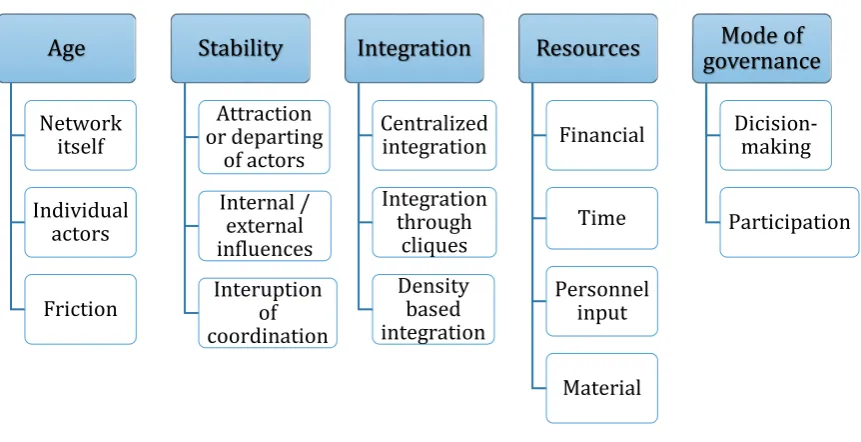
The second theoretical concept is collaborative networks. Based on theories from Provan and colleagues and, in particular, the recent contribution of Raab, Mannak and Cambré (2015), five configurations are set. To assess the predicted effectiveness of the collaborative networks, information has to be gathered on the age (1), the stability (2), the integration (3), the resources (4) and the mode of governance (5) (blue labels in Figure II: Coding scheme network effectiveness). In order to assess the five configurations, each is assigned several categories which together provide a detailed overview of the individual feature and hence the assumed effectiveness of the collaborative network (white labels in the scheme). The categories are derived from the same theories as the features. In accordance, all the relevant data is coded in line with these features and categories. As with the other scheme, the coding is executed with ATLAS.ti which facilitates the data analysis of qualitative research. If a certain sentence, statement or characteristic indicates that a certain category of a feature is present, it is coded with that particular feature and more specific category. Coding the data on the basis of the named features and categories enables easy detection and order of the data. Consequently, after coding the relevant data in this manner, it allows for application of the formula of Raab, Mannak and Cambré (2015) and to predict the assumed effectiveness of the collaborative networks.
A collaborative network is assumed to be effective if the network is at least three years old; has high levels of system stability; is centrally integrated; has either sufficient resources or is governed by a NAO (Raab, Mannak, & Cambré, 2015). Both the interviews and the coding scheme are derived from theoretic insights of the previous chapter. The scheme itself is specifically shaped to match the formula, which is being used to predict the effectiveness of the collaborative networks. By coding the data based on the scheme, it allows for implementing the formula and thus to predicted levels of effectiveness. By implementing the formula on the collaborative networks of A, B and C, different scores on the scheme and formula and thus varying predicted levels of effectiveness could be explained. For example, one collaborative network has the perfect levels and combination of the features, whereas another has a less favored combination. Then, predicted levels of effectiveness would vary and could easily be discussed based on the formula and coding scheme.
29 as there is no prior knowledge on the required budget per capita, is it not possible to set a quota. Therefore, perceptions of the participating actors on the amount of available budget will be taken into account. As there were limits to collecting data due to privacy concerns, this thesis was not able apply the helpful software UCINET and its feature NetDraw to detect key actors and create a complete overview of the ‘integration’ of the collaborative networks. Therefore, the structure is based on the information gathered by the interviews. Provan and Milward (1995) argued that a centrally integrated network tends to be more effective, however Provan and Sebastian (1998) argued that integration through cliques has a stronger effect on the effectiveness. Therefore, both centralized integration and clique integration will be examined in the assessment of this configuration. The ‘mode of governance’ of the collaborative networks will be assessed by questioning actors who is formally in control and how decisions are being made. In line with the early work of Provan and Milward (1995), three modes of governance will be distinguished, i.e. shared governance; lead-organization; NAO-governed. The scores on these five configurations allow for conclusion on the predicted effectiveness of the specific collaborative networks.
Figure II: Coding scheme network effectiveness
Source: Own compilation
During examination of the configurations certain expectations arose. Concerning network age this thesis expects that not all of the collaborative networks would have reached the ‘three-year age criterion’. Therefore, it is assumed that the collaborative networks would face challenges and friction during cooperation, especially between preventive and repressive actors. This thesis expects that the collaborative networks have formed sustainable and sufficient relations, i.e. there is no instability due to attraction or departing of actors. In addition, it is assumed that the main goal of the collaborative networks remain unaltered. There are no prior expectations of internal or external influences that destabilize the collaborative networks. With regard to the structure
30 and integration, it is assumed that the collaborative networks are centrally integrated, with certain cliques of actors that cooperate closely. In addition, it is expected that the actors perceive the resources to be insufficient. This expectation is not substantiated by academic knowledge, yet it is formed by, perhaps a pessimistic, prospect of a man his desire to have more; “earth provides enough to satisfy every man’s needs, but not every man’s greed – Mahatma Gandhi”. This thesis assumes that in all of the of the collaborative networks a municipality will function as a lead-organization considering that the local approach sets the municipality as a central lead-organization who is accountable for the approach and its results. Judging from literature, this thesis expects the municipalities to face challenges with regard to the friction between preventive and repressive actors and tensions between efficiency and inclusiveness. This expectations indicate that this thesis seeks to conclude on the collaborative networks their effectiveness on the network-level; thus by assessing the efficiency, stability, level of conflict, coordination and commitment (Kenis & Provan, 2009; Provan & Milward, 2001).
3.3 Conclusion
31
4 Case selection
This chapter elaborates on reasons that for choosing this specific theme and these specific collaborative networks. Additionally, this chapter describes the present collaborative networks in terms of budget, risk assessment, inhabitant count, activity and form of governance. This chapter provides basic background information on the anonymous collaborative networks.
The research strategy applied in this thesis is not a new one; there have been numerous assessments of the effectiveness of collaborative networks. This study could have been conducted on any collaborative network being active on any theme. Yet, this thesis is unique in its area of subject, as to date there is no in-depth assessment of the effectiveness of the radicalization prevention and counter-radicalization networks in the Netherlands; none of the studies have tested the counter-radicalization approach to literature on network effectiveness. Hence, the main reason to select this particular case. In addition, as the threat of terrorism spreads around the globe, effective remedies are of utmost importance; which makes this assessment all the more interesting and necessary. Within the areas of research, i.e. radicalization and network effectiveness, the established collaborative networks in order to prevent and counter radicalization are the topic. To be more specific, Babbie (1998) stated that the what and whom that is being studied can be considered the units of analysis (Babbie E. R., 1998). Therefore, the local networks A, B and C are set as the unit of analysis.
The local collaborative networks A, B and C have been chosen considering that theyhave confirmed to have experienced cases of radicalization within their municipality, as they had individuals who went on Jihad. Data from February 28th of 2015 displays that the concerned municipalities had varying amounts of inhabitants who went on Jihad (De Telegraaf, 2015). These numbers are based on statements by the municipality’s representatives. In addition, these municipalities are among the eighteen municipalities that received financial aid from the ministry of Security and Justice on account of the local approach to prevent and counter radicalization and jihadism, the municipalities received varying amounts of aid (NCTV, 2016). The varying amounts of aid allows for examination of the influence of the available budget on the effectiveness of collaborative networks. It immediately became evident that the greater the financial aid, the greater the documentation and the greater the efforts to prevent and counter radicalization.
32 the inhabitants. A smaller municipality could receive more financial aid than a larger municipality. Which resulted in the question whether more documentation causes more financial aid or vice versa. However, the financial aid appeared to be parallel with risk assessment.
The three collaborative networks have to be understood as organizations cooperating on multiple themes. The relationships among actors were present prior to the rise of the social problem of radicalization, for example on themes as crime prevention. Nevertheless, this thesis observed that higher the risk of radicalization in a certain area, the more organizations assign and train specialists responsible for the specific theme. Each of the collaborative networks fit the description of the lead-organization mode of governance. The municipalities are considered to be the lead-organization that monitor and coordinate network activity and gather the relevant actors. In line with Whelan (2015), in security networks, like the present collaborative networks, the lead-organization is does not so much govern the networks, but rather stimulates decision making.
33
5 Results
This chapter displays an analysis of the gathered data and seeks to process in-depth information in order to answer the research question of this thesis. Sections 5.1 to 5.5, in line with the formula of Raab, Mannak and Cambré (2015), address network age, network stability, resource munificence, network integration and mode of governance respectively. The conclusions that emanate from sections 5.1 to 5.5 enable the implementation of the previously mentioned formula. The formula enables conclusion on the effectiveness of the concerned collaborative networks. Section 5.6 features an analysis on the comprehensiveness of the collaborative networks and a discussion on plausible improvements. The section adds strength as it covers factors that are not included in the formula. This chapter functions as a solid base that enables overall conclusions.
5.1 Network age and friction
Raab, Mannak and Cambré (2015) stated that “at least 3 years are needed to build a sustainable collaboration, especially if inherent functional tensions exist between the participating organizations (p.497)”. Within their research on Safety Houses in the Netherlands they observed tensions between law enforcement and welfare organizations. Initially this thesis was not intended to question or adapt the formula which resulted from their study, yet during the interviews it became evident that the factors surrounding the networks to prevent and counter radicalization were different. Different factors surrounding the theme made their criteria for a minimal network age of three years debatable. Merely one out three of the examined local networks had reached the age of three years at the time of the interviews. Yet, it is questionable what is ought to be determined as the ‘birth’ of the network. Respondents were asked for what duration of time they were involved in the efforts of preventing and tackling radicalization, which varied from two to almost five years. The personalized integral approaches, however, had been applied by local networks for many years. Therefore, the cooperation between actors from different disciplines is not new (Radic-01; Radic-06). A staff member of a Safety House perceives two developments:
34 The line of argumentation in the quotation indicates the presence of trust among the different actors, yet that cooperation with new individuals of some organizations challenges efficiency. A key factor in the theory on the age of the network and its network-level effectiveness should entail that it concerns a newly emerged network without previous existing cooperation. This is not the case with the examined networks as actors previously cooperated, and still cooperate, on other themes (Radic-01; Radic-03; Radic-05; Radic-11). Therefore, even though two out of three examined networks have not been engaged for at least three years on the phenomenon of radicalization, they do not face challenges of trust. These findings challenge the age criterion of the formula by Raab, Mannak and Cambré (2015).
Notably, respondents share the perception that the involved actors are willing to share information and cooperate in order to achieve the common goal. This willingness is important for both the preventive, curative and repressive efforts of the network. However, this does not indicate that there are no tensions whatsoever. The observed tension between law enforcement and welfare organizations by Raab, Mannak & Cambré (2015) seem to be absent in the local networks concerned with radicalization. Surprisingly, both schools (Radic-04; Radic-08) and welfare organizations (Radic-07; Radic-10) state to have good relations and cooperation with the neighborhood officer and the police. Initially, the tension between preventive and repressive actors was expected to be present the most. Apparently, organizations acknowledged that in order to achieve a safe society and environment, cooperation is necessary; a perception that is shared by an employee involved with safety of a municipality (Radic-06). My initial assumption seems to be outdated, at least on a topic of this magnitude. A manager of a welfare organization stated:
“I have seen the time that youth workers absolutely did not want to share information with the police, a time that fortunately has ended years ago. (Radic-10)”
35 “If a repressive approach is chosen, then the welfare and care actors are explained why the approach is chosen and that it does not exclude care and help. Vice versa, if we waive the repression and see if we can achieve something through care, we motivate our choices (Radic-05)”. In this thesis it is observed that cooperation, based on a foundation of trust due to clear mutual expectations, – to a certain extent – prevents unexpected events that could inflict severe damage to the trust and cooperation and hence collaborative network effectiveness on the network-level.
A topic for debate is the value conflict between the values of privacy or safety. A staff member of a Safety House argued:
“In these kind of cases, I really think that safety is far more important than privacy. As far as I'm concerned, much more should be allowed. On the other hand, you have to be very careful, there may be consequences for people who ever have been registered somewhere, despite that where they were registered for never really had to be true. That indicates a degree of caution (Radic-02).”
36 framework with regard to sharing private information will most probably enhance the effectiveness of the network and its capabilities of early signaling.
The newly introduced law, Temporary act of administrative measures against terrorism, can cause some friction if the measures are not reported to the local authorities. A staff member of Safety House perceived that the minister (Safety and Justice) enforced a passport measure, and the concerned municipality was simply confronted with it. The measure was announced and “the media and the family were earlier informed than the municipality (Radic-02)”. Strangely however, article 7 paragraph 1 of the aforementioned law obligates the minister of Safety and Justice to consult the Mayor of the concerned municipality prior to imposing a measure granted under article 2 and 3 of that law, which covers measure of withholding of a passport. Article 7 paragraph 1 adds that if the circumstances are urgent to the extent that it obstructs the ability to consult with the concerning mayor, the minister of Safety and Justice is allowed to waive the obligation of consultation and instructs the minister to inform the mayor immediately. Meaning, even under urgent circumstances the municipality should be informed before execution. The frustrations of the respondent could have been prevented if the minister simply followed the law. Nevertheless, as merely one side of the story was heard, this should be read as an illustration. The coordinator of radicalization prevention of a municipality argues that they are yet to see the effects of this law, and that it is acceptable if the national measures are justified. However, “you do not want that the national actors undermine what you have built up locally (radic-05)”. Therefore, consultation is strongly preferred to uphold the local efforts and coordination.
On the basis of the data obtained by the interviews this thesis challenges the age-criterion of the formula by Raab, Mannak and Cambré (2015). The existence of previous cooperation among the involved actors should be taken into consideration preparatory to implementation of the age-criterion. This thesis argues that the previous, and ongoing, cooperation of the actors on other themes have prepared them for cooperation on preventing and combatting radicalization. The actors more and more grasp the understanding of safety through cooperation between distinct disciplines. Due to clear mutual expectations, open negotiations and cooperation on the approach taken, friction between both the preventive and repressive camps is merely minimally present. If the local networks apply the same strategies for cooperation with the national actors with regard to the newly introduced Temporary act of administrative measures against terrorism, than no or minimal friction is foreseen. The collaborative networks on preventing and combatting radicalization did not require a minimum of three years to build sustainable collaboration.
5.2 Stability
37 of internal or external changes on the network (Raab, Mannak, & Cambré, 2015, p. 497)”. In this line the networks their stability was examined. Multiple respondents perceive new actors joining the network, yet that these actors are small, and often new, organizations (Radic-01; Radic-02; Radic-03; Radic-05). Therefore, these actors cannot be labeled as ‘important actors’ able to drastically change the dynamics and functioning of the network. Nevertheless, the same respondents acknowledge that their emergence causes difficulties in cooperation.
“There are new actors through the socialization of care, all kinds of providers that occur. That is a factor that creates difficulties. (...) Those companies are applying a commercial-approach. It is difficult to build the relations in a manner that these types of issues can be well-addressed (Radic-01).”
“The new, small pgb-bureaus often go their own way and there is insufficient control on it. They also lack the ability to find and cooperate with the network. When it comes to regulated care, actors know where to find each other and there exists good coordination (Radic-02).”
38 Therefore, the regular network actors are deemed fixed and stable (Radic-05; Radic-07). In line with Provan and Milward (1995) this thesis acknowledges that quick attraction or department of networks members could harm the outcome, yet this thesis argues that it has to concern important actors to destabilize the network. As there are no new actors attracted that could drastically change the dynamics of the collaborative networks, and there are no actors refraining from cooperation, there is no instability.
If the coordination of the network is stable, i.e. there have been no major changes to the strategy and the structure of the network, then the network will be more effective (Raab, Mannak, & Cambré, 2015). Obviously, the goal of the network is permanent, i.e. the prevention and countering of radicalization. The gathered data indicates that there are no major, yet merely subtle, changes to the local approaches as the statement of the coordinator of a municipality illustrates:
“The document is 90% equivalent to the 2016 document. We continue with what we were doing, with a few small nuances in the projects. (Radic-05)”
Similar statements have been made by representatives of the other municipalities (Radic-01; Radic-06). A staff member concerned with safety of a municipality argued to have a steady approach, they finished some projects and started some minor new ones (Radic-06). However, most respondents mentioned the changing situation in Syria and Iraq; IS is losing terrain which results in radicals returning to Europe and homegrown radicals refraining from travelling to those countries. This changing dynamic in the middle east causes a shift in the focus here in the Netherlands, i.e. returnees will require more attention in the nearby future; an expectation, and anticipated on, by the NCTV (NCTV, 2017). This shift was foreseen and the collaborative network will not require any new actors for this shift. Therefore, this minor shift within the entire approach will not destabilize the collaborative networks. The approach towards returnees will be discussed in-depth in section 5.6.