APRIL - MAY, 2017, VOL. 4/21 www.srjis.com Page 5218 TECHNOLOGY ENHANCED LANGUAGE LEARNING IN INDIAN EDUCATION
SCENARIO: REFLECTING UPON ROLE OF ICT AND MULTIMEDIA ON LEARNING ENGLISH AS A SECOND LANGUAGE
Rajeev Kaushal
Assistant Professor, Department of Education, Gagan College of Management &
Technology, Agra Road, Aligarh
It is no denying the fact that one‟s repertory and proficiency of syntactics and semantics is the index of one‟s personality and is the key to one‟s success in life. Language learning is an indispensable part of school curriculum. The 21st century better known as the Information Age is witnessing a paradigm shift in pedagogical practices. ICT and multimedia have touched every facet of life and education is also no exception to this as these are being effectively employed in transacting the curriculum to the pupils by means of smart classes, virtual classes, online learning etc. Although Technology enhanced language learning (TELL) is in vogue in the current scenario yet it is in a nascent phase in India. The present paper highlights the role of TELL on learning English as a second language (ESL) besides throwing light on the pace of its development and use in India.
Keywords: TELL, ESL, ICT, Multimedia, Information Age.
Introduction:
TELL (Technology enhanced language learning)
The word TELL is an acronym for Technology-enhanced language learning and deals with the impact of technology on teaching and learning a second language also called the L2.
Technology-enhanced language learning refers to the use of the computer as a technological
innovation to display multimedia as a means of complementing teaching of language by
language teachers. TELL is not a teaching method but an approach that can be used alongside
a teaching method to help teach. TELL can be used alongside textbooks for a much more in
depth learning experience. TELL turns the classroom into a student-centered environment.
Tracing the historical background
TELL was first known as CAI - Computer Assisted Instruction and/or CALL- Computer Assisted Language Learning during the early 1970s. Levy (1997) defines CALL as “the
search for and study of applications of the computer in language teaching and learning.” It Scholarly Research Journal's is licensed Based on a work at www.srjis.com
APRIL - MAY, 2017, VOL. 4/21 www.srjis.com Page 5219
emphasizes learning and not teaching. CALL encompasses tools that facilitate language
learning process. It is meant to supplement face-to-face language instruction and not supplant
it. CALL dates back to the 1960s, when it was first introduced on university mainframe
computers. The PLATO project, initiated at the University of Illinois in 1960, is an important landmark in the early development of CALL (Marty 1981). The history of CALL suggests
that computer can be made use of in language teaching in different ways viz. as a tutor which
offers language drills or skill practice, a stimulus for discussion and interaction or a tool for
writing and research. With the advent of the Internet, it can also be a medium of global
communication and a source of limitless authentic materials.
The term CALI (Computer-assisted language instruction) was in use before CALL, reflecting its origins as a subset of the general term CAI (computer-assisted instruction). CALI fell out
of favor among language teachers, however, as it appeared to imply a teacher-centered
approach (instructional) whereas language teachers are more inclined to prefer a
student-centered approach, focusing on learning rather than instruction. CALL began to replace CALI
in the early 1980s (Davies & Higgins 1982: p. 3). The current philosophy of CALL puts a
strong emphasis on student-centered materials that allow learners to work on their own. Such
materials may be structured or unstructured, but they normally embody two important
features: interactive learning and individualized learning. CALL is essentially a tool that
helps teachers facilitate the language learning process. It can be used to reinforce what has
already been learned in the classroom or as a remedial tool to help learners who require
additional support.
An alternative term, TELL (Technology-enhanced language learning) also emerged around the early 1990s: e.g. the TELL Consortium project, University of Hull.
Warschauer (1996) and Warschauer & Healey (1998) identified three historical phases of CALL, classified according to their underlying pedagogical and methodological approaches
[image:2.595.115.475.628.762.2]as shown in the figure below.
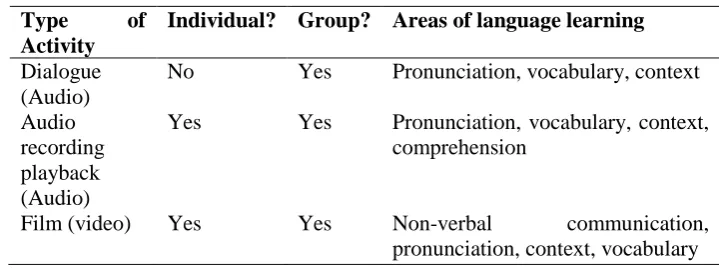
Table 1: Activities Included In Tell Type of
Activity
Individual? Group? Areas of language learning
Dialogue (Audio)
No Yes Pronunciation, vocabulary, context
Audio recording playback (Audio)
Yes Yes Pronunciation, vocabulary, context, comprehension
APRIL - MAY, 2017, VOL. 4/21 www.srjis.com Page 5220
Online Journal (text)
[image:3.595.82.530.71.411.2]Yes Yes Reading, writing, syntax, spelling, vocabulary, context, comprehension
FIGURE 1: HISTORY OF ‘CALL’ (WARSCHAUER, 1996)
In a later publication Warschauer changed the name of the first phase of CALL from
Behavioristic CALL to Structural CALL and also revised the dates of the three phases
(Warschauer, 2000):
Structural CALL: 1970s to 1980s
Communicative CALL: 1980s to 1990s
Integrative CALL: 2000 onwards
A glimpse of recent innovations:
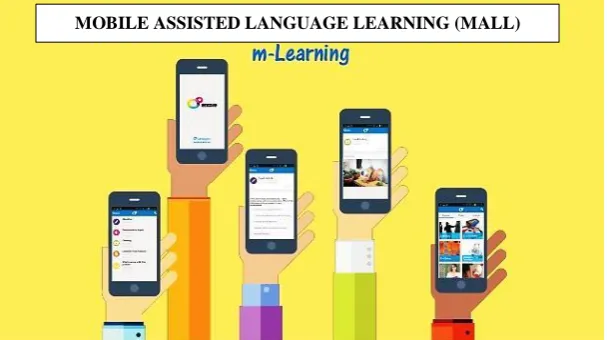
MALL (acronym for Mobile-assisted language learning) is the use of handheld computers or cell phones to assist in language learning. MALL is a subset of both Mobile Learning
(m-learning) and computer-assisted language learning (CALL). MALL has evolved to support
students‟ language learning with the increased use of mobile technologies such as mobile
phones (cellphones), MP3 and MP4 players, PDAs and devices such as the iPhone. With
MALL, students are able to access language learning materials and to communicate with their
teachers and peers at anytime, anywhere.
Behaviouristic CALL
(1960s - 1970s)
Based on Behaviouristic Learning Model
(Mainframe)
•Drill and Practice •Explicit grammatical
explanation •Translation tests at
various intervals •Audio-lingual method •Judgemental feedback •Focus on analysis of
language (ACCURACY)
Communicative CALL
1970s - 1980s
Cognitive Learning Theory
Learning through discovery, expression, and development
(PCs) •Simulations •Communication exercises •Language games •Text reconstruction programmes
•Implicit rather explicit grammar instruction •Focus on using the
language (FLUENCY) Integrative CALL 1990s Socio-cognitive Theory Internet & Multimedia
•Integration of various skills (listening, speaking, reading, and writing)
•Integration of text,
animation, sound, graphics, video into the language learning
•Greater emphasis on language use in authentic social contexts
•A range of informational, communicative & publishing tools for every pupil
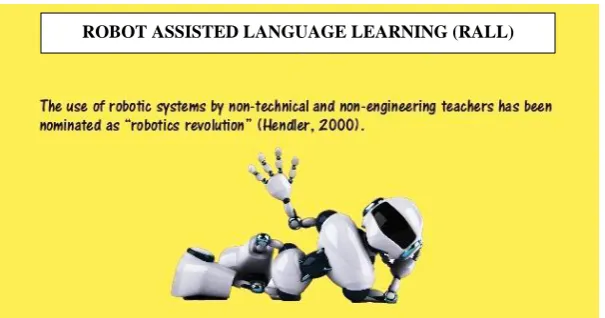
APRIL - MAY, 2017, VOL. 4/21 www.srjis.com Page 5221 FIGURE 2: SHOWING MOBILE ASSISTED LANGUAGE LEARNING (MALL) RALL (acronym for Robot assisted language learning) is the use of robots to assist in language learning. Robots not only encompass features of CALL/MALL but are also capable
of independent movements, voice/visual recognition, environmental interactions, non-verbal
communication viz. gestures, facial expressions and actions. RALL can create a useful
collaboration with pupils to improve and enhance their speaking and listening abilities and
provoke learner‟s interest and motivation as robots encompass such features as
anthropomorphism, flexibility, mobility, repeatability, adaptability, intelligence, sensing etc.
Research and development of RALL started around 2004, mainly in countries like Japan,
Korea and Taiwan where English is taught as a foreign language. Japan‟s ATR research
international institute conducted research on student motivation during recess in elementary
schools with ROBOVIE, a robot that remembers around 300 English sentences, simple
everyday expressions and recognizes 50 words (Kanda, Hirano, Eaton & Ishiguro, 2004). In
March 2004, Korean developer Yujin Robot announced a home robot IROBI, loaded with
services such as reading English, photo books and English chanting (Han, Jo, Park & Kim,
2005). In Taiwan, You, Shen, Chang, Liu and Chen (2006) applied ROBOSAPIEN, an
Infrared remote controllable toy-like robot manufactured by Wow-Wee Toys, to an English
classroom with five instruction models.
APRIL - MAY, 2017, VOL. 4/21 www.srjis.com Page 5222 FIGURE 3: SHOWING ROBOT ASSISTED LANGUAGE LEARNING (RALL)
DISQUISITION: Philosophical Rationale
In parlance of educational philosophy, three terms are encountered viz. Metaphysics,
Philosophy and Axiology. Metaphysics is the branch of philosophy responsible for the study
of existence. It is the foundation of a worldview. It answers the question "What is real?" It
encompasses everything that exists, as well as the nature of existence itself. It says whether
the world is real, or merely an illusion. It is a fundamental view of the world around us.
Without an explanation or an interpretation of the world around us, we would be helpless to
deal with reality. Metaphysics helps in the formulation of aims of education and curriculum is
the means of realization of those aims. Epistemology is the study of our method of acquiring
knowledge. It answers the question, "How do we know?" It is concerned with how our minds
are related to reality, and whether these relationships are valid or invalid. Flaws in
epistemology will make it harder to accomplish anything. Methods of teaching and pedagogy
are undoubtedly related to Epistemology. As per epistemology of Nyaya Darshan, there are four means (Pramanas) of acquiring knowledge as under:
Perception (Pratyaksa)- Visual, Aural, Gustatory, Tactile, Olfactory Inference (Anumana)
Comparison (Upmana)
Verbal Testimony (Shabd Pramanikta)
Out of these four, two pramanas viz. Perception and Verbal testimony have a profound
bearing on teaching-learning process. Psychological research has shown that verbal
information is in fact better remembered when accompanied by a visual image.
Digital content, animations and videos make lessons rich and interesting. Students understand
and grasp the concepts easily.
APRIL - MAY, 2017, VOL. 4/21 www.srjis.com Page 5223 Psychological Rationale
Technology-enhanced multimedia instruction benefits foreign language vocabulary
acquisition because students receive information via multiple channels and then can recall
information better. Dual coding theory states that when information is presented through
visual and auditory channels, it facilitates retention (Pavio, 1986). „Combining pictures,
mental imagery, and verbal elaboration could be an effective method in promoting
understanding and learning from text by students ranging from grade school to university
level‟ (Pavio, 1991). Technology furnishes opportunities for interaction, allows for immediate
feedback, increases learner autonomy, simulates real-life situations and experiences through
video, audio, and graphics (Chun & Brandl, 1992; Legenhausen & Wolff, 1990). Integration
of images and sounds together with text enhances vocabulary acquisition (Chun & Payne,
2004; Chun & Plass, 1996). Research showed that the combination of textual and visual
information is more effective in facilitating vocabulary acquisition than definitions of foreign
language words alone (Akbulut, 2007; Jones & Plass, 2002; Nikolova, 2002). Liu (1994)
found that technology offers tools and opportunities to enhance vocabulary acquisition. The
use of visuals can enhance language teaching as they help teachers bring the real world into
the classroom, thereby making learning more meaningful and more exciting (Brinton, 2000).
Research shows that low verbal ability students especially benefit from visual aids and input
(Peek, 1993).
Acquisition and Learning
According to Stephen Krashen (1982), the acquisition of a language is a natural process; whereas learning a language is a conscious one. In the former, the student needs to partake in natural communicative situations. In the latter, error correction is present, as is the study of
grammatical rules isolated from natural language. English not being our Mother tongue
therefore requires learning. A language teaches us four skills viz. listening, speaking, reading
and writing. Add to this, any verbal encompasses four components:
1) Phonetics (structure and sequence of speech sounds, pronunciation)
2) Syntactics (grammar)
3) Semantics (vocabulary)
4) Pragmatics (rules for appropriate and effective communication)
As regards teaching of English as a second language, various methods have been employed
viz. translation method, rote memorization of grammatical rules and vocabulary, direct
method etc. however in the wake of paradigm shifts in pedagogy of English language these
APRIL - MAY, 2017, VOL. 4/21 www.srjis.com Page 5224
being evolved and in vogue to make the learners of English language proficient in the use of
pronunciation, grammar and vocabulary, TELL being one of them. In fact, the pedagogical
finesse encompasses a smart blend of conventional and innovative techniques.
Multisensory Instruction
Multisensory Instruction is that type of instruction in which sensory learning experiences are
derived from more than one sense organ. This concept was introduced by philosophers like
Francis Bacon, Mulcaster and Comenius and their concept was given a solid Psychological
base by Edgar Dale, Bruner, Charles etc. Interest in the Role of SENSES in Learning was
already there in Educational circles when instructional media began their ascendency.
Research findings of Cobun (1968) indicate that RETENTION of what is LEARNED is related to SENSE EXPERIENCE. Multisensory learning is therefore a psychologically and
philosophically valid concept that aims at making learning:
Meaningful
Speedy
Enduring
Interesting
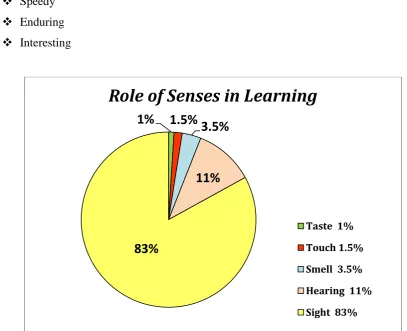
FIGURE 4: PIE CHART HIGHLIGHTING ROLE OF SENSES IN LEARNING (COBUN)
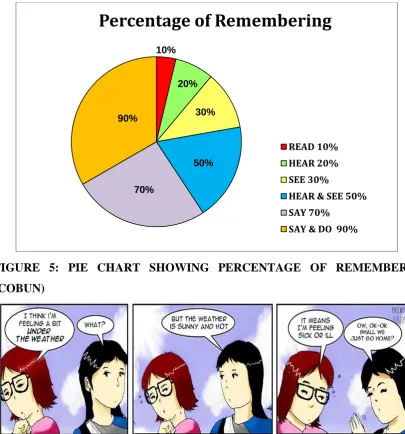
Observation and research by Cobun tended to show (holding time as nearly constant as possible) that people generally remember what is shown in the pie-chart below.
1% 1.5% 3.5%
11%
83%
Role of Senses in Learning
Taste 1%
Touch 1.5%
Smell 3.5%
Hearing 11%
[image:7.595.88.496.347.678.2]APRIL - MAY, 2017, VOL. 4/21 www.srjis.com Page 5225 FIGURE 5: PIE CHART SHOWING PERCENTAGE OF REMEMBERING (COBUN)
(Idioms based on picture-conversation) (Idiom – Under the weather)
According to Clark and Lyons (2004), two different types of memories are involved in the
process of learning viz. working memory and long-term memory. Furthermore, the working
memory too has two sub-components; one specialized in visual input and the other one in
auditory input. For example, if a graphic is explained by words presented in audio, learning
the new information is better than if the words are presented in text (Clark and Lyons, 2004).
This pertains to multisensory learning. When the visual and phonetic inputs are perceived
simultaneously they are organized to form a cohesive idea to be finally integrated with active
prior knowledge from long term memory. The two memories work together in
complementary ways, to form what is called an updated mental model that will be stored in
long-term memory, where it lasts indefinitely (Clark and Lyons, 2004).
10%
20%
30%
50%
70% 90%
Percentage of Remembering
READ 10% HEAR 20% SEE 30%
HEAR & SEE 50% SAY 70%
[image:8.595.92.498.70.505.2]APRIL - MAY, 2017, VOL. 4/21 www.srjis.com Page 5226 Sociological Rationale
Vygotsky‟s Socio-cultural theory states that developmental processes take place through
participation in cultural, linguistic, and historically formed settings viz. schooling and peer
group interactions (Vygotsky, 1986). The crux of the theory is Zone of Proximal
Development (ZPD), which is defined as a distance between what a learner is able to do
independently and what s/he is able to do with a social support. Therefore, learning happens
through interactions between an “expert” (teacher) and a “novice” (student), where an “expert” provides guidance and assistance to a “novice.”
Kern (2006) emphasized the importance of a pedagogical approach to technology enhanced multimedia instruction by stating that “technology-based language teaching is not a method
but is integrated into various pedagogical approaches” (p. 200). Technology allows for
multimedia instruction and a multisensory learning environment. Research has shown that
using technology-enhanced multimedia instruction in the classroom helps to tailor instruction
to students with different abilities (Wu & Zhang, 2010) and facilitates quick sharing and
building of knowledge within the participatory environment (Asselin & Moayeri, 2011).
Technology features viz. interactivity, capacity, flexibility, speed, novelty and numerous
automatic functions promote learning and creativity amongst students (Allen, 2003; Loveless,
2002). Visual aids, when integrated into the lesson plan through media, attract students´
attention to the topic presented in the class, enhance and facilitate comprehension of grammar
and language, increase students‟ motivation as well as help students memorize the new
vocabulary and structures thereby expanding their syntactic and semantic repertory. To
render the acquisition of language more meaningful for the students, teachers must bring the
real world into the classroom.
Second Language Acquisition (SLA) research perceives students as active learners capable of
creating their own ideas that they can later use to make sense of their own learning
(Ruschoff & Ritter, 2001). SLA research implies that language acquisition should be
achieved by having plenty of opportunities for communicative language activities that allow
for the negotiation of meaning and exchange of information between speakers. Harper,
Squires, and Mcdougall (1996) stated that learning should be viewed as an active and
dynamic process and knowledge should be viewed as something that students can construct,
not something that can be passively received. Teachers often focus on following the beaten
track, teaching static knowledge where students are required to consume “packed in boxes”
pieces of information rather than produce and create knowledge themselves (Sawyer, 2006).
APRIL - MAY, 2017, VOL. 4/21 www.srjis.com Page 5227 well as the mere learning of facts will no longer be sufficient in order to live, learn, and
work… in the society of 2012.” Research also shows that technology-enhanced multimedia
instruction increases student motivation (Boehm, 2009; Torff & Tirotta, 2010), develops
curiosity and makes learning experiences memorable (Allen, 2003). However, SLA research
indicates that technology itself is neither effective nor ineffective in the classroom. The
pedagogy, that stands behind the use of technology and the way teachers can make use of it,
is what makes technology effective (Armstrong & Yetter-Vassot, 1994; Zhao & Frank 2003).
It may be reiterated here that technological aids can only supplement teaching and learning,
they cannot supplant the teacher in any way. What needs to be emphasized here is that a
balance has to be struck between the conventional classroom practices and smart classroom
practices. The employment of smart classroom practices must find way both in pedagogy and
student learning.
Lam (2000) indicated that merely providing teachers with technology-enhanced multimedia resources is not enough. It is necessary to convince them of the benefits of using it in the
classroom. Studies suggest that teachers‟ lack of knowledge and professional development to
prepare them for the integration of technology into the curriculum (Akins, 1992; Lam, 2000;
Winnans & Sardo Brown, 1992; Zammit, 1992), teachers‟ lack of confidence in their skills
with technology (George & Camarata, 1996; Winnans & Sardo Brown, 1992; Zammit, 1992),
their level of education and the amount of teaching experience (Moore & Carel, 1998) may
be some of the factors that stand in the way of the effective implementation of
technology-enhanced multimedia instruction. Research found that teachers who hold constructivist views
on teaching were more willing to use technology enhanced multimedia in the classroom than
teachers who did not hold such views (Becker, Ravitz, & Wong, 1999; Ertmer, 2005; Ertmer,
Gopalakrishnan, & Ross, 2001). According to constructivist theory, learners are active
participants in tasks in which they "construct" new knowledge derived from their prior
experience. Learners also assume responsibility for their learning and the teacher is a
facilitator rather than a purveyor of knowledge. Whole language theory embraces
constructivism and postulates that language learning moves from the whole to the part, rather
than building sub-skills to lead towards the higher abilities of comprehension, speaking, and
writing. It also emphasizes that comprehending, speaking, reading, and writing skills are
interrelated, reinforcing each other in complex ways. Language acquisition is, therefore, an
active process in which the learner focuses on cues and meaning and makes intelligent
guesses. Computer-supported collaborative learning (CSCL) uses instructional methods
APRIL - MAY, 2017, VOL. 4/21 www.srjis.com Page 5228
learning. Learning takes place through conversations about content and grounded interaction
about problems and actions. Advocates of social learning claim that one of the best ways to
learn something is to teach it to others. Social networks have been used to foster online
learning communities around subjects as diverse as test preparation and language education.
According to Bandura’sSelf-efficacy theory, individuals are likely to engage in activities to the extent they perceive themselves to be competent at those activities. Self-efficacy is
defined as the belief in one‟s ability to achieve a goal or an outcome (Bandura, 1977, 1997).
German philosopher, Alexander von Humboldt aptly remarks, “A language cannot be
taught. One can only create conditions for learning to take place.” By employing
multimedia, one certainly creates such conditions. “Videos, like other theme-based materials,
are effective springboards for other content-based classroom activities. They provide
background information and proper stimuli for subsequent reading, writing, speaking and
listening activities.” (Stoller, 1993)
Indian scenario
India is a multilingual nation. Although the eighth schedule of Indian Constitution has
recognized 22 languages yet two languages have a prime significance viz. Hindi and English.
The Constitution of India designates the official language of the Government of India as
Hindi written in the Devanagari script as well as English. English being a lingua franca is
taught as a second language in India. In fact, English is the prime medium of Instruction in
convent schools, majority of universities and some acme government schools.
1. Pre-service teacher-education:
The teacher-education programmes in India are being run on the traditional lines without any
substantial change or modification to keep pace with the changing realities. The „SKILL’
development aspect of the programme is the most neglected one. As per two-year B.Ed.
curriculum released by National Council of Educational Research and Training, the
Curriculum components have been visualized in three clusters viz. Groups A, B and C,
ending with a „Final Reporting and Presentation‟. Under Group C (Section I: Experiences for
Teacher Enrichment) use of ICT for Effective Learning has been emphasized. This includes
awareness and effective use of ICT as a tool for learning, appreciating the use of audio,
audio-visual aids and ICT (Internet and Computer Technology); develop and use teaching
aids in the classroom both print and audiovisual material, and ICT (Pedagogy of language
viz. English, Urdu, Sanskrit); ICT applications (Pedagogy of Mathematics) Audio-visual
aids, CD-ROM, multimedia, internet (Pedagogy of Social sciences). As regards
APRIL - MAY, 2017, VOL. 4/21 www.srjis.com Page 5229
addition to the theoretical aspect. Most of the institutions do not even take pains to acquaint
the pupil-teachers with the effective as well as efficient use of ICT. And a few merely make
the students familiar with the basics of ICT only on a half-baked theoretical basis. It is a
matter of irony that most of the teacher-educators teaching pedagogy of language(s)
theoretically emphasize the use of audio-visual aids but themselves never use them for their
own teaching sessions.
2. In-service teaching:
A majority of language teachers follow the beaten track in that they rely only on theoretical
part thus totally neglecting the practical aspect. They are reluctant to use audio-visual aids in
their classroom. They lack the true spirit of philosophy i.e. quest for knowledge. School
management and authorities also have a lackadaisical attitude in that they are satisfied with
status quo. Some studies reported that there is a lack of professional development to prepare
teachers for the integration of technology into the curriculum (Akins, 1992; Winnans & Sardo
Brown, 1992; Zammit, 1992).
Barriers
Some impediments may be listed as under:
Adherence to beaten track and aversion to innovation
Aversion of in-service language teachers to integrate technology with curriculum.
Teacher-educators teaching pedagogy of language(s) themselves not well proficient in the
use of ICT based skills.
Some language teacher-educators also lack interest in ICT integration and need
motivation.
Practical use of ICT based skills not being made. Emphasis on theoretical part only.
Majority of the pupil-teachers who opt for pedagogy of English language have either
half-baked or poor knowledge of ICT.
Lackadaisical attitude / vested interests of school management and authorities.
Poor infrastructure, non-availability of electricity and the required technology.
Teachers / teacher-educators who fail to realize the philosophical and/or psychological
rationale(s) as discussed above.
Technological advancement in a nascent phase
Lack of technological awareness
Glimmer of hope:
The paradigm shifts in Pedagogy of English as second language and advent of ICT have
APRIL - MAY, 2017, VOL. 4/21 www.srjis.com Page 5230
medium schools and some reputed government schools (KVS) have stated adopting the
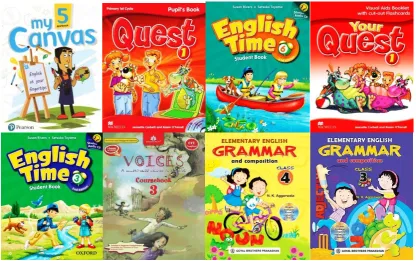
concept of TELL. Add to this, a majority of esteemed text book publishers in India viz.
Pearson India, S.Chand, Madhuban, Goyal brothers, Frank brothers, Appu series etc. are
also embracing this very concept and have blazed a trail in this regard by means of furnishing
interactive CDs (comprising multimedia lessons, quizzes, evaluation exercises, audio lingual
text material, slideshows) along with English Grammar and Literature books. However, the
concept of TELL in India is in a nascent phase and has a long way to go as regards its
generalization.
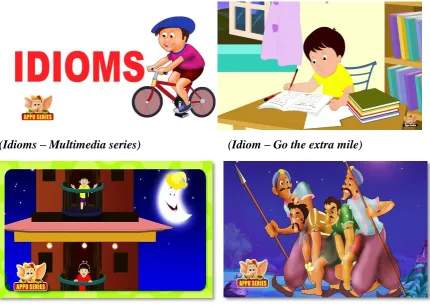
(Idioms – Multimedia series) (Idiom – Go the extra mile)
[image:13.595.82.513.257.563.2](Idiom – Let’s call it a day) (Idiom – To be caught red-handed)
FIGURE 6: MULTIMEDIA APPROACH IN ENGLISH LANGUAGE LEARNING
APRIL - MAY, 2017, VOL. 4/21 www.srjis.com Page 5231 FIGURE 7: PREPOSITIONS (VISUAL PERCEPTION + ORAL & WRITTEN WORD)
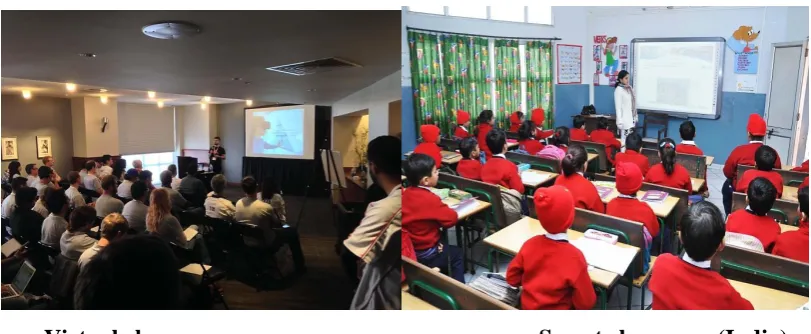
[image:14.595.90.507.411.672.2]APRIL - MAY, 2017, VOL. 4/21 www.srjis.com Page 5232 Virtual classroom Smart classroom (India) FIGURE 9: A GLIMPSE OF VIRTUAL & SMART CLASSROOMS
Conclusion:
What light is to darkness, language is to the human beings. Human beings are the only
creatures on Earth who are endowed with the unique and precious gift of a well-defined
structured language. Language has been the basis of existence of human civilization and
transference of cultural heritage from generation to generation. Verbal language (oral and
verbal) is the basis of human communication. Wilkins rightly says, “Without grammar very little can be conveyed….but without vocabulary nothing can be conveyed” (p.111, quotes in
Lewis, 2000).In a developing country like India, a constant touch with the outside world is
indispensable to keep abreast of the latest trends and developments in the fields of
agriculture, medicine, industry, telecommunications, transport and basic research systems.
Without the adequate knowledge of and proficiency in English language, we cannot train and
expect our prospective engineers, doctors, technocrats and researchers to keep pace with
current scenario in their respective fields. In consonance with the essence of the philosophy
of Pragmatism and the changing needs of the society, teacher-educators and in-service
teachers have to keep themselves abreast of the knowledge aspect and the effective as well as
efficient utilization of ICT in English language learning. ICTs also provide learners with
powerful new tools to represent their knowledge with text, images, graphics, and video. In
order to introduce and understand the need of ICT in educational institutions, teachers or
students undergoing teacher education must first comprehend and be at ease with ICT. They
must be given opportunities for acquisition of new knowledge. This can be made possible by
promoting ICT-based training programs introduced in their curriculum.
The following can help in this regard:
Orientation programmes
APRIL - MAY, 2017, VOL. 4/21 www.srjis.com Page 5233 Seminars
Conferences
Guest lectures
Workshops
The concept of TELL in India is in a nascent phase and has a long way to go as regards its
generalization. A majority of government schools are still either unaware or devoid of this
concept reasons being manifold. It is the onus of Government to ensure its generalization and
follow up at all levels of school education, recruitment of proficient English language
teachers, training of pre-Service and in-service teachers.
References
Computer-assisted language learning retrieved June24, 2017 from https://en.wikipedia.org/wiki/Computer-assisted_language_learning
Educational technology retrieved June 22, 2017 from
https://en.wikipedia.org/wiki/Educational_technology
Han, J. (2012). Emerging technologies: Robot assisted language learning. Journal of Language Learning & Technology. Vol.16. No. 3, October 2012, pp. 1-9. Retrieved June 24, 2017 from http://llt.msu.edu/issues/october2012/emerging.pdf
Ketsman, O. (2012). Technology-Enhanced Multimedia Instruction in foreign language classrooms: A Mixed Methods Study (Doctoral Dissertation). University of Nebraska. Retrieved June 15, 2017 from
http://digitalcommons.unl.edu/cgi/viewcontent.cgi?article=1112&context=cehsedaddiss
Mobile assisted language learning retrieved June 24 from https://en.wikipedia.org/wiki/Mobile-assisted_language_learning
Technology enhanced language learning retrieved June 23, 2017 from https://ccit205.wikispaces.com/Technology-enhanced+language+learning