Bachelor Thesis
Improvement of Perceived Customer Value generated by
Say Yeah Motion Media
Lisanne Brinkman University of Twente
Title
Improvement of Perceived Customer Value generated by Say Yeah Motion Media.
Date and Place
2nd of July 2015, Enschede
Name
L.J. Brinkman
Student number
S1351230
Course
Bachelor International Business Administration
Institution
University of Twente
Supervision University of Twente
Ir. J.W.L. van Benthem Drs. P. Bliek
Commissioning company
Say Yeah Motion Media
Supervision Say Yeah Motion Media
Ms. R. S. Guillot Mr. J. Eppink
University of Twente
Say Yeah Motion Media
Management summary
This research, which is commissioned by Say Yeah Motion Media, is conducted in order to improve the perceived customer value of its health and government related customers. Say Yeah Motion Media is a Dutch media company located in Enschede. Every video offered by Say Yeah Motion Media can be described as customized, since the customers are in the middle of the attention. The following question will be answered within this research:
In what way should Say Yeah arrange its value proposition in order to improve the perceived
customer value of their health and government related customers?
In order to provide insight in the way Say Yeah should arrange its value proposition to eventually improve the perceived customer value of these target customers, a combination of literature study and field research is used. Within the literature study two comprehensive models of La Pierre (2000) are selected on which the field study is based. Semi-structured interviews, partly based on these analytical models, are conducted with two managers of Say Yeah followed by eight target customers. The data gathered during these interviews will be analysed in order to create an understanding of the value proposition of Say Yeah and the perceived customer value of these customers. Since both models contain similar elements, a clear comparison of the data can be made. The comparison of these two analyses will provide insight in the extent to which the value proposition is aligned to the perceived customer value.
In general, it can be stated that the value proposition is aligned to the perceived customer value to a relatively high extent. The majority of the customers perceive the quality of the products and services of Say Yeah as appropriate and sufficient. Although some suggestions are made, since some
customers do not experience optimal value on every element within the models. When the value proposition of Say Yeah is arranged differently of the followings aspects, the perceived customer value might probably improve.
Briefing and debriefing Co-operation
Preface
The research that is in front of you right now, is written as part of finishing my Bachelor International Business Administration at the University of Twente. It is commissioned by Say Yeah Motion Media, a media production company in Enschede. By conducting this research, I hope I will contribute in the process of making the right decisions regarding the arrangement of an appropriate value proposition for Say Yeah Motion Media.
This Bachelor thesis could not have been carried out without the support of different people. First of all, I like to thank Mr. J. Eppink for the opportunity to conduct this research within his company. Then I like to thank my supervisor of Say Yeah, Ms. R. S. Guillot, for her proper support and clear advices. I am grateful for all the information and sociability that the other colleagues within Say Yeah gave me. Regarding the University of Twente, I would like to thank my supervisor Ir. J.W.L. van Benthem for the support he gave me, and Drs. P. Bliek for being a co-reader.
Finally, I would like to thank all the customers who participated within this research and were willing to give clear and comprehensive answers wherever they could.
Thank you all, for your time, energy and co-operation within the realization of this Bachelor thesis.
Table of content
Table of Content ...5
Chapter 1: Introduction ...7
1.1 Research outline ...7
1.2 Occasion ...7
1.3 Academic relevance ...7
1.4 Company description ...9
1.4.1 Structure ...9
1.4.2 Target market ...9
1.4.3 Mission ...9
1.5 Practical relevance...9
1.6 Problem statement ...10
1.7 Research questions ...10
1.8 Research goal ...10
Chapter 2: Theoretical Framework ...11
2.1 Definition of value proposition ...11
2.1.1 Different types of value propositions ...11
2.1.2 Analytical models of value proposition ...12
2.1.3 Value proposition house ...12
2.1.4 Value proposition equation ...12
2.1.5 Total value proposition ...12
2.2 Definition of customer value ...13
2.2.1 Customer value and customer satisfaction ...13
2.2.2 Perceived customer value and desired customer value ...14
2.2.3 Perceived customer value ...14
2.2.4 Analytical model of perceived customer value ...16
Chapter 3: Research Methodology ...17
3.1 Type of Research ...17
3.2 Data collection ...17
3.2.1 Semi-structured interviews ...17
3.2.2 Ranking method ...18
3.3 Sampling ...18
3.3.1 Management respondents ...18
3.3.2 Customer respondents ...18
3.4 Customer value determination process model ...19
Chapter 4: Data and Analysis ...21
4.1 Data & analysis value proposition ...21
4.2 Data & analysis perceived customer value...23
4.3 Analysis comparison value proposition and perceived customer value ...27
Chapter 5: Conclusion ...31
5.1 Strength of current value proposition ...31
5.2 Comparison value proposition and customer value ...31
5.3 How Say Yeah should arrange its value proposition ...31
5.3.1 Briefing and debriefing ...31
5.3.2 Co-operation ...32
5.3.3 Transparency ...32
5.3.4 Branding ...32
5.4 Relevance of improvements ...32
Chapter 6: Discussion ...33
6.1 Sampling ...33
6.2 Socially desirable answers ...33
6.4 Characteristics research methods ...34
6.5 Strength of conclusion ...34
Chapter 7: Recommendations ...35
7.1 Recommendations with regard to Say Yeah ...35
7.2 Recommendations with regard to further research ...35
Chapter 8: References ...36
Chapter 9: Appendix ...38
Appendix A. Activity schedule ...38
Appendix B. Company description Say Yeah Motion Media ...39
Appendix C. Value proposition house ...41
Appendix D. Value proposition equation ...41
Appendix E. Elements value proposition ...41
Appendix F. Differences customer value and customer satisfaction ...43
Appendix G. Balances perceived customer value ...43
Appendix H. Predetermined question guide of customer value and value proposition ...43
Appendix I. Outline interview management ...45
Appendix J. Outline interview customers ...47
Appendix K. Remaining sampling methods ...49
Appendix L. Drivers mentioned per customer respondent ...50
Appendix M. Customer description of Say Yeah ...51
Chapter 1 – Introduction
1.1 Research outline
This bachelor thesis will start with an introductory chapter in which the occasion and relevance of this research will become clear. This information will be followed by a company description and the research questions. Chapter 2, includes the theoretical framework in which the main concepts are fully described. The founding information about the selection of certain definitions will become clear as well as the corresponding models used. Chapter 3 will fully clarify the research method that is used within this research. The data gathered within this research will be analysed within chapter 4, after which it is possible to provide answers to the sub-questions. The main research question will be discussed during the conclusion in chapter 5 followed by an appropriate discussion in chapter 6. In chapter 7 recommendations will be provided for both Say Yeah Motion Media and further research. Chapter 8 and 9 will respectively include the references and the appendix. This research will be conducted based on a time schedule which can be found in Appendix A.
1.2 Occasion
Companies operating in business markets these days, have to deal with high levels of competition in rapidly changing environments (Gosselin, 2006). First of all, the increased amount of competition is caused by the globalisation, a worldwide integration that includes the integration of products and services (Al-Rodhan, 2006). Thereafter the fast developments within technology, especially in communication and information, enable companies to globally share information in order to produce specific products or deliver a specific service. Also, the maturity of the business markets in many developing countries increases the competition (Gosselin, 2006).
A high level of competition leads to a high amount of supply of similar products and services offered by different companies. Therefore customers have many alternatives to choose from, which creates an opportunity to compare quality and prices along these product. The internet and other worldwide information systems provide some assistance to customers, within this process. ‘Comparison websites’ create the opportunity for customers to compare products and suppliers, even based on opinions and experiences of other customers (Atteveld, 2006). In addition to the comparing opportunities, customers themselves have a willingness to put time and effort in the process of finding the most appropriate product or service (Schuur, 2013). Due to these developments, every customer is aware of the alternatives that are offered and is able to find a product or service which might perfectly fit their needs. In this way, customers become more exacting and critical, and the position of the customers with respect to suppliers has become stronger (Prins, 2001).
Companies should know how to deal with these developments and respond to it. According to Brown (2002) companies should really focus on their customers and should know what the customers’ best offering should look like. They should offer products and services that are aligned to the needs and requirements of the customers, since the current critical customers often prefer to only conduct business with companies that offer products or services which ultimately best fit their needs (Day G. S., 1994).
Marketers currently believe that ‘’organizations ultimately achieve success only by satisfying the specific needs of their target customers’’ (Brown, 2002, p. 110).
1.3 Academic relevance
perceive the worth of products and services or certain elements within these offerings.
Only a few suppliers are aware of such information and therefore deliver value in the best possible way. Many firms still have problems with understanding how their customers value their offerings and what elements they value the most. While ‘’the ability to pinpoint what value products and services have to one’s customers, has never been more important’’ (Anderson & Narus, 1998, p. 5). Literature argues companies to really focus on their customers. This is not for a more socially acceptable way of doing business, but because understanding the way customers value products and service is becoming a commercial imperative (Yamamoto, n.d., p. 548).
As mentioned before, Brown (2002) states that organizations are able to finally achieve success, only by meeting the specific needs of their customers. In order to confirm this relevance, Graf and Maas (2008) indicate that it is crucial for a company to understand the way their customers judge and value their services or products, to finally achieve a competitive advantage. In other words, to achieve success and gain a competitive advantage, companies should understand the customer value. Customer value can be defined as the way customers value certain products or services. Customer value can be regarded as ‘’the cornerstone of business market management’’(Anderson & Narus, 2004, p. 5). Day (1994) mentions that firms which focus on customer value, are often positively associated with delivering superior performance. Menon, Homburg & Beutin (2005) agree with this statement, since understanding customer value will probably ensure firms to better manage their customer value delivery process. Business companies should therefore first understand the customer value, to subsequently anticipate on it.
Whenever the customer value is understood, a company should align its own business processes and offerings to these value elements. They should create the actual customer value by offering an appropriate proposition of products and services that include elements of the customer value. In other words, they should provide a suitable value proposition. This is the promise of the value they will be offered (Osterwalder, Pigneur, Bernarda, & Smith, 2014). According to Gale (2000), aligning people and processes within a certain company to the needs and value elements of the targeted customers, will enable that company to clarify their customer value proposition. The process of adapting a value proposition to customer value, will eventually lead to a situation in which companies are able to deliver and communicate superior value on the main factors that are valued by its customers (Gale, 2000, p. 10).
Delivering products or services which are of high value to customers will create many satisfied customers who might be willing to repurchase. Besides, it creates a lower risk of losing customers to competitors who better anticipate on the customer value. The consequences of satisfied customers are emphasised by Gale (2000) since he states that achieving customer value pays off in a higher revenue growth, higher market-share gain, more profitability and a better shareholder value. ‘’Identifying and creating Customer value is regarded as an essential prerequisite for long-term company survival and success’’ (Abdolvand & Norouzi, 2012, p. 4973).
1.4 Company description
One of the many firms which is currently not able to provide itself with information on the above mentioned aspects in the most comprehensive way, is Say Yeah Motion Media. Therefore they are not optimally aware of their customer value. A clear company description will be illustrated beneath, based on the official website of Say Yeah and interviews conducted with both managers.
Say Yeah Motion Media (hereafter: Say Yeah) is a Dutch media production company located in Enschede. Say Yeah is specialized in visualizing communication with a focus on film, 2D and 3D. Together with its customers, Say Yeah tries to solve communication problems by the visualization and communication of a specific message. Say Yeah converts communication matters into images,
especially moving images, or in other words motion media. Say Yeah can be characterized by the creation of a wide range of customized videos that support the marketing purposes of their customers. 1.4.1 Structure
The structure of Say Yeah can be described as a flat organization structure, since there is no clear hierarchical order. The staff exist out of 10 members, including two main project managers. These managers, which include the managing director of the company, have contact with the customers the most. The other eight staff members within Say Yeah are accountable to the main project managers. Beyond its full-time equivalent, they also have four to five trainees every moment. Within the recent period the amount of trainees was slightly higher than the average, approximately six trainees every moment (Say Yeah, 2015).
1.4.2 Target market
Say Yeah produces video productions, delivered to companies in a Business-to-Business market mostly within Twente. The customers have a broad background varying from government, semi-government, to business companies. Currently, Say Yeah has a customer database of 100 customers. Within this entire database, 60 customers are customers who have purchased videos of Say Yeah more than once. The amount of core customers for who Say Yeah produces videos with regularity, will be around 25 customers.
Despite their broad target market, Say Yeah wants to focus on a specific niche market in the future. Health and government related customers, seem to appeal for Say Yeah more often. Currently, these customers are the biggest source of income, which might be up to 55%. Therefore Say Yeah wants to focus their target market on health and government related customers especially. At the moment, Say Yeah has eight government related customers who are responsible for no less than 35% of the total revenues and four health related customers, responsible for 25% of the revenues (Say Yeah, 2015). Customers beyond the health and government niche are responsible for the remaining part of the revenues.
1.4.3 Mission
The interviews conducted with the management of Say Yeah revealed that there is no clear existing mission. Say Yeah does not apply an official business plan in which such elements should be included. One of the managers formulated a mission spontaneously during the interview in the following way: ‘’Creating added-value by telling a specific message by video instead of another way of
communicating. It is about telling a message in such a way that is has an effect’’ (Say Yeah, 2015). Additional information on the company description of Say Yeah is illustrated in Appendix B.
1.5 Practical relevance
According to the management, video is one of the most effective ways communicating, therefore Say Yeah is able to create added value to their customers. Whatever type of video Say Yeah is offering, providing value is considered to be a key, according to their official website. ‘’Products should yield results, and that is why every production is customized. Every video has its own dynamics, adapted to the specific needs and goals of that specific customer’’ (Say Yeah, 2014).
Despite the fact that Say Yeah tries to offer videos which fully match the needs of their customers, they never conducted research on the extent to which these needs are actually fulfilled. They do not know whether their videos and service delivered accordant to the customer value, or what elements can be improved. They sometimes experience some difficulties with understanding their customer value and therefore it is important to become aware of these aspects. Since they want to focus on a specific niche market, it is even more important to become aware of what these customers want. This target group will become the majority of the purchasers and therefore the major source of revenues. When Say Yeah is able to identify the customer value of these targeted customers, and is capable of offering a corresponding value proposition, optimal customer value can be generated. More customers would probably repurchase and eventually more satisfied customers can be recognized. This will eventually lead to a revenue growth, higher market-share gain, better profitability and a better image. The interest of the management in this research is notable, since it can be regarded as the beginning of a comprehensive research towards their target customers. The fact that they experience some
difficulties with understanding these customers, will create the opportunity to carry out an analysis which would be of practical value.
1.6 Problem statement
Say Yeah is not fully aware of the customer value of its health and government related customers and therefore they are not able to create optimal customer value. Hence the following research questions have been formed.
1.7 Research questions
Main question
In what way should Say Yeah arrange its value proposition in order to improve the perceived
customer value of their health and government related customers?
Sub-questions
How can the current value proposition of Say Yeah be described?
What drivers does Say Yeah describe as the most important value drivers?
In what way do health and government related customers perceive the value of the products and
services of say yeah?
What do health and government related customers perceive as the most important value drivers?
To what extent is the value proposition of Say Yeah aligned to the perceived customer value of
health and governmental related customers?
1.8 Research goal
Chapter 2 - Theoretical framework
2.1 Definition of Value proposition
As stated earlier, it is important for firms to understand the way customers value products, services and specific elements within these offerings. Thereafter it is certainly essential to anticipate on these elements of customer value. It is important to actually create the value rather than just understand it. Since the actual creation of customer value occurs in the customer’s sphere, a supplier itself cannot create that value. Suppliers only facilitate the creation of customer value by producing resources and processes which represent potential value for the customers (Grönroos, 2011). The potential value for the customers facilitated by a company is described in a company’s value proposition. In other words, the only thing a supplier can do, is create and offer a value proposition that corresponds to the
customer value (Vargo & Lusch, 2007). A value proposition describes the bundle of products and services that will create value for a specific customer segment targeted by a firm (Osterwalde & Pigneur, 2009). Each value proposition caters to the requirements of a specific customer segment (Osterwalde & Pigneur, 2009). In other words, a value proposition explains how a company can solve possible problems that their customers might face, satisfy their needs and/or improve their current situation as to eventually create value.
Anderson and Narus (1998) state that value and price are the main elements of a market offering, so these elements are the main characteristics of a value proposition. Essentially, there are two levers that a firm can pull in order to improve a value proposition, the quality lever and the price lever (Feuss, n.d., p. 4).
2.1.1 Different types of value propositions
Three different types of value proposition which firms can deliver, can be recognized: all benefits, favourable points of difference and resonating focus (Anderson, Narus, & Rossum, 2006).
The ‘all benefits approach’ simply lists all the possible benefits that the products or services offered by a company, might create. This approach seems to require the least knowledge about the customers and competitors and therefore results in the weakest marketplace offer. The ‘favourable points of difference approach’ is aware of the fact that their customers have alternative products or services to purchase. It requires knowledge about the next best alternative in order to make a list of as much favourable points of differences a firm is offering as possible, compared to its next best alternative (Anderson et al., 2006).
The ‘resonating focus approach’, will be the focus of this research, since it seems to be the golden standard when it comes to value propositions It focuses on delivering a value proposition which is ‘’powerfully captivating’’ (Anderson et al., 2006, p.5). This can be created when offering a product or service with a few distinguishing and superior elements that matter most to a specific customer segment. This customer focused approach, tries to create value on aspects that customers value the most, followed by the communication of these findings in such a way that it conveys a sophisticated customer understanding (Anderson et al., 2006).
2.1.2 Analytical models of value proposition
Value proposition has a clear definition. Aside from the abovementioned different types, literature seems to agree on the one definition. Nevertheless different models exist which demonstrate a different part of a value proposition and are connected to customer value in a different way.
2.1.3 Value proposition House
A general model of value proposition which can be recognized, is the ‘value proposition house’. It is a model which actually gives a broad description of a company’s general value proposition including: target market, end-user insights, competitive environment, end-user benefit, reasons to believe and the discriminator (Appendix C). It is necessary to map the first part of a possible value offer, since such a general value proposition is the primary reason why customers turn to a specific company over its competitors (Osterwalde & Pigneur, 2009). So when all elements within the ‘value proposition house’ are clearly described and correspond with the value elements customers prefer, there might be a higher probability that those customers want to do business with that specific company instead of its
competitors.
Despite its relevance, these elements are connected to desired customer value, a type that will not be used during this research. Customer value can be divided into desired and perceived customer value (Section 2.2.2). The perceived customer value is about the value that is already perceived due to purchasing or using a product or service. Whereas the desired customer value demonstrates what a customer values before any purchase is done. The ‘value proposition house’ analyses the customer value before customers are exposed to any product or service. It is based on desired customer value rather than perceived customer value. The analysis within this research has a focus on perceived customer value, therefore the analysis will not influence the elements within the ‘value proposition house’. Besides, insufficient data will be available to complete every single element within this model. Due to these reasons, the model can be regarded as irrelevant within this research.
2.1.4 Value proposition equation
In order to get an appropriate analysis of a value proposition based on perceived customer value, it is essential to include the elements of ‘price and value’ or in other words ‘benefits and sacrifices’. Based on these thoughts Anderson and Narus (1998) made up an equation that will capture a more detailed essence of a value proposition including the next best alternative (Appendix D).
In order to analyse the value proposition by means of this model, it is necessary to know which competitor produces the next best alternative. It is important to have information about the value and price of the next best alternative. This is not feasible and goes beyond the scope of this research since there is little to no knowledge about the prices and value of the next best alternative of Say Yeah. The first part of the equation can be fully described but because of the latter part it is not possible to use this model.
2.1.5 Total value proposition
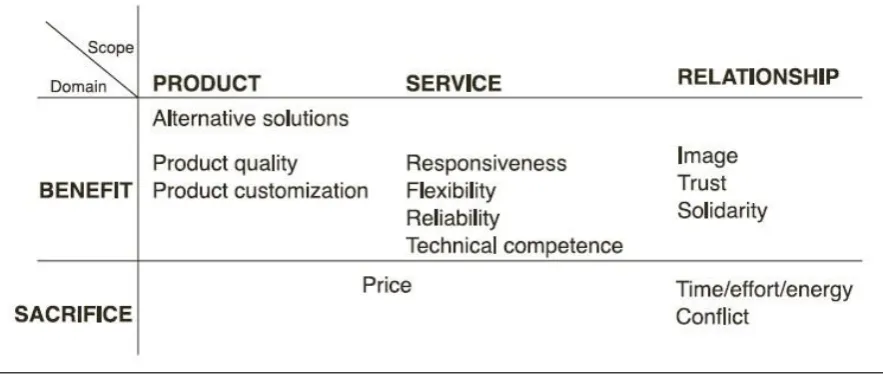
Figure 2: Total value proposition (La Pierre, 2000)
Both value and price aspects are included, referred to as ‘benefits and sacrifices’. The thirteen elements in the middle of the model are related to either these benefits or sacrifices. These elements will give insight in the value proposition of Say Yeah. According to La Pierre (2000), a value
proposition can be analysed based on thirteen elements. The first ten elements give insight in the value and benefits that are gained by doing business with Say Yeah. The last three elements provide
information about the sacrifices that must be made when doing business with Say Yeah. The model captures many aspects including product, service and relationship aspects which are used to create a comprehensive insight of the value proposition. The elements within the model will be explained in Appendix E.
The elements are based on a perceived customer value model (Table 4) of La Pierre (2000) and therefore perfectly corresponds with the elements of that model, which will be explained later in section 2.2.4. In order to have the possibility to explicitly compare the analysis of value proposition and customer value (on which the value proposition should be based), it is most valid to have the same elements. These elements are called ‘drivers’ by La Pierre (2000).
2.2 Definition of customer value
According to Parasuraman (1997), customer value seems to be a topic which is of growing interest to both managers and researchers. ‘’Over the past years, the Marketing Science Institute has consistently included customer value in the list of its research priorities’’ (Ulaga, 2001, p.315). Literature states that marketers in these days place customer value at the core of their marketing strategies during business activities (Ulaga, 2001).
Customer value explains the perspective of how certain customers judge and value products, services or elements within these offerings (Graf & Maas, 2008). Customer value describes the relationship or the interaction between the quality of a product or service that the customer experiences and the price that is paid to obtain that product or service. Customer value describes how important certain elements are compared to the entire product or service. It also describes how to manage it, in order create a satisfied customer’’ (MVS Position Paper, n.d., p. 3). Customer value is a concept which is perceived by the customers only, rather than objectively determined by the suppliers (Kiritsis, Emmanouilidis, Koronios, & Mathew, 2009).
2.2.1 Customer value and customer satisfaction
A lot of academic articles about customer value can be found. In many of these articles customer value is associated with customer satisfaction. Most articles also appoint customer satisfaction since the two concepts seem to be very similar. Yet, the similarities between customer value and customer
satisfaction are used interchangeable too often. This is incorrect since these concepts are two different dynamics associated with a purchasing decision (MVS Position Paper, n.d.). The definition of
customer value is clear already, but the definition of customer satisfaction still needs some
explanation. Customer satisfaction seems to be the consumer's evaluation of the perceived discrepancy between prior expectations and the actual performance of a product or service as perceived after its consumption (Caruana, 2002, p. 815).Both concepts seem to overlap with some parts of their definitions, but there are a couple of crucial differences illustrated in Appendix F. These differences provide additional information on the clarification of why this research focusses on the concept of customer value instead of customer satisfaction. An short explanation will be given beneath.
First of all it is important that the highest amount of useful information is gathered to eventually create a comprehensive and meaningful recommendation about arranging the value proposition of Say Yeah. Therefore it is appropriate to choose the broadest and most recent concept which is customer value. Secondly, customer value seems to be most appropriate since Say Yeah is operating in a business-to-business market rather than business-to-business-to-customer market. This research is about identifying customer value within the entire health and government related segment and not just for specific customers. After all, this research eventually is about the arrangement of a value proposition based on customers, therefore it should be possible to create an alignment between a value proposition and a concept which illustrates the value of customers. This is most appropriate when focusing on customer value.
2.2.2 Perceived customer value and desired customer value
Within the concept of customer value, two different perspectives can be recognized: ‘perceived customer value’ and ‘desired customer value’. Customers may consider value at different times, since the perception of value can reflect prior to purchases or after experiencing a product or service (Woodruff, 1997).
As stated before, the perceived customer value comes down to the assessment of what has already happened and experienced , whereas the desired customer value demonstrates what the customers want to happen or which benefits are sought (Graf & Maas, 2008). Perceived customer value is dependent on a specific user experience (Graf & Maas, 2008, p. 5). According to Graf and Maas (2008), perceived customer value is a trade-off between benefits and sacrifices that is actually
perceived by a customer. When measuring this perspective of customer value, current customers need to be asked since they already experienced a product or service. Desired customer value on the other hand, is independent on a specific use experience (Graf & Maas, 2008). It describes a conceptualized relationship between a customer and a product or service. When measuring desired customer value, there will be a focus on potential customers, since these customers do not have an experience with a product or service yet.
This research focusses on ‘perceived customer value’ rather than ‘desired customer value’, since the management of Say Yeah is interested in the judgements and values of current customers. They cannot state with a 100% certainty which target customers are willing to purchase a video in the future, so the potential customers cannot be recognized. At the same time, ‘the total value proposition model’ of La Pierre (2000) focusses on perceived customer value instead of desired customer value. Due to these reasons, perceived customer value is more appropriate within this research than desired customer value.
2.2.3 Perceived customer value
Perceived customer value is a concept of which several definitions exist. Literature shows a wide range of definitions which all define the concept, but in a slightly different way. According to Day (2002) not a single definition is widely accepted and besides it is stated that current definitions of the concept seem to be somewhat ambiguous (Parasuraman, 1997). Some examples of definitions will be demonstrated beneath.
perceptions of what is received and what is given’’ (Zeithaml, 1998, p. 14).
2. Perceived customer value is a ‘’customer perceived preference for and evaluation of those products attributes, attribute performance, and consequences arising from use that facilitate (or block) achieving the customer goals and purposes in use situations’’ (Graf & Maas, 2008, p. 6).
3. Anderson and Narus (1998) state that ‘’customer perceived value in business markets is the worth in monetary terms, of the technical, economical, service and social benefits a customer’s company receives in exchange for the price it pays for a market offering’’ (Anderson & Narus, 1998, p. 54).
4.‘’Customer value in business markets is the perceived worth in monetary units of the set of
economic, technical, service and social benefits received by a customer firm in exchange for the price paid for a product offering, taking into consideration the available alternative suppliers’ offerings and prices’’ (Anderson, Jain, & Chintagunta, 1993, p.5).
Despite the different perspectives, most of the definitions on perceived customer value have some area of consensus. Almost all definitions come down to the idea that it can be described as the offering a customer gets in exchange for the price the customer pays for it.
All definitions seem to address a slightly different perspective of this trade-off. No one definition is widely accepted, but within this research some seem to be more appropriate than others. The second definition for example, focuses on achieving certain goals that customer might have. This definition is inappropriate since it is not only important to know whether goals are achieved or not, but also how and in what particular way these goals are achieved. Say Yeah wants to focus on the overall value so that they might be able to get information about why those goals are achieved or not. The third and fourth definition are both about the value in monetary terms, which is too restricted since Say Yeah wants to know more about the perceived value than just the monetary terms. Besides this research is conducted in a qualitative way, so monetary terms (which are often expressed in terms of numbers) seem to be inappropriate. The fourth definition even has to do with possible competition and the alternative products. This goes beyond the scope of this research, since it is not possible to take into account some competitors. This is due to the time that is scheduled for this research and restricted knowledge about the competitors within the management of Say Yeah. Broad definitions such as the first one seem to be best suited, since it creates the most comprehensive and a qualitative picture from the trade-off between what one gets and what one pays.
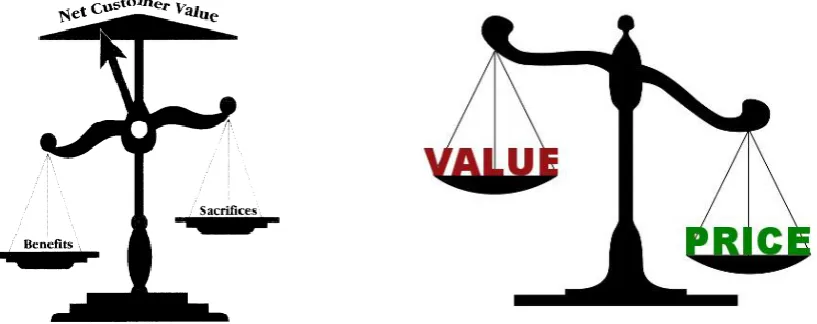
The general trade-off, which can be recognized within such a broad definitions corresponds to one of the business definitions of Woodall (2003): the ‘net perceived customer value’, which is a utilitarian balance of benefits and sacrifices. It involves a trade-off between what the customer receives (e.g. quality, benefits, value and utilities) and what the customer gives up to acquire and use the product (e.g. price and sacrifices) (Woodruff, 1997).The main elements within this trade-off, correspond with the main characteristics a market offering has according to Anderson and Narus (1998): its value and its price. Benefits can be compared with value whereas the sacrifices with price. The focus during this research will be on the latter definition of perceived customer value, and will be demonstrated by two similar balances in Appendix G.
2.2.4 Analytical models of perceived customer value
be made when doing business with Say Yeah (La Pierre, 2000). The clear explanation of the different drivers within this model can be found in appendix E also, since these drivers correspond with the elements of the total value proposition (Figure 2).
Chapter 3: Research methodology
3.1 Type of research
This research will be conducted in a qualitative way and therefore the data that will be collected will not be numerical. The research questions and the questions asked to respondents are open question, which is a characteristic of qualitative research (Baarda, 2014). Qualitative research is appropriate within this thesis since this research is about exploring a phenomenon. Qualitative research is often related to descriptive research which has a major purpose to describe a situation or an event rather than declaring or explaining a phenomena (Babbie, 2013). This aspect corresponds with this research as well. Even though it is widely known that qualitatively research can sometimes cope with problems of subjectivity, a qualitative descriptive research is still most appropriate in this case.
3.2 Data collection
While conducting qualitative research, different types of data will be collected. First of all, secondary data will be gathered in order to create a theoretical framework and get some information about the general company description of Say Yeah. Secondary data can be described as data that is originally gained for some specific purpose but then reused for another research question (Hox & Boeije, 2005). The secondary data which will be used during this research are based on academic articles and books about the main concepts followed by the official website of Say Yeah. The actual analysis will be done with primary data, which is original data that is collected for the specific research goal within this research. The primary data will be collected by means of interviews with the management of Say Yeah, as well as with their target customers.
3.2.1 Semi-structured interviews
Both interviews will be conducted in the same way since both models of value proposition (Figure 2) and perceived customer value (Table 4) include the same elements. The management and the
customers will be interviewed face-to-face and in a semi-structured way. The semi-structured approach is appropriate since it is important to cover all the relevant items of the question guide. At the same time there is a possibility to take advantage of the additional data which can be asked for. Respondents might give additional data which creates an opportunity to get new insight and ideas. New insight can also be created due to the fact that the interviews consist of open-ended questions. This type of questions create the opportunity for respondents, to answer in their own words, rather than forcing them to choose from a fixed number of responses (Mack, Woodsong, Macqueen, Guest, & Namey, 2005).
The interviews will both partly be based on the pre-determined question model of La Pierre (Appendix H), which is directly connected to the elements of the ‘perceived customer value’ model (Table 4). Since both models include the same elements, this question guide will be used within the value proposition too (Figure 2). The management questions will be adjusted towards a supplier perspectives, so these questions will give insight in the way Say Yeah thinks they perform on the certain elements. In other words, information will be provided about the way Say Yeah thinks their customers value their products and services. The customer questions will have a customer perspective and provide insight in the perceived customer value. Some of the questions within the original model seem to be irrelevant within this industry, so these are omitted. Besides, some questions resemble each other, so in that case two questions are being combined to one single question.
3.2.2. Ranking method
Beyond the questions based on the model, some additional questions will be asked including a ‘ranking question’. By the use of a ‘ranking question’ information can be provided about prioritizing drivers. As stated before, customer value also includes a description of the importance of certain elements compared to the entire offering. Therefore the analysis of the value proposition and
perceived customer value should not exclude this part. Hence, a question will be asked in which both parties should choose the five most important drivers out of all thirteen drivers included in the models. It is a method in which the scores, 1, 2, 3, 4 and 5 are substituted to the five most important drivers (Wilcoxon, 1945). ‘Driver 1’ represents the most important driver, whereas ‘driver 5’ represents the least important driver within the five most important drivers. Ranking is a method in which the comparison and therefore the assessment of the different drivers becomes clear (Zwaard & Goossens, 1997). This question creates an opportunity to literally compare the answers of the management to the answers of the customers, since they will have to answers the same question by using the same answer possibilities. The entire outline of the interviews with the management and the customers will
respectively be found in Appendix I and J.
3.3 Sampling
The process of selecting specific respondents out of an entire population, is called sampling (Babbie, 2013). To get a right sample, a specific sampling method should be selected out of the different possible methods. The methods within this research will be illustrated in the following sections. 3.3.1 Management respondents
First of all the management of Say Yeah is interviewed. Only two interviews will be conducted within Say Yeah since the management consist of just two managers (n=2). These persons have contact with the customers the most and ultimately are in charge. While sampling the management respondents, no specific sampling method is used, since all possible members of the management are interviewed. 3.3.2 Customer respondents
According to Day (2002), ‘’Customer value can differ from consumer to consumer depending upon their priorities and background’. Due to this information, it is necessary to focus on a specific niche market within all different customers of Say Yeah. It is assumed that within such specific niche, the perceived customer value will be quite equal since these customers might have similar priorities and backgrounds. Focussing on such a specific target group would therefore create the opportunity to really go in depth and recognize patterns along the given answers. A specific focus is appropriate, since this idea is in line with the fact that Say Yeah wants to focus on their specific health and government target market.
In total, eight different targeted customers (n=8) will participate within this research. Out of the four health customers Say Yeah has, four customers will be interviewed (n=4). The government related databases consists of eight customers, but also the four most important government customers will be interviewed (n=4). The entire government related database will not be interviewed, since it is
necessary to equalize the amount of government customers to the amount of health customer. In this way the ratio of the type of respondent will not be skewed.
are selected based on a subjective opinion instead of the ‘probability theory’ (Babbie, 2013).
Thereafter, ‘purposive sampling’, is a method in which the units being observed are selected based on the judgement of the researcher about which one will be the most useful or representative (Babbie, 2013, p. 128). The goal is to focus on specific characteristics of a population which eventually will enable a researcher to answer specific research questions. The characteristics of purposive sampling seem to correspond with the characteristics of the sample used within this research. This research focus is on health and government related customer for a specific reason which eventually will be beneficial to answering the main research question. Besides, Saunders (2004) states that purposive sampling is often conducted when there is a small sample size (n=8). The other possible research methods and the reason why those are less appropriate, will be explained in Appendix K.
3.4 Customer value determination process
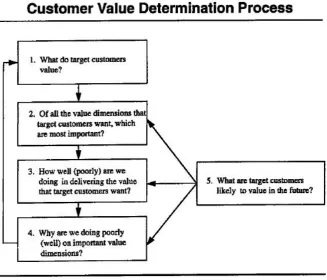
[image:19.595.91.419.319.599.2]The abovementioned research methods will be performed following a specific ‘’customer value determination process model’’ (Figure 5) of Woodruff (1997). According to Woodruff (1997), this model is an expanded framework for understanding customer value. In order to answer the main research question the combination of the analysis of the value proposition of Say Yeah related to perceived customer value of the targeted customers is necessary. To get an analysis of both concepts, this model seems to be appropriate since it can include both concepts in the correct way, after a few adjustments are made.
Figure 5: Customer value determination process (Woodruff, 1997)
Before the first steps of this model can be carried out, the current value proposition of Say Yeah should be determined. This will be done by analysing the answers of the interviews with the management of Say Yeah. Until now, it is possible to answer the first two sub-questions:
How can the current value proposition of Say Yeah be described?
What drivers does Say Yeah describe as the most important value drivers?
In what way do health and government related customers perceive the value of the products and services of say yeah?
What do health and government related customers perceive as the most important value drivers?
When all the information is gathered and both analyses are done, it is possible to compare the data. Step three (3) within this model is about comparing the data. Step three (3) will give insight into the extent to which these data correspond with each other. In others words, the extent to which Say Yeah is doing well or poor at delivering value to their target customers. This third step is equivalent to the last sub-question:
To what extent is the value proposition of Say Yeah aligned to the perceived customer value of
health and governmental related customers?
This research can be described as a descriptive research, since it has the purpose to describe a
situation or an event rather than declaring or explaining a phenomenon. Therefore it is not possible to complete step four (4). The reasons why Say Yeah is doing well or poor on the value dimensions might not be fully clarified. The analysis might give some insight in a few possible reasons and the comparison of the ranking process of the drivers might create an extra opportunity as well. Although, a comprehensive foundation about the reasons why, will not be possible. Step four (4) will therefore be indirectly answered to the greatest extent that might be possible.
Step five (5) goes beyond the focus of this research and therefore this step will not be taken into account. Step five will be changed into another question, which in fact is the main research question. Step five (5) will give insight in the way Say Yeah should adjust its value proposition in order to really correspond with the perceived customer value of their targeted customers. Step five (5) will therefore provide information to answer the main research question:
In what way should Say Yeah arrange its value proposition in order to improve the perceived
Chapter 4: Data and Analysis
4.1 Data & Analysis value proposition
Based on the interviews with the management of Say Yeah the following aspects which are combined and summarized, will illustrate the value proposition of Say Yeah (n=2). The order in which the data is presented corresponds with the order of the elements within the ‘total value proposition model’ (Figure 2) of La Pierre (2000). The data will give insight in the way the management of Say Yeah thinks they perform on each driver. In other words, how Say Yeah thinks their targeted customers value their projects and service on these aspects. This information, which is based on opinions rather than facts, is followed by the ranking question of the most important drivers. This analysis will provide answers to the first two sub questions.
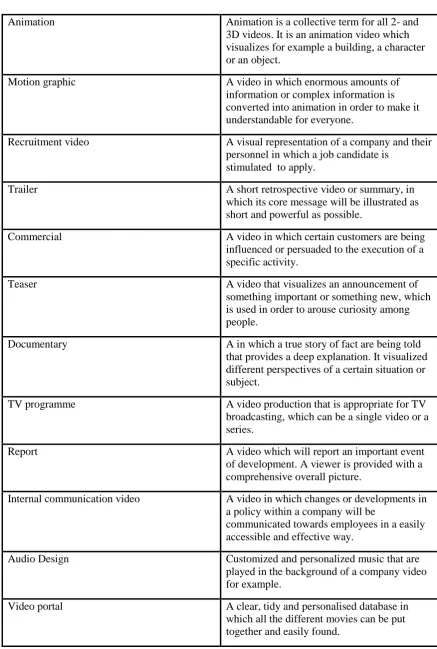
1. Alternative solutions - The interviews reveal that Say Yeah offers a wide range of seventeen alternative videos. All videos can be used for different purposes and problems, so every customer is provided with a selected but sufficient range of products. As it is about these problems, Say Yeah states that their movies make a major contribution in solving these problems due the reactions customers have about their experiences with Say Yeah. The videos deliver such a high contribution in solving the
problems, since they know exactly how to transmit a message of the customers into a video. As Say Yeah understands its customers so well, they are able to really touch people to eventually put them into motion. These aspects ensure that ultimately the customers’ goals will be achieved.
2. Product quality - The management of Say Yeah is aware of the fact that the durability of their videos has become shorter due technical developments which are rapidly occurring. This is also due to the changing environments in which the customer companies operate. They state that the videos in first instance had a durability of three to four years, but that has changed to one year only, most of the times. The reliability of the products is high, since the videos themselves cannot change or become worse. Besides, the improvements of quality are clearly present. Every year the videos are produced in a better way, so the quality of the videos improves over the years. One of the interviews reveals that Say Yeah is sure it delivers high quality products of which the finishing touch is always better than that of competitors (n=1). Yet, the other managers states that they are aware of the fact that they not always take the best camera shots, but they make sure that the message within the video is transmitted the way it should (n=1). 3. Product customization - The interviews reveal that the products of Say Yeah are fully customized, due to the idea that ‘’the customer is always right.’’ The wishes and needs of the customers will become clear by means of extensive conversations in which the customers will be asked all sorts of questions. During this process, which Say Yeah calls ‘’co-creation’’, the customers will be involved so that afterwards the customers feel connected to their own videos. Say Yeah takes the role of a listener within this process. However, they admit that some factors might not for a 100% be according to the wishes and needs of the customers. Some aspects might be deviating due to the intractability and expertise of Say Yeah, but this will also happen in consultation. According to the management, Say Yeah is able to meet the needs of the customers in a better way than its competitors will. They are very good at transmitting the message in the most effective way and besides they offer a products which competitors do not offer such as the video portal.
4. Responsiveness - ‘’Sometimes we visit our customers in order to get a better feeling of their business so we can improve tailoring the videos to their wishes’’. Due to a lack of time, this does not happen enough according to the management. Concerning the general responsiveness, the management is really positive. As the interview reveals, they react in a quick way and other jobs will be put aside when customers seem to experience difficulties. They will provide a quick service in which they will always listen to the customers, so all problems will be solved.
Yeah, 2015). But this flexibility will not be infinite, there is some sort of standard which indicates whenever customers can adjust elements or not. In case of urgency Say Yeah has some space for their core customer, but they don’t appreciate it when this happens too often.
6. Reliability - The level of reliability of Say Yeah can be regarded as high, since it is one of its core values. The credibility of the offers and bills are high, since they are clear and complete in terms of information and conditions. They work in a transparent pattern which is based on working hours. These hours can be can be found on a rate-card. According to the management, the extent to which Say Yeah is keeping its promises is high too. They are aware of the fact, that they sometimes suffer with start-up problems but these problems can be solved in time. The competences of the staff members are proper. All members participated in an appropriate education program, so they can all be described as professionals. During the years, the skills of these members even developed.
7. Technical competence - The interviews reveal that Say Yeah describes itself as a very specialized company due to the high appreciation they receive. The staff is educated and able to share their
knowledge in the right way. The quality of the footage may not be the best, but the combination of images together with the story of the video ensures that their videos are the best. The creativity of Say Yeah can be regarded as sufficient but they do not perform crazy activities for some extraordinary creativity. The technology used within the company is appropriate and up-to-date. They always use the latest equipment. 8. Image – According to the management, the customers would describe Say Yeah as a young company in which everything is possible. Say Yeah is a reliable team player who is thinking along and produces effective and creative videos of high quality. Say Yeah fully understands the message of the customers and therefore they are able to transmit that message in the best way. The image of Say Yeah is positive and they appear to be very credible, since they keep their promises.
9. Trust - The information that is provided by Say Yeah is always as accurate as possible. They always inform their customers about the current state of the videos, financial information and other information that is needed. This information is always sincere, since the entire company of Say Yeah can be regarded as sincerely. They have sixty core customers who keep purchasing videos. Agreements or promises are always met and customers can count on Say Yeah. Say Yeah will do whatever is needed to ensure that the video will be effective.
10. Solidarity - Say Yeah is committed to its customers to a high extent. They are willing to help whenever they can and even when it is beyond the contract terms. They try to stay in touch with their customers after they delivered a video, to get information about the effectiveness of the video and about possible future videos. They focus on helping their customers and they are even willing to get their customers in touch with other parties when needed. During a business relation, Say Yeah shares its own difficulties which they come across, with their customers. Being vulnerable is always positive according to the management, since they think that it might trigger other honest reactions of the customers. 11. Price - The prices of the products and services of Say Yeah do not change very often. However the quality of the videos improved over the years, so one might say that the prices figuratively decreased. They think that the price/quality ratio is fair, sometimes this ratio is unfair towards Say Yeah. In general the videos of Say Yeah are more expensive than their competitors’ videos, but these competitors do not offer such a high quality.
same amount of effort into their relationship, which comes down to aligning the ideas about the core message of the video with the corresponding budget.
13. Conflict - Conflicts do not often occur within the business relations of Say Yeah, since they think that a dispute will not solve a problem. They will always find a way to shy away from disputes, but whenever necessary they will find an appropriate way to solve such a conflict, by means of conversations. A primary reason for a possible conflict might be a disagreement about the budget. Regarding the
interference of Say Yeah, they do not interfere with the business goals of their customers. They assume that their customers know how to run their businesses and therefore no disagreements about business goals will ever occur.
[image:23.595.57.518.249.357.2]It can be concluded that the management is satisfied about their products and services since the majority of the answers are positive. Yet a few negative remarks are made of which the managers are aware.
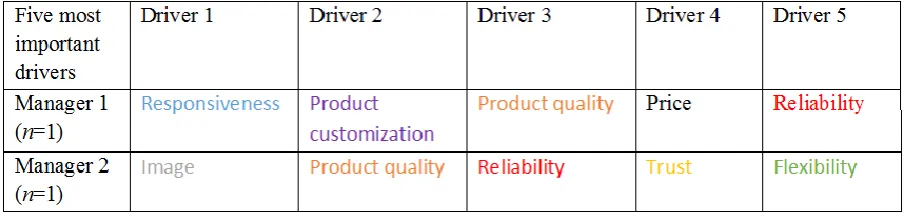
Table 5: Five most important drivers within the value proposition of Say Yeah.
The table above (Table 5) demonstrates the answers of the ranking question, in which the management of Say Yeah was asked to rank the five most important drivers. As the table demonstrates these answers do not correspond in the same way as the answers on the open questions. Both project managers do attach the most value to very different drivers, but they seem to agree on the importance of product quality and reliability. Both product quality and reliability are mentioned twice (n=2). Besides they agree on the fact that, solidarity, conflict, technical competence, alternative conflicts and time/effort/energy can be
regarded as less important drivers. No similarities can be found along the certain spots within this ranking process. None of the drivers are mentioned on the same spot.
4.2 Data & analysis perceived customer value
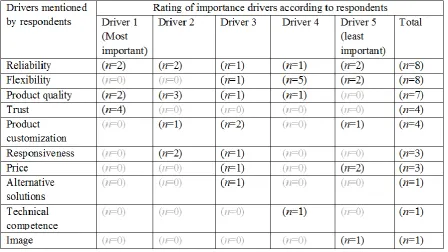
The following data, which is combined and summarized, will illustrate the opinions of the eight respondents, about the products and services of Say Yeah (n=8). It will provide insight in the perceived customer value of these respondents. The order in which the data is presented corresponds with the order of the elements within the ‘perceived customer value model’ (Table 4) of La Pierre (2000). This data is followed by the importance of the different drivers. The entire analysis which is based on opinions rather than facts, will eventually provide an answer to the third and fourth sub-question.
1. Alternative solutions – All respondents experience that whenever they do not know what type of video they want, Say Yeah provides different and sufficient types of possible videos (n=8). After discussing these types, the appropriate video comes up. The advices of Say Yeah within this consultation are
regarded as important and decisive. However one respondent thinks this process can improved when more examples of these videos are shown (n=1). Every respondent assumes that the contribution of the videos in achieving the goal is high, due to high amount of positive reactions and the reach that has increased (n=8). Though two respondents state that the effectiveness of the videos cannot be measured and
therefore one would appreciate it to set some measureable goals before producing the video (n=1). In this way the customers are able to check whether the video is as effective as they wanted. They can check e.g. whether the video itself caused the increase in brand awareness of 10% or it is due to some other reasons. 2. Product quality - The overall level of quality of the videos is regarded as high according to all
technical aspects in which the lyrics, images and audio perfectly match. Besides the film techniques that are used can be described as proper. According to the lifetime of the videos some customers are aware of the fact that this not only determined by Say Yeah, but nevertheless all respondents experience its lifespan as sufficient (n=8). The lifetime is estimated on an average of two to three years. As far as some
customers can judge they recognize a consistency within the quality and some even state that the quality has improved over the years (n=6)
3. Product customization - In general the majority of the respondents experiences that the videos are fully customized (n=6). They state that within this process Say Yeah listens to the requirements and wishes of the customers and they make effort to understand its customers. However two respondents experience that Say Yeah does not listen that carefully (n=2). Say Yeah is too focused on their own opinion sometimes, but they should create some space for their customers in finding out what they really want.
During the customization process one would prefer to get involved in the production of the video more often, even when producing a short video (n=1). At the moment when customers see parts of the
production in the meantime, they assume that the video would correspond more to what they had in mind at first. Despite the fact that the office of Say Yeah is closely located to its customers and the professional experiences of Say Yeah, most customers do not necessarily assume that Say Yeah is able to better meet their needs than competitors can (n=5). Out of the five respondents who are able to judge about the diversification of the wide products range, the majority thinks this range is not distinctive from its competitors (n=4).
4. Responsiveness - The level of responsiveness within the service of Say Yeah is described as high according to all customers (n=8). Say Yeah is always willing to help their customers. They are easy to reach even after office hours, and are able to quickly come up with appropriate solutions. Within the production Say Yeah should sometimes better listen to its customers according to the minority (n=2). In the beginning Say Yeah does not always understands its customers very well, but this has improved. In first instance they apply their own approach which is too simplistic and performed with a blinkered view. According to all customers, Say Yeah does not visit their customers often beyond the projects meetings, but this is not necessary since Say Yeah has enough knowledge about the businesses activities of their customers (n=8).
5. Flexibility - The level of flexibility is regarded as high and this seems to be an element on which Say Yeah distinguishes itself from others, according to all respondents (n=8). Say Yeah starts with the production very fast and they are flexible regarding time, and locations or approaches to be used. All respondents agree on the fact that Say Yeah easily adapts to the wishes of the customers (n=8). Say Yeah will always think along and never turn customers away, even when it is about urgent cases which
suddenly pop up.
6. Reliability - The reliability of Say Yeah is described as high, but some improvements can be made. The bills seems to be proper according to the majority of the customers (n=6). However, two respondents states that those are not very accurate (n=2). The number of hours spent on the production is not always in accordance with the offer that was made in first instance. The way Say Yeah allocates hours to the actual work and the justification of these hours is not clear enough according to some respondents (n=2). Their promises on the other hand are always clear. They keep their promises and are even willing to adjust these promises based on the wishes of the customer according to all respondents (n=8). The productions are not fully correct the first time. This is not only because of Say Yeah, since it is dependent on the briefing of the customers too. ‘A start-up problem’ therefore is not the correct term according to the customers since none of the respondents describe this as something bad (n=0). In general the competence of the staff can be regarded as high and professional, which even develops over the years. Although one customer states that its company does not appreciate it that the speed and quality of the videos are affected by the fact that projects are led by trainees too often (n=1).
does not agree on this (n=2). These respondents think that Say Yeah is just suitably creative. Their creativity is adjusted to the type of customers and therefore they are not very distinctive and trendy. Besides, they rely on the requirements of their customers too much, instead of controlling the process with their own creativity. The intense focus on Twente results in footage that less unique, similar and sometimes even standardized. The level of creativity is therefore reduce due to this focus. All customers think that Say Yeah is specialized, but some also states that their specialty is not distinctive when comparing to competitors (n=8). Since Say Yeah does not use technical terms towards its customers, all respondents agree on the idea that Say Yeah expresses its knowledge in an appropriate way (n=8). However, some improvements should be made since they are too modest in expressing their knowledge according to some respondents (n=2). Say Yeah has more potential than they actually say they have. Besides, the way in which they show their customers how they reached the final script and why they choose a specific content, can be improved too. It is stated that some respondents would appreciate it when Say Yeah fully explains what activities they perform, how they perform them and more importantly why they perform these activities (n=2). This should be followed by information about how they have reached the final script and how they came up with a specific implementation. This process is not transparent enough. As far as the customers can judge, the equipment is appropriate and up to date to the majority (n=5).
8. Image - The overall image of Say Yeah can be regarded as positive according to all respondents (n=8). Some state that the image of Say Yeah sometimes is related to the personal image of the managers (n=2). The respondents describe Say Yeah as enthusiastic, dynamic and flexible with a focus on Twente. Some customers state that the focus on Twente is too concentrated (n=2). This leads to the fact that within Twente, Say Yeah uses the same footage too much and they miss potential customers beyond the area of Twente. All respondents state that the credibility within its image is high because ‘’they say what they do and do what they say’’ (n=8). Say Yeah is enthusiastic, but they do not promise things which they cannot live up to. They should sometimes act less modestly since some customers experience that Say Yeah has more potential than they actually say (n=2). They should better profile themselves since many people still have the image that Say Yeah is just a little video production company but currently they are able to offer much more than just ‘a video’.
9. Trust - In general all respondents have confidence in Say Yeah (n=8). Say Yeah can be regarded as very sincere since none of the customers have the feeling that they are being fooled (n=0). In general the information that is provided is correct and accurate. Although sometimes the information can be a little vague and they should be more straightforward (n=2). After the video is produced, Say Yeah is always interested in the effect and whether everything went well or not. The majority thinks that Say Yeah will do whatever it takes to achieve the best result (n=7). While one respondent actually states that its organisation experiences little to no after care (n=1). Say Yeah provides too little advices about the distribution of the videos. The way in which customers should present the videos or the best places are often rarely mentioned by Say Yeah.
10. Solidarity – The level of solidarity and commitment is experienced are very high by all respondents (n=8). Say Yeah is really committed to its customers and Twente and feels responsible for the transfer of the message within the videos. Say Yeah always wants to help when customers run into problems. Some of the customers explicitly state that Say Yeah does not focus on profit but on the business relationships, which they always want to improve (n=3). As far as the respondents can judge, Say Yeah is really open towards its customers and they would definitely share its own problems whenever these are present (n=8). Because of the fact that clear agreements are made before the productions starts, it is not needed to go beyond the contract terms. Whenever this is necessary, all customers still think that Say Yeah would also respond to those needs (n=8).
references to the quality (n=2). The general price quality ratio can therefore be regarded as fair to the majority.
12. Time/effort/energy – The interviews reveal that is it easy to get in touch with Say Yeah, especially by mail. The contact moments between Say Yeah and its customers can be regarded as sufficient according to the majority of the customer (n=7). These moments are a few times a year often by mail or telephone and real life meetings occur when videos are produced. The amount of real life meetings during projects should be higher according to one respondent (n=1). Regarding the effort, every customer seems to be satisfied (n=8). Say Yeah puts a lot of effort in everything they do, not only on the business aspects but also in personal contact. They invite customers to lunches, drinks and events. Meanwhile all customers experience the effort they have to do themselves, as a little effort (n=8). Customers only have to explain their goals and the message that should be transmitted, and make sure that they are aware of the current state of the video. Therefore all respondents experience a ratio of effort which is in proportion and therefore fair (n=8).
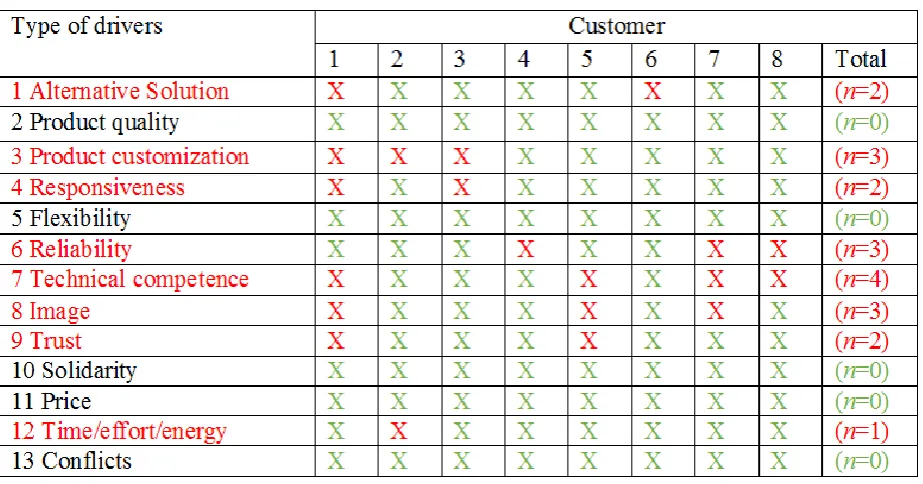
13. Conflict - Some respondents sometimes have discussions with the management but none of the respondents experiences some serious conflicts (n=8). This is except for one conflict, which has been resolved already. Conflicts are rarely present due to the clear agreements that are made beforehand. All customers are sure that any future conflicts would be solved very quickly (n=8). Conflicts about the business goals of the customers never appear since Say Yeah does not get involved in these goals. This is proper since all customers think that Say Yeah should absolutely not interfere within these goals (n=8). In general, all respondents are satisfied about the products and services of Say Yeah, but some negative experiences are mentioned referring to a particular group of drivers.
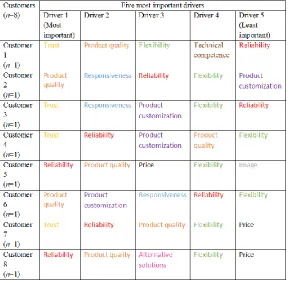
[image:26.595.59.508.390.642.2]
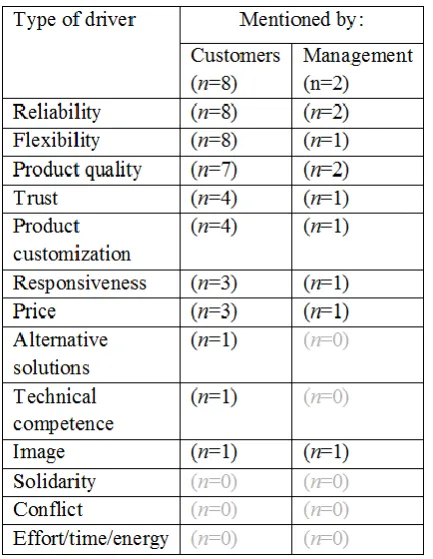
Table 6: Most important drivers according to the customer respondents.