Reducing Meat Consumption Using A Mobile
Application
Marrit Schellekens
Supervisor: Dr. A. Kamilaris
February 2018
Abstract
Contents
1 Introduction 3
2 State of the Art 3
2.1 Literature Review: Perceived benefits and barriers of reducing
meat consumption . . . 3
2.2 How habits can help . . . 5
2.3 Existing Apps . . . 5
3 Ideation 6 3.1 Design guidelines . . . 6
3.2 Exploratory Sketching . . . 8
3.3 The log screen . . . 8
3.4 The Goal setting . . . 11
3.5 Progress visualization . . . 12
4 design and implementation 13 4.1 Logging of meal . . . 13
4.2 The leveling system . . . 13
4.3 The inspire and inform buttons . . . 13
4.4 The Impact Screen . . . 16
4.5 The visualization screens . . . 16
4.6 Notifications . . . 16
4.7 Implementation . . . 17
5 Evaluation 17 5.1 Formative Evaluation . . . 17
5.2 Final Evaluation . . . 17
6 Conclusion 21 7 Future Work 21 References 23 Appendix A Sketches 25 Appendix B Inspire and inform strings 29 B.1 Inspire strings . . . 29
B.2 Inform strings . . . 30
B.3 Sources . . . 31
Appendix C Calculations for the Impact Screen 32
1
Introduction
Agriculture has a big impact on our environment. It causes climate change, animal habitats disappearing, eutrophication of water bodies and water short-ages. Agriculture also utilizes pesticides, and animal agriculture plays a role in creating antibiotics resistance (Tilman et al., 2001). Animal agriculture is more resource intensive than plant agriculture. When comparing a meat-based diet against the ovo-lacto vegetarian diet, the meat-based diet requires more energy, land and water (Pimentel & Pimentel, 2003). Reducing meat intake is the most effective measure concerning food that a consumer can take to reduce their greenhouse emissions.(Garnett, 2011). In fact, the only other measures that are more effective are living car-free, avoiding airplane flights and limit-ing the amount of children. (Wynes & Nicholas, 2017). A diet that contains less meat and more plant foods is not only environmentally better but also has a positive effect on the individual’s health. A reduction of meat and increase in vegetables is associated with lower rates of cancers and coronary heart dis-ease (Duchin, 2005). Given these advantages (both globally and individually) convincing people to reduce their meat consumption is an important task.
Technology can be a helpful tool for convincing people to reduce their meat consumption because it can easily be scaled up for limited cost, and is always present in a way humans could never be.
2
State of the Art
2.1
Literature Review: Perceived benefits and barriers of
reducing meat consumption
To develop a technological tool it has to be investigated what pathways will work best to convince consumers. This section contains the results of a literature research on the perceived benefits of and barriers to reducing meat consumption, the strongest motivation for reducing meat consumption, and how well informed people are about the benefits.
moderation’ . Additionally ’plant-based diet’ is mostly used when talking about the health benefits of meat-reduction, while flexitarian/vegetarian is used more when talking about the ethical benefits (especially animal rights). In Povey et al. (2001) The meat eaters didn’t have ethical associations towards a vegetarian diet. (The respondents were limited to 8 associations) In Lea et al. (2006) the highest recognized ethical benefit was ’Help the environment’, with 35% of people agreeing. ’Animal welfare’ was just below that with 30% of agreement.
Health is also the most important motivation for people to reduce their meat intake. In Latvala et al. (2012), and Tobler, Visschers, and Siegrist (2011) health was the biggest motivation for reducing the meat consumption. In Lentz, Con-nelly, Mirosa, and Jowett (2018) cost savings were ranked higher than health. In de Boer, Sch¨osler, and Aiking (2017) both environment and variation in meals were ranked higher than health. This last difference is probably because that study focused on young people (18-35 years). Most likely health reasons become more important as people grow older. Another motivation that was consistently mentioned across studies was taste and/or variation (Lentz et al., 2018; Latvala et al., 2012; de Boer et al., 2017). The importance of other reasons such as an-imal welfare and environment differs across the studies. The motivations don’t change when only looking at people who already substantively reduced their meat intake. (Lentz et al., 2018; de Boer et al., 2017). However, when looking at vegetarians, animal welfare became the most important motivation. (Lentz et al., 2018; de Boer et al., 2017).
The biggest perceived barrier to reducing meat reduction is the enjoyment of eating meat (Povey et al., 2001; de Boer et al., 2017; Lea & Worsley, 2003; Hoek, Pearson, James, Lawrence, & Friel, 2017; Macdiarmid, Douglas, & Campbell, 2016). The second biggest barrier was having to change eating habits. (Lea et al., 2006; de Boer et al., 2017; Lea & Worsley, 2003; Hoek et al., 2017; Macdiarmid et al., 2016). Other barriers that were often mentioned were lacking information or cooking skills, the belief that regularly eating meat was healthy and having to cook for a meat-loving family or partner. (Povey et al., 2001; Lea et al., 2006; de Boer et al., 2017; Lea & Worsley, 2003; Hoek et al., 2017; Macdiarmid et al., 2016).
The environmental impact of meat is structurally underestimated by con-sumers. People consistently rate eating less meat as the lowest effective diet measure, thinking that it was less important than: buy organic, avoiding air transport, eating local, eating seasonal, avoiding packaging, and avoiding food waste (Lentz et al., 2018; Hoek et al., 2017; Tobler et al., 2011). It was also rated lowest when compared to general methods to reduce greenhouse emission, such as energy use and waste (Vanhonacker, Van Loo, Gellynck, & Verbeke, 2013). Lea et al. (2006) shows that there is also a lot of uncertainty on the other advantages, such as animal welfare, which had an uncertainty of 43%, increasing efficiency of food production with 51% uncertainty, and have a tasty diet with 37%.
is structurally underestimated. Animal welfare seems to be especially important to those who have completely cut out meat of their diet, but less so for those who have only reduced their meat consumption. The biggest barrier for people to reduce their meat consumption is their enjoyment of eating meat and not wanting or being able to change their cooking and eating habits. It seems that the most promising pathways are to inform people about the additional benefits of reducing meat consumption (besides health), help them to gradually create new habits and offer tasty recipes, which are mostly quick and easy.
2.2
How habits can help
When we talk about habits we don’t just refer to the frequency of an occur-rence. According to Lally, Van Jaarsveld, Potts, and Wardle (2010), drawing on the work of Wood, Tam, and Witt (2005) and Verplanken (2006), ”habits are acquired through incremental strengthening of the association between a situa-tion (cue) and an acsitua-tion, i.e. repetisitua-tion of a behaviour in a consistent context progressively increases the automaticity with which the behaviour is performed when the situation is encountered”. Lally et al. (2010) show that the median time to establish a habit is 66 days, although there is a large difference between individuals, resulting in a range of 18 to 254 days. They also show that not per-forming the behavior one time does not lead to a significant decrease in habit strength.
2.3
Existing Apps
Self Mon-itoring Goal setting Feedback behavior outcome Leader boards So-cial
Less X X x x x
Climatarian Challenge
X v X x x
Darwin Challenge
X X X X X
TastyVist x v x x x
Quit meat X x X x x
Veganm8 x x v x X
VeggieApp x x v x x
Eat4Good x x X x x
forGood x x X x X
Table 1: Behavior change Techniques used by various apps. vin Goal Setting column means that the goal is chosen by the app and cannot be changed by the user. v in Goal setting means that the app sets a default goal that the user can’t change.
the reason(s) that you want to reduce your meat consumption. (Climate, health, animal welfare, industrial agriculture, or fight global hunger.) You also select in which situations you have difficulty finding meatless alternatives, the reasons that you find it hard to eat less meat (for example tradition, or taste, or lack of knowledge), and the difficulty rating (easy or expert). The app then offers several possible goals or tasks. Every task has a difficulty rating. It offers the possibility of notifications to remind you of your chosen goal. People can swipe through the tasks untill they find one that they like. When completing a task you earn points, and if enough points have been earned the user ’levels up’.
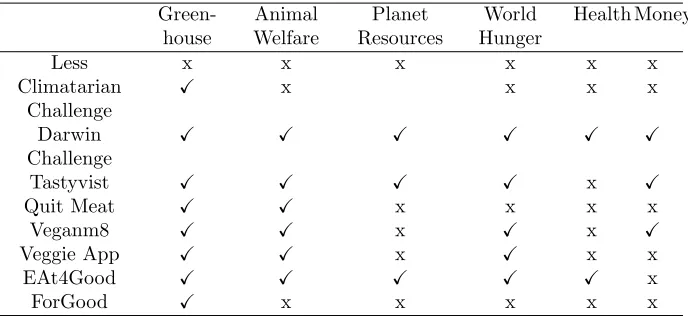
In tables 1 and 2 an overview is given of all the different techniques used in the apps. In table 3 an overview is given of which advantages the app promotes. It was decided that self monitoring and feedback on behavior outcomes were the most important elements to incorporate in the app. Additionally either a social element or a gamification element could be included.
3
Ideation
3.1
Design guidelines
Lev-els
Chal-lenges
Recipes Tips & Background
Less x x x x
Climatarian Challenge
x x x x
Darwin Challenge x X x x
TastyVist X X x X
Quit Meat x x X x
Veganm8 x x X x
VeggieApp x x X X
EAt4Good x x x X
[image:7.612.136.480.440.598.2]ForGood X X x x
Table 2: Behavior change Techniques used by various apps. A continutation of table 1. Green-house Animal Welfare Planet Resources World Hunger Health Money
Less x x x x x x
Climatarian Challenge
X x x x x
Darwin Challenge
X X X X X X
Tastyvist X X X X x X
Quit Meat X X x x x x
Veganm8 X X x X x X
Veggie App X X x X x x
EAt4Good X X X X X x
ForGood X x x x x x
automated reaction to certain contextual clues. A habit may be formed by repeatedly performing an action. Additionally, implementation intentions can help in establishing a habit. (Verplanken & Wood, 2006).
One barrier mentioned by multiple people is that they really enjoy eating meat. This barrier should be addressed by incorporating recipes without meat that taste good and tips to create appealing meals without needing meat. Ad-ditionally, the app should fit unobtrusively into people’s life and offer help or advice at the right moment, offer feedback on how well they are doing and if they are meeting their goals. Also, because people seem to be largely unaware of all the benefits of reducing meat consumption, the app should inform them of these benefits in an intuitive and meaningful way.
In summary, the following design guidelines were extracted. The app should:
1. Create new habits and disrupt old ones.
2. Help the user create tasty recipes that don’t require additional cooking skills.
3. Clearly inform the user of how they are doing and their progress.
4. Inputting their meat consumption should be quick and easy.
5. The user should feel accomplished when they manage to reduce their meat consumption.
6. Inform users about the advantages of reducing meat consumption.
3.2
Exploratory Sketching
To start of with several initial sketches were made. These sketches were to explore various designs and methods of incorporating the design guidelines. In figure 1 one example of these sketches can be seen. More sketches can be found in appendix A. In figure 3.2 an early prototype can be seen made with prototype design software MarvelApp. For some design elements there were several considerations and options. These elements will be discussed in the following subsections.
3.3
The log screen
When choosing how to log the reduction in meat two different guidelines have to be balanced. On the one hand you want to make it as quick and easy as possible for people to log their successes or failures (guideline 5) In this the Darwin Challenge excels, only one button press is needed. However, by leaving out too many details might not feel rewarded for certain actions. (guideline 6) For example, having complete meat-free days might not be practical for some people. (For example those who participate in a cooking group, or where their partner often prepares dinner). For them a ’Vegetarian till 5’ approach might be more suitable. However, this approach will not be rewarded by the Darwin app. Another problem is if you want to be more effective in reaching your goal by choosing different kinds of meat. For example, beef is by far the worst meat when it comes to causing climate change. In the ’climatarian challenge’ this also means losing more points compared to eating chicken. However, this approach could be problematic because beef is arguably better for saving animal lives since more meat is gathered from one animal life. One workaround would be to let people set their motivation beforehand and use this to personalize which meats are ’good’or ’bad’. The downside of this is that making users aware of all of the positive benefits of meat reduction will help make the user for stronger intentions (guideline 8). By only focusing on one motivation this effect would be lost. Given these considerations it was chosen to not include the type of meat eaten.
Portion size is also problematic. Allowing people to log the amount of meat eaten means they will be rewarded when eating smaller portions. However, if you use icons such as in the climatarian challenge app different people might have very different ideas about how big a big or small portion is. On the other hand, forcing people to input the amount of grams eaten means an extra men-tal task (and in many situations people might not actually know how much eat they’ve eaten). Given these considerations, it was chosen to not have a portion option or an option for different kinds of meat. However, the app will allow logging for each meal separately.
3.4
The Goal setting
be more likely to maintained). They are easy to remember and people know immediately if they are accomplishing their goal or not. It was chosen to have specific days and meals on each day in order to create strong habits that rely on contextual clues. For example, people might associate not eating meat with laundry day, or the specific time they get home. This effect would be lost if people could simply choose to eat ’x days meatfree’. Additionally, recording the type of animal eaten won’t be reflected in the results reached. In the end a hybrid design was chosen. In the beginning a goal is chosen by the user, e.g. ’meatless Mondays’. When the user doesn’t eat meat on Monday, they receive 2 points per meal. When the user does eat meat on Monday, they receive negative points. These negative points start at -1, but grow bigger with each subsequent time the user fails their goal. When they succeed at their goal for one meal this streak is broken and the negative points awarded is reset to -1. This is because missing a single instance doesn’t hinder the building of a habit, but longer periods of not performing the behavior do impact the habit (source), so when the user does not achieve their goal, they should be encouraged as quickly as possible to start their habit again. If the user has a meat-free meal outside of their set goal they are awarded 1 point.
When the user reaches a certain amount of points they ’level up’. (source) state that the average time to establish a habit is 60 days. Therefore the final level should correspond to 60 days of performing the habit successfully. Ideally the user should then be urged to choose a harder goal and start over again. Of course, this should not be forced and only at the user’s volition.
3.5
Progress visualization
Several systems were considered. One such system was a streak system. This would visualize the days that the user succeeded or failed in their goals using colored circles. This idea was rejected for several reasons. Firstly, the system would become quite complicated to interpret because many of the goals are only relevant on one day (i.e. meatless Mondays). This makes it ambiguous what the color should be on those days where there is no set goal. Additionally it would make it harder to see the increase or decrease in progress. Also, after failing a streak the user might be demotivated to start again because they lost their ’progress’ or streak length.
indicates how far away the user is from levelling up. The third visualization is a detailed break-up of points gained or lost during the last week using various colored circles.
4
design and implementation
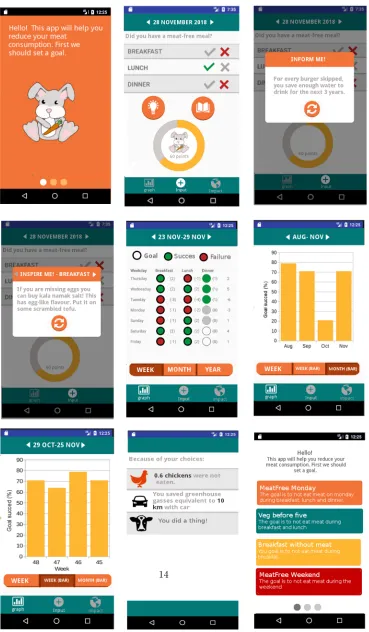
Then a more detailed design was made of the various screens. This can be seen in figure 3 and a navigation diagram can be found in 4. The design guidelines come back in the following way in this design:
4.1
Logging of meal
The logging segment is designed as described in section 3.3, including the dif-ferent meals of the day (breakfast, lunch, and dinner) but excluding the type of animal and amount eaten. The user presses either a check mark or cross which will then change from grey to green/red. The user can also reverse their input. It was placed on the main screen so input was as quick and easy as possible. The date can be changed by pressing the arrow buttons on top of the screen, or by opening a calendar widget by pressing the date itself. This logging segment supports 4: Inputting their meat consumption should be quick and easy.
4.2
The leveling system
The point system as described in more detail in 3.4 is set up to promote habits. Not eating meat on a day with a goal has a higher reward than not eating meat on a day without a goal. Additionally, a failure streak is punished harsher than one single failure.The leveling up animal and donut chart were placed on the main page. In this way the user can see their current progress with a quick glance when inputting their data. This supports1: Create new habits and disrupt old ones, 3: Clearly inform the user of how they are doing and their progress and 5: The user should feel accomplished when they manage to reduce their meat consumption.
4.3
The inspire and inform buttons
has. These can be found in appendix B.2 and the sources for these inform strings can be found in appendix B.3. Both dialogs can show a new string by pressing the refresh button, and for the inspire strings the meal category can be changed with arrow buttons. The recipes and information strings are also presented to the user through the notifications. This supports 2: Help the user create tasty recipes that don’t require additional cooking skills. and 6: Inform users about the advantages of reducing meat consumption
4.4
The Impact Screen
On the impact screen the user can see how much greenhouse gasses they have saved. This is calculated using the input of the user and expressed in kms driven by car. The user can also see how many chickens, cows and pigs weren’t killed because of their diets choices. The calculations can be found in appendix C. This supports5: The user should feel accomplished when they manage to reduce their meat consumption. and 6: Inform users about the advantages of reducing meat consumption.
4.5
The visualization screens
On the visualization page there is a tabbed layout that allows the user to toggle between three different kind of visualizations. The first is a detailed overview of the points lost and gained during the week for each meal. This is done using a colored circle for each meal. The second and third visualizations are bar graphs that show the success percentage of their goal. This second bar graph has a span of one week per bar, while the third bar graph has a span of one month per bar. For all three the visualizations the user can change the data by pressing the arrows on the top of the screen which are next to the date that is currently selected. In this way they can go back or forward in time. This supports 3: Clearly inform the user of how they are doing and their progress.
4.6
Notifications
4.7
Implementation
The app was made using Android Studio. To create the barcharts and donut graph the library MPChartLib was used.
5
Evaluation
5.1
Formative Evaluation
A quick user test was done in order to find possible usability issues. A user walked through the app, voicing their thought process out loud. The following usability issues arose.
• During setup the user was first asked to select their desired goal and notifi-cation option, then a small tutorial was given about the point system. The test users indicated that this sequence was confusing and it was reversed.
• It was desired to have a symbol indicating on the main screen if a particular meal had the goal of not eating meat. This was implemented by using a leaf icon since this corresponds with the vegetarian option on restaurant menus.
• It was often unclear that the example picture during the small tutorial about the point system was just an example and couldn’t be interacted with. This issue wasn’t solved.
• The detailed overview of the points gained or lost during the last week is not understandable for people with red-green color blindness. This issue wasn’t solved, but a potential solution could be using icons inside the circles, or replacing the circles with check marks and crosses.
• Choosing a goal or notification option could be skipped by simply paging forward. This was not the intention and fixed.
• Several bugs and spelling errors were fixed.
The final design of the app can be seen in figure 5.1.
5.2
Final Evaluation
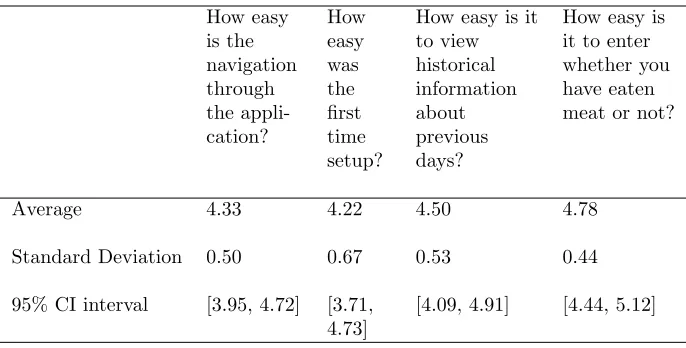
How easy is the navigation through the appli-cation? How easy was the first time setup?
How easy is it to view historical information about previous days?
How easy is it to enter whether you have eaten meat or not?
Average 4.33 4.22 4.50 4.78
Standard Deviation 0.50 0.67 0.53 0.44
[image:19.612.134.477.122.296.2]95% CI interval [3.95, 4.72] [3.71, 4.73]
[4.09, 4.91] [4.44, 5.12]
Table 4: The results of questions regarding the ease of a certain actions. The scale was from 1 to 5. 1 had the label ”very hard”. 5 had the label ”very easy”
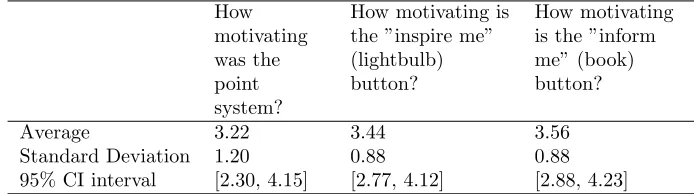
of the app. Most score on average above 3 and below 4. This means that most elements in the app were found to be motivating.
When asked about missing features, 3 out of 7 respondents wanted a more freedom when it comes to setting a goal. A custom goal option that allows choosing specific meals during the week would accommodate this. Additionally 3 out of 7 respondents had some problems with certain buttons being too small. The following improvements were also suggested once:
• ”Individual goals (say I want to not eat meat tomorrow evening, but I do this evening)”.
• ”Next to CO2, the amount of water and (animal) food saved would be very interesting to me.”
• ”A clearer overview of your progress.”
• ”More pictures/icons would be nice”
• ”In the visualization part, the icons that represent goal, success and failure could be improved. Maybe adding an extra help screen could work, where you also explain what the grey circle means.”
How motivating was the point system?
How motivating is the ”inspire me” (lightbulb) button?
How motivating is the ”inform me” (book) button?
Average 3.22 3.44 3.56
Standard Deviation 1.20 0.88 0.88
[image:20.612.130.477.188.285.2]95% CI interval [2.30, 4.15] [2.77, 4.12] [2.88, 4.23]
Table 5: How motivating several components of the app are. The scale was from 1 to 5. 1 had the label ”Not motivating at all”. 5 had the label ”Very motivating”
How motivating was the leveling system?
How motivating were the notifica-tions?
How motivating was the impact screen which showed you the impact of your actions?
Average 3.22 3.33 3.89
Standard Deviation 1.30 0.50 0.93
95% CI interval [2.22, 4.22] [2.95, 3.72] [3.18, 4.60]
6
Conclusion
The aim of this project was to design a mobile application that motivates people to reduce their meat consumption. Animal agriculture has many negative effects on the world around us. It increases global warming, increases eutrophication, and requires more resources than plant agriculture. Additionally, animal welfare in animal agriculture is often of a low standard, and some people might have ethical problems with the slaughtering of animals. During the initial literature research it was found that people often underestimate the environmental prob-lems of meat, and/or have trouble changing their cooking habits. Additionally many people had a personal reason for wanting to reduce their meat consump-tion: they wanted to improve their health. Based on these findings an app was designed that informed people about the disadvantages of meat, inspired them with vegetarian recipes, promoted concrete goal setting, motivated them with points and a levelling system, and helped to create new habits. Based on the final evaluation it seems the app is easy to use. Most elements were seen as moderately motivating. Based on the final evaluation it seems that the app is suited for the intended purpose: help people lower their meat consumption. However, the final evaluation was only filled in by 9 people, of which exactly only one was part of the intended target group. Additionally most respondents only used the app for a few minutes. Another limitation is that although users were asked how motivating they found each component, this does not necessar-ily translate to these components actually helping people to reduce their meat consumption.
7
Future Work
References
de Boer, J., Sch¨osler, H., & Aiking, H. (2017). Towards a reduced meat diet: Mindset and motivation of young vegetarians, low, medium and high meat-eaters. Appetite, 113, 387 - 397. Retrieved from
http://www.sciencedirect.com/science/article/pii/S0195666316305311
doi: https://doi.org/10.1016/j.appet.2017.03.007
Duchin, F. (2005). Sustainable consumption of food: a framework for analyzing scenarios about changes in diets. Journal of Industrial Ecology, 9(1-2), 99–114.
Garnett, T. (2011). Where are the best opportunities for reduc-ing greenhouse gas emissions in the food system (includreduc-ing the food chain)? Food Policy, 36, S23 - S32. Retrieved from
http://www.sciencedirect.com/science/article/pii/S0306919210001132
(The challenge of global food sustainability) doi: https://doi.org/10.1016/j.foodpol.2010.10.010
Hoek, A., Pearson, D., James, S., Lawrence, M., & Friel, S. (2017). Shrinking the food-print: A qualitative study into consumer perceptions, experi-ences and attitudes towards healthy and environmentally friendly food behaviours. Appetite,108, 117–131.
Lally, P., Van Jaarsveld, C. H., Potts, H. W., & Wardle, J. (2010). How are habits formed: Modelling habit formation in the real world. European journal of social psychology,40(6), 998–1009.
Latvala, T., Niva, M., M¨akel¨a, J., Pouta, E., Heikkil¨a, J., Kotro, J., & Forsman-Hugg, S. (2012). Diversifying meat consumption patterns: Consumers’ self-reported past behaviour and intentions for change. Meat science,
92(1), 71–77.
Lea, E., Crawford, D., & Worsley, A. (2006). Public views of the benefits and barriers to the consumption of a plant-based diet. European journal of clinical nutrition,60(7), 828.
Lea, E., & Worsley, A. (2003). Benefits and barriers to the consumption of a vegetarian diet in australia. Public health nutrition,6(5), 505–511. Lentz, G., Connelly, S., Mirosa, M., & Jowett, T. (2018).
Gaug-ing attitudes and behaviours: Meat consumption and poten-tial reduction. Appetite, 127, 230 - 241. Retrieved from
http://www.sciencedirect.com/science/article/pii/S0195666317313934
doi: https://doi.org/10.1016/j.appet.2018.04.015
Macdiarmid, J. I., Douglas, F., & Campbell, J. (2016). Eating like there’s no tomorrow: Public awareness of the environmental impact of food and reluctance to eat less meat as part of a sustainable diet. Appetite, 96, 487–493.
Povey, R., Wellens, B., & Conner, M. (2001). Attitudes towards fol-lowing meat, vegetarian and vegan diets: an examination of the role of ambivalence. Appetite, 37(1), 15 - 26. Retrieved from
http://www.sciencedirect.com/science/article/pii/S0195666301904064
doi: https://doi.org/10.1006/appe.2001.0406
Scarborough, P., Appleby, P. N., Mizdrak, A., Briggs, A. D., Travis, R. C., Bradbury, K. E., & Key, T. J. (2014). Dietary greenhouse gas emissions of meat-eaters, fish-eaters, vegetarians and vegans in the uk. Climatic change, 125(2), 179–192.
Tilman, D., Fargione, J., Wolff, B., D’Antonio, C., Dobson, A., Howarth, R., . . . Swackhamer, D. (2001). Forecasting agriculturally driven global en-vironmental change. Science,292(5515), 281-284. Retrieved from Tobler, C., Visschers, V. H., & Siegrist, M. (2011). Eating green. consumers’
willingness to adopt ecological food consumption behaviors. Appetite,
57(3), 674–682.
Vanhonacker, F., Van Loo, E. J., Gellynck, X., & Verbeke, W. (2013). Flemish consumer attitudes towards more sustainable food choices. Appetite, 62, 7–16.
Verplanken, B. (2006). Beyond frequency: Habit as mental construct. British Journal of Social Psychology,45(3), 639–656.
Verplanken, B., & Wood, W. (2006). Interventions to break and create consumer habits. Journal of Public Policy & Marketing,25(1), 90–103.
Wood, W., Tam, L., & Witt, M. G. (2005). Changing circumstances, disrupting habits. Journal of personality and social psychology,88(6), 918.
Wynes, S., & Nicholas, K. A. (2017). The climate mitigation gap: education and government recommendations miss the most effective individual actions.
Environmental Research Letters,12(7), 074024.
B
Inspire and inform strings
B.1
Inspire strings
dinner
•Peanuts are a great meat substitute in almost all asian dishes.
•You can turn a chili con carne recipe into a chili sin carne by simply replacing the ground beef with lentils.
•You probably know tofu, but have you tried tempeh (fermented soy-beans) or seitan (wheat-protein) yet?
•If you want to give tofu a lot of taste you should press out the water. Wrap the tofu in a dishtowel and place heavy books on top. Let this sit for 1.5 hours. Then you should marinate the tofu in a sauce that is water-based. In this way the tofu sucks up the sauce as much as possible.
•Legumes contain a lot of protein and make for great meat substi-tutes. Legumes include beans, peanuts, peas, lentils and green beans. You can for example add 100 gram peas per person to a vegetable dish and just leave out the meat.
•Cooked eggs taste delicious with spinach. Add some mashed potatoes for a hearty winter meal, or mix with cream and use it as filling for a delicious quiche!
lunch
•Peanut Butter is filled with protein. It is the perfect vegetarian spread.¡/item¿
•You can make a delicious omelet! An omelet can for example be filled with bell pepper, onion, spinach and a little bit of cheese. Omelets are great for using leftovers.
•A classic cheese sandwich is of course always great, but if you want something extra you can add some harissa (Tunisian hot pepper sauce) to it.
•For a mediterranean take on the sandwich you can use some tomato slices, balsamic vinegar and goat cheese.
breakfast
•You can have a bowl with some delicious fruits!
•Some yogurt with muesli is a common breakfast meal and completely vegetarian!
•Try having some toast with h¨uttenk¨ase and fresh strawberries for a refreshing morning meal.
•Toast with scrambled eggs is a delicious standard. Try adding in some fresh herbs if you want to pimp it a bit.
•Start experimenting with overnight oats! The basis is milk (600ml) and oats (200g). Then you can add a wide range of toppings. Exam-ples are fruit, cinnamon, or honey.
B.2
Inform strings
•The livestock sector is responsible for 18
•The average US consumer requires more than 1.08 hectare (over two football fields) of land each year to sustain his or her current diet. In contrast, a vegetarian diet only requires less than 0.14 hectare of land per person per year.
•It takes (on average) about 1789 liters of water to grow a kg of soybeans, and 3340 L for a kg of eggs. In contrast 4856 L are used to produce 1 kg of pork and 15497 liters to produce 1 kg of beef.
•Habitable land is the total land on the globe without glaciers or bar-ren land. If the whole world adopted the curbar-rent diet of the Nether-lands we would need to use 99.99 of habitable land available. If we adopted the diet of the USA we would need 137.65% of habitable land available. A vegetarian diet greatly reduces the land use.
•Of all antibiotics sold in the USA around 80% are sold for use in animal agriculture. This could contribute to antibiotics resistance.
•Modern day chickens are bred to grow very big, very fast. This brings a lot of health problems with it. The chickens often suffer from lame-ness and malformed legs. When they are 40 days old, 26 percent of the chickens have problems walking.
•18% of pigs die before they get to slaughter. This is because pigs are bred to have a very high amount of piglets. This causes a lower birthweight and riskier pregnancy.
•Chickens are usually kept at 18 chickens per mˆ2. The small amount of space means restricted movement and an increase in disease.
•A meal without meat is often cheaper than a meal with meat. This is because peas, beans, peanuts and cheese are often cheaper than meat.
•Eating a plant-based diet is a great way to reduce greenhouse gasses! The only actions that are more effective are avoiding air travel, living car free, buying green energy and having fewer children.
•Agriculture is the second biggest driver of biodiversity decline.
•Animal agriculture is the biggest reason for excess nitrogen in the en-vironment. This can contribute to global warming, ozone depletion, and eutrophication.
B.3
Sources
Climate Change
Steinfeld, Henning, et al. Livestock´s long shadow: environmental issues and options. Food and Agriculture Org., 2006
The Four Lifestyle Choices That Most Reduce Your Carbon Footprint.” Lund University, Department of Cardiothoracic Surgery, Clinical Sciences, Lund University, 29 May 2018,
Land Use Peters, Christian J., et al. Carrying capacity of US agricul-tural land: Ten diet scenarios. Elementa: Science of the Anthropocene 4.1 (2016): 1.
Ritchie, Hannah. “How Much of the World´s Land Would We Need in Order to Feed the Global Population with the Average Diet of a given Country?” Our World in Data, 3 Oct. 2017, ourworldindata.org/agricultural-land-by-global-diets.Water UseChapagain, A. K., and A. Y. Hoekstra. Volume
1: Main Report. (2004). Chicken Welfare
Knowles, Toby G., et al. Leg disorders in broiler chickens: prevalence, risk factors and prevention. PloS one 3.2 (2008): e1545. Turner, Jacky, et al. “The Welfare of Boiler Chickens in the European Union.” 2005.
Beter Leven Dieren Met Het Beter Leven Keurmerk. Beterlevenken-merk.nl, beterleven.dierenbescherming.nl.Pig Welfare
Varkenshouderij Anno 2016. Zes Miljoen Varkens Sterven Nog Voor De Slacht. Plan Van Aanpak Biggensterfte Faalt. Apr. 2016.Bio Diversity Maxwell, Sean L., et al. Biodiversity: The ravages of guns, nets and bull-dozers. Nature 536.7615 (2016): 143-145.Nitrogen
C
Calculations for the Impact Screen
A medium meat eater emits 5,93 kg CO2e per day, a pescetarian 3,94 kg CO2e per day (Scarborough et al., 2014). This means that when a medium meat eater eats pescetarian for one day they save 1,99 kg CO2e per day. Percentages of meat per meal based on dutch numbers. (Doesn’t add to 100 because snacks are left out). Dutch people have famously sad breakfast and lunch so by using international numbers a more equal distribution might be found.
Breakfast 5% - 0.1 kg Co2 saved LUnch 17% - 0.3 kg Co2 saved Dinner 72% - 1.4 kg CO2 saved
New cars sold in the EU emit 118 gCO2/km. (Source: https://www.eea.europa.eu/publications/co2-emissions-new-cars-and-vans-2016)
—————————————————— Animals saved
According to (http://www.countinganimals.com/how-many-animals-does-a-vegetarian-save/) In a year a vegetarian saves
23.685 chickens 0.119 (cows+calfs) 0.376 pigs
So per day a vegetarian saves: 0.0649 chickens 0.000326 cows 0.00103 pigs Again using the meat distribution per meal
Breakfast 5
0.00324 chickens 0.0000163 cows 0.0000515 pigs LUnch 17
0.011 chicken 0.000456 cows 0.000175 Dinner 72
0.0467 chickens 0.000235 cows 0.000742 pigs
Meat Tracker
For my graduation project of the study Creative Technology at University of Twente I am creating an app that encourages people to reduce their meat consumption. The download for the app can be found at . If you want to help us improve the app you can download it and use it for a while. Afterwards you should fill in this questionnaire.
Since the app isn't offered through the official Play Store you have to give permission to install apps from unknown sources. A detailed guide on how to do this can be found here: https://android.gadgethacks.com/how-to/android-basics-enable-unknown-sources-sideload-apps-0161947/
How long did you use the app Mark only one oval.
Just once 1 day 2 days 3 days 4-7 days 1-2 weeks Longer This is a required question
Are you interested in reducing your meat consumption? Mark only one oval.
No, I don't want to reduce my meat consumption
I've already reduced my meat consumption to a level I'm satisfied with I've already reduced my meat consumption but I would like to reduce it even more. Yes, I am interested in reducing my meat consumption
I'm vegetarian This is a required question
What is your motivation for wanting to eat less meat? Check all that apply.
I don't want to eat less meat To combat global warning To fight global hunger To become healthier Animal welfare To use less resources Help nature and wildlife To save money Other: This is a required question
Have you ever tried to reduce your meat consumption in the past, and how successful were you?
This is a required question
How easy is the navigation through the application? Mark only one oval.
1 2 3 4 5 Very hard Very easy This is a required question
How easy was the first time setup? Mark only one oval.
1 2 3 4 5 Very hard Very easy This is a required question
How easy is it to view historical information about previous days? Mark only one oval.
1 2 3 4 5 Very hard Very easy This is a required question
[image:33.612.136.295.486.625.2]How easy is it to enter whether you have eaten meat or not?
Mark only one oval. 1 2 3 4 5 Very hard Very easy This is a required question
Do you think this app can help you reduce your meat consumption, and how?
This is a required question
Section 2
What were your expectations before downloading the app?
This is a required question Have your expectations been fulfilled?
This is a required question How motivating was the point system? Mark only one oval.
1 2 3 4 5 Not motivating at
all Very motivating This is a required question
How motivating is the "inspire me" (lightbulb) button? Mark only one oval.
1 2 3 4 5 Not motivating at
all Very motivating This is a required question
How motivating is the "inform me" (book) button? Mark only one oval.
1 2 3 4 5 Not motivating at
all Very motivating This is a required question
How motivating was the leveling system? Mark only one oval.
1 2 3 4 5 Not motivating at
all Very motivating This is a required question
How motivating were the notifications? Mark only one oval.
1 2 3 4 5 Not motivating at
all Very motivating This is a required question
[image:34.612.138.301.347.610.2]How motivating was the impact screen which showed you the impact of your actions? Mark only one oval.
1 2 3 4 5
Not motivating at
all Very motivating This is a required question
Which features of the app motivate you the most to eat less meat? Check all that apply.
Inspire me (lightbulb) button Inform me (book) button Levelling system Notifications
Impact Screen that showed the consequences of my choices Other:
This is a required question
Are there features in this app that you would want to remove?
This is a required question
Are there features in this app that you are missing or would want to add?
This is a required question
Do you have any other suggestions for the improvement of this app?
This is a required question
Would you suggest this application to your friends?
This is a required question
If you answered yes to the previous question, why? If you answered no, why not?
This is a required question
Submit
Never submit passwords through Google Forms.
Powered by
Google Forms
This form was created inside of University of Twente.
Report Abuse - Terms of Service - Additional Terms
Screen reader support enabled.
[image:35.612.135.309.145.263.2]Edit this form