
Factors that influence knowledge sharing in a software engineering organization
34
0
0
Full text
(2) Acknowledgement Writing my master thesis was not a short or easy process but it definitely was an exciting learning experience. There are some people who shared their knowledge with me during this process and without them the completion of this project would never be possible. First, I would like to thank my thesis supervisor at the University of Twente, dr. Bas Kollöffel for all the guidance and support he offered me. I am grateful for all the valuable feedback, for always finding the time to plan a meeting and answer my questions and mostly for always being positive and encouraging about this project! Also, I would like to thank Rike Bron as the second assessor of this thesis for her valuable and useful comments and suggestions, and for helping me also with the statistical analysis of this study. Finally, I want to thank my external supervisor for all his help and support during my internship and all the people in the company who participated in the study. It’s a pleasure to work with you all! This adventure has come to an end; I am grateful for the experience and everything I learned during this time. I know I still have a lot to learn and I am looking forward! J. 2.
(3) Abstract The purpose of this paper is to explore which organizational and social factors can be related with knowledge sharing in the dynamic context of a software engineering organization. In software engineering, employees are called to manage a high amount of knowledge that is constantly and rapidly growing and changing due to the rapid growth of technology. In this constantly changing environment, knowledge sharing can help employees to handle everyday issues in a more efficient and timely way and therefore it’s very important for the organization. However, it has been noticed that knowledge sharing is not always an easy process and it often fails to meet expectations within an organization. To facilitate and improve knowledge sharing processes between employees in an organization, it’s important to know which are those factors that can influence knowledge sharing in an organizational context. In previous studies, many organizational and social factors have been identified as predictors for knowledge sharing; this study aims to explore whether these factors apply in this specific organizational context. Additionally, this study aims to measure knowledge sharing in three different organizational levels (team, department, office) and initiate a discussion about possible differences between them. In order to collect data, a questionnaire that was built and used in a previous study that was replicated in this specific context- was sent to the employees of a software engineering organization. To explore whether the expected relationships between the variables that have been previously identified and modeled, Structural Equation Modeling (SEM) was used. Also, a correlational analysis was realized. Finally, the mean scores for knowledge sharing behaviour in the three different organizational levels were considered. The expected relations were not supported from the SEM analysis. The only factor that proved to have an impact on knowledge sharing behaviour of the employees in the organization is structural social capital. Other organizational and social factors were not proved to have a significant impact on knowledge sharing. Possible reasons for these unexpected results are discussed in the last chapter of this paper. Also, knowledge sharing behaviour of employees has different scores in each of the three organizational levels, the highest score was achieved in the team level. This is also discussed and analysed in the last chapter. Keywords: knowledge sharing, software engineering, engineering approach, emergent approach. 3.
(4) Table of Contents Chapter 1: Introduction.............................................................................................. 5 1.1 Problem Statement .......................................................................................................5 1.2 Overview.......................................................................................................................5 Chapter 2: Conceptual Framework ............................................................................ 6 2.1 Knowledge and Knowledge Sharing...............................................................................6 2.2 Software Engineering Organizations..............................................................................7 2.3 Managing Knowledge Sharing: The Two Approaches.....................................................7 2.3.1 The Engineering Approach .........................................................................................8 2.3.2 The Emergent Approach .............................................................................................9 2.4 The model of van den Hooff and Huysman (2009) .......................................................11 2.5 Model Reflection and Current Study ...........................................................................12 2.6 Research Questions.....................................................................................................13 Chapter 3: Methodology ...........................................................................................14 3.1 Research Design ..........................................................................................................14 3.2 Context of the Study ...................................................................................................14 3.3 Participants .................................................................................................................15 3.4 Instruments and Measures..........................................................................................15 3.5 Procedure ...................................................................................................................16 3.6 Data Analysis...............................................................................................................17 Chapter 4: Results ....................................................................................................19 4.1 Descriptive Statistics ...................................................................................................19 4.2 Correlation Analysis ....................................................................................................19 4.3 Structural Equation Modeling......................................................................................20 Chapter 5: Discussion & Conclusions .......................................................................23 5.1 Predictors of Knowledge Sharing .................................................................................23 5.2 Knowledge Sharing in Different Organizational Levels .................................................24 5.3 Limitations of the current study and recommendations for future research................25 References ................................................................................................................26 Appendix A-Questionnaire .......................................................................................32. 4.
(5) Chapter 1: Introduction This chapter includes the problem statement of this study and also it provides an overview of this article’s structure. 1.1 Problem Statement Knowledge is power and it is also one sure source for business success (Nonaka, 1995). The development of economic globalization together with the constantly growing application of information technology result in growing importance of knowledge as a renewable and strategic resource for organizations (Liu & Wang, 2011) to achieve and maintain an advantage over their competitors (Dube & Ngulube, 2012, Ghobadi & D’Ambra 2012; Mkhize 2015). Especially within the field of software engineering, knowledge has a crucial role. As Rus and Lindvall (2002) explain, a vast amount of knowledge in various areas is required for a software engineering organization to be competitive and achieve its goals. Since the knowledge needed is various and it is constantly growing, employees need to find an effective way to identify, locate and use it (Rus & Lindvall, 2002). However, knowledge is held by individuals and therefore knowledge creation for an organization could happen when those individuals interact with each other at various organizational levels (Ipe, 2003). Knowledge sharing is the process during which employees mutually exchange their knowledge to create new knowledge (van den Hooff & de Ridder, 2004) and it is also the first step to create new organizational knowledge and increase the value of existing knowledge (Balozi, Othman & Isa, 2016). For the software engineering organizations to achieve their goals and deal with their challenges, knowledge sharing between employees needs to be facilitated and promoted (Ghobadi, 2015; Jinming & Yuntao, 2011; Khoza & Pretorius, 2017). But knowledge sharing is not an automatic action as it is highly dependent on human factors (Castaneda, Pardo, & Toulson, 2015; Castaneda & Toulson, 2013; Storey & Barnett, 2000). Huysman and Wulf (2006) stated that individuals do not share their knowledge under any circumstances and in general they do not share the amount of knowledge that the organizations would like them to. There are many factors that have been considered as impactors of knowledge sharing within an organization. Since the success of knowledge sharing is determined by those factors, it is crucial to know, analyse and understand them (Chatterjee, 2014). There are many studies that aim to identify the factors that can impact knowledge sharing behaviours in an organization but the explanation is still limited (Castaneda, Rios & Duran, 2016). This study aims to explore which are the factors that can impact knowledge sharing behaviour but focuses on employees who are working in the knowledge intensive and rapidly changing environment of a software engineering organization located in Eindhoven, the Netherlands. 1.2 Overview In Chapter 2, the conceptual framework of this study will be described in more detail. More specifically all the variables that were included in this study and their expected relationships will be presented and explained there. The method that was used in the current study, including the description of objectives, context, instrumentation and procedures, will be described in Chapter 3. Chapter 4 will present the results of the study which will be discussed and further explained in Chapter 5. Also, in Chapter 5 the limitations of this study and recommendations for future research will be included. 5.
(6) Chapter 2: Conceptual Framework 2.1 Knowledge and Knowledge Sharing Knowledge is undoubtedly a critical strategic resource for an individual but also a source of sustainable competitive advantage for an organization (Yu, Lu & Liu, 2010). According to Bratianu and Orzea (2010) there is not a universal definition of knowledge but since many researchers examined the concept from different perspectives, there are many and various definitions of knowledge in literature. A widely accepted working definition is the one provided by Davenport and Prusak (1998); they defined knowledge as “a fluid mix of framed experience, values, contextual information, and expertise insight that provides a framework for evaluating, and incorporating new experiences and information. It originates and is applied in the minds of the knower.” (Davenport & Prusak 1998, p. 5). From an intraorganizational perspective, knowledge is defined as being what the organization knows and how something new is handled and anticipated to increase performance and gain a competitive advantage (Khatova & Block, 2016). It is often embedded in organizational documents but also in routines, processes, practices and norms (Al-Qadhi, Nor, Ologbo & Knight, 2015). However, as mentioned above a characteristic of knowledge is that it results from the experience, insights, contextual information and values of the knower and therefore it resides in the mind of the knower (Al-Qadhi et al., 2015). As Nonaka and Takeuchi (1995) remarked an organization will not be able to create any knowledge unless employees share their knowledge with each other. Weiss (1999) mentions that an individual’s full extent of knowledge may never be realized and utilized from an organization unless there are sufficient opportunities to share that knowledge with others. Knowledge sharing is therefore the process to transform individual into organizational knowledge (Foss et al., 2010), the best way to disseminate knowledge between employees in an organization (Trung & Thang, 2017). Knowledge sharing is defined as the process during which individuals mutually exchange their knowledge and jointly create new knowledge (Nonaka, 2007). There are two central processes during knowledge sharing: knowledge donating and knowledge collecting (van den Hooff & de Ridder, 2004). In an organization knowledge sharing can take place in the following ways: in a formal and structured way for instance formal meetings, presentations etc., but also in a more informal and unstructured way like gathering during breaks, small-talk in the office corridors etc. (Al-Qadhi et al., 2015). According to Rus and Lindvall (2002) knowledge sharing can be seen as a prevention and mitigation strategy for an organization. For example, knowledge sharing between employees can prevent the loss of important knowledge when individuals who own key knowledge becoming unavailable, or it can reduce the time needed to acquire certain knowledge that already exists in the organization and it can prevent from repeating the same mistakes or performing rework (Rus & Lindvall, 2002). Moreover, sharing of knowledge between employees leads to the dissemination of creative ideas and thus it contributes to creativity and innovation in organizations (Armbrecht, Chapas, Chappelow & Farris, 2001). Also, the ability of an organization to meet the expectations of a customer and to be regarded competitive is highly dependent on the ability of their employees’ skills to share their knowledge efficiently and effectively (Khoza & Pretorius, 2017), and that means that knowledge sharing becomes the reason to cause a change in a current behaviour or create new behaviours (Hejase et al., 2014). In short, the importance of knowledge sharing is crucial for an organization since this is the process during which individual knowledge can be transformed into organizational knowledge that afterwards can be converted into economic and competitive value for the organization (Hendriks, 1999; Hejase et al., 2014). 6.
(7) 2.2 Software Engineering Organizations A software engineering organization has some special characteristics that can make knowledge sharing a big challenge. First, as it has been noticed, software development teams do not always benefit from existing experience in the organization and often during their projects they repeat the same mistakes, perform rework and spend their time to gain knowledge that is already available (Rus & Lindvall, 2002). This could be avoided when employees collaborate, and share their knowledge with each other. Individuals already have or acquire important knowledge while working on specific projects and by sharing this knowledge with their colleagues, mistakes could be avoided, successful processes could be repeated and all these will lead to a decrease of software projects’ time and costs (Rus & Lindvall, 2002). Hence, knowledge sharing could help to solve problems that arise in software development projects in a faster and cheaper way that when there is no sharing of knowledge (Ghobadi & D’Ambra 2012; Kukko & Helander 2012). Second, employees of a software engineering organization need to handle a high amount of knowledge that is necessary to do their job effectively. Software development is a very demanding process in terms of knowledge needed as it is rapidly changing and it involves a lot of people working in different phases and activities of the same project (Rus & Lindvall, 2002). An example is that employees constantly need to take into consideration and be up to date with the latest technologies available (Rus & Lindvall, 2002). Knowledge sharing can help employees to manage to keep up with technological updates (Menolli, Cunha, Reinehr, & Malucelli, 2015). Another example is the requirement for knowledge about the domain for which software is being developed, and this can also be provided via training but mostly by hiring knowledgeable employees and spreading the knowledge through the team (Rus & Lindvall, 2002). Finally, software engineering projects are normally quite complex and therefore not managed by one and only person but require the involvement of various people who have different roles and different backgrounds (Ewusi-Mensah, 2003; Chau & Maurer, 2004). Software development is basically a team process during which team members should effectively collaborate despite the differences in location, culture or even time zones (Rus & Lindvall, 2002). Therefore, in a software engineering project the presence of individual knowledge is not sufficient but the awareness of others’ expertise is crucial for success (Faraj & Sproull, 2000). Rus and Lindvall (2002) highlighted that employees often spend the same amount of time and attention determining whom to contact within the organization as they do getting the job done. Despite of all the benefits many organizations have realized that knowledge sharing is not a common practice and that insight and experiences developed in one part of an organization may never reach the other parts (Hejase et al., 2014). Software engineering organizations often fail to meet expectations of a customer not because there is a lack of individuals’ important knowledge and expertise but because they are not fully aware of which factors can influence knowledge sharing among employees (Killingsworth, Yajiong & Yongjun, 2016). It is therefore important to identify which are these factors and specify to what extent they can be managed. 2.3 Managing Knowledge Sharing: The Two Approaches In order to identify which are the factors that can impact knowledge sharing within an organization and define how they can do this, Van den Hooff and Huysman (2009). 7.
(8) distinguished two different approaches in the knowledge management literature: the engineering and the emergent approach. Those approaches will be discussed below. 2.3.1 The Engineering Approach The engineering approach is focusing on the top-down management of knowledge sharing; it assumes that knowledge is an object that can be transferred from one individual to another and knowledge sharing can be enhanced by providing the appropriate instruments and conditions, such as organizational and technical infrastructure (van den Hooff & Huysman, 2009). Organizational factors are among the factors that can have significant influence on knowledge sharing (Yassin et al., 2013). From an engineering approach, several influencing factors for knowledge sharing have been identified and those are organizational structure, organizational culture and ICT infrastructure. All these factors and how they can be related with knowledge sharing within an organization will be described in the next paragraphs. Organizational structure is among the factors that can have an impact on knowledge sharing processes in an organization. Iftikhar, Eriksson & Dickson (2003) suggested that the availability of knowledge is related with the organizational structure. Organizational structure refers to creating an organizational environment that facilitates knowledge sharing (van den Hooff & Huysman, 2009). Such an environment consists of certain elements that are considered as knowledge sharing facilitators. First, the importance of clear roles and responsibilities and the reduction of barriers (e.g. hierarchical) to knowledge sharing, is highlighted (van den Hooff & Huysman, 2009). Other studies have emphasized that a lack of strategy and unclear business objectives act as barriers to knowledge sharing (Mukamala & Razmerita, 2014). Second, recognition and incentives, the role of information in the company, governance and accountability structures (i.e. where knowledge resources are spent and how knowledge is integrated in organizational processes) have also been proved to have an impact on knowledge sharing processes in an organization (Smith & McKeen, 2002). Third, researchers have proved that a less centralized organizational structure that promotes interaction among employees can also have a positive impact on knowledge sharing (Jones, 2005; Kim & Lee, 2006). Traditional bureaucratic organizations may hinder knowledge creation whether a more flexible and decentralized organizational structure can promote knowledge sharing (Sharratt & Usoro, 2003). Finally, Smith and McKeen (2002), identified some organizational practices that promote knowledge sharing behaviours, these are: rewards and recognition, monitoring, training, and facilitation of knowledge sharing at work which refers to providing all useful sources for employees to share their knowledge. Next, another organizational aspect that was identified as having an impact on knowledge sharing processes in an organization is the organizational culture. Every organization has its own culture that includes specific values, beliefs and systems; all of them may act as encouraging- or impeding- factors for knowledge creation and knowledge sharing within this organization (Newell et al., 2009; Michailova & Minbaeva, 2012). In other words, if the environment of an organization is not conducive enough for knowledge sharing, it becomes difficult for the employees to share their knowledge (Kukko & Helander, 2012). Davenport, DeLong, and Beers (1998) described a culture with positive orientation to knowledge as one that “highly values learning on and off the job and one in which experience, expertise, and rapid innovation supersede hierarchy”. The absence of a knowledge sharing friendly culture has been cited as the most important obstacle to knowledge sharing (Rus & Lindvall, 2002; Hendriks, 2004). Rus and Lindvall (2002), described that the employees, in organizations that do not foster a sharing culture, may feel possessive about their knowledge and hesitate to share it because they have the idea that the organization values them because of this knowledge and therefore, if they share it, they are no 8.
(9) more useful to the organization. Therefore, organizational culture that promotes knowledge sharing seems to be an important condition for effective knowledge sharing within an organization. The last organizational factor that will be examined in this paper is Information and Communication Technology (ICT) infrastructure, which refers to the various electronic devices or technologies that enable people to gather, store, and send information (Steinmueller, 2000). Hendriks (1999), proposed that ICT support can enhance employees’ motivation to share their knowledge. ICT infrastructure, can facilitate team work and enable the knowledge sharing process (Sharratt & Usoro, 2003). There are indeed many ICT tools that can be used to facilitate knowledge sharing processes in an organization. In more detail, ICT could enable the integration of three functionalities that when facilitated collectively, a shared information workspace could be created; these functionalities are: communication, information storage and retrieval and collaboration (Nelissen, Wenneker & van Selm, 2008). Hendriks (1999), described the ways that ICT infrastructure can enhance knowledge sharing; first, it can help to reduce barriers to knowledge sharing (for example temporal- or physicaldistance), second it can promote new organizational forms of knowledge sharing (e.g. virtual knowledge teams) and it can facilitate access to information bases (for example an electronic document management system), third it can improve the processes involved in knowledge sharing (e.g. case-based reasoning systems that can be used to extract information from past cases within an organization) and finally it can help locate the various elements that are relevant to knowledge sharing (e.g. locate knowledge carriers and knowledge seekers within the organization, locate expertise etc.). All these elements discussed above can have a positive impact on knowledge sharing when used appropriately. 2.3.2 The Emergent Approach The emergent approach highlights the situated and collective nature learning has and therefore it suggests that knowledge creation and sharing emerges from social dynamics between employees as it is a process that resides as part of day to day activities (van den Hooff & Huysman, 2009). The variable that is related to this approach is social capital that is defined as “the sum of the resources, actual or virtual, that accrue to an individual or group by possessing a durable network of more or less institutionalized relationships of mutual acquaintance and recognition" (Bourdieu & Wacquant, 1992: 19). Knowledge should not only be seen as a technical artefact but the social environment within which it is developed and used should be considered as well (Iftikhar, Eriksson & Dickson, 2003). Basically, knowledge sharing is a process of social interaction in organizations since the biggest amount of knowledge is shared socially (Lin, 2007; Smith & McKeen, 2002; van den Hooff et al., 2012). Therefore, it is mandatory to also examine the impact that social factors have on knowledge sharing processes. People will not share their knowledge with someone that they do not trust -in terms of reputation or expertise- but they need to know who is providing the information and assess their credibility (Smith & McKeen, 2002). Bock et al. (2005) demonstrated that an anticipated reciprocal relationship can importantly and positively influence knowledge sharing attitude. Huang et al. (2008) also suggested that people tend to share knowledge easier when they want to maintain a favourable relationship with other members of the team. In this paper the role of social capital in relation to knowledge sharing is explored. Social capital comprises both the network and the assets that may be mobilized through that network (Nahapiet & Ghoshal, 1998). It enhances both knowledge availability and the knowledge sharing process itself (McFadyen & Canella, 2004). In other words, social capital can be considered a collective. 9.
(10) resource that manifests itself in social networks where it affects opportunities for collaboration and social support (Kawachi & Berkman, 2001). Three aspects of social capital were distinguished: structural-, cognitive-, and relational- social capital (Nahapiet & Ghoshal, 1998). All three aspects can be related with knowledge sharing processes in an organization (van den Hooff and Huysman, 2009). The structural dimension refers to the process of building and forming social ties through interaction and thus the ability to make contacts (Lee, 2009). This interaction among employees is likely to enhance knowledge sharing as it has been shown to be positively related to knowledge acquisition and knowledge exchange (Lefebvre, Sorenson, Henchion & Gellynck, 2016). It is about the overall pattern of connections between actors, in other words who you reach and how you reach them when you need certain knowledge (van den Hooff & Huysman, 2009, Nahapiet & Ghoshal, 1998). It also refers to the way that teams are created within an organization and to what extent these teams depend on each other to complete specific tasks, how much interaction and communication exists among these teams (Meng, Clausen & Borg, 2018). Thus, structural social capital can positively influence knowledge sharing by providing access to people with relevant knowledge or relevant needs and questions (van den Hooff & Huysman, 2009). The cognitive dimension refers to the resource of a social system that leads to shared representations and interpretations of things (Nahapiet & Ghoshal, 1998). In an organizational context, it could be described as the extent to which employees of an organization have a shared understanding of their work, tasks and teamwork (Meng et al., 2018). It is important for knowledge sharing when employees share a common language, codes and narratives (van den Hooff & Huysman, 2009, Nahapiet & Ghoshal, 1998). It has been suggested that when employees share a common vision it is more possible that they are willing to share knowledge with each other while the lack of this shared vision can lead to conflicts and misunderstandings that after all will prevent knowledge sharing (Lefebvre et al., 2016). Finally, the relational dimension explores the assets created and leveraged through relationships: trust, norms and sanctions, obligations and expectations, identity and identification (van den Hooff & Huysman, 2009, Nahapiet & Ghoshal, 1998). Relational social capital refers to trust among employees that when exists it can enhance knowledge sharing by erasing any confusion of employees that the person they’ll share their knowledge with can be an ally or act opportunistically (Lefebvre et al., 2016). All three social capital dimensions are not independent from each other but some relations among them have been suggested in literature. First, structural social capital has been shown as an enabler for cognitive social capital. Nooteboom (2004) explains that interaction among employees (i.e. structural social capital) allows them to share common experiences and therefore increases the possibility to develop a common vision of things (i.e. cognitive social capital). On the other hand, the lack of interaction and collaboration between employees decreases the feeling of solidarity and the sense of a shared purpose (Newell, Tansley, & Huang, 2004). Second, structural social capital is also found to enhance relational social capital. It is argued that when employees interact and communicate that also contributes into better understand each other’s abilities, intentions and behaviours and helps building trust relations with each other (Lefebvre et al., 2016). Finally, the cognitive social capital has been shown to promote relational social capital. A common vision, understanding, language etc. between employees of an organization is expected to promote development of interpersonal trust (Lefebvre et al., 2016). Thus, the three dimensions of social capital should not only be explored independently but also the relations with each other should be considered.. 10.
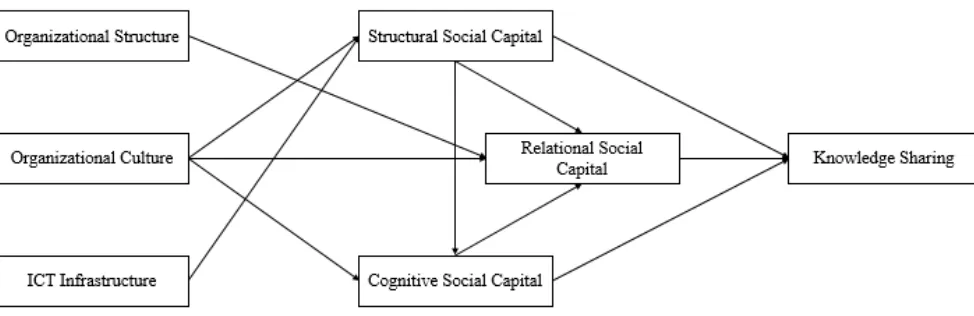
(11) 2.4 The model of van den Hooff and Huysman (2009). Figure 1. Path model identified by Van den Hoof and Huysman (2009). Van den Hooff and Huysman (2009) concluded that both approaches contribute to explain knowledge sharing in an organization. However, the variables that are part of the engineering approach have a more indirect impact on knowledge sharing since they are the ones that create the conditions for the social dynamics of the emergent approach that have a direct impact on knowledge sharing (van den Hooff & Huysman, 2009). As depicted in Figure 1, all dimensions of social capital have an immediate impact on knowledge sharing and have a mediating role between organizational variables and knowledge sharing (van den Hooff & Huysman, 2009). In more detail, van den Hooff and Huysman (2009) found the following interrelations between the variables that were tested in their model (see Figure 1): • Organizational culture has been shown to impact all three social capital dimensions. Van den Hooff and Huysman (2009) argued that establishing a safe and knowledge friendly organizational culture creates also an environment where employees feel better to communicate and interact with each other (i.e. structural social capital), develop a mutual understanding (i.e. cognitive social capital) and finally an atmosphere of trust and reciprocity is promoted (i.e. relational social capital). • Organizational structure found to positively impact relational social capital. That suggests that when there are clear roles and reduced structural barriers in relation to knowledge sharing processes that can also lead to more trust and a reciprocal relationship between employees (van den Hooff & Huysman, 2009). • ICT infrastructure found to impact structural social capital since the various ICT systems in an organization can provide employees with more clarity about who has what kind of knowledge and how they can contact that person and thus enhance interaction and communication among employees (van den Hooff & Huysman, 2009). • Structural social capital involves social interaction between employees that proved to have an impact on mutual trust and obligations (relational social capital) as well as on shaping a common set of goals that are shared among employees (cognitive social capital) (van den Hooff & Huysman, 2009). • Cognitive, social capital had a positive impact on relational social capital, since as previously discussed shared language, goals and values can work as a fertile. 11.
(12) •. ground for mutual trust among the members of a group (van den Hooff & Huysman, 2009). Finally, all three dimensions of social capital have been shown as described previously to have a direct impact on knowledge sharing within the organization (van den Hooff & Huysman, 2009).. 2.5 Model Reflection and Current Study To sum up, van den Hooff and Huysman (2009) identified the model that was described above and in brief suggests that there are some organizational and social factors that can directly or indirectly impact knowledge sharing within an organization. They got their results from six different organizations that have one characteristic in common which is that all of them were considered as knowledge intensive organizations; including a heavy lifting and transport company, an insurance company, a consultancy company, a mail service company and finally a cable provider. So, their study did not focus on testing their model only in one specific organizational context but the they chose to have participants from various organizational contexts. On the other hand, the current study aims to explore to what extent each of these identified relations between the variables apply to a specific organizational context that has some very special characteristics. This is the context of a software engineering organization. In this context there are some challenges in relation to knowledge sharing that were described above and therefore it’s interesting to find out whether this same model can be used in this environment or not, and discuss similarities and differences with the study of van den Hooff and Huysman (2009). Moreover, Shull et al. (2004) highlighted the importance of replicating studies in software engineering because there are too many uncontrollable sources of variation among different environments that can impact the results of a study. Therefore, running more studies in various environments is the starting point for credibility and learning and allows more robust conclusions to be drawn since related studies address each other’s weak points and knowledge can be combined directly or via a form of meta-analyses (Shull et al., 2004). Therefore, by replicating the study that was conducted by van den Hooff and Huysman (2009) and addressing the similarities and differences between the two studies will enhance understanding of knowledge sharing mechanisms within an organization as well. Next to the model, another thing that this study aimed to do is to measure knowledge sharing in three different organizational levels (team, department, office) and describe whether there are any significant differences between the scores for knowledge sharing between those three levels. As mentioned previously knowledge creation happens when there is interaction between employees at various organizational levels (Ipe, 2003). Knowledge sharing is not a process that should only take place between employees who are working in the same team, but also between employees within a department or an organization and is some cases even across different organizations (Ghobadi & D’ Ambra 2012; Soinil, Makinen & Tenhunen, 2007). Therefore, it is important to measure knowledge sharing in all those different levels and observe if there are any significant differences. Since those potential differences can provide a better understanding on how knowledge sharing works, outputs of this study can also be used to enhance knowledge sharing efforts in an organization. This study measured knowledge sharing behaviour between employees who are working in the same team, in the same department or in different departments across the same organization and the differences that were found between those different levels will be described in this article too.. 12.
(13) 2.6 Research Questions This study replicated the study that was conducted by van den Hooff and Huysman to determine whether the identified relations among organizational- and social- variables and knowledge sharing between employees can be supported in the organizational context of a software engineering organization. First and foremost, the current study aims to give an answer to the following question: RQ1: Which are the organizational and social factors that are related with the knowledge sharing behaviour of employees who are working in a software engineering organization? Sub-Question 1: Is the model created and tested by van den Hooff and Huysman (2009) applicable in the specific context? Sub-Question 2: Which are the relationships between the different organizational and social factors and knowledge sharing behaviour in the organization? Additionally, this study aims to explore the differences between knowledge sharing scores in different organizational levels. It is expected that knowledge sharing is higher among employees who work in the same team and even for employees of the same department but is lower when it is measured among employees of the whole organization. There is limited if no input in this area and therefore this study aimed to provide a first answer and initiate a discussion based on the following question: RQ2: Are there any differences between the scores for knowledge sharing behaviour in the three organizational levels distinguished (team, department, organization)? Is the hypothesis that knowledge sharing in a team will be higher followed by the department and organization confirmed?. 13.
(14) Chapter 3: Methodology 3.1 Research Design The current study is a case study with an exploratory nature that aimed via a correlational design to point out whether there are any relationships between organizational(structure, culture and ICT infrastructure) and social- (cognitive-, structural- and relationalsocial capital) factors and knowledge sharing in the context of a software engineering organization. The expected relationships between the variables are depicted in Figure 1 which shows the patterns that have been identified in the study that was earlier realized by van den Hooff and Huysman (2009). The current study aimed to discuss whether the same patterns apply in a different organizational context, under different circumstances. The independent variables were organizational -structure and -culture, and ICT infrastructure. The mediating variables were structural- cognitive- and relational- social capital. Finally, the dependent variable was knowledge sharing. On top of that, the study aims to measure knowledge sharing in three different organizational levels (team-, department- and office- level) and describe the possible differences between scores in each of these three levels. 3.2 Context of the Study This study was conducted in an international software engineering organization and more specifically in the office located in Eindhoven, the Netherlands. The company develops content management, delivery and advertising software solutions for TV service providers and content owners. It operates product development, support and sales offices throughout Europe, Asia and the Americas. This organization maintains the majority of its expert workforce in software engineering, R&D and customer service. During the study, a total of 139 employees were working in the Eindhoven office. Because of the nature of the industry, it is very important for the employees to be able to work under pressure and a constantly changing work environment. At the time of the study, there was a high turnover in the company since some of the employees were leaving the company and many new hires were coming in. It is observed that most the employees during the time of this study were working in the company no longer than 3 years (45.1% of the participants were working in the company from 1 up to 3 years). What can be problematic for the organization in this case is that as Rus and Lindvall (2002) highlighted it is quite common that when employees are leaving from an organization, an important part of knowledge and information is leaving with them while employees who remain or enter the company most of the times need to “re-invent the wheel” and spend an important amount of time and effort to replace and recreate the knowledge that’s gone. Also, the new employees should gain a high amount of knowledge as soon as possible in order to do their job effectively. All new employees participate in an introductory course to get familiar with the products. However, the amount of knowledge that can be gained via those courses is not always sufficient for the employees to effectively do their job. Employees, mostly gain their knowledge on-the-job, from working together with their colleagues, asking questions, solving problems and so on. Moreover as described for every high-tech organization since technology is growing rapidly they should manage to be up to date with the latest trends in the industry. Currently the organization is making an effort to monitor and improve knowledge sharing processes between employees. At the moment, knowledge sharing happens occasionally and individually between certain employees but it is not known at what extent the employees interact and share knowledge, by what means and under what conditions they 14.
(15) do or would do this. Therefore, it’s hard to monitor and promote knowledge sharing within the organization. That’s the reason it is important to identify which are the factors that can have an important impact (positive or negative) on knowledge sharing between employees of the organization. The main purpose of this study is to explore what is the knowledge sharing status currently in the office and define which are the organizational and social factors that are related with it. The results of this study will be used to design an effective knowledge sharing strategy in order to improve knowledge sharing processes and organizational performance and competitiveness. 3.3 Participants All 139 employees who, at the moment of the study, were working in the office located in Eindhoven, the Netherlands, were invited to participate in the survey. The unit of analysis was the individual employee. Employees were approached via email to complete an online survey after they were informed about the purpose and content of the study. After two weeks 51 usable questionnaires (a 37% response rate) were received back. Those 51 questionnaires were analysed. The clear majority of the respondents are male employees (92.2%). This was expected since the clear majority of the employees who work in the office are male and it is also in line with the population rate between male and female in IT industry. Moreover, most of the respondents are full-time employed (90.2%). Also, at the moment that this study took place the number of employees who are working in the company for many years is significantly lower compared to new hires and employees who work not more than three years who are a majority in the company. So, most of the participants were working in the company from 1-3 years (45.1%) whereas there is a much lower percentage of employees working in the company for more than five (5) years (17.6%). 3.4 Instruments and Measures The data was collected via an online survey. The questionnaire that was used for this study, was created by van den Hoof and Huysman (2009). Some parts of this questionnaire were adapted, as described below, to fit the context of the specific study. The questionnaire had in total 94 questions and sub-questions. The first questions were about gender, years and type of employment in the company (full-time, part-time) and the department that each employee is working for. These questions were followed by questions aiming to assess knowledge sharing in the team, in the department and in the office, organizational structure and culture, ICT infrastructure, structural- cognitive- and relationalsocial capital. At last, there was an open question where participants can leave any comment relevant to the survey. Knowledge sharing was measured with eight questions on a 5-point Likert scale (1; “Completely Disagree” to 5; “Completely Agree”), adapted by van den Hoof and Huysman (2009). In this study knowledge sharing was measured separately for three different organizational levels: team- departmental- and organizational- level. To achieve that, each question of the original scale was divided and replied in three sub questions (each for every organizational level) so employees can assess their knowledge sharing behaviours differently for each level. An example question is “I regularly inform my colleagues on what I am working on” followed by the sub questions a. “Colleagues in my team”, b. “Colleagues in my department”, c. “Colleagues in the Eindhoven office”. Reliability scores for knowledge sharing scales were acceptable for the team level with Cronbach’s α = .78, for the department level with Cronbach’s α = .79 and for the office level with Cronbach’s α = .87. 15.
(16) Organizational structure was measured with six questions on a 5-point Likert scale (1; “Completely Disagree” to 5; “Completely Agree”), adapted by van den Hoof and Huysman (2009). The questions of this scale aimed to explore the importance of the structure of the organization in relation to knowledge sharing. An example question for this is “the structure of our organization facilitates the exchange of knowledge across departments” or “this organization uses a standardized reward system for knowledge sharing”. The reliability for this scale was Cronbach’s α = .72. Organizational culture was measured with seven items on a 5-point Likert scale (1; “Completely Disagree” to 5; “Completely Agree”), adapted by van den Hoof and Huysman (2009). The purpose of this scale was to assess whether a knowledge friendly culture exists in the organization in order to facilitate sharing of knowledge between employees. Questions that used were: “In this organization employees are encouraged to ask other for help whenever necessary” or “Employees are encouraged to innovate, to investigate and to experiment”. The reliability score was Cronbach’s α = .75. ICT infrastructure was measured with seven questions on a 5-point Likert scale (1; “Completely Disagree” to 5; “Completely Agree”), adapted by van den Hoof and Huysman (2009). The existence or not of ICT infrastructure to support knowledge sharing processes was assessed, an example question is “The ICT facilities within this organization provide important support for knowledge sharing”. Reliability for the ICT scale was Cronbach’s α = .91. Structural social capital was measured with seven questions on a 5-point Likert scale (1; “Completely Disagree” to 5; “Completely Agree”), adapted by van den Hoof and Huysman (2009). The questions of this scale aimed to explore the importance of the structural social capital in relation to knowledge sharing. An example question for this is “When a customer has a question, I know which colleague or department will be able to help”. The reliability for this scale was Cronbach’s α = .73. Cognitive social capital was measured with four questions on a 5-point Likert scale (1; “Completely Disagree” to 5; “Completely Agree”), adapted by van den Hoof and Huysman (2009). The questions of this scale aimed to explore the importance of the cognitive social capital in relation to knowledge sharing. An example question for this is “Often I only need half a word when I am talking about work with my colleagues”. The reliability for this scale was Cronbach’s α = .71. Finally, relational social capital was measured with four questions on a 5-point Likert scale (1; “Completely Disagree” to 5; “Completely Agree”), adapted by van den Hoof and Huysman (2009). The questions of this scale aimed to explore the importance of the relational social capital in relation to knowledge sharing. An example question for this is “I view this organization as a group I belong too”. The reliability for this scale was Cronbach’s α = .76. 3.5 Procedure After getting an approval the survey that was going to be used was pilot tested to estimate the time needed to complete the survey and to avoid misspellings or unclarity to the questions asked. When this pilot test was completed and before contacting all the participants, the managers from all different departments were contacted and were informed upfront about the survey that was coming, its content and its purpose. Three days later the participants were contacted individually via email about the survey. In total all 139 employees who were working in the Eindhoven office during that time were contacted. The email sent included an introduction note about the survey and a link to transfer the participants to the welcome page of the survey. They were informed upfront for 16.
(17) the content, the purpose, the anonymity and the way the data provided will be used and analysed. Their participation was voluntarily and anonymous. The questionnaire that was used in this survey can be found in Appendix A. To achieve a higher response rate, it was decided that the option to skip any question is given to the participants and it was made clear that they can quit and close the survey at any time. The only mandatory questions were the ones about department and years of working in the company. The time that was provided to fill in the questionnaire was planned to be two weeks. At the beginning of the second week the participants received a reminder that there is still one week left to complete the survey. At the end of the second week the questionnaire was made unavailable. When the data collection process was completed the data analysis process took place. The steps that were taken to analyze the data and draw conclusions are presented in the next section. 3.6 Data Analysis The data analysis consisted of several steps. First, a descriptive statistics analysis was performed in order to review the scores for each of the variables and also to analyse possible differences between the scores for knowledge sharing in each of the three distinguished organizational levels. Second, correlations were calculated and investigated to have a first overview of the relations that exist between the variables. In order, to identify the organizational and social factors that affect knowledge sharing processes in the organization and explore whether the patterns that have been previously identified in the study of van den Hooff and Huysman (2009), apply in the context of a software engineering organization, the method of Structural Equation Modelling (SEM) was used. SEM was not only selected because it is the method that was used in the study of van den Hooff and Huysman (2009) but also because it’s a method that allows to measure and analyse several variables and multiple dependent relationships between the variables simultaneously (Hoe, 2008). To assess the goodness of fit for the tested model some fit indices have to be calculated. There are various opinions among researchers about which are the fit indices that should be considered, according to Holmes-Smith (2006) the use of at least one fit index from each different category of model fit is recommended. The categories are three: absolute fit, incremental fit and parsimony - adjusted fit. Based on this, the following indexes were considered: chi-square and GFI statistics from the absolute fit level, CFI from the incremental fit level and the chi square value divided by its degrees of freedom (CMIN/DF) from the parsimony - adjusted level. To decide which fit indices should be taken into consideration and be reported some characteristics of this study have been considered. Mostly this refer to sample size which is important for SEM, and the fact that sample size in this study was small lead to the decision to use the Comparative Fit Index (CFI) which is a commonly used goodness of fit indicator that takes into account sample size (Byrne, 1998) and performs well even with a small sample size (Tabachnick and Fidell, 2007). Due to the same reason -sample size- it is decided not to take into consideration one of the often-used fit indices RMSEA which according to Tasoobshirazi and Wang (2016) should be avoided to be reported when sample sizes are smaller than 200 especially combined with low degrees of freedom since it has been found to be elevated for smaller sample sizes and increase the risk for Type II error (Chen et al., 2008; Kenny, Kaniskan, & McCoach, 2014). Overall, for the model to be considered as a good fit the chi square should be non-significant, GFI should be >.90 (Jöreskog & Sorbom 1984), CFI have to be also >.90 (Bentler, 1990) and the CMIN/DF should not exceed 3 (Marsh & Hocevar, 1985). SEM will also be used to look at the specific 17.
(18) paths among the variables. The significance of the standardized paths will be explored to identify the strength of relationships (if existing) among variables. According to Chin (1998), standardized paths should be at least 0.20 and ideally above 0.30 in order to be considered meaningful for discussion. The results of this analysis are presented in the next chapter.. 18.
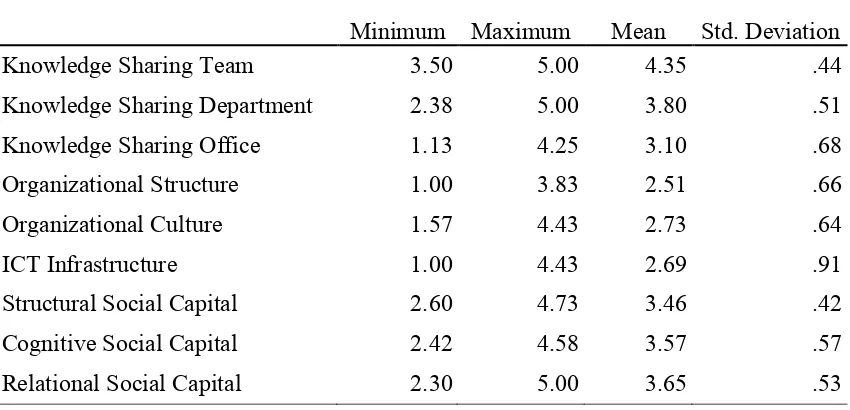
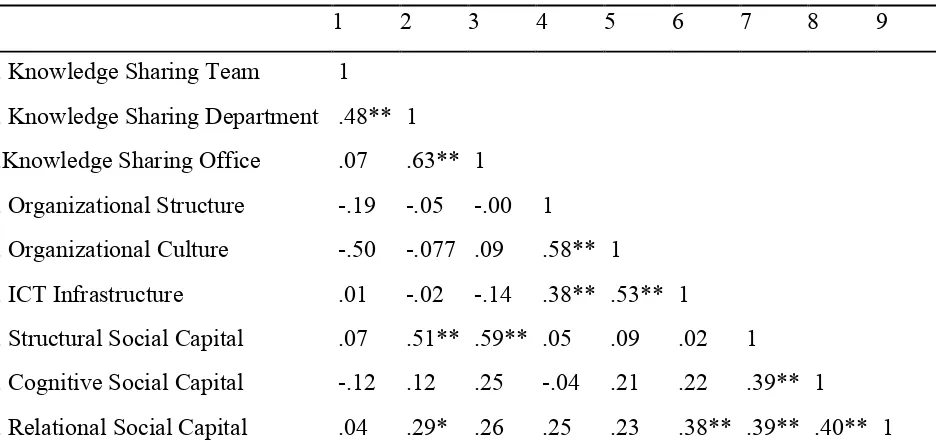
(19) Chapter 4: Results The purpose of this study was to measure knowledge sharing between employees who are working in a software engineering organization. Knowledge sharing was measured in three different organizational levels; in the team, in the department and in the whole office. Also, the study aimed to identify which are the organizational and social factors that can be related and have an impact on knowledge sharing in the organization and how these factors interact with each other. The data that was collected were analysed to provide answers for the research questions. The following sections will provide an overview of descriptive statistics for the examined variables, followed by a correlational analysis. Finally, the results of SEM and inferential statistics will be also described here. 4.1 Descriptive Statistics This study aimed to analyse knowledge sharing in three different organizational levels. As shown in Table 1, knowledge sharing scored a higher mean score when measured at the team level (M = 4.35, SD = .44), followed by the mean score for the departmental level (M = 3.80, SD = .51) and the lowest score was at the office level (M = 3.10, SD = .68). This indicates that knowledge sharing among the employees who are in the same team is stronger than among employees who work in the same department or the same office. Also, the variables that measure organizational aspects (organizational -structure and -culture and ICT infrastructure) had quite lower mean scores compared to the variables that were used to assess the social aspects (structural-, cognitive- and relational- social capital). The mean scores for all the variables tested in this study are displayed in Table 1. Table 1 Summary of minimum and maximum scores, means and standard deviations.. Knowledge Sharing Team. Minimum Maximum 3.50 5.00. Mean Std. Deviation 4.35 .44. Knowledge Sharing Department. 2.38. 5.00. 3.80. .51. Knowledge Sharing Office. 1.13. 4.25. 3.10. .68. Organizational Structure. 1.00. 3.83. 2.51. .66. Organizational Culture. 1.57. 4.43. 2.73. .64. ICT Infrastructure. 1.00. 4.43. 2.69. .91. Structural Social Capital. 2.60. 4.73. 3.46. .42. Cognitive Social Capital. 2.42. 4.58. 3.57. .57. Relational Social Capital. 2.30. 5.00. 3.65. .53. 4.2 Correlation Analysis In Table 2 the correlations between the variables are presented. This table shows a correlation between each of the organizational variables. Hence, organizational structure is 19.
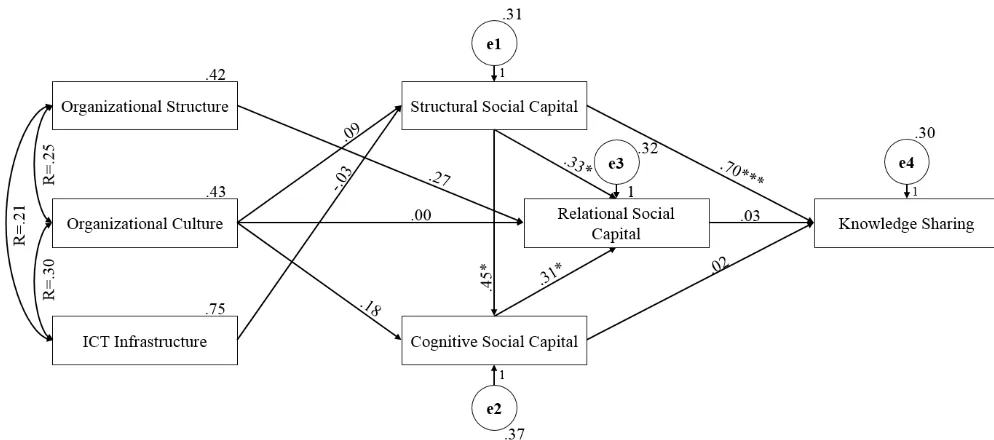
(20) related with organizational culture (r = .58, p < .01), a relation exists between organizational culture and ICT infrastructure (r = .53, p < .01) and finally organizational structure is also related with ICT infrastructure (r = .38, p < .01). On the other hand, all the social variables are also related with each other, however the relationships between the social variables are not as strong as between organizational variables. More specifically, cognitive social capital seems to be related with structural social capital (r = .39, p < .01) and with relational social capital (r = .40, p < .01), and structural social capital is also related with relational social capital (r = .40, p < .01). Finally, there seems to be a positive relation between knowledge sharing in the three different organizational levels, knowledge sharing in the team is positively related with knowledge sharing in the department (r = .48, p < .01) and knowledge sharing in the department is related with knowledge sharing in the office (r = .63, p < .01). However, knowledge sharing in the team does not seem to be related with knowledge sharing in the office. Finally, the only variable that is related with knowledge sharing seem to be structural social capital at the department level (r = .51, p < .01) and at the office level (r = .59, p < .01) and also relational social capital only at the department level (r = .29, p < .05). Table 2 Correlations between variables. 1 1. Knowledge Sharing Team. 2. 3. 4. 5. 6. 7. 8. 9. 1. 2. Knowledge Sharing Department .48** 1 3.Knowledge Sharing Office. .07. .63** 1. 4. Organizational Structure. -.19. -.05. 5. Organizational Culture. -.50. -.077 .09. .58** 1. 6. ICT Infrastructure. .01. -.02. .38** .53** 1. 7. Structural Social Capital. .07. .51** .59** .05. .09. .02. 1. 8. Cognitive Social Capital. -.12. .12. .25. -.04. .21. .22. .39** 1. 9. Relational Social Capital. .04. .29*. .26. .25. .23. .38** .39** .40** 1. -.00. -.14. 1. Note: **Correlation is significant at the .01 level (two-tailed); *Correlation is significant at the .05 level (two-tailed). 4.3 Structural Equation Modeling In order to test whether the expected relationships existed, SEM was performed with SPSS AMOS. In order to perform SEM, the dependent variable should be at the interval level. In this model the dependent variable is knowledge sharing in the office of a software engineering organization. This variable was measured on a 5-point Likert-scale and therefore the interval level prerequisite was met. The model had a good fit. The chi square value is not significant (χ2 = 12.9, p >.05, df = 7) and the ratio of chi square to degrees of freedom is below 3 (CMIN/df = 1.8). The CFI value is >.90 (CFI =.93) and finally GFI is also >.90 (GFI = .94).. 20.
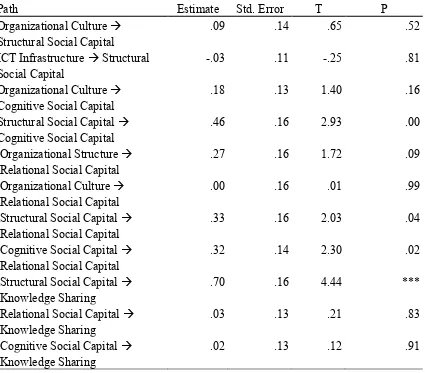
(21) Figure 2. Tested Path model. Note: ***Estimate is statistically significant at the .001 level (two-tailed); *Estimate is statistically significant at the .05 level (two-tailed). Moreover, Table 3 shows the regression weights for each of the hypothesized paths. The only paths that were supported by the analysis are described below. The results indicated that structural social capital is the only variable that is related with knowledge sharing (β = .70, t = 4.44, p < .001). Moreover, structural social capital is related also with cognitive social capital (β = .46, t = 2.93, p < .05) and with relational social capital (β = .33, t = 2.03, p < .05). Finally, the relation between cognitive social capital and relational social capital is also supported (β = .32, t = 2.30, p < .05).. 21.
(22) Table 3 Standardized path coefficients. Path Organizational Culture à Structural Social Capital ICT Infrastructure à Structural Social Capital Organizational Culture à Cognitive Social Capital Structural Social Capital à Cognitive Social Capital Organizational Structure à Relational Social Capital Organizational Culture à Relational Social Capital Structural Social Capital à Relational Social Capital Cognitive Social Capital à Relational Social Capital Structural Social Capital à Knowledge Sharing Relational Social Capital à Knowledge Sharing Cognitive Social Capital à Knowledge Sharing. Estimate Std. Error .09 .14. T. P .65. .52. -.03. .11. -.25. .81. .18. .13. 1.40. .16. .46. .16. 2.93. .00. .27. .16. 1.72. .09. .00. .16. .01. .99. .33. .16. 2.03. .04. .32. .14. 2.30. .02. .70. .16. 4.44. ***. .03. .13. .21. .83. .02. .13. .12. .91. 22.
(23) Chapter 5: Discussion & Conclusions 5.1 Predictors of Knowledge Sharing The purpose of the current study is to enhance understanding about knowledge sharing processes within the field of software engineering. Specifically, the first research question of this study aimed to identify which of the organizational- and social- factors that have been previously identified in research can be directly or indirectly related with knowledge sharing in the context of a software engineering organization. The model that has been identified by a previous study realized by van den Hooff and Huysman (2009) has been tested. As described earlier in this paper, this model of van den Hoof and Huysman (2009) is built on two different approaches related to managing knowledge sharing within an organization: the engineering approach (including organizational structure, organizational culture and ICT infrastructure) and the emergent approach (including structural- cognitive- and relational- social capital). The variables related with the engineering approach (i.e. organizational factors) have been found by van den Hooff and Huysman (2009) to be indirectly related with knowledge sharing within an organization via the impact they found to have on the social variables; in other words, organizational aspects are the ones that could create the conditions for social capital to develop within the organization. However, the results of this study do not support any of these expected relations between organizational variables and the aspects of social capital. According to the results of this study, the organizational factors cannot be related with any of the dimensions of social capital and therefore the mediating role of social capital between organizational factors and knowledge sharing cannot be confirmed too. This is in accordance with Milana and Maldaon (2015) who suggested that generation and development of social capital in an organization is subject to conditions that do not all fall under control of the organization. Hence, social capital within this context cannot be related with the organizational environment (culture, structure, ICT infrastructure). From an emergent approach the examined variables were structural- cognitive- and relational- social capital. All three variables have been identified by van den Hooff and Huysman (2009) as directly related with knowledge sharing in an organization. In the current study, the only relation that is supported is between structural social capital and knowledge sharing. The hypothesized paths between cognitive social capital and knowledge sharing, relational social capital and knowledge sharing, are not supported by the results of this study. However, in accordance with the results of van den Hooff and Huysman (2009), the expected relations between the social factors are also confirmed here, so structural social capital affects cognitive- and relational- social capital, and cognitive social capital also affects relational social capital. So, social capital aspects, are not independent but they seem to be related with each other. Overall, the model that was identified by van den Hooff and Huysman (2009) was not confirmed by the results of the current study. To explain the differences between the two studies, some aspects of this study are discussed as possibly related with the differences in the results. First, as mentioned above, what differentiates this specific study, is the context in which it took place. Van den Hooff and Huysman (2009) collected their results from multiple organizations and fields. On the other hand, this study took place in the dynamic context of a software engineering organization, a context that has been characterized as a knowledge intensive context. The knowledge that is needed in a software engineering organization is constantly changing and growing - for instance, due to the advance of technology- and it requires employees to have the ability to follow up with everything new in the field. In short, knowledge has a crucial role for the organization to gain and maintain an advantage over 23.
(24) competitors (Khoza & Pretorius, 2017). As highlighted by Rus and Lindvall (2002) a software organization depends heavily on knowledgeable employees and for a software developer it is crucial to be able to access these employees to get help at different stages of their day to day work. It is therefore very important, to know whom to contact in each phase and who has what knowledge. The importance of structural social capital as defined in the theoretical framework is made clear. In this study, it seems to be the only variable that can be related with knowledge sharing processes in the organization. It is very important for employees to be aware of what their co-workers know, to know who they should contact when they have specific questions and to know how they can do it. The importance of a network and interaction is highlighted. Indeed, Danziger and Hull (2000) found that the employees who work in high tech organizations tend to seek answers to their questions primarily from the most informal and personal sources, mostly their colleagues than from most formal and technologically-based sources. This can partly explain the importance of structural social capital as an impactor for knowledge sharing in the organization. Second, adding to the nature of the organization, the conditions and the characteristics of the participants at the moment of the study should all be considered. The organization was during the study characterized by a very dynamic and rapidly changing environment, where many new employees were coming in and many employees were leaving the company. Most of the participants were working in the company from 1 and no longer than 3 years. Therefore, most of them were quite new to the company. This can maybe explain a more focused interest on trying to create a network within the organization, interact with their colleagues and locate the knowledge in the organization, in order to know which colleague has the knowledge they will possibly need and how to reach them. It can be possible that at a later point in time, also other factors start to matter more but when everything is quite new and the co-workers are the most important source for information, interaction is what basically impacts sharing of knowledge. So, it’s possible that the time an employee is working in the company may not be sufficient for other social factors to be evolved and have an impact on knowledge sharing and also the organizational factors were not perceived yet from the employees in a degree that they will have an effect on the social aspects and indirectly on knowledge sharing. Finally, the high turnover rate by itself can have an impact on the organizational context and dynamics. Therefore, a high turnover rate can influence how people see things and also the way that knowledge sharing works in the organization. Again, the results may be very different during another point in time. 5.2 Knowledge Sharing in Different Organizational Levels The second research question, was about the differences that exist between knowledge sharing behaviour in different organizational levels, and more specifically in a team, in a department and in the organization. Literature did not focus on this distinction in relation with knowledge sharing before and this question was exploratory in nature. It was expected that employees who work in the same team tend to share more knowledge with each other since they work closer to each other, followed by employees in the same department and the lowest score was expected for knowledge sharing between employees in the whole organization. Indeed, the results showed that employees who work in the same team tend to share more knowledge with each other, followed by employees who work in the same department and the lowest score was for knowledge sharing among employees from the whole organization. A possible explanation for that can be that within a team some of the mechanisms that can possibly positively impact knowledge sharing are further developed and therefore employees feel safe and easier share their knowledge with each other. Since structural social capital has 24.
(25) proved to have an impact on knowledge sharing, one can assume that interaction within members of the same team is higher and that explains the higher knowledge sharing score within the team. However, that is something that should be further explored. Another possible explanation is that just the knowledge that an employee needs is located mostly in their own team or sometimes department and that is the reason why employees tend to share more knowledge with colleagues who work in the same team or department. Finally, the different organizational levels seem to be related with each other. In that way, when knowledge sharing in the team level is high this can affect knowledge sharing in a department, and knowledge sharing in a department can possibly positively affect knowledge sharing in the office. 5.3 Limitations of the current study and recommendations for future research While interpreting the results of the current study also some limitations should be taken into consideration that can also provide some recommendations for future research. First, the generalizability of the results is low since this study is context-specific as it took place only in one specific organization (i.e. case study). Therefore, it is a recommendation to replicate this study in more software engineering organizations and during different periods of time and conditions for the results to be generalizable. As discussed previously, it’s very important to replicate studies in software engineering because there are too many uncontrollable sources of variation among different environments that can impact the results of a study (Shull et al., 2004). Second limitation is the small sample size of this study in regard to the statistical method that was used. The sample size in this study was rather small and SEM normally is a method that requires a much larger sample. This can also be a possible explanation about the different and unexpected results of this study. So, no definite conclusions should be made. A recommendation is to perform the same study in a larger sample of employees who also work in a software engineering organization. Finally, this study initiated a discussion about knowledge sharing in three different organizational levels. This is a topic that has not been discussed in literature and the differences that were found between the different organizational levels in this study could only be used as the starting point for further exploration of the nature and reasons for their existence.. 25.
(26) References Al-Qadhi, Y. H., Nor, K. M., Ologbo, A. C., & Knight, M. B. (2015). Knowledge sharing in a multi-nationality workforce: Examining the factors that influence knowledge sharing among employees of diverse nationalities. Human Systems Management, 34(3), 149–165. doi:10.3233/HSM-150844 Alavi, M., & Leidner, D. E. (2001). Knowledge management and knowledge management systems: Conceptual foundations and research issues. MIS Quarterly, 25(1), 107-136. doi:10.2307/3250961 Armbrecht, F. M. R., Chapas, R. B., Chappelow, C. C., Farris, G. F., Friga, P. N., Hartz, C. A., Mcllvaine, M. E., Postle, S. R., & Whitwell, G. E. (2001). Knowledge management in research and development. Research Technology Management, 44(4), 28–48. doi:10.1080/08956308.2001.11671438 Balozi, M. A., Othman, S. Z., & Isa, M. F. M. (2016). Predictors of knowledge sharing behaviour: Case of the Tanzanian healthcare sector. International Journal of Research in IT, Management and Engineering, 6(8), 1-8. Bentler, P. M. (1990). Comparative fit indexes in structural models. Psychological Bulletin, 107, 238-246. doi:10.1037/0033-2909.107.2.238 Bourdieu, P., & Wacquant, L. P. D. (1992). An invitation to reflexive sociology. Chicago: University of Chicago Press. Bratianu, C., & Orzea, I. (2010). Tacit knowledge sharing in organizational knowledge dynamics. Proceedings of the European Conference on Intellectual Capital, 11(2), 107–114. Byrne, B.M. (1998). Structural Equation Modeling with LISREL, PRELIS and SIMPLIS: Basic Concepts, Applications and Programming. Mahwah, New Jersey: Lawrence Erlbaum Associates. Castaneda, D. I., Pardo, C., & Toulson, P. (2015). A Spanish knowledge sharing instrument validation. Electronic Journal of Knowledge Management, 13(1), 3–12. Castaneda, D. I., Ríos M. F., & Durán, W. F. (2016). Determinants of knowledge-sharing intention and knowledge-sharing behavior in a public organization. Knowledge Management & E-Learning, 8(2), 372-386. Castaneda, D. I., & Toulson, P. (2013). The value of human resources measurement in intellectual capital and knowledge sharing. Electronic Journal of Knowledge Management, 11(3), 226–234. Chatterjee, S., (2014). Managing constraints and removing obstacles to knowledge management. Journal of Knowledge Management, 12(4), 24-38. Chau, T., & Maurer, F. (2004). Knowledge sharing in agile software teams. Lecture Notes in Computer Science, 3075, 173-183. doi:10.1007/978-3-540-25967-1_12. 26.
Figure
+2
Related documents
These implies that population increase was causing pressure on land leading to agricultural intensification and reduction in planting distances of crops, which resulted to high
In determining performance, credibility, rate of electoral violence and independence of election management bodies (EMBs) in Ghana and Kenya in light of the
I understand that I may gain access to my personal information held by South Coast MXC, West Coast MCC, Keith & District MCC, Riverland JMC, Motocross
Matchmaker Pressable Translucent pellets are designed both for Press & Stain and the majority of situations where only an incisal edge needs to be added to the pressing
The purpose of the study was to investigate the effect of a multisensory approach to Spanish instruction founded in Orton-Gillingham on the (1) foreign language writing, and
With our systematic and standardised audit procedure and approach, we carried out independent and objective supervision and assessment and provided consultancy services regarding
manufactures and modifi es the following parts, which together with the m/31 com- ponents and Stemple 76/45 receiver, are used to assemble an STG-76W submachine gun:
Planning for entry to the Register of Career Development Professionals either through completing additional qualifications (or units of qualifications) or, by
