THE EFFECT OF TEAM COHESION
ON TEAM PERFORMANCE AND THE
ROLE OF PROBLEM-SOLVING
STRATEGIES IN TEAMS DURING A
CPR SIMULATION
Aniek Poort
Enschede, August 2018
Examination Committee
A.M.G.M. Hoogeboom, MSc
Dr. M. Groenier
S. de Laat, MSc
Master thesis
Educational Science and Technology
2 MASTER THESIS
Title
THE EFFECT OF TEAM COHESION ON TEAM PERFORMANCE AND THE ROLE OF PROBLEM-SOLVING STRATEGIES IN TEAMS DURING A CPR SIMULATION
Author A. POORT [email protected]
Graduation committee
1s t supervisor A.M.G.M. HOOGEBOOM, MSC [email protected]
2ND supervisor DR. M. GROENIER [email protected]
3
Table of contents
Acknowledgement ... 4
Abstract ... 5
1 introduction ... 6
2 Theoretical framework ... 7
2.1 Action teams ... 7
2.2 Team cohesion ... 7
2.3 Problem-solving strategies ... 8
2.3.1 Planning ... 9
2.3.2 Decision-making ...10
2.3.3 Information sharing ...10
3 Method ...11
3.1 Research design ...11
3.2 Research context ...11
3.3 Respondents and sampling ...12
3.4 Measures ...12
3.5 Procedure...15
3.6 Data analysis ...15
4 Results ...16
4.1 The use of problem-solving strategies in high and low performing teams...16
4.2 Mediation effects ...18
5. Discussion ...20
5.1 Limitations and future research...22
5.2 Practical implications ...22
6 Conclusion ...23
Reference list...24
4
Acknowledgement
Working on this master thesis was a valuable experience to finalize the master Educational Science and Technology. Even though, it was not the first time I wrote a thesis, it was really a different project that I learned a lot from. Therefore, would like to thank everyone who supported me during these final months of my study.
I would like to thank Marcella Hoogeboom, my first supervisors for all her input during the entire process and guiding me to find a focus in my research that I was interested in. Also, I would like to thank Marleen Groenier, my second supervisor for the coffee breaks, that always helped to get a new perspective. The support from Stijn de Laat during data collection process and the first and final part of the project was very helpful. I would also like to thank the ECTM, Mathilde Hermans and Eline Mos-Oppersma for their cooperation in the project. Of course, I would also like to thank Fabienne Lok, Joscha Friedrich and Bryce Cherry, I really enjoyed time we spent together working on our theses and I appreciate all our discussions that helped me a lot.
Finally, I want to thank all my friends and family who have supported me, listened to me, and helped me relax. Not only during this project, but also during the years before.
Aniek Poort,
5
Abstract
Teams performing cardiopulmonary resuscitation (CPR) have to act quickly and engage in effective teamwork to increase survival chances of the patient. Not only technical skills identified by protocol are relevant in CPR, but teamwork skills are required as well. Part of these teamwork skills is interaction. So far, not a lot of research has ben done about what types of interaction leads to higher team performance in CPR. Earlier research in other domains showed that more cohesive teams perform better and certain types of interaction lead to higher team performance, this study tried to establish whether this also accounts for CPR teams. From literature, planning, decision-making, and information sharing were identified as problem-solving strategies in interaction. It was hypothesized that more cohesive teams would perform better than less cohesive teams, and that this relation would be mediated using problem-solving strategies. In this observational study, video data of 17 student teams performing CPR in a simulated setting was coded. Also, team members filled in a scale on team cohesion and team performance was assessed by two expert raters. There was little variance on team cohesion, which was high for all teams. It was therefore not surprising that team cohesion did not predict team performance or the use of problem-solving strategies. Lag sequential analysis showed little differences in problem-solving strategies between high and low performing teams. Furthermore, mediation analysis showed no mediating effect for all problem-solving strategies in the team cohesion
– team performance relation. Findings from this study indicate that much is still unclear regarding effective interaction in high performing CPR teams and the role of team cohesion. Perhaps the time that students spend on practicing during the course, could be a contributing factor.
6
1
introduction
Cardiopulmonary resuscitation (CPR) is an emergency situation, characterized by high-stakes, complexity, and a common goal of the resuscitation team (Fernandez Castelao, Russo, Riethmüller, & Boos, 2013). It is essential to start CPR and initiate defibrillation quickly and efficiently to reduce the risk of mortality after a cardiac arrest, as the chance of the patient’s survival diminishes with 10 percent
for each minute that CPR is delayed (Hunziker et al., 2011). CPR guidelines mainly focus on technical aspects. However, since technical skills alone are not sufficient to guarantee effective team performance, teamwork skills are needed as well (Risser et al., 1999). Thus, quality and speed of care influence patient outcomes, and good teamwork is essential (Mellick & Adams, 2009). One aspect of teamwork skills, that seems relevant in CPR is team interaction. In order to provide patients with good care, effective interaction is crucial (Leonard, Graham, & Bonacum, 2004).
In CPR, effective interaction is associated with successful resuscitation (Marsch et al., 2004). So far, research regarding interaction in CPR teams has mainly focused on the quantity of interaction (Hunziker et al., 2009; Mullen & Copper, 1994). However, it is more relevant to look at the content or quality, since quantity of interaction affected team performance less than the quality of interaction. One type of interaction that helps teams to avoid error in emergency situations is problem-solving strategies (Risser et al., 1999). Application of problem-solving strategies includes letting all team members take part in the process. This implies, that not only the team leader should be aware of all relevant information, but the whole team needs to have a common understanding (Risser et al., 1999). Three types of problem-solving strategies applicable to medical emergency situations are planning, decision-making and information sharing.
Effective interaction is not the only factor that seems to lead to higher team performance. Another contributing factor is team cohesion (Gully, Devine, & Whitney, 1995). In general, research has shown that more cohesive teams perform better (Beal, Cohen, Burke, & McLendon, 2003). However, this has not been confirmed for CPR teams. However, in interdependent tasks, where interaction is required, team performance is influenced stronger by team cohesion than in tasks that do not require interaction between team members. This could be explained by the fact that teams have to work together to succeed, and more work is exchanged and coordinated in these interdependent tasks (Beal et al., 2003). This implies teams can only succeed if all members are committed and participate, while in tasks that do not require as much interaction, individual work may be sufficient. It can be argued that CPR is an interdependent tasks, since teamwork was found to be an important aspect of successful CPR (Mellick & Adams, 2009). It would therefore be expected that team cohesion positively predicts team performance in CPR as well. However, little is known regarding interaction differences between high and low cohesive teams, and how this affects team performance in CPR.
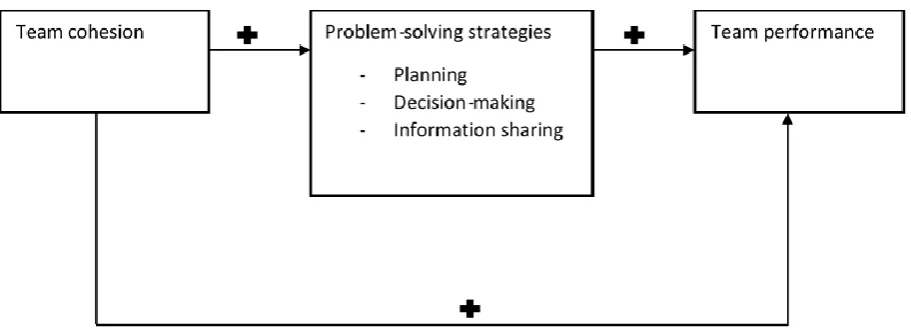
7 Figure 1 Research model
2
Theoretical framework
Interaction is an important factor during CPR regarding team performance. First, characteristics of teams engaging in this task will be introduced. Secondly, the relation between team cohesion and team performance in CPR will be discussed. Then, three types of problem-solving strategies as presented in the research model will be discussed.
2.1
Action
teams
CPR teams can be characterized as action teams since they work in critical and complex situations (Fernandez Castelao et al., 2013). Action teams are characterized by intense, interdependent, and unpredictable tasks (Kolbe et al., 2014). They operate in novel situations that might differ from what has been encountered in previous explicit trainings or experiences, and must therefore interact regularly with their environment (Marks, Zaccaro, & Mathieu, 2000). According to Marks et al (2000) it is important that these teams engage in qualitative high communication, since it is unlikely that merely an addition of effort will suffice to be successful in these complex situations. Often, members of action teams have specialized roles to respond to these unpredictable situations (Sundstrom, Meuse, & Futrell, 1990). During a resuscitation, every team member has a specific role that assigns certain responsibilities to each member in order to effectively conduct CPR (Mellick & Adams, 2009). Together, the team needs to respond quickly to unforeseen events in a coordinated manner to function effectively. For example, free and efficient information transfer is needed to coordinate the actions of the CPR team (Edmondson, 2003). Also, since teams are able to perform better when working in a better team climate, cohesion can have an essential part in determining whether a team can be successful (Pierre, Hofinger, & Buerschaper, 2008).
2.2
Team cohesion
[image:7.595.71.527.66.231.2]8 In teams where performance has far-reaching consequences there is a stronger relation between team performance and cohesion than in other contexts (Castaño et al., 2013). This relates to
CPR, where it is about saving a patient’s life. Also, if teams perform tasks that demand more interaction, team cohesion positively affects team performance more strongly (Gully et al., 1995; Mullen & Copper, 1994)., However, research regarding the positive relation between team cohesion and team performance (Beal et al., 2003; Castaño et al., 2013) has not specifically focused on the context of medical emergencies or CPR. However, studies have shown that teams that have worked together for a longer time, perform better than newly formed teams (Hunziker et al., 2009). Another study confirmed the relation between team familiarity and team performance in medical simulations. Furthermore, it was found that stable teams, that kept the same team members over time, improved significantly in performance over time. This development was not found for the dynamic teams, of which composition changed for each scenario (Joshi, Hernandez, Martinez, AbdelFattah, & Gardner, 2017).
Even though these studies show a positive link between familiarity and team performance, they do not directly establish whether the same effect exists between team cohesion and team performance in CPR teams. However, it can be argued that both concepts are related because teams need to work together for some time, and thus become more familiar, before they can build relations and develop cohesion (Chiocchio & Essiembre, 2009). Castaño et al. (2013) argue for the time teams need to develop cohesion according to the team development model of Tuckman (1965) that distinguishes several stages that teams need to go through to become cohesive. This process implies that teams need to spend a certain amount of time together to become cohesive (Castaño et al., 2013). Also, if teams have more contact during their work, members become more connected to their team (Mesmer-Magnus & DeChurch, 2009). Thus, it takes time for teams to become cohesive, which means that as teams get more familiar and work together for a longer time they will be able develop higher team cohesion. Therefore, it is expected that in CPR, team cohesion has a positive effect on team performance.
Hypothesis 1: more cohesive teams perform better than less cohesive teams in a CPR context
2.3
Problem-solving strategies
Interaction entails the reciprocal continuous sharing of information in teams, and when this is done correctly, it leads to higher performance (Zijlstra, Waller, & Philips, 2012). It is a key mechanism for team members who work towards the same goal (Marks et al., 2000). In medical teams, members share information, take decisions together and perform similar tasks (Jin-Kyoung & Suk-Won, 2015). Research has shown that quality of interaction is positively related to team performance in action teams (Hunziker et al., 2009; Marks et al., 2000). Marks et al. (2000) suggest that quality is about how useful verbal statements are towards coordination, which enables teams cope with changes in the situation. This seems relevant in CPR, since effective team coordination can be hindered in acute medical and chaotic situations (Rehim, DeMoor, Olmsted, Dent, & Parker-Raley, 2017). It is therefore suggested that qualitative interaction helps team to coordinate during CPR, which could lead to higher team performance. More specifically, research with nursing teams in a simulation-based training showed a positive relation between nursing performance and interaction regarding planning, evaluation, assessment and implementation. However, interaction that was unrelated to the nursing task, was negatively related to performance (Jin-Kyoung & Suk-Won, 2015). These results suggest that task-related interaction is an important aspect regarding team performance in medical teams (Jin-Kyoung & Suk-Won, 2015).
9 sure all relevant information is clear (Risser et al., 1998). This fits communication in medical teams, during which members share information, take decisions together and perform similar tasks (Jin-Kyoung & Suk-Won, 2015). Using problem-solving strategies also entails clarification of the importance of the relevant protocol, which decreases the chance of error. Research showed that work teams that engaged in more problem-solving strategies, showed more effective team work processes, such as task prioritization and allocation of resources (Tesluk & Mathieu, 1999).
Risser et al. (1998) created an integrated framework of teamwork behaviors in a medical emergency department that includes these problem-solving strategies. According to this framework, teams can engage in strategies that will help them to become effective by using planning, decision-making methods and sharing information (Risser et al., 1999). First, planning is conceptualized by Lei et al. (2016) as the way in which teams evaluate the dynamic task situation and develop plans on the go. Second, decision-making refers to collecting and integrating information, using sound reasoning, identifying alternatives, choosing the best option and evaluating consequences (Cannon-Bower, Tannenbaum, Salas & Volpe, as cited in Salas, Burke, & Samman, 2001). Third, information sharing is about transferring information on time and accurately within the team, which helps the team to coordinate their actions effectively, and to establish a shared understanding of the patient (Risser et al., 1999).
2.3.1
Planning
Planning is a key process when teams needs to coordinate their work to fulfill tasks, and is essential in complex tasks that cannot be solved individually (Dechurch & Haas, 2008). During CPR, planning is about distributing tasks, assigning roles, and timing tasks, and it positively influences team performance (Fernandez Castelao et al., 2013). When working under time pressure, teams high in task cohesion show more effort and plan more effectively than teams that are less task cohesive (Zaccaro, Gualtieri, & Minionis, 1995). Stress caused by time pressure can lead to a disruption, that only high task cohesive teams are able to cope with, because they put in higher effort to complete the task (Zaccaro et al., 1995). Even though the study of Zaccaro et al. (1995) did not include social cohesion, it is not expected that this would change the positive effects of cohesion on planning, as task and social cohesion are strongly correlated (Beal et al., 2003).
Regarding the possible link between planning and team performance it was suggested that planning in the CPR process can be used by teams to compensate for the shortage of team coordination in resuscitation protocol (Fernandez Castelao et al., 2013). Different types of planning exist, but reactive strategy adjustment predicts team coordination best, and has a positive effect on team effectiveness (Dechurch & Haas, 2008). This type of planning supports teams to respond to unexpected events. When engaging in this type of planning, teams follow an initial plan but also adapt to changes in their task environment. In this type of planning, a certain level of coordination processes are supported by an initial plan (Dechurch & Haas, 2008). This could fit the CPR context, since teams need to respond to changes in the situation. However, certain pre-established protocols need to be followed as well (European Resuscitation Council, 2015). This protocol could be seen as the initial plan, but in case of unexpected events, the team needs to respond. Thus, team cohesion seems to relate to planning, and planning supports team effectiveness. Therefore, planning may also explain the cohesion-performance relation.
Hypothesis 2:
H2a: More cohesive teams engage in more planning behaviors than low cohesive teams
H2b: Teams that engage in more planning behaviors perform better than teams that engage in less planning behaviors.
10
2.3.2
Decision-making
In action teams, like medical teams that have to deal with emergencies, much information needs be maintained during situations with high workload and stress. It is possible that decisions are biased because of incomplete, erroneous and ambiguous data (Paris, Salas, & Cannon-Bowers, 2000). This is relevant since in medical situations teams need to find the correct diagnosis, which forms the basis of good care (Tschan et al., 2009). Also, in order to be successful, teams need to coordinate different sources of information and integrate these (Zaccaro et al., 1995). Translated to CPR, this could possibly mean that team members, family members of the patient, and doctors serve as information sources that the team needs to integrate to make a decision. When making a decision under time pressure, high team cohesion facilitates interaction and supports teams to decide (Zaccaro et al., 1995). Since cohesion supports interaction, and interaction is required to integrate different sources of information, it is expected that higher team cohesion will lead to better decision-making.
Relevant decision-making behaviors can be derived from a model of decision-making, that proposed a decision-making process from identification of the problem to making a decision (Franz, 2012). Based on the model of Franz (2012), the following central behaviors are distinguished in this process: defining the scope of the problem, requesting and providing information within the team, collection of information from external sources, and evaluating information in relation to a possible diagnosis. The decision-making process can be hindered by poor information sharing (Franz, 2012). When decisions are made in a limited time, less time is spent to collect and process information, less people are involved in making the decision, and evaluation of possible solutions is inadequate (Zaccaro et al., 1995). Making a decision following a structure enables teams to discuss all information (Franz, 2012). This implies, that teams can properly consider all options, based on facts. In this way, engaging in decision-making behaviors could lead to higher team performance. Since decision-making seems to be related to team cohesion and team performance, it also expected to mediate between team cohesion and team performance.
Hypothesis 3:
H3a: More cohesive teams engage in more decision-making behavioral patterns than less cohesive teams
H3b: Teams that engage in more decision-making behavioral patterns perform better than teams that engage in less decision-making behavioral patterns.
H3c: Decision-making behavioral patterns mediate the relationship between team cohesion and team performance
2.3.3
Information sharing
11 Furthermore, as more teamwork and information sharing are required to perform well, team cohesion could be expected to contribute as well. In interdependent tasks, like CPR, team members have to focus on what information is necessary to achieve team goals. Research has shown that teams with high levels of task cohesion offered more information than low task cohesive teams during a time pressured task (Zaccaro et al., 1995). Also, in high cohesive teams, members respond more often to information requests when working under time pressure than low cohesive teams (Zaccaro et al., 1995). As high cohesive teams are more committed to their task, they may be more inclined to share the relevant information to complete the task. This suggests a positive link between team cohesion and information sharing. If high cohesive teams, share more information and consequently perform better, information sharing might explain the cohesion-performance relation.
Hypothesis 4:
H4a: more cohesive teams engage in more information sharing than less cohesive teams
H4b: Teams that engage in more information sharing patterns perform better than teams that engage in less decision-making information sharing patterns.
H4c: information sharing patterns mediate the relationship between team cohesion and team performance
3
Method
3.1
Research design
A quantitative research design was used to reliably study to what extent team cohesion affects team performance and whether this relation is mediated by using problem-solving strategies in a CPR context. For this, (1) team cohesion, (2) problem-solving strategies, and (3) team performance ratings were distinguished. Three types of data sources were used to measure these constructs: (1) a team cohesion scale filled in by all team members, (2) video-recordings from the assessment scenarios, (3) a team performance scale filled in by expert raters.
3.2
Research context
Research in CPR situations can take place in simulated settings, since it is difficult to practice CPR in a real-life setting. Not only does CPR occur unplanned, but observers would have to be present from the start of the event, and ethical considerations play a role as well. By using simulation settings to practice, these issues can be avoided (Hunziker et al., 2009). Also, simulations provide a safe and realistic setting, where learners can practice skills and make mistakes (Salas et al., 2008).
The faculty of Behavioural, Management and Social Sciences cooperated with the Experimental Centre of Technical Medicine (ECTM) for this study. First-year master students of Technical Medicine at the University of Twente follow an obligatory Advanced Life Suppo rt (ALS) course. During this course, students learn the theoretical knowledge and practical skills that they need to integrate and apply in CPR simulations. The course contains 9 learning goals, which can be found in Appendix 1. Even though guidelines from the European Resuscitation council (European Resuscitation Council, 2015) are followed, the ALS-course does not provide any certifications. More important is that students get competent in clinical reasoning in an ALS situation. The ECTM offers two simulation rooms for Technical Medicine students to practice their skills to learn in a safe environment: The Intensive Care Unit (ICU) and the operation room (OR). In both rooms, a Human Patient simulator(CAE iStan/CAE HPS), a patient monitor (Infinity, Draeger) and defibrillator (Philips) were present (ECTM, 2017). Also, audio-visual data of the ALS-course sessions was provided by a METIvision system that uses three
12
3.3
Respondents and sampling
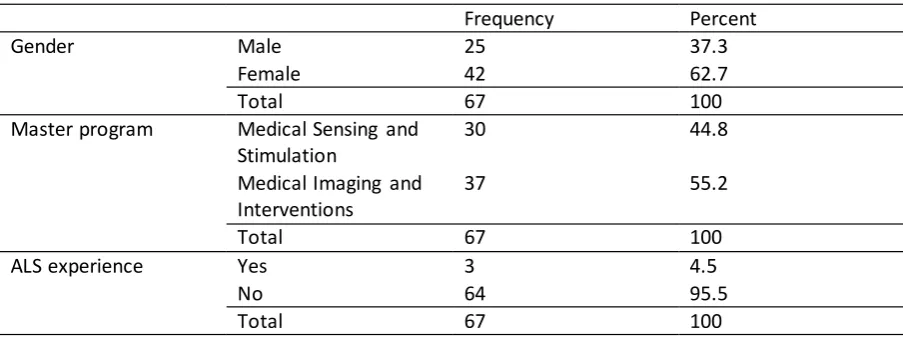
[image:12.595.71.523.311.480.2]Students who followed the obligatory ALS-course in the first year of the master program of Technical Medicine were approached to participate in this study. During the first lecture of the course they were informed about the goal and procedure of study by the research team. It was emphasized that participation was voluntary and that the research would not affect their grade. In total, 81 students signed up for the ALS course, of which 30 students followed the Medical Sensing and Stimulation master track and 37 students followed the Medical Imaging and Interventions master track. Two students dropped out of the course and two students did not give informed consent, and therefore did not participate in the study. Since data was collected on a team level, 3 teams had to be excluded. In total, 67 students participated in the study; divided over 17 teams, consisting of 4 students, except for one team that consisted of 3 students (table 1). The age in the group ranged from 20 years to 26 years old, and 25 males and 42 females participated. Most students (95.5%) did not have experience in ALS resulting from a similar course.
Table 1
Demographic Information of Participants
Frequency Percent
Gender Male 25 37.3
Female 42 62.7
Total 67 100
Master program Medical Sensing and Stimulation
30 44.8
Medical Imaging and Interventions
37 55.2
Total 67 100
ALS experience Yes 3 4.5
No 64 95.5
Total 67 100
3.4
Measures
Team cohesion
After performing the assessment of the ALS-course, a translated cohesion scale (Mathieu, 1991) (Appendix 2) was used to ask students about their individual perception of the cohesiveness on their team. The scale had sufficient internal consistency (Cronbach’s Alpha .94). The scale consists of three items related to social cohesion and three items related to task cohesion. All items were measured with a 7-point Likert scale that ranged from completely disagree to completely agree. This way, the level of team cohesion can be compared with interaction and team performance in one simulated scenario.
Team performance
Teams are assessed by two teachers from the ALS-course, who are considered expert raters. Performance assessment is based on the validated team effectiveness scoring list by Gibson, Cooper and Conger (2009). The scale consists of four items with a 1 to 7 Likert-scale, with 1 meaning very inaccurate and 7 meaning very accurate (Appendix 3). The scale had sufficient internal consistency
13 Problem-solving strategies
14 Table 2
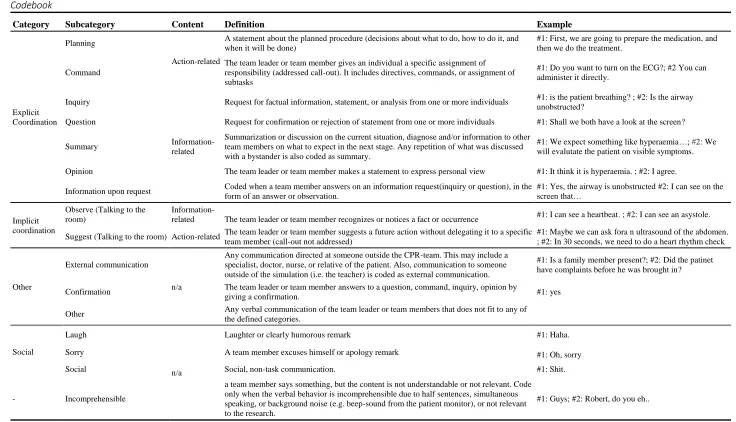
Codebook Table 2. Coding Scheme
Category Subcategory Content Definition Example
Explicit Coordination
Planning
Action-related
A statement about the planned procedure (decisions about what to do, how to do it, and when it will be done)
#1: First, we are going to prepare the medication, and then we do the treatment.
Command
The team leader or team member gives an individual a specific assignment of responsibility (addressed call-out). It includes directives, commands, or assignment of subtasks
#1: Do you want to turn on the ECG?; #2 You can administer it directly.
Inquiry
Information-related
Request for factual information, statement, or analysis from one or more individuals #1: is the patient breathing? ; #2: Is the airway unobstructed?
Question Request for confirmation or rejection of statement from one or more individuals #1: Shall we both have a look at the screen?
Summary
Summarization or discussion on the current situation, diagnose and/or information to other team members on what to expect in the next stage. Any repetition of what was discussed with a bystander is also coded as summary.
#1: We expect something like hyperaemia…; #2: We will evalutate the patient on visible symptoms.
Opinion The team leader or team member makes a statement to express personal view #1: It think it is hyperaemia. ; #2: I agree.
Information upon request Coded when a team member answers on an information request(inquiry or question), in the form of an answer or observation.
#1: Yes, the airway is unobstructed #2: I can see on the screen that…
Implicit coordination
Observe (Talking to the room)
Information-related The team leader or team member recognizes or notices a fact or occurrence #1: I can see a heartbeat. ; #2: I can see an asystole.
Suggest (Talking to the room) Action-related The team leader or team member suggests a future action without delegating it to a specific team member (call-out not addressed)
#1: Maybe we can ask fora n ultrasound of the abdomen. ; #2: In 30 seconds, we need to do a heart rhythm check
Other
External communication
n/a
Any communication directed at someone outside the CPR-team. This may include a specialist, doctor, nurse, or relative of the patient. Also, communication to someone outside of the simulation (i.e. the teacher) is coded as external communication.
#1: Is a family member present?; #2: Did the patinet have complaints before he was brought in?
Confirmation The team leader or team member answers to a question, command, inquiry, opinion by
giving a confirmation. #1: yes
Other Any verbal communication of the team leader or team members that does not fit to any of the defined categories.
Social
Laugh
n/a
Laughter or clearly humorous remark #1: Haha.
Sorry A team member excuses himself or apology remark #1: Oh, sorry
Social Social, non-task communication. #1: Shit.
- Incomprehensible
a team member says something, but the content is not understandable or not relevant. Code only when the verbal behavior is incomprehensible due to half sentences, simultaneous speaking, or background noise (e.g. beep-sound from the patient monitor), or not relevant to the research.
15
3.5
P
rocedure
Before the practical sessions of the ALS course started, the Ethical committee of the University of Twente approved the study. At the end of the first lecture of the ALS course, the research team informed the students of the course about the goals and procedure of the research. It was emphasized that participation was voluntary and that the study would not affect their grade. A week later, students were asked to give informed consent and to fill out a survey to collect demographic information (Appendix 4). A team could only be included in the study if all members had given informed consent. During the course, students practiced several CPR simulations during scheduled sessions. Finally, the course assessment took place, during which data was collected. Two teams performed their assessment simultaneously in two separate rooms. During this assessment, all participating teams were recorded on video while performing their CPR simulation scenario. During the sessions, the research team was present in a separate room to collect the data. After performing the assessment, students were guided to another room to fill in the team cohesion scale (Appendix 2). All collected data was encrypted (Appendix 5) to ensure anonymity for the participating students.
3.6
Data analysis
After all teams had completed the assessment, 20 minutes of each video was coded with the Noldus Observer XT software. First, the videos were pre-cutted by two observers. This means, all utterances that were made during the scenario were distinguished. An utterance was defined as one meaningful statement by a member of the team, consisting of one or multiple sentences (Strijbos, Martens, Prins, & Jochems, 2006). For each utterance, it was indicated which team member had made a statement. After pre-cutting, the videos were divided over two other observers. Each video was then coded by one of the observers according to the codebook. Besides that, 3 videos were coded by both observers to establish interrater reliability. After coding the first video the agreement between observers was 64.8% (K = .63, p< .001, 95% CI, .58 to .68). After double coding the first video, observers discussed differences to improve the reliability. This led to an agreement of 89.6 % (K = .89, p< .001, 95% CI, .86 to .92) in the second video, and 91.5 % (K = .91, p< .001, 95% CI, .88 to .94) in the third video.
Before testing the hypotheses, SPSS version 22 was used for descriptive statistics to obtain an overview of all variables and to check assumptions for analyses. The Shapiro-Wilk test was used to check distribution of the continuous variables. Normality was not accepted for team cohesion (W (17) =.80, p < .01). However, as team cohesion only served as an independent variable, this di not have further consequences. For the other variables normality was accepted; team performance (W (17) =.95, p > .05), planning (W (17) =.94, p > .05), decision-making (W (17) =.92, p > .05), and information sharing (W (17) =.92, p > .05).
The data was explored to see if teams differed in the use of problem-solving strategies. Since problem-solving strategies were expected to mediate between team cohesion and team performance, a lag sequential analysis was performed for high and low performing teams. A median split was performed to distinguish high and low performing teams. The lag sequential analysis would show whether certain interaction sequences had occurred more often than could be expected by chance (Bakeman & Quera, 2011), and whether this differed between high and low performing teams. For each sequence the z-score was computed based on the sequence matrix from the Observer XT software. A z-score is found to be significant if it is either higher than 1.96 or lower than -1.96 (Field, 2009). This indicates that a sequence occurred more or less often than a 95% chance level.
16 the regression coefficients of the relation between de mediating variables and team performance. Finally, the mediation effects were tested. The confidence interval of the mediation model was determined by looking at the indirect effects of independent variable on dependents variable in the output generated by the PROCESS v3.0 application. If the confidence interval of the indirect effect did not contain zero, the mediation was found to be significant.
4
Results
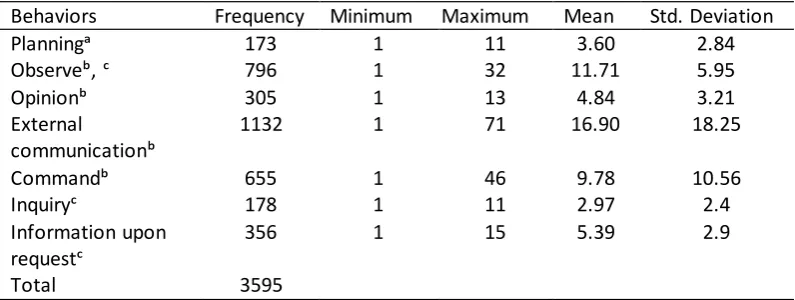
[image:16.595.77.457.313.429.2]Table 3 shows the minimum and maximum values of all variables from the research model and team familiarity, including the mean and standard deviation for all 17 teams. Teams obtained performance scores ranging from 17 to 28 with an average of 23.41 (SD = 2.65). Regarding team cohesion, all teams scored high, with 38.64 on average (min. 30, max. 42, SD = 3.54). In total, 7790 utterances were coded for the 17 teams that participated in the study of which 3595 utterances were used to test the hypotheses. Table 4 shows the amount of individual interaction behaviors applicable to planning, decision-making, and information sharing in all teams.
Table 3
Descriptive Statistics
N Minimum Maximum Mean Std. Deviation
Team performance 17 17,00 28,00 23,1 2,645
Team cohesion 17 30 42 38,64 3,54
Team familiarityᵃ 17 2 4 3.05 .85
Planning 17 5 18 10,18 3,80
Decision-making 17 1 9 3,88 2,23
Information sharing 17 32 69 47,41 11,94
[image:16.595.71.469.487.637.2]Note: a = With how many of your team members have you worked together before?
Table 4
Behavior Frequencies
Behaviors Frequency Minimum Maximum Mean Std. Deviation
Planningᵃ 173 1 11 3.60 2.84
Observeᵇ, ᶜ 796 1 32 11.71 5.95
Opinionᵇ 305 1 13 4.84 3.21
External
communicationᵇ
1132 1 71 16.90 18.25
Commandᵇ 655 1 46 9.78 10.56
Inquiryᶜ 178 1 11 2.97 2.4
Information upon requestᶜ
356 1 15 5.39 2.9
Total 3595
Note: a = part of planning; b = part of decision-making; c = part of information sharing
4.1
The use of problem-solving strategies in high and low performing teams
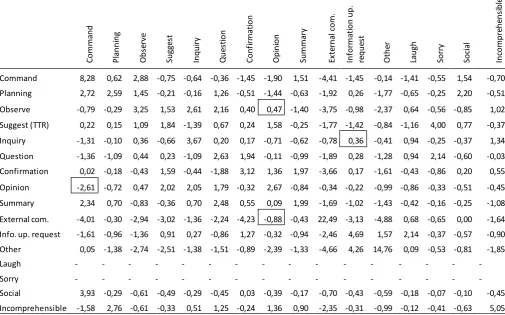
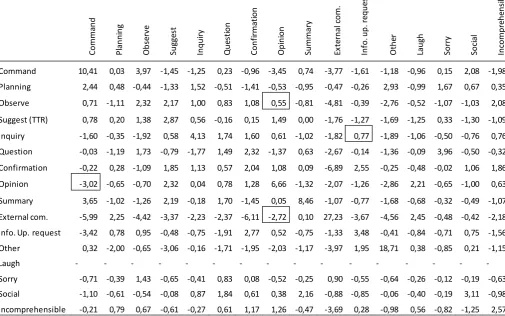
17 5 and table 6. The boxes show the z-values for the behavioral sequences that were part of the problem-solving strategies. In both low and high performing teams, the opinion – command sequence occurred below chance (z = -2.61 and z = -3.02, respectively). Also, in high performing teams, external communication is less likely to trigger an opinion (z = -2.72), while in low performing teams this sequence was not significant (z = -.88). There were no other significant differences in behavioral sequences between low and high performing teams. This already indicated that there were little differences in the use of problem-solving strategies between high and low performing teams.
Table 5
Z-scores Low Performing Teams
Co mma n d P la n n in g O b se rv e Su gg es t In q u ir y Q u es ti o n C o n fi rma ti o n O p in io n Su mma ry Ex te rn al c o m. In fo rma ti o n up . re q u es t O th er La u gh So rr y So ci al In co mp re h en si b le
Command 8,28 0,62 2,88 -0,75 -0,64 -0,36 -1,45 -1,90 1,51 -4,41 -1,45 -0,14 -1,41 -0,55 1,54 -0,70 Planning 2,72 2,59 1,45 -0,21 -0,16 1,26 -0,51 -1,44 -0,63 -1,92 0,26 -1,77 -0,65 -0,25 2,20 -0,51
Observe -0,79 -0,29 3,25 1,53 2,61 2,16 0,40 0,47 -1,40 -3,75 -0,98 -2,37 0,64 -0,56 -0,85 1,02
Suggest (TTR) 0,22 0,15 1,09 1,84 -1,39 0,67 0,24 1,58 -0,25 -1,77 -1,42 -0,84 -1,16 4,00 0,77 -0,37 Inquiry -1,31 -0,10 0,36 -0,66 3,67 0,20 0,17 -0,71 -0,62 -0,78 0,36 -0,41 0,94 -0,25 -0,37 1,34 Question -1,36 -1,09 0,44 0,23 -1,09 2,63 1,94 -0,11 -0,99 -1,89 0,28 -1,28 0,94 2,14 -0,60 -0,03 Confirmation 0,02 -0,18 -0,43 1,59 -0,44 -1,88 3,12 1,36 1,97 -3,66 0,17 -1,61 -0,43 -0,86 0,20 0,55
Opinion -2,61 -0,72 0,47 2,02 2,05 1,79 -0,32 2,67 -0,84 -0,34 -0,22 -0,99 -0,86 -0,33 -0,51 -0,45
Summary 2,34 0,70 -0,83 -0,36 0,70 2,48 0,55 0,09 1,99 -1,69 -1,02 -1,43 -0,42 -0,16 -0,25 -1,08
External com. -4,01 -0,30 -2,94 -3,02 -1,36 -2,24 -4,23 -0,88 -0,43 22,49 -3,13 -4,88 0,68 -0,65 0,00 -1,64 Info. up. request -1,61 -0,96 -1,36 0,91 0,27 -0,86 1,27 -0,32 -0,94 -2,46 4,69 1,57 2,14 -0,37 -0,57 -0,90 Other 0,05 -1,38 -2,74 -2,51 -1,38 -1,51 -0,89 -2,39 -1,33 -4,66 4,26 14,76 0,09 -0,53 -0,81 -1,85
Laugh - - - -
Sorry - - - -
18 Table 6
Z-scores High Performing Teams
Co mma n d P la n n in g O b se rv e Su gg es t In q u ir y Q u es ti o n C o n fi rma ti o n O p in io n Su mma ry Ex te rn al c o m . In fo . u p . r eq u es t O th er La u gh So rr y So ci al In co mp re h en si b le
Command 10,41 0,03 3,97 -1,45 -1,25 0,23 -0,96 -3,45 0,74 -3,77 -1,61 -1,18 -0,96 0,15 2,08 -1,98 Planning 2,44 0,48 -0,44 -1,33 1,52 -0,51 -1,41 -0,53 -0,95 -0,47 -0,26 2,93 -0,99 1,67 0,67 0,35
Observe 0,71 -1,11 2,32 2,17 1,00 0,83 1,08 0,55 -0,81 -4,81 -0,39 -2,76 -0,52 -1,07 -1,03 2,08
Suggest (TTR) 0,78 0,20 1,38 2,87 0,56 -0,16 0,15 1,49 0,00 -1,76 -1,27 -1,69 -1,25 0,33 -1,30 -1,09
Inquiry -1,60 -0,35 -1,92 0,58 4,13 1,74 1,60 0,61 -1,02 -1,82 0,77 -1,89 -1,06 -0,50 -0,76 0,76 Question -0,03 -1,19 1,73 -0,79 -1,77 1,49 2,32 -1,37 0,63 -2,67 -0,14 -1,36 -0,09 3,96 -0,50 -0,32
Confirmation -0,22 0,28 -1,09 1,85 1,13 0,57 2,04 1,08 0,09 -6,89 2,55 -0,25 -0,48 -0,02 1,06 1,86
Opinion -3,02 -0,65 -0,70 2,32 0,04 0,78 1,28 6,66 -1,32 -2,07 -1,26 -2,86 2,21 -0,65 -1,00 0,63
Summary 3,65 -1,02 -1,26 2,19 -0,18 1,70 -1,45 0,05 8,46 -1,07 -0,77 -1,68 -0,68 -0,32 -0,49 -1,07
External com. -5,99 2,25 -4,42 -3,37 -2,23 -2,37 -6,11 -2,72 0,10 27,23 -3,67 -4,56 2,45 -0,48 -0,42 -2,18 Info. Up. request -3,42 0,78 0,95 -0,48 -0,75 -1,91 2,77 0,52 -0,75 -1,33 3,48 -0,41 -0,84 -0,71 0,75 -1,56 Other 0,32 -2,00 -0,65 -3,06 -0,16 -1,71 -1,95 -2,03 -1,17 -3,97 1,95 18,71 0,38 -0,85 0,21 -1,15
Laugh - - - -
Sorry -0,71 -0,39 1,43 -0,65 -0,41 0,83 0,08 -0,52 -0,25 0,90 -0,55 -0,64 -0,26 -0,12 -0,19 -0,63 Social -1,10 -0,61 -0,54 -0,08 0,87 1,84 0,61 0,38 2,16 -0,88 -0,85 -0,06 -0,40 -0,19 3,11 -0,98 Incomprehensible -0,21 0,79 0,67 -0,61 -0,27 0,61 1,17 1,26 -0,47 -3,69 0,28 -0,98 0,56 -0,82 -1,25 2,57
4.2
Mediation effects
All hypotheses in the mediation model were tested with the PROCESS v3.0 application of Hayes (2013). Because of small variance in the team cohesion variable, it was not possible to use a median split, and consequently a t-test to analyze hypothesis 1. Therefore, PROCESS v3.0 was used to test this hypothesis as well. Results showed no significant relationship between team cohesion and team performance (β=.,25 p=.20), F(1,15) = 1.82, p= .20, with an R² of .11. Even though there was no significant relation between the independent and dependent variable of the mediation model, mediation analysis could still be performed (Hayes, 2013). According to this model, a significant relationship between the independent and dependent variable is not required for mediation. The results of the mediation analysis are presented in table 7.
Table 7
Mediation Analysis
Products of coefficients BC Percentile 95% CI
Β Se Lower Upper
TC → P → TP -.002 .094 -.229 .182
TC → DM →TP -.000 .065 -.124 .134
TC → IS → TP .026 .080 -.029 .097
19 As stated by hypothesis 2, it was expected that the relationship between team cohesion and team performance would be mediated by planning. The regression coefficients showing the relation between all variables of the mediation model with planning as a mediator are presented in figure 2. None of the values were found to be a significant predictor. First, regarding hypothesis 2a, no significant relationship was found between team cohesion and planning (β =. -14, p=.63), F(1,15) = .25, p = .63, with an R² of .02. Secondly, the relation between planning and team performance was not significant either (H2b) (β=.016, p=.93). Thirdly, planning was found not to mediate between team cohesion and team performance (β=-.-.002, se=.09) and CI [-.229, .182]. The confidence interval contained zero, which means no support was found for mediation of planning between team cohesion and team performance (H2c).
Figure 2 Model coefficients with planning as a mediator
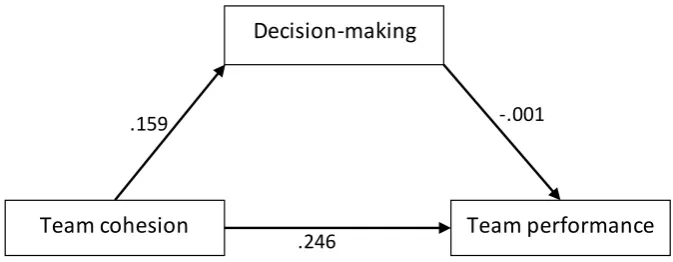
Hypothesis 3 stated that decision-making would mediate the relationship between team cohesion and team performance. The coefficients of the corresponding model are presented in figure 3, all of which were nonsignificant. First, regarding hypothesis 3a, no significant relationship was found between team cohesion and decision-making (β=.159, p=.33), F (1,15) = .1.02, p = .33, with an R² of .25. Secondly, the coefficient indicating the relation between decision-making and team performance was not significant either (β=-.001, p=1 (H3b). Thirdly, decision-making was found not to mediate between team cohesion and team performance (β=-.-.000, se=.07) and CI [-.124, .134]. The confidence interval contained zero, thus no support was found for H3c, decision-making did not mediate between team cohesion and team performance.
Figure 3 Model coefficients with decision-making as a mediator
Team cohesion
Team performance
Decision-making
.159 -.001
[image:19.595.69.406.600.731.2]20 Finally, according to hypothesis 4, the relationship between team cohesion and team performance would be mediated by information sharing. The coefficients showing the relation between all variables of the mediation model with information sharing as a mediator is presented in figure 4, no significant relations were found. First, hypothesis 4a was not supported, no significant relationship was found between team cohesion and information sharing (β=.749, p=.39), F(1,15) = .78, p = .39, with an R² of .05. Secondly, the coefficient indicating the relation between information sharing and team performance was not significant either (β=.035, p=.55) (H4b). Thirdly, information sharing was found not to be a mediating variable between team cohesion and team performance (β=-.026, se=.08) and CI [-.029, .097]. The confidence interval contained zero, thus no support was found for mediation of information sharing between team cohesion and team performance (H4c).
Figure 4 Model coefficients withinformation sharing as a mediator
5. Discussion
The purpose of this study was to investigate the relationship between team cohesion and team performance, and the mediating role of problem-solving strategies in a simulated CPR setting. Data to test the hypotheses was collected through a team cohesion scale, a team performance scale and coded video data. Results showed that team cohesion did not significantly predict the use of problem-solving strategies or team performance Also, problem-solving strategies did not have a significant relation to team performance and did not mediate between team cohesion and team performance. Several explanations can be given for these results.
To start with, very small variance was found in team cohesion, all teams scored above average on the cohesion scale after performing their assessment. Therefore, it was not surprising that no significant relation was found between team cohesion and team performance. Because differences on the dependent variable, team performance, cannot be explained if there are no differences in the independent variable, team cohesion. Thus, it is possible teams differ on another factor, which does explain performance differences. The high levels of team cohesion could be possibly explained by the fact that since students selected their own teams, teams were formed based on friendships or earlier projects. This is supported by the fact in most teams, students reported to have worked together with a large part of their team before. On the other hand, the course required a lot of teamwork, which means that even if team members were not familiar with each other at the beginning of the course, they may have gotten to know each other by the time of the assessment. Not only did all teams practice together during the scheduled course sessions, but students were expected to practice in their own time as well. As mentioned by Chiocchio and Essiembre (2009), it takes time for teams to develop cohesion. Since all teams scored high on team cohesion, teams could have spent sufficient time together to build a high level of cohesion before the assessment, either before or during the course. However, as it was not measured how much time teams spent together, there is no evidence for this assumption.
21 were assumed to be supported by higher team cohesion, lead to better performance and serve as mediating factors. However, when looking at the results of the lag sequential analysis, only one sequence of decision-making (external communication – opinion) occurred significantly below chance in high performing teams, that was not significant in low performing teams. This indicates that high performing teams evaluate information from external sources less often than low performing team and directly continue to action instead. This is supported by the fact that planning, which is identified as action-related behavior in the codebook, occurred significantly above chance after external communication in high performing teams but not in low performing teams. The fact that none of the other sequences significantly differed between high and low performing teams, already indicated little differences in the use of problem-solving strategies between high and low performing teams in a CPR simulation. This was further confirmed by the mediation analyses.
Planning, decision-making and information sharing were not predicted by team cohesion. Even though this expectation was based on literature, this finding was not surprising as teams differed little on team cohesion. When looking more detailed into planning, this study was not able to support the findings of Zaccaro et al. (1995) who argued that high cohesive teams show more effective planning behaviors than low cohesive team when working under time pressure, since they are capable of dealing with stress. In CPR, some level of time pressure is present, since the resuscitation needs to start as quickly as possible and quick action is required to enhance the survival chance of the patient (Hunziker et al., 2011). Since there were no low cohesive teams, it could not be checked, whether those teams showed less planning behaviors under time pressure in CPR. However, this does not explain why planning is not significantly related to team performance or does not act as a mediator. The different types of planning as explained by DeChurch and Haas (2008), may offer an explanation. Reactive strategy adjustment as a way of planning, may be less suitable for the CPR context than expected. Even though teams have to respond to unexpected events, protocol still needs to be followed. This suggests a more important role of deliberate planning, in which teams do not revise their initial plan because protocol is used to respond to unexpected events and teams are not supposed to deviate from protocol. This could explain why planning did not contribute to better team performance because the effects of deliberate planning on team coordination and performance have shown to be less strong than reactive strategy adjustment (Dechurch & Haas, 2008).
Similar to planning, decision-making was not related to team cohesion or team performance either. In situations characterized by limited resources and high workload, decisions can be inadequate as a result of incomplete or unambiguous information. Often, decisions are made without discussing alternative options, but if some elements of the situation are familiar, actions are based on a recognized pattern (Paris et al., 2000). At the time of the assessment, students have already practiced CPR several times during the course sessions and in their own time. As a result of this, they may already have become familiar with different types of events and know how they should respond to this. Consequently, they may be less inclined to follow the entire decision-making model but instead only use parts of the decision-making process. This coincides with the way decision-making was measured. Behaviors of the decision-making model (Franz, 2012) were included in the codebook, but only individual sequences of two behaviors were identified, while the whole decision-making process entails a more elaborate collection of behaviors. Thus, if teams show separate decision-making sequences, it does not lead to higher team performance according to the results of this study. However, it remains unclear whether it would make a difference for team performance if teams would go through the entire process to make a decision.
22 relevance of the information that is shared. This fits to the findings of Marks et al. (2000) who stated that quality is more important that quantity in predicting team performance. In addition, another possibility is that it is not just about sharing information, but also what is subsequently done with that information. Earlier research showed that individual information sharing behaviors, like talking to the room do not differ between high and low performing teams, but that differences are found when looking at interaction patterns (Kolbe et al., 2014). Elaborating to these findings, it might be expected that if the team does not respond properly to new information, the information sharing behavior may contribute less to team performance than if a team uses the information to diagnose and treat the patient. Thus, it is argued that sharing information by itself is insufficient to support team performance, but that relevance of the content and how teams act upon information might be more important.
5.1
Limitations and future research
This research was conducted carefully, however there are some limitations that should be considered. First, as data for this study was collected during an existing ALS course, it was not possible to include a large sample size. The small sample size of 17 teams, consisting of students with similar background, limits the generalizability of the results. Besides that, members of all teams had a similar background in technical medicine, while CPR teams in practice might be more diverse. This leads to the question whether this would make a difference in how teams interact. Since people with different backgrounds might have learned different knowledge and working methods, which could possibly result in different ways of interaction as well. Secondly, team performance was only rated by one teacher from the ALS course per team, which means interrater reliability could not be determined for team performance. Even though the performance scale was discussed with both teachers beforehand, who said to rate teams similarly, it cannot be said with certainty that they rated the teams equally.
This study did not consider the time that teams had spent together during the course as a confounding variable. As mentioned by Chiocchio and Essiembre (2009), it takes time for teams to become cohesive. This suggests that even though some teams might be less familiar than others at the beginning of the course, this can be compensated for by spending more time working together as a team to become cohesive. Since no data regarding practice time was collected, this cannot be confirmed. Therefore, it would be interesting to ask teams to report how much time they have practiced besides the obligated course sessions. This way, it can be investigated whether teams that have spent more time together, interact more effectively and perform better than teams that have spent less time on practicing CPR.
Another limitation and reason for future research is about team cohesion and the use of problem-solving strategies, as there were no low cohesive teams. The initial idea following the research model was to do a lag sequential analysis based on a median split of team cohesion. However, since this was not possible because of low variance in this variable, it would be interesting to do a similar study with teams that vary on cohesion. This could show whether certain problem-solving strategies are used more, or less often than could be expected by chance based on level of team cohesion. Also, if there are low and high cohesive teams in the study, it would provide an opportunity to clarify the team cohesion – team performance link in CPR.
5.2
Practical implications
23 on how much students think aloud. Secondly, teams in this study were formed by students themselves, which may explain the high levels of team cohesion. Even if teams are formed with members who do not know each other yet, this does not seem to be problematic as all teams reported similar levels of team cohesion at the end of the course. However, if teams are not familiar yet, they should be provided with sufficient time to work together to build team cohesion. For the ALS course this means that teams could be formed at random or could be picked by students themselves, since both familiar and unfamiliar teams reached a high level of team cohesion.
6
Conclusion
24
Reference list
Bakeman, R., & Quera, V. (2011). Sequential analysis and observational methods for the behavioral
sciences. Cambridge: University Press.
Beal, D. J., Cohen, R. R., Burke, M. J., & McLendon, C. L. (2003). Cohesion and performance in groups:
A meta-analytic clarification of construct relations. Journal of Applied Psychology, 88(6), 989–
1004. https://doi.org/10.1037/0021-9010.88.6.989
Castaño, N., Watts, T., & Tekleab, A. G. (2013). A reexamination of the cohesion-performance
relationship meta-analyses: A comprehensive approach. Group Dynamics, 17(4), 207–231.
https://doi.org/10.1037/a0034142
Chiocchio, F., & Essiembre, H. (2009). Cohesion and performance: A meta-analytic review of
disparities between project teams, production teams, and service teams. Small Group Research,
40(4), 382–420. https://doi.org/10.1177/1046496409335103
Dechurch, L. A., & Haas, C. D. (2008). Examining team planning through an episodic lens: Effects of
deliberate, contingency, and reactive planning on team effectiveness. Small Group Research,
39(5), 542–568. https://doi.org/10.1177/1046496408320048
ECTM. (2017). Facilities ECTM: Simulated ICU. Retrieved June 28, 2018, from
https://www.utwente.nl/en/ectm/facilities/simulates-icu/
Edmondson, A. C. (2003). Speaking up in the operating room: How team leaders promote learning in
interdisciplinary action teams. https://doi.org/10.1111/1467-6486.00386
European Resuscitation Council. (2015). ERC guidelines for resuscitation 2015.
Fernandez Castelao, E., Russo, S. G., Riethmüller, M., & Boos, M. (2013). Effects of team coordination
during cardiopulmonary resuscitation : A systematic review of the literature. Journal of Critical
Care, 28, 504–521. https://doi.org/10.1186/s12909-015-0389-z
Field, A. (2009). Discovering statistics (3rd ed.). London: SAGE Publications.
Franz, T. M. (2012). Group dynamics and team interventions: Understanding and improving team
performance. Malden: Wiley-Blackwell.
Gibson, C. B., Cooper, C. D., & Conger, J. A. (2009). Do you see what we see? The complex effects of
perceptual distance between leaders and teams. Journal of Applied Psychology, 94(1), 62-76.
25 Gully, S. M., Devine, D. J., & Whitney, D. J. (1995). A meta-analysis of cohesion and performance:
Effects of level of analysis and task inter- dependence. Small Group Research, 26(4), 497–520.
Retrieved from
http://journals.sagepub.com.ezproxy2.utwente.nl/doi/pdf/10.1177/1046496495264003
Hayes, A. F. (2013). Introduction to Mediation, Moderation, and Conditional Process Analysis : A
Regression-Based Approach. In Introduction to Mediation, Moderation, and Conditional Process
Analysis: A regression-based approach. New York: The Guildfor Press.
Hunziker, S., Johansson, A. C., Tschan, F., Semmer, N. K., Rock, L., Howell, M. D., & Marsch, S. (2011).
Teamwork and leadership in cardiopulmonary resuscitation. Journal of the American College of
Cardiology, 57(24), 2381–2388. https://doi.org/10.1016/J.JACC.2011.03.017
Hunziker, S., Tschan, F., Semmer, N. K., Zobrist, R., Spychiger, M., Breuer, M., … Marsch, S. C. (2009).
Hands-on time during cardiopulmonary resuscitation is affected by the process of teambuilding:
a prospective randomised simulator-based trial. BMC Emergency Medicine, 9(1), 3.
https://doi.org/10.1186/1471-227X-9-3
Jin-Kyoung, P., & Suk-Won, H. (2015). The relationship between cmmunication and nursing
performance in simulation-based team learning.
https://doi.org/10.17485/ijst/2015/v8i26/80659
Joshi, K., Hernandez, J., Martinez, J., AbdelFattah, K., & Gardner, A. K. (2017). Should they stay or
should they go now? Exploring the impact of team familiarity on interprofessional team training
outcomes. American Journal of Surgery. https://doi.org/10.1016/j.amjsurg.2017.08.048
Kolbe, M., Grote, G., Waller, M. J., Wacker, J., Grande, B., Burtscher, M. J., & Spahn, D. R. (2014).
Monitoring and talking to the room: Autochthonous coordination patterns in team interaction
and performance. Journal of Applied Psychology, 99(6), 1254–1267.
https://doi.org/10.1037/a0037877
Lei, Z., Waller, M. J., Hagen, J., & Kaplan, S. (2016). Team adaptiveness in dynamic contexts:
Contextualizing the roles of interaction patterns and in-process planning. Group & Organization
Management, 41(4), 491–525. https://doi.org/10.1177/1059601115615246
Leonard, M., Graham, S., & Bonacum, D. (2004). The human factor: the critical importance of
effective teamwork and communication in providing safe care. Qual Saf Health Care, 13, 85–90.
https://doi.org/10.1136/qshc.2004.010033
26 team interaction training for adaptation to novel environments. Journal of Applied Psychology,
85(6), 971–986. https://doi.org/10.1037//0021-90I0.85.6.971
Marsch, S. C. U., Müller, C., Marquardt, K., Conrad, G., Tschan, F., & Hunziker, P. R. (2004). Human
factors affect the quality of cardiopulmonary resuscitation in simulated cardiac arrests.
Resuscitation. https://doi.org/10.1016/j.resuscitation.2003.08.004
Mathieu, J. (1991). A cross-level non recursive model of the antecedents of organizational
commitment and satisfaction. Journal of Applied Psychology, 76 (5)(5), 607–618.
Mellick, L. B., & Adams, B. D. (2009). Resuscitation team organization for emergency departments: A
concep- tual review and discussion. The Open Emergency Medicine Journal, 2, 18–27.
Mesmer-Magnus, J. R., & DeChurch, L. A. (2009). Information sharing and team performance: A
meta-analysis. Journal of Applied Psychology, 94(2), 535–546.
https://doi.org/10.1037/a0013773
Mullen, B., & Copper, C. (1994). The relation between group cohesiveness and performance: An
integration. Psychological Bulletin, 115(2), 210–227.
https://doi.org/10.1037/0033-2909.115.2.210
Paris, C. R., Salas, E., & Cannon-Bowers, J. A. (2000). Teamwork in multi-person systems: a review and
analysis. Ergonomics, 43(8), 1052–1075.
Pierre, M. S., Hofinger, G., & Buerschaper, C. (2008). Crisis management in acute care settings:
human factors and team psychology in a high stakes environment. New York: Berlin.
Rehim, S. A., DeMoor, S., Olmsted, R., Dent, D. L., & Parker-Raley, J. (2017). Tools for Assessment of
Communication Skills of Hospital Action Teams: A Systematic Review.
https://doi.org/10.1016/j.jsurg.2016.09.008
Risser, D. T., Rice, M. M., Salisbury, M. L., Ii, M., Simon, R., Jay, G. D., & Berns, S. D. (1999). The
potential for improved teamwork to reduce medical errors in the emergency department.
Annals of Emergency Medicine, 34(3), 373–383.
Salas, E., Burke, C. S., & Samman, S. N. (2001). Understanding command and control teams operating
in complex environments. Information Knowledge Systems Management, 2(4), 311–323.
Salas, E., Wilson, K. A., Lazzara, E. H., King, H. B., Augenstein, J. S., Robinson, D. W., & Birnbach, D. J.
(2008). Simulation-based training for patient safety : 10 Principles that matter, 4(1), 3–8.
27 they talking about? Computers & Education, 46(1), 29–48.
https://doi.org/10.1016/j.compedu.2005.04.002
Sundstrom, E., Meuse, K. P. De, & Futrell, D. (1990). Work teams: Application and effectiveness.
American Psychologist, 45(2), 120–133. https://doi.org/10.1037//0003-066x.45.2.120
Tesluk, P. E., & Mathieu, J. E. (1999). Overcoming roadblocks to effectiveness: Incorporating
management of performance barriers into models of work group effectiveness. Journal of
Applied Psychology, 84(2), 200–217. https://doi.org/10.1037/0021-9010.84.2.200
Tschan, F., Semmer, N. K., Gurtner, A., Bizzari, L., Spychiger, M., Breuer, M., & Marsch, S. U. (2009).
Explicit reasoning, confirmation bias, and illusory transactive memory: A simulation study of
group medical decision making. Small Group Research, 40(3), 271–300.
https://doi.org/10.1177/1046496409332928
Tuckman, B. W. (1965). Developmental sequence in small groups. Psychological Bulletin, 63, 384–
399. doi:10.1037/h0022100
Zaccaro, S. J., Gualtieri, J., & Minionis, D. (1995). Task cohesion as a faciliator of team decision making
under temporal urgency. Military Psychology, 7(2), 77–93.
https://doi.org/10.1207/s15327876mp0702_3
Zaccaro, S. J., Rittman, A. L., & Marks, M. A. (2001). Team leadership. The Leadership Quarterly, 12,
451–483. https://doi.org/0.1016/S1048-9843(01)00093-5
Zijlstra, F. R. H., Waller, M. J., & Philips, S. I. (2012). Setting the tone: Early interaction patterns in
swift-starting teams as a predictor of effectiveness. European Journal of Work and
28
Appendices
Appendix I course description
Goal
The course Advanced Life Support enables students to adequately assess and treat a
patient in resuscitation setting according to protocolled guidelines by making use of a
systematic clinical approach and medical technology.
The following learning objectives are pursued:
1.
The student can describe the underlying principles of therapies that are
commonly used in a resuscitation setting
2.
The student can describe the possibilities and limitations of diagnostic
technologies that are commonly used in a resuscitation setting
3.
The student is able to relate information derived from the anamnesis,
physical examination, arterial blood gas values, venous laboratory values,
echography, X-thorax and the patient monitor to an individual patient case.
4.
The student can perform resuscitation in a team according to the protocol of
shockable and non-shockable rhythms in a simulated resuscitation setting.
5.
The student can adequately perform chest compressions, non-invasive
ventilation techniques, medication administration, and electrical therapies
that are part of the resuscitation protocol in a simulated resuscitation setting.
6.
The student can adequately communicate and collaborate in a team in a
simulated resuscitation setting.
7.
The student can handover patients in a structured way according to the
SBAR methodology.
8.
The student can analyze a patient in a structured way according to the
ABCDE methodology.
9.
The student can propose an adequate diagnostic and therapeutic strategy
based on the available clinical and contextual information of a patient case.
Content
In the course Advanced Life Support, we will follow the guidelines provided by the European Resuscitation Council. Yet, we do not intend to train resuscitation teams or to provide any certifications, but to create insight in medical technologies and procedures that are relevant in the management of patients witch a circulatory arrest.
During the course, students will practice and become acquainted with medical technologies and skills, in which the underlying therapeutic and diagnostic principles are underlined. Next, specific attention is given to the clinical approach of patient assessment and the interpretation of critical body functions. The major part of the course consists of sessions in which knowledge and skills have to be integrated and applied on a simulated patient case in a resuscitation setting.