A Thesis Submitted for the Degree of PhD at the University of Warwick
http://go.warwick.ac.uk/wrap/59461
This thesis is made available online and is protected by original copyright. Please scroll down to view the document itself.
in Discrete Event Simulation:
A Stochastic Neural Network Approach
by
Stephen Curram MSc (Warwick)
BSc (Kent)
A thesis submitted in partial fulfIlment of the requirements for the degree of "Doctor of Philosophy"
University of Warwick Warwick Business School
Contents
Chapter 1
Introduction
11.1 Background 1
1.2 Method of Approach 3
1.3 Overview of Chapters 4
Chapter 2
A Review of Approaches for Representing Decision Making
Behaviour in Simulation Models
62.1 Simulation Modelling 6
2.2 2.3
2.1.1 Simulation Modelling Approaches 6
2.1.2 Introduction to Discrete Event Simulation
2.1.3 Discrete Event Simulation Modelling Approaches 2.1.4 Comparison Between the Simulation Approaches Simulation Objects
Intelligent Agents
2.3.1 Intelligent Decision Making and Intelligent Agents 2.3.2
Aims
in Representing Intelligence2.3.3 Decision Making in the Simulation Context 2.3.4 Paradigms for Representing Intelligence
7 9 12 12 14 14 15 17 20 2.3.5 Implications of AI Paradigms for Intelligent Agents in Simulation 27 2.4 Desirable Features of Approaches to Representing Decision Making 28
2.4.1 Accuracy of Representation
2.4.2 Ability to Represent Variety in Decisions 2.4.3 Data Driven Model Development
2.4.4 Clarity of Representation
2.4.5 Explanation of Decision Outcome 2.4.6 Allowance for Uncertainty
2.5 Current Representations of Intelligent Decision Making 30
2.5.1 Abstraction 31
2.5.2 Knowledge-Based Systems 32
2.5.2.1 Defining a Knowledge-Based System 32 2.5.2.2 Combining Knowledge-Based Systems with Simulation 34
2.5.3 Rule Induction 41
2.5.4 Fuzzy Sets 43
2.6 Alternative Representations of Decision Making 45
2.6.1 Case-Based Reasoning 45
2.6.2 ~eural~etworks 46
2.7 Evaluating the Approaches 49
2.7.1 Abstraction 49
2.7.2 Knowledge-Based Systems 50
2.7.3 Rule Induction 53
2.7.4 Fuzzy Sets 55
2.7.5 Case-Based Reasoning 56
2.7.6 ~eural ~etworks 58
2.8 Comparison of Approaches 60
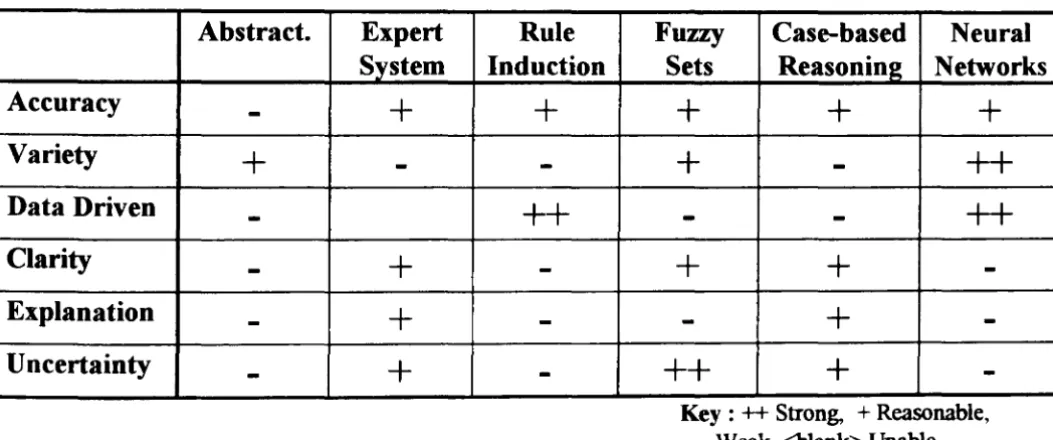
2.8.1 Summary of Strengths and Weaknesses of Approaches 60
2.8.2 Potential for Further Investigation 63
Chapter 3
The Practical Use of Neural Networks with a View to the
Representation of Intelligent Decision Making
643.1 The Principles of~eural ~etworks 65
3.1.1 The
Origins
of Artificial ~eural ~etworks 653.1.2 The Structure of a ~eural ~etwork 67
3.1.3 ~eural ~etwork Training Paradigms 70
3.2 The Multilayer Perceptron 70
3.2.1 Features of the Multilayer Perceptron 70
3.2.2 The Functional Form of the ~etwork 71
3.3
3.4
The Practice of Using the Multilayer Perceptron 3.3.1 Selecting Variables
3.3.2 Coding the Variables
3.3.3 Setting Gain and Momentum Parameters 3.3.4 Generalisability of Results
3.3.5 Analysing Neural Network Results
Neural Network Representations of Stochastic Processes 3.4.1 The Characteristics of Stochastic Neural Network
Representations
3 .4.2 Real-Valued Decision Outcomes
3.4.3 Classification Type Decision Outcomes 3.4.4 Overview of Stochastic Representation
Chapter 4
Examining Stochastic Neural Network Representations using
79 79 80 82 83 88 91 91 92 94 97Artificially Generated Data
994.1 Method of Investigation 99
4.2 4.3
The Development of the Neural Network Software Representing Continuous Valued Output Variables
4.3.1 Approach to Representing Decisions with Continuous Valued Outputs
4.3.2 Continuous Data Sets
4.3.2.1 Beta Distribution Varying a}
4.3.2.2 Beta Distribution Varying a} and a2 4.3.3 Neural Network Training and Testing
4.3.4 Results of Experimentation 4.3.4.1 Beta( a}, 1) Distribution 4.3.4.2 Beta(at, (2) Distribution 4.3.5 Investigating the Effects of Class Size
4.3.6 Overview of Results for Continuous Valued Output Models
4.4 Representing Classification Outputs 120 4.4.1 Approaches to Representing Decisions with Classification
Outputs 120
4.4 .1.1 Training with a Probability Input Variable (INV AR) 120 4.4.1.2 Training with Class Membership Probabilities as Outputs
(OUTDATA) 121
4.4.1.3 Allowing the Network to Determine Class Probabilities
(OUTNET) 125
4.4.2 Discrete Data Sets 125
4.4.2.1 Binomial Data Sets using Random Variable as an Input 126 4.4.2.2 Binomial Data Sets with Class Membership Probabilities
as Outputs 127
4.4.2.3 Binomial Data with Network Attributing Class
Membership Probabilities 128
4.4.3 Neural Network Training and Testing 128
4.4.4 Results of Experimentation 130
4.4.4.1 Results using Random Variable as an Input 130 4.4.4.2 Results using Class Membership Probabilities as Outputs 131 4.4.4.3 Results using Network Training to Attribute Probabilities 133
4.4.5 Investigating the Effects of Class Size 134
4.4.6 Comparison of Approaches for Modelling Classification Outputs 135
4.5 Independent Validation Data 137
4.6 Conclusions 138
Chapter 5
Issues for the Practical Use of Stochastic Neural Network Models
141 5.1 Encoding the Situation5.1.1 Specifying Variables
5.1.2 Specific vs General Specifications 5.1.3 Observed and Possible Behaviour
5.2 Hybrid Neural Network / Knowledge-Based System 5.2.1 Reasoning Behind a Hybrid Approach 5.2.2 Organisation of the Hybrid Model 5.2.3 The Task Allocation Unit
5.2.4 Neural Network Modules 5.2.5 Rule-Based Modules
Chapter 6
Testing the Neural Network / Knowledge-Based Hybrid
Model in Practice : The Bank Simulation
1506.1 Choosing the Application 150
6.2 The Bank Simulation Model 152
6.2.1 Overview of the Model 152
6.2.2 Bank Activities 154
6.2.3 User Interactions 158
6.2.4 Specifying Scenarios 160
6.3 The Pilot Study 160
6.3.1
Aims
of the Pilot 1606.3.2 Data Collection 161
6.3.3 Modelling and Implementation 162
6.4 Data Collection 163
6.4.1 Considerations in Setting Up the Data Collection 163
6.4.2 Setting Up Scenarios 164
6.4.3 Specifying Exit Penalties 166
6.4.4 Recording Decision Data 167
6.4.4.1 Arrival Decision Data 168
6.4.4.2 In Queue Decision Data 170
6.4.5 Conducting the Data Collection Sessions 171
6.4.6 The Decision Making Questionnaire 173
6.5 Data Analysis and Model Building 175
6.5.1 Organising the Analysis 175
6.5.2 Identifying Sub-decisions and Dimension Reduction 177 6.5.3 Overview of Decision Upon Arrival at the Bank 178
6.5.4 'Which Service?' Decision 179
6.5.5 Queuing Decision Upon Arrival at the Bank: 'Join or Balk?' 180
6.5.5.1 Information: Join or Balk 180
6.5.5.2 Transactions: Join or Balk 188
6.5.5.3 Business: Join or Balk 195
6.5.6 Queue Joining Decisions 202
6.5.6.1 Transaction Queue Decision 202
6.5.6.2 Business Queue Decision 205
6.5.6.3 Currency Queue Decision 206
6.5.7 Reneging Decisions 207
6.5.7.1 The Decision Task 207
6.5.7.2 Issues for Building a Neural Network Model 209
6.5.7.3 The Network Training Data 214
6.5.7.4 Developing the Neural Network Model 216
6.5.7.5 Rule-Based Components 219
6.5.8 Queue Swapping Decisions 220
6.5.8.1 Queue Swapping Data 221
6.5.8.2 Rule-Based Decision Model 222
6.6 Implementing the Decision Modules 224
6.6.1 Implementation Strategy 224
6.6.1.1 Implementation for Special Customers 225
6.6.1.2 Implementation for All Customers 227
6.6.2 The Neural Networks 228
6.6.3 Arrival Decision Modules 229
6.6.4 Reneging Decision Module 230
6.6.5 Queue Swapping Modules 232
6.7 Observations on the Bank Simulation 233
6.7.1 The Bank Simulation as a Vehicle for Investigation 233
6.7.2 Decision Models 235
6.7.3 Decision Model Validation 236
Chapter 7
Discussion of the Stochastic Neural Network / Hybrid
Modelling Approach
2397.1 Research Context 239
7.2 Basis of the Approach 240
7.3 Results from the Artificial Data Sets 242
7.4 Results from the Bank Simulation Study 245
7.5 Strengths and Weaknesses of the Approach 251
7.5.1 Strengths 252
7.5.2 Weaknesses 254
7.5.3 Comparison with Other Approaches
7.6 Application in Practice
Chapter 8
Conclusions and Future Research
8.1 Conclusions
8.2 Future Research
References
Appendices
A : The Neural Network Software
Al : Using the Neural Network Software
A2 : Neural Network Software Code
A2.1 Library Units
A2.2 Library Code Details
B : Bank Simulation Program
B 1 : Pro gram Structure
B2: Input Distributions
B3: Entity Attributes
B4: MicroSim Commands
B5: Bank Simulation Program Listing
C : Bank Simulation Scenarios
D : Bank Simulation - Participants Instructions E : Example Decision Outcome Datasets
F : Bank Simulation Questionnaire
G : Decision Mapping Forms for Bank Simulation H : Stay / Balk Decisions for the Bank Simulation
HI : Information Service H2: Transactions Service H3 : Business Service H4 : Currency Service
I : Reneging Decision for the Bank Simulation
J : Implementation of Intelligence Modules in the Bank Simulation J1: Customer Attributes
J2: Decision Module Code
D-l E-l F-I
G-l
H-l
H-l H-13 H-24 H-28
I-I
J-I
J-l
Tables
2.1 Strengths and Weaknesses of Approaches to Representing Intelligent
Decision Making 60
4.1 Input values for Beta(at,l) : 66 examples (Small-Structured) 107
4.2 Ranges and Mid-Points for 0.1 : 66 Examples (Small-Random) 107
4.3 Input values for Beta( at, 1) : 231 examples (Large-Structured) 107 4.4 Ranges and Mid-Points for 0.1 : 231 Examples (Large-Random) 108
4.5 Beta(a1,1) : Mean Square Errors & Mean Absolute Deviations of the
Neural Network Models 111
4.6 Beta( 0.1,0.2) : Mean Square Errors & Mean Absolute Deviations of the
Neural Network Models 115
4.7 Results for Beta(a1,a2) Large Data Set with Large Class Intervals 118 4.8 Summary of Results from Continuous Distribution 119 4.9 Input values for Binomial: 36 examples (Small-Structured) 127 4.10 Ranges and Mid-Points for p : 36 Examples (Small-Random) 127 4.11 Input values for Binomial: 121 examples (Large-Structured) 127 4.12 Ranges and Mid-Points for p : 121 Examples (Large-Random) 127 4.13 Results for Binomial with Random Variable as Input 130 4.14 Results for Binomial with Membership Probabilities as Outputs 132 4.15 Results for Binomial with Network Attributing Membership Probabilities 133 4.16 Results for Large Data Set with Large Class Intervals 134
4.17 Comparison of Approaches using Binomial Data 135
6.1 Summary of Scenarios for the Bank Simulation 165
6.2 Format of Data Collected for Arrival Decision 168
6.3 Format of Data Collected for In-Queue Decision 170
6.4 Information Data showing Percentage of Customers Staying 180 6.5 Transaction Data showing Percentage of Customers Staying 189 6.6 Business Data showing Percentage of Customers Staying 195 6.7 Currency Data showing Percentage of Customers Staying 198
6.8 Transaction Queue Choices 203
6.9 Business Queue Choices 205
6.l1
Currency Queue Choices206
6.12
Currency Queue Choices for the Reduced Problem207
6.l3
Summary of Reneging Cases208
6.l4
Proportion of Customers Reneging for each Service208
6.l5
Group Ranges for Reneging Decision Data215
6.l6
Extract from Reneging Data Set Showing Cumulative Probabilities216
6.l7
Summary of Decision Groups and Decision Models219
6.l8
Summary of the Number of Queue Swapping Cases221
Figures
3.1 A Biological Neuron 67
3.2 A Typical Artificial Neuron 67
3.3 Typical Neuron Activation Functions 68
3.4 A Three Layered Neural Network Architecture 69
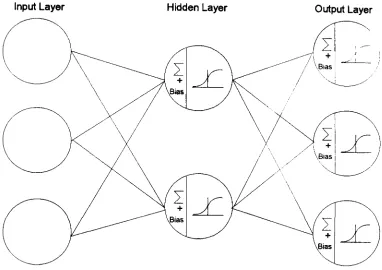
3.5 illustration of a 3*2*3 Multilayer Perceptron 72
3.6 An Illustration ofUnderfitting, Overfitting and Generalisation 84
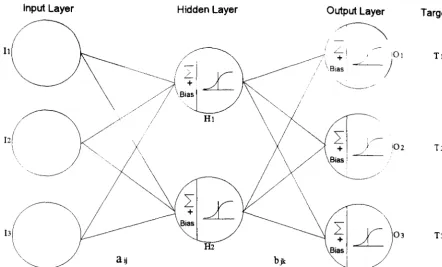
4.1 Example Neural Network Structure 105
4.2 Density Functions for the Beta( Ut,U2) Distribution 106 4.3 Beta(ut,l): Residual Plots for Small-Structured Data Set (2*8*1) 112
4.4 Beta(ut,l): Residual Plots for Small-Random Data Set (2*1 *1) 112
4.5 Beta(ut,l): Residual Plots for Large-Structured Data Set (2*8*I(L)) 113
4.6 Beta(ut,I): Residual Plots for Large-Random Data Set (2*2*1) 113
4.7 Beta(Ul,U2): Residuals for Small-Structured Data Set (3*12*I(L)) 116
4.8 Beta(uI,u2): Residuals for Small-Random Data Set (3*8*1) 116 4.9 Beta(Ul,U2): Residuals for Large-Structured Data Set (3*12*I(L)) 117
4.10 Beta(Ul,U2): Residuals for Large-Random Data Set (3*12*1) 117
4.11 Examples of Binomial( 4,p) Distribution 126
4.12 Classifications for Best Networks with Random Variable as Input 131 4.13 Classifications for Best Networks with Class Probabilities as Outputs 132 4.14 Classifications for Best Networks Detennining Class Probabilities 134
5.1 Screen Display of the Petrol Station Model 143
5.2 Neural Network / Knowledge-Based Hybrid 147
6.1 Screen Shot of Bank Simulation 153
6.2 Activity Cycle Diagram for Bank Customers 155
6.3 Activity Cycle Diagram for Human Controlled Customers 156
6.4 Service Distributions for Bank Simulation 157
6.5 User Selection Options for a Transaction Customer 159 6.6 Screen Shot of Bank Simulation Showing Exit Penalty 167
6.7 Overview of Decision upon Arrival 179
6.9 Information Test Results for the OUTDATA Network 185 6.10 Information Test Results for the Bounded OUTDATA Network 186 6.11 Information Test Results for the OUTNET Network 187 6.12 Transaction Test Results for the OUTNET Network 193 6.13 Transaction Test Results for the Bounded INV AR Network 194
6.14 Business Tests Results for the INV AR Network 197
6.15 Currency Results for the INV AR Network 200
6.16 Currency Results for the Bounded INV AR Network 201 6.17 Currency Results for the Bounded OUTDATA Network 201
6.18 Renege Model Test Results for 2*6*2 Network 217
Acknowledgements
A number of people have offered help and encouragement during the course of this
research, to whom I am indebted.
Firstly I would like to thank Robert Hurrion and John Mingers for their time and extremely useful comments during the preparation of the thesis. Also thanks go to Adrian Escott for his proof reading, and to Zoe Evans for converting my neuron sketch to an electronic format and for her role as chief guinea pig for my experiments.
Also I wish to thank my friends for their encouragement and support during this research. In particular to Bernadette Baker (for saying the right things at the right times), Frances O'Brien, Susanna Hogan, Andrew Martin, Maureen Meadows, Carol Moxham and lain Munro.
Abstract
The problem of representing decision making behaviour in discrete event simulation was investigated. Of particular interest was modelling variety in the decisions, where different people might make different decisions even where the same circumstances hold.
An initial investigation of existing and alternative approaches for representing decision making was carried out. This led to the suggestion of using a neural network to represent the decision making behaviour in the form of a multi-criteria probability distribution based on data of observed decision making.
The feasibility of the stochastic neural network approach was investigated. Models were fitted using artificial data from discrete and continuous distributions that included the shape parameters as inputs, and tested against known results from the distributions. Also a bank simulation was used to collect data from volunteers who controlled the queuing decisions of customers inside the bank. Models of their behaviour were created and implemented in the bank simulation to automate the decision making of customers.
The investigation established the feasibility of the approach, although it indicated the need for substantial amounts of data showing examples of decision making. A hybrid model that combined the stochastic neural network approach with a rule-based approach allowed the development of more general models of decision making behaviour.
1.1 Background
Chapter 1
Introduction
Discrete event simulation involves modelling the behaviour and interactions of entities in a system. Entities can, for example, represent customers in a service system, products in a manufacturing system or paperwork in an office. The models generally involve situations where activities can occur that take a specific amount of time, usually determined by sampling from a probability distribution, and where there are queues due to limited availability of resources. Entities are modelled by specifying their behaviour at each stage of the system. The behaviour of entities can usually be
modelled simply since it exists within tightly bound limits. Any choices faced by entities are extremely limited and require only simple rules to model them. However, some situations exist where the behaviour of entities is not straightforward, and the choices made should be based on the states of a number of criteria that exist in the system. In other words, the entities are required to exhibit some intelligence. In these situations, the ordinary approaches in discrete event simulation are generally too limited to model the behaviour effectively.
In most cases intelligent behaviour is ignored or handled in a highly simplified manner. The simulations use either simple rules or random sampling to determine the outcome. These generally take little or no account of the decision criteria. In some cases more advanced knowledge-based systems are used that take account of the factors that affect the decision making, and model the causal relationships that lead to the final decision. The knowledge-based approach generally assumes that all of the entities will
act in a similar manner. Given a particular set of circumstances, all the entities will
follow the same decision making process and end up making the same decision.
differences in the decision making are ignored, or a probability distnbution is used and most of the decision criteria ignored.
This study involves looking at modelling approaches that allow the differences in the
decision making behaviour of people to be modelled, at the same time as taking account of the factors that affect the decisions. This means that there is an interest in actual behaviour rather than some sort of optimal decision making. The purpose of modelling such a situation is to accept that in some cases people's innate decision making behaviour cannot be changed, but that aspects of the system could be designed so as to affect the decision criteria. For instance, it is difficuh to change directly the behaviour that people exhibit when driving in certain circumstances, but the design of the traffic flow systems might change the circumstances and therefore indirectly change the behaviour.
The original brief of the study was broad, looking at modelling approaches in general. During the review of literature the study focused on neural networks as an approach that might offer a way of achieving the twin goals of representing stochastic variation in decision making while still taking account of the decision criteria. The approach was substantially different to any that had been used before, so the main purpose of the study became the evaluation of the neural network approach.
The aims of the study were :
1. To review the current approaches for representing intelligent decision making, with consideration of alternative approaches,
2. To develop a stochastic based approach for representing decision making behaviour using neural networks,
1.2 Method of Approach
The research was investigative by nature. It involved determining an area of research interest, identifying modelling goals, identifying and developing an approach to try to achieve those goals, and detennining the feasibility of that approach.
The investigation required a careful step by step approach. Although simulation is an
established area of Operational Research, and neural networks are currently receiving a
lot of research attention, little work has been done in combining the areas together.
The development of the new approach had a number of possible routes that could be
followed. Thus care was taken to divide the investigation into a series of stages, and
review the results before continuing onto the next stage. The aim was to make the
decisions on the direction of research as informed as possible at the time.
The first stage of the investigation was to review the literature on the representation of
intelligence in general, and more specifically in simulation. Literature was also
reviewed for the application of the neural network technique. The review of literature
continued throughout the study, particularly for the neural networks which is still a
rapidly developing area. There is also a high experiential element to the effective use
of neural networks which was gained by applying the approach to other problem areas.
The stochastic neural network models were developed on the theoretical grounds of
the reported abilities of neural networks, and partly by considering their use on
hypothetical problems. The first stage of testing out the models was their use on
artificially generated data sets. This allowed the use of known functions against which
the results of the model could be judged. The initial experiments were ad hoc, to see if there was any validity in the approach. Once this was confirmed, a structured
experimental framework was designed for analysing the accuracy of models.
It was considered important to be able to ascertain some of the practical implications of using the stochastic neural networks in a simulation application. The choice of
would be a specific case, so care was required in generalising the lessons from the
experiment.
The limitations of any single study mean that not every issue surrounding the new
approach can be addressed. The aim was to address the fundamental issues of the
feasibility of the approach. The outcome of the study was bound to raise other issues
for investigation.
1.3 Overview of Chapters
Chapter 2 reviews the area of representing intelligent decision making in simulation as
it currently stands. There is a consideration of the paradigms for representing
intelligence, and the requirements of an approach for the represention intelligent
behaviour that allows variability in decision making. There is a review of methods and
case studies that have been described in the literature, and possible alternative methods
are identified. Finally there is a comparison of the methods with regard to the potential
for further research.
Chapter 3 considers the structure and use of neural networks in detail. The basic
principles are described, with particular concentration on the structure and use of one
type of network, the multilayer perceptron. There is then consideration of the
formulation of data structures that would allow decision criteria and stochastic
elements to be represented by neural network models.
Chapter 4 describes experiments with the stochastic based neural networks using
artificially generated data from known probability distributions. The results from the
neural network models are compared against the known values for the distributions to
evaluate the representational accuracy.
Chapter 5 considers issues and adaptations required for the neural network approach
for it to be used in practical applications. A hybrid approach is suggested that
combines neural network and rule-based components together to produce more
Chapter 6 describes the use of the neural network approach on a practical case study involving simulating the queuing behaviour of customers in a bank. This is used to determine the issues involved in using the approach in practice in terms of specifying the decision making, training and validating the neural networks, and implementing the models in a simulation.
Chapter 7 draws together the issues raised in the previous chapters and discusses the conditions necessary for the neural network approach to be applied in practice. A number of potential application areas are proposed.
Chapter 2
A Review of Approaches for Representing
Decision Making Behaviour in Simulation
This chapter reviews the area of representing decision making behaviour in simulation
as it currently stands, and examines other approaches that could have potential
benefits. Section I describes the main features of discrete event simulation. Section 2
discusses the use of object oriented approaches to simulation. In Section 3, a
description of intelligent agents is given, with some discussion on the main paradigms for representing intelligence. Section 4 describes some desirable features for an
approach to representing intelligent decision making. In Section 5, approaches to
representing intelligence in simulations which are currently being used or have been
suggested are described. Section 6 looks at some alternative approaches which might
have potential. All of the approaches discussed are evaluated in Section 7. Finally in
Section 8 there is a comparison of the methods with regard to potential for further
research.
2.1 Simulation Modelling
2.1.1 Simulation Modelling Approaches
There are several forms of simulation which exhibit different features and different
modelling methods. Static simulations represent a system at a particular point in time,
these could be scale models of buildings, or Monte Carlo simulation used to evaluate
mathematical functions. Continuous simulations involve modelling continuous changes
in the state of a system with respect to time. Systems dynamics is an example of an
approach for continuous simulation. It is very much interested in causal loops, rates of
change and long term dynamics of a system. Discrete event simulation treats changes
over time as a stepwise rather than a continuous process. In the simulation, events in the system are seen to occur at particular points in time. So time is advanced in steps,
Out of all the simulation approaches, discrete event simulation is the one which is
generally most concerned with tracing the actions of individual objects. The models
are very much based on queueing systems where the objects can be involved in an
activity (performing some task, being processed etc.) or be in a waiting state (usually a
queue) where they are waiting for the right conditions to start an activity.
Since the focus of the thesis is on representing intelligent decision making, it is most natural that this should involve models of individual decision makers. Thus discrete
event simulation is the most natural approach in which this should take place. This does not necessary preclude the use of the models which are developed in other forms
of simulation, and this issue will be considered further at the end of the thesis.
2.1.2 Introduction to Discrete Event Simulation
Thesen and Travis (1992) describe simulation as "the use of a computer model to
mimic the behaviour of a complicated system and thereby gain insight into the
performance of that system under a variety of circumstances".
Essentially the simulation model is a dynamic technique for representing a dynamic
system. The dynamic nature of the system means that the components of the system
change over time. For instance, a bank system may be defined by the customers in a
particular branch who wish to avail themselves of its services. An individual customer at various points in time may be entering the bank, queuing at a service counter, being
served at a particular counter. At different points in time the system will be in a particular state that is represented by the activities in which various components of the
system are involved.
The form of simulation which will be referred to from now on is discrete event
simulation. This is where the state of the system is viewed as changing in distinct
steps, as opposed to a continuous gradual change. Thus a customer in the bank changes from being in a queue to being served, and then from being served to having
state to change. The simulation employs a time clock to measure when these discrete
changes in state take place. A system which changes continuously over time can be
approximated using the discrete event approach using fixed-increment time advance,
where the simulation clock is advanced in fixed steps and the state of the system is
updated at each step. The fixed-increment time advanced model could be used to represent situations such as cars travelling down a stretch of motorway.
The use of the simulation model allows changes to be observed which may otherwise
be too disruptive, expensive, time consuming or simply dangerous to try with the real
system. The simulation may be used for quantitative experimentation to numerically compare the performance of a number of different system configurations. Also a
visual-interactive simulation model as developed by Hurrion (1980) can allow the user
to learn more about a system through being able to make operational changes in the
model and watch the results on a graphical representation of the system.
At this point it is useful to define what is meant by a system, at least from a discrete
event simulation perspective. Schmidt and Taylor (1970) define a system as being a
"collection of entities which act and interact together towards the accomplishment of
some logical end". Entities include the 'customers' of the system who may be actual customers in a service system or the products in a manufacturing system, and the
resources which perform some sort of processing of the customers and may be pieces
of machinery or servers.
In order to create a simulation model of the system, the main entities must be identified and the behaviour of the entities must be understood and replicated, incorporating any
random variations that may occur. Each entity may be involved in a number of
activities, where the behaviour of the entity is represented by the choice, order and
duration of activities, and how it interacts with the other entities in the system.
In many cases the behaviour of the entity is well understood because the system is relatively predictable. A factory production line, for instance, has a well-ordered set of
controlled. Where variation in the time to perform an activity occurs, this can be modelled using a probability distribution.
Even in cases where alternative behaviour is possible, it may be modelled using
probability distributions. For example, at a petrol station, 40% of customers require
unleaded fuel, 50% four star, and 10% diesel. Using the probability distribution, each
car arriving is allocated into one of the classes, and this class effects its behaviour in
predictable ways at various parts of the system (which pumps it can go to, filling times
etc.). When it comes to paying for the fuel, another distribution is used to find which
method of payment is being used, and time to perform the activity allocated as
appropriate.
Cases exist where the decision is more complicated, and is dependent on a number of
highly variable but critical factors which are present within the simulation. If a clear
policy exists in the system then this decision may already have been made (perhaps in
the case of a machine breakdown), and so the behaviour is predictable and fairly easy
to model. Where no clear policy exists, modelling the behaviour of the entity requires
some element of representing intelligent decision making.
2.1.3 Discrete Event Simulation Modelling Approaches
Pidd (1992) describes four main approaches to building discrete event simulation
models: Event-based, Activity-based, 3-Phase, and Process-based. All the methods
are based on the principle that the simulation can only change state after an
unconditional event occurs (i.e. one scheduled to occur after a certain amount of time)
which may then allow conditional events to occur (events which happen if the correct conditions exist). Unconditional delays usually represent an entity being involved in an
activity for a certain period of time, while conditional delays are usually queues. Each
method uses an executive which records a
list
of the scheduled, unconditional events and advances the simulation clock onto the next event time. The differences betweenthe approaches occur in the way that the execution of events is handled at a particular
stage in the simulation, involving the resolution of unconditional and conditional
Event-based Approach
In the Event-based approach, the executive stores a list of unconditional events along with the time that each is due to occur. The occurrence of the next unconditional event causes the executive to start a segment of the simulation code. This segment has sole responsibility for resolving the particular unconditional event, as well as any conditional events that may be enabled by the change in state.
The advantage of the approach is that execution of the code is efficient, only dealing with those possibilities which may occur after a particular unconditional event. The disadvantage is that the code can become complicated since all possible consequences from a particular event must be handled by the specific segment. This can increase the difficulty in building and making changes to the model.
Activity-based Approach
The Activity-based approach has a simple executive that stores a list of times for unconditional events, but does not associate a particular event with those times. At a particular time, all possible activities are tested, one at a time. The activities have a condition to test if they should be used, either involving testing a time for an activity to see if an unconditional delay has finished, or circumstances for a conditional delay to see if it has been resolved. Each activity has code to represent its behaviour if the conditions are passed.
The activity-based approach has relatively simple activity code. Since each activity is
considered individually, it is only necessary to consider one activity at a time, along with the links to neighbouring activities. This makes for simple, modular code that can be changed with relative ease. Care must be taken in defining the boundaries of an activity and the interactions with other activities, as well as ensuring that the conditions for the activity are accurate and exhaustive. The main drawback of the approach is
that each event requires a check of the conditions of every activity making the approach inefficient. In addition, the order in which the activities are checked is
knock on effects on other activities must be checked first so that the consequences of
an event can be traced through the system.
3-Phase Method
The 3-Phase method can be thought of as a mix between the event-based and
activity-based approaches as described above. The 3-Phase method (A,B and C phases) uses
an executive like that of the event-based approach, keeping a list of the times of
unconstrained delays along with the corresponding events. The A-Phase is the update
of the clock to the next scheduled event. At the time that an event occurs, the
executive starts the B-Phase which is a segment of code that resolves only the
scheduled event. Thus the B-Phase code is made up of only those events which will
occur after unconstrained delay, and only one of those events will be used at a particular time. When the B-Phase has been resolved, the C-Phase is started, which is
similar to the activity-based approach. Here, only events which can occur after
conditional delays are checked, to see if the conditions are such that the event can occur. As in the activity-based approach, the order that the conditional events are checked is important.
The 3-Phase method maintains much of the efficiency of the event-based approach,
since only one unconditional event is checked for each clock period, but splits up
events into manageable blocks as in the activity-based approach. This means that the simulation can be designed using simple blocks, while having relatively efficient execution times.
Process-based Approach
The Process-based approach uses the concept of entities having a pre-defined set of
processes that they must pass through. At any particular point in time an entity (if in the system) will be involved in a constrained or unconstrained delay. The approach differs from the previous three in that it is based around entities, rather than around events. The executive keeps data on entities, recording for each the reactivation time
unconstrained delay, and the current list that has entities which can proceed if the conditions allow. The clock is advanced to the nearest time on the future list and the
corresponding entity activated, followed by a check on all entities on the current list.
The process-based approach has an intuitive feel in that the analyst can map through
the lifecycle of the entity from beginning to end. The approach is reasonably simple if the system has uncomplicated process paths. Interaction with other entities adds to the
complexity, as does having various process paths for a particular entity.
2.1.4 Comparison Between the Simulation Approaches
The activity-based approach has the clearest and simplest programming approach,
since each activity can be dealt with individually, however the need to check all
conditions reduces its computational efficiency. The event-based approach has
computational efficiency, in that only relevant events are tested, but at the expense of
the ease of programming. The 3-phase method is a good compromise between the two
approaches, having the programming simplicity of the activity-based approach but
better computational efficiency. The process-based approach has an intuitive
entity-orientated approach, but this is at the expense of programming ease, particularly as the
process routes become more complicated.
Models that have elements of intelligent decision making are likely to have fairly
complicated process routes, since the decision will often involve a choice of different routes. Therefore, in this analysis the 3-phase method is preferred. However, the basic approaches to representing intelligent agents should be valid for all four modelling approaches, the differences being with the final implementation details in the
model.
2.2 Simulation Objects
While this thesis does not directly involve the use of object oriented simulation
techniques, it is useful to be aware of the possibility of using objects to represent
components of the simulation, including those that are required to make decisions.
models, such that they may allow 'intelligence' modules to be easily incorporated.
regardless of the approach used to actually represent the intelligence.
Birtwistle et al. (1980) describe the concept of using objects as first introduced by
SIMULA, a programming language designed for process-based simulation. An object
is a simulation component made up of three parts: a header identifying the object, data
structures that specify state variables, and an ordered sequence of actions to be carried
out. The object allows for the classic process-based approach to be used. The data
structures contain a list of the actions to be performed to allow the progress of the
object to marked. The action descriptions are a set of instructions for the behaviour of
the object at each stage of the process. While this approach allows an object to
contain its own behaviour, the limitations of the language do not allow for the easy
insertion of 'intelligent' modules.
Joines et al. (1992) describe a
e++
based system for process-based simulation.This
allows simulation objects which exhibit the object-oriented features of utility of classes,encapsulation and class inheritance that allow objects to be re-used and adapted. The
flexibility offered by this approach makes the concept of the slot in 'intelligence'
modules more feasible. The constraints of the system are imposed by the
process-based handling of events, which as discussed in Section 2.1.2, do not allow for the easy
implementation of highly variable logic paths, as may be required for a decision making
object.
Pidd (1995) is critical of the process-based approaches, and identifies weaknesses of
the entity focused approach in complex systems where a high degree of interaction
occurs between entities. The approach assumes that the executive can cycle through
entities determining whether each can progress further through their process, however
where interaction is concerned, independence is lost and the logic of the system can
vary depending on the order in which entities are reviewed. Pidd suggests the use of
the three-phase approach, being activity rather than entity focused. Here both the
entities and activities are implemented as objects. The entities contain information
represent the overall behaviour in the simulation. Thus it is the activity which interacts with its client entities and specifies how each will be processed.
Overall, it is the three-phase method that looks most promising for handling the complex logic routing which is likely to result from using decision making units. A decision making module could be treated as an activity, specifying how the entity will act. However, a more attractive approach would be for the entity to contain its own decision making modules which interact with the appropriate activities to make a decision. This approach means that different classes can have different decision making mechanisms, as well as allowing decision methods to be developed and slotted into the appropriate entities.
2.3
Intelligent Agents
In the previous sections there has been some mention of incorporating intelligent decision making into a simulation. This section provides a more detailed discussion of what is meant by an intelligent agent, and the actual forms of decision making that would be represented in a simulation. In any discussion of intelligence, there must be consideration of the main paradigms for representing intelligence, a subject which is under fierce debate.
2.3.1 Intelligent Decision Making and Intelligent Agents
For the sake of clarity it is necessary to distinguish between the decision making that goes on in the real world, and the decision making in the simulated world. Despite the simulation being a representation of the real world, and the decision making in the simulation being a representation of real world decision making, the simulated world is bound to be a more abstract one, which is bound to influence the way that the decision making is represented. To this end, in the real world there will be what is termed an
intelligent decision maker, while in the simulation there will be an intelligent agent.
some awareness of the conditions that exist that may effect the decision, and can apply their knowledge to come up with an appropriate action.
An intelligent agent is defined by Turban (1992) as an "Expert or knowledge-based system that is embedded in computer-based information systems (or their components) to make them smarter". There is actually no reason why the intelligent agent needs to be a knowledge-based system rather than any other artificial intelligence approach. Within the simulation context, the aim is for the intelligent agent to make decisions in the simulation in a way that is representative of the decision maker in the real system, that is, to make the same sorts of decisions in the same circumstances.
Robertson (1986) offers another definition of intelligent agents, geared more directly for the simulation technique:
"[an] intelligent agent ... has a number of expert rules that support its behaviour and an 'agenda' that defines its goals. The intelligent agent then 'lives' in the simulated world until the 'agenda' is exhausted."
In Robertson's view "every object is an Intelligent object". The intelligent agent is given a number of goals to achieve, and needs to make decisions using rules on how to execute them. Most of the rules will be fairly simple and well-defined processing steps, particularly in the case of a document or a piece of machinery. Some goals may need more complicated rules for making decisions.
Robertson's definition of an intelligent agent is more general than the one used in this thesis. Here an intelligent agent is an entity in a model or simulation which is called upon to make a decision that requires weighing up alternatives based on a number of criteria, and where no simple policy exists for making that decision. No assumption or stipulation is made for the method by which the behaviour is represented.
2.3.2 Aims in Representing Intelligence
notes the problems in coming up with an accepted and workable definition of
intelligence. Sheil (1987) notes that "describing anything as intelligent means we don't
fully understand it" and adds "lacking any precise definition of what it means to be 'intelligent', most people will conclude that an intelligent computer system will behave much as a person would".
In terms of creating artificial intelligent systems, Jackson (1974) and Sheil (1987) agree
that it is not realistic to try to copy the details of human intelligence, but better to try
to simulate the outward appearance of intelligence within a limited domain. Simon
(1995) states ''there is no immediately obvious reason why there should be any close
connection between research directed at designing intelligent systems and simulating
human cognition, or between the corresponding theories of intelligence". However,
Simon does later acknowledge that the two areas can learn from each other. The goal
of only giving the outward appearence of intelligence, is often referred to as 'soft AI'.
Others would see Artificial Intelligence, as Boden (1990) puts it, as ''the science of
intelligence in general". The goal is to explain the way that intelligence works using
models, and possibly to replicate human intelligence, modelling the internal workings
rather than just the external appearance.
Standard simulation involves modelling processes to the appropriate level of detail.
Representing the outward appearance of individual processes, and the interactions
between processes is generally considered more important than the detail of how, say,
a particular machine works. In a similar vein, in developing intelligent agents for
simulation modelling the interest is in the less ambitious but more achievable aim of producing something that can give the appearance of being smart, without actually
trying to model all the human processes that lead to intelligence. To do this, it is
necessary to limit the intelligence to a very narrow domain. In the case of the
intelligent agents in simulation, the intelligence involves making a decision about an
2.3.3 Decision Making in the Simulation Context
Simulation modelling is used for evaluating the performance of systems under differing configurations. This is done by modelling the behaviour and interactions of individual components in the system. This includes modelling the decision making behaviour of components of the system if this is thought likely to affect the operation of the system in any significant way.
It is worth considering what form a decision can actually take within the limited structure of a simulation model. One form of decision making is where there is a choice from one of a set of mutually exclusive possibilities. This can be thought of as choosing from a discrete set. For instance, in driving a car, there may be a decision at some point of whether or not to overtake the car in front. The set of possible decisions might be i) to overtake, ii) to not overtake yet. Another example, is where a customer entity in a supermarket needs to decide which queue they will join for a checkout counter (one out of all the possible counters).
Another form of decision is where there needs to be control of some continuous process. The decision is the amount of change which is to be made to some parameter. Again using the example of driving a car, there might be the need to decide whether to change the acceleration (or deceleration) of the car, and by how much, in response to circumstances (speed limits, other cars etc.). In both cases the decision is likely to involve the consideration of a number of factors, some of which the intelligent agent may not be accurately aware of due to limits in what can realistically be perceived by the decision maker in real life.
In an abstract sense, only these two forms of representing decisions are necessary, since all other decision making can be formulated as one of these two. F or instance, in
the discrete case, if there is a set of decisions from which several can be chosen at once, it is possible to define this as a set of mutually exclusive decisions.
(relatively) simple rules and probability distributions that are usually employed in simulations.
In order to consider the types of decisions that might be made within the simulation context, the notion of three archetypes for decision makers (and their equivalent intelligent agents) has been developed, these are the Machine Artificial Intelligence,
the Expert or Controller, and the Customer.
Machine Artificial Intelligence
Perhaps the simplest type of intelligent decision maker, in terms of understandability, is the Machine Artificial Intelligence (MAl), such as an automatic guided vehicle. This machine will generally have clear and transparent criteria for making decisions, and should make consistent decisions (i.e. always make the same decision given a particular situation).
The system for representing intelligence should already be in existence for the MAl, and provided it is software based, and can be interfaced with the simulation software, it can be used directly. In terms of representing an existing MAl, the task is relatively trivial, and so will not be considered further in the main investigation of the thesis. However, insights from developing a system to represent intelligent decision making in simulations may help in setting up an MAl in the first place.
Expert (or Controller)
The (Expert) decision maker is a human being who, in some way, has control of the whole or part of the system.
This will
often be a manager or operator of some process.This
person is likely to have good knowledge of the system and can often be thoughtof as an 'expert' in that system. Whether or not that person makes optimal decisions, and whether the simulation should attempt to replicate that decision making or attempt to improve on it (and thus aid better decision making), is dependent on the
Being closely related to the system of interest, the person should be available for discussions on their decision making. That person might be expected to be reasonably consistent in their decisions, but not perfectly so.
The review of the literature later in the chapter shows that it in cases where there is some effort put in to representing intelligent decision making in a simulation, it is most commonly the Expert who is modelled.
Customer
The Customer of a system may also be called upon to make intelligent decisions in deciding on how to act within the system. This is most likely to occur in a service type operation. The Customer is unlikely to have intimate knowledge of the full workings of the system, but may base their decisions on 'common sense' knowledge developed outside or based on partial (customer perceived) knowledge of the system.
This
means that while the Customers may not be seen to be employing 'expert' skills, they are likely to be using skills of every day decision making.The decisions that the Customer makes may not be optimal (as far as the system or the Customer is concerned), being based on limited experience with the system. A Customer's interaction with the system is likely to be as part of a wider system (outside the scope of the simulation) that can lead them to bring other criteria which are not observable into the decision process. Due to these extra criteria, different perceptions of the situation, and differences in evaluating uncertainty, it is likely that different Customers
will
make different decisions in the same situation. This means that a system which represents the decision making of different Customers is likely to have to represent different decisions even when the decision criteria are the same.There is also an issue of acquiring information for how Customers make their decisions. Being temporary visitors to the system, they may not be available for
The detailed representation of customer decision making is largely ignored in simulation modelling. While there are particular difficulties in representing the behaviour of customers, there are situations where this can have a significant impact on the performance of the system. Indeed, it is the previous lack of interest which makes this type of decision maker of particular interest to this study.
Combining Archetypes
A mixture of archetypes is possible, particularly for Experts and Customers. For instance, a car driver may be seen as having intimate knowledge of the system (car, road layout, highway code, etc.) and so may be seen as an Expert, although their decisions may not be optimal in terms of safety or traffic flow (typical aims for a traffic system as a whole). Car drivers are likely to have a limited perception of the traffic flow as a whole, bring in decision criteria from outside the traffic system, and display different decisions in similar situations, so that they display characteristics of the Customer agent. Car drivers may also not be available to try and explain their decision
making.
2.3.4 Paradigms for Representing Intelligence
Boden (1995) suggests that most AI scientists fall into one of two computational paradigms, which Boden calls classical AI and connectionism, although other paradigms do exist.
Classical AI is a symbolic approach where knowledge and expertise is represented through the explicit definition of concepts and relationships. These sorts of structures are often called cognitive or rationalist. The symbolic approach has the advantages of being explicit, and hierarchical. Opponents of the approach claim that human intelligence is not just based around the manipulation of symbols. It involves intuition, something that is said to develop through experience and goes beyond rational rules.
relationships and knowledge that are being captured are not clear. However, the PDP models are able to learn from example, rather than being programmed as with the classical AI approach. One of the main criticisms of the PDP approach is that the structures which are being modelled are extremely simple compared to the human brain, and in many cases their working shows little resemblance to the biological counterpart.
Other paradigms do exist. These often come under the heading of embodied entities, involving a concentration on behaviour that is bound up with, rather than separated from, the real world environment. From these, Boden (1994) notes the approach of situated robots that interact with the world through hardwired behaviours with competition between the low level behaviours, and some higher level (but non-programmed) interactions.
It is worth looking in more detail at the arguments which have been made for and against the paradigms, and see how they relate to the problem in hand of representing decision making in simulations.
Classical AI
Since the classical paradigm is the most established, it will be used as the starting point for discussion. A number of terms are used which fall into this paradigm: cognitivism, rationalistic, symbolic and representational. Although some would argue that there are differences between some of the concepts represented by the terms, they will be taken together as being indicative of the classical paradigm.
Winograd & Flores (1986) describe the discipline of cognitive science as coming from within the rationalistic tradition. This tradition is depicted by Wino grad & Flores in the following steps:
1. Characterise the situation m terms of identifiable objects with well-defined
properties.
3. Apply the rules logically to the situation of concern, drawing conclusions about
what should be done.
Norman (1981) stresses the importance of symbolic representations ill cognItIve science, saying ''to some, the very essence of a cognitive system is that of a symbol
processing system" and "issues of representation and processing form the basis of
Cognitive Science".
Newell (1981) draws comparisons between computer techno 10 gy and human beings as
symbol processors. Computers have various levels : device level involves the physical
electronics, circuit level consists of the electric currents, logic level involves the
processing of bits, while the program level contains the data structures, symbols and
programs, and on top of that is the Processor-Memory-Switch level which is the
medium that contains data and information. Newell states that ''the logic level
structure that creates a particular symbol system is called the architecture". Newell
describes humans as "physical symbols systems", so that ''there must exist a neural
organisation that is an architecture -i.e., that supports a symbol structure".
Varela (1992) states that-for cognitivism, ''the central intuition is that intelli~e (including human intelligence) so resembles a computer in its essential characteristics
that cognition can be defined as computations of symbolic representations". Varela also summarises the cognitivist research programme using the set of questions and
answers which are recounted below:
Question # 1: What is cognition:
Answer: Information processing: Rule-based manipulation of symbols.
Question # 2: How does it work?
Answer: Through any device which can support and manipulate discrete
physical elements: the symbols. The system interacts only with the form of
Question
# 3: How do I know when such a cognitive system is functioning properly?Answer:
When the symbols appropriately represent some aspect of the real world, and the information processing leads to a successful solution of theproblem posed to the system.
The representationist VIew described above is exemplified by the expert systems
approach. Forsyth (1989) describes the four main methods of knowledge
representation in expert systems as being rules (in if-then format), semantic nets
representing relationships between objects as linguistic links between nodes, frames
that act as records to contain data and rules, and Hom clauses which are a form of
predicate logic. In all cases there is an inference engine that is separate from the knowledge and which provides a search mechanism to try and find solutions to queries
by tracing through the hierarchy of symbolic relationships. Expert systems, regardless
of the method of knowledge representation, manipulate symbols to infer information
through relationships. They use a hierarchical structure to represent differing levels of
knowledge, and above all the individual symbols and relationships are explicit.
An implication of being able to represent intelligence through symbolic manipulation is that the appropriate symbols and their relationships with each other must be identified.
In trying to model the expertise of a human in some domain, the symbolism of that person must be captured, a process described as knowledge acquisition. However,
Dutta (1993) notes the difficulty in getting people to explain their decision making, and
states that "knowledge acquisition is widely recognised today as the bottle-neck, and
the most critical part, in the development of knowledge-based systems.
The difficulty of the knowledge acquisition process has been regarded as a symptom of
the weakness of the entire cognitivist approach.
Dreyfus et al. (1986) take issue with the notion that all decision malcing can be
adapt experience can not be captured by a set of flat rules. They layout five stages of skill acquisition in humans :
1. Novice: where facts and features relevant to the skill are recognised, along with
some rules for determining actions.
2. Advanced Beginner: where performance reaches a marginally acceptable level after the novice has had sufficient experience in dealing with real situations.
3. Competence: hierarchical decision making is learned, where the relative importance of features can be assessed, and appropriate goals identified.
4. Proficiency: the person starts to recognise situations through previous experience in an intuitive rather than analytic way, but will still think analytically about what to do.
5. Expertise: the expert knows what to do from a mature understanding that is developed through experience. The expert uses intuition in recognising a situation and deciding what to do.
Dreyfus et al. emphasise that "intuition or know-how ... is neither wild guessing nor supernatural inspiration, but the sort of ability we all use all the time as we go about our everyday tasks". The implication of this is that the expert has gone beyond the stage that can be represented by rational rules, and that by trying to represent knowledge symbolically, the best that can be achieved is competence.
In summmg up, the key argument about the appropriateness of Classic AI as a representation of intelligence is whether or not there can be a split between the hardware of the brain, and the software of the mind. The cognitivist hypothesis is that the mind can be treated as a separate entity, and its workings represented through the computational manipUlation of symbols. The approach is countered by arguments that there is more to intelligence than rational and logical manipulations of symbols, and that intuition through experience plays a heavy part in everyday decision making.
Connectionist AI
Boden (1990) points out that connectionism is a general term which covers a variety of systems, but which have the common features of having simple processing units with parallel connections between them. The connections specify relationships between the individual processing units. Neuroscience and the functioning of the brain and nervous system were the original inspiration for connectionist models, although many models function in a significantly different manner from the brain. The most commonly used connectionist models are neural networks.
McClelland et al. (1986) state that the reason why people are smarter than machines is that the brain's computational architecture is much better at natural information processing tasks. Connectionism tries to capture some of the features of the brain's computational architecture. Hinton et al. (1986) point out that while the cognitivist symbolic approaches use local representations of relationships between symbols, neural network models use representations that are distributed across the processing units, and that each unit is involved in representing several concepts.