Developing a Framework for Improving Older Adults' Technology Acceptance within a Case Example of Elderly Support:
Using Theory and Human Centred Design for Designing the Introduction of the VictoryaHome System
Sophie J.I.M. Spitters (s1020986) University of Twente
First Supervisor: Matthijs L. Noordzij University of Twente
Second Supervisor: Pascal Wilhelm University of Twente
Abstract
Many assistive technologies are being developed to support independently living elderly and their often older informal caregivers in the ageing process. Even though these technologies have many advantages, the technology acceptance in this user group is generally low. A lot of research has therefore been done on designing systems with a better acceptance rate.
However, far less research focuses on the product implementation. This study therefore aims to develop a framework for improving older adults’ technology acceptance within a case example of elderly support, focusing on the system introduction. In doing so, the currently available knowledge on influencing technology acceptance is synthesized first. Then, the case of VictoryaHome, a European research project that is developing an assistive technology for elderly and their caregivers, is intensively studied in order 1) to generate case specific design solutions for the technology introduction, and 2) to develop new insights into the current technology acceptance theory. To reach these objectives, a human centred design approach is followed and the first three phases of the human centred design cycle are executed. The first phase consists of understanding the context of use and eliciting
video, 2) a training, where users have hands-on experience with the system in their own homes, 3) a user manual, and 4) supervised discussions leading to agreements to resolve privacy issues and to coordinate use behaviour between users. The user requirements, design guidelines and rich context information can on the one hand be used as example or inspiration for similar cases. On the other hand, the deep understanding of the study subject gained by in-depth qualitative research has theoretical implications. The results of this study suggest that two dominant models of technology acceptance could be integrated, and that ‘coordinating use behaviour’ could be an important additional determinant of technology acceptance in a multi-user context. Experimental studies are necessary to confirm the value of the found user requirements and the new insights into the technology acceptance theory.
Table of Contents
Abstract ... II Table of Contents ... IV
Introduction ... 7
Elderly and their Informal Caregivers ... 9
Technology in Elderly and Informal Caregiver Support Today ... 11
Technology Acceptance ... 14
Explaining technology acceptance. ... 15
Human Centred Design for Technology Interaction and Acceptance ... 26
The Present Study: Aims, Objectives and Research Questions ... 28
Research questions. ... 30
Methods ... 33
Justification of the Study Design ... 33
Knowledge on the subject VictoryaHome. ... 35
Tasks to achieve system supported user goals. ... 35
Information to support the decision to adopt. ... 36
User needs and preferences. ... 36
User requirements. ... 37
Design guidelines. ... 39
Participants ... 39
Apparatus and Materials ... 41
The VictoryaHome system. ... 41
Procedure ... 43
Hierarchical Task Analysis. ... 43
User study. ... 44
Requirements analysis and design guidelines. ... 48
Principles Knowledge: What Should be Known and Knowledge Gaps ... 49
Expert agreement map: what should be known. ... 50
User maps: knowledge gaps and misconceptions. ... 51
How-To-Knowledge: Tasks to Achieve System Supported User Goals ... 56
Persuasive Information: System Related User Values ... 57
Expressed User Needs ... Error! Bookmark not defined. User Requirements ... 64
Design Solutions ... 67
Discussion ... 72
Interpretation of the Results. ... 74
Macro Level Findings. ... 74
Micro Level Findings. ... 78
Implications for Practice ... 80
Study Limitations ... 82
Future Research ... 85
Conclusion ... 86
References ... 87
Appendix A: Overview of age related functional decline ... 98
Appendix B: Personas for the elderly resident users ... 100
Appendix C: Interview guide ... 102
Appendix D: Informed consent ... 110
Appendix E: Between sessions information letter ... 111
Appendix F: Concept mapping exercise ... 112
Appendix G: Tabular task decomposition for the elderly resident users ... 113
Appendix H: Tabular task decomposition for informal caregivers ... 118
Appendix I: Participants’ attribute – consequence – value ladders... 131
Appendix K: Additional themes found in participants’ concept maps ... 135
Appendix L: Interview coding scheme and detection matrix ... 138
Appendix M: User manual for elderly residents ... 141
Appendix N: User manual for informal caregivers ... 157
Appendix O: Training hand outs for elderly residents ... 180
Appendix P: Training hand outs for informal caregiers ... 192
Appendix Q: Notes for trainers including the link to the informational video ... 205
Appendix R: Movie script ... 206
Introduction
The world population is growing older. The World Health Organisation (WHO; 2013a) reported that in 2012, 11% of the world population was over 60 years old and they expect this number to increase to about 20% in 2050 (WHO, 2013b). In Europe, the proportion of people being at least 60 years of age is currently 20% already. The ageing trend does not only entail an increased older population, older adults’ health has also improved over the years
(Crimmins, 2004; CBS, 2002). These trends are in itself a positive signal reflecting improved living conditions. However, many people do still experience functional decline towards the end of their life because of diseases, conditions or impairments (Crimmins, 2004; WHO, 2013b). This is represented for example by the fact that in the Netherlands 70% of people over 65 years old have at least one chronic disease compared to 32% in the total Dutch population (Gijsen, Oostrom & Schellevis, 2013). So even though health has improved for elderly over the years, the saying ‘old age has its infirmities’ still holds true and with the growing number of older adults, supporting elderly in their daily functioning is a pressing issue.
Elderly support should preferably take place in the comfort of the older adult’s own home with the help of family members and friends (Steele, Lo, Secombe, & Wong, 2009). Steele et al. (2009) state that remaining independent is something that is highly valued by elderly people. This could be an important reason why older adults tend to favour staying in their own home over placement in an institution (Tinker & Lansley, 2005). Tinker and
collaboration between informal and professional caregivers should be promoted and supported (Asscher, 2013; Van Rijn, 2013). In other Western countries, an increase in the reliance on informal caregivers for elderly support is also visible (Magnusson, Hanson, & Borg, 2004). However, with a changing society where families become smaller and family members live far apart more often, including family members in elderly support is not always easy. Caring for older people in their own homes and supporting the involvement of informal caregivers thus asks for innovative ideas and solutions.
The role that technology can play in elderly support and its organisation is promising. The development and uptake of new technologies in healthcare has grown rapidly over the last decades (Magnusson et al., 2004). Furthermore, politics currently seem to encourage the implementation of such technologies. The minister of Health, Welfare and Sports in the Netherlands, for example, has recently published the five year goal to support older adults living independently by making telecommunication with health care professionals available and making use of domotics (Schippers & Van Rijn, 2014). Domotics is defined as “the integration of technology and services through home networking for a better quality of living” (Van Berlo, 2002, p.77). There is no restriction set on what sorts of technology or services can be used in the field of domotics. However, for the implementation of such technologies to be successful, there are important factors that should be taken into account.
lowest among older people. Elderly people also encounter more problems with using technology (Napp, 2008; Hara, Naka, & Harada, 2009). Vision problems and reduced fine motor skills for example influence the ease with which a computer is used, making it more difficult to read (small) text on a screen and controlling the mouse cursor. Technological solutions are therefore designed that try to overcome these issues.
This research focuses on the implementation of such assistive technologies for elderly and their older informal caregivers, promoting technology acceptance by designing an
evidence-based introduction of a system. A framework to improve technology acceptance is developed within a case example of elderly support. This is done by researching what factors influence technology acceptance and investigating how the design of a system introduction can positively influence these factors. A human centred design approach is followed to reach design solutions that relate closely to users’ needs and preferences. The study involves the actual design of an introduction for the studied case system with an in-depth analysis of the case. The case study forms the basis for the development of specific design solutions for an introduction that could improve technology acceptance and more general insights into the technology acceptance theory. In this chapter, a more elaborate description of the target users is provided first. After that, a short overview of available technology in elderly and informal caregiver support will be given. The discussion will then move on to the issue of technology acceptance. Next, the design methodology, human centred design, is introduced into the discourse. Eventually, the studied case is presented and the scope of the research is set. The research questions are also formulated in this section.
Elderly and their Informal Caregivers
de Statistiek (CBS; 2011) adds to this statement that elderly actually do live at home longer nowadays. They show that the percentage of Dutch people over 80 years of age that are institutionalised has decreased from 20% in 2000 to 14% in 2010 and that in 2010, six out of seven people over 80 still lived at home completely independent or with some form of support. Furthermore, it is stated that at this age women live alone at home far more
The second part of the target group in this research consists of the informal caregivers or family and friends of the elderly resident. Middle-aged and older informal caregivers form a significant section among informal caregivers. CBS (2013) states that in 2012, 19 percent of people aged between 50 and 65 years old were an informal caregiver, which is the largest percentage compared to other age groups. Also, the number of hours spend on providing informal care tends to increase with age. In the group of informal caregivers, people under the age of 65 spend on average between 8 and 11 hours per week on providing care. For people aged 65 to 75 years old, this was 14 hours per week. Furthermore, CBS (2006) shows that informal care is given mostly to an ill or frail parent, which is the case for 60% of the informal caregivers. Most informal caregivers that take care of a parent are aged 50 to 54 years old. In this age group, more specifically people aged 50 to 65 years old, the employment rate has increased over the years, especially among women (Arts & Otten, 2013). Together with the fact that women provide informal care almost twice as often as men, this could partially explain why one in seven informal caregivers feels at least fairly burdened with providing care (CBS, 2013). Since adults over 50 years old have the most significant role in providing informal care, they will be the targeted informal caregivers in this research.
Furthermore, they also fit the picture of users that less frequently use technology than younger users and are generally less motivated to use new technologies (CBS, 2014; Czaja et al., 2006). Thus, the target group in this study are independently living elderly and older informal caregivers, with adults over 50 years considered as older adults, and adults over 70 considered as elderly.
Technology in Elderly and Informal Caregiver Support Today
A wide range of technology is already available to help elderly in all kinds of facets of their daily living. These types of technology fall under the term assistive technology.
individual to perform a task they would otherwise be unable to do or increases the ease and safety with which the task can be performed” (p. 224). Some examples of assistive
technologies for elderly are: alarm systems with which an elderly resident can send out an alarm in case of emergency; dusk till dawn lights that give a constant low intensity light during the night to prevent accidents when people get out of bed; something as simple as a walking stick; or something as complex as (social) robots that can perform various tasks, from grabbing and bringing items, to alerting people when they need to have a drink or take
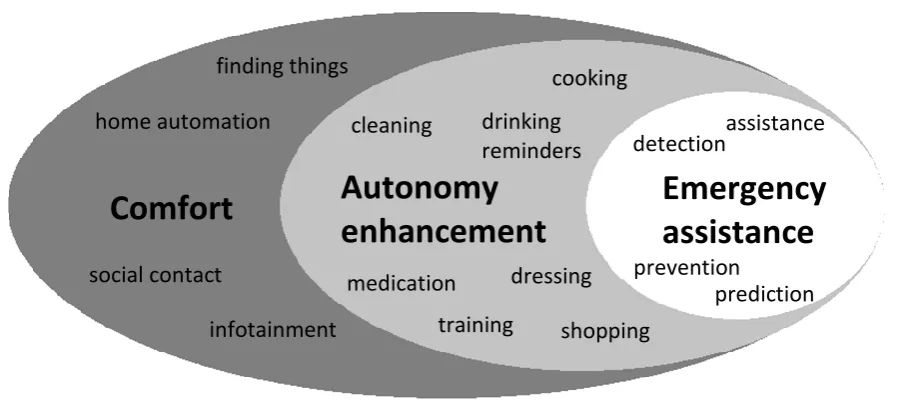
medication, or being some form of companion (Miskelly, 2001; Curry, Trejo, Tinoco, & Wardle, 2002; Huijnen, Badii, Van den Heuvel, Caleb-Solly, & Thiemert, 2011). This small selection of assistive technologies already shows that there are many different types of technologies available, and that there are many scenarios in which they can be beneficial. Kleinberger, Becker, Ras, Holzinger and Müller (2007) summarize the usage scenarios for technologies currently available to assist elderly in living at home independently as
For (informal) caregivers, also different types of technologies have been developed to support them in taking care of elderly living at home. Most of the technologies that target older adults’ caregivers pertain to the concept of telecare, which Magnusson et al. (2004) define as “the delivery of care services from a distance to elderly patients living at home, some of whom are living in rural areas” (p.224). These services consist for example of remote health monitoring services that can keep track of heart rate, skin temperature and activity. When (strong) deviations from baseline measurements occur, caregivers can decide to take action or prompt the elderly resident to take action. Other examples are the alarm systems mentioned before, or services for virtual visiting, where a video and audio connection makes it possible to have a remote doctor’s consult for instance.
The supporting technologies and services for caregivers come with many advantages. Whitten, Doolittle, Mackert, and Rush (2003) mention benefits like time and travel savings, increased quality of care and the possibility to include family members in the caregiving process that are not able to be physically present. For the latter benefit, it should be
considered that virtual visiting, or videoconferencing, adds value to just audio conferencing
Emergency
assistance
Autonomy
enhancement
Comfort
assistance detection
prediction prevention
finding things
home automation
social contact
infotainment shopping
dressing
training
cooking
cleaning drinking reminders
[image:13.595.79.535.71.276.2]medication
because of the increased feeling of social presence that is experienced (Cukor et al., 1998). This means it feels more like having a ‘real’ visit or ‘really’ being with the other person. This feeling of social presence is formally defined by Lee (2004) as: “[the] experience of para-authentic social actors [which means]: experiencing the representation of other humans who are connected by technology” (p.45). Kristoffersson, Coradeschi, Eklundh, and Loutfi (2011) confirm that health care professionals experienced a high feeling of social presence when they used a telepresence robot to get in touch with elderly that were located in their own home.
For elderly residents and their caregivers to experience the benefits of supporting technologies, they have to use them properly. It has already been mentioned that aging comes with functional declines that can influence how successful the interaction with certain
technologies is (Napp, 2008). In addition, elderly seem less interested in using certain technologies (Morrell et al., 2000). The next section will focus on the latter issue and addresses technology acceptance and its determinants.
Technology Acceptance
age groups. However, older adults have been using technology more often over the years. Mitzner et al. (2010) note for example that overall older adults use a wide variety of
technologies, ranging from microwaves and televisions to mobile phones and computers. CBS (2014) reported that in 2006 only 57% of people aged between 65 and 75 years had access to a computer compared to 85% in 2013. Having said that, computer access in this age group is still considerably lower than the average access in the Dutch population, which is 96%. Czaja et al. (2006) confirm that older adults are less likely to use computers, internet and technology in general than younger adults, and that older adults use computers for fewer activities.
However, it must be noted that elderly tend to have positive attitudes towards several assistive technologies and their usefulness (e.g. Demiris et al., 2004; Gaul & Ziefle, 2009; Rahimpour, Lovell, Celler, & McCormick, 2007). Gaul and Ziefle (2009) report that even though many elderly have a positive attitude towards using assistive technology, acceptance was lowest in the oldest age group (75+). They also found that technology acceptance varied greatly in this age group was, indicating the importance of taking into account the diversity of an elderly user group. Broadbent, Stafford, and MacDonald (2009) found that acceptance of an assistive robot increased among elderly, when it was proposed to them that the robot could increase their independency if they could no longer handle everyday tasks. So, although technology acceptance is generally low among the oldest age groups, there is also a wide variation. Acceptance of assistive technologies seems to be higher than that of other technologies. The following paragraph reviews factors that influence technology acceptance.
Explaining technology acceptance.
Technology acceptance is an interdisciplinary research topic and has therefore been investigated from different perspectives in different fields of study. In this subsection the most important theoretical frameworks of technology acceptance from different academic
evidence-based design approach used in this study. Reed, McNicholas, Woodcock, Issen and Bell (2014) acknowledge the importance of identifying existing theory on producing desired situation improvements, such as improving technology acceptance, and note that its
articulation can facilitate effective design. After the discussion of the different theoretical frameworks, the role of these frameworks in improving technology acceptance by means of designing a system introduction will be discussed in more detail and represented in an initial action-effect diagram (Reed et al., 2014). An action-effect diagram represents an
intervention, in this case a system introduction, and its anticipated effects.
Behavioural Determinants.
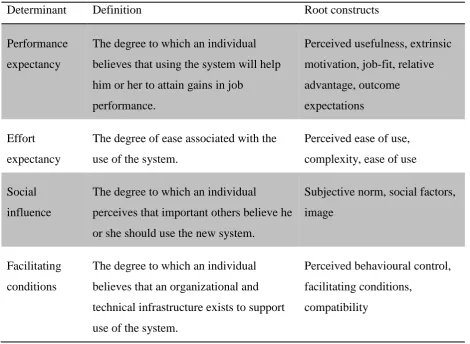
UTAUT (see Figure 2) contains three main determinants of the intention to use a certain technology, namely: 1) performance expectance (similar to TAM’s perceived usefulness), 2) effort expectancy (similar to TAM’s perceived ease of use), 3) social
influence, and 4) facilitating conditions. Facilitating conditions do not influence behavioural intention, but affect technology usage directly. Definitions of the four main determinants are shown in Table 1. UTAUT complies with the Theory of Planned Behaviour (TPB) (Azjen, 1991) which is the extension of the TRA (Benbasat & Barki, 2007).
The model includes four moderating factors: gender, age, experience and voluntariness of use. In the target group of independently living elderly and their informal caregivers, females are overrepresented. Furthermore, they have an older age and even though older adults are getting more experienced with technology, this is generally still less than the younger adults in society. Venkatesh et al. (2003) describe the effects of the moderating variables on the relationships between the behavioural determinants and the intention to use technology. Their results show that for older women with little technology experience, the group that is overrepresented in our target group, the relationship between social influence and behavioural intention and the relationship between effort expectancy and behavioural intention is stronger than for younger male users with more technology experience. So, to improve the likelihood of people actually using a new technology, the behavioural
Table 1
Definitions and root constructs of UTAUT determinants, adopted from Venkatesh et al. (2003)
Determinant Definition Root constructs
Performance expectancy
The degree to which an individual believes that using the system will help him or her to attain gains in job
performance.
Perceived usefulness, extrinsic motivation, job-fit, relative advantage, outcome
expectations Effort
expectancy
The degree of ease associated with the use of the system.
Perceived ease of use, complexity, ease of use Social
influence
The degree to which an individual
perceives that important others believe he or she should use the new system.
Subjective norm, social factors, image
Facilitating conditions
The degree to which an individual believes that an organizational and technical infrastructure exists to support use of the system.
Perceived behavioural control, facilitating conditions,
[image:18.595.64.535.427.771.2]compatibility
System and Design Characteristics.
In the field of Information Systems (ISs), scientists have researched the system
characteristics that influence the intention to use technology and that lead to user satisfaction. An often used model in the ISs discipline to predict or determine the successfulness of an IS is the DeLone and McLean Information System Success Model (DeLone & McLean, 2003), which is shown in Figure 3. As can be seen, the model is a process model with three stages important for IS success: system creation, system experience and systems benefits. In each of these stages, different criteria for success are defined. After researching the associations between these factors DeLone and McLean (2003) decided to also incorporate the variance properties in the process model by showing the relations between the success factors. They found that the following system characteristics influence the intention to use an IS and the experienced user satisfaction: 1) the quality of the system, 2) the quality of the communicated information and 3) the quality of the service that comes with the system. The specific
Table 2
Variables in the DeLone and McLean model explained, adopted from Petter et al. (2013).
Success var. Definition Examples of root constructs,
operationalizations and measures System
quality
Desirable characteristics of an IS. Ease of use/ learning, system flexibility and reliability, intuitiveness, response time. Information
quality
Desirable characteristics of the system outputs (content, reports, dashboards).
Relevance, understandability, accuracy, conciseness,
completeness, currency, timeliness, usability.
Service quality
Quality of the service or support that system users receive from the IS organization and IT support personnel in general or for a specific IS.
[image:20.595.64.537.456.766.2]System use Degree and manner in which staff and customers utilize the capabilities of an IS.
Amount of use, frequency of use, nature of use, appropriateness of use, extent of use, purpose of use. User
satisfaction
Users’ level of satisfaction with the IS. Single item, semantic differential scales, multi-attribute scales Net benefits Extent to which ISs are contributing to
the success of individuals, groups, organizations, industries, and nations.
Improved decision making, improved productivity, cost reductions, consumer welfare.
users’ attitudes towards using a certain technology can partly be achieved be designing and developing a product that is perceived as high quality.
Table 3
Definitions of the key antecedents of information and system quality as defined by Wixom and Todd (2005).
Antecedent Definition
Currency1 The user’s perception of the degree to which the information is up to date Completeness1 The degree to which the system provides all necessary information Accuracy1 The user’s perception that the information is correct
Format1 The user’s perception of how well the information is presented
Timeliness2 The degree to which the system offers timely responses to requests for information or action
Reliability2 The dependability of system operation
Flexibility2 The way the system adapts to changing demands of the user
Integration2 The way the system allows data to be integrated from various sources Accessibility2 The ease with which information can be accessed or extracted from the
system
1
Antecedents of information quality 2 Antecedents of system quality
Users’ Knowledge and their Decision Making Process.
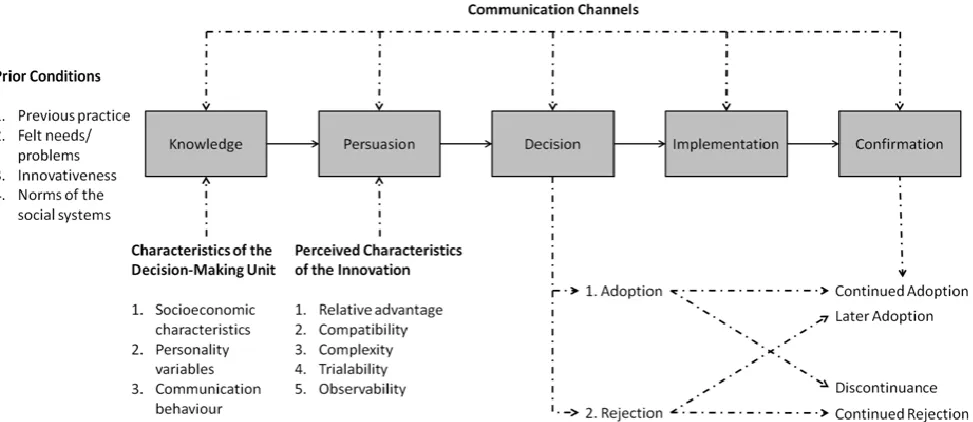
through certain channels over time among the members of a social system” (p.5). Part of this process captures the decision making process that an individual goes through when deciding whether or not to adopt a new technology. The related choices and actions are summarized in the stages of the innovation-decision process, shown in Figure 4. The first stage, the
knowledge stage, is concerned with exposing an innovation to individuals and communicating three types of knowledge to them: awareness-knowledge, involving information that an innovation exists; how-to knowledge, involving the information necessary to use an innovation properly; and principles knowledge, involving information that deals with the functioning principles underlying how an innovation works (Rogers, 2003). At the second stage, the persuasion stage, individuals form an (un)favourable attitude towards the innovation based on its characteristics. Since innovations come with uncertainty, more information is sought in this stage on the innovation’s expected consequences. People interpret what messages are credible and consult peers and other individuals that are socially close for their insights. When an attitude is formed, the individual decides whether or not to adopt the innovation in the decision stage. This decision is preferably based on a trial period. After these more mental processes, an innovation is adopted and put into use in the
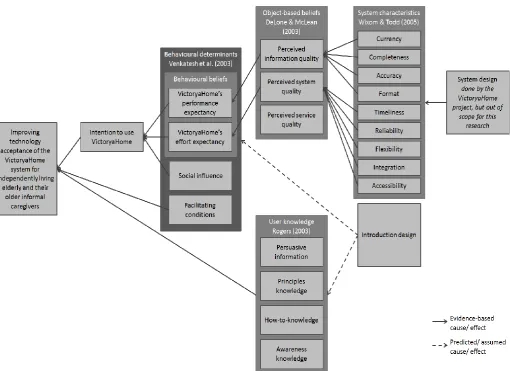
In this section, the problem of technology acceptance, especially with elderly users, was raised and different models on explaining technology acceptance have been discussed. These models form the basis for the development of our framework for improving technology acceptance and the design of an evidence-based system introduction. A synthesis of the discussed models is found in the initial version of the action-effect diagram presented in Figure 5. It can be seen that the models and findings from DeLone and McLean (2003) and Wixom and Todd (2005) focus on improving technology acceptance by designing a high-quality system. This will lead users of the system to form a positive attitude towards the system itself and consequential towards using the system. Designing a high-quality system, which falls out of the scope of this research, thus indirectly influences the behavioural
determinants described by Venkatesh et al. (2003) in UTAUT. It is proposed that designing a good introduction of the system can further influence these behavioural determinants, and so impact technology acceptance. Furthermore, Rogers (2003) has demonstrated the importance of supporting individuals in their decision making process on adopting technology by
[image:24.595.59.546.102.313.2]providing different types of information to increase their knowledge. Increasing users’
knowledge is therefore also an important aim that is proposed to be reached by designing a good system introduction. The theory presented in Figure 5 gives a clear overview of what factors should be influenced by the introduction to achieve improved technology acceptance. However, the underlying theory gives no direct insight into how the introduction design should be established to come to the best solutions. Therefore, the next section will focus on a design model, human centred design, that is used to achieve the desired changes.
Human Centred Design for Technology Interaction and Acceptance
To support independently living elderly and their caregivers, facilitate successful user-system interaction, and improve technology acceptance the technological solution and their introduction have to be well designed. Human centred design (HCD) is a design philosophy that seems especially fruitful for addressing these issues. Human centred design (HCD), often referred to as user centred design, is a design philosophy that is concerned with incorporating the user’s perspective into development processes in order to achieve usable systems
(Maguire, 2001a). A more formal definition of HCD is given by the International Organization of Standardization (ISO) in their 9241-210 ISO standard: “[HCD is an] approach to systems design and development that aims to make interactive systems more usable by focusing on the use of the system and applying human factors/ergonomics and usability knowledge and techniques” (ISO/TC 159 SC/ 4, 2010, ch.2 par.7). These definitions illustrate two important aspects of the HCD philosophy. The first is the goal to develop usable systems and the second is using methods that focus on the user in achieving this goal.
Designing usable systems has many advantages, with i.e. safety being an important advantage in the context of elderly support. Usability is a highly valued characteristic in technology development and is defined by ISO/TC 159 SC/ 4 (1998) in their 9241-11 ISO standard as: “[the] extent to which a product can be used by specified users to achieve specified goals with effectiveness, efficiency and satisfaction in a specified context of use” (ch.3 par.1). This means that a technical system, such as a certain software application, should not only provide the possibility to fulfil certain tasks, but should do this in a way that supports users in interacting with the system. Besides preventing system misuse or users from
becoming frustrated, designing usable systems comes with advantages like increased
errors, and therefore increase safety, is especially important in safety critical situations where errors can have detrimental consequences (Harte et al., 2014). Such situations can be easily found in healthcare contexts, particularly when the users have to use a technology without assistance, as is the case with assistive technologies that elderly use in their own homes. Kaufman et al. (2003), for example, found a variety of usability problems with a telemedicine device that was used by (elderly) users in their own home to electronically transmit glucose and blood pressure readings to their physicians. In achieving usable designs following usability guidelines is essential (Bevan, 2009).
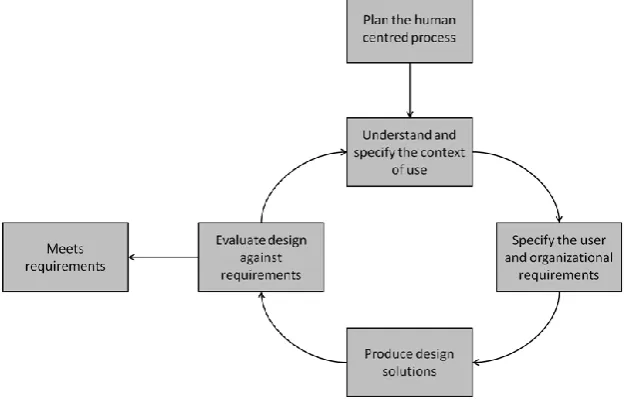
HCD is furthermore focused on using user oriented methods to promote usable designs. The key activities of HCD are summarized in the human centred design cycle,
on the market. HCD is a good methodology to follow for designing usable products and improving technology acceptance in general. However, because the diversity of the elderly users makes it hard to predict usability issues without following a HCD approach, this method is considered especially suitable for this study, which involves designing for independently living elderly and their caregivers. It is important to note that in this study not a technological system is being developed, but the introduction of such a system. However, for developing an introduction, which can be seen as a different type of system, the same HCD principles, such as usability and user-oriented design still hold. In the final section of the introduction, the scope and context of the research are given, together with the research questions.
The Present Study: Aims, Objectives and Research Questions
[image:28.595.152.465.323.523.2]This study aims to develop a framework for improving older adults’ technology acceptance within a case example of elderly support, and focuses on the system introduction. To recap, technology acceptance was defined in this study as the degree and manner in which target users use a certain technology and its capabilities (Petter et al., 2013), which can be interpreted as the adoption and continued adoption of technology. The first study objective involves synthesizing the currently available knowledge on influencing technology
acceptance. The results of this objective are covered in Figure 5. The second objective involves generating case specific design solutions and recommendations for the technology introduction that can be used in similar cases. Maher and De Silva Garza (1997) confirm that case based reasoning, or learning from previous design experiences, is an important aspect of design support. The third objective involves using the in-depth qualitative analysis of the case for developing new insights into the current technology acceptance theory. This is done in a bottom-up fashion by investigating the data for new factors that might influence technology acceptance or new relations between known factors (see Figure 5). For designing the
introduction, a HCD approach is followed, which includes understanding the determinants of technology acceptance as found by Venkatesh et al. (2003) and Rogers (2003) in this specific case example.
The studied case is the European research project VictoryaHome, wherein a technological service is being developed to promote the (self) care of elderly and improve quality of life. A HCD approach was followed throughout the project and after performing HCD methods like focus groups, low-fidelity prototyping, storyboarding, heuristic
evaluations and usability testing (Maguire, 2011a) a relatively advanced prototype has been developed. Using these methods to create a user oriented and usable product already
facilitates technology acceptance. However, from our previous discussion, it was concluded that besides product characteristics more factors, such as user knowledge and behavioural beliefs, influence the acceptance of technology. Furthermore, users themselves have expressed a need for more than a usable system during early user testing by saying for
example: “I think I’m a bit too old to understand all that. It’s a bit too difficult for me” (Smart Homes, 2013). Assuming that the product itself is indeed usable, this statement indicates that at least at first glance it might not be perceived as such. This is an indication that the
system quality. For these reasons it is proposed that a good system introduction, focussing on both cognitive and affective aspects, could by a means to positively influence the
determinants of technology acceptance.
The HCD methodology will be used to investigate how the determinants of technology acceptance developed by Venkatesh et al. (2003) and Rogers (2003), presented in Figure 5, should be influenced in a way that complies to users’ needs and preferences. To make sure that the introduction design is directly based on the users’ needs and not heavily influenced by the researcher’s ideas of a good introduction, no initial ideas of the introduction’s components are specified. This fits the HCD principles where an iterative approach to design is taken. For this study that means the expected results are high level introduction components and some initial ideas on how these components should be worked out. The components will be further worked out using fitting design guidelines from literature. In following iterations, the design should be evaluated and optimised by using HCD methods that focus on the more detailed aspects of the introduction design.
Research questions.
The defined aim of this study is developing a framework for improving older adults’ technology acceptance within a case example of elderly support, and with a focus on the system introduction. To reach our two remaining objectives of 1) generating case specific design solutions and recommendations for the technology introduction and 2) using the in-depth qualitative analysis of the case for developing new insights into the current technology acceptance theory, the first three phases of the HCD cycle will be followed (Figure 6). Going through a set of iterations of all four phases of the HCD cycle as is suggested by Maguire (2011a) falls out of the scope of this research, because of time issues. Research questions are asked based on these phases and the found determinants of technology acceptance as
HCD phase 1: Understanding and specifying the context of use.
The first phase of the HCD cycle used for reaching our objectives is understanding and specifying the context of use. Maguire (2001b) defines the following aspects as being part of the context of use: the users, the tasks, the physical environment and the organisational environment. The physical environment is not yet defined, since the introduction to the VictoryaHome system can take place in several environments, including the users’ own homes or a specially equipped demonstration space. The organisational environment is also not yet defined. Possibilities include starting a VictoryaHome company that delivers the full service, including system introduction, or get health organisations involved to partially or fully take over the delivery of services. The context of use analysis will therefore focus on getting a deep understanding of the users and their tasks. Gould and Lewis (1985) confirm the importance of an early focus on the users and their tasks. The first step for getting a deeper understanding on the users was a literature study of which the results were summarised in the introduction of this research report. Maguire and Bevan (2002) support doing secondary research to understand the users, since it gives the possibility to gain knowledge on a wide variety of users and user characteristics with relatively little effort. To get a deeper
understanding of the users’ needs, beliefs and their tasks, especially in relation to the defined determinants of technology acceptance, being the behavioural determinants in UTAUT (Venkatesh et al., 2003) and the knowledge needs for making the decision to adopt (Rogers, 2003), the following research questions are posed:
1. What principles knowledge do users need on the subject VictoryaHome?
2. What tasks do users have to perform to achieve the system supported user goals? 3. What persuasive information will help users to make a good decision on whether
to adopt the system?
HCD phase 2: Specifying user requirements.
Based on the results of the analysis of the context of use, the second phase of the HCD cycle can be executed, which is specifying user requirements regarding the design of the introduction. These requirements are usually largely based on the expressed user needs. Maiden (2008) defines a user requirements as: “[a requirement that] comes from a user or other type of stakeholder and expresses a property of the domain or business process that the introduction of a new system will bring about” (p.90). User requirements are thus focussed on goals that users have and not on how those goals should be achieved. Now that the meaning of a user requirement is clear the following research question can be posed:
5. What user requirements should the introduction of the VictoryaHome system support?
HCD phase 3: Producing design solutions.
When the user requirements are set, the third phase of the HCD cycle is reached, in which solutions should be thought of that meet these requirements. Here is room for more creative processes. The solutions to the user requirements can be seen as guidelines for the design of the system. The design solutions, therefore, have to be integrated. In addition to the user requirements and user preferences there is also a need to take into account design
principles and guidelines from literature when formulating design solutions (Maguire & Bevan, 2002). Based on this discussion the last research question is formulated:
6. What are users’ preferences for design solutions for the VictoryaHome introduction?
7. What are suitable design guidelines from literature for the VictoryaHome introduction?
Methods
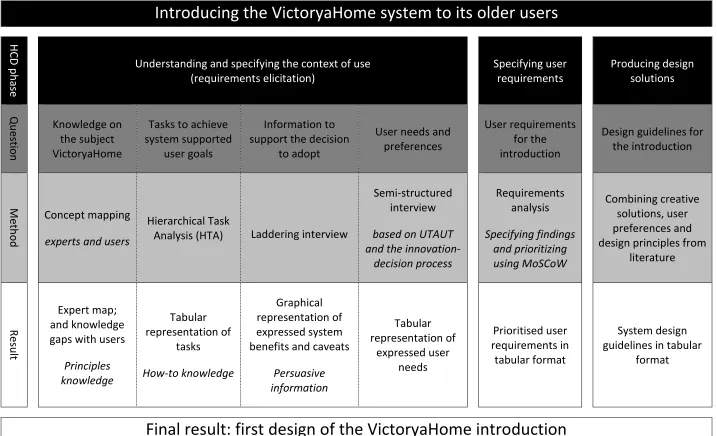
To answer the posed research questions, the study design shown in Figure 7 was created. The design will be explained in this section by first justifying how the methods used can provide for answers to the research questions. Then the participants and used materials will be described followed by a detailed description of the used procedure. The section is concluded by describing how the data is analysed.
Justification of the Study Design
As stated in the previous section, the first three phases from the HCD cycle are performed in this study. In each of these phases different questions have to be answered to come to a good end product. For each question the method used to come to an answer is explained and defended briefly. An overview of the study design is found in Figure 7.
Knowledge on the subject VictoryaHome.
For an insight into the principles knowledge that users need concept mapping is performed. This type of knowledge is not often considered by information providers. However, Rogers (2003) states that users do benefit from having principles knowledge, knowing how a service or system works, when they are deciding if they should adopt a new technology. He furthermore states, that having the right principles knowledge can prevent people from stopping system use after they have initially adopted it. The idea that someone has on how a certain system works is called a mental model (Crandall, Klein, & Hoffman, 2006). A method for eliciting a person’s mental model is concept mapping, where users present their knowledge in a diagram. Concept mapping is seen as both an effective and an efficient method for conveying a person’s mental model (Edwards & Fraser, 1983).
Introducing the VictoryaHome system to its older users
H CD p h aseUnderstanding and specifying the context of use (requirements elicitation) Specifying user requirements Producing design solutions Que st io n Knowledge on the subject VictoryaHome
Tasks to achieve system supported
user goals
Information to support the decision
to adopt
User needs and preferences
User requirements for the introduction
Design guidelines for the introduction M et h o d Concept mapping
experts and users
Hierarchical Task
Analysis (HTA) Laddering interview
Semi-structured interview
based on UTAUT and the
innovation-decision process Requirements analysis Specifying findings and prioritizing using MoSCoW Combining creative solutions, user preferences and design principles from
literature
Result
Expert map; and knowledge gaps with users
Principles knowledge Tabular representation of tasks How-to knowledge Graphical representation of expressed system benefits and caveats
Persuasive information Tabular representation of expressed user needs Prioritised user requirements in tabular format System design guidelines in tabular
format
[image:34.842.65.782.63.499.2]Final result: first design of the VictoryaHome introduction
invalid ideas held by users on the system’s work mechanisms. In order to recognize
knowledge gaps, the concept maps of users will be compared to an expert concept map. To prevent the expert map from entailing irrelevant details, one agreement map is made based on the maps from several experts in different project areas. Since all experts work closely
together to cooperatively develop the service, or system, Victoryahome, it is assumed that all experts have knowledge on the core principles of VictoryaHome. Furthermore, all experts have extended knowledge in their own fields of expertise. For this study, it is said that users do not need to have all the knowledge individual experts have, but would already greatly benefit from the core principles underlying VictoryaHome, that all experts are assumed to know of. It should furthermore be noted that the VictoryaHome system is a service, involving several technological devices. When speaking of the principles underlying the VictoryaHome system, it is not meant how each of these devices work specifically. What is meant is, how the entire service works with the devices being just a part of that. Furthermore, it should be noted that experts’ mental models are usually associated with a better organization of available knowledge instead of more detailed knowledge (Glaser, 1987).
Tasks to achieve system supported user goals.
Stanton (2006) confirms that HTA is well suited for understanding how-to knowledge and states that it is often used for the development of training requirements, a form of education that focuses on teaching skills.
Information to support the decision to adopt.
To get a deeper understanding of the perceived usefulness of the VictoryaHome system and the persuasive information that can support people in their innovation decision process, a laddering interview is done. In a laddering interview, a person’s personal values that are triggered by certain product attributes are discovered (Reynolds & Gutman, 1988). This is done by asking participants to recall attributes of a product that they find especially positive or negative (usually in relation to a different product) and then probe the respondent with questions like ‘why is that important to you?’ to retrieve the underlying reasons and eventually the underlying values. Van den Abeele and Zaman (2009) demonstrated that laddering is a useful method for understanding the user experience (UX) of a product, part of that being how a user experiences the product’s usefulness. It is proposed that by asking people to continuously answer to the question why they find something important, a richer insight into the experienced benefits will result compared to a normal interview where people are not probed to elaborate. Another advantage of laddering is that a clear insight into the system’s usefulness and the relating personal values is important information for a user in the persuasion stage of the innovation decision process, since in this stage users gather all
information that they need to make a well informed decision on whether to start using a system. Knowing if the system’s uses comply to their needs and if the related values comply to their own can be deciding in this process. Bourne and Jenkins (2005) verify that laddering is indeed often used for developing marketing strategies.
User needs and preferences.
To elicit technology acceptance related user needs and requirements for the
focused on UTAUT (Venkatesh et al., 2003) and more generally on people’s introduction preferences. First of all, Woods (1997) states that using a semi-structured interview in discovering the context of use in a HCD process is a valuable methodology. Barriball and While (1994) specify that this type of interview is especially suitable for discovering perceptions and opinions and has the advantage that probing can be used to clarify those opinions. Since the variables in UTAUT are all perceptions and attitudes of the users towards a technological system, a semi-structured interview seems a valid way of discovering those. Furthermore, using open ended questions instead of i.e. a questionnaire gives the opportunity to not only discover the valence and strength of the attitudes, but also the underlying factors providing a better understanding of the attitudes. By doing a semi-structured interview it is assured that all the factors of UTAUT are discussed while still giving people the opportunity to elaborate on and explain their answers, also in relation to other general introduction related needs and preferences (Courage & Baxter, 2005).
User requirements.
For specifying the user requirements, the results of the context of use analysis are first of all specified. Maguire and Bevan (2002) state that user requirements can be drawn from the analysis of the context of use. However, Robertson and Robertson (2012) note that
misunderstanding requirements is a big problem that should be avoided by writing
unambiguous and testable requirements. They explain that incorporating the rationale, or the background reason, of a requirement in its formulation removes much of the ambiguity and makes the importance of a requirement clear for all the stakeholders. Furthermore, including a fit criterion, a measure, makes the requirement testable. This is especially useful in the
findings different types of requirements can be obtained: functional requirements describing what a system must be able to do, non-functional requirements describing what qualities a system must have, and constraints describing limitations or restrictions on the system of the developing process (Robertson & Robertson, 2012).
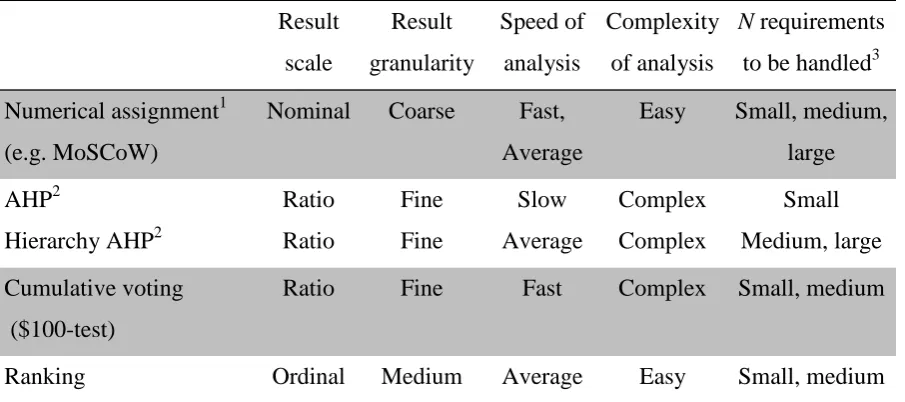
When specific user requirements are obtained, they are prioritized to appropriately allocate resources. With limited resources, like time and money, usually not all requirements can be implemented (Richards, 2014). To make sure that these resources are used effectively, it is therefore important to prioritize requirements. There are several methodologies for doing this. Based on performed comparisons on prioritization techniques Table 4 was made to show the different considerations that are involved in selecting an appropriate prioritization method (Berander & Andrews, 2005; Hatton, 2008; Vestola, 2010). Based on this table it can be concluded that numerical assignment techniques, where requirements get categorized into a small number of priority groups, are most suitable for a more quick-and-dirty prioritization of requirements, since the method takes relatively little effort to execute and results into a rough prioritization. Contrarily, Analytic Hierarchy Process (AHP) and Hierarchy AHP (Karlsson, Wohlin, & Regnell, 1998; Saaty, 1987) are most fitting for a detailed prioritization for the reason that they give ratio results and are able to handle detailed requirements. AHP
furthermore has the advantage that it is able to check for prioritization inconsistencies made by users. Such an inconsistency is found when a user states A > B and C > A, but C < B. Considering that this research falls within the early stage of what is meant to be an iterative design process, where requirements change over iterations and need to be prioritized over and over, a quick-and-dirty method, where ease of performing the prioritization is valued more than reaching very accurate and detailed results, is viewed to be most appropriate. Therefore, the MoSCoW method, a numerical assignment technique, will be used to prioritize the
Design guidelines.
Taking the user requirements and using them to develop design solutions or design guidelines is a more creative process in the HCD process. Maguire (2001a) notes for example that brainstorming is a good way to come up with design solutions for requirements in a project. Therefore did the semi-structured interview not only focus on user needs, but also on possible solutions. Another valued practice for shaping a design is the inclusion of design guidelines from literature (e.g. Maguire & Bevan, 2002). Design guidelines from literature also provide a possibility to give details to the proposed solutions in an informed way. Participants
The user studies took place with four social groups, usually families, consisting of one or two independently living (potential) care recipients and one or two (potential) informal caregivers. The selection of groups was led by the Dutch care organisation Envida, a partner
Result scale Result granularity Speed of analysis Complexity of analysis N requirements to be handled3 Numerical assignment1
(e.g. MoSCoW)
Nominal Coarse Fast, Average
Easy Small, medium, large AHP2
Hierarchy AHP2
Ratio Ratio Fine Fine Slow Average Complex Complex Small Medium, large Cumulative voting ($100-test)
Ratio Fine Fast Complex Small, medium
Ranking Ordinal Medium Average Easy Small, medium
1
[image:39.595.76.529.149.350.2]Numerical assignment also deals well with additional requirements. 2 AHP is suitable for more detailed requirements and includes a user consistency check making the method fault tolerant. 3 N < 20 is small; 20 < N < 100 is medium; N > 100 is large.
Table 4.
in the VictoryaHome project, and formed a judgement sample (Marshall, 1996) of Dutch participants. This means that a sample was selected that is viewed as most productive for answering the research question. In this case the sampling method was used to try to respect the heterogeneity of users and user situations in the selection, conform to the
recommendations of Newell and Gregor (2002), by taking a range of variables into account in the selection procedure. The variables taken into account were: age, gender, marital status, health problems and elderly-caregiver relation. The resulting group of care recipients
consisted of two males and three females aged 59 to 92 years (M = 79; SD = 13). The group included one couple and one person with considerable health problems. Corresponding to the main research question and arguments in the introduction, also informal caregivers were selected with a relatively older age. The group of informal caregivers consisted of one male and four females aged 53 to 68 years (M = 62; SD = 7). The relationship to the care recipient was different for each group member and concerned siblings, friends, a child-parent
relationship and a husband-wife relationship. It is important to note that people with (mild) cognitive impairments were not allowed to enter the study for ethical reasons, elderly are usually considered vulnerable participants that require careful attention in a study. To ensure participants’ wellbeing, a pilot test was performed to check if the study design was not too straining or provoked any other significant discomforts. In the pilot test, the user study as described in the procedure section was performed. The participants were instructed to clearly indicate if they experienced any discomforts. After the test, participants were asked again if any parts of the study were uncomfortable for them, and if they had problems with the
Apparatus and Materials
The study participants were exposed to a number of materials in the user study. All users had to fill out a paper and pencil questionnaire to retrieve their demographic details and technology experience. Moreover, previous to the concept mapping exercise all participants went through a worked out example of how to make a concept map. Additionally, users received an information sheet about the interview procedure and signed informed consent. All materials can be found in the appendices. In addition to these materials users tested a fully functioning prototype of the VictoryaHome system. Innovative assistive technologies, like the VictoryaHome system, are new, and very few people have experience with them or know what they are. To make sure the participants could give informed responses in the study, they were therefore given the system for a trial period. This way they could get familiar with the system and form an understanding of its functionalities and its potential impact on their lives.
The VictoryaHome system.
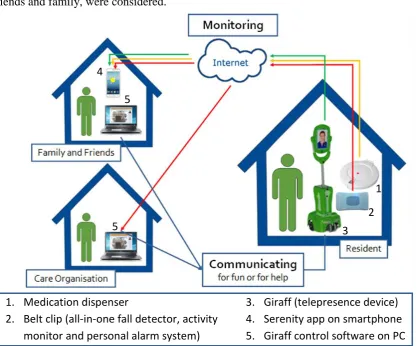
VictoryaHome is developing a technically based service to improve wellbeing and facilitate appropriate caring among independently living elderly and their caregivers. At the time of the study, a first prototype had been built that was used in the current study. The prototype incorporates a digital platform together with smart devices that were already on the market. These devices are: an all-in-one fall detector, activity monitor and personal alarm system (the belt clip produced by onCaring), an automatic pill dispenser (the Careousel produced by PharmaCell) and a mobile telepresence device (the Giraff produced by Giraff Technologies AB). The prototype furthermore included a smart phone application for family and friends (the serenity app), an online dashboard for response centre employees and a software program to control the Giraff with a PC. All devices and applications communicate with each other over the cloud.
1. Medication dispenser 3. Giraff (telepresence device) 2. Belt clip (all-in-one fall detector, activity
monitor and personal alarm system)
4. Serenity app on smartphone 5. Giraff control software on PC
3 2
1 4
5
5
Figure 8. Overview of the VictoryaHome system architecture. Red notifications are most urgent and indicate emergencies; yellow notifications are health related, but less urgent; and green notifications are the least urgent social notifications.
app on their smart phone. This app shows notifications based on the following events measured by the smart devices: missed medication, detected falls, alarm button presses, requests for social contact and low activity. The events are categorized and colour coded based on their urgency and summarised in the serenity icon that gives a quick overview of the resident’s state (see Figure 8). Caregivers can then decide to virtually visit the resident using the telepresence device, the Giraff, as a response to these updates or when they feel a need for contact. The Giraff is used for video conferencing and can be remotely controlled by the caregivers to drive through the resident’s house using the Giraff software on their PC. Figure 8 gives an overview of the devices that make up the VictoryaHome system, how they
[image:42.595.79.498.380.726.2]Procedure
During the research, several methods were used. This section will explain the specific procedures that were performed. The methods using direct user involvement are bundled in this section as the user study. The HTA was performed separate of the user study, and was continuously updated until after all participants finished the user study.
Hierarchical Task Analysis.
To understand the tasks that users have to perform when using the VictoryaHome system, a HTA was performed. Annett (2003) has described seven principle steps for doing a HTA that were followed in this research. The purpose of analysis was already defined (1) as understanding the tasks that users perform with the VictoryaHome system. Agreement with stakeholders on task goals (2) was achieved by looking at published documents of the VictoryaHome system and retrieving the system’s goals. These goals were validated by confirmation of the consortium manager of the VictoryaHome project. Next, sources of task information were identified (3). Since there were no actual users yet, information for the task analysis was searched for in the project documents where some instruction documents were available. However, since these documents were not worked out yet, direct interaction with the system by the researcher was also used as an important source of information. The final sources of information were informal discussions with users that tested the system. The information was used to make draft task decomposition diagrams (4) that were discussed with the consortium manager to make adjustments and recheck validity (5). Tasks were
the user needs that resulted from the interview. Lastly, requirements (instead of hypotheses) important for learning and performance were generated (7).
User study.
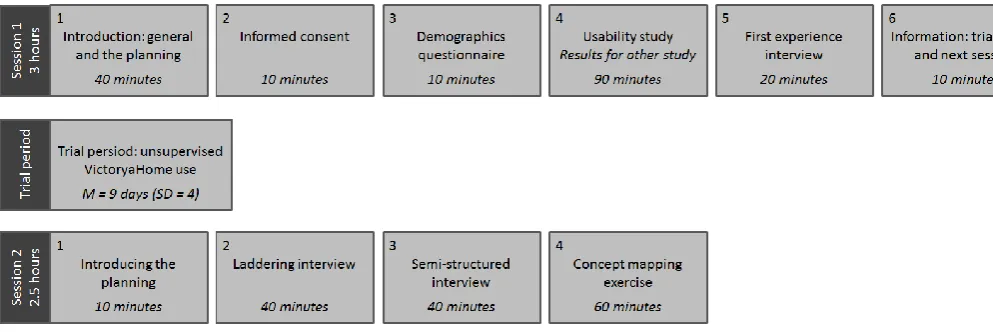
An overview of the main activities in the user study and their approximate duration is presented in Figure 9. The user study with potential VictoryaHome users was performed in combination with the system’s usability test and consisted of two sessions at the participant’s home with a non-supervised trial period in between. The first session that took about three hours in total started with an introduction of the VictoryaHome project, the system and the planning for the day. When all the participants’ questions about the study were answered and informed consent was signed (Appendix D) the participants started with filling in a short questionnaire on their demographic details, living and health situation and technology experience. Starting with easy questions to make users feel comfortable complies with the advice that Baarda, de Goede, and Teunissen (2005) give. After the questionnaire the usability test was performed. Participants performed several tasks with the VictoryaHome system and answered usability related questions in between the tasks. When the usability test was finished a short interview was performed on the participant’s experiences during the tests and
for some time, so that they could form an informed opinion about how it would be for them to really use the system, about the system uses and its characteristics, and to get a better
understanding of what VictoryaHome entails. It was assumed that this would result in more elaborate, thoughtful and realistic responses on system use in the second session of the user study.
Laddering interview.
[image:45.595.36.533.207.373.2]happens, ensuring valid results, the interviewer tried to keep a relaxed atmosphere during the interview. Furthermore, when participants could not answer a question or when a certain topic became too sensitive the researcher applied one of Reynold and Gutman’s (1988) specific interviewing techniques that can be found in the interview guide in Appendix C.
The interview was analysed following the procedure of Reynolds and Gutman (1988). The analysis started with extracting individual ladders from the interview for each participant. A content analysis over all the elements of the ladders followed. In the content analysis the elements of the ladders were first categorised as either attributes of the system, consequences of these attributes or personal values. What followed was a grouping of elements that
represented something similar and labelling these groups. Ladders where then reformulated using just these labels. The direct and indirect connections between attribute, consequence and value elements in the ladders were summarized over the participants and presented in an implication matrix, which is basically an aggregation of all individual results. Based on the aggregated data in the implication matrix a hierarchical value map (HVM) was deducted and ladders were reconstructed. For a worked-out example, see Reynolds and Gutman (1988).
Semi-structured interview.
Following the laddering interview, a semi-structured interview on specific and potential technology acceptance related factors was performed. The interview covered the perceptions that the participants had of the system lead by the factors in UTAUT. In the interview it was furthermore discussed how the participants would have liked to be introduced to the system in hindsight. Topics about content and presentation were covered. The interview scheme can be found in the interview guide in Appendix C.
given a code name. Several iterations of structuring and grouping these codes followed. It should be noted that these groupings happened in a bottom-up fashion. However, four of the highest order categories were set, being the UTAUT behavioural determinants. Participants’ elaborations during the interview could lead to other categories developing. Furthermore, other categories developed from the part of the interview that focused on other general introduction related needs and preferences.
Concept mapping.
To get an understanding of the principles knowledge, that potential VictoryaHome users should have and what knowledge they had after a short trial phase the study participants as well as the VictoryaHome experts made a concept map on VictoryaHome. All
VictoryaHome work package leaders were invited to participate as experts. The work packages of the VictoryaHome project are: management, exploitation, user centred design trials, technical development and dissemination. The expert concept maps were used to get an overview of the knowledge that participants would preferably have, since Rogers (2003) found that a continued acceptance of technology benefits from users having principles
Based on the expert concept maps one agreement map was constructed. All concepts that were found in at least two expert maps were covered in the agreement map. This
procedure was followed to exclude information that was too specialist. When all but one expert did not include a concept in their map, either because they did not know about the concept or because they did not find it relevant, the concept is considered as irrelevant or too detailed and thus unnecessary for users to know as explained in the section justifying the use of concept mapping. With the selected concepts a new concept map was constructed trying to include most connections that were also found in the separate expert maps. The validity of the agreement map was ensured by involving the project manager for feedback on the first and revised versions. The propositions from the user maps were then compared to the propositions in the expert agreement map to get an understanding of the knowledge participants had about VictoryaHome at the end of the study.
Requirements analysis and design guidelines.
since knowledge was a topic that was only generally discussed in the semi-structured interview. The VictoryaHome consortium manager and the researcher reviewed the prioritization and made adjustments if they saw necessary. Adjustments were made for example when requirements were seen as technically too difficult to implement. This is in agreement with Tudor and Walter’s (2006) notion that all stakeholders should be included in the prioritization of requirements. For each of the requirements, design solutions were then proposed. In the semi-structured interview not only user needs, but also preferred solutions were covered. These solutions were taken as the core guidelines for the design. The design guidelines were complemented with more general design guidelines from literature. Design guidelines were searched in the GoogleScholar database. Search terms for finding guidelines related specifically to the resulted design solutions for the introduction. Search terms that were added were ‘elderly’ or ‘older adults’, ‘design’ and ‘guidelines’. If no guidelines specifically for older adults were found, general guidelines were considered. Papers were selected that specifically stated a list of guidelines relevant for the introduction design solutions. However, the search was not exhaustive.
Results
The section will start with a presentation of the knowledge that users should have about VictoryaHome and the knowledge gaps that participants had. What follows is a description of (significant) tasks that users have to perform when using the system. Then the most important persuasive information for making a decision on system adoption is presented. After the presentation of these information related results, the user needs that were deducted from the interviews are discussed. Based on these results, user requirements were deducted, these are presented together with solutions for the user requirements and design guidelines. Principles Knowledge: What Should be Known and Knowledge Gaps
of this knowledge participants had (and could communicate) after the user tests and what knowledge they were still missing. In this section the results are presented.
Expert agreement map: what should be known.
All VictoryaHome work package leaders were asked to develop concept maps in order to discover what knowledge VictoryaHome users should preferably have. The resulting expert agreement map is found in Figure 10. It can be seen that the expert agreement map has a hierarchical structure with each hierarchical layer representing a theme. The first layer in the hierarchy considers VictoryaHome as a service trying to fulfil several higher order goals. The next three layers focus on VictoryaHome as a system with specific system goals. The
following layer describes the target users, while the devices that they will use are covered next. The hierarchy is completed by presenting the different measures that are taken by the system and the way these measures are communicated throughout the system. Besides the hierarchical structure, it can be seen that the concepts in the expert map are highly interlinked. The concepts in yellow were only found in one expert map, but were included for
User maps: knowledge gaps and misconceptions.
The concept maps made by the participants were compared to the expert agreement map to discover important knowledge gaps. It was first of all checked what exact propositions from the expert maps were not found in the individual user maps. An overview of these results is shown in the detection matrix in Table 5. It was found that on average users had 5 (SD = 2.4) of the 45 expert propositions in their concept map. Furthermore, it was found that 64% of the propositions were not found in any of the participants’ maps and 89% was only found in a low number of participant maps (0-3 participants). The results of the informal caregivers and the elderly were very similar, and are therefore not discussed separately.
[image:51.595.77.519.72.444.2]The propositions that were not covered in any of the user maps cover several themes. Participants first of all did not mention that VictoryaHome is a service that comes with a