
University of Warwick institutional repository: http://go.warwick.ac.uk/wrap
A Thesis Submitted for the Degree of PhD at the University of Warwick
http://go.warwick.ac.uk/wrap/62104
This thesis is made available online and is protected by original copyright.
Please scroll down to view the document itself.
Equivalence
By
Amir Hossein Asghari
A thesis submitted in partial fulfilment of the requirements
for the degree of
Doctor of Philosophy in Mathematics Education
University of Warwick
Institute of Education
PAGE
NUMBERING
AS
Table of Contents
TABLE OF CONTENTS 2
ACKNOWLEDGMENTS 5
DECLARATION 6
ABSTRACT 7
INTRODUCTION 8
ONE STUDY. THREE PHASES 8
PART I: PRELIMINARY AND PILOT STUDY 12
INTRODUCTION 13
CHAPTER 1: PRELIMINARY STUDY 14
1.1 THE SEED OF THE PRELIMINARY STUDY 15
1.2 WHAT WAS THE PRELIMINARY STUDY ABOUT? 16
Literature 16
1.2.1 Communication 17
1.2.2 Proof 18
1.3DEFINING SITUATION 20
1.4THE FIRST DEFINING SITUATIONS. THE FIRST INTERVIEWS 21
1.5ONE DEFINING SITUATION. MANY INTERVIEWS 22
1.5.1 The pre-interview analysis of the situation 23
1.5.2 The first interview 24
The first "successful" record 24
1.6THE SITUATION. REVISITED 27
1.6.1 Reflection on the situation. unity and plurality 27
1.6.2 The Mad Dictator Task 30
The underlying structure of the Mad Dictator Task 31
1.7FURTHER SAMPLE 32
Results 35
1.8 DISCUSSION: SUCCESS OR FAILURE 37
CHAPTER 2: PILOT STUDY 41
2.1INTRODUCTION 42
2.2DIDACTICAL PHENOMENOLOGY 42
2.3PHENOMENOGRAPHY 43
2.4PILOT STUDY 44
2.5RESULTS 45
2.5.1 The difference in what students did to organize the situation 45
2.5.2 The difference in their outcomes 48
2.5.3 The difference between their goals 48
2.6DISCUSSION 49
2.7RESEARCH AS A LEARNING EXPERIENCE 51
2.8 Box CONCEPT IS A LOCAL CONCEPT 52
Box Concept 53
2.9SUMMARY AND REFLECTION 56
PART TWO: METHODOLOGY AND LITERATURE REVIEW 58
INTRODUCTION 59
CHAPTER 3: METHODOLOGY 60
3.1INTRODUCTION 61
3.2PHENOMENOGRAPHY. A DEFINITION 61
3.3PHENOMENOGRAPHY. A DILEMMA 63
3.5 THE PURPOSE OFTHE STUDY 64
3.5.1 Organizing 65
3.5.2 Validity 69
3.6 METHODS 71
3.6.1 Participants 72
3.6.2 Interviews 73
The Content 74
The Structure 76
3.6.3 Analysis 76
CHAPTER 4: LITERATURE AS TO EQUIVALENCE RELATIONS 80
4.1 INTRODUCTION 81
4.2 SKEMP 83
4.3 DIENES 87
Reflexivity, Symmetry and Transitivity 93
4.4 FREUDENTHAL 97
Transitivity isthe link between local and global order 99
4.5 SUMMARY AND AFTERWORD 101
PART THREE: RESULTS 102
INTRODUCTION 103
CHAPTER 5 105
RESULTS (I): GROUPING 105
5.1 INTRODUCTION 106
5.2 GROUPING 106
5.2.1 Matching Conception 107
5.2.2 Single-Group Conception 113
5.2.3 Multiple-Group Conception 125
5.3 GROUPS 130
5.3.1 Two to Many 131
5.3.2 In and Out 137
5.3.3 Unity 139
5.4 GROUP OR SET 144
CHAPTER 6 148
RESULTS II: MATCHING 148
6.1 INTRODUCTION 149
6.2 TRANSITIVITY 150
6.3 SYMMETRY 157
6.4 GEOMETRICAL SYMMETRY 160
6.4.1 Logically Equivalent, Structurally Different 160
6.4.2 Geometrical Symmetry as a Matching Symmetry 162
6.5THE INTEGRATION OF GROUPING AND MATCHING 167
PART 4: TOWARDS A UNIFYING PICTURE 177
INTRODUCTION 178
CHAPTER 7: HISTORICAL INSTANCES 180
7.1 INTRODUCTION 181
7.2 HISTORICAL CONCEPTIONS OF EQUIVALENCE RELATIONS 188
7.3 EUCLID (AND HILBERT) 190
7.4GAUSS 197
CHAPTER 8: DISCUSSION 203
8.1 INTRODUCTION 204
8.2 INTERPRETIVE SCOPE 206
8.3.1 Partitions 209
8.3.2 Equivalence Relations 211
8.4 CONTENT 216
8.4.1Experts' accounts of the Task 217
8.4.2 What is embedded in the Mad Dictator Task? 221
8.5 THE PURPOSE OF THE STUDY REVISITED! 223
CHAPTER 9: IMPLICATIONS •••••••••••••••••••••••.•••••••••••••••••••••••••••••••••••••••••••••••••••••••••••••••••••••.••230
9.1 INTRODUCTION 231
9.2 SOME FIRST-ORDER PERSPECTIVES 231
9.2.1 A fundamental but otherwise useless theorem! 232
9.2.2 Transitivity and Frtransitivity 237
9.3 PEDAGOGICAL NEEDS 240
9.4 THE MAD DICTATOR TASK AS A TEACHING TOOL 246
CHAPTER to: EPILOGUE 249
THE JOURNEY BACK 250
THE JOURNEY AHEAD 252
PART 5: REFERENCES AND APPENDICES 256
REFERENCES 257
APPENDICES 262
ApPENDIX A: THE MAD DICTATOR TASK 263
Checking task: 264
The least amount of information task: 264
The intersection task: 265
The union task: 265
ApPENDIX B: DR BOB BURN'S LEITER 266
ApPENDIX C: DR ALI ENAYAT'S SOLUTION TO THE MAD DICTATOR TASK 267
Acknowledgments
Thanks to:
My supervisor, Prof. David Tall, for supporting me to intellectually
grow,
My supervisor, Adrian Simpson, who with his canny questions helped
me to sharpen my answers,
Prof. Ference Marton who virtually supervised me during my
phenomenographical journey,
Dr. Bob Bum who with his letters encouraged me to accomplish this
thesis,
Prof. Ian Stewart who helped me to overcome one of my long-lasting
problems,
My logic teacher, Prof. Ali Enayat, for being always willing to answer
my questions.
In addition, I am grateful to all the above people for giving their permission for
me to use our personal communications in this thesis.
Thanks especially to the participants in this study who opened their mind to me,
and for giving me the joy of learning.
Thanks also to my friend, Matthew Inglis, who literarily and critically read this
thesis.
This thesis is dedicated to my beloved wife, Maryam, for loving me; my lovely
daughter, Niloufar, for correcting my punctuation! And last but not least my
Declaration
I, the author, declare that the work herein is my own and has not been submitted
for a degree at another university. Part of the ideas implicitly or explicitly used in
this thesis has been published in the following papers:
Asghari, H.A.: 2004a, 'Students' experiences of equivalence relations', in O. McNamara (ed.), Proceedings of British Society for Research into Learning Mathematics, 24, 1, 7-12.
Asghari, H.A.: 2004b, 'Organizing with a focus on defining, a phenomenographic approach', in MJ. Hoines & A.B. Fuglestad (eds.), Proceedings of the 28th Conference of the International Group for the Psychology of Mathematics Education, Vol. 2, pp. 63-70.
Asghari, A. H.: 2005a, 'Examples: generating versus checking', in D. Hewitt and
A. Noyes (eds.), Proceedings of the sixth British Congress of Mathematics Education held at the University of Warwick, pp. 25-32. Available from
www.bsrlm.org.uk.
Asghari, A. H.: 2005b, 'A mad dictator partitions his country', in R.Barwell and A. Noyes (eds.), Research in Mathematics Education, 7, pp. 33-45.
Asghari, H.A. and Tall, D.O.: 2005, 'Students' experience of equivalence relations: a phenomenographic approach', in H.L. Chick and
J.L.
VincentAbstract
This thesis seeks to answer one single question: "what is an equivalence relation?" A more correct, though longer, version of this question is "what are the qualitatively different ways in which people experience an equivalence relation?" The second question is not simply a version of the first one. It has a completely different nature and consequently demands a completely different answer. The
answer to the first question can be found in any textbook on the foundations of mathematics; while the second question can be answered only by conducting research where people are given a chance to reveal their conceptions of equivalence relations. These two questions embody two integrated phases of this thesis linked together with a transitory phase.
The first phase starts with a definite answer to the first question, i.e. the standard definition of equivalence relations. This definition is used to design a certain situation consisting of certain tasks embodying the corresponding notion. The initial intention of the situation is to get students to define certain predetermined concepts related to the notion of interest, and the effectiveness of the situation is characterized by the extent of students' success to do so. The tasks are tried out on a smallish sample of students. To put it bluntly, the situation fails to achieve its aim. In the process of interviewing the students it becomes clear that the standard definition is just an advanced means of organizing by which the given situation {and many others} can be organized. More importantly, there is a growing realization that the initial intention of the study ignores the richness of the students' ways of organizing the situation in favour of maintaining a narrow criterion for success. Relinquishing the latter in favour of the former is the turning point from the first phase to the second.
The second phase is a transitory phase in which more weight has been put on what students use to organize the given situation. Although the focus of this phase is not on the notion of equivalence relation, the students' works reveal some
unexpected aspects of this notion. This suggests the possibility of using the original tasks for pursuing an unexpected purpose in the main (i.e. third) phase of this thesis.
Introduction
This study is a journey of learning, both for me and the interviewees participating
in the study. The interviewees are involved in a situation where they are asked to
tackle certain tasks (see Appendix A). For them, learning takes place by a change
in the way that they see the situation. This change is reflected in the way that they
tackle the tasks involved. For me, learning takes place by a change in the way that
I see the concepts embedded in the situation, i.e. equivalence relations and
partitions. This change emerges from an investigation into what the participants
learn.
With a few minor modifications, the above paragraph could be the last one
in this thesis. It is a reflection on my journey at the end, rather than a road map
adopted at the start. In effect, this thesis is an attempt to shed light on this opening
paragraph.
One study, three phases
As far as my own experience is concerned, this study has three different, though
integrated, phases.
In the first phase, the focus is on the process of defining a concept. This
phase is reported under "preliminary study" (Chapter I), where a concept is
chosen as the intended concept to be defined. Then, certain tasks are designed
around this concept. The aim of the tasks is to bring familiarity with the new
concept while prompting students to define this newly emerged concept. A varied
selection of concepts is chosen in this stage. The concept of equivalence relation
is one of them; at the outset it is no more, no less important than the others. The
name for all these tasks (hereafter, "situation" and "Mad Dictator Task" are often
used interchangeably until otherwise stated.) The tasks are the result of a library
search about the subject. However, eventually the tasks are drawn on my own
understanding of the subject. The initial aim of the Mad Dictator Task is to lead
'lay' students (unfamiliar with the mathematical definition of equivalence
relations) to define an equivalence relation as traditionally defined, i.e. a relation
possessing the three properties of being reflexive, symmetrical and transitive. The
success of the tasks is determined by the extent to which the students notice and
define these predetermined properties. In the process of interviewing students it is
realized that the ideas that the students exploit to tackle the tasks are far better,
though less organized, than expected. In other words, compared to the students'
ideas. my initial ideas for handling the tasks appear to be quite artificial; however,
while the former is spontaneous the latter is systematic. This leads to the second
phase of the study in which the definition that I had in mind is regarded just as an
advanced means of organizing the given situation.
The second phase of the study is a transitory phase in my thinking that is
embodied in Chapter 2, "pilot study". Organizing is the main theme of this phase
in which the aim is to investigate the ways that students organize the given
situation. To achieve this aim the study adheres tophenomenographic methods.
This phase is set in a frame based on some of Freudenthal's ideas about the
organizing activities. The pilot study is quite open to the students' ideas. whether
they are related to the notion of equivalence relation or not. Yet. the most
important finding of this phase is a new definition. and accordingly a new
literature. This opens the possibility of using the original tasks for pursuing an
unexpected purpose in the main (i.e. third) phase of this thesis.
The third phase of the study evolves from the previous two phases.
Equivalence relations from the first stage come back to the stage, and the idea of
organizing from the second phase merges into some of the phenomenographical
ideas. Here, the original tasks (the first three tasks given in Appendix A), together
with two new tasks (the last two tasks given in Appendix A), serve a different
purpose. That is, they are used to investigate students' conceptions of equivalence
relations and partitions. I do stick to this aim in the remainder of the study.
However, the very meaning of this aim, and the extent to which this bizarre
situation (Mad Dictator Task) is suitable to achieve this aim, is revealed in the
fullness of time. For the time being, suffice it to say that from the middle of
Chapter 3 onwards this thesis progresses in two directions. One is investigating
the variation in the ways that students tackle the tasks involved. The other is
preparing the ground for interpreting this variation in terms of students'
conceptions of equivalence relations and partitions. Chapter 3 makes a theoretical
attempt to bring these two together. Afterwards, they seemingly diverge. The
literature reviewed in Chapter 4 is about equivalence relations and partitions, or
better to say, about the ways that these notions are understood by three prominent
educators and/or mathematicians. In Chapters 5 and 6, where the results of the
study are reported, these notions. or more accurately. my understanding of these
notions recedes into the background. giving way to what students learn from their
involvement in this rather peculiar situation. The next two chapters attempt to
unite the students' experience of the situation and their experience of the notions
in this study are unfamiliar with equivalence relations and partitions as
mathematical notions. To resolve this difficulty, it is shown that what has been
portrayed in Chapter 5 and 6 also appears in some other situations that are
commonly believed to embody the notions of interest. In this regard, the results of
this study are used to read the 'history' of the subject (Chapter 7), and to
reinterpret the results of other research in which the participants are mathematics
students whom have been introduced to the standard definitions (Chapter 8).
These different sources lend meaning to each other and gain meaning from each
other, and all together give rise to an unexpected result, that of a distinction
between "equivalence" as an experience and "equivalence" as a concept (i.e.
equivalence relation). This is extended in the last section of Chapter 8 where the
purpose of this study is revisited. Chapter 9 considers the implications of the
findings for the teaching of the subject and the possibility of using the Mad
Dictator Task as a teaching tool. And finally, the last chapter (Chapter 10) is a
short epilogue that includes a summary of the thesis and suggestions for further
Introduction
In part 1, I report the first two phases of this study in the first two chapters:
Chapter 1 and Chapter 2 are concerned with the preliminary and the pilot study
respectively. This part is a small-scale thesis. It includes the background, a review
of literature related to the initial objectives of the research, the methodology and
the results.
The first chapter is about situations that are devised to get students to define
an intended concept. This chapter describes in detail the process of devising one
of these situations. This situation is around the concept of equivalence relation.
The initial aim of the situation is to lead students to define symmetry and
transitivity which, together with reflexivity, constitute the defining properties of an
equivalence relation. The situation is tried out on a small sample of undergraduate
students. The students "successfully" meet the requirements of the situations
without noticing the intended properties, and more importantly, without defining
what they use. This entails a change in my perception of the role of definitions:
that a definition is just an advanced means of organizing. This realization opens a
new chapter in my study embodied here in the second chapter of this thesis, the
pilot study.
The pilot study is characterized by two features: first, the so-called turn to
organizing and second, my introduction and subsequent adherence to
phenomenography. The corresponding chapter (Chapter 2) includes my first
phenomenographic practice, my first phenomenographic interviews and analysis.
1.1 The seed of the preliminary study'
This research implicitly started twelve years ago. while I was preparing for my
first day at school as a so-called teacher assistant. I had to work in a mathematics
class that was a marginal class in the students' mathematics course. On the one
hand. the main teacher would cover the whole subject and he would grade the
students, and on the other hand, from the school point of view, my class was an
opportunity to fill the empty hours in their timetable aimed at keeping students in
the class. Therefore, as an inexperienced teacher it seemed I would have many
difficulties, the smallest one, having control over the students' behaviours to
satisfy the school rules. So I decided to devise or find problems that attract the
students' attention, so as to let me focus my attention on controlling
communication of ideas related to those problems rather than controlling students'
behaviour within the school rules. At the end of that academic year, even though I
couldn't satisfy the school in having a silent class characterized by the monotone
voice of the teacher and glazed eyes of the students, my students and I felt that we
did a lot of meaningful activities.
The next six years, as a teacher, I held to the same ideas even in those
courses in which I had to cover a predetermined subject and I must convey a
normative way of seeing that subject.
During those years, I occasionally had a chance to work on activities that
had been designed to bring familiarity with new concepts. Furthermore I was
engaged in the class endeavours in its journey from that familiarity to the
fully-fledged definitions of those concepts. But being involved as a teacher and having
1 As a small sign of the extent of the drastic changes occurred in this study it is interesting to say
responsibility of bridging the starting activities and the fully-fledged definitions. I
had little opportunity to investigate students' experience. This opportunity is what
I found from the outset in the preliminary study of my doctoral thesis.
1.2 What was the preliminary study about?
Following my experience as a teacher. the preliminary study was devoted to
devising situations. which on the one hand, could bring familiarity with new
concepts. and on the other hand. could prompt students to define these newly
emerged concepts. Acknowledging the literature, those situations were called
defining situations.
Literature
Two approaches were recognizable in the literature that at the time was akin to my
research. First, the research that had started with familiar concepts (mainly.
geometrical ones) and then had led the students to appreciate good definitions of
those concepts; and second research that had engaged students in problematic
situations where the concepts to be defined would emerge in the course of solving
certain problems. The first group appreciated nothing less than a definition having
standard requirements for mathematical definitions (Borasi, 1994, p.175), the
second group allowed a definition consistent with the formal one, i.e. a statement
characterising the concept to be defined and eliminating the often concrete aspects
of the situation (see, for example Mariotti and Fischbein, 1997). "Defining" had
been used by both groups for what students had been engaging in. As an example
of the first group, I cite de Villiers (1998):
And as an example of the second group I just cite the title of Mariotti and
Fischbein's paper (ibid, p.219), "defining in classroom activities".
Though this surface similarity is enough to justify the name that Ichose (defining situation), defining situation had still much to learn and much to inherit
from these approaches. Perhaps, the most important one was the spotting of
communication and proof as prompting elements in both of them.
1.2.1 Communication
Students need to develop an appreciation of the need for precise definitions and for communication power of conventional mathematical terms by first communicating in their own words.
(NCTM, E-Standards, Communication section)
The exploitation of communication as a prompting element in the situation aimed
at "defining" could be seen in different forms:
• Communication between participants in the situation (between
researcher/teacher and students, and between students) that for example
could be seen when students had been invited to work in groups as in
Furinghetti and Paola's (2000) study, "definition as a teaching object: a
preliminary study"; or in Mariotti and Fischbein's study, as a collective
discussion between students and teacher to harmonise between a
"spontaneous defining process and a mathematical defining process".
• Communication as a meta-cognition element, between an individual and a
mental "supposed others" (Shimizu, 1997) that like an "internal enemy"
(following Mason et aI, 1982) ask questions and make critiques "in the
process of making a mathematical definition".
• Communication inherent in the situation as could be seen in the following
How would you explain in words, without making a sketch, what these quadrilaterals are to someone not yet acquainted with them? (de Villiers, 1998; following students' search for a definition of "rhombus")
Moreover, within and beyond these educational (research) contexts,
communication as a social aspect shapes the norms and standards of mathematics.
Communication, though important, misses its point if we do not consider that "in
mathematics a definition does not just serve to explain to people what is meant by
a certain word" (Freudenthal, 1973, p.416). There is also something deeper and
structurally more important about them, that, "in mathematics definitions are links
in deductive chains" (Freudenthal, 1973, p.416). It seems that for the latter aspect
those educational (research) situations, having an interest in defining, had been
relating more or less toproof.
1.2.2
Proof
Mathematics differs from all other sciences in requiring that its propositions be proved ...But you cannot prove a proposition unless the concepts employed in formulating it are clear and unambiguous, and this means that the concepts used in a proof either must be basic concepts ... or must be rigorously defined in terms of such basic concepts. Mathematics, therefore, since it is about proof is also about definition. (Mayberry, 2000, p.3)
Alongside of this meta-mathematical dependence of proof on definition, a brief
review of the literature showed that, in one way or another, understanding of
proofs is related to understanding of definitions. Itseems also reasonable that the students' competence in dealing with proofs is somehow affected by their ability
to handle the related definitions. For example, in a transition course entitled "An
Introduction to Higher Mathematics", Moore (1994) found students' inability to
state the definitions was a source of difficulties in writing out proofs. Bills and
Tall (1998) working with students in a university lecture course in Analysis,
"comprehension of systematic proof". Again, using Analysis, Alcock and
Simpson (1998) reported that different ways of understanding the dual role of
definitions (both that if the definitional property holds, then the objects belongs to
the class under consideration, and that if the object is known to belong to that
class, then the definitional property can be taken as a consequence) could have
different effects on students' work with certain sorts of proofs involving this dual
use.
However, as soon as "defining" comes into play, definitions that so far have
served a taken-for-granted, but important, role (in carrying out the proofs) come
into focus. Accordingly, proofs that so far were mere users of definitions provide
the necessary motives for defining what deserves to have a definition.
The theorems of mathematics motivate the definitions as much as the definitions motivate the theorems. A good definition is "justified" by the theorems that can proved with it, just as the proof of the theorem is "justified" by appealing to a previously given definition. (Rota, 1997. p.97)
In some way. this inherent relationship of definitions and proofs was
well-appreciated in the situations having an interest in defining .For example, in de
Villers' (1998) study. the students had been engaging in making a list of
properties of a familiar figure. and then choosing certain properties as defining
properties to provide a definition for the concept involved. In addition, de Villers
aimed at leading students to an appreciation and construction of "economical"
definitions that in addition to having a more economical form (due to being more
"hierarchical" than "partltional"), were characterized by their potential power to
shorter and easier proof. In de Villers' activities, "proofs" served two different
purposes: First, in the deductive phase of the activities where the chosen
the figure-could be used to logically deduce all other properties from it; and
second, in de Villers' usage of economy in proof as a mobilizing element to look
for economical definitions.
Unlike de Villers who, by introducing different stages in his study, had kept
defining separate from, though related to, the processes of proof, Borasi (1994)
had appreciated a more interwoven relationship between those two processes.
Following Lakatos (1976), Borasi (ibid, pp. 180-183) used a theorem and its proof
to refine "the tentative definition" of the concept (a "polygon") her students had
been proving the theorem about.
In brief, the literature underlined the importance of communication and
proof in the process of defining, although they were in use in different forms and
for different purposes. In the next section, I will explain the way that I was to
exploit them.
1.3 Defining situation
The notion of defining situation was characterised by certain problems and tasks
around the target concepts that were unfamiliar to students who would be
involved in the situation. As it has already been mentioned, a defining situation
aimed at, on the one hand, bringing familiarity with new concepts, and on the
other hand, prompting students to define newly emerged concepts. Having been
informed by the literature, I came to appreciate communication and proof as
essential parts of a defining situation.
Regarding communication, in addition to communication between students
(in the case of working in group) and between students and the researcher, a
defining situation involved a certain communication inherent in the situation and
that would be played by two students, or it could demand explaining something to
others. An example of the latter can be seen in de Villers (see Section 1.2.1), or in
the following:
Explain it to your peer as parsimoniously as you can. Give her or him the least information ... (See the details in Section 1.5.)
Regarding proof, I shall say that what I had in mind was a very mild role,
something like the role of the argument in Mariotti and Fischbein's (1997) study:
a compelling argument aimed at making explicit the reasons for certain choices.
Generally speaking, a defining situation was anon-standard situation where
the mathematics that students could experience is a form of non-standard
mathematics (Burn et ai, 1998, p.82) in which "Math can be seen to be created,
rather than discovered ...in that the reasons why certain choices are made (rather
than having them given ex cathedra) can be explored".
1.4 The first defining situations, the first interviews
A varied selection of concepts (e.g, the highest common factor, the limit and so
on) was chosen as target for the first defining situations. But, on the one hand, the
length of the designed situations mainly consisted of several problems or tasks
around the target concept, and on the other hand, having access to onl y an
opportunistic sample of students made it difficult to have a reliable data about
each situation as a whole. As a result, the first interviews had been devoted to only
a certain part of each situation, mainly one problem or task from each situation in
each interview. Therefore the preliminary study had no chance to approach one of
its main objectives; that was revising the situations for the next stages of the
study. In sum, regarding the short access to students, the preliminary study turned
1.5 One defining situation, many interviews
The first defining situation that had a chance to be examined on several occasions
was a situation based on equivalence relations. Here is the outline of the first
version of the situation. I shall stress that it is the first version of a task that will be
the sole task in this study. This first version "remains a crazy example" (to quote
one of my supervisors). Nonetheless. it had a vital effect on my understanding of
the situation. It also shows to what extent my knowledge shaped the way that I
was interpreting the situation.
I planned to give the following information to the students. See Textbox 1.
Ten painters should paint ten doors such that:
Each painter has to paint his own door (painter No1 paints door No1, painter N02 paints door N02. painter N03 paints door N03 and so on).
Either no two painters paint the same door or all the doors they paint are the same.
Before going to the next page to see an example of an acceptable painting.
please write here anything that has just come to your mind.
Textbox 1
Then through a milieu of examples and non-examples starting with the example
shown in Figure 1. the situation would lead students to another activity (see
Textbox 2) that was supposedly the main part of the situation.
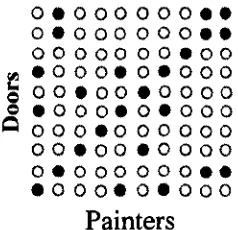
0.000000 ••
0.000000 ••
0000000.00
til .000.0.000
S
00.00.0000QQ.000.0.000
000.000000 00.00.0000
0.000000 ••
• 000.0.000
[image:24.512.186.305.565.680.2]Painters
Create your own painting, and then explain it to your peer as parsimoniously as
you can. Give her or him the least information, but still be sure that with given
information she or he would recreate your painting.
Textbox 2
1.5.1 The pre-interview
analysis of the situation
As mentioned above, the situation was based on the concept of equivalence
relation, i.e. a relation having three properties: reflexivity, symmetry and
transitivity (see Section 1.6.2 for a formal definition). But unlike an equivalence
relation that is a particular relation between the elements of only one set, the
situation seems to be about a relation between two sets, i.e. the set of painters and
the set of doors. Nonetheless, these two sets have "the same number of elements",
even though their elements belong to two different contexts. Therefore, there
should be some tools to lead students to a context-free situation, viz. the relation
between the elements of the set of natural numbers from one to ten. In order to
achieve a context-free situation, the blank grids presented to students to make
their own examples were label-free grids as the grid
In addition to this slight change in the appearance
0000000000 0000000000 0000000000 0000000000 0000000000 0000000000 0000000000 0000000000 0000000000 0000000000
shown in Figure 2.
of the grids, there was a deeper reason that could
potentially lead students to a context-free situation:
Figure 2: A blank grid
symmetry of each example.
It was supposed that thesymmetry of each example is more accessible as a property of the dotted grid
rather than something about the painters and the doors. Therefore, giving the least
amount of information-the most parsimonious one-could simultaneously guide
Supposing all these assumptions, the study turned to the first interview on the
situation related to equivalence relations.
1.5.2 The first interview
The first interview on equivalence relations (the situation regarding equivalence
relations) took place with Shion, at that time a graduate student in mathematics.
The interview aimed at seeing the situation through the eyes of a colleague to
revise it for interviewing with students that had not been taught equivalence
relations. But interestingly and surprisingly the situation turned to be a novel
situation for her. That novelty had at least two consequences; first, providing a
"successful" record of what was expected of the situation, and second, calling my
attention to the context of the problems including the "real world" elements such
as painters and doors.
The first "successful" record
If we define the success of the situation in terms of the achievement of its objectives, the first result was a success. In other words the outcome of Shion's
engagement in the situation partly met my expectations: she spotted the
"symmetric" property of each example; and while creating her own examples
drew the symmetry from the given conditions.
Although, as we will see, the formulation of the situation had been changed
after the Shion's interview, it is worth pausing to consider her interview to justify
the subsequent modifications.
Shion spotted the symmetry property while checking Figure 1 to see
whether it is an example or not.
She immediately realized that Figure 1 is a symmetric figure. But, she was still in
doubt whether Figure 1 is an example of an acceptable painting or not.
Nonetheless, she replaced the given conditions by the symmetry, and then used the
symmetry to check the examplehood of other figures. For example, she used it to
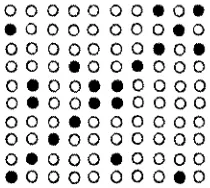
reject the following figure (Figure 3).
0000000.0 •
[image:27.512.200.305.183.277.2]• 0000000.0 0000000.0. 000.00.000 0.00 •• 0000 0.00 •• 0000 000.000000 00.0000000 0.000.0000 .0000000.0
Figure 3: A Non-Symmetric Non-Example Figure
Shion: Maybe I can omit this one [first condition], and if I think about this condition [second condition], they can cover the whole things; for my image, symmetry is like they can cover whole things, so if the graph is symmetric ...referring to this graph, it is not symmetric, so maybe, this figure cannot cover the whole condition.
As I expected Shion came up with the idea of symmetry. Thus, I implicitly
encouraged her to argue for her idea. Hereafter, when I refer to the interviews, I
will use "interviewer", "I" and "Amir" interchangeably. Moreover, square
brackets are used to introduce my comments.
Interviewer: But symmetry is not in the conditions, so how you are sure about symmetry? You have only one figure that symmetry is correct in it, but if it isn't an example so, maybe symmetry is not correct. Shion: So if I want to say this one isn't symmetry, so this figure [Figure 3] can not express this one, then first I need to confirm the first figure
[Figure 1] can express or can not express.
As yet the idea of symmetry had been based on only one example-in- trust (it is
supposed to be an example because the interviewer has presented it). Therefore,
Interviewer: Maybe figure [Figure 1], not special example.
Accordingly, Shion gave her very first argument on symmetry.
symmetry is correct in this another figure, because it's a
Shion: Now I am thinking from this expression, I can think about some symmetric figure or not.
Shion: Now I am thinking, from the beginning, painters and doors are different, but there is no meaning, I don't need to have this difference. I can swap doors and painters; now I am thinking if I choose two painters the doors are the same or not, but then if doors are the same then painters must be the same. That's why, I can think about some symmetry property because I can swap or I can change the coordinates. It means symmetry.
Having given her first argument on symmetry, Shion referred to symmetry to
[image:28.512.200.302.347.442.2]accept the following non-example as an example (Figure 4).
Figure 4: A Symmetric Non-Example Figure
Although she applies symmetry in every step that she takes, there is something
about symmetry that still bothers her. Not satisfied with her own first argument,
while making her own example she is still looking for a reason for that.
Shion: Totally black is also acceptable; it means if all of the circles are
"or" , it's also okay, everyone is symmetric?
And after a long discussion that is mainly about the "real world" context of the
black, because
this condition it's "or".
is Why
situation, she again returns to that bothersome question.
And eventually, while struggling to make another example she comes to the
following reason.
Shion: [She turns (2, 7) into black, and all at a sudden] because the first sentences, (7, 2) must be black, because from the first sentences (7, 7) is black, then suddenly we need this. That /s why the graph has symmetry property.
This very first interview had several important effects on the present study, among
them, recognising the situation's defects and acknowledging the importance of
making examples. Accordingly, the situation was modified.
1.6 The situation,
revisited
As mentioned, and it can be seen from Shion's excerpts quoted above, the
situation unexpectedly turned to be a novel situation for Shion. Furthermore, she
was struggling with the situation more than was expected. As the following
excerpt shows, it seems that her struggling was partly related to the real world
context of the situation.
Shion: The purpose of the painters is a goal, so if there are ten doors, these ten doors must be painted by someone; so the first sentence is the goal; so my question is, this is a goal, if we have ten doors we want to paint all, if each painter paints one then they can paint all of the doors; the first line we can satisfy this goal.
Shion's long-term struggling with the situation caused the first reflection on the
situation.
1.6.1 Reflection on the situation, unity and plurality
Itseemed that the obscurity of the situation was mainly reflected in the conflict
between the real world's demands on the painters (and/or doors) and the
paints one of the doors, and in the latter, one door could be painted by several
painters!
The situation was intended to relate the painters to each other by the doors
that they paint, but the individuality of painters and doors prevailed over that
intention. In particular, as numbered painters and doors they looked like single
individuals characterized by their names (painter No 1, painter N02 ... ; door No1,
door No 2 ... ). Therefore, while the painters painted their own doors as individual
and unit (and the doors were painted as individual and unit), the situation
demanded plurality, i.e. a painter as a person that paints something, a door as
something that can be painted. In a more formal vein, the situation imposed being
a member of the set of painters on each individual painter, aimed at repeatedly
referring to him or her as the painter of certain doors (and similarly seeing each
individual door in the set of doors could mean that it can be repeatedly painted by
certain painters). The intended plurality let the painters relate to each other by the
doors that they paint; now they were not only single individuals, but also someone
that can fill one of the two sides of a relationship, or more importantly fill both
sides of a relationship; they were simultaneously unit and plural.
This plurality can be implicitly seen in the eloquent and still informal
introductory paragraph of the chapter on relations in Stewart and Tall (2000,
p.62):
Each one of the 'two things' in Stewart and Tall examples implicitly belongs to a
set (regardless of the difficulties that the examples from the realms of set theory
could make); therefore, even though, for example, 1 in 2
>
1 is treated as an individual, being in the set of integer gives an infinite access to it and illuminatesits plurality.
As a particular relation, an equivalence relation inherits all the above
peculiarities in a more remarkable way. When we are looking for a concrete
example of equivalence relation, we are apt to define a relation between
two
different things or people, say,
both
have the same colour,both
live in the samestreet; we can check the possession of the given relationship between those two
things or people by pointing to those two; we can do that in a more concrete level,
or using Dienes' words (1976, p.9), in 'first order attributes' realms, say, they are
both
green, for the first relation, and theyboth
live in Oxford Street, for thesecond. However, as Dienes pointed out, the former described by 'second order
attributes' is more
abstract
and more difficult than the latter:To
have the same colour as something
else is a much more sophisticated judgement than to say that they are both green. (ibid, p.9)I should add that passing to 'second order attributes' realms seems inextricable
from grasping the reflexive property. To grasp the reflexive property, first we
must go one step further in the situation, and look at the situation as ' ... having the
same colour as .. .', ' ... living in the same street as .. .', and so on; that demands, on
the one hand, a transfer from unity to plurality in the sense described for relations
in general, and on the other hand, a transfer from plurality to unity, i.e. coming
from
both
toeach.
Bringing plurality and unity together is what I tried to achieve in the next
1.6.2 The Mad Dictator Task
Following the above considerations the context of the situation had been changed
as follows. See Textfigure 1.
A country has ten cities. A mad dictator of the country has decided that he wants to introduce a strict law about visiting other people. He calls this 'the visiting law'.
A visiting-city of the city, which you are in, is: A city where you are allowed to visit other people.
A visiting law must obey two conditions to satisfy the mad dictator:
1.When you are in a particular city, you are allowed to visit other people in that city.
2. For each pair of cities, either their visiting-cities are identical or they mustn't have any visiting-cities in common.
The dictator asks different officials to come up with valid visiting laws, which obey both these rules. In order to allow the dictator to compare the different laws, the officials are asked to represent their laws on a grid such as the one below (Figure 5).
~ 0000000000
.': Q) 0000000000
.~ ..c 0000000000 ~ ~ 0000000000
CIS
go
0000000000E e 0000000000
::s 0.0000000000
o ~ 0000000000
>-
..c 0000000000'0
0000000000You are here
Figure 5: A grid to represent a visiting law
Textfigure 1: The Mad Dictator Task
And the second task changed to the following. See Textbox 3.
The mad dictator decides that the officials are using too much ink in drawing up these laws. He decrees that, on each grid, the officials must give the least amount of information possible so that the dictator (who is an intelligent person and who knows the two rules) could deduce the whole of the official's visiting law.
Looking at each of the examples you have created, what is the least amount of information you need to give to enable the dictator to deduce the whole of your visiting law.
As far as the order of the tasks is concerned, a preference was given to the
student-made examples demanded in the first task; accordingly, the situation
aimed at leading students to the symmetry and transitivity through creating their
own examples and giving the minimum amount of information demanded in the
second task.
The underlying structure of the Mad Dictator Task
As repeatedly mentioned before, the Mad Dictator Task is based on the notion of
equivalence relation. I shall give the standard definition of an equivalence relation
for future reference. According to the standard account, an equivalence relation is
a relation - on a set S that has three properties: reflexivity (a-a for all a in S),
symmetry (ifa-b then b-at, transitivity (ifa-b and b-e then a-c). Suppose - is an
equivalence relation on S and a is an arbitrary element of S, then the set of all
elements of S that are related to a is called the equivalence class of a. It follows
from reflexivity, symmetry and transitivity that for each pair of elements of S, say
a and b, either the equivalence class of a isequal to the equivalence class of b or
the intersection of the equivalence class of
a
and the equivalence class ofb is theempty set. Given this and also considering that every element, say
a,
belongs to anequivalence class, namely the equivalence class of a, it can be seen that an
equivalence relation on a set Spartitions the set into equivalence classes, i.e. the
set is divided into mutually exclusive classes. Conversely, suppose there is a set of
mutually exclusive subsets of S, such that each element of S belongs to one of
them, then the following relation is an equivalence relation:
In the context of the Mad Dictator Task, let
a -
b ifb is a visiting-city ofa.
Then- would be an equivalence relation, providing that we have satisfied the second
conditions of a visiting law:
For each pair of cities, either their visiting-cities are identical or they mustn't have any visiting-cities in common.
Consider that by giving a "metonymical/ definition" in which, a city is used to
refer to people in the city, the new formulation had brought plurality and unity
together. That is to say, "each city is its own visiting-city" metonymically stands
for "in each city you can visit other people". Thus, the first condition of a visiting
law guarantees that each city has at least one visiting-city, i.e. that city itself. It is
the reflexive law that is visible as the main diagonal of the grid.
Having captured the reflexivity, the situation aimed at leading students to
the two other properties of an equivalence relation, symmetry and transitivity.
1.7 Further sample
Having considered such details, the preliminary study went further with a small
opportunistic sample of students comprising two first year undergraduate
mathematics students, and two second year undergraduate physics students, all
were students at the University of Warwick, one of the top five ranked universities
in UK.
The two mathematics students have been taught equivalence relations and
related subjects four weeks before the interview in a course entitled 'Foundations'
held at the University. The two physics students had no previous 'formal' idea
about equivalence relations and related subject.
2According to Lakoff and Johnson (1980, p. 36), metonymy "has primarily a referential function. that
Regarding the nature of the second task involving communication between
an official and the dictator, and aiming at making this communication an actual
communication between two people (presumably one of them an official and the
other the dictator), the students were invited to be interviewed in pairs, i.e. two
mathematics students together, and two physics students together.
As mentioned before, the main change in the structure of the interviews was
giving a preference to making examples, compared to the first interview in which
making examples on the one hand, and checking certain figures to see whether
they are example or not on the other hand, had no preference order. But still it was
not the dynamic of making examples that was considered as important; as a result,
it was taken for granted, while student-made examples, the product, were regarded
as the core of the first task. The reason for this ignorance of the former in favour
of the latter was the so-called importance of the second task for leading students
to consider symmetry and transitivity, the two concepts seemingly embedded in
the situation.
Practically, the interviews had a simple structure; the two tasks (generating
an example of a visiting law, and giving the minimum amount of information)
were posed in order. As soon as one of the students had made one or two
examples agreeable to all (interviewer and interviewees), we started the second
task. On the other hand, the interviewer, more like a teacher aiming at teaching
certain predetermined concepts, sought those concepts in students' utterances. The
interview with the physics students illuminates the nature of the initial interviews.
Andy is one of the two physics students who made his own examples,
noticed symmetry of each figure, and gave a reason for that, and suggested the
Andy: I am going to tell you some groups, each group visits all the other ones in the group and hence it is visited by all the other ones in the group, it visits them and it is visited by them.
Soon afterwards, I helped him to separate the given conditions from the symmetry
(in the following, interviewer and interviewee agreed to take the first condition for
granted):
Andy: The second one implies the symmetry,
Interviewer: The second one implies the symmetry or the symmetry property implies the second one,
Andy: They imply each other,
Interviewer: But you have an example here [pointing to a symmetric non-example figure],
Andy: This is symmetrical, oh no, it isn't, and this one doesn't work.
And then, desperately looking for the transitivity the interviewer asked the
following direct question:
Interviewer: What condition must you add to have the second one?
Andy: The second law implies symmetry; the symmetry doesn't imply the second law [while scrutinizing the present examples], I am not sure what sort of answer you are looking for.
And shortl
y
after that:Andy: I can't think of any way to say the second law better than it is already said.
So far I have only given a glimpse of one of the interviews. More surprises were
to come when I compared the results of the two interviews (interview with the
Results
Hargi and Shakil, the two mathematics students, came to talk about symmetry
when they were looking for the minimum amount of information:
Hargi: If you just give me a symmetrical half, you can give me half, then I can do it by symmetry.
Interviewer: Why?
Hagri: Because two can visit six, two can visit five, five must be allowed to visit two and six, two must be allowed to visit five and six, six must be allowed to visit two and six, [asking Shakil] you just give me mirror.
Shakil: Why? It isn't a requirement.
Having come from a geometric expression of symmetry to a more algebraic one,
while asking interviewer:
Hagri: Is it that a requirement that if two goes to five then five goes to two?
Interviewer: Is it that part of the conditions?
Hagri: I'm not sure; [murmuring the conditions] no, it's not a condition.
Just returned to the task of giving the minimum amount of information:
Hagri: I'm still worried about if two goes to five, doesn't necessarily mean that five goes to two.
Shakil: No.
Hagri: It doesn't mean necessarily, because five can go to five, two can go to five, so they have.
Shakil: Yah, the city in common,
Hagri: Visiting-city in common, so five doesn't necessarily go to two, because, um, five does go to two, five does go to two; because if five goes to two, they go to each other, two can go to five, and five can go to five, then, um, you can deduce that from conditions, we've got this identity, a goes to
Hagri then employed this newly confirmed property to reject Shakil's figure as an
example:
Hagri: I am saying picture what he's got there, it is valid, it does not obey example.
And soon after, they accepted a symmetric non-example figure as an example; and
has to be symmetric, now not symmetric, it's not the rules, it's not an
they gave "half of the information" (the symmetric half) as the minimum amount
of information, while considering other properties:
Hagri: I ignore the diagonal; I'll give half of the information.
Interviewer: Does it work always?
Hagri: I guess if you had like a rotating group, if you like, two can go to five, five can go to seven, then,
Shakil: Two has to go to five.
Hagri: Seven has to go to five, and ...
While in the course of the consecutive events there was no sign of relating the
symmetry idea and grouping idea to each other on the one hand, and separating
them from each other on the other hand, all of a sudden they realized the
equivalence relation in the situation:
Shakil: Basically it's an equivalence relation; this is reflexive, symmetric and transitive.
But surprisingly, not even the successful deduction of these three properties from
the two given conditions was of help to them to separate the different concepts
encountered:
Interviewer: What symmetric, it has not.
about symmetry, necessarily both
if one properties
is or
Hagri: That means if you come up with a symmetric picture it must be an example, symmetry is equal to
that two happen [the two given conditions].
In comparison, Andy, one of the two physics students, related the symmetry idea
to the other ideas when only two cities were involved in:
Andy: Because it's gonna be each city that you visit can visit you, it's gonna be symmetrical about that line, that's what implied by this, so it's gonna be symmetrical down there, urn, three and six are grouped.
Even so, when more than two cities were involved, still those two ideas appeared
as isolated ones:
Andy: Each in a group visits all the other ones in the group, because one is the same group as five, so then it visits one, five and seven, five is in the same group as one and seven, and five so visit one, five and seven.
While in the last excerpt there is no sign of symmetry, in the following there is
only a loose reference to symmetry:
Andy:
If
you go along the columns one by one, and you see, you know symmetry, you can see that two visi t nine and ten you know that they must visit each other, so you check that ten visits nine~In general, he referred to many different ideas without maintaining those ideas
from one time to the other, and without necessarily relating those ideas to each
other as the mathematics students did.
These two interviews radically affected my criterion for success and failure
of the situation.
1.8 Discussion: success or failure
When I started the preliminary study, my criterion for success was whether
students engaging in the situation could spot certain predetermined concepts or
Having that criterion in mind let me scrutinize the last two interviews in terms of
success or failure.
Both groups of students successfully noticed symmetry, while only the
mathematics students who had already been taught equivalence relations noticed
transitivity. Therefore, as far as symmetry is concerned, the situation could be
taken as a success, and regarding transitivity, as a failure, particularly, since the
study would eventually target students who have not been taught the subject. i.e.
students that are more like the physics students than the mathematics students.
Moreover, the students brought to my attention something I had previously
ignored, something that was not then a yardstick to assess the success of the
situation, but turned out to be as effective as symmetry and transitivity when
tackling the requirements of the situation, i.e. the idea of 'grouping'. To be
precise, despite the fact that I was aware of the idea of 'grouping' (or in a certain
sense, 'partitioning') as a logically closely related concept to equivalence
relations, the presence of symmetry and transitivity prevented me from realizing
the extent to which the other concepts were involved.
Beyond those individual concepts, this first study revealed something that
certainly played a crucial role in preparing me for relinquishing my criterion for
success, i.e. the ways that those individual concepts could be related to each other.
While for me those individual concepts had certain relations informed by the
formal treatment of them, for students, they were mainly related to each other by
their functionality within the situation.
Altogether, considering the data it seemed that my original view of success
which was mainly based on tracing certain predetermined concepts in students'
that view by modifying the tasks and/or adding certain new tasks in such a way
that they would facilitate (1) the students' grasp of the missing concept of
'transitivity', and (2) the predetermined ways of connecting all the concepts
involved in the situation. Furthermore, any measures of success should take
account of two criteria, the extent to which those predetermined concepts would
be brought up in each interview, and the extent to which their logical relations
would be matched with the standard ones. To put it more simply: the more
standard the outcome, the more successful the situation. On the other hand, by
narrowing the situation in order to make success more likely, the more restricted,
involved and artificial it would be. Nonetheless, there would still be no guarantee
that it would achieve what it had been designed to achieve.
Given this, a certain fact that was then in the background of my reading of
Mariotti and Fischbein (1997) had been come to the foreground, i.e. students'
unforeseen difficulties. Quite akin to this study, they introduced a problem
situation in which 'the concept to be defined functionally emerges from the
solution of a problem'. Despite the indispensable and involved role of the teacher
in their experiment to guide students to overcome the conflict between 'the
spontaneous process of conceptualization and the theoretical approach to
definitions', they repeatedly report the students' unforeseen difficulties to
transcend the concrete situation to reach to the intended 'systematic organization
of concepts'. If in their experiment, with such an involved role of the teacher, leading students to define certain intended concepts was so problematic, reducing
the role of the teacher (as I aimed for) would result in a more complex situation.
reading of Mariotti and Fischbein-the very same issue that was raised by the
preliminary study-was 'systematic organization of concepts':
In fact, theoretically, a definition relates the new object to all the others, in such a way that a chain (system) of definitions is built up; this system is an organic and coherent whole. The gap between a spontaneous defining process and a mathematical defining process concerns both the origin of the concepts and their organization within a theoretical system.
(Mariotti and Fischbein, 1997, p.225)
The preliminary study opened a new chapter in my thinking in which Ilearned to
consider defining in the realm of organizing. The initial stages of this chapter in
2.1
Introduction
As the initial data revealed students' spontaneous ways of tackling the given
situation (those that were not necessarily intended by me). they also shook my
concerns about success and failure. Accordingly, the study gradually began a
process of revision thoroughly embracing every aspect of it; the intention of the
study turned to be an investigation of the ways that students organize the given
situation, and following that, the methods of interviewing and analyzing were
naturally revised.
This chapter looks at some aspects concerning the organizing activities.
Particularly, Freudenthal's works on this issue are mentioned. After this, the
methodology (i.e.phenomenography) to be used is described briefly. I also give
the first data that were collected and analysed under my new perspective. Finally.
based on the students' works on the Mad Dictator Task, I report a 'new' definition
of equivalence relations. and consequently a new representation for them, which
seems to be overlooked in the literature.
2.2
Didactical Phenomenology
A continuous change in my reading of the literature was the least result of the
analysis of the data all through the study. I have already mentioned one of these
new readings, i.e. my reading of Mariotti and Fischbein (see section 1.8); now I
discuss another one, i.e. my reading of Freudenthal.
Freudenthal's works has certainly had a great effect on the literature as to
defining. He himself favoured defining as a learning activity, though only as the
finishing touch of an organizing activity:
means of the deductive organization of the properties of an object.
(Freudenthal, 1973, p. 417)
Ten years on (1983), in Freudenthal's monumental work, defining does not retain
its earlier importance in the organizing activities. In Didactical Phenomenology
the goal is "the constitution of mental objects" rather than making concepts
explicit.
Our mathematical concepts, structures, ideas have been invented as tools to organise the phenomenon of the physical, social and mental world. Phenomenology of a mathematical concept, structure, or idea means describing it in its relation to the phenomena for which it was created, and to which it has been extended in the learning process of mankind, and, as far as this description is concerned with the learning process of the young generation, it is didactical phenomenology, a way to show the teacher the places where the learner might step into the learning process of mankind. (ibid, p. ix) ... what a didactical phenomenology can do is ... starting from those phenomena that beg to be organized and from that starting point teaching the learner to manipulate these means of organizing", (ibid, p.32, emphasis added)
Looking at the initial data, the idea of organizing that was then in the background
of my reading of Freudenthal came to the foreground. I learnt to see the situation
that the students were engaged in as a situation that "begs to be organized". Given
this, I shall add that I only have partly adopted Freudenthal's plan; I became
interested in the ways that students organize the given situation, rather than
teaching them any particular ways of organizing the given situation and/or
"teaching them to manipulate any particular means of organizing". Now I needed
a methodology that was fit for what I was about to investigate. At the time,
phenomenography seemed an ideal choice.
2.3 Phenomenography
Experiences are reflected in statements about the world, in acts carried out, in artifacts produced. Now, in the light of what we know about the world, such statements can appear more or less valid or consistent or useful, the acts more
or less skilled, the artifacts more or less functional. .. we have to bracket4 such
judgments. We have to look at the statements, acts, and artifacts to find out what ways of experiencing particular aspects of the world they reflect, regardless of their validity, skilfulness, or functionality.
(Marton and Booth, 1997, p.120)
All I did towards the end of the preliminary study had a phenomenographic ring.
For example, I had spontaneously started to bracket my judgment, to see the
situation through students' eyes, and to consider the variation in the students'
experience of the situation, as phenomenographers do. However, it was only
under the pilot study that I explicitly, and as far as I could, truly, put this approach
into practice. Foreshadowing a more thorough account of phenomenography in
the methodology chapter (Chapter 3), here I give a snapshot of it in the context of
two interviews.
2.4 Pilot Study
The pilot study occurred with two students having no formal previous experience
of equivalence relations, partitions and related concepts usually used to define it.
Tyler is an undergraduate computer science student and Jimmy is a sixth form
student studying mathematics. I interviewed them individually. In the course of
the interview, I invited them to think and talk aloud in order to audiotape their
utterances. Also, they were encouraged to write their ideas. The interviews had a
simple structure; the two tasks (generating an example of a visiting law, and
giving the minimum amount of information) were posed in order, but the timing
and questions were contingent on students' responses. The interviews aimed at
reaching a mutual understanding between interviewer and interviewee (in the
sense of Booth et aI, 1999, p.69) of the situation and the ways that interviewee
organized it. Therefore the interviewer did not judge the interviewees' utterances
4Somewhere else (p.119),as a footnote. they add: "Tobracket is a term from phenomenology.


![so if we'vegottwo-six,wealso[Figure24],nowsupposethatFigure 24](https://thumb-us.123doks.com/thumbv2/123dok_us/9782231.479332/126.528.49.474.185.537/so-if-we-vegottwo-six-wealso-figure-nowsupposethatfigure.webp)
![Hess:Figure 33Andfromthesetwooneis[in], thisoneis[in], and](https://thumb-us.123doks.com/thumbv2/123dok_us/9782231.479332/131.516.48.474.36.747/hess-figure-andfromthesetwooneis-in-thisoneis-in-and.webp)
![to beidenticalwith1[Figure37]Figure 37The rest speaks for itself.](https://thumb-us.123doks.com/thumbv2/123dok_us/9782231.479332/137.528.70.447.229.654/beidenticalwith-figure-figure-the-rest-speaks-for-itself.webp)
