http://wrap.warwick.ac.uk
Original citation:
Sitthiworachart, J. and Joy, Mike (2004) Using web-based peer assessment in fostering
deep learning in computer programming. In: International Conference on Education and
Information Systems - Technologies and Application, Orlando, FL, 21-25 Jul 2004.
Published in: EISTA '04: International Conference on Education and Information
Systems: Technologies and Applications, Proceedings, Volume 3 pp. 231-236.
Permanent WRAP url:
http://wrap.warwick.ac.uk/34152
Copyright and reuse:
The Warwick Research Archive Portal (WRAP) makes this work by researchers of the
University of Warwick available open access under the following conditions. Copyright ©
and all moral rights to the version of the paper presented here belong to the individual
author(s) and/or other copyright owners. To the extent reasonable and practicable the
material made available in WRAP has been checked for eligibility before being made
available.
Copies of full items can be used for personal research or study, educational, or not-for
profit purposes without prior permission or charge. Provided that the authors, title and
full bibliographic details are credited, a hyperlink and/or URL is given for the original
metadata page and the content is not changed in any way.
A note on versions:
The version presented here may differ from the published version or, version of record, if
you wish to cite this item you are advised to consult the publisher’s version. Please see
the ‘permanent WRAP url’ above for details on accessing the published version and note
that access may require a subscription.
Deep Learning in Computer Programming
Jirarat Sitthiworachart?? and Mike Joy
Department of Computer Science, University of Warwick, Coventry, CV4 7AL, UK [email protected],
WWW home page:http://www.dcs.warwick.ac.uk/
Abstract. Active learning is considered by many academics as an im-portant and effective learning strategy. Students can improve the quality of their work by developing their higher cognitive skills through reflection on their own ideas and practice of analytic and evaluative skills. Peer as-sessment is one of the successful approaches which can be used to enhance this deep learning. In this paper we discuss a novel web-based peer as-sessment system to support computer programming courses. We discuss the educational rational for the system, and the deep learning theory, report on its deployment on large programming modules. The prelimi-nary results indicate that the system has successfully helped students to develop their higher cognitive skills in learning computer programming.
1
Introduction
Assessment is a tool for learning, but traditional assessment methods often en-courage surface learning, characterised by memorisation and comprehension of information. Deep learning, such as creating new ideas, and critical judgement of a student’s work, can be encouraged by the use of peer assessment [1–3]. When students evaluate each others’ work they think more deeply, see how others tackle problems, learn to criticise constructively, and display important cognitive skills such as critical thinking [4, 5]. As part of a study investigating the extent that peer assessment can promote deep learning in a programming course, we have developed a novel web-based peer assessment tool specifically designed to support computer programming courses, which automates the mark-ing process, anonymises the participatmark-ing students, and provides comprehensive monitoring facilities for the teacher.
This paper first gives an overview of surface and deep learning, which can be described by using six categories of learning in Bloom’s Taxonomy [6], which require students to use thinking skills at each level, starting from the simplest to the complex. Deep learning approaches and the key elements to encourage a deep learning approach are discussed. Finally, we describe the novel web-based peer assessment system, and report on its deployment on a large computer programming course.
2
Deep Learning
Learning is increasing knowledge and understanding. Some students see learning as a matter of memorising and reproducing knowledge in ways acceptable to the teacher and only to cope with course requirements. Others see learning as a way to establish personal meaning, by transforming the information and ideas in relation to their existing knowledge and experience [8]. Brown, Bull, and Pendlebury [9] define learning as “changes in knowledge, understanding, skills and attitudes brought about by experience and reflection upon that experience”, and summarize that students are expected to have two main skills, which are knowledge and thinking skills (critical judgement).
2.1 What is Deep Learning?
Deep learning is characterised by students conceptualizing approaches, seeking interconnections between concepts and data, and engaging in reflection [10]. According to Biggs [11], deep learning is “the use of high-level, abstract cogni-tive processes that teachers want students to develop, which include explaining, arguing, reflecting, and applying knowledge to problems that are not in the textbook, relating new problems to established principles, and hypothesizing”. Cox and Clark [12] describe deep learning as “the capacity to use explanatory concepts creatively, and leads to students’ ability to think about problem situa-tions and devise new solusitua-tions to those problems”. Rosie [13] argues that deep learning is not a function or attribute of the learner but is a strategy that stu-dents can adopt. He suggests that deep learning requires higher order cognitive skills, meaningful engagement in and enjoyment of learning, and a desire to think conceptually rather than to amass detail.
Thus to achieve deep learning students need a base knowledge and compre-hension of information, which is surface learning, and they need to be able to apply their knowledge to solve problems. Once they can do these things they can abstract from their knowledge and experience so that they can move beyond known solutions to new and innovative applications and to use judgement in evaluating alternative solutions [6, 12]. It can be concluded that students need to begin with surface learning and progress systematically to deeper learning approaches. For the purposes of this paper, we use Bloom’s categorization of cognigative skills [6], (usually referred to as “Bloom’s Taxonomy”), although others are available, such as Anderson and Krathwohl’s revision of the Taxon-omy [7].
2.2 Surface and Deep Learning
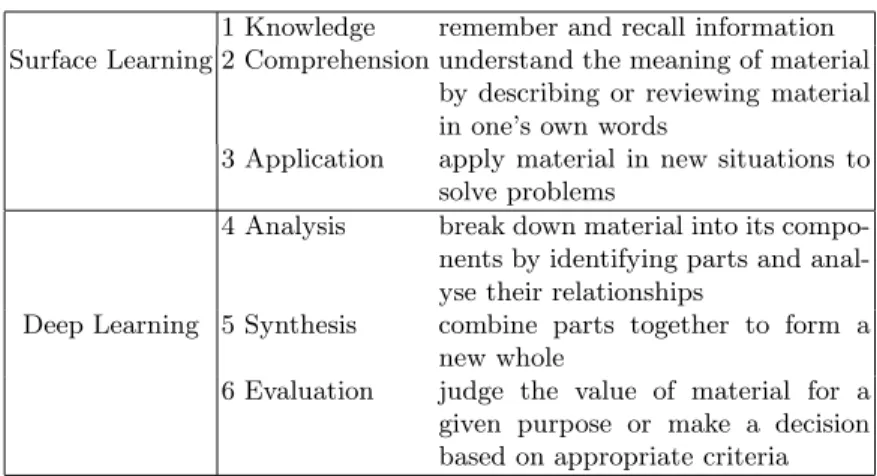
learning consists of the first three levels of Bloom’s Taxonomy, namely Knowl-edge, Comprehension, and Application, which emphasise recall and application of trivial procedural knowledge. The final three levels of Bloom’s Taxonomy, Analysis, Synthesis, and Evaluation, are combined into a problem-solving skills category or deep learning level [12]. It should be noted that each succeeding level assumes competence at an earlier level. For example, students should have knowledge and comprehension of information before they can apply their knowl-edge to solve problems. A brief description of the six categories of learning in Bloom’s Taxonomy is given in Table 1.
Table 1.Six categories of learning in Bloom’s Taxonomy
1 Knowledge remember and recall information Surface Learning 2 Comprehension understand the meaning of material
by describing or reviewing material in one’s own words
3 Application apply material in new situations to solve problems
4 Analysis break down material into its compo-nents by identifying parts and anal-yse their relationships
Deep Learning 5 Synthesis combine parts together to form a new whole
6 Evaluation judge the value of material for a given purpose or make a decision based on appropriate criteria
The difference between surface and deep learning is relevant in analysing stu-dent learning intentions, learning styles, learning approaches adopted and learn-ing outcomes [14]. In surface learnlearn-ing, students learn by passively re-produclearn-ing [8]. They learn simply to memorise facts, study without reflecting, and accept the information given without question [8, 14]. In contrast, in deep learning, stu-dents learn by active transformation [8]. They seek to understand the issues and interact critically with the contents, to relate ideas to previous knowledge and experience, to examine the logic of the arguments and relate the evidence pre-sented to the conclusions, and become actively interested in the course content [8, 14].
2.3 Deep Learning Approaches
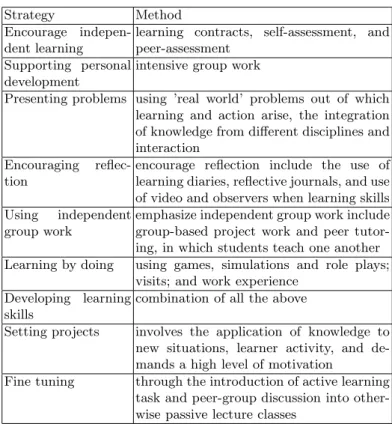
There are many authors who have suggested a variety of approaches to help students achieve deep learning. For example, Entwistle [8] suggests that deep learning can be promoted through curriculum design, teaching, and assessment. Grauerholz [15] proposes teaching holistically to help students achieve deep learning. Nine strategies for fostering a deep learning approach has been pub-lished in the AAHE Bulletin [1], and are summarised in table 2.
Table 2.Nine strategies for fostering deep learning
Strategy Method
Encourage indepen-dent learning
learning contracts, self-assessment, and peer-assessment
Supporting personal development
intensive group work
Presenting problems using ’real world’ problems out of which learning and action arise, the integration of knowledge from different disciplines and interaction
Encouraging reflec-tion
encourage reflection include the use of learning diaries, reflective journals, and use of video and observers when learning skills Using independent
group work
emphasize independent group work include group-based project work and peer tutor-ing, in which students teach one another Learning by doing using games, simulations and role plays;
visits; and work experience Developing learning
skills
combination of all the above
Setting projects involves the application of knowledge to new situations, learner activity, and de-mands a high level of motivation
Fine tuning through the introduction of active learning task and peer-group discussion into other-wise passive lecture classes
solu-tions. Peer assessment also relates to the four key elements identified by Biggs as required for fostering a deep learning approach: the motivational context, active learning, interaction with others, and a well-structured knowledge base [11]. We have investigated how the peer assessment process can be adapted to work in the context of computer programming, and the effectiveness of that process.
However, deep learning is difficult to assess or see [15]. Some students may be resistant to deep learning, because it is hard work and students must be highly motivated to do it. Therefore, students should be provided with the tools to perform this higher cognitive activity and be stimulated to do it. For this reason we have chosen a web-based peer assessment tool to support our investigation.
3
Peer Assessment
Falchikov [16] defines peer assessment as “the process whereby groups rate their peers”. Somervell states that peer assessment engages students in making judge-ments on the other students’ work [17]. In the peer assessment process, students are involved both in the learning and in the assessment process. Peer assessment is primarily a tool for learning rather than for summative assessment [9]. Dochy and McDowell remark that “peer assessment is not only a tool to provide a peer with constructive feedback which is understood by the peer. Above all, peer assessment is a tool for the learner himself.” [18]
Receiving many and frequent peer feedbacks can prevent some errors and provide hints for making progress in learning [19]. Thus the peer assessment process provides many benefits to students, including the following:
– it encourages of students’ deep learning skills in programming by making judgements and providing feedback on other student’s work [2, 3];
– students have opportunities to compare and discuss about what constituted a good or bad piece of work, which help them to improve their programming style and think more deeply about the quality of work [20];
– when marking, students realise mistakes that they had made in their own answers - the more marking students did, the better their own results became [3];
– students develop self-assessment and reflective learning skills [2, 17]; and
– students’ understanding of the assessment process deepens [9].
3.1 Research Method
Students learn how to design and develop programs in the shell, which is a pro-gramming language that allows programs to be written in many styles. There are three programming assignments in this module, which students submit via the department’s “BOSS” online submission system [21]. The second of the three assignments was marked using a peer assessment process. The purposes of per-forming the experiment in peer assessment were:
– to investigate the extent that peer assessment in a programming course pro-motes deep learning;
– to assess the accuracy of students’ judgements during a peer assessment exercise; and
– to provide evidence that peer assessment in computer programming has a positive pedagogical effect.
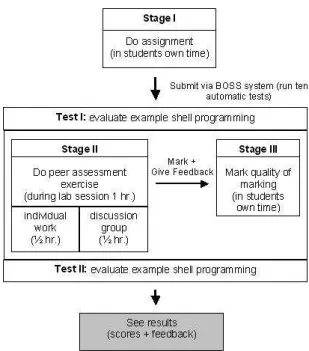
Fig. 1.Peer assessment process
Stage I: Students do the assignment in their own time. Then they submit the assignment via the online submission system. Ten automatic tests are then run on the submitted pro-grams.
Stage II: Students are divided into small groups (three students per group), each group consisting of students with a range of abilities. Each student is assigned three other students’ assignments to mark during the first half hour of a lab session. Then they discuss their marking with the other students in their group, who marked the same assign-ments.
Stage III: In their own time, each student marks the quality of three markers’ marking. This additional stage aims to develop students’ critical judgement and encourage them to take the assessor role more seriously during stage II.
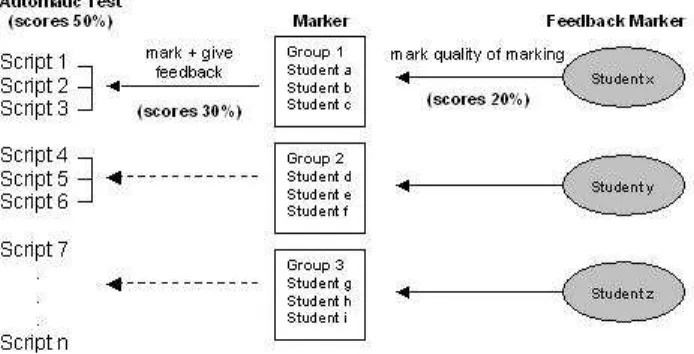
Fig. 2.Peer assessment mark scheme
Automatic test: The online submission system tests a student’s assign-ment against different inputs to check whether it func-tions correctly. Ten tests are used.
Marker: Student markers mark assignments.
Feedback marker: Student feedback marker reports on the quality of the marking given by the three markers.
Mark Scheme The marking scheme is illustrated in Figure 2. In this peer assessment process, 50% of the marks are awarded by the teacher (automatic tests) and the remaining 50% are awarded by the students (peer assessment):
Automatic Test 50%
Peer Assessment
- Part I: mark assignment 30% - Part II: mark quality of marking 20%
Peer marks are based on three markers; the average of the three marks is calculated. If one of markers does not appear to have marked work seriously (that is, does not appear to have read the program carefully and answer the marking criteria properly), the mark he or she gives will not be included in the average and the other marks will be scaled. The marking of assignments by students is possible since they are given guidance, automatic test scores and results, a marking scheme, and well-explained marking criteria.
3.2 Web-based Peer Assessment
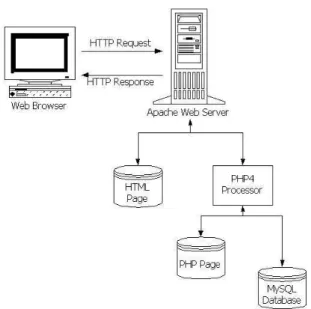
Fig. 3.Architecture of the web-based peer assessment system
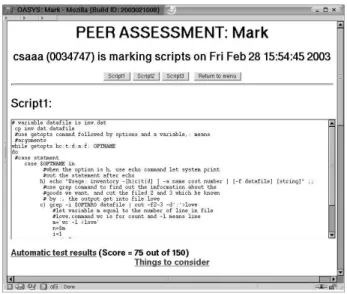
running on a Linux platform. This architecture is illustrated in Figure 3. Dy-namic web pages are written in PHP4 and static web pages are written in HTML. This web-based peer assessment provides anonymity for all users. Students are allowed to revise the marks they give until the marking deadline is reached. They receive a username and password by email before starting the peer as-sessment exercise. After students login, the menu page displays three steps for students to follow (i.e. mark assignment, mark quality of marking, and see mark). They can see the scripts that they have been assigned to mark easily by click-ing on the script buttons (Figure 4). They can view the automatic test results by clicking on the link on each script page to open a popup window displaying the results. A “Things to consider” link is provided below containing marking guidance.
Fig. 4.Assignment script onMarkweb page
Mark Assignment In this visual inspection step, students mark and provide feedback on other students’ assignments by answering nine questions about:
– Readability (comments, indentation, variable names);
– Correctness (correct output, appropriate error handling, correct exit status); and
– Style (easy to follow, well structured, use of appropriate utilities).
criteria is provided for each group of questions by clicking on the links on the left.
Mark Quality of Marking In this step, students mark the quality of marking given by each of the three markers on a particular script. They need to answer three questions about whetherthe suggestions the markers gave in each section (readability, correctness, and style) are relevant, well explained and useful to students. The marking given by the three markers is displayed at the top of the page and the student enters the feedback marks at the bottom.
See Mark In this final step, students can see their mark from both the auto-matic test and the peer assessment. AMarking calculationslink at the bottom of the page provides an explanation of how the overall mark is calculated. If the students do not mark any of three scripts, they may lose some marks. The full mark and comments that the three peer markers gave the student’s assignment are also available. This also includes the full mark that they were given based on the quality of their own marking.
Monitor Marking The monitor marking web page reports the students’ marks and any absent markers, and is only available for tutors. The highlighted columns show the standard deviation of the three markers for both Step I and Step II in order to know how spread out the marks are. If the standard deviation is less than a preset value, it is deemedacceptable, but if the standard deviation is more than a given upper limit, it means the marks from the three markers have a very wide range, and the tutor may have to reconsider the marks for that student. The tutor can access each script by using the “Script ID” box at the top of the web page.
4
Results
Students’ opinions At the end of the process, each student was required to fill in a detailed online questionnaire, and the following preliminary observations suggest that the exercise has been beneficial.
– 69% of students realise mistakes that they made in their own answer when marking other students’ work.
– 76% of students discuss with their groups when marking and think this discussion helps them understand more about the assignment.A few students find starting a discussion difficult.
– 58% of students feel comfortable when assigning marks. A few students did not fully understand the marking criteria.
– 80% of students agree that seeing good and bad programs help them in learning programming, and marking helps them to think more deeply about their own work.
For most of the questions in the questionnaire, the responses when compared by gender were broadly similar. However, male students appeared to feel signif-icantly more comfortable assigning marks than did the female students. Almost 80% of non-UK students would like to recommend the peer assessment to friends as a way of learning more, but only 50% of UK students would like to do this, and this may form the basis for further investigation.
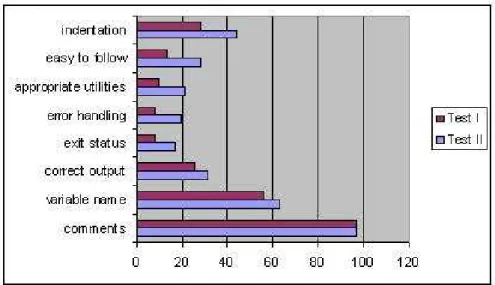
4.1 Evaluating students’ evaluation skills
Fig. 5.Pre and post peer-assessment test results
4.2 Quality of students’ marking
In order to ascertain the accuracy of the students’ marking, the programs were also marked independently by an experienced tutor, and each student’s mark was then compared against the tutor mark. The marks awarded by the students were mostly higher than those awarded by the tutor, the means differing by ap-proximately 18%, and scaling of peers’ marks yielded results which, in almost all cases, matched the tutor’s. This is consistent with other studies which in which peer marks are consistently higher than tutors [22]. With guidance, and design of appropriate information flow, peer assessment can be of a similar quality to that made by subject experts.
5
Discussions
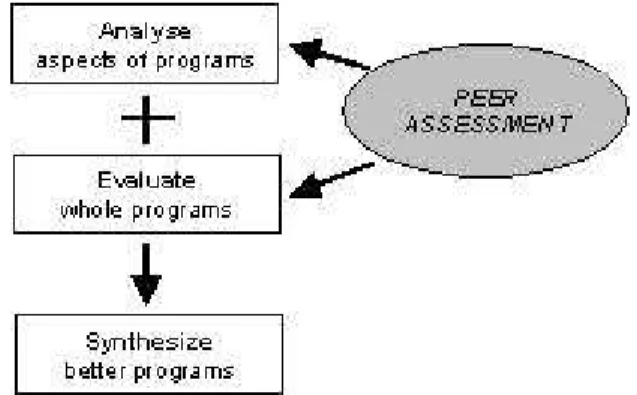
Fig. 6.Deep learning approach
The results of our investigation indicate that peer assessment encourages stu-dents to develop higher level cognitive skills in learning computer programming. This includes the analysis and evaluation of programs, which leads students to develop new creative approaches and styles when writing programs (as illustrated in Figure 6):
– Analyse aspects of programs - peer assessment starts students thinking about what aspects of their programs are wrong and what works well when they compare their work with other students’ work.
– Evaluate whole programs - making judgement on other students’ work helps students to evaluate their own programs. They can recognise what consti-tutes good and poor programs.
The students’ responses generally appear to support our view that students can learn from each other through this process. Seeing different ways of solving programming problems and marking each other’s works helps students’ self-assessment and writing better programs:
“I got the chance to observe two scripts that used different methods than my own solution to satisfy the specification. In order to be confident in my ability to mark these scripts fairly, I had to spend a long time studying them and hence acquiring an improved knowledge of how shell scripts are composed.”
“Marking others’ work helps me criticise my own work and remind me of my own problems.”
Most students seemed satisfied with their marks, and considered that with adequate guidance the marks from peers could be as reliable as the marks from a tutor. However, some students think the marks awarded by students are graded using different standards to those awarded by tutors. Markers could only base marks on how good the script was compared to their own answers, and some students therefore think no student is really qualified to mark another student’s work, as they are not trained for marking and are not experts:
“I would say peer assessment in a better way to learn how to write a good program. Nevertheless, some markers may not have the skill of marking and understanding of script.”
“I think it is hard to mark a student when you’ve never marked as-signments before, especially UNIX scripts as I never had any previous experience with it. Additionally, the things I consider good or bad may not be the same for other people.”
It was difficult in the students’ view to avoid friendship marking, resulting in over-marking (they often felt favourable towards their friends) [20]:
“When marking I was inclined to be generous because I expected that everyone else would be to me.”
“Very hard to do when you are marking someone who is technically in the same boat as you.”
6
Conclusions
(analysis, evaluation and synthesis) rather than surface learning strategies in the peer assessment process, contributes to effective learning. Students also realise their own strengths and weaknesses when marking a good or poor piece of work. Preliminary evaluation of the exercise indicates that it has contributed positively to the students’ learning experience.
References
1. AAHE Bulletin: Deep Learning, Surface Learning. AAHE Bulletin 45(8) (1993) 10–13
2. Topping, K.: Peer assessment between students in colleges and universities. Review of Educational Research68(1998) 249–276
3. Bhalerao, A., Ward, A.: Towards electronically assisted peer assessment: a case study. Association for Learning Technology (ALT-J)9(1) (2001) 26–37
4. Sluijsmans, D., Dochy, F., Moerkerke, G.: Creating a learning environment by using self- peer- and co-assessment. Learning Environments Research1(1999) 293–319 5. Tsai, C., Lin, S., Yuan, S.: Developing science activities through a net worked peer
assessment system. Computers and Education38(2002) 241–252
6. Bloom, B.S. (Ed.): Taxonomy of educational objectives: The classification of edu-cational goals: Handbook I, cognitive domain. New York, Longmans (1956) 7. Anderson, L.W., Krathwohl, D.R.: A Taxonomy for Learning, Teaching, and
As-sessing: A Revision of Bloom’s Taxonomy of Educational Objectives. New York, Addison Wesley (2001)
8. Entwistle, N.: Promoting Deep Learning Through Teaching and Assessment. In: Assessment To Promote Deep Learning. American Association for Higher Education (AAHE), Washington, DC (2001) 16–26
9. Brown, G., Bull, J., Pendlebury, M. (eds.): Assessing student learning in higher education, Routledge, London (1997) 21–39
10. Jenkins, T.: The Motivation of Students of Programming. Proceedings ITiCSE 2001. ACM SIGCSE33(3) (2001) 53–56
11. Biggs, J.: Assessing for Quality in Learning. In: Assessment To Promote Deep Learning. American Association for Higher Education (AAHE), Washington, DC (2001) 70–73
12. Cox, K., Clark, D.: The Use of Formative Quizzes for Deep Learning. Computers and Education30(3/4) (1998) 157–167
13. Rosie, A.: Deep Learning: A dialectical approach drawing on tutor-led. Learning in Higher Education1(1) (2000) 45–59
14. Beattie, V., Collins, B., McInnes, B.: Deep and surface learning: a simple or sim-plistic dichotomy? Accounting Education6(1) (1997) 1-12
15. Grauerholz, L.: Teaching Holistically to Achieve Deep Learning. College Teaching
49(2) (2001) 44–50
16. Falchikov, N.: Learning Together: Peer tutoring in higher education. Routledge Falmer, London (2001)
17. Somervell, H.: Issues in assessment, enterprise and higher education: the case for self-, peer and collaborative assessment. Assessment and Evaluation in Higher Ed-ucation18(1993) 221–233
19. Lin, S., Liu, E., Yuan, S.: Web-based peer assessment: feedback for students with various thinking-styles. Learning17(2001) 420–432
20. Brindley, C., Scoffield, S.: Peer Assessment in Undergraduate Programmes. Teach-ing in Higher Education3(1) (1998) 79–89
21. Luck, M., Joy, M.: A Secure On-line Submission System. Software - Practice and Experience29(8) (1999) 721–740