ralph broenink
Master’s Thesis
Services, Cyber Security and Safety Group
Faculty of Electrical Engineering, Mathematics and Computer Science University of Twente
Botnets, large international networks of infected computers (so-called bots), play a central part in the digital underground economy, providing the infrastructure required for a multitude of malicious activities. To ensure a botnet keeps running, the botnet owner utilizes specialized technologies to send control messages to his bots, while keeping resilience against take down and stealth against detection from law enforcement agencies and rivals. Parties such as these are developing detection and take down methodologies.
However, botnet owners are in the advantage: even after detection and take down, it is hard to trace the owner, who remains unpunished and can continue his criminal career. This proves to be a significant problem for law enforcement, as a confiscated machine may not provide direct leads. Often, it is not known which machine was managed by which miscreant or was part of which specific botnet infrastructure.
In this research, we propose a novel approach in identifying the infras-tructure and miscreant belonging to confiscated machines. We define a set of characteristics that can be applied to confiscated hard disks. These will then be used to extract clusters of machines with commonalities from large datasets. We will validate our approach by applying it to a test dataset of 104 different disk images, showing how experts would use this to gain insight in large datasets.
This work would not have been possible without the help, guidance and feedback of several individuals. I would like to take the opportunity to express my sincere gratitude towards them.
First of all, I would like to thank Maarten Everts for enthusiastically thinking along and providing me with the feedback I needed. Although meeting face-to-face has not always been easy (thoughGoogle Hangouts did their job), I could always count on his involvement and this work would not have been possible without his guidance.
Additionally, I’d like to thank Pieter Hartel for being part of my grad-uation committee. Although we weren’t able to meet often, his critical feedback has improved the scientific value of this work.
I also wish to thank Floor Jansen for her involvement in this project. Although she was not an expert on the technical aspects of my work, she was able to bring me back to right track when I was lost in a problem. A thank you also to Peter Wagenaar for complementing Floor’s expertise and providing me with the topic of this paper and useful technical insights that have greatly improved some parts of this thesis.
I am also grateful to the members of the National High Tech Crime Unit of the Netherlands Police Agency for providing me a place to complete my final research project and welcoming me to the world of crime fighting. They made me feel at home, for which I am sincerely grateful. A special thank you to the investigators that allowed me to interview them in the final phases of my research and lent me their time, creativity and expertise.
Last of all, I want to thank my friends and family, who have been sup-portive during my entire study, the members of Inter-Actief, for allowing me to evolve myself (beyond becoming amicrowave student– quickly cooked, but tasteless), and everybody else who has been encouraging with respect to the final part of my study.
Ralph Broenink
1 introduction 1
1.1 Problem 1
1.2 Contribution 3
2 b otnet overview 5
2.1 Economy 5
2.1.1 Setup 5
2.1.2 Host Recruitment 6
2.1.3 Monetization 9
2.2 Technology 13
2.2.1 Control Topologies & Channels 13
2.2.2 Resilience Enhancing Technologies 16
2.2.3 Recent Developments 18
2.3 Detection & Aftermath 20
2.3.1 Detection Techniques 20
2.3.2 Analysis & Take Down 22
2.3.3 Botmaster Traceback 25
2.3.4 Digital Forensics 25
2.4 Conclusion 26
3 method 27
3.1 Characteristics 27
3.1.1 Network Operations 28
3.1.2 System Operations 31
3.1.3 Not Implemented Characteristics 32
3.2 Creating and Visualising Relations 33
3.2.1 Analysis 34
3.2.2 Limitations 35
3.2.3 Visualisation 37
4 results 39
4.1 Dataset 39
4.2 Excluded Characteristics 40
4.3 Quantitative Analysis 40
4.3.1 Validation 42
4.3.2 Efficiency 44
4.4 Interviews with Investigators 44
4.4.1 Discussion on the Method 44
4.4.2 Discussion on the Results 46
4.4.3 Discussion on the Visualization 48
4.4.4 Conclusion 49
4.5 In-depth Cluster Analysis 49
4.5.1 BredoLab Cluster 50
4.5.2 Strongly Connected c&c Cluster 51
4.5.3 Encrypted Cluster 52
4.5.4 Conclusion 53
5 discussion 55
5.1 Future Work 56
5.2 Research Questions 57
5.3 Conclusion 58
a pro of-of-c oncep t implementation 59
a.1 Accessing Disk Images 59
a.2 Indexing 60
a.3 Analysis & Visualisation 61
b analysis of d otfiles 65
b.1 Requesting Dotfiles from Others 65
b.2 Dotfiles from GitHub 66
b.3 Conclusion 67
1
INTRODUCTIONNot many people may be realizing it, butbotnetsare an important part of our day-to-day lives. Most of the spam received daily originates from a botnet and important websites are down from time-to-time due to botnet-initiated attacks. Currently, your home computer may even be part of a yet undiscovered botnet, without you knowing it.
Botnets are networks of infected hosts (zombiesorbots, fromrobot) under centralized control by a human operator, known as the botmas-terorbotherder[46,63]. Owners of infected computers are unaware of their participation in a botnet; bot recruitment usually occurs via similar channels as infection by other types of malware. However, botnets distin-guish themselves from normal malware by the usage of a communication channel to the botnet operator, allowing these miscreants to issue com-mands to their bots to perform a multitude of malicious activities while remaining relatively anonymous.
Due to the massive scale of botnets – size estimates of single botnets range from several thousands to thirty million bots [79] – they are effective for financial gain, harming vital infrastructures and for performing other illegal activities [33]. Since a larger network with more capacity has more capabilities, it can be put to use more often for a wider range of purposes, generating more revenue for the botmaster. They are therefore always looking to recruit more bots for their network.
Parallels with regular cloud services can be drawn – services are of-fered on multiple hosts working towards the same goal – making botnets underground cloud service providers, or even Swiss army knives, specif-ically purposed for illegal activities. However, one must carefully note that nodes in a botnet do not participate voluntarily and recruitment requires a stealthy set-up via malware. Furthermore, contrasting cloud services, botnets consist of unreliable nodes, as any participant may clean or shutdown their computer at any time.
1.1 problem
The sheer amount of illegal activities performed by botnets has sparked the interest of academia, security companies and law enforcement agencies. Time and effort is put into investigating botnet operations and developing botnet detection, disruption and take down methodologies [3,20,46]. Although such efforts lead to a deep understanding of botnets, the ultimate goal of tracking down the miscreants is a hard and tedious process.
Law enforcement agencies are particularly interested in identifying miscreants, attributing malicious activities to a single person or a criminal organization. Often, disks are seized to allow detailed forensic analysis of the botnet, but mostly this does not lead to the capture of any miscreant [63]. Reasons for this are multitude; contributing factors are a robust service-oriented underground economy and the development of resilience and stealth enhancing technologies. Examples include the use ofstepping stonesto obfuscate the real location of the botmaster (seeSection 2.3.3). However, using and managing their botnet, miscreants are bound to leave traces. Such traces may include the specific architecture of their net-work, their victims or even personal traces on central machines (so-called Command & Control servers, orc&cs) [66]. Combining these character-istics, we can build a profile of the machine (and possibly the managing miscreant) by finding relations between different seized machines.
When doing this on a substantial dataset, we expect to see similar patterns and networks of related machines, matching multiple machines operated by one common miscreant and part of the same infrastructure. This may aid investigation, possibly resulting in direct leads or a (more) complete picture of the miscreant, but may also provide the justification for the allocation of more resources for a more in-depth investigation.
This supports our main problem to be stated as follows:
How can we reliably determine which c&c machines were managed by the same person or have been part of the same infrastructure?
In the process of building a profile based on infrastructural or user char-acteristics, there are two main requirements. First and foremost, we must build a profile that is precise enough to retain low false positive and low false negative ratios, ensuring that machines are not being disregarded as being not managed by the same miscreant or part of the same network. Secondly, profiling must complete in reasonable time and with limited resources, and results must be presented in a clear way, ensuring that our method does not burden investigators with additional complicated tasks. From this, we have gathered the following research questions that need to be answered before we can provide a solution to our problem:
1. Which identifying characteristics can be found inside a c&c? 2. How can these characteristics be used to reliably identify a common
miscreant or infrastructure?
3. How can results be presented to the investigator?
1.2 c ontribu tion
The contribution of this research is twofold. InChapter 2, we will start by providing an overview of the current state of literature regarding botnet technology, economy and detection techniques. We will find that the underground economy is increasingly being powered by botnets, utiliz-ing specific technologies to enhance their stealth against detection and resilience against take downs. We will also discuss take down methods, and explain why botmaster traceback is often hindered.
The second part of this research will focus on investigating the possi-bility of finding relations between confiscated machines using user and machine specific characteristics. InChapter 3, we will discuss the charac-teristics we will use to relate machines together and how we came from this to a visualisation.Chapter 4describes our steps in confirming and validating our results, including a quantitative analysis, interviews with experts and in-depth analysis of some of our data.
2
B OTNET OVERVIEWIn this chapter, we will discuss the current state of research regarding botnet economy, technology and detection.Section 2.1describes the un-derground economy that has formed around botnets and the services both utilized and provided by botnets.Section 2.2provides an introduc-tion on the technologies used by botmasters to form and operate their botnet. Finally, inSection 2.3an overview of detection, take down and botmaster traceback methods is provided.
2.1 ec onomy
Where cybercriminals used to sell their illegal products individually, the underground economy is now evolving into a market where everything is offered to conduct crime, ranging from malicious code to the infrastruc-ture required to control the spread of malware [90]. Services offered are increasingly diversified and trending towards specialization, ranging from supply chain management, software development and distribution, to customer support, training and post-sales services. Most of these services are characterized by their ease of use and strong customer orientation, offering user-friendly controls and dashboards.
Botmasters are increasingly becoming an intermediary within the un-derground economy, outsourcing the collection of enough hosts for their botnet and the maintenance of their software. They limit themselves to offering malicious services, renting out their botnet and making money in the process. An overview of the underground economy surrounding the botmaster is provided inFigure 2.1.
2.1.1 Setup
To start building a botnet, the botmaster needs to invest in software and hardware to control his botnet. Instead of building and developing this themselves, botmasters can opt to outsource this to other miscreants – at a price. In this subsection, we will discuss two main parts of the setup: the software (i. e.bot kit) and the hosting of the software.
2.1.1.1 Bot Kits
There are developers designing and building so-calledbot kits, offering everything required to build a basic botnet that can easily be customised.
Basic features such as malware and basic management mechanisms are often included by default [6,53]. Additionally, these kits allow a great deal of customization, typically through modules and plug-ins that are sold separately. Such modules may provide specific functionality, such as information stealers, form grabbers orweb injectsfor specific websites
(seeSection 2.1.3.6).
Prices for bot kits vary wildly. Basic configurations with the newest versions may be sold for prices ranging from $2000 to $3000 [52,95],
In this paper, all prices
are listed in us dollar. although prices half of that have also been seen [67]. Additional modules
are sold for $50–$1000, depending on the capabilities. A complete vip package, including all modules, is sold for $3000–$6000 [52,67].
Updates are also sold, for instance to fix bugs or improve malware that is losing its potential due to vulnerabilities being patched and anti-virus software being updated. Kits may also integrate with other malicious services and for instance automatically apply obfuscation methods when required (seeSection 2.2.2.2), typically for rates of $10–$20 per obfuscation or in a subscription model [52].
2.1.1.2 Bulletproof Services
After acquiring the necessary software, the botmaster needs a place to put this online (see alsoSection 2.2.1).Bulletproof hosting providersoffer hosting services that keep customer information confidential to ensure the anonymity of the miscreant. Other services include ddos protection, ip masking(hiding the real ip address of the server) and similar services, aimed at protecting the servers from takedowns from law enforcement and competitors. Furthermore, providers are often based in jurisdictions where cyber laws are weak or non-existent, making them immune to notice-and-take-down requests [52].
It is therefore unsurprising that demand for bulletproof service providers is high and that they are significant market enablers. Bulletproof services are provided for a monthly fee of $300 to $500, after a one-time setup fee of $50–$100 [52].
2.1.2 Host Recruitment
Victim
$
$
Botkit
$ $
Botmaster
Exploit Pack
Email Address List
$
$
Traffic-PPI Provider
Exploit Server
$ Spammer
Packer
$
$
Sales
Compromised Site
$
Hosting Provider
2.1.2.1 Drive-by Downloads
A commonly used method to install malicious software, is the utilization ofdrive-by downloads. Such downloads rely onexploit kits: software pack-ages bundling multiple exploits targeting vulnerabilities in web browsers and their plugins (e. g. Flash and Java).
When visiting a compromised website or viewing a website using a compromised advertising network [45], victims are redirected toexploit servershosting exploit kits. Upon visit, the browser is analysed and served with the proper exploit for the host’s operating system, browser and plug-ins. If the exploit is successful, malware is downloaded to and executed on the victim’s computer [12,21].
To successfully perform a drive-by download, four requirements need
In 2013, a large Dutch news site was compromised through code injection into one of their advertising networks. Users were redirected to an exploit kit abusing vulnerabilities in Java, allowing the download
of malware [69].
to be satisfied: a compromised website, an exploit kit, an exploit server and a redirection chain from the compromised website to this server; a user would visit the compromised site and get redirected through the chain to the exploit server hosting the exploit kit. Traditionally, exploit kits have been sold for one-time fees, allowing unlimited use once purchased, leaving the miscreant responsible for the other aspects.
Recently, a software-as-a-service model emerged: the Blackhole exploit kit offers licensing for a pre-installed exploit server that can be configured by clients to drop various malware variants, all aspects of hosting and updating the software are handled by the Blackhole team, starting at $500 per month [77]. Clients are still responsible for getting victims to the exploit server – which is an art yet other miscreants are concerned with.
2.1.2.2 Pay-per-Install
Considering the number of targeted victims, their location and the bot-master’s budget, the global dissemination of malware can also be entirely outsourced topay-per-install(ppi) service providers, allowing botmas-ters to focus their efforts on monetizing their botnets.Caballero et al. distinguished three roles in the pay-per-install market [9]:
clients want to install their malware on a number of hosts, profiting from the malicious activities enabled by malware deployed on the target’s hosts. These may for instance be botmasters looking to expand their botnet.
providers develop special programs (downloaders) that remain under their control. These pieces of software can receive and install the client’s programs and track whether the install succeeds. Providers usually install multiple client programs on the same host.
method, including torrents, drive-by downloads, spam, or even using other ppi services [21]. Instead of victimizing new hosts them-selves, providers pass their software down to affiliates and pay per confirmed install.
To keep monetizing ppi, stealth installs are required. Clients are often in charge of providing stealthy programs, while affiliates rely upon the provider to provide them with a stealthy downloader. Stealth can be gained by usingpackers(seeSection 2.2.2.2), which are again developed and sold by third parties.
It depends on the ppi provider how exactly installs are generated – clients are generally not concerned with their methods. For instance, traffic-ppiproviders offer complete drive-by download solutions, requir-ing their clients only to provide their malware binaries, while takrequir-ing care of generating traffic to lure victims to malicious-serving hosts, redirecting them toward exploit kits and exploiting them. These solutions may in turn be offered by affiliates, making Traffic-ppi providers middle-men between traffic generators, exploit kit writers and clients [21].
Prices per install depend on the geographic location of the victim. In countries such as the United States, install rates average $100–$150 per thousand installs, while a geographically mixed set of installs sells at prices as low as $7–$15 per thousand hosts [90,75]. The price differences are caused by the likelihood that a malicious file will be successfully installed, the wealth of the country and the internet speed. For botnets, a mixed set may be sufficient for many purposes, although a specific country may be targeted for information theft purposes, aiming at a specific language, purchasing method or financial institution.
2.1.3 Monetization
After having infected hosts with malicious software and having set up their WebMoney
(wmtransfer.com)
allows users to have multiple purses, each for WebMoney units linked to a different currency. For example, wmz (i. e. the z purse) is used for carrying out transactions in us dollars. The exchange rate for every purse is fixed by a guarantor based on the local legal environment.
botnet, botmasters have the ability to command their bots to perform a multitude of malicious activities for their customers. These customers have varying motives, ranging from cyber vandalism, cyber crime and hacktivism, to cyber terrorism and cyber warfare [94].
[52]. Bitcoins are another example of a currency that is popular in the underground economy [71].
Malicious activities performed by botnets can be separated in two groups. The first group of activities focuses on systems not part of the botnet, where the botnets have the distinct advantage that they are large networks with great resources, providing anonymity for the botmaster and being flexible enough to stay ahead of the law (e. g.Denial of Service, spamandclick fraud). The second group aims at attacking the bots and their users themselves, providing similar services as ‘traditional’ malware, but taking advantage of the diverse and large group of infected systems to which the botmaster has gained access (e. g.extortionandBitcoin mining).
2.1.3.1 Denial of Service
One of the most popular uses of botnets involvesdistributed denial of service(ddos) attacks [16]. Typically, these attacks are executed by setting all bots in the botnet to send large amounts of traffic to the computer under attack, leading to the denial of service of the victim’s computer when there are insufficient resources to handle all incoming requests.
Such attacks are only successful if the attacker has accumulated greater resources than the victim; otherwise, the victim could cope with the attack. This implies that larger and better-known websites can only be taken down by coordinated attacks of large botnets.
ddos attacks are a powerful tool for instances of extortion, unfair competition, hacktivism and (when targeting critical infrastructures) cyberterrorism. A particular example of ddos attacks on large scale, were the websites of major financial institutions being targeted during the WikiLeaks affair [38], but smaller attacks keep happening every day [97].
2.1.3.2 Spam
By commanding large numbers of bots, thousands of unsolicited emails can be transmitted in a matter of minutes [65]. Mails sent typically include a hyperlink to a commercial website or are used for phishing purposes; sending the user to a website mimicking another (e. g. banking) website and persuading the user to enter his credentials or other private details. Blacklisting is one of the classic methods to divert spam, but due to the transient and distributed nature of botnets, it is hardly effective black-listing individual bots, as each individual bot will only send low volumes of email by itself and could easily be exchanged for another bot. This allows for great successes of spam runs and explains why the majority of international spam is sent by botnets [65,96].
recently or to which region they belong. The value of an email address is also contingent upon whether it belongs to a free email service (e. g. Gmail or Hotmail), with email addresses belonging to these services selling for half the price of normal email addresses [56].
Prices for a targeted mailing (i. e.spam-as-a-service) range from $70 for thousands of addressees to $1000 for tens of millions [86]. Botnets are sometimes also rented out for larger campaigns ($10,000 per month for 100 million emails per day), typically after being offered a free trial to evaluate performance of the botnet [56]. Spam revenue estimates vary wildly, ranging up to two million dollars per day for a single botnet [28].
2.1.3.3 Click Fraud
Advertising networks sell advertising space on websites. In turn, these Well-known and popular advertising networks include
DoubleClickand
Google AdSense.
networks pay website owners a portion of their revenue for every click a visitor generates on their website [13,17]. When bots are set by the botnet owner to perform clicks on his own websites, revenue can quickly be generated, representing fraud, since these bots do not have the intention of buying the product offered.
2.1.3.4 Link Building
To assess the relevancy and popularity of a website, search engines use a number of criteria. One of these is the amount of links to the website; the more links there are, the higher a website appears in search results [17].
Search engine optimization(seo) is a legitimate business in itself that is concerned with optimizing the factors that impact the position of a web-site in search results. Botnet operators have automated the optimization process and post lots of links to the same website, on different weblogs, forums and other websites. Such links are stuffed inside randomly gener-ated sentences with specific keywords and placed into legitimate looking comments. Reportedly, seo spam can be bought for $300 per month [79].
2.1.3.5 Content Delivery & Proxying
Other criminals, though especially the botmaster himself, may want to host content that is unwelcome or illegal. Phishing sites, malware or botnet updates must be defended from disruption – hosting such content on a central server makes it relatively easy to identify and take down.
2.1.3.6 Information Theft
Typical botnet malware allows the botnet owner to remotely install addi-tional modules to retrieve confidential information stored on the users’ computers. Such modules may include keyloggers, data crawlers, or man-in-the-browserphishing attacks [55].
In the latter case, when a victim visits a page specified by the botmaster (so-calledtrigger pages), which may for instance be an online banking environment, a malicious page or additional frame (web inject) is injected into the user’s browser. Since the injected content carefully mimics the expected page’s style, the ssl information appears to be correct and the url in the address bar does not change, the injection is hard to detect.
The injected page may request the victim to enter his personal or bank-ing details or may request the user to transfer money. When done carefully, the victim may not suspect anything and may even voluntarily bypass any additional security measures set up by the attacked website (e. g. confirmation text messages or security tokens).
Stolen data may also be sold on irc (chat) networks or underground forums and includes credit card numbers, addresses, names, phone num-bers, usernames and passwords, social security numbers and bank account information [15]. Depending on the victim’s nationality, prices for full packages of a single user’s data range from $5 to $8 [28].
2.1.3.7 Extortion
A specific category of malware is calledransomware, which uses extor-tion as a way to gain money from a victim. Ransomware locks an entire computer, showing a message supposedly from a law enforcement agency. Such messages are along the lines of “you have browsed illicit materials
Popular payment methods include Ukash and Paysafecard voucher codes, which are sold at petrol stations and supermarkets.
and must pay a fine” and are provided with an air of authenticity and can not be dismissed, causing victims to pay up (estimates show that a little less than 3% of victims pay, totalling a worldwide extortion estimate of over $5 million). Other forms of ransomware encrypt files on the hard disk and require payment for the decryption key. However, even after payment, access is often not restored [87].
2.1.3.8 Bitcoin Mining
c omplexit y stealth l atency resilience
Centralized low medium low low
Peer-to-Peer medium high medium medium
[image:23.595.105.414.93.168.2]Random low low high high
Table 2.1: Overview of some core properties of botnet control topologies [11]
Due to the significant computing resources required to find solutions to
the Bitcoin problem, miners typically join forces in amining pool, where The value of a Bitcoin fluctuates highly; during the writing of this paper, the value of one Bitcoin went from $100 to around $1,000 and back down to $500. More about Bitcoins in general can be found at
bitcoin.org. An
overview of Bitcoin exchanges is available from e. g.
bitcoincharts.com.
participants share performance and earnings. However, due to the massive amount of computing power available in botnets, they can be used for mining instead, without sharing the earnings with the participants [42]. Additionally, locally stored Bitcoins could also be stolen by the miscreant.
2.1.3.9 Pay-per-Install
Botmasters can also opt to act as a ppi affiliate (seeSection 2.1.2.2) and allow other miscreants to install software on bots within their network. This may involve installing a downloader on the compromised host, which automatically contacts a ppi provider for new binaries to install [9,21]. This service is also sometimes referred to asInstall-by-Install(ibi) [52].
Installed software may conduct similar activities as mentioned in the previous parts of this section, including click fraud, or the theft of in-formation, but may also sell software to the user under false pretences (e. g. fake anti-virus software) or may even include malware used by other botmasters looking to expand their botnet [9].
2.2 technol o gy
Botnets use specific technology for infection and recruitment, control, stealth against detection and resilience against take downs by law en-forcement or other hostiles. In this section, we will dive into the different technologies used by botmasters.
2.2.1 Control Topologies & Channels
2.2.1.1 Centralized
The most straight-forward approach to send commands to the bots in a botnet, is to set up a centralCommand & Control server, orc&c server, to which all bots connect. The centralized architecture allows for messages to arrive in a predictable manner and with low latency. However, by centralizing botnet communication, all bots connect to the same end point, which is both easier to detect and easier to take down.
Two prevalent technologies to facilitate c&c communications are irc and ht tp, the latter of which is becoming more and more popular due to its clear advantages [84,98]. Although there are other technologies, including Jabber or a self-written protocol, they are only used sporadically in comparison to irc and ht tp.
irc-based One of the first automated bot systems is known asEggdrop, a non-malicious bot that was aimed at helping channel operators with managing channels on theInternet Relay Chat(irc) chat network [84]. Although it did not offer services known to botnets today, it allowed
Although the last version of Eggdrop is from 2011, it is still a popular irc bot. Eggdrop is available
fromeggheads.org.
multiple bots to work together under centralized control.
Since then, bots with more nefarious purposes emerged, aiming to attack other users or bots on the chat network and hiding the attacker in the process. Bots were increasingly used to take down large targets and more bots were required, but voluntary participants were hard to find. Instead, miscreants resorted to distributing their bot software by hiding in legitimate files, creating the first botnets as we know them today.
irc is still being used as the backbone of some botnets [25,84,85]. These all connect to the same irc network, where the botnet operator can give them commands. Although usage of irc is simple and effective for botnet owners, detection and take down methods of irc-based botnets are widely available. Most firewalls today block irc connections by default and the usage of these kinds of botnets is therefore declining [98].
ht tp-based To mitigate the blocking of irc, botnets are resorting to using the web (ht tp) as an alternative. Using ht tp, bots regularly pull information from a public-facing website, contrasting irc-based botnets that get their commands pushed from the central server.
$ $
Botmaster
C&C C&C
(a) Centralized topology
$ $
Botmaster
(b) Peer-to-peer topology
$ $
Botmaster
(c) Random topology
Figure 2.2: Schematic diagrams of different control topologies
2.2.1.2 Peer-to-Peer
In contrast, in apeer-to-peer(p2p) communication architecture, there’s no centralized c&c server being a single point of failure. Instead, every bot has the ability to communicate with other bots. The botnet operator issues their commands to a few individual bots, which will spread the commands through some of the bots they are aware of, slowly propagating the message through the network [22].
The utilization of peer-to-peer networks increases resilience of the network and is therefore more resistant against take downs, but the design of peer-to-peer systems is more complex and does not provide guarantees on message delivery or latency. Messages could take several days to reach all nodes, which is a significant disadvantage. In 2010, p2p topologies were only used in 2% of the botnets, but their usage is increasing [84].
2.2.1.3 Random
known to owner known to each b ot
Centralized all none
Peer-to-Peer few few
[image:26.595.181.491.91.167.2]Random zero or one zero or one
Table 2.2: Overview of number of bots known to participants in botnets with different topologies
It is loosely based on the peer-to-peer architecture; every bot communi-cates by scanning and searching randomly for other bots on the internet, for instance by trying all ip addresses in a specific range. When active bot malware is detected, the message is sent and the receiving bot continues scanning for the next bot [11].
Although implementation of a random communication model is rather easy, it is hard to make any delivery and latency guarantees. Furthermore, the botnet may easily be detected by its constant scanning and probing for other bots, reducing its stealth.
2.2.2 Resilience Enhancing Technologies
Researchers and law enforcement are actively identifying, comprehending and disrupting botnets. Botnet owners have developed several techniques to ensure continuous operation of the botnet and increase their resilience against take downs.
2.2.2.1 Location
If a single location of the centralized c&c server has been hard-coded within the bot software, it can’t be changed quickly when it is taken down. After disruption, bots will not be able to receive new instructions and although some bots may opt to function in an alternative ‘zombie’ mode and continue to propagate and harvest information, the botnet has largely become dysfunctional [88]. There are two methods to mitigate this issue:
d omain flux Usingdomain flux, the botnet does not utilize a single c&c domain. Instead, every bot receives adomain generation algorithm (d ga) that computes a list of domains to be contacted, based on factors such as the current date [55]. Since the domain list changes as time
pro-Instead of a dynamic domain generation algorithm, a fixed list of domain names could also be utilized.
fast-flux Fast-flux networksutilize dns mappings to obfuscate the real central location of the botnet. In fast-flux networks, one dns name points to multiple bots in the botnet. These pointers are quickly cycled amongst the participants of the botnet to accommodate for the often occurring population changes within the botnet [39]. Every bot in the network may receive the content to deliver and serve this independently, but may also act as areverse proxy, relaying every request to a central location (mother ship) and sending every reply back to the original sender.
Only by shutting down the domain name, the dns server, or by taking down the command structure, a fast flux network can be brought to a halt. An additional layer of redirection may be gained by hosting the dns service itself within a fast-flux network (double flux), allowing every bot to become a dns server, accepting and forwarding dns queries [93].
2.2.2.2 Obfuscation
To prevent proper understanding of botnets, malware programmers typi-cally opt to obfuscate their software [51]. Obfuscation involves the hiding of the actual meaning of the malicious code, making the binary code inten-tionally ambiguous and hindering proper understanding of the program’s flow – either by researchers or by anti-virus software – while maintaining the program’s functionality and semantics.
One of the solutions for the malware builder is to maintain the client software in encrypted form, (partially) decrypting it as needed during execution [35]. The binary may also be slightly modified to change its sig-nature and size, for example by rearranging instructions or the insertion of junk (e. g.no-opcommands).
Usingpackers, obfuscation techniques can be applied automatically.
It is even possible to implementanti-debugging traps, allowing the pro- Packing can be very effective, to the point that bots stay online for years.
gram to detect whether it runs in a controlled environment or debugger, preventing researchers from investigating its behaviour. As anti-virus vendors keep adding new signatures to their databases and uncloaking programs, executables are often repacked to avoid detection. Repacking occurs on average every 11 days [9], although other malware (e. g.Citadel) advises to do this more often. Some distribution software (Zlob) was even shown to repack malware for every infected host separately.
2.2.2.3 Interference
Since botnets are used to make money, competition between botnets is prevalent. As computers get infected with malware from different botnets, botmasters may opt to remove other bots from an infected machine, not having to share profits with other botnets. TheSpyEyemalware, for instance, detected and removed software from theZeuSbot, which is its most prominent competitor [53]. Furthermore, malware may also disrupt and interfere with anti-virus software, to prevent detection and removal of the software.
2.2.3 Recent Developments
In addition to the techniques described in the previous section, botmas-ters are actively exploring new defensive techniques to stay ahead of researchers. In this section, we take a brief look at developments seen in recent years or are expected to emerge in the near future.
2.2.3.1 Social Media as Control Channel
Botmasters have started using other communication channels besides the ht tp, irc and p2p channels described inSection 2.2.1. One of these new channels is the usage of social networks. The global success of social net-works in our lives depends on them being online 24/7 and their prevalence ensures traffic does not stand out from normal traffic. This makes them ideal replacements for c&c’s of botmasters looking to increase stealth of their botnets [30].
2.2.3.2 Mobile Botnets
Miscreants are also looking to expand their networks by expanding to mobile devices. One of the first mobile botnets was formed with the SymbOS/Yxes worm [2], but as mobile operating systems become increas-ingly more advanced and prevalent, mobile botnet capabilities are also increasing dramatically, both on iPhones [44] and Android devices [41]. Although mobile devices are typically more protected and harder to infect through official application stores,rootedorjail brokendevices, as well as devices using unofficial stores, are more vulnerable to an attack. Second-hand phones may also contain malware installed by the previous user, or in some cases, the seller.
2.2
t
e
c
h
n
o
l
o
g
y
19
Centralized (ht tp) Bots pull commands from ht tp sites - + Bobax [92]
Peer-to-Peer Commands are passed from bot to bot + + Nugache [57]
Random Commands are sent randomly ++ - Conficker C [43,62]
Domain flux Use of multiple domain names + +/- Torpig [55]
Single fast-flux Use of multiple ip addresses + +/- Storm [57]
Double fast-flux Single fast-flux + fast-fluxed dns ++ +/- Warezov/Stration [93]
Obfuscation Hiding application flow + + Zeus [6]
Communication encryption Hiding contents of messages + + Rustock [10]
Binary encryption Hiding contents of application + + Mariposa [51]
Instant repacking Changing application signature on the fly + ++ Zlob [9]
Interference Disrupting other botnets or software + + SpyEye [53]
Social media Using social media as communication channel - + Koobface [58]
Mobile botnets Using mobile devices as bots - + SymbOS/Yxes [2]
[image:29.595.154.752.107.400.2]Javascript botnets Implement botnets using Javascript - + experimental[76]
2.2.3.3 Javascript Botnets
Instead of using Javascript to start drive-by downloads or otherwise infect a victim’s computer, the Javascript capability of a browser can be used to perform malicious activities: as long as the browser stays on an infected page, it has almost complete control over the browser.
Utilizing (for instance) advertising networks, it is possible to create a large, but volatile, botnet of browsers having a web page open with a specifically designed script, allowing commands to be issued [76]. Such botnets may be used to perform ddos attacks, send email spam, perform distributed computational tasks [83] or other malicious activities and are hard to detect due to the absence of malware and lack of erratic behaviour.
2.3 detection & aftermath
In the previous section, we have discussed methods used to increase the resilience and stealth of botnets (see alsoTable 2.3). These are just two of many factors characterizing botnets – other factors includingchurn (measuring the rate of growth), effectiveness, population, complexity, intended usage and infection methods [3,32,36,60]. However, resilience and stealth are crucial from the botmaster’s perspective for allowing to continue to operate the botnet undisturbed from law enforcement and other parties looking to take down a botnet.
However, researchers are in this same game, looking for methods al-lowing them to detect and identify the presence of bots and c&c servers in a network. In this section, we will discuss some of the most prevalent methods for botnet detection. We will furthermore discuss methods to take down the botnet and identify its herder.
2.3.1 Detection Techniques
Detecting a botnet may be based on three phenomena: malicious traffic
Note that some techniques have only proven themselves in a controlled environment. Actual figures on the usage of detection techniques are unknown, as organizations are secretive about their usage of security technologies.
from bots, control traffic from c&cs or its presence on a file system. The former is typically used to identify a server running bot software within a network, while the latter is used to detect bot software on a specific server.
2.3.1.1 Network Traffic
When identifying bots inside a network, any of the data sources available can be used, including full packet tap data and dns lookup information, but alsoip flow data. The latter effectively is a summary of traffic patterns occurring on the network, grouping connections and listing timestamps, number of transferred bytes and protocols used [54].
signature-based In asignature-baseddetection system, signatures of traffic generated by known malware and botnets are used to identify erratic behaviour in a live network. Although effective for some purposes, using signature-based detection requires the knowledge of the signatures of malicious use in advance. If signatures are lacking for a specific botnet variation, or an entirely new kind of botnet, detection is not possible. This may be mitigated by automatically generating signatures, although exten-sive training sets are still required [40]. However, the usage of polymor-phism by malware authors (Section 2.2.2.2), may make signature-based detection soon obsolete.
anomaly-based A second technique for identifying botnet traffic is the usage ofanomaly-baseddetection systems. Instead of relying on signatures, suspicious behaviour is detected by deviations from normal system operation.Gianvecchio et al.have shown that they were able to distinguish bots from normal users in internet chat networks [19]. Similar principles can be applied to network traffic, possible anomalies including high traffic volumes or suspicious packet sizes.
Researchers have proposed several approaches to developing anomaly-based systems. irc-anomaly-based botnets have been identified by the combination of bots operating in the same irc channel and them generating traffic levels custom toport scans[5]. Others have written systems that com-bine information from automatedintrusion detection systems(ids) to recognize typical traffic patterns of hosts trying to infect other hosts [23]. Classifying the malicious traffic generated by bots in a botnet (e. g. ddos or spam traffic) may also be used for the identification of infected hosts. For instance, a method designed byBrodsky and Brodskyrelied on the assumption that botnets tend to send large amounts of spam in a relatively short period of time [8].
2.3.1.2 Control Traffic
identify traffic with the c&c, which could directly lead to, but at the very least provide pointers to, the centralized server.
Using ip flow information,Gu et al.have shown to be able to identify control traffic when nodes respond to the same query within the same time frame and similar content [24].Karasaridis et al.designed a detection scheme to calculate the distances between monitored flow data and a pre-defined flow model [29].
One may also be able to identify control traffic by scanning dns re-quests for domain names seemingly generated by domain generation algorithms (Section 2.2.2.1). d gas will typically generate multiple invalid domains, which are queried by the infected host, resulting innon-existent domain (nxd omain) responses from the dns server. The detection of clusters of nxd omain responses with characteristics of randomly-generated domains, could indicate the presence of bots trying to commu-nicate with their c&c [1].
2.3.1.3 File System Indicators
Although most detection methods are geared towards using network data to identify botnets, it may not always be possible to obtain this kind of data: different servers may be sharing the same internet connection, servers may have been confiscated for other reasons or organizations want to identify a c&c by regular scanning their infrastructure. For this, file system indicators (e. g. file names, sizes and contents) may be used to identify a botnet instead [100].
2.3.2 Analysis & Take Down
When a botnet has been found, it is prudent to estimate its size, impact and, more importantly, its command structure. This information can then be used to plan a successful botnet take down, or at the very least, provide statistics on botnet usage. There are two ways to shut down a botnet: removing discovered bots or taking down the command and control structure by shutting down the c&c.
The former is a slow and tedious operation. Even relatively small botnets are highly resilient against such a take down and require high amounts of bots to be removed, even in the rare case that the entire network topology is known. This makes such take downs only effective in the early stages of a botnet [60,61]. Above all, control over every bot is often lacking. A more effective and feasible way is to take down the c&c, or at least to disrupt its communications. However, since there is no c&c structure in a p2p botnet, this is no attack vector in these botnets.
en-forcement are limited by law, although it is unclear where the line should
be drawn. In 2010, the Dutch National High Tech Crime Unit (nhtcu) The nht cu was formed in 2007 as part of the National Crime Squad. At the time of writing, the unit consisted of approximately 90 investigators (of which 50% digital and 50% tactical).
has taken down the BredoLab botnet and infiltrated the c&cs to send a message notifying the victims of the infection (see alsoSection 4.1). This has been the subject of discussions regarding the legality of such practices [81] and eventually led to the Dutch police receiving a Big Brother Award by digital civil rights movement Bits of Freedom [70].
However, although the Dutch government is currently (2014) in the process of legalising counter-hacking [72], Dutch law enforcement already has competencies for seizing equipment, conducting house searches, ar-resting and prosecuting suspects, forensic analysis, etcetera [94].
It should also be noted that even a successful take down does not mean it is definitive. Botnets are built to withstand disruption; after a take down, another criminal may step up and continue operations, making the phenomenon of botnets hard to stop [7].
2.3.2.1 Infiltration
An obvious way to learn several aspects of a botnet’s activity is to infil-trate the botnet by joining the c&c channel [47]. One could mimic the behaviour of an actual bot and record any information it can observe, which may include bot identities and transactional information.
However, for this technique to work, one must be able to join the c&c channel, which can only be achieved in irc-based botnets. Furthermore, infiltration does typically not allow for the take down of a botnet.
2.3.2.2 Sinkholing & Takeover
Since some botnets use domain generation algorithms for their com-munications, the botmaster has to ensure that the calculated domains are registered in advance. When the algorithm leaks or is deduced from analysis of the malware, it is possible to predict which domains will be used by the botnet and be registered before the botmaster is able to do so [55]. This allows all traffic destined for a c&c server to be forwarded to another server that observes and records all traffic it receives, a process also known assinkholing.
2.3.2.3 p2p Index Poisoning
Due to the complexity of creating a p2p protocol, some p2p botnets adopt existing p2p file sharing protocols. Such protocols often employ file indexes that are shared amongst participants in the network, allowing participants to search for files in the network.
To receive commands in a for botnet use adapted p2p protocol, a botmaster publishes their commands in this file index, under a specific time-dependent search query. Bots search the file index for this query based on the current date and receive the associated command [61].
However, anyone is able to publish information into this index. Similar to the sinkholing attack, by analysing the source code and behaviour of the malware, queries can be predicted. This can in turn be used to publish bogus information under these queries, severely hindering botnet communications [34].
2.3.2.4 Sybil Attack
Another method to disrupt communications within a p2p botnet is by
The nameSybilis
derived from a book with the same title, which is a case study of
a woman diagnosed with multiple personality disorder.
inserting large amounts of fake nodes orsybilsinto the network. Instead of forwarding c&c commands, they reroute or block these [14]. In order to be effective, sybil nodes must remain active and participate in underlying p2p protocols (contrasting index poisoning), but do not have to respond to the botmaster’s commands to participate in malicious activities.
2.3.2.5 Blacklisting
Using blacklists, it is possible to blacklist a c&c server in firewalls, al-though this will typically not affect the operations on a global scale.
When a query or peer blacklist is maintained within the network, this may also be effective for p2p botnets. Such blacklists may be residual from the underlying p2p networks. Legitimate peers do not process queries in the query blacklist and will not process messages from and to peers in the peer blacklist [60].
2.3.2.6 Take Down & Seizure
2.3.3 Botmaster Traceback
After botnet operations have been brought to a halt, law enforcement is interested in tracing the responsible botmaster. The botmaster is a central player in the botnet economy (seeSection 2.1and especiallyFigure 2.1), although law enforcement is also interested in the other parties. However, not all parties perform illegal activities (e. g. finding exploits, building botkits and providing bullet-proof hosting may not be illegal [73]), while others are only minor players and no significant enablers of malicious activities (e. g. affiliates or botnet salespeople).
Tracing the botmaster is not always easy, as he typically does not con-nect directly to his c&c, but usesstepping stonesto obfuscate his real lo-cation [48]. Stepping stones are a chain of ssh servers, proxies, bouncers and any other network redirection services that make manually tracking the traffic a tedious and time-consuming process [63].
Even if all technical challenges would be resolved, all providers in the world would cooperate and the true source ip address would be found, this does not mean that the relevant machine can be physically located. Smartphones, open wireless access points, the tor anonymization net-work and public computers may hinder traceback efforts [63].
There are other, non-technological methods to locate miscreants. Tradi-tional detective work may for instance follow the money, e. g. identifying money mules(people offering miscreants to use their banking account temporarily) and follow relations from there [20,37]. However, for com-plex organizations, even this may not always be possible and the botmaster may never be identified.
2.3.4 Digital Forensics
Digital forensics is concerned with analysing disk images, memory dumps, network packet captures and so forth [18]. Digital forensics finds its ori-gins in scientifically proven methods towards the preservation, collection, validation, identification, analysis, interpretation, documentation and presentation of digital evidence [91]. It could provide additional informa-tion about the botmaster, which may lead to a successful traceback, may provide (additional) evidence for a possible conviction or may at the very least be relevant for later research on the usage of botnets.
con-suming phase [31]. The final two stages of a digital forensic investigation constitute the presentation of findings and the closure of the incident, en-tailing critical review of the forensic investigation and disposal of evidence and preservation of information [4].
Tools are constantly being developed to support researchers in the
Examples of popular forensic tools include Forensic Toolkit (ftk,
accessdata.com)
and EnCase Forensic
(encase.com).
third and fourth stages. Several software packages exist for creating and analysing disk images and other data sources. Developing tools for anal-ysis is challenging, as the data is diverse and there are huge amounts of data to be analysed [18].
Though most data will not be relevant to the case, constituting operating system files, libraries and (often) pornographic media, some miscreants leave personal traces, such as their user accounts, traces of login sessions, application traces (e. g.dotfiles, seeSection 3.1.2.1), emails, browsing cache and chat sessions [66]. Most tools are able to scan the file system and extract the useful bits of information from the filesystem, although further technical analysis, such as file system analysis, memory analysis and inspection of the boot sector could be used to discover even more useful leads for an investigation [66,74].
2.4 c onclusion
Until recently, a botmaster was required to build his own software and re-cruit his own bots. Nowadays, a service-oriented and diverse underground economy has formed, with miscreants specializing in their expertise of e. g. finding exploits, building software and infecting hosts. This economy is advantageous for botmasters, as they can now primarily focus their efforts on monetizing their botnets.
Botmasters require a communication channel between them and their bots, while remaining resilient against take down and retaining stealth to prevent detection. Different techniques have been developed to keep the botnet active as long as possible, including the usage of obfuscation and interference techniques.
These techniques hinder detection by law enforcement, researchers and other interested parties. Although some detection methods have been successful, finding the botmaster remains a tedious and time-consuming process. This also means that law enforcement is left with evidence it could not link to a miscreant, stalling prosecution.
3
METHODThe purpose of this work is to aid law enforcement with their efforts of taking down botnets by trying to find identifying characteristics in confiscated machines. We will use this information to identify a common miscreant and common infrastructure between these machines. In this section, we will discuss the characteristics we use in our approach and how these characteristics lead to a result that can be used by investigators.
3.1 characteristics
In this section, we will discuss properties we may find within machines that have been used for botnet operations (i. e. c&cs). However, the same characteristics may also be found in disk images of other machines (unrelated to botnets). Therefore, characteristics will be described in a broad sense, allowing the re-use of our findings in other investigations not specifically tailored for c&c investigations.
The type of characteristics we will include in our approach, depends on the system setup, which primarily entails the operating system used. Many c&c servers (e. g. ZeuS, SpyEye and BredoLab [6,53]) utilize a Unix-like operating system. Therefore, we limit our scope to these operating systems, discarding other operating systems. Broadening our scope to include e. g. Windows-based disk images would involve accounting for a whole different server architecture, which is left as future work.
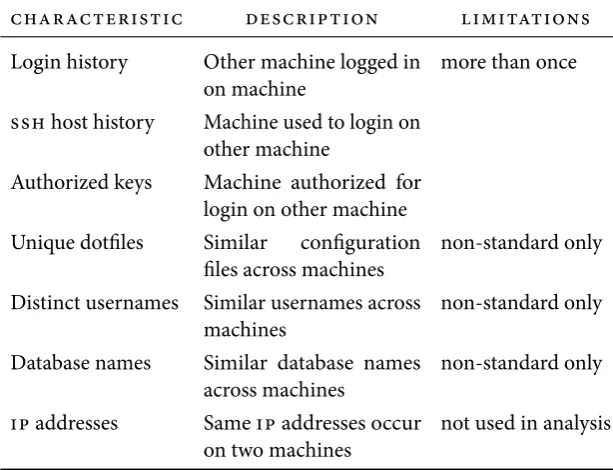
In the following discussion, we have created a distinction between char-acteristics identifying thenetworkingoperations and characteristics that identify theoperationsof the machine itself. This distinction illustrates a clear difference between the two groups: the first group of characteristics is used to find relations between machines where a direct link already exists (e. g. one machine connected to another), while the second group is used to infer new relations based on unified behaviour, such as similar software or configuration.
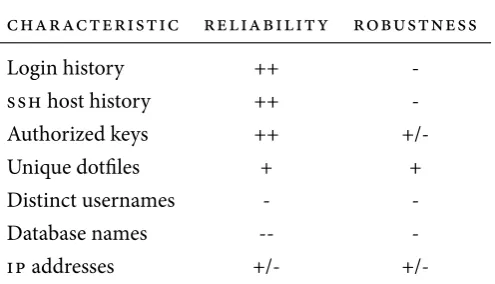
Though this distinction may seem subtle, it provides important infor-mation on the reliability of the created relations. No interpretation of data is required in the group of networked operations (e. g. machines have either connected or not), while we need to contextually interpret the data before creating a relation with the group of system operations.
198.51.100.3
?
198.51.100.3 198.51.100.3
(a) Direct relation between two known machines
198.51.100.3
?
198.51.100.3 198.51.100.4
198.51.100.3 198.51.100.4
(b) Indirect relation through an un-known third machine
Figure 3.1: Examples of the two types of relations that can be inferred from the login history. As shown in (a), there is a direct relation between two machines in the dataset, where one has logged in on the other. In (b), a relation is inferred between two machines because a third machine has logged in on both.
Listing 3.1: Example of entries in thewtmpfile, showing that three different ip addresses logged in to this machine.
username pts/3 203.0.113.15 Thu Apr 3 09:01 - 15:01 (06:00) username pts/3 198.51.100.45 Wed Apr 2 19:51 - 19:53 (00:01) username pts/3 203.0.113.99 Wed Apr 2 09:05 - 16:33 (07:27) username pts/3 203.0.113.15 Tue Apr 1 11:45 - 16:35 (04:49)
3.1.1 Network Operations
All of the characteristics listed as network operations, have been obtained from several log files across the system. In general, the occurrence of the ip address of one machine in the log file of another, indicates a relation between the two machines.
3.1.1.1 Login History
A second location in which login history is stored, is thewtmpfile.
It contains a full log of all previous logins to the system. This file also Thewtmpfile can be
viewed using thelast
command on most Linux-systems.
contains the ip address and time of login, but also the time of logout. Its primarily purpose is auditing and accounting of system states.
Assuming system operators (i. e. botmasters) do not clear these files, we can use these in two ways to create a relation, as shown inFigure 3.1. Firstly, we may have two disk images of which one has logged in to the other (where the client has been used as a stepping stone for the server) and we can match the ip address in the history file with the ip address of the server, resulting in a direct relation. For instance, would we encounter a login history similar toListing 3.1, we can conclude a direct relation between our machine and203.0.113.15,198.51.100.45and203.0.113.99.
Secondly, we could see an indirect relation between two distinct disk im-ages, where the same ip address has logged in, without actually having the machine belonging to this ip address in the dataset. For instance, would we encounter two similar login histories, e. g.203.0.113.99occurring in both machines, we can use this as a relation.
3.1.1.2 ssh Host History
Remotely accessing the terminal of a Unix system is usually done using ssh (Secure Shell) [68]. It provides a secure channel between the user (client) and the system (server or host), that allows commands to be issued to the machine. The security is partially based onpublic-key cryptography
by utilizing akey pairthat is uniquely generated for every machine. A key pair consists of two components: a public component that is advertised and a private component that is kept secret.
Information encrypted with the public component can only be decrypted with the private component.
The connection between the ssh client and server is secured using this key pair: the public key is advertised by the server to connecting clients, while the private key is kept secret to the server. A client encrypts some random information with the public key, while challenging the server to successfully decrypt it using the private key. To ensure that a future connection to the same address is with the exact same server, the client stores the public component in aknown hostsfile (seeListing 3.2). If the public key changes, the client refuses to connect to the server as this is recognized as a possibleman-in-the-middle attack. For this to work properly, it is assumed that the public key is unique for the server and no two keypairs with the same public component exist.
Listing 3.2: Example of an entry into the known hosts file [66].
192.168.1.103 ssh-rsa AAAAB3NzaC1yc2EAAAABIwAAAQEA4RjYT7I+f49 a70MY6S/1YT63tCUDOz5Yt4N1RpeOtiVQ9BBG23YO3/N+byoLs7dLPxuR +YR/Gg57YmNiF5xu2EHM0ewoKL2Y3adjFTUoDhJTYaKg7u3fqb1 TxSERlEeHP2K1i0LaDxl6uDLOvNqy4H/f2XtRuwXMDViysmjWPR0 dCaTbj+D3jbO1Ucg5MIqRlctcM/AH3kF50xiBfamgINtsiJ/jDz9 IEDUCXaN9/D+LBT/sw3PS8kWghYlyIyHNLruWQtp3heFekw2P/1 eKqtaZHZuzf5QzUUyvLQhdQ60fOQmr3JN0jWIruIgRTSDORACHkVy8 YQUBbw2WbaC/Hw==
which hosts was connectedfromthe current host. See alsoFigure A.1
(page 62) for an example.
This also means that we can use this information in a similar manner as with the login history to create a relation, only ‘reversed’. We may have two disk images, where one has served as the client and the other as the server, and we can match the public key known to the client with the private key (or ip address) of the server. Additionally, we may also have two disk images both having connected to the same unknown third server.
3.1.1.3 Authorized Keys
While normally, users would authenticate themselves to a system using a password, users may also opt to set up a personal key to authorize themselves. Authentication using authorized keys has several advantages, including the removal of the need of sending a password over the network and virtually eliminating the possibility of attackers brute forcing the password as keys are typically much longer than passwords.
Similar to the known hosts mechanism, this also uses public-key cryp-tography: the user retains his private key, while the public key resides on the remote host. To prove access to the system, the server sends a challenge (i. e. some random information) encrypted using the public key to the client, requiring the client to decrypt it using its private key.
3.1.1.4 ip Addresses
When a server is used as c&c, it will probably store some information entailing to the ip addresses of victims. These ip addresses may be present in a database, stored in files or present in log files. A second way in which ip addresses could be used on a machine is to connect multiple machines together, e. g. for the sharing of databases.
Based on this information, we can create relations between machines – if one victim’s ip address is present on multiple machines, or one machine has the ip address of another machine configured, we can assume that these machines have a relation with each other.
3.1.2 System Operations
The characteristics in this section are used to create inferred relations, based on unified behaviour between machines.
3.1.2.1 Personal Configuration Files
So-calleddotfiles, files and directories with names starting with a dot (‘.’), are used in Unix-like operating systems to personalise the user experience. These files are located in the user’s home directory and may contain settings and usage history for different applications. Even when the user is not aware of the presence of these files (they are hidden by default) they may contain useful information that can be used to create a profile of the user. This information may include, for instance, shell command history, recently opened files or even application passwords [66].
We expect these files to be highly personal, but as described in
Ap-pendix B, attempts to use these dotfiles to create a detailed profile have
failed due to a multitude of reasons, most importantly because we were unable to obtain a substantive labelled comparison dataset. We have there-fore reverted to comparing the exact contents of dotfiles across systems, ignoring any characterizing properties that may be hidden within the contents themselves.
3.1.2.2 Distinct Usernames
When users are created on a machine, either during system setup or picked by the system operator in a later stage, they are given a name. This username will typically contain some description of the intended use of the account, e. g. the name of the intended user (john), the name of the service (majordomo) or the name of a hosted site (cnn-com).
incor-rect relations, we do consider similar distinctive usernames on different machines a relation.
3.1.2.3 Database Configuration
When a miscreant installs their (c&c) server, he will probably be using a similar set-up for similar activities. It is therefore also probable that a similar database configuration is used. As inspecting the data in the database itself is rather difficult (as this depends on the specific version of the software used), we will focus on a ‘quick win’ with the names of the databases: if two systems have similarly named databases, we will assume a relation between the two.
However, we must be careful using this relation. Because the same miscreant will probably use different purposes for different machines in his infrastructure and other miscreants may use a similar set-up for similar purposes, this characteristic is likely to generate false positives, depending on the dataset used.
3.1.3 Not Implemented Characteristics
In addition to the characteristics listed above, some other characteristics could be used to link two or more machines together. Unfortunately, there was not enough time to implement them all, leaving them as future work.
3.1.3.1 Email Addresses
Similar to matching ip addresses across machines, we could scan for email addresses in configuration files (perhaps from the system operator) or for addresses from victims. Unfortunately, scanning for these takes a long time and many similar email addresses are expected to be found on different unrelated systems, due to e. g. software developers leaving their email address in a copyright or support notice. It is possible to create a proper filter for this, but it would take too much time.
3.1.3.2 Stolen Login Details
3.1.3.3 Installed Software
One could look at the software the system operator has installed; some users prefer to use other software than others. Furthermore, a machine that has for instance been purposed as c&c will probably have other software installed than a simple webserver. Due to differences in system setup, differences between package managers, but above all since one miscreant probably utilizes multiple systems with different purposes, this characteristic did not make it off the drawing board.
3.1.3.4 File System Structure
System adminstrators will probably have their own preferences when setting up a system. Although Unix enforces some principles and there are numerous ‘good’ practices, the contents of a user’s directory and the location of custom packages and files may reveal some information about the administrator. Additionally, some parts of the file system may be encrypted and the choice of encryption scheme and vault location are dependent on the administrator’s choices. Unfortunately, the creation of such a profile in a system-independent way that is uniquely enough to consider it a relation, is very hard and thus not included.
3.1.3.5 Domain Names
Based on the domain name configured to be used by the machine or domain names the machine has connected to, machines could also be related to each other. Although this is similar to the ip address matching, this also allows for a fuzzy approach, where two similar domain names (e. g.example1.com andexample2.com) are also matched. However, creating a match based on this information has not been done, as domain names are harder to detect than ip addresses. Furthermore, creating a reliable fuzzy filter would have been a significant effort.
3.2 creating and visualising rel ations
198.51.100.45
Evidence002
Evidence001 198.51.100.175
198.51.100.156
Evidence003
Figure 3.2: Example of a graph before unnecessary nodes have been removed. Most of the relations shown are through an unknown host, but since the same ip address is found on multiple known machines, a relation is still created. However, unknown host198.51.100.175does not provide a new relation and is therefore removed.
3.2.1 Analysis
The access to the disk images involves the use of different command-line utilities to extract disk images, which are effectively compressed byte-by-byte copies of full disks, to a file system that is accessible from the operating system as a normal disk. Though this may seem straightforward, the process involves customised software accommodating for all different file structures, that was specifically developed as part of this research.
In the second step, we use a combination of file system structure, file contents and other system utilities to obtain the data required for a proper analysis of the characteristics, including data such as usernames, dotfiles, ssh host keys and authorized keys.
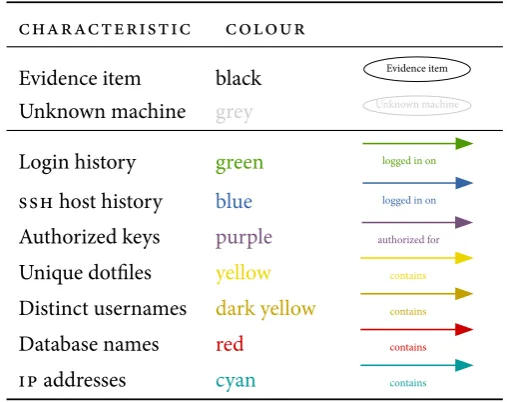
The final step involves the actual analysis of the data. We have chosen to represent our relations using a (multi-)graph structure. Every piece of information identified as relevant by a specific characteristic, is added as an edge between a machine and another machine part of our dataset (direct relations) or with an unknown third machine (indirect relations). In the latter case, we consistently identify these unknown third machines with the same node, allowing the reliable creation of indirect relations.
![Table 2.1: Overvi ew of some core p rop erti es of botn et con trol top olog i es [11]](https://thumb-us.123doks.com/thumbv2/123dok_us/9857554.486942/23.595.105.414.93.168/table-overvi-core-rop-erti-botn-trol-olog.webp)