Byte-based Language Identification with Deep Convolutional Networks
Johannes Bjerva
University of Groningen The Netherlands [email protected]
Abstract
We report on our system for the shared task on discrimination of similar languages (DSL 2016). The system uses only byte representations in a deep residual network (ResNet). The system, named ResIdent, is trained only on the data released with the task (closed training). We obtain 84.88% accuracy on subtask A, 68.80% accuracy on subtask B1, and 69.80% accuracy on subtask B2. A large difference in accuracy on development data can be observed with relatively minor changes in our network’s architecture and hyperparameters. We therefore expect fine-tuning of these parameters to yield higher accuracies.
1 Introduction
Language identification is an unsolved problem, certainly in the context of discriminating between very similar languages (Baldwin and Lui, 2010). This problem is tackled in the Discriminating between Similar Languages (DSL) series of shared tasks (Zampieri et al., 2014; Zampieri et al., 2015). Most suc-cessful approaches to the DSL shared task in previous years have relied on settings containing ensembles of classifiers (Goutte et al., 2016). These classifiers often use various combinations of features, mostly based on word, character, and/or byten-grams (see, e.g., Cavnar et al. (1994), Lui and Baldwin (2012)). We are interested in exploring a single methodological aspect in the current edition of this shared task (Malmasi et al., 2016). We aim to investigate whether reasonable results for this task could be obtained by applying recently emerged neural network architectures, coupled with sub-token input representa-tions. To address this question, we explore convolutional neural networks (CNNs) and recurrent neural networks (RNNs). Deep residual networks (ResNets) are a recent building block for CNNs which have yielded promising results in, e.g., image classification tasks (He et al., 2015; He et al., 2016). ResNets are constructed by stacking so-called residual units. These units can be viewed as a series of convolutional layers with a ‘shortcut’ which facilitates signal propagation in the neural network. This, in turn, allows for training deeper networks more easily (He et al., 2016). In Natural Language Processing (NLP), ResNets have shown state-of-the-art performance for Semantic and Part-of-Speech tagging (Bjerva et al., 2016). However, no previous work has attempted to apply ResNets to language identification. 2 Method
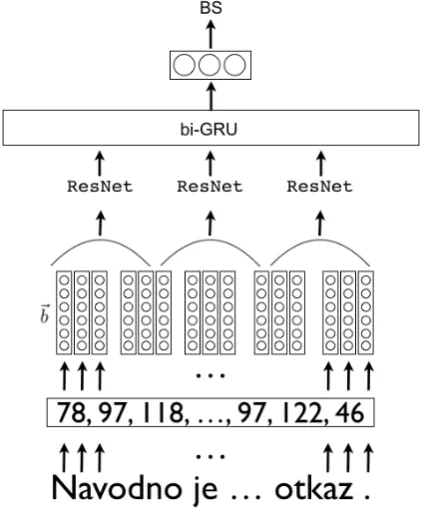
Several previous approaches in the DSL shared tasks have formulated the task as a two-step classification, first identifying the language group, and then the specific language (Zampieri et al., 2015). Instead of taking this approach, we formulate the task as a multi-class classification problem, with each language / dialect representing a separate class. Our system is a deep neural network consisting of a bidirectional Gated Recurrent Unit (GRU) network at the upper level, and a Deep Residual Network (ResNet) at the lower level (Figure 1). The inputs of our system are byte-level representations of each input sentence, with byte embeddings which are learnt during training. Using byte-level representations differs from character-level representations in that UTF-8 encodes non-ascii symbols with more than one byte, which This work is licensed under a Creative Commons Attribution 4.0 International License. License details:
http://creativecommons.org/licenses/by/4.0/
potentially allows for more disambiguating power. A concrete example can be found when considering the relatively similar languages Norwegian and Swedish. Here, there are two pairs of letters which are interchangeable: where Swedish uses ‘¨a’ (C3 A4) and ‘¨o’ (C3 B6), Norwegian uses ‘æ’ (C3 A6) and ‘ø’ (C3 B8). Hence, using the lower-level byte representation, we allow the model to take advantage of the first shared byte between these characters. The architecture used in this work is based on the sequence-to-sequence labelling architecture used in Bjerva et al. (2016), modified for the task of language identification. Our system is implemented in Keras using the Tensorflow backend (Chollet, 2015; Abadi et al., 2016).
Figure 1: Model architecture: ResNet with byte representations (~b), with a bi-GRU at the upper level. The input example sequence is converted to a sequence of byte identifiers (one integer per byte, rather than one integer per character), which are converted to a byte embedding representation. This input is treated by the ResNet, followed by the bi-GRU, finally yielding the language idBS(Bosnian).
2.1 Gated Recurrent Unit Networks
GRUs (Cho et al., 2014) are a recently introduced variant of RNNs, and are designed to prevent van-ishing gradients, thus being able to cope with longer input sequences than vanilla RNNs. GRUs are similar to the more commonly-used Long Short-Term Memory networks (LSTMs), both in purpose and implementation (Chung et al., 2014). A bi-directional GRU makes both forward and backward passes over sequences, and can therefore use both preceding and succeeding contexts to predict a tag (Graves and Schmidhuber, 2005; Goldberg, 2015). Bi-directional GRUs and LSTMs have been shown to yield high performance on several NLP tasks, such as POS and semantic tagging, named entity tagging, and chunking (Wang et al., 2015; Yang et al., 2016; Plank et al., 2016; Bjerva et al., 2016).
2.2 Deep Residual Networks
Deep Residual Networks (ResNets) are built up by stacking residual units. A residual unit can be ex-pressed as:
yl=h(xl) +F(xl,Wl),
xl+1 =f(yl), (1)
wherexl andxl+1 are the input and output of the l-th layer,Wl is the weights for thel-th layer, and
use in our experiments. ResNets can be intuitively understood by thinking of residual functions as paths through which information can propagate easily. This means that, in every layer, a ResNet learns more complex feature combinations, which it combines with the shallower representation from the previous layer. This architecture allows for the construction of much deeper networks. ResNets have recently been found to yield impressive performance in both image recognition and NLP tasks (He et al., 2015; He et al., 2016; ¨Ostling, 2016; Conneau et al., 2016), and are an interesting and effective alternative to simply stacking layers. In this paper we use theassymetricvariant of ResNets as described in Equation 9 in He et al. (2016):
xl+1=xl+F( ˆf(xl),Wl). (2)
Our residual block, using dropout and batch normalization (Srivastava et al., 2014; Ioffe and Szegedy, 2015), is defined in Table 1. In the table,mergeindicates the concatenation of the input of the residual block, with the output of the final convolutional layer.
type patch/pool size
Batch normalization + ReLu + Dropout (p= 0.5)
Convolution 8
Batch normalization + ReLu + Dropout (p= 0.5)
Convolution 4
Merge
Maximum pooling 2
Table 1: Residual block overview.
2.3 System Description
We represent each sentence using a byte-based representation (Sb). This representation is a
2-dimensional matrixSb ∈Rs×db, wheresis the zero-padded sentence length anddbis the dimensionality
of the byte embeddings. Byte embeddings are first passed through a ResNet in order to obtain a repre-sentation which captures something akin to byten-gram features.1 The size ofnis determined by the
convolutional window size used. We use a convolutional window size with length8, meaning that for each byte in the input, the ResNet can learn a suitable representation incorporating up to8bytes of con-text information. These overlapping byte-basedn-gram features are then passed through to the bi-GRU, which yields a sentence level representation. The softmax layer applied to the bi-GRU output is then used in order to obtain the network’s predicted class per input.
2.3.1 Hyperparameters
The hyperparameters used by the system were tuned on an altogether different task (semantic tagging), and adapted for the current task. The dimensionality of our byte embeddings, db, is set to64. Our
residual block is defined in Section 2.2. We use rectified linear units (ReLUs) for all activation functions (Nair and Hinton, 2010), and apply dropout withp= 0.1to both input weights and recurrent weights in the bi-GRU. All GRU layers have100hidden units.
All experiments were run with early stopping monitoring validation set loss, using a maximum of 50 epochs, and a batch size of 100. Optimisation is done using the ADAM algorithm (Kingma and Ba, 2015), with the categorical cross-entropy loss function as training objective.
For the B tasks, we train the model in the same way as for the A tasks. Only a handful of instances (n ≈5) per B run are classified as belonging to a language which the B group does not contain. These cases are automatically converted to being in the class hr. For the B tasks, we also perform a simple clean-up of the data. We first remove all hyperlinks, hashtags and usernames from the text with a simple regex-based script. We then remove all tweets classified as English. We submitted three runs for each subtask. The system used for runs 1, 2 and 3 contain five, four and three residual blocks respectively.
1Note that bytes are passed through the ResNetone by one, yielding one representation per byte, rather than as a whole
3 Results
Test Set Track Run Accuracy F1 (micro) F1 (macro) F1 (weighted)
A closed Baseline 0.083
A closed run1 0.8462 0.8462 0.8415 0.8415
A closed run2 0.8324 0.8324 0.8272 0.8272
A closed run3 0.8488 0.8488 0.8467 0.8467
B1 closed Baseline 0.020
B1 closed run1 0.682 0.682 0.6802 0.6802
B1 closed run2 0.676 0.676 0.6708 0.6708
B1 closed run3 0.688 0.688 0.6868 0.6868
B2 closed Baseline 0.020
B2 closed run1 0.684 0.684 0.6788 0.6788
B2 closed run2 0.698 0.698 0.6942 0.6942
[image:4.595.103.495.94.292.2]B2 closed run3 0.664 0.664 0.6524 0.6524
Table 2: Results for all runs in subtasks A, B1 and B2 (closed training).
es-ar es-es es-mx fr-ca fr-fr id my pt-br pt-pt hr bs sr
es-ar 824 77 94 0 1 1 0 2 1 0 0 0
es-es 90 778 127 0 1 0 0 1 2 0 1 0
es-mx 210 269 520 0 0 0 0 1 0 0 0 0
fr-ca 0 0 0 956 44 0 0 0 0 0 0 0
fr-fr 0 0 0 93 905 0 0 1 0 1 0 0
id 0 0 0 0 0 951 48 0 0 0 0 1
my 0 0 0 0 0 30 970 0 0 0 0 0
pt-br 0 0 1 0 0 0 0 891 107 1 0 0
pt-pt 0 1 0 0 0 0 0 78 920 0 1 0
hr 0 0 0 0 0 0 0 0 0 823 150 27
bs 0 0 0 0 1 0 0 1 0 143 730 125
sr 0 0 0 0 1 0 0 0 0 15 67 917
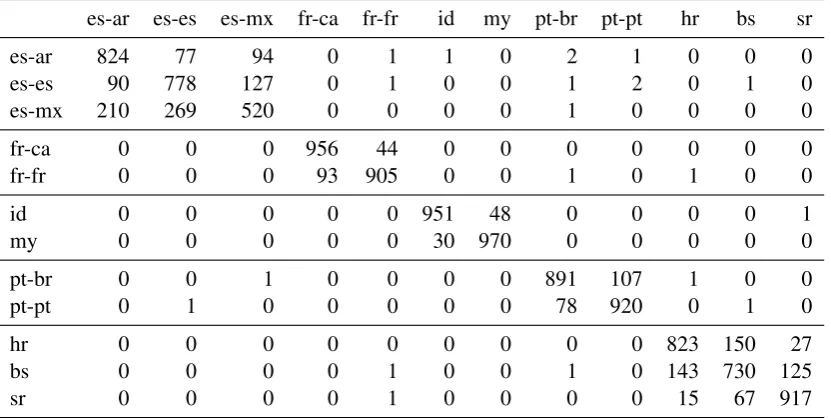
Table 3: Confusion matrix, closed run 3, on test set A. The x-axis indicates predicted labels, and the y-axis indicates true labels.
We evaluate our system in subtasks A, B1 and B2. Subtask A contains data for five language groups, with two to three languages in each group (Tan et al., 2014). Subtask B1 and B2 contain data for a subset of the languages in subtask A, compiled from Twitter. Subtask B1 contains the amount of tweets necessary for a human annotator to make reliable judgements, whereas B2 contains the maximum amount of data available per tweet.
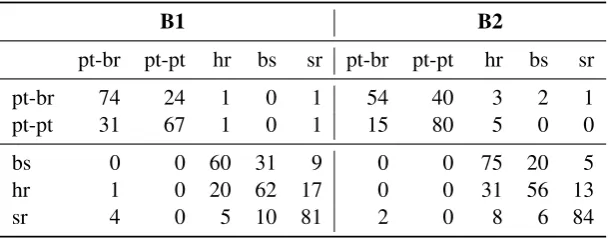
For subtasks A and B1, run 3 results in the best accuracy on test, whereas run 2 results in the best accuracy on B2. The results are shown in Table 2. Table 3 and Table 4 contain confusion matrices for the results in subtask A and B respectively.
4 Discussion
[image:4.595.93.509.338.547.2]B1 B2
pt-br pt-pt hr bs sr pt-br pt-pt hr bs sr
pt-br 74 24 1 0 1 54 40 3 2 1
pt-pt 31 67 1 0 1 15 80 5 0 0
bs 0 0 60 31 9 0 0 75 20 5
hr 1 0 20 62 17 0 0 31 56 13
[image:5.595.147.454.62.181.2]sr 4 0 5 10 81 2 0 8 6 84
Table 4: Confusion matrix, closed run 3 on test set B1 (left) and closed run 2 on test set B2 (right). The x-axis indicates predicted labels, and the y-axis indicates true labels.
performance, there is a large gap between our system and the best performing systems (e.g. C¸¨oltekin and Rama (2016), who obtain 89.38% accuracy on task A, 86.2% on B1, and 82.2% on B2). This can to some extent be explained by limitations caused by our implementation.
The largest limiting factor can be found in the fact that we only allowed our system to use the first ca. 384 bytes of each training/testing instance. For the training and development set, and subtask A, this was no major limitation, as this allowed us to use more than 90% of the available data. However, for subtasks B1 and B2, this may have seriously affected the system’s performance. Additionally, we restricted our system to using only byte embeddings as input. Adding word-level representations into the mix, would likely increase system performance.
We also observed considerable differences in development accuracy when changing hyperparameters of our network in relatively minor ways. For instance, altering the patch sizes used in our CNNs had a noticeable impact on validation loss. However, altering the amount of residual blocks used, did not have a large effect on results. The neural network architecture, as well as most of the hyperparameters, were tuned on an altogether different task (semantic tagging), and adapted for the current task. Further fine tuning of the network architecture and hyperparameters for this task would therefore likely lead to narrowing the performance gap.
5 Conclusions
We implemented a language identification system using deep residual networks (ResNets) coupled with a bidirectional Gated Recurrent Unit network (bi-GRU), using only byte-level representations. In the DSL 2016 shared task, we achieved reasonable performance, with 84.88% accuracy on subtask A, 68.80% accuracy on subtask B1, and 69.80% accuracy on subtask B2. Although acceptable performance was achieved, further fine tuning of input representations and system architecture would likely improve per-formance.
Acknowledgements
We would like to thank the Center for Information Technology of the University of Groningen for their support and for providing access to the Peregrine high performance computing cluster, as well as the anonymous reviewers for their valuable feedback.
References
Benoit Steiner, Ilya Sutskever, Kunal Talwar, Paul A. Tucker, Vincent Vanhoucke, Vijay Vasudevan, Fer-nanda B. Vi´egas, Oriol Vinyals, Pete Warden, Martin Wattenberg, Martin Wicke, Yuan Yu, and Xiaoqiang Zheng. 2016. Tensorflow: Large-scale machine learning on heterogeneous distributed systems. arXiv preprint arXiv:1603.04467.
Timothy Baldwin and Marco Lui. 2010. Language identification: The long and the short of the matter. InHuman Language Technologies: The 2010 Annual Conference of the North American Chapter of the Association for Computational Linguistics, pages 229–237. Association for Computational Linguistics.
Johannes Bjerva, Barbara Plank, and Johan Bos. 2016. Semantic Tagging with Deep Residual Networks. In
Proceedings of COLING 2016, Osaka, Japan, December.
William B Cavnar, John M Trenkle, et al. 1994. N-gram-based text categorization. Ann Arbor MI, 48113(2):161– 175.
C¸a˘grı C¸¨oltekin and Taraka Rama. 2016. Discriminating similar languages: experiments with linear SVMs and neural networks. InProceedings of the 3rd Workshop on Language Technology for Closely Related Languages, Varieties and Dialects (VarDial), Osaka, Japan.
Kyunghyun Cho, Bart Van Merri¨enboer, Caglar Gulcehre, Dzmitry Bahdanau, Fethi Bougares, Holger Schwenk, and Yoshua Bengio. 2014. Learning phrase representations using RNN encoder-decoder for statistical machine translation. InProceedings of EMNLP 2014, Doha, Qatar.
Franc¸ois Chollet. 2015. Keras.https://github.com/fchollet/keras.
Junyoung Chung, Caglar Gulcehre, KyungHyun Cho, and Yoshua Bengio. 2014. Empirical evaluation of gated recurrent neural networks on sequence modeling. arXiv preprint arXiv:1412.3555.
Alexis Conneau, Holger Schwenk, Lo¨ıc Barrault, and Yann Lecun. 2016. Very Deep Convolutional Networks for Natural Language Processing.arXiv preprint arXiv:1606.01781.
Yoav Goldberg. 2015. A primer on neural network models for natural language processing. arXiv preprint arXiv:1510.00726.
Cyril Goutte, Serge L´eger, Shervin Malmasi, and Marcos Zampieri. 2016. Discriminating Similar Languages: Evaluations and Explorations. InProceedings of the 10th International Conference on Language Resources and Evaluation (LREC 2016).
Alex Graves and J¨urgen Schmidhuber. 2005. Framewise phoneme classification with bidirectional LSTM and other neural network architectures. Neural Networks, 18(5):602–610.
Kaiming He, Xiangyu Zhang, Shaoqing Ren, and Jian Sun. 2015. Deep residual learning for image recognition.
arXiv preprint arXiv:1512.03385.
Kaiming He, Xiangyu Zhang, Shaoqing Ren, and Jian Sun. 2016. Identity mappings in deep residual networks.
arXiv preprint arXiv:1603.05027.
Sergey Ioffe and Christian Szegedy. 2015. Batch Normalization: Accelerating Deep Network Training by Reduc-ing Internal Covariate Shift. InProceedings of The 32nd International Conference on Machine Learning, pages 448–456.
Diederik Kingma and Jimmy Ba. 2015. Adam: A method for stochastic optimization. InProceedings of ICLR 2015, San Diego, USA.
Marco Lui and Timothy Baldwin. 2012. langid.py: An off-the-shelf language identification tool. InProceedings of the ACL 2012 system demonstrations, pages 25–30. Association for Computational Linguistics.
Shervin Malmasi, Marcos Zampieri, Nikola Ljubeˇsi´c, Preslav Nakov, Ahmed Ali, and J¨org Tiedemann. 2016. Discriminating between Similar Languages and Arabic Dialect Identification: A Report on the Third DSL Shared Task. In Proceedings of the 3rd Workshop on Language Technology for Closely Related Languages, Varieties and Dialects (VarDial), Osaka, Japan.
Vinod Nair and Geoffrey E Hinton. 2010. Rectified linear units improve restricted boltzmann machines. In
Proceedings of the 27th International Conference on Machine Learning (ICML-10), pages 807–814.
Barbara Plank, Anders Søgaard, and Yoav Goldberg. 2016. Multilingual Part-of-Speech Tagging with Bidirec-tional Long Short-Term Memory Models and Auxiliary Loss. InProceedings of ACL 2016.
Nitish Srivastava, Geoffrey E Hinton, Alex Krizhevsky, Ilya Sutskever, and Ruslan Salakhutdinov. 2014. Dropout: a simple way to prevent neural networks from overfitting. Journal of Machine Learning Research, 15(1):1929– 1958.
Liling Tan, Marcos Zampieri, Nikola Ljubeˇsic, and J¨org Tiedemann. 2014. Merging Comparable Data Sources for the Discrimination of Similar Languages: The DSL Corpus Collection. InProceedings of the 7th Workshop on Building and Using Comparable Corpora (BUCC), pages 11–15, Reykjavik, Iceland.
Peilu Wang, Yao Qian, Frank K Soong, Lei He, and Hai Zhao. 2015. A Unified Tagging Solution: Bidirectional LSTM Recurrent Neural Network with Word Embedding. arXiv preprint arXiv:1511.00215.
Zhilin Yang, Ruslan Salakhutdinov, and William Cohen. 2016. Multi-Task Cross-Lingual Sequence Tagging from Scratch.arXiv preprint arXiv:1603.06270.
Marcos Zampieri, Liling Tan, Nikola Ljubeˇsi´c, and J¨org Tiedemann. 2014. A Report on the DSL Shared Task 2014. InProceedings of the First Workshop on Applying NLP Tools to Similar Languages, Varieties and Dialects (VarDial), pages 58–67, Dublin, Ireland.