Nonparametric Bayesian Storyline Detection from Microtexts
Vinodh Krishnan Georgia Institute of Technology
Atlanta, GA 30308
Jacob Eisenstein
Georgia Institute of Technology Atlanta, GA 30308 [email protected]
Abstract
News events and social media are com-posed of evolving storylines, which cap-ture public attention for a limited period of time. Identifying storylines requires integrat-ing temporal and lintegrat-inguistic information, and prior work takes a largely heuristic approach. We present a novel online non-parametric Bayesian framework for storyline detection, using the distance-dependent Chinese Restau-rant Process (dd-CRP). To ensure efficient linear-time inference, we employ a fixed-lag Gibbs sampling procedure, which is novel for the dd-CRP. We evaluate on the TREC Twit-ter Timeline Generation (TTG), obtaining en-couraging results: despite using a weak base-line retrieval model, the dd-CRP story cluster-ing method is competitive with the best entries in the 2014 TTG task.
1 Introduction
A long-standing goal for information retrieval and extraction is to identify and group textual references to ongoing events in the world (Allan, 2002). Suc-cess on this task would have applications in per-sonalized news portals (Gabrilovich et al., 2004), intelligence analysis, disaster relief (Vieweg et al., 2010), and in understanding the properties of the news cycle (Leskovec et al., 2009). This task at-tains a new importance in the era of social media, where citizen journalists can document events as they unfold (Lotan et al., 2011), but where repe-tition and untrustworthy information can make the reader’s task especially challenging (Becker et al., 2011; Marcus et al., 2011; Petrovi´c et al., 2010).
A major technical challenge is in fusing infor-mation from two heterogeneous data sources: tex-tual content and time. Two different documents about a single event might use very different vocab-ulary, particularly in sparse social media data such as microblogs; conversely, two different sporting events might be described in nearly identical lan-guage, with differences only in the numerical out-come. Temporal information is therefore critical: in the first case, to find the commonalities across dis-parate writing styles, and in the second case, to iden-tify the differences. A further challenge is that un-like in standard document clustering tasks, the num-ber of events in a data stream is typically unknown in advance. Finally, there is a high premium on scal-ability, since online text is produced at a high rate.
Due to these challenges, existing approaches for combining these modalities have been somewhat heuristic, relying on tunable parameters to control the tradeoff between textual and temporal similar-ity. In contrast, the Bayesian setting provides ele-gant formalisms for reasoning about latent structures (e.g., events) and their stochastically-generated re-alizations across text and time. In this paper, we describe one such model, based on the distance-dependent Chinese Restaurant Process (dd-CRP; Blei and Frazier, 2011). This model is distinguished by the neat separation that it draws between tex-tual content, which is treated as a stochastic emis-sion from an unknown Multinomial distribution, and time, which is modeled as a prior on graphs over documents, through an arbitrarydistance function. However, straightforward implementations of the dd-CRP are insufficiently scalable, and so the model
has been relatively underutilized in the NLP liter-ature (Titov and Klementiev, 2011; Kim and Oh, 2011; Sirts et al., 2014). We describe improvements to Bayesian inference that make the application of this model feasible, and present encouraging empir-ical results on the Tweet Timeline Generation task from TREC 2014 (Lin et al., 2014).
2 Model
The basic task that we address is to group short text documents into an unknown number of story-lines, based on their textual content and their tempo-ral signature. The textual content may be extremely sparse — the typical Tweet is on the order of ten words long — so leveraging temporal information is crucial. Moreover, the temporal signal is multi-scale: in the 24-hour news cycle, some storylines last for less than an hour, while others, like the dis-appearance of the Malaysian Airlines 370 plane in 2014, continue for weeks or months. In some cases, the temporal distribution of references to a storyline will be unimodal and well-described by a parametric model (Marcus et al., 2011); in other cases, it may be irregular, with bursts of activity followed by pe-riods of silence (He et al., 2007). Finally, it will be crucial to produce an implementation that scales to large corpora.
The distance-dependent Chinese Restaurant Pro-cess (dd-CRP) meets many of these criteria (Blei and Frazier, 2011). In this model, the key idea is that each instance (document) i “follows” another instanceci (where it is possible thatci =i),
induc-ing a graph. We can compute a partitioninduc-ing over in-stances by considering the connected components in the undirected version of the follower graph; these partitions correspond to “tables” in the conventional “Chinese Restaurant” analogy (Aldous, 1985), or to clusters. The advantage of this approach is that it is fundamentally non-parametric, and it introduces a clean separation between the textual data and the covariates: the text is generated by a distribution as-sociated with the partition, while the covariates are associated with the following links, which are con-ditioned on a distance function.
The distribution over follower links for document
ihas the following form,
Pr(ci =j)∝ (
f(di,j), i6=j
α, i=j, (1)
wheredi,jis the distance between unitsiandj, and
α > 0 is a parameter of the model. Large values ofαinduce more self-links and therefore more fine-grained partitionings. Since we are concerned with temporal covariates, we define the distance function as follows:
f(di,j) =e
−|ti−tj|
a . (2)
Thus, the likelihood of documentifollowing doc-ument j decreases exponentially as the time gap |ti−tj|increases.
The text of each document iis represented by a vector of word countswi. The likelihood
distribu-tion is multinomial, condidistribu-tioned on a parameterθ as-sociated with the partition to which documenti be-longs. By placing a Dirichlet prior onθ, we can an-alytically integrate it out. Writingz(c)for the clus-ter membership induced by the follower graphc, we have:
P(w|c;η) =Y k
P({wi:zi(c)=k};η) (3)
=Y k
Z
θP({wi:z
(c)
i =k} |θ)P(θ;η)dθ
(4)
Given a multinomial likelihood P(w | θ) and a (symmetric) Dirichlet prior P(θ | η), this in-tegral has a closed-form solution as the Dirichlet-Multinomial distribution (also known as the mul-tivariate Polya distribution). The joint probability is therefore equal to the product of Equation 1 and Equation 4,
P(w,c) =Y
i
P(ci;α, a) Y
k
P({wi:z(c)i =k};η).
Estimation of these hyperparameters is described in §3.2.
3 Inference
The key sampling equation for the dd-CRP is the posterior likelihood,
Pr(ci=j |c−i,w)∝Pr(ci=j)P(w |c).
The prior is defined in Equation 1. Let`represent the likelihood under the partitioning induced when the linkci is cut. Now, the likelihood term has two
cases: in the first case,jis already in the same con-nected component asi (even after cutting the link ci), so no components are merged by settingci=j.
In this case, the likelihoodP(w |ci =j)is exactly
equal to`. In the second case, settingci =jcauses
two clusters to be merged. This gives the likelihood,
P(w |ci=j,c−i)
∝ P({wk:z
(c)
k =z(c)j ∨z(c)k =z(c)i })
P({wk:z(c)k =z(c)i })P({wk:z(c)k =z(c)j })
,
where the constant of proportionality is exactly equal to`. Each of the terms in the likelihood ratio is a Dirichlet Compound Multinomial likelihood. This likelihood function is itself a ratio of gamma func-tions; by eliminating constant terms and exploiting the identityΓ(x+ 1) = xΓ(x), we can reduce the number of Gamma function evaluations required to compute this ratio to the number of words which ap-pear inbothclusters z(c)i and zj(c). Words that oc-cur in neither cluster can safely be ignored, and the gamma functions for words which occur in exactly one of the two clusters cancel in the numerator and denominator of the ratio. Note also that we only need compute the likelihood forci with respect to
each cluster, not for every possible follower link.
3.1 Online inference
While we make every effort to accelerate the compu-tation of individual Gibbs samples, the complexity of the basic algorithm is superlinear in the number of instances. This is due to the fact that each sam-ple requires computing the probability of instancei joining every possible cluster, while the number of clusters itself grows with the number of instances
(this growth is logarithmic in the Chinese Restau-rant Process). Scalability to the streaming setting therefore requires more aggressive optimizations.
To get back to linear time complexity, we em-ploy a fixed-lag sampling procedure (Doucet et al., 2000). After receiving instancei, we perform Gibbs sampling only within the fixed window[ti −τ, ti],
leaving cj fixed iftj < ti −τ. This approximate
sampling procedure implicitly changes the underly-ing model, because there is no possibility of linkunderly-ing ito a later messagejif the time gaptj −ti> τ.
Since we are only interested in obtaining a single storyline clustering — rather than a full Bayesian distribution over clusterings — we perform anneal-ing for samples towards the end of the samplanneal-ing window. Specifically, we set the temperature to γ = 2.0 and exponentiate the sampling likelihood by the inverse temperature (Geman and Geman, 1984). This has the effect of interpolating between probabilistically-correct Gibbs sampling and a hard coordinate-ascent procedure.
3.2 Hyperparameter estimation
The model has three parameters to estimate: • α, the concentration parameter of the dd-CRP • a, the offset of the distance function
• η, the scale of the symmetric Dirichlet prior. We interleave maximization-based updates to these parameters with sampling, in a procedure inspired by Monte Carlo Expectation Maximization (Wei and Tanner, 1990). Specifically, we compute gradients on the likelihoodP(c)with respect toαanda, and take gradient steps after every fixed number of sam-ples. For the symmetric Dirichlet parameterη, we employ the heuristic from Minka (2012) by setting the parameter toη= P(K−1)/2
klogpk, whereKis the
num-ber of words that appear exactly once, andpkis the
probability of choosing the kth word from the
vo-cabulary under the unigram distribution for the en-tire corpus.
4 TREC Evaluation
a summary that captures relevant information. We perform the task on 55 queries with different times-tamps and compare our results with 13 groups that submitted 50 runs for this task in 2014.
We consider the following systems:
Baseline We replace the distance-dependent prior with a standard Dirichlet prior. The number of clusters is heuristically set to 20. Annealed Gibbs sampling is employed for inference.
Offline inference The dd-CRP model with offline inference procedure (described in§3).
Online inference The dd-CRP model with online inference procedure (described in§3.1). For the online inference implementation, we set the size of window and number of iterations to five days and 500 respectively. For the baseline, the pa-rameter of the Dirichlet prior was set to a vector of 0.5 for each cluster. These values were chosen through 10-fold cross validation.
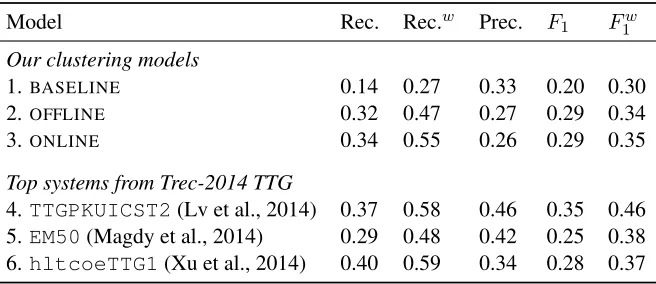
To measure the quality of the clusterings obtained by these models, we compare the average weighted and unweighted F-measures for 55 TREC topics, using the evaluation scripts from the TREC TTG task. Overall results are shown in Table 1. The ON-LINE MODEL has the best weighted F1 score, out-performing the offline version of the same model, even though its inference procedure is an approxi-mation to theOFFLINE MODEL. It may be that its approximate inference procedure discourages long-range linkages, thus placing a greater emphasis on the temporal dimension. Both models were trained over 500 iterations, and the ONLINE MODEL was 30% faster to train than the offline model.
Compared to the other 2014 TREC TTG systems, our dd-CRP models are competitive. Both mod-els outperform all but one of the fourteen submis-sions on the unweightedF1 metric, and would have placed fourth on the weightedFw
1 metric. Note that the TREC evaluation scores both clustering qual-ity and retrieval. We use only the baseline retrieval model, which achieved a mean average precision of 0.31. The competing systems shown in Table 1 all use retrieval models that are far superior: the re-trieval model for top-ranked PKUICST team (line 4) achieved a mean average precision (MAP) of 0.59 (Lv et al., 2014), and the QCRI (Magdy et al.,
2014) and and hltcoe (Xu et al., 2014) teams (lines 5 and 6) used retrieval models with MAP scores of at least 0.5. Bayesian dd-CRP storyline clustering was competitive with these timeline generation systems despite employing a far worse retrieval model, so improving the retrieval model to achieve parity with these alternative systems seems the most straightfor-ward path tostraightfor-wards better overall performance.
5 Related work
Topic tracking and first-story detection are very well-studied tasks; space does not permit a complete analysis of the related work, but see (Allan, 2002) for a summary of “first generation” research. More recent non-Bayesian approaches have focused on string overlap (Suen et al., 2013), submodular opti-mization (Shahaf et al., 2012), and locality-sensitive hashing (Petrovi´c et al., 2010). In Bayesian story-line analysis, the seminal models are Topics-Over-Time (Wang and McCallum, 2006), which asso-ciates a parametric distribution over time with each topic (Ihler et al., 2006), and the Dynamic Topic Model (Blei and Lafferty, 2006), which models topic evolution as a linear dynamical system (Nallapati et al., 2007). Later work by Diao et al. (2012) offers a model for identifying “bursty” topics, with infer-ence requiring dynamic programming. All these ap-proaches require the number of topics to be iden-tified in advance. Kim and Oh (2011) apply a distance-dependent Chinese Restaurant Franchise for temporal topic modeling; they evaluate using predictive likelihood rather than comparing against ground truth, and do not consider online inference.
Model Rec. Rec.w Prec. F1 Fw
1 Our clustering models
1. BASELINE 0.14 0.27 0.33 0.20 0.30 2. OFFLINE 0.32 0.47 0.27 0.29 0.34 3. ONLINE 0.34 0.55 0.26 0.29 0.35 Top systems from Trec-2014 TTG
[image:5.612.143.471.60.202.2]4.TTGPKUICST2(Lv et al., 2014) 0.37 0.58 0.46 0.35 0.46 5.EM50(Magdy et al., 2014) 0.29 0.48 0.42 0.25 0.38 6.hltcoeTTG1(Xu et al., 2014) 0.40 0.59 0.34 0.28 0.37
Table 1:Performance of Models in the TREC 2014 TTG Task. Weighted recall andF1are indicated as Rec.wandF1w.
Monte Carlo and Metropolis Hastings, and a custom data structure; this inference procedure was complex enough to warrant a companion paper (Ahmed et al., 2011b). The rCRP is also employed by Diao and Jiang (2013, 2014). In contrast, the dd-CRP makes no Markovian assumptions, and efficient inference is possible through relatively straightforward Gibbs sampling in a fixed window.
6 Conclusion
We present a simple non-parametric model for clus-tering short documents (such as tweets) into sto-rylines, which are conceptually coherent and tem-porally focused. Future work may consider learn-ing more flexible temporal distance functions, which could potentially represent temporal periodicity or parametric models of content popularity.
Acknowledgments
We thank the reviewers for their helpful feedback. This research was supported by an award from the National Institutes for Health (R01GM112697-01), and by Google, through a Focused Research Award for Computational Journalism.
References
Amr Ahmed, Qirong Ho, Jacob Eisenstein, Eric Xing, Alexander J. Smola, and Choon H. Teo. 2011a. Uni-fied analysis of streaming news. InWWW, pages 267– 276, Hyderabad, India.
Amr Ahmed, Qirong Ho, Choon H Teo, Jacob Eisenstein, Eric P Xing, and Alex J Smola. 2011b. Online in-ference for the infinite topic-cluster model: Storylines
from streaming text. InAISTATS, pages 101–109, Fort Lauderdale, FL.
David J Aldous. 1985.Exchangeability and related top-ics. Springer.
James Allan. 2002.Topic detection and tracking: event-based information organization, volume 12. Springer Science & Business Media.
Hila Becker, Mor Naaman, and Luis Gravano. 2011. Be-yond trending topics: Real-world event identification on twitter. InProceedings of the International Confer-ence on Web and Social Media (ICWSM), pages 438– 441.
David M Blei and Peter I Frazier. 2011. Distance de-pendent chinese restaurant processes. The Journal of Machine Learning Research, 12:2461–2488.
David M Blei and John D Lafferty. 2006. Dynamic topic models. InProceedings of the 23rd international con-ference on Machine learning, pages 113–120. ACM. Qiming Diao and Jing Jiang. 2013. A unified model for
topics, events and users on twitter. InProceedings of Empirical Methods for Natural Language Processing (EMNLP).
Qiming Diao and Jing Jiang. 2014. Recurrent chinese restaurant process with a duration-based discount for event identification from twitter. InThe 18th Pacific-Asia Conference on Knowledge Discovery and Data Mining (SDM’14).
Qiming Diao, Jing Jiang, Feida Zhu, and Ee-Peng Lim. 2012. Finding bursty topics from microblogs. In Pro-ceedings of the Association for Computational Lin-guistics (ACL), pages 536–544, Jeju, Korea.
Arnaud Doucet, Simon Godsill, and Christophe Andrieu. 2000. On sequential monte carlo sampling meth-ods for bayesian filtering. Statistics and computing, 10(3):197–208.
the 13th international conference on World Wide Web, pages 482–490. ACM.
Stuart Geman and Donald Geman. 1984. Stochastic re-laxation, gibbs distributions, and the bayesian restora-tion of images.IEEE Transactions on Pattern Analysis and Machine Intelligence, pages 721–741.
Qi He, Kuiyu Chang, and Ee-Peng Lim. 2007. Analyz-ing feature trajectories for event detection. InSIGIR, pages 207–214. ACM.
Alexander Ihler, Jon Hutchins, and Padhraic Smyth. 2006. Adaptive event detection with time-varying poisson processes. InKDD, pages 207–216. ACM. Dongwoo Kim and Alice Oh. 2011. Accounting for
data dependencies within a hierarchical dirichlet pro-cess mixture model. Incikm, pages 873–878.
Jure Leskovec, Lars Backstrom, and Jon Kleinberg. 2009. Meme-tracking and the dynamics of the news cycle. InProceedings of Knowledge Discovery and Data Mining (KDD), pages 497–506.
Jimmy Lin, Miles Efron, Yulu Wang, and Garrick Sher-man. 2014. Overview of the trec-2014 microblog track. InProceedings of the Twenty-Third Text RE-trieval Conference.
Gilad Lotan, Erhardt Graeff, Mike Ananny, Devin Gaffney, Ian Pearce, and danah boyd. 2011. The arab spring— the revolutions were tweeted: Informa-tion flows during the 2011 tunisian and egyptian revo-lutions.International journal of communication, 5:31. Chao Lv, Feifan Fan, Runwei Qiang, Yue Fei, and Jianwu Yang. 2014. PKUICST at TREC 2014 Mi-croblog Track: feature extraction for effective mi-croblog search and adaptive clustering algorithms for TTG. Technical report, DTIC Document.
Walid Magdy, Wei Gao, Tarek Elganainy, and Zhongyu Wei. 2014. Qcri at trec 2014: applying the kiss prin-ciple for the ttg task in the microblog track. Technical report, DTIC Document.
Adam Marcus, Michael S Bernstein, Osama Badar, David R Karger, Samuel Madden, and Robert C Miller. 2011. Twitinfo: aggregating and visualizing mi-croblogs for event exploration. Inchi, pages 227–236. ACM.
Thomas Minka. 2012. Estimating a dirichlet dis-tribution. http://research.microsoft. com/en-us/um/people/minka/papers/
dirichlet/minka-dirichlet.pdf.
Ramesh M Nallapati, Susan Ditmore, John D Lafferty, and Kin Ung. 2007. Multiscale topic tomography. In
KDD, pages 520–529. ACM.
Saˇsa Petrovi´c, Miles Osborne, and Victor Lavrenko. 2010. Streaming first story detection with applica-tion to twitter. InProceedings of the North American Chapter of the Association for Computational Linguis-tics (NAACL), pages 181–189, Los Angeles, CA.
Dafna Shahaf, Carlos Guestrin, and Eric Horvitz. 2012. Trains of thought: Generating information maps. In
Proceedings of the Conference on World-Wide Web (WWW), pages 899–908, Lyon, France. ACM. Kairit Sirts, Jacob Eisenstein, Micha Elsner, and Sharon
Goldwater. 2014. Pos induction with distribu-tional and morphological information using a distance-dependent chinese restaurant process. In Proceed-ings of the Association for Computational Linguistics (ACL), Baltimore, MD.
Caroline Suen, Sandy Huang, Chantat Eksombatchai, Rok Sosic, and Jure Leskovec. 2013. Nifty: a system for large scale information flow tracking and cluster-ing. InProceedings of the Conference on World-Wide Web (WWW), pages 1237–1248.
Ivan Titov and Alexandre Klementiev. 2011. A bayesian model for unsupervised semantic parsing. In Pro-ceedings of the 49th Annual Meeting of the Associa-tion for ComputaAssocia-tional Linguistics: Human Language Technologies-Volume 1, pages 1445–1455. Associa-tion for ComputaAssocia-tional Linguistics.
Sarah Vieweg, Amanda L. Hughes, Kate Starbird, and Leysia Palen. 2010. Microblogging during two natu-ral hazards events: What twitter may contribute to situ-ational awareness. InProceedings of the SIGCHI Con-ference on Human Factors in Computing Systems, CHI ’10, pages 1079–1088, New York, NY, USA. ACM. Xuerui Wang and Andrew McCallum. 2006. Topics over
time: a non-markov continuous-time model of topi-cal trends. InProceedings of the 12th ACM SIGKDD international conference on Knowledge discovery and data mining, pages 424–433. ACM.
Greg CG Wei and Martin A Tanner. 1990. A monte carlo implementation of the em algorithm and the poor man’s data augmentation algorithms. Journal of the American Statistical Association, 85(411):699–704. Tan Xu, Paul McNamee, and Douglas W Oard. 2014.