Proceedings of SSST-5, Fifth Workshop on Syntax, Semantics and Structure in Statistical Translation, pages 52–60,
An Evaluation and Possible Improvement Path for Current SMT Behavior
on Ambiguous Nouns
Els Lefever1,2 and V´eronique Hoste1,2,3
1LT3, Language and Translation Technology Team, University College Ghent
Groot-Brittanni¨elaan 45, 9000 Gent, Belgium
2Dept. of Applied Mathematics and Computer Science, Ghent University
Krijgslaan 281 (S9), 9000 Gent, Belgium
3Dept. of Linguistics, Ghent University
Blandijnberg 2, 9000 Gent, Belgium
Abstract
Mistranslation of an ambiguous word can have a large impact on the understandability of a given sentence. In this article, we describe a thorough evaluation of the translation qual-ity of ambiguous nouns in three different se-tups. We compared two statistical Machine Translation systems and one dedicated Word Sense Disambiguation (WSD) system. Our WSD system incorporates multilingual infor-mation and is independent from external lex-ical resources. Word senses are derived auto-matically from word alignments on a parallel corpus. We show that the two WSD classifiers that were built for these experiments (English– French and English–Dutch) outperform the SMT system that was trained on the same cor-pus. This opens perspectives for the integra-tion of our multilingual WSD module in a sta-tistical Machine Translation framework, in or-der to improve the automated translation of ambiguous words, and by consequence make the translation output more understandable.
1 Introduction
Word Sense Disambiguation (WSD) is the NLP task that consists in assigning a correct sense to an ambiguous word in a given context. Tradition-ally, WSD relies on a predefined monolingual sense-inventory such as WordNet (Fellbaum, 1998) and WSD modules are trained on corpora, which are manually tagged with senses from these inventories. A number of issues arise with these monolingual su-pervised approaches to WSD. First of all, there is a lack of large sense-inventories and sense-tagged cor-pora for languages other than English. Furthermore,
sense inventories such as WordNet contain very fine-grained sense distinctions that make the sense dis-ambiguation task very challenging (even for human annotators), whereas very detailed sense distinctions are often irrelevant for practical applications. In ad-dition to this, there is a growing feeling in the com-munity that WSD should be used and evaluated in real application such as Machine Translation (MT) or Information Retrieval (IR) (Agirre and Edmonds, 2006).
ity were for the first time obtained by Carpuat and Wu (2007) and Chan et al. (2007). Both papers describe the integration of a dedicated WSD mod-ule in a Chinese-English statistical machine trans-lation framework and report statistically significant improvements in terms of standard MT evaluation metrics.
Stroppa et al. (2007) take a completely dif-ferent approach to perform some sort of implicit Word Sense Disambiguation in MT. They introduce context-information features that exploit source sim-ilarity, in addition to target similarity that is modeled by the language model, in an SMT framework. For the estimation of these features that are very simi-lar to the typical WSD local context features (left and right context words, Part-of-Speech of the focus phrase and context words), they use a memory-based classification framework.
The work we present in this paper is different from previous research in two aspects. Firstly, we evaluate the performance of two state-of-the-art SMT systems and a dedicated WSD system on the translation of ambiguous words. The comparison is done against a manually constructed gold-standard for two language pairs, viz. English–French and English–Dutch. Although it is crucial to measure the general translation quality after integrating a dedi-cated WSD module in the SMT system, we think it is equally interesting to conduct a dedicated evaluation of the translation quality on ambiguous nouns. Stan-dard SMT evaluation metrics such as BLEU (Pap-ineni et al., 2002) or edit-distance metrics (e.g. Word Error Rate) measure the global overlap of the trans-lation with a reference, and are thus not very sen-sitive to WSD errors. The mistranslation of an am-biguous word might be a subtle change compared to the reference sentence, but it often drastically affects the global understanding of the sentence.
Secondly, we explore the potential benefits of a real multilingual approach to WSD. The idea to use translations from parallel corpora to distinguish be-tween word senses is based on the hypothesis that different meanings of a polysemous word are often lexicalized across languages (Resnik and Yarowsky, 2000). Many WSD studies have incorporated this cross-lingual evidence idea and have successfully applied bilingual WSD classifiers (Gale and Church, 1993; Ng et al., 2003; Diab and Resnik, 2002) or
systems that use a combination of existing Word-Nets with multilingual evidence (Tufis¸ et al., 2004). Our WSD system is different in the sense that it is independent from a predefined sense-inventory (it only uses the parallel corpus at hand) and that it is truly multilingual as it incorporates information from four other languages (French, Dutch, Span-ish, Italian and German depending on the target lan-guage of the classifier). Although our classifiers are still very preliminary in terms of the feature set and parameters that are used, we obtain interesting re-sults on our test sample of ambiguous nouns. We therefore believe our system can have a real added value for SMT, as it can easily be trained for differ-ent language pairs on exactly the same corpus which is used to train the SMT system, which should make the integration a lot easier.
The remainder of this paper is organized as fol-lows. Section 2 introduces the two machine transla-tion systems we evaluated, while sectransla-tion 3 describes the feature construction and learning algorithm of our multilingual WSD system. Section 4 gives an overview of the experimental setup and results. We finally draw conclusions and present some future re-search in Section 5.
2 Statistical Machine Translation Systems
For our experiments, we analyzed the behavior of two phrase-based statistical machine translation (SMT) systems on the translation of ambiguous nouns. SMT generates translations on the basis of statistical models whose parameters are derived from the analysis of sentence-aligned parallel text corpora. Phrase-based SMT is considered as the dominant paradigm in MT research today. It com-bines a phrase translation model (which is based on the noisy channel model) and a phrase-based de-coder in order to find the most probable translatione
of a foreign sentencef(Koehn et al., 2003). Usually the Bayes rule is used to reformulate this translation probability:
argmaxep(e|f) =argmaxep(f|e)p(e)
This allows for a language modelp(e)that guar-antees the fluency and grammatical correctness of the translation, and a separate translation model
transla-tion. Training of both the language model (on mono-lingual data) as well as the translation model (on bilingual text corpora) requires large amounts of text data.
Research has pointed out that adding more train-ing data, both for the translation as for the lan-guage models, results in better translation quality, (Callison-Burch et al., 2009). Therefore it is impor-tant to notice that our comparison of the two SMT systems is somewhat unfair, as we compared the Moses research system (that was trained on the Eu-roparl corpus) with the Google commercial system that is trained on a much larger data set. It remains an interesting exercise though, as we consider the commercial system as the upper bound of how far current SMT can get in case it has unlimited access to text corpora and computational resources.
2.1 Moses
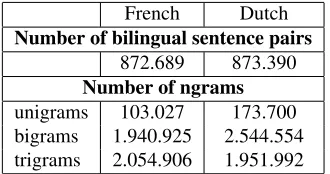
The first statistical machine translation system we used is the off-the-shelf Moses toolkit (Koehn et al., 2007). As the Moses system is open-source, well documented, supported by a very lively users fo-rum and reaches state-of-the-art performance, it has quickly been adopted by the community and highly stimulated development in the SMT field. It also fea-tures factored translation models, which enable the integration of linguistic and other information at the word level. This makes Moses a good candidate to experiment with for example a dedicated WSD mod-ule, that requires more enhanced linguistic informa-tion (such as lemmas and Part-of-Speech tags). We trained Moses for English–French and English– Dutch on a large subsection of the Europarl corpus (See Section 3 for more information on the corpus), and performed some standard cleaning. Table 1 lists the number of aligned sentences after cleaning the bilingual corpus, and the number of uni-, bi- and tri-grams that are comprised by the language model.
2.2 Google
In order to gain insights in the upper bounds for current SMT, we also analyzed the output of the Google Translate API1 for our set of ambiguous nouns. Google Translate currently supports 57 lan-guages. As both the amount of parallel and
mono-1http://code.google.com/apis/language/
translate/overview.html
French Dutch
Number of bilingual sentence pairs 872.689 873.390 Number of ngrams unigrams 103.027 173.700 bigrams 1.940.925 2.544.554 trigrams 2.054.906 1.951.992
Table 1: Statistics resulting from the Moses training phase
lingual training data as well as the computer power are crucial for statistical MT, Google (that disposes of large computing clusters and a network of data centers for Web search) has very valuable assets at its disposal for this task. We can only speculate about the amount of resources that Google uses to train its translation engine. Part of the training data comes from transcripts of United Nations meetings (in six official languages) and those of the Euro-pean Parliament (Europarl corpus). Google research papers report on a distributed infrastructure that is used to train on up to two trillion tokens, which re-sult in language models containing up to 300 billion ngrams (Brants et al., 2007).
3 ParaSense
[image:3.612.345.510.71.158.2]correct translation in five supported target languages (viz. French, Italian, Spanish, German and Dutch) for an ambiguous focus word in a given context.
In order to detect all relevant translations for the twenty ambiguous focus words, we ran GIZA++ (Och and Ney, 2003) with its default set-tings on our parallel corpus. The obtained word alignment output was then considered to be the clas-sification label for the training instances for a given classifier (e.g. the French translation resulting from the word alignment is the label that is used to train the French classifier). This way we obtained all class labels (or oracle translations) for all training instances for our five classifiers (English as an input language and French, German, Dutch, Italian and Spanish as target languages). For the experiments described in this paper, we focused on the English– French and English–Dutch classifiers.
We created two experimental setups. The first training set contains the automatically generated word alignment translations as labels. A postpro-cessing step was applied on these translations in or-der to automatically filter leading and trailing deter-miners and prepositions from the GIZA++ output. For the creation of the second training set, we man-ually verified all word alignment correspondences of the ambiguous words. This second setup gives an idea of the upperbound performance in case the word alignment output could be further improved for our ambiguous nouns.
3.1 Classifier
To train our WSD classifiers, we used the memory-based learning (MBL) algorithms implemented in TIMBL (Daelemans and van den Bosch, 2005), which has successfully been deployed in previous WSD classification tasks (Hoste et al., 2002). We performed very basic heuristic experiments to de-fine the parameter settings for the classifier, leading to the selection of the Jeffrey Divergence distance metric, Gain Ratio feature weighting and k = 7 as number of nearest neighbours. In future work, we plan to use an optimized word-expert approach in which a genetic algorithm performs joint feature se-lection and parameter optimization per ambiguous word (Daelemans et al., 2003).
3.2 Feature Construction
For the feature vector construction, we combine lo-cal context features that were extracted from the En-glish sentence and a set of binary bag-of-words fea-tures that were extracted from the aligned transla-tions in the four other languages (that are not the target language of the classifier).
3.2.1 Local Context Features
We extract the same set of local context features from both the English training and test instances. All English sentences were preprocessed by means of a memory-based shallow parser (MBSP) (Daelemans and van den Bosch, 2005) that performs tokeniza-tion, Part-of-Speech tagging and text chunking. The preprocessed English instances were used as input to build a set of commonly used WSD features:
• features related to thefocus word itself being the word form of the focus word, the lemma, Part-of-Speech and chunk information,
• local context featuresrelated to a window of three words preceding and following the focus word containing for each of these words their full form, lemma, Part-of-Speech and chunk in-formation
These local context features are to be considered as a basic feature set. The Senseval evaluation ex-ercises have shown that feeding additional informa-tion sources to the classifier results in better system performance (Agirre and Martinez, 2004). In fu-ture experiments we plan to integrate a.o. lemma information on the surrounding content words and semantic analysis (e.g. Singular Value Decomposi-tion (Gliozzo et al., 2005)) in order to detect latent correlations between terms.
3.2.2 Translation Features
lemma information. Per ambiguous focus word, a list of all content words (nouns, adjectives, adverbs and verbs) that occurred in the aligned translations of the English sentences containing this word, was extracted. This resulted in one binary feature per se-lected content word per language. For the construc-tion of the translaconstruc-tion features for the training set, we used the Europarl aligned translations.
As we do not dispose of similar aligned trans-lations for our test instances (where we only have the English test sentences at our disposal), we had to adopt a different strategy. We decided to use the Google Translate API to automatically generate translations for all English test instances in the five target languages. This automatic translation pro-cess can be done using whatever machine translation tool, but we chose the Google API because of its easy integration. Online machine translation tools have already been used before to create artificial parallel corpora that were used for NLP tasks such as for instance Named Entity Recognition (Shah et al., 2010). Similarly, Navigli and Ponzetto (2010) used the Google Translate API to enrich BabelNet, a wide-coverage multilingual semantic network, with lexical information for all languages.
Once the automatic aligned translations were gen-erated, we preprocessed them in the same way as we did for the aligned training translations. In a next step, we again selected all content words from these translations and constructed the binary bag-of-words features.
4 Evaluation
To evaluate the two machine translation systems as well as the ParaSense system on their performance on the lexical sample of twenty ambiguous words, we used the sense inventory and test set of the Sem-Eval Cross-Lingual Word Sense Disambiguation task. The sense inventory was built up on the ba-sis of the Europarl corpus: all retrieved translations of a polysemous word were manually grouped into clusters, which constitute different senses of that given word. The test instances were selected from the JRC-ACQUIS Multilingual Parallel Corpus2and BNC3. There were in total 50 test instances for each
2
http://wt.jrc.it/lt/Acquis/
3
http://www.natcorp.ox.ac.uk/
of the twenty ambiguous words in the sample. To la-bel the test data, native speakers assigned three valid translations from the predefined clusters of Europarl translations to each test instance. A more detailed description of the construction of the data set can be found in (Lefever and Hoste, 2010a). As eval-uation metric, we used a straightforward accuracy measure that divides the number of correct answers by the total amount of test instances. As a baseline, we selected the most frequent lemmatized transla-tion that resulted from the automated word align-ment (GIZA++).
The output of the ParaSense WSD module con-sists of a lemmatized translation of the ambiguous focus word in the target language. The output of the two statistical machine translation systems, however, is a translation of the full English input sentence. Therefore we manually selected the translation of the ambiguous focus word from the full translation, and made sure the translation was put in its base form (masculine singular form for nouns and adjectives, infinitive form for verbs).
Table 2 lists the accuracy figures for the baseline, two flavors of the ParaSense system (with and with-out correction of the word alignment with-output), Moses and Google for English–French and English–Dutch. A first conclusion is that all systems beat the most frequent sense baseline. As expected, the Google system (where there was no limitation on the training data) achieves the best results, but for French the considerable difference in training size only leads to modest performance gains compared to the ParaSense System. Another interesting obser-vation is that the ParaSense system that uses manu-ally verified translation labels hardly beats the sys-tem that uses automatically generated class labels. This is promising as it makes the manual interven-tions on the data superfluous and leads to a fully au-tomatic system development process.
Figure 1 illustrates the accuracy figures for French for all three systems (for the ParaSense system we used the flavor that incorporates the non-validated translation labels) on all individual test words.
Figure 1: Accuracy figures per system for all 20 test words
French Dutch
Baseline 63% 59%
ParaSense system
Non Corrected 75% 68%
word alignment labels
Corrected word 76% 68%
alignment labels
SMT Systems
Moses 71% 63%
[image:6.612.342.512.344.616.2]Google 78% 74%
Table 2: Accuracy figures averaged over all twenty test words
match, range) are particularly hard to disambiguate,
while others obtain very high scores (e.g.letter,
mis-sion, soil). The almost perfect scores for the latter
can be explained by the fact that these words all have a very generic translation in French (respectively
let-tre, mission, sol) that can be used for all senses of
the word, although there might be more suited trans-lations for each of the senses depending on the con-text. As the manual annotators could pick three good translations for each test instance, the most generic translation often figures between the gold standard translations.
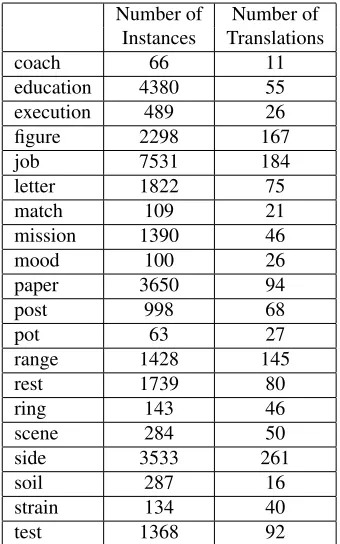
The low scores for some other words can often be explained through the relationship with the number of training instances (corresponding to the frequency
Number of Number of Instances Translations
coach 66 11
education 4380 55
execution 489 26
figure 2298 167
job 7531 184
letter 1822 75
match 109 21
mission 1390 46
mood 100 26
paper 3650 94
post 998 68
pot 63 27
range 1428 145
rest 1739 80
ring 143 46
scene 284 50
side 3533 261
soil 287 16
strain 134 40
test 1368 92
Table 3: Number of instances and classes for all twenty test words in French
[image:6.612.97.276.344.469.2]are very ambiguous (respectively 167 and 145 trans-lations to choose from).
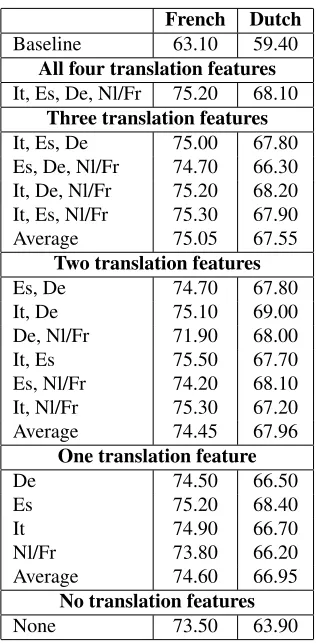
The main novelty of our ParaSense system lies in the application of a multilingual approach to per-form WSD, as opposed to the more classical ap-proach that only uses monolingual local context fea-tures. Consequently we also ran a set of additional experiments to examine the contribution of the dif-ferent translation features to the WSD performance. Table 4 shows the accuracy figures for French and Dutch for a varying number of translation features including the other four languages: Italian, Span-ish, French and Dutch for the French classifier or French for the Dutch classifier. The scores clearly confirm the validity of our hypothesis: the classifiers using translation features are constantly better than the one that merely uses English local context fea-tures. For French, the other two romance languages seem to contribute most: the classifier that uses Ital-ian and Spanish bag-of-words features achieves the best performance (75.50%), whereas the classifier that incorporates German and Dutch translations ob-tains the worst scores (71.90%). For Dutch, the in-terpretation of the scores is less straightforward: the Italian-German combination achieves the best result (69%), but the difference with the other classifiers that use two romance languages (Italian-Spanish: 67.70% and Italian-French: 67.20%) is less salient than for French. In order to draw final conclusions on the contribution of the different languages, we probably first need to optimize our feature base and classification parameters. For the current experi-ments, we use very sparse bag-of-words features that can be optimized in different ways (e.g. feature se-lection, reduction of the bag-of-words features by applying semantic analysis such as Singular Value Decomposition, etc.).
5 Conclusion
We presented a thorough evaluation of two statis-tical Machine Translation systems and one dedi-cated WSD system on a lexical sample of English ambiguous nouns. Our WSD system incorporates both monolingual local context features and bag-of-words features that are built from aligned trans-lations in four additional languages. The best re-sults are obtained by Google, the SMT system that
French Dutch
Baseline 63.10 59.40
All four translation features It, Es, De, Nl/Fr 75.20 68.10
Three translation features
It, Es, De 75.00 67.80
Es, De, Nl/Fr 74.70 66.30 It, De, Nl/Fr 75.20 68.20 It, Es, Nl/Fr 75.30 67.90
Average 75.05 67.55
Two translation features
Es, De 74.70 67.80
It, De 75.10 69.00
De, Nl/Fr 71.90 68.00
It, Es 75.50 67.70
Es, Nl/Fr 74.20 68.10
It, Nl/Fr 75.30 67.20
Average 74.45 67.96
One translation feature
De 74.50 66.50
Es 75.20 68.40
It 74.90 66.70
Nl/Fr 73.80 66.20
Average 74.60 66.95
No translation features
[image:7.612.348.506.68.390.2]None 73.50 63.90
Table 4: Accuracy figures for French and Dutch for a varying number of translation features including the other four languages viz. Italian (It), Spanish (Es), German (De) and French (Fr) or Dutch (Nl)
is built with no constraints on data size or compu-tational resources. Although there is still a lot of room for improvement on the feature base and op-timization of the WSD classifiers, our results show that the ParaSense system outperforms Moses that is built with the same training corpus.
We also noticed large differences among the test words, often related to the number of training in-stances and the number of translations the classifier (or decoder) has to choose from.
Additional experiments with the ParaSense sys-tem incorporating a number of varying translations features allow us to confirm the validity of our hy-pothesis. The classifiers that use the multilingual bag-of-words features clearly outperform the clas-sifier that only uses local context features.
selection. In addition, we will apply semantic anal-ysis tools (such as SVD or LSA) on our multilingual bag-of-words sets in order to detect latent semantic topics in the multilingual feature base. Finally, we want to evaluate to which extent the integration of our WSD output helps the decoder to pick the cor-rect translation in a real SMT framework.
References
E. Agirre and P. Edmonds, editors. 2006. Word Sense Disambiguation. Algorithms and Applications. Text, Speech and Language Technology. Springer, Dor-drecht.
E. Agirre and D. Martinez. 2004. Smoothing and Word Sense Disambiguation. In Proceedings of EsTAL -Espa˜na for Natural Language Processing, Alicante, Spain.
Th. Brants, A.C. Popat, P. Xu, F.J. Och, and J. Dean. 2007. Large Language Models in Machine Transla-tion. In Proceedings of the 2007 Joint Conference on Empirical methods in Natural Language Process-ing and Computational Natural Language LearnProcess-ing, pages 858–867.
C. Cabezas and P. Resnik. 2005. Using wsd tech-niques for lexical selection in statistical machine trans-lation. Technical report, Institute for Advanced Com-puter Studies, University of Maryland.
C. Callison-Burch, Ph. Koehn, Ch. Monz, and J. Schroeder. 2009. Findings of the 2009 Workshop on Statistical Machine Translation. InProceedings of the 4th EACL Workshop on Statistical Machine Trans-lation, pages 1–28, Athens, Greece.
M. Carpuat and D. Wu. 2007. Improving statistical machine translation using word sense disambiguation. In Proceedings of the 2007 Joint Conference on Em-pirical Methods in Natural Language Processing and Computational Natural Language Learning (EMNLP-CoNLL), pages 61–72, Prague, Czech Republic. Y.S. Chan, H.T. Ng, and D. Chiang. 2007. Word sense
disambiguation improves statistical machine transla-tion. InProceedings of the 45th Annual Meeting of the Association of Computational Linguistics, pages 33– 40, Prague, Czech Republic.
W. Daelemans and A. van den Bosch. 2005. Memory-based Language Processing. Cambridge University Press.
W. Daelemans, V. Hoste, F. De Meulder, and B. Naudts. 2003. Combined optimization of feature selection and algorithm parameters in machine learning of language. Machine Learning, pages 84–95.
M. Diab and P. Resnik. 2002. An Unsupervised Method for Word Sense Tagging Using Parallel Corpora. In Proceedings of ACL, pages 255–262.
C. Fellbaum. 1998. WordNet: An Electronic Lexical Database. MIT Press.
W.A. Gale and K.W. Church. 1993. A program for align-ing sentences in bilalign-ingual corpora. Computational Linguistics, 19(1):75–102.
43nd Annual Meeting of the Association for Computa-tional Linguistics. (ACL-05).
V. Hoste, I. Hendrickx, W. Daelemans, and A. van den Bosch. 2002. Parameter Optimization for Machine-Learning of Word Sense Disambiguation. Natural Language Engineering, Special Issue on Word Sense Disambiguation Systems, 8:311–325.
P. Koehn, F.J. Och, and D. Marcu. 2003. Statistical Phrase-based translation. InHLT-NAACL 2003: ference combining Human Language Technology con-ference series and the North American Chapter of the Association for Computational Linguistics conference series, pages 48–54, Edmonton, Canada.
P. Koehn, H. Hoang, A. Birch, C. Callison-Burch, M. Federico, N. Bertoldi, B. Cowan, W. Shen, C. Moran, R. Zens, C. Dyer, O. Bojar, A. Constantin, and E. Herbst. 2007. Moses: Open Source Toolkit for Statistical Machine Translation. InProceedings of the ACL 2007 Demo and Poster Sessions, pages 177–180, Prague, Czech Republic.
P. Koehn. 2005. Europarl: a parallel corpus for statisti-cal machine translation. InTenth Machine Translation Summit, pages 79–86, Phuket, Thailand.
E. Lefever and V. Hoste. 2010a. Construction of a Benchmark Data Set for Cross-Lingual Word Sense Disambiguation. In Nicoletta Calzolari, Khalid Choukri, Bente Maegaard, Joseph Mariani, Jan Odijk, Stelios Piperidis, and Daniel Tapias, editors, Proceed-ings of the seventh International Conference on Lan-guage Resources and Evaluation (LREC’10), Valletta, Malta, May. European Language Resources Associa-tion (ELRA).
E. Lefever and V. Hoste. 2010b. SemEval-2010 Task 3: Cross-Lingual Word Sense Disambiguation. In Proceedings of the 5th International Workshop on Se-mantic Evaluation, ACL 2010, pages 15–20, Uppsala, Sweden.
R. Navigli and S.P. Ponzetto. 2010. BabelNet: Building a very large multilingual semantic network. In Pro-ceedings of the 48th Annual Meeting of the Associ-ation for ComputAssoci-ational Linguistics, pages 216–225, Uppsala, Sweden.
H.T. Ng, B. Wang, and Y.S. Chan. 2003. Exploiting par-allel texts for word sense disambiguation: An empiri-cal study. In41st Annual Meeting of the Association for Computational Linguistics (ACL), pages 455–462, Sapporo, Japan.
F. J. Och and H. Ney. 2003. A systematic comparison of various statistical alignment models. Computational Linguistics, 29(1):19–51.
K. Papineni, S. Roukos, T. Ward, and Zhu W.-J. 2002. BLEU: a method for automatic evaluation of machine translation. InProceedings of the 40th Annual Meet-ing of the Association for Computational LMeet-inguistics.
Ph. Resnik and D. Yarowsky. 2000. Distinguishing sys-tems and distinguishing senses: New evaluation meth-ods for word sense disambiguation. Natural Language Engineering, 5(3):113–133.
H. Schmid. 1994. Probabilistic part-of-speech tagging using decision trees. In Proceedings of the Interna-tional Conference on new methods in Language Pro-cessing, Manchester, UK.
R. Shah, B. Lin, A. Gershman, and R. Frederking. 2010. SYNERGY: A Named Entity Recognition System for Resource-scarce Languages such as Swahili using On-line Machine Translation. In Proceedings of the Second Workshop on African Language Technology (AFLAT 2010), Valletta, Malt.
L. Specia. 2006. A Hybrid Relational Approach for WSD - First Results. In Proceedings of the COL-ING/ACL 2006 Student Research Workshop, pages 55– 60, Sydney, Australia.
N. Stroppa, A. van den Bosch, and A. Way. 2007. Exploiting source similarity for smt using context-informed features. In Proceedings of the 11th Con-ference on Theoretical and Methodological Issues in Machine Translation (TMI 2007).
D. Tufis¸, R. Ion, and N. Ide. 2004. Fine-Grained Word Sense Disambiguation Based on Parallel Cor-pora, Word Alignment, Word Clustering and Aligned Wordnets. In Proceedings of the 20th International Conference on Computational Linguistics (COLING 2004), pages 1312–1318, Geneva, Switzerland, Au-gust. Association for Computational Linguistics. D. Vickrey, L. Biewald, M. Teyssier, and D. Koller. 2005.