A Usage-Based Model of Early Grammatical Development
Barend Beekhuizen
LUCL Leiden University
Rens Bod
ILLC
University of Amsterdam [email protected]
Afsaneh Fazly and Suzanne Stevenson
Department of Computer Science University of Toronto
afsaneh,[email protected]
Arie Verhagen
LUCL Leiden University
Abstract
The representations and processes yield-ing the limited length and telegraphic style of language production early on in acqui-sition have received little attention in ac-quisitional modeling. In this paper, we present a model, starting with minimal lin-guistic representations, that incrementally builds up an inventory of increasingly long and abstract grammatical representations (form+meaning pairings), in line with the usage-based conception of language ac-quisition. We explore its performance on a comprehension and a generation task, showing that, over time, the model bet-ter understands the processed utbet-terances, generates longer utterances, and better ex-presses the situation these utterances in-tend to refer to.
1 Introduction
A striking aspect of language acquisition is the dif-ference between children’s and adult’s utterances. Simulating early grammatical production requires a specification of the nature of the linguistic repre-sentations underlying the short, telegraphic utter-ances of children. In the usage-based view, young children’s grammatical representions are thought to be less abstract than adults’, e.g. by having stricter constraints on what can be combined with them (cf. Akhtar and Tomasello 1997; Bannard et al. 2009; Ambridge et al. 2012). The represen-tations and processes yielding the restricted length of these early utterances, however, have received little attention. Following Braine (1976), we adopt the working hypothesis that the early learner’s grammatical representations are more limited in length (or: arity) than those of adults.
Similarly, in computational modeling of gram-mar acquisition, comprehension has received more
attention than language generation. In this pa-per we attempt to make the mechanisms underly-ing early production explicit within a model that can parse and generate utterances, and that in-crementally learns constructions (Goldberg, 1995) on the basis of its previous parses. The model’s search through the hypothesis space of possible grammatical patterns is highly restricted. Start-ing from initially small and concrete representa-tions, it learns incrementally long representations (syntagmatic growth) as well as more abstract
ones (paradigmatic growth). Several models
ad-dress either paradigmatic (Alishahi and Stevenson, 2008; Chang, 2008; Bannard et al., 2009) or syn-tagmatic (Freudenthal et al., 2010) growth. This model aims to explain both, thereby contribut-ing to the understandcontribut-ing of how different learncontribut-ing mechanisms interact. As opposed to other models involving grammars with semantic representations (Alishahi and Stevenson, 2008; Chang, 2008), but similar to Kwiatkowski et al. (2012), the model starts without an inventory of mappings of single words to meanings.
Based on motivation from usage-based and con-struction grammar approaches, we define several learning principles that allow the model to build up an inventory of linguistic representations. The model incrementally processes pairs of an
utter-anceU, consisting of a string of wordsw1. . . wn,
and a set of situationsS, one of which is the
situa-tion the speaker intends to refer to. The other situ-ations contribute to propositional uncertainty (the uncertainty over which proposition the speaker is trying to express; Siskind 1996). The model tries to identify the intended situation and to understand how parts of the utterance refer to certain parts of that situation. To do so, the model uses its growing inventory of linguistic representations (Section 2)
to analyzeU, producing a set of structured
seman-tic analyses or parses (Fig. 1, arrow 1; Section 3).
The resulting best parse,U and the selected situa-tion are then stored in a memory buffer (arrow 2), which is used to learn new constructions (arrow 3) using several learning mechanisms (Section 4). The learned constructions can then be used to gen-erate utterances as well. We describe two experi-ments: in the comprehension experiment (Section 5), we evaluate the model’s ability to parse the stream of input items. In the generation experi-ment (Section 6), the model generates utterances on the basis of a given situation and its linguistic knowledge. We evaluate the generated utterances given different amounts of training items to con-sider the development of the model over time.
2 Representations
We represent linguistic knowledge as
construc-tions: pairings of a signifying form and a signi-fied (possibly incomplete) semantic representation
(Goldberg, 1995). Themeaningis represented as
a graph with the nodes denoting entities, events, and their relations, connected by directed unla-beled edges. The conceptual content of each node is given by a set of semantic features. We assume that meaning representations are rooted trees. The
signifying form consists of a positive number of
constituents. Every constituent has two elements: a phonological form, and a pointer to a node in the signified meaning (in line with Verhagen 2009). Both can be specified, or one can be left empty. Constituents with unspecified phonological forms
are calledopen, denoted within the figures. The
head constituent of a construction is defined as the constituent that has a pointer to the root node of the signified meaning. We furthermore require that no two constituents point to the same node of the signified meaning.
This definition generalizes over lexical ele-ments (one phonologically specified constituent) as well as larger linguistic patterns. Fig. 2, for in-stance, shows two larger constructions being com-bined with each other. We call the set of construc-tions the learner has at some moment in time the
constructiconC(cf. Goldberg 2003).
3 Parsing
3.1 Parsing operations
We first define a derivation d as an assembly
of constructions in C, using four parsing
opera-tions defined below. In parsing, derivaopera-tions are
constrained by the utterance U and the situations
utterance
situation 1
situation n
situation 2 ...
situations input item
construction 1 construction 2 construction 3
construction n
constructicon analysis
(utterance, intended situation, analysis)
...
...
memory buffer
1 1
2
[image:2.595.314.518.70.160.2]3 (utterance, intended situation, analysis) (utterance, intended situation, analysis)
Figure 1: The global flow of the model
S, whereas in production, only a situations
con-strains the derivation. The leaf nodes of a deriva-tion must consist of phonological constraints of
constructions that (in parsing) are satisfied byU.
All constructions used in a derivation must map to
the same situations∈S. A constructioncmaps to
siff the meaning ofcconstitutes a subgraph ofs,
with the features on each of the nodes in the
mean-ing ofcbeing a subset of the features on the
corre-sponding node ofs. Moreover, each construction
must map to a different part ofs. This constitutes
a mutual exclusivity effect in analyzingU: every
part of the analysis must contribute to the
compos-ite meaning. A derivationdthus gives us a
map-ping between the composed meaning of all
con-structions used indand one situations∈S. The
aggregate mapping specifies a subgraph of sthat
constitutes the interpretation of that derivation.
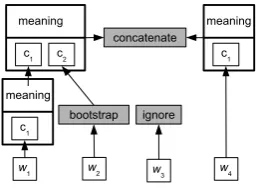
The central parsing operation is theCOMBINA
-TIONoperator◦. Inci◦cj, the leftmost open
con-stituent of ci is combined withcj. Fig. 2
illus-tratesCOMBINATION. COMBINATIONsucceeds if
both the semantic pointer of the leftmost open
con-stituent ofciand the semantic pointer of the head
constituent ofcj map to the same semantic node
of a situations
Initially, the model has few constructions to an-alyze the utterance with. Therefore, we define three other operations that allow the model to cre-ate a derivation over the full utterance without combining constructions. First, a known or un-known word that cannot be fit into a derivation,
can be IGNOREd. Second, an unknown word can
be used to fill an open constituent slot of a
con-struction with the BOOTSTRAP operator.
Boot-strapping entails that the unknown word will be associated with the semantics of the node. Finally,
the learner can CONCATENATE multiple
con-{move}
{agent,mover} {location,goal}
{animate,Adam} {surface}
PHON: Adam
SEM:
PHON: ɛ
SEM: {move}
{agent,mover} {location,goal}
{animate,Adam}
situation
O =
PHON: put
SEM:
PHON: it
SEM: {move}
{patient,moved} {location,goal}
{object,entity} {surface}
{patient,moved}
{object,entity}
PHON: Adam
SEM:
PHON: ɛ
SEM: {move}
{agent,mover} {location,goal}
{animate,Adam}
PHON: put
SEM:
PHON: it
SEM: {move}
{patient,moved} {location,goal}
{object,entity} {surface}
[image:3.595.85.521.65.256.2]Leftmost open constituent of this construction, pointing to {move}-node of meaning
Figure 2: Combining constructions. The dashed lines represent semantic pointers, either from con-stituents to the constructional meaning (black) or from the constructions to the situation (red and blue).
bootstrap
w3
ignore meaning
c1 c2
meaning
c1
w1 w2 w4
c1 meaning concatenate
Figure 3: The CONCATENATE, IGNORE and
BOOTSTRAPoperators (internal details of the
con-structions left out).
structions. This allows the learner to interpret a
larger part of the situation than with COMBINA
-TION only. The resulting sequences may be
ana-lyzed in the learning process as constituting one larger construction, consisting of the parts of the concatenated derivations. Fig. 3 illustrates these three operations.
3.2 Selecting the best analysis
Multiple derivations can be highly similar in the
way they map parts ofU to parts of ans∈S. We
define aparseto be a set of derivations that have
the same internal structure and the same mappings to a situation, but that use different constructions in doing so (cf. multiple licensing; Kay 2002). We
take the most probable parse of U to be the best
analysis ofU. The most probable parse points to a
situation, which the model then assumes to be the
identified situationorsidentified. If no parse can be
made,sidentifiedis selected at random fromS.
The probability of a parsepis given by the sum
of the probabilities of the derivationsdsubsumed
under that parse, which in turn are defined as the
product of the probabilities of the constructionsc
used ind.
P(p) =X
d∈p
P(d) (1)
P(d) =Y
c∈d
P(c) (2)
The probability of a constructionP(c)is given
by its relative frequency (count) in the
construc-ticonC, smoothed with Laplace smoothing. We
assume that the simple parsing operations of IG
-NORE,BOOTSTRAP, andCONCATENATIONreflect
usages of an unseen construction with a count of
0.
P(c) = P c.count+ 1
c0∈Cc
0.count+|C|+ 1 (3)
The most probable parse, U and sidentified are
[image:3.595.117.247.327.422.2]4 Learning mechanisms
The model uses the best parse of the utterance to develop its knowledge of the constructions in the
constructiconC. Two simple operations,UPDATE
andASSOCIATION, are used to create initial
con-structions and reinforce existing ones respectively.
Two additional operations,PARADIGMATIZATION
andSYNTAGMATIZATION, are key to the model’s
ability to extend these initial representations by inducing novel constructions that are richer and more abstract than existing ones.
4.1 Direct learning from the best parse
The best parse is used to UPDATE C. For this
mechanism, the model uses the concrete
mean-ing of sidentified rather than the (potentially more
abstract) meaning of the constructions in the best
parse.1Every construction in the parse is assigned
the subgraph of sidentified it maps to as its new
meaning, and the count of the adjusted
construc-tion is incremented with 1, or added toC with a
count of 1, if it does not yet exist. This includes
applications of the BOOTSTRAP operation,
creat-ing a mappcreat-ing of the previously unknown word to a situational meaning.
ASSOCIATEconstitutes a form of simple
cross-situational learning over the memory buffer. The intuition is that co-occurring word sequences and meaning components that remain unanalyzed across multiple parses might themselves comprise the form-meaning pairing of a construction. If the unanalyzed parts of two situations contain an over-lapping subgraph, and the unanalyzed parts of two utterances an overlapping subsequence of words,
the two are mapped to each other and added toC
with a count of 0.
4.2 Qualitative extension of the best parse Syntagmatization Some of the processes de-scribed thus far yield analyses of the input in which constructions are linearly associated but lack appropriate relational structure among them.
The model requires a process, which we callSYN
-TAGMATIZATION, that enables it to induce further
hierarchical structure.
In order for the learner to acquire constructions in which the different constituents point to
differ-ent parts of the construction’s meaning, theASSO
-1This follows Langacker’s (2009) claim that the processed
concrete usage events should leave traces in the learner’s mind.
CIATEoperation does not suffice. We assume that
the learner is able to learn such constructions by using concatenated derivations. The process we
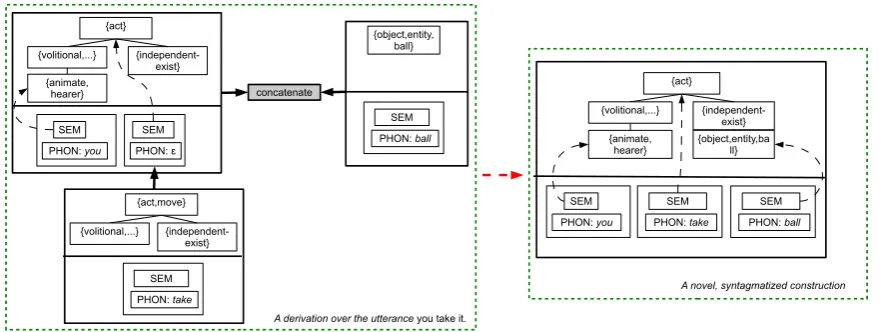
propose isSYNTAGMATIZATION. In this process,
the various concatenated derivations are taken as constituents of a novel construction. This instanti-ates the idea that joint processing of two (or more) events gradually leads to a joint representation of these, previously independent, events.
More precisely, the process starts by taking the
top nodes T of the derivations in the best parse,
whereT consists of the single top node if noCON
-CATENATION has been applied, or the set of
con-catenated nodes of the parse tree ifCONCATENA
-TION has been applied (e.g. for the derivation in
Fig. 3,|T|= 2). For each top nodet∈T, we take
the root node of the construction’s meaning, and
define itssemantic frameto consist of all children
(roles) and grandchildren (role-fillers) of the node in the situation it maps to. The model then forms a
novel constructioncsynby taking all the
construc-tions in the parse whose semantic root nodes point to a node in this semantic frame, referring to those
as the setRof semantically related constructions.
As the novel meaning ofcsyn, the model takes the
subgraph of the situation mapped to by the joint mapping of all constructional meanings of
con-structions inR.
R, as well as all phonologically specified
con-stituents oftitself, are then linearized as the
con-stituents ofcsyn. The novel construction thus
con-stitutes a construction with a higher arity, ‘joining’ several previously independent constructions. Fig. 4 illustrates the syntagmatization mechanism.
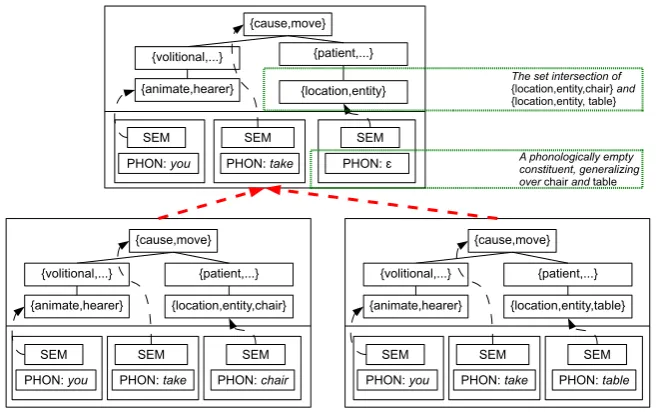
Paradigmatization Due to our usage-driven ap-proach, all learning mechanisms so far give us maximally concrete constructions. In order for the model to generalize beyond the observed input, some degree of abstraction is needed. The model
does so with the PARADIGMATIZATION
mecha-nism. This mechanism recursively looks for min-imal abstractions (cf. Tomasello 2003, 123) over
the constructions inC and adds those toC, thus
creating a full-inheritance network (cf. Langacker 1989, 63-76).
con-{act}
{volitional,...}
{animate, hearer}
{independent-exist}
SEM SEM
PHON: you PHON: ɛ
{act,move}
{volitional,...} {independent-exist}
SEM
PHON: take
concatenate
{object,entity, ball}
SEM
PHON: ball
{act}
{volitional,...}
{animate, hearer}
{independent-exist}
SEM SEM
PHON: you PHON: take
{object,entity,ba ll}
SEM
PHON: ball
A derivation over the utterance you take it.
[image:5.595.79.519.71.237.2]A novel, syntagmatized construction
Figure 4: The SYNTAGMATIZATION mechanism. The mechanism takes a derivation as its input and
reinterprets it as a novel construction of higher arity).
stituents must be mappable: both constructions have the same number of constituents and the paired constituents point to a mapped node of the meaning. The meaning of the abstracted construc-tion is then set to this overlapping subgraph, which is the lowest possible semantic abstraction over the constructions. The constituents of this new ab-straction have a specified phonological form if the more concrete constructions share the same word, and an unspecified one otherwise. The count of an abstracted construction is given by the cardinality of the set of its direct descendants in the network. This generalizes Bybee’s (1995) idea about type frequency as a proxy for productivity to a network structure. Fig. 5 illustrates the paradigmatization mechanism.
5 Experimental set-up
The model is incrementally presented with U, S
pairings based on Alishahi & Stevenson’s (2010) generation procedure. In this procedure, an utter-ance and a semantic frame expressing its meaning (a situation) are generated. The generation pro-cedure follows distributions occurring in a corpus of child-directed speech. As we are interested in the performance of the model under propositional uncertainty, we add a parametrized number of
ran-domly sampled situations, so thatSconsists of the
situation the speaker intends to refer to (scorrect)
and a number of situations the speaker does not
intend to refer to.2Here, we set the number of
ad-2We are currently researching the effects of sampling
non-correct situations that have a greater likelihood of overlap
ditional situations to be1or5; the other parameter
of the model, the size of the memory buffer, is set to 5 exemplars.
For the comprehension experiment, we
eval-uate the model’s performance parsing the input
items, averaging over every 50 U, S pairs. We
track the ability toidentifythe intended situation
fromS. Identification succeeds if the best parse
maps toscorrect, i.e. ifsidentified = scorrect. Next,
situation coverage expresses what proportion of
sidentifiedhas been interpreted and thus how rich the
meanings of the used constructions are. It is de-fined as the number of nodes of the interpretation of the best parse, divided by the number of nodes
ofsidentified. Finally,utterance coverage tells us
what proportion of U has been parsed with
con-structions (excludingIGNORED; includingBOOT
-STRAPPED words). The measure expresses the
proportion of the signal that the learner (correctly or incorrectly) is able to interpret.
For exploring languageproduction, the model
receives a situation, and (given the constructicon) finds the most probable, maximally expressive, fully lexicalized derivation expressing it. That is: among all derivations terminating in phonologi-cally specified constituents, it selects the deriva-tions that cover the most semantic nodes of the given situation. In the case of multiple such derivations, it selects the most probable one, fol-lowing the probability model in Section 3. We
only allow for theCOMBINATION operator in the
derivations, asBOOTSTRAPPINGandIGNORE
{cause,move}
{volitional,...}
{animate,hearer}
{patient,...}
{location,entity,chair}
SEM SEM SEM
PHON: you PHON: take PHON: chair
{cause,move}
{volitional,...}
{animate,hearer}
{patient,...}
{location,entity,table} {cause,move}
{volitional,...}
{animate,hearer}
{patient,...}
{location,entity}
SEM SEM SEM
PHON: you PHON: take PHON: ɛ
SEM SEM SEM
PHON: you PHON: take PHON: table
A phonologically empty constituent, generalizing
over chair and table
The set intersection of
{location,entity,chair} and
[image:6.595.135.470.73.280.2]{location,entity, table}
Figure 5: The PARADIGMATIZATION mechanism. The construction on top is an abstraction obtained
over the two constructions at the bottom.
fer to words in a givenU, andCONCATENATEis a
back-off method for analyzing more ofU than the
constructicon allows for. The situations used in the generation experiment do not occur in the training items, so that we truly measure the model’s ability to generate utterances for novel situations.
The phonologically specified leaf nodes of the best derivation constitute the generated utterance
Ugen. Ugen is evaluated on the basis of its mean
length, in number of words, itssituation
cover-age, as defined in the comprehension experiment,
and itsutterance precisionandutterance recall.
To calculate these, we take the maximally
overlap-ping subsequenceUoverlapbetween the actual
utter-ance Uact associated with the situation and Ugen.
Utterance precision (how many words are gener-ated correctly) and utterance recall (how many of the correct words are generated) are defined as:
Utterance precision= |Uoverlap|
|Ugen| (4)
Utterance recall= |U|overlapU |
act| (5)
Because theU, S-pairs on which the model was
trained, are generated randomly, we show results for comprehension and production averaged over
5simulations.
6 Experiments
A central motivation for the development of this model is to account for early grammatical produc-tion: can we simulate the developmental pattern of the growth of utterance length and a growing potential for generalization? The same construc-tions underlying these producconstruc-tions should, at the same time, also account for the learner’s
increas-ing grasp of the meanincreas-ing of U. To explore the
model’s performance in both domains, we present a comprehension and a generation experiment.
6.1 Comprehension results
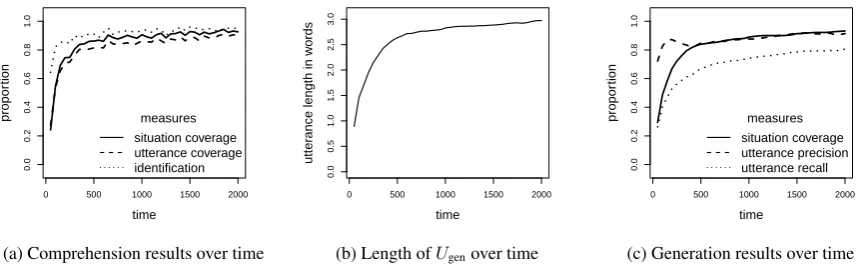
Fig. 6a gives us the results over time of the com-prehension measures given a propositional
un-certainty of 1, i.e. one situation besides scorrect
in S. Overall, the model understands the
utter-ances increasingly well. After 2000 input items,
the model identifies scorrect in 95% of the cases.
With higher levels of propositional uncertainty (not shown here), performance is still relatively
robust: given 5 incorrect situations in S, scorrect
is identified in 62% of all cases (random
guess-ing gives a score of 17%, or 1
6). Similarly, the
[image:6.595.112.292.611.700.2]mea-0 500 1000 1500 2000
0.0
0.2
0.4
0.6
0.8
1.0
time
propor
tion
measures situation coverage utterance coverage identification
(a) Comprehension results over time
0 500 1000 1500 2000
0.0
0.5
1.0
1.5
2.0
2.5
3.0
time
utter
ance length in w
ords
(b) Length ofUgenover time
0 500 1000 1500 2000
0.0
0.2
0.4
0.6
0.8
1.0
time
propor
tion
measures situation coverage utterance precision utterance recall
[image:7.595.80.512.81.214.2](c) Generation results over time
Figure 6: Quantitative results for the comprehension and generation experiments
sures do not display what proportion of the utter-ance or situation is analyzed correctly.
6.2 Generation results
Quantitative results Fig. 6b shows that the av-erage utterance length increases over time. This indicates that the number of constituents of the used constructions grows. Next, Fig. 6c shows the performance of the model on the generation task. After 2000 input items, the model generates pro-ductions expressing 93% of the situation, with an utterance precision of 0.91, and an utterance recall of 0.81. Given a propositional uncertainty of 5, these go down to 79%, 0.76 and 0.59 respectively. Comparing the utterance precision and recall over time, we can see that the utterance preci-sion is high from the start, whereas the recall gradually increases. This is in line with the ob-servation that children predominantly produce er-rors of omission (leaving linguistic material out an adult speaker would produce), and few errors of comission (producing linguistic material an adult speaker would not produce).
Qualitative results Tracking individual produc-tions given specific situaproduc-tions over time allows us to study in detail what the model is doing. Here, we look at one case qualitatively. Given the
sit-uation for which the Uact is she put them away,
the model generates, over time, the utterances in Table 1. The brackets show the internal hierarchi-cal structure of the derivation. This development illustrates several interesting aspects of the model. First, as discussed earlier, the model mostly makes errors of omission: earlier productions leave out more words found in the adult utterances. Only at
t= 550, the model makes an error of commission,
using the wordinerroneously.
[[she]
put]
[she
[put]]
[[she]
[put]
[in]]
[[she]
put
them
[a
w
ay]]
[[she]
put
[them]]
[[she]
put
them
[a
w
ay]]
[[she]
put
[them]
aw
ay]
[[she]
put
them
aw
ay]
t 50 500 550 600 950 1000 1050 1400
Table 1: Generations over timetfor one situation.
Starting from t = 600 (except at t = 950),
the model generates the correct utterance, but the derivations leading to this production differ. At
t = 550, for instance, the learner combines a
completely non-phonologically specific construc-tion for which the constituents refer to the agent, action and goal location, with three ‘lexical’ con-structions that fill in the words for those items..
The constructions used aftert = 550are all more
specific, combining 3, or even only 2 constructions
(t ≥ 1400) where the entire sequence of words
“put them away” arises from a single construction. Using less abstract constructions over time seems contrary to the usage-based idea that con-structions become more abstract over the course of acquisition. However, this result follows from the way the probability model is defined. More spe-cific constructions that are able to account for the input will entail fewer combinations, and a deriva-tion with fewer combinaderiva-tion operaderiva-tions will often be more likely than one with more such opera-tions. Given equal expressivity of the situation, the former derivation will be selected over the lat-ter in generation.
[image:7.595.310.521.257.344.2](Gold-{cause,move} {volitional,...,,
cause-location} destination}{location, {animate,..}
{affected,..., stationary}
{object,artefact} {object, artefact}
SEM SEM SEM SEM SEM
PHON: put
PHON: ɛ PHON: ɛ PHON: ɛ PHON: ɛ
{rest,act} {volitional
, ...} {animate,...}
{destination, location} {location,entity}
SEM SEM SEM PHON:ɛ PHON:ɛ PHON:ɛ {act}
{volitional,...} {animate,
hearer}
{indepen-dent-exist} {object,artefact}
SEM SEM SEM PHON: you PHON PHON: it
(b) (c)
[image:8.595.78.283.69.224.2](a)
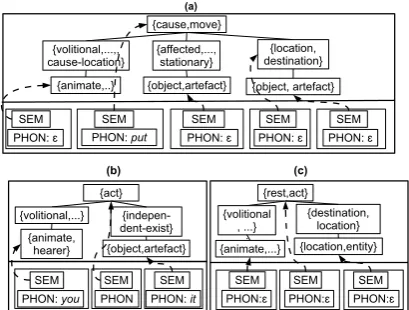
Figure 7: Some representations att= 2000
berg, 2006, 94-95). Pre-emption is the effect that a language user will select a more concrete rep-resentation over the combination of more abstract ones. The effect can be reconceptualized in this model as an epiphenomenon of the way the prob-ability model works: simply because combining fewer constructions in a derivation is often more probable than combining more constructions, the former derivation will be selected over the lat-ter. Pre-emption is typically invoked to explain the blocking of overgeneralization patterns, and an in-teresting future step will be to see if the model can simulate developmental patterns for well-known cases of overgeneralization errors.
The potential for abstraction The paradigma-tization operation allows the model to go beyond observed concrete instances of form-meaning pairings: without it, unseen situations could never be fully expressed. Despite this potential, we have seen that the model relies on highly concrete con-structions. The concreteness of the used patterns, however, does not imply the absence of more ab-stract representations. Fig. 7 gives three
exam-ples of constructions inCin one simulation.
Con-struction (a) could be seen as a verb-island con-struction (Tomasello, 1992, 23-24). The second
constituent is phonologically specified with put,
and the other arguments are open, but mapped to specific semantic functions. This pattern allows for the expression of many caused-motion events. Construction (b) is the inverse of (a): the argu-ments are phonologically specified, but the verb-slot is open. This would be a case of a pronominal
argument frame [youVit], which have been found
to be helpful in the bootstrapping of verbal
mean-ings (Tomasello, 2001). Finally, (c) presents a case of full abstraction. This construction licenses
ut-terances such asI sit here,you stay there and
er-roneous ones likehe sits on(which, again, will be
pre-empted in the generation of utterances if more
concrete constructions licencehe sits on it).
Summarizing, abstract constructions are ac-quired, but only used for those cases in which no concrete construction is available. This is in line with the usage-based hypotheses that abstract con-structions do emerge, but that for much of lan-guage production, a lanlan-guage user can rely on highly concrete patterns. A next step will be to measure the development of abstractness and length over the constructions themselves, rather than the parses and generations they allow.
7 Conclusion
This, admittedly complex, model forms an attempt to model different learning mechanisms in interac-tion from a usage-based construcinterac-tionist perspec-tive. Starting with an empty set of linguistic rep-resentations, the model acquires words and gram-matical constructions simultaneously. The learn-ing mechanisms allow the model to build up
in-creasingly abstract, as well as increasinglylong
constructions. With these developing representa-tions, we showed how the model gets better over time at understanding the input item, performing relatively robustly under propositional uncertainty. Moreover, in the generation experiment, the model shows patterns of production (increasingly long utterances) similar to those of children. An important future step will be to look at these pro-ductions more closely and investigate if they also converge on more detailed patterns of develop-ment in the production of children (e.g. item-specificity, as hypothesized on the usage-based view). Despite highly concrete constructions suf-ficing for most of production, inspection of the ac-quired representations tells us that more abstract constructions are learned as well. Here, an inter-esting next step would be to simulate patterns of overgeneralization in children’s production.
Acknowledgements
References
Nameera Akhtar and Michael Tomasello. 1997. Young Children’s Productivity With Word
Or-der and Verb Morphology. Developmental
Psy-chology, 33(6):952–965.
Afra Alishahi and Suzanne Stevenson. 2008 A Computational Model of Early Argument
Struc-ture Acquisition.Cognitive Science, 32(5):789–
834.
Afra Alishahi and Suzanne Stevenson. 2010. A computational model of learning semantic roles
from child-directed language. Language and
Cognitive Processes, 25(1):50–93.
Ben Ambridge, Julian M Pine, and Caroline F Rowland. 2012. Semantics versus statistics in the retreat from locative overgeneralization
er-rors. Cognition, 123(2):260–79.
Colin Bannard, Elena Lieven, and Michael Tomasello. 2009. Modeling children’s early
grammatical knowledge. Proceedings of the
National Academy of Sciences of the United States of America, 106(41):17284–9.
Martin D.S. Braine. 1976. Children’s first word
combinations. University of Chicago Press, Chicago, IL.
Joan Bybee. 1995. Regular morphology and the
lexicon. Language and Cognitive Processes, 10
(5):425–455.
Nancy C.-L. Chang. 2008. Constructing
Gram-mar: A computational model of the emergence of early constructions. Dissertation, University of California, Berkeley.
Daniel Freudenthal, Julian Pine, and Fernand Go-bet. 2010. Explaining quantitative variation in the rate of Optional Infinitive errors across lan-guages: a comparison of MOSAIC and the
Vari-ational Learning Model. Journal of Child
Lan-guage, 37(3):643–69.
Adele E. Goldberg. 1995. Constructions. A
Construction Grammar Approach to Argument Structure. Chicago University Press, Chicago, IL.
Adele E Goldberg. 2003. Constructions: a new
theoretical approach to language. Trends in
Cognitive Sciences, 7(5):219–224.
Adele E. Goldberg. 2006. Constructions at Work.
The Nature of Generalization in Language. Ox-ford University Press, OxOx-ford.
Paul Kay. 2002. An Informal Sketch of a Formal
Architecture for Construction Grammar.
Gram-mars, 5:1–19.
Tom Kwiatkowski, Sharon Goldwater, Luke Zettlemoyer, and Mark Steedman. 2012. A Probabilistic Model of Syntactic and Seman-tic Acquisition from Child-Directed Utterances
and their Meanings. InProceedings EACL.
Ronald W. Langacker. 1989. Foundations of
Cog-nitive Grammar, Volume I. Stanford University Press.
Ronald W. Langacker. 2009. A dynamic view of
usage and language acquisition. Cognitive
Lin-guistics, 20(3):627–640.
Jeffrey M Siskind. 1996. A computational study of cross-situational techniques for learning
word-to-meaning mappings. Cognition, 61(1-2):39–
91.
Michael Tomasello. 1992. First Verbs: A study
of early grammatical development. Cambridge University Press, Cambridge, UK.
Michael Tomasello. 2001 Perceiving intentions and learning words in the second year of life. In Melissa Bowerman and Stephen C. Levinson,
editors, Language Acquisition and Conceptual
Development, chapter 5, pages 132–158. Cam-bridge University Press, CamCam-bridge, UK.
Michael Tomasello. 2003. Constructing a
lan-guage: A Usage-Based Theory of Language Acquisition. Harvard University Press, Cam-bridge, MA.
Arie Verhagen. 2009 The conception of contions as complex signs. Emergence of
struc-ture and reduction to usage. Constructions and