Detection and Correction of Preposition and
Determiner Errors in English: HOO 2012
Pinaki Bhaskar
Aniruddha Ghosh
Santanu Pal
Sivaji Bandyopadhyay
Department of Computer Science and Engineering, Jadavpur University188, Raja S. C. Mallick Road Kolkata – 700032, India
pinaki.bhaskar @gmail.com
arghyaonline @gnail.com
santanu.pal.ju @gmail.com
sivaji_cse_ju @yahoo.com
Abstract
This paper reports on our work in the HOO 2012 shared task. The task is to automatically detect, recognize and correct the errors in the use of prepositions and determiners in a set of given test documents in English. For that, we have developed a hybrid system of an n-gram statistical model along with some rule-based techniques. The system has been trained on the HOO shared task’s training datasets and run on the test set given. We have submitted one run, which has demonstrated an F-score of 7.1, 6.46 and 2.58 for detection, recognition and correction respectively before revision and F-score of 8.22, 7.59 and 3.16 for detec-tion, recognition and correction respectively after revision.
1
Introduction
Writing research papers or theses in English is a very challenging task for those researchers and scientists whose first language or mother tongue is not English. Depicting their research works proper-ly in English is a hard job for them. Generalproper-ly their papers, which are submitted to conferences, may be rejected not because of their research works but because of the English writing, which makes the papers harder for the reviewer to understand the intentions of author. This kind of problem will be faced in any field where someone has to provide
material in a language other than his/her first lan-guage.
The mentoring service of Association for Com-putational Linguistics (ACL) is one part of a re-sponse. This service can address a wider range of problems than those related purely to writing. The aim of this service is that a research paper should be judged only on its research content.
The organizer of “Help Our Own” (HOO) pro-posed and initiated a shared task in 2011 (Dale and Kilgarriff, 2010), which attempts to tackle the problem by developing tools or techniques for the non-native speaker of English, which will automat-ically correct the English prose of the papers so that they can be accepted. This tools and tech-niques may also help native English speakers. This task is simply expressed as text-to-text generation or Natural language Generation (NLG). In the 2011 shared task, all possible errors were covered which made the task enormously huge. In 2012, the task is more specific and only deals with de-terminers and prepositions as described in (Dale and Kilgarriff, 2011).
For this shared task, HOO, we have developed two models, one is rule-based model and the other is the statistical model for both determiners and prepositions. Then we have combined both these models and developed our system for HOO 2012.
2
Related Work
The English language belongs to the Germanic languages branch of the Indo-European language family, widely spoken on six continents. The HOO
shared task is organized to help authors with writ-ing tasks. Identifywrit-ing grammatical and lwrit-inguistic errors in text is an open challenge to researchers. In recent times, researchers (Heidorn, 2000) have provided quite a benchmark for spell checker and grammar checkers, which is commonly available. In this task it is aimed to correct errors beyond the scope of these commonly available checkers i.e. detection and correction of jarring errors at part-of-speech (POS) level, syntax level and semantic lev-el. Earlier Heidorn (1975) developed augmented phrase structure grammar. (Tetreault et. al., 2008) has dealt with error pattern with preposition by non-native speakers. Meurers and Wunsch (2010) showed a surface based state-of-the-art machine learning technique, which deals with some fre-quently used prepositions. (Elghafari et al., 2010) worked on Data-Driven Prediction of Prepositions in English. Boyd et al. (2011) used an n-gram based machine-learning approach. Last year we have also participated in this shared task; our sys-tem report was reported in (Bhaskar et. al., 2011).
3
Corpus Statistics
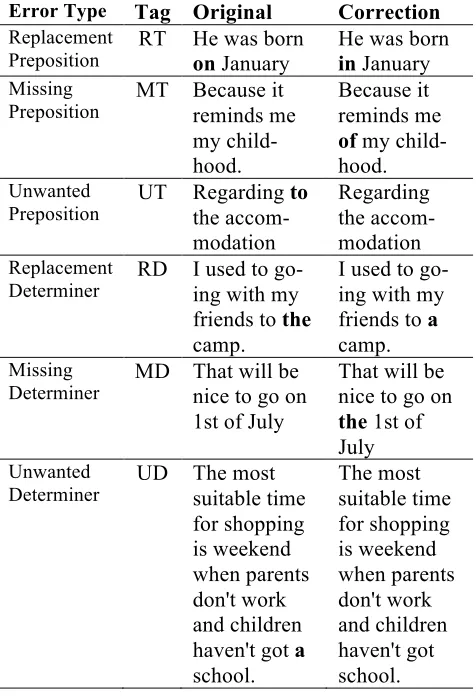
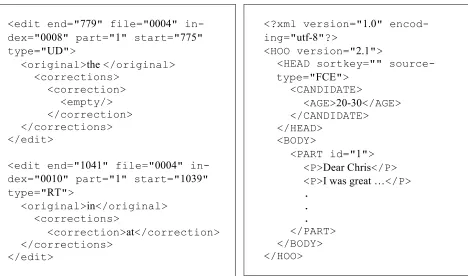
There are two sets of data, training set and test set provided by the organizer. The training set has 1000 documents, which are collected from the FCE dataset. The publicly available dataset was in the native FCE format. So, the organizer first convert-ed it to the HOO data format. Then CUP annota-tors found the errors and marked them up in the dataset. This year the task is only about the errors related to prepositions and determiners. So the or-ganizer set only six types of errors, listed in table 1, which were dealt with this year. Hence, the other errors were discarded and replace with its corre-sponding standoff annotation in the training set. The training set consists of 1000 documents of to-tal 374680 words, which means 375 words per document. All the standoff annotations of training set were provided and an example of the standoff annotation is shown in the figure 1. Table 2 gives the error statistics of training set as reported in (Dale et. al., 2012).
The test dataset has another 100 documents, which contain total of 18013 words at an average of 180 words per document. The test data was pro-cessed as the training data was done, but the stand-off annotation of the test documents was not provided before the task completion. The
docu-ments were provided in XML format as shown in the figure 2.
Error Type Tag Original Correction
Replacement
Preposition RT He was born on January He was born in January Missing
Preposition MT Because it reminds me
my child-hood.
Because it reminds me
of my child-hood.
Unwanted
Preposition UT Regarding the accom-to
modation
Regarding the accom-modation
Replacement
Determiner RD I used to go-ing with my
friends to the
camp.
I used to go-ing with my friends to a
camp.
Missing
Determiner MD That will be nice to go on
1st of July
That will be nice to go on
the 1st of July
Unwanted
Determiner UD The most suitable time
for shopping is weekend when parents don't work and children haven't got a
[image:2.612.309.547.111.459.2]school. The most suitable time for shopping is weekend when parents don't work and children haven't got school.
Table 1. Examples of the six types of error.
Error
Type # Training # before # Test
Revised
# after Revised
UT 822 43 39
MT 1104 57 56
RT 2618 136 148
Prep 4545 236 243
UD 1048 53 62
MD 2230 125 131
RD 609 39 37
Det 3887 217 230
Total 8432 453 473
Words/
Error 44.18 39.77 38.08
[image:2.612.315.541.502.691.2]<edit end="779" file="0004" in-dex="0008" part="1" start="775" type="UD">
<original>the </original> <corrections>
<correction> <empty/> </correction> </corrections> </edit>
<edit end="1041" file="0004" in-dex="0010" part="1" start="1039" type="RT">
<original>in</original> <corrections>
<correction>at</correction> </corrections>
</edit>
Figure 1: An example of a standoff error annotation
4
System Description
The task is consisted of two coarse parts – Preposi-tion and Determiner detecPreposi-tion, recogniPreposi-tion and cor-rection. In our previous year’s hybrid model, to resolve preposition errors, a rule-based model was developed and for determiner errors, a linear statis-tical method was used. There was no linear statisti-cal model for prepositions. So this year we have induced a statistical model to incorporate larger coverage of preposition error detection, which is not detected by the appropriate preposition list de-scribed in section 4.1.2.
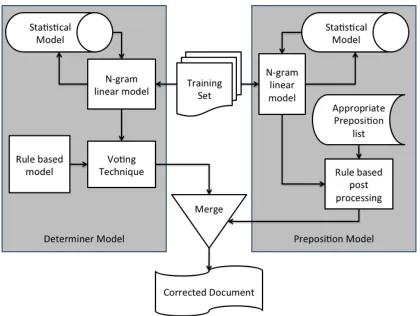
To resolve preposition errors and determiner er-rors we have built a hybrid model for both of them and used a voting technique among the rule based and statistical model for determiners and rule based post processing for prepositions. The system architecture is shown in the figure 3.
<?xml version="1.0" encod-ing="utf-8"?>
<HOO version="2.1">
<HEAD sortkey="" source-type="FCE">
<CANDIDATE>
<AGE>20-30</AGE> </CANDIDATE> </HEAD>
<BODY>
<PART id="1"> <P>Dear Chris</P> <P>I was great …</P> .
[image:3.612.69.537.68.344.2]. . </PART> </BODY> </HOO>
Figure 2: An example of the XML format of documents
4.1
Preposition Error Detection
4.1.1
Statistical Model for Preposition
An n-gram based linear statistical model is used. From the training corpus, it was trained with 3, 5 and 7-gram models. After testing, the 5-gram mod-el is performing best as from 3-gram, the statistical model fails to classify since probability distance is too small among the probable set to distinguish proper one while in 7-gram it fails to score high as training data set is relatively small and there are no similar occurrences. For the statistical model, dif-ferent linguistic information is taken as features. Initially, surface words are only considered which actually is similar to fingerprinting technique. Due to different inflected forms, the system fails to identify possible cases for a similar type of error with different inflected forms. Hence the root form of the word is included as a feature. Chunk infor-mation is included as a feature. The preposition with same word varies with if following word is animate or inanimate. As example,
Figure 3. System Architecture
The text is parsed using the Stanford Dependen-cy parser1 to retrieve animate and inanimate infor-mation. After including animate and inanimate information the system didn’t improve much as training data set is quite small and animate infor-mation is not correct for names. Hence, this feature is discarded from the statistical model.
4.1.2
Appropriate Preposition List
An appropriate preposition list consists of list of words along with preposition. The list is prepared in different corpus and training data. In the list, all possible formation with a word and preposition is stored. Let us take an example:
admit ST to SB admit to
From corpus, two patterns for admit are found. Between admit and preposition something (ST)
1 http://nlp.stanford.edu/software/lex-parser.shtml
may come. Hence both of the entries are combined and formed in a regular expression format.
admit (ST)* to SB
4.1.3
Rule Based model for Preposition
Rule based post processing was applied on output of statistical model. For the rule based post pro-cessing, an appropriate preposition list was pre-pared manually. The list contains 1567 entries. The list is associated with animate and inanimate in-formation. Hence, we aim to use dependency par-ser to identify subject object relation. Since the test data was in XML format, raw text was extracted from the XML document and the extracted sen-tences were parsed using Stanford dependency par-ser.
model, we have found that due to the list being small, few errors are being detected. Hence from the training corpus, the appropriate proposition list is enriched. The list is prepared in regular expres-sion format. Here is an example:
ask * out + invite on a date
In the above example, + means the two phrases have a similar meaning and * means one or more words can appear between the two words. Hence, when a match is found from the appropriate propo-sition list with the first word or the prepopropo-sition, the words local to it are validated. Since the task is about correcting preposition errors, only words are matched with the list.
grateful to SB for ST
In the above example, ST means something or an object and SB means somebody or a subject, this information being retrieved from the depend-ency parser.
4.2
Determiner Error Detection
At the beginning of the determiner error detection task, we found that generation of list of rules to detect and correct the probable linguistic errors is a non-exhaustive set. Hence, we have decided to use a statistical model. After the statistical model, a rule based system is implemented with a few rules for the determiner devised from grammar books as for certain patterns statistical model fails to identi-fy.
4.2.1
Statistical Model for Determiner
Similarly to preposition error detection, here a 5-gram linear statistical model is used. As same au-thors are prone to repeat same types of mistakes, we have decided to list out the errors from the training corpus documents. We have listed the er-rors document wise. In the training corpus, age information of author is mentioned. Hence docu-ments are grouped according to age. After a close inspection of the document wise error list, the age group is prone to make similar type of errors, which depicts the attributes of the age group. Our statistical model is trained with every set of train-ing data grouped by age separately. Hence differ-ent statistical models are prepared for differdiffer-ent age
groups. Now statistical model are applied accord-ing to the age group. It is found that age wise train-ing incurred better result than strain-ingle statistical model over whole data.
4.2.2
Rule Based Model for Determiner
It is found that statistical models works best for detecting the a and an determiner whereas perfor-mance drops for the determiner. Hence, rules for
the are crafted manually from grammar books. A few rules for a and an are defined based on the first letter of the following word.
Among the determiners, usage of the is the most complicated one. For the rule based system differ-ent lists like nation, nationalities, unique objects, etc are produced. A few of the rules, which have been developed for the the determiner are men-tioned below.
1. In most cases, if a sentence starts with a proper noun or common noun the is dropped.
2. Before a country name, the is dropped except if starts with kingdom or republic.
3. They system checks whether a common noun is appeared in a previous line of the docu-ment, i.e. it has already been referred to, in which case the is added.
4. If subject and object belong to same class i.e. they share the same hyponym class, the is added to the subject.
5. In case of superlatives like best, worst etc.
the is added.
6. Before numerals, the is added.
7. Before unique things, the is added. Unique-ness is defined if a thing has single embod-iment like moon etc.
8. It is found that if some geographical location is mentioned at a position other than start of sentence, the is added.
For different rules word lists are prepared such as a unique things list, superlatives, common nouns, country names, citizenships etc.
trims the first two characters and maps them into a phoneme to decide between a and an.
4.2.3
Voting Technique
The voting technique is used on the output of the rule based model and the statistical model. For a
and an determiners, statistical model works best, especially in missing determiner and unnecessary determiner but for wrong determiner the rule based model performs better. For the determiner, the sta-tistical model identified missing determiner and unnecessary determiner cases to some extent whereas list based rule-based system elevates the accuracy.
5
Evaluation
The system was evaluated for its performance in detecting, recognizing and correcting preposition and determiner errors in English documents. Sepa-rate scores were calculated for detection, recogni-tion and correcrecogni-tion for both the errors of preposition and determiner separately and then combined scores were also calculated. For all re-sults, the organizer has provided three measures: Precision, Recall and F-Score. The precise defini-tions of these measures as implemented in the evaluation tool, and further details on the evalua-tion process are provided in (Dale and Narroway, 2012) and elaborated on at the HOO website.4
Each team was allowed to submit up to 10 sepa-rate runs over the test data, thus allowing them to have different configurations of their systems
4 See www.correcttext.org/hoo2012.
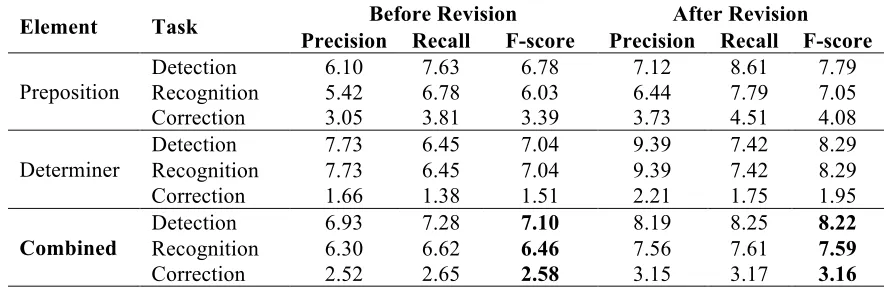
uated. Teams were asked to indicate whether they had used only publicly available data to train their systems, or whether they had made use of privately held data. We have submitted only one run (JU_run1) which has demonstrated F-scores of 7.1, 6.46 and 2.58 for detection, recognition and correc-tion respectively before revision. And after revi-sion it has demonstrated F-scores of 8.22, 7.59 and 3.16 for detection, recognition and correction re-spectively. Table 3 shows all the results of our run. We had used only publicly available data to train our systems, which are provided by the organizer as training set; we didn’t use any privately held data.
6
Conclusion and Future Works
Our system has achieved F-scores of 8.22, 7.59 and 3.16 in detection, recognition and correction respectively. Our system failed to detect and cor-rect many syntactic and semantic errors like wrong
a determiner. Since the data consists of mostly mail conversation, it retains huge number of spelling mistakes, which misdirected the statistical, and rule based model to detect probable errors. For
the determiner, if the size of the produced lists in-creases, better accuracy can be achieved with the rule-based system. Co-reference is another issue to identify, as the determiner is used mostly subse-quent references. Anaphora resolution might there-fore be of some help.
Element Task Before Revision After Revision
Precision Recall F-score Precision Recall F-score
Preposition Detection Recognition 6.10 5.42 7.63 6.78 6.78 6.03 7.12 6.44 8.61 7.79 7.79 7.05 Correction 3.05 3.81 3.39 3.73 4.51 4.08
Determiner
Detection 7.73 6.45 7.04 9.39 7.42 8.29
Recognition 7.73 6.45 7.04 9.39 7.42 8.29 Correction 1.66 1.38 1.51 2.21 1.75 1.95
Combined
Detection 6.93 7.28 7.10 8.19 8.25 8.22
Recognition 6.30 6.62 6.46 7.56 7.61 7.59
[image:6.612.81.525.509.654.2]Correction 2.52 2.65 2.58 3.15 3.17 3.16
Acknowledgments
We acknowledge the support of the IFCPAR fund-ed Indo-French project “An Advancfund-ed Platform for Question Answering Systems” and the DIT, Gov-ernment of India funded project “Development of English to Indian Language Machine Translation (EILMT) System Phase II”.
References
Adriane Boyd and Detmar Meurers. Data-Driven Cor-rection of FunctionWords in Non-Native English. In 2011 Generation Challenges, HOO: Helping Our Own in the Proceedings of the 13th European
Work-shop on Natural Language Generation (ENLG), 28th – 30th September, 2011, Nancy, France.
Anas Elghafari, Detmar Meurers and Holger Wunsch, 2010. Exploring the Data-Driven Prediction of Prep-ositions in English. In the Proceedings of the 23rd In-ternational Conference on Computational Linguistics, Beijing, China, 2010.
George Heidorn. 2000. Intelligent writing assistance. In R Dale, H Moisl, and H Somers, editors, Handbook of Natural Language Processing, pages 181–207. Marcel Dekker Inc.
GE Heidorn. 1975. Augmented phrase structure gram-mars. In: BL Webber, RC Schank, eds. Theoretical Issues in Natural Language Processing. Assoc. for Computational Linguistics, pp.1-5.
J R Tetreault and M S Chodorow. 2008. The ups and downs of preposition error detection in ESL writing.
In Proceedings of the 22nd International Conference
on Computational Linguistics, pp-865-872, Manches-ter,2008.
Pinaki Bhaskar, Aniruddha Ghosh, Santanu Pal and Sivaji Bandyopadhyay. May I correct the English of your paper!!!. In 2011 Generation Challenges, HOO: Helping Our Own in the Proceedings of the 13th Eu-ropean Workshop on Natural Language Generation
(ENLG), pp 250-253, 28th – 30th September, 2011, Nancy, France.
Robert Dale and A Kilgarriff. 2010. Helping Our Own: Text massaging for computational linguistics as a new shared task. In Proceedings of the 6th Interna-tional Natural Language Generation Conference, Dublin, Ireland, pages 261–266, 7th-9th July 2010. Robert Dale and A Kilgarriff. 2011. Helping our own:
The HOO 2011 pilot shared task. In Proceedings of
the 13th European Workshop on Natural Language Generation (ENLG), 28th – 30th September, 2011, Nancy, France.
Robert Dale and George Narroway. 2012. A framework for evaluating text correction. In Proceedings of the Eighth International Conference on Language Re-sources and Evaluation (LREC2012), 21–27 May 2012.