D S Sharma, R Sangal and J D Pawar. Proc. of the 11th Intl. Conference on Natural Language Processing, pages 56–62, Goa, India. December 2014. c2014 NLP Association of India (NLPAI)
Use of GPU and Feature Reduction for Fast Query-by-Example Spoken
Term Detection
Gautam Mantena, Kishore Prahallad
International Institute of Information Technology - Hyderabad, India [email protected], [email protected]
Abstract
For query-by-example spoken term de-tection (QbE-STD) on low resource lan-guages, variants of dynamic time warp-ing techniques (DTW) are used. How-ever, DTW-based techniques are slow and thus a limitation to search in large spo-ken audio databases. In order to enable fast search in large databases, we exploit the use of intensive parallel computations of the graphical processing units (GPUs). In this paper, we use a GPU to improve the search speed of a DTW variant by parallelizing the distance computation be-tween the Gaussian posteriorgrams of spo-ken query and spospo-ken audio. We also use a faster method of searching by av-eraging the successive Gaussian posterior-grams to reduce the length of the spoken audio and the spoken query. The results in-dicate an improvement of about 100x with a marginal drop in search performance.
1 Introduction
Query by example spoken term detection (QbE-STD) task is to detect a spoken query within a spo-ken audio database. In a conventional approach, an automatic speech recognition (ASR) system is used to convert the speech signal to a sequence of symbols and then text-based search techniques are exploited for search (Sz¨oke et al., 2008), (Saraclar and Sproat, 2004), (Miller et al., 2007). How-ever, ASR-based techniques assume the availabil-ity of labelled data for training the acoustic and language models and thus a limitation for low re-source languages. To overcome this issue, dy-namic time warping (DTW) based techniques are
proposed for QbE-STD search (Zhang and Glass, 2009), (Anguera and Ferrarons, 2013), (Mantena et al., 2014), (Gupta et al., 2011), (Hazen et al., 2009).
Parameters extracted from the speech signal such as Mel-frequency cepstral coefficients and frequency domain linear prediction cepstral coef-ficients (Thomas et al., 2008), (Ganapathy et al., 2010) cannot be used directly as they also cap-ture speaker information. To overcome this is-sue, Gaussian (Zhang and Glass, 2009), (Anguera and Ferrarons, 2013), (Mantena et al., 2014) and phone (Gupta et al., 2011), (Hazen et al., 2009) posteriorgrams are used as feature representations for DTW-based search. Gaussian posteriorgrams are a popular feature representation in low re-source scenarios as they do not require any prior labelled data to compute them. In (Zhang and Glass, 2009), (Mantena et al., 2014), (Anguera, 2012), Gaussian posteriorgrams are shown to be a good feature representation to suppress speaker characteristics and to perform search across multi-lingual data.
Segmental DTW (S-DTW) is a popular tech-nique for searching a spoken query within a spo-ken audio data (Zhang and Glass, 2009). In (Zhang and Glass, 2011), it is shown that the com-putational upper bound of S-DTW is of the or-der O(mn2), where m, n are the lengths of the
spoken audio and spoken query respectively. To improve the search time, variants of DTW-based techniques with a computational upper bound of
Sproat, 2004), (Miller et al., 2007) and thus a lim-itation for searching large databases.
An approach to improve the search speed is to use hardware solutions such as graphical process-ing units (GPUs). GPU is a computprocess-ing device that are designed for intensive, highly parallel compu-tations that are often needed in real time speech applications. In ASR, GPUs have been used to compute the acoustic likelihoods for large mixture models (Shi et al., 2008), (Cardinal et al., 2008), and in building computation intensive machine learning algorithms such as deep neural networks (Povey et al., 2011), (Bergstra et al., 2010). In (Zhang et al., 2012), GPUs were used to perform constraint based search to prune out the spoken audio references to perform the QbE-STD search. The pruning process was implemented by comput-ing a lower bound estimate for DTW.
In this paper, we use a GPU to improve the search speed of NS-DTW using Gaussian poste-riorgrams as feature representation of speech. The contributions of this paper are as follows: (a) Ex-perimental results to show the effect of the Gaus-sian posteriorgram dimension on the QbE-STD search using NS-DTW algorithm, (b) GPU imple-mentation of NS-DTW. The results indicate that by using a GPU, NS-DTW search speed can be made independent (an approximation) of the di-mension of the Gaussian posteriorgram, and (c) We also use a faster method of searching by av-eraging the successive Gaussian posteriorgrams to reduce the length of the spoken audio and the spo-ken query. The results indicate an improvement of about 100x with a marginal drop in search perfor-mance.
The organization of the paper is as follows: Sec-tion 2 describes the database used in this work. In Section 3, we describe the DTW-based algorithm used to perform the search. Section 4 and Section 4.1 describes the computation of Gaussian posteri-orgrams and its effect on the search speed. Section 5 describes the GPU implementation of NS-DTW and followed by conclusions in Section 6.
2 Database and Evaluation
In this work, we use MediaEval 2012 data for eval-uation which consists of audio recorded via tele-phone in 4 South African languages (Barnard et al., 2009). We consider two data sets, develop-ment (dev) and evaluation (eval) which contain spoken audio (reference) and spoken query data.
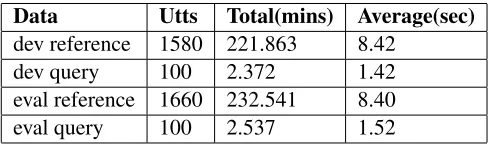
[image:2.612.315.560.101.175.2]The statistics of the audio data is shown in Table 1.
Table 1: Statistics of MediaEval 2012 data.
Data Utts Total(mins) Average(sec)
dev reference 1580 221.863 8.42
dev query 100 2.372 1.42
eval reference 1660 232.541 8.40
eval query 100 2.537 1.52
All the evaluations are performed using 2006 NIST evaluation criteria (Fiscus et al., 2007), (Metze et al., 2012) and the corresponding max-imum term weighted values (MTWV), average miss probability (MP) and false alarm probability (FAP) are reported.
3 QbE-STD using NS-DTW
In this paper, a variant of DTW-based technique referred to as non-segmental DTW (NS-DTW) is used for QbE-STD search (Mantena et al., 2014). LetQandRbe a spoken query and a spoken audio
(or reference) containingnandmfeature vectors
respectively and are given as follows:
Q = [q1,q2, . . . ,qi, . . . ,qn]d×n (1) R = [u1,u2, . . . ,uj, . . . ,um]d×m (2)
Each of these feature vectors represent a d
di-mensional Gaussian posteriorgrams (as described in Section 4). The distance measure between a query vector qi and a reference vector uj is the
negative logarithm of the cosine similarity of the two vectors and is given by:
d(i, j) =−log ˆqTi ˆuj
, (3)
whereˆqi= ||qqii|| andˆuj = ||uujj||.
A similarity matrix S of size m ×n is
com-puted to align the reference and query feature vec-tors. Let i, j represent a column and a row of a
matrix. For DTW search, the start and end time stamps are approximated by allowing the query to start from any point in the reference and is given byS(1, j) =d(1, j). Once the matrixSis
initial-ized the update equations for alignment are given by Eq. 4.
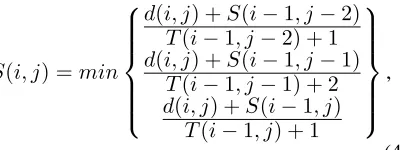
S(i, j) =min
d(i, j) +S(i−1, j−2)
T(i−1, j−2) + 1
d(i, j) +S(i−1, j−1)
T(i−1, j−1) + 2
d(i, j) +S(i−1, j)
T(i−1, j) + 1 ,
(4) whereT(i, j) is a transition matrix which rep-resents the number of transitions required to reach
i, jfrom a start point. On computing the similarity
matrix, the end point of the query within a refer-ence is given byminj{S(n, j)}and followed by a path traceback to obtain the start time stamp.
In segmental-DTW the reference is partitioned based on the length of the query and a DTW is performed for each partition resulting in a compu-tational upper bound ofO(mn2)for search. How-ever, in NS-DTW, the reference is not partitioned and a similarity matrix of size m × n is
com-puted resulting in a computational upper bound of
O(mn)(Mantena et al., 2014).
During the QbE-STD search, there is a possi-bility of the query to be present in the reference more than once. Hence, 5 best alignment scoring indices are considered from the similarity matrix (Mantena et al., 2014).
4 Feature Representation using Gaussian Posteriorgrams
In general, Gaussian posteriorgrams are obtained by a two step process (Anguera, 2012), (Mantena et al., 2014). In the first step, acoustic parameters such as frequency domain linear prediction cep-stral coefficients (FDLP) are extracted from the speech signal (Mantena et al., 2014). A 25 ms window length with 10 ms shift is considered to extract 13 dimensional features along with delta and acceleration coefficients for FDLP. An all-pole model of order 160 all-poles/sec and 37 filter banks are considered to extract FDLP.
In general, spectral features such as Mel-frequency cepstral coefficients (MFCC) are used to compute Gaussian posteriorgrams. However, in (Mantena et al., 2014), we have shown that the FDLP parameters were working better than the conventional features such as MFCC.
In the second step, Gaussian posteriorgrams are computed by training a Gaussian mixture model (GMM) with d number of Gaussians using the
spoken audio data and the posterior probability ob-tained from each Gaussian is used to represent the
acoustic parameter. Thus, 39 dimensional FDLP parameters are mapped toddimensional Gaussian
posteriorgrams. In Section 4.1 we provide experi-mental results to show the effect ofdon the search
speed in the context of QbE-STD.
4.1 Effect of Gaussian Posteriorgram Dimension on the Search Time
[image:3.612.94.295.58.133.2]In this Section, we compute the search perfor-mance and search time on dev dataset by vary-ing the number of Gaussians (d). We consider the search time as the time required to search all the queries within a reference dataset. Table 2 show the miss probability (MP), false alarm probability (FAP), maximum term weighted value (MTWV), and search time (in minutes) obtained using the Gaussian posteriorgrams of FDLP for various val-ues ofd.
Table 2: Miss probability (MP), false alarm prob-ability (FAP), maximum term weighted value (MTWV) and search time on dev dataset for vari-ous Gaussian posteriorgram dimensions (d) (Man-tena et al., 2014).
d MP MTWV
Search
FAP Time
(10−2) (mins)
8 0.824 0.595 0.084 18.39
16 0.652 0.917 0.207 22.57
32 0.540 1.098 0.292 30.60
64 0.465 1.207 0.349 47.53
128 0.426 1.136 0.399 80.24
256 0.400 1.241 0.410 145.07
512 0.476 0.658 0.422 274.98
1024 0.413 1.009 0.432 534.15
From Table 2, it can be seen that MTWV in-creases with an increase in d. However, with an
increase indthere is increase in search time and
thus resulting a slower QbE-STD search. In (Man-tena et al., 2014), d = 128 is considered as an optimum value of the Gaussian posteriorgram di-mension based on the MTWV and the search time. A more detailed description of the performance of NS-DTW by varying the dimensions of the Gaus-sian posteriorgrams is given in (Mantena et al., 2014).
by Eq. (4)) along with the path traceback for
[image:4.612.361.488.64.227.2]d = 128(as shown in Table 3). It is to be noted that the path traceback includes the selection of 5 best alignment scoring indices from each of the reference file and thereby obtaining the start and end time stamps.
Table 3: Time taken for distance computation,
d(i, j), and for update equations, S(i, j), along
with the alignment path traceback. It is to be noted that we used= 128as the dimension of the Gaus-sian posteriorgrams.
Time (mins)
d(i, j) 66.15
S(i, j)+
14.08 Path traceback
From Table 3, it can be seen that the distance computation occupies 82.44% of the total search time. Thus, we are motivated to use GPUs for fast distance computation. A more detailed description of GPU implementation of NS-DTW is provided in Section 5.
5 GPU Accelerated NS-DTW
In this Section, we use NVIDIA CUDA frame-work to exploit parallel processing for fast QbE-STD search. CUDA follows a single instruction multiple data (SIMD) paradigm where the GPU cores executes the same instruction on different portions of the data (Nickolls et al., 2008). DTW-based variants perform the update equations in a sequential manner and thus an issue for GPU im-plementations (Zhang et al., 2012), (Sart et al., 2010). A solution to overcome the problem is to parallelize a part of the computation such as the distance calculation for a search speedup. In this paper, we use NVIDIA GT 610 graphic card with 48 cores and a GPU memory of 2048 MB.
CUDA is known for fast matrix operations such as multiplication and thus we exploit its use for distance computation. To exploit the computing power of the GPU, we use matrix multiplication of the complete reference (R) and query (Q) fea-ture vectors. LetSˆrepresent anm×nmatrix such thatSˆ(i, j) = d(i, j). Sˆ can be obtained as fol-lows: Sˆ = −log(RTQ), whereR andQ are the reference and query feature vectors (as described in Eq. (1) and Eq. (2)). It is to be noted that
RTQrepresents anm×nmatrix andlog(RTQ) performs a logarithmic operation on all them×n
elements in the matrix.
Log
S^
Query (Q)
GPU Reference (R)
[image:4.612.116.265.207.266.2]Matrix Multiplication (RTQ)
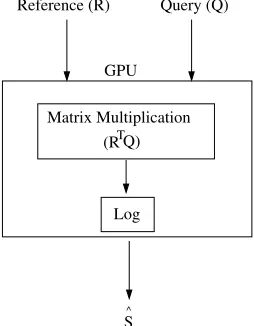
Figure 1: A general block diagram of the distance computation in a GPU for NS-DTW.
The GPU implementation of the NS-DTW is as follows:
1. CPU copies the reference and query Gaussian posteriorgrams into the GPU memory.
2. To initializeSˆ, CUDA kernels (or functions) are used and is obtained in a two step process: (a) Firstly, the dot product is performed using matrix multiplication given byRTQ, and (b) Then the log operation is performed. Fig. 1 shows a general block diagram of the opera-tions performed using GPU to obtainSˆ.
3. The CPU, then copies theSˆ into the system memory (RAM) and then performs the up-date equations as described in Eq. (4). It is to be noted that the distance of each of the query and reference Gaussian posteriorgrams have been computed inStep 2and thus we use
ˆ
S(i, j) instead ofd(i, j) in the update equa-tions given by Eq. (4).
5.1 Use of Batch Processing for Search
To maximize the number of parallel computations on the GPU we use batch processing wherein NS-DTW is performed on a query Q and the entire
database of references pooled to a single sequence of Gaussian posteriorgrams. This single sequence of Gaussian posteriorgrams is referred to as a ref-erence batch (Rb) and is given as follows:
Rb = [R1d×m1, R2d×m2, . . . ,
whereRdk×m
k is a matrix of sized×mkwhich
represents the kth reference containing mk se-quence of Gaussian posteriorgrams of dimension
d. The size ofRb isd×M, whereM = L P k=1
mk.
On obtaining Rb, Sˆ is then computed as fol-lows: Sˆ = −log(RT
bQ). IfRb is very large we split the data into a smaller batches and processes a single batch at a time. On computing the simi-larity matrixS, we select500best alignment score indices and perform a path trace back to obtain the start time stamps of the possible search hits. From the dev dataset, we have observed that there were no queries which are present in more than 500 spo-ken audio and thus we select 500 best alignment score indices for detection.
[image:5.612.95.274.413.550.2]5.2 Comparison of Search Time: GPU vs CPU
Fig. 2 shows the search speed of NS-DTW us-ing CPU and GPU cores. It is to be noted that we use batch processing on the GPU for QbE-STD search. From Fig. 2, it can be seen that the GPU implementation is faster than that of the CPU and the search speed is independent (an approxima-tion) of the dimension (d).
8 16 32 64 128 256 512 1024
0 100 200 300 400 500 600
d
Time (minutes)
CPU GPU
Figure 2: NS-DTW search time on dev data by varying the dimensions of the Gaussian posterior-grams using CPU and GPU cores.
To summarize the search performance and speed of NS-DTW, in Table 4 we show MP, FAP, MTWV and speedup of QbE-STD search ford≥
128using a GPU. We define speedup as the ratio of NS-DTW search time on CPU and to that of the search time obtained using a GPU.
[image:5.612.325.511.528.682.2]From Table 4, it can be seen that there is an improvement in the search performance (MTWV) ford = 128,256, 512, 1024as compared to the
Table 4: Miss probability (MP), false alarm prob-ability (FAP), maximum term weighted value (MTWV) and search speed on dev dataset using a GPU ford= 128,256,512,1024.
d MP FAP( MTWV Speedup
10−2)
128 0.363 1.214 0.450 6.91x
256 0.393 1.010 0.452 11.48x
512 0.359 1.078 0.475 27.06x
1024 0.334 1.149 0.489 40.80x
MTWVs as shown in Table 2. It is to be noted that, to compute the values in Table 2 we have selected 5 best alignment scores from each referenceR(as
described in Section 3) and to compute the values in Table 4, we have selected 500 best alignment scores from the reference batch Rb (as described in Section 5.1). The results indicate a decrease in the miss probability in Table 4 as compared to that of Table 2 ford= 128,256,512,1024and thus an improvement in the search performance (MTWV).
5.3 Use of Feature Reduction for Search
In this Section, we intend to further improve the search time by modifying the NS-DTW. In this pa-per, we reduce the query and reference Gaussian posteriorgram vectors before performing search. In this method, we average the successive Gaus-sian posteriorgrams to reduce the length of the spoken audio and the spoken query.
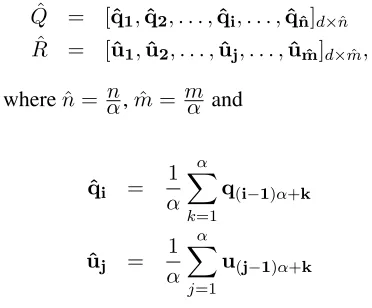
Consider a reduction factor α ∈ N. Let Qˆ, Rˆ
be the sequence of reduced set of feature vectors representing the query and reference.QˆandRˆare obtained as follows:
ˆ
Q = [qˆ1,ˆq2, . . . ,qˆi, . . . ,ˆqˆn]d×nˆ
ˆ
R = [uˆ1,uˆ2, . . . ,uˆj, . . . ,uˆmˆ]d×mˆ,
wherenˆ= αn,mˆ = mα and
ˆ qi =
1
α α X
k=1
q(i−1)α+k
ˆ uj =
1
α α X
j=1
u(j−1)α+k
Given a reduction factor α ∈ N, a window of size α is considered over the posteriorgram
fea-tures and a mean is computed. The window is then shifted byαand another mean vector is computed.
Table 5: Maximum term weighted value (MTWV), speedup and memory usage (%) obtained on dev and eval datasets forα= 1,2,3andd= 1024using a GPU. It is to be noted that forα= 1, the GPU memory
is not sufficient to load the whole reference dev and eval database. Thus, forα = 1, the reference dev and eval datasets are partitioned into 2 and 3 smaller batches respectively.
α dev eval
MTWV Speedup Memory MTWV Speedup Memory
1 0.489 40.80x 83.15% 0.469 41.37x 63.46%
2 0.474 116.37x 88.63% 0.453 117.34 91.03%
3 0.462 211.12x 61.73% 0.4353 217.60x 63.31%
1 2 3 4 5 6
0.35 0.4 0.45 0.5
α
MTWV d=128d=256 d=512 d=1024
1 2 3 4 5 6
0 200 400 600
α
Speedup
d=128 d=256 d=512 d=1024
1 2 3 4 5 6
0 25 50 75 100
α
GPU Memory (%)
d=128 d=256 d=512 d=1024
(a)
(c) (b)
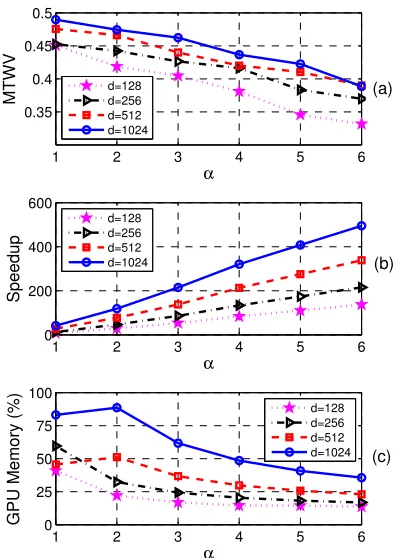
Figure 3: (a) MTWV, (b) Speedup, and (c) GPU memory usage (in percentage) obtained usingd= 128,256,512,1024for various values ofαon dev
dataset. It is to be noted thatα= 1represents the NS-DTW without feature reduction.
A more detailed description about the algorithm is provided in (Mantena et al., 2014).
In Fig. 3, we show the MTWV, speedup, and GPU memory usage (in percentage) obtained us-ingd= 128,256,512,1024forα= 1,2,3,4,5,6 on dev dataset. It is to be noted thatα = 1 rep-resents the NS-DTW without feature reduction. From Fig. 3, it can be seen that the search perfor-mance decreases with an increase inαbut there is
an improvement in speedup and GPU memory us-age. Ford= 512,1024, GPU memory is not
suffi-cient to load the whole reference batch and so it is partitioned to 2 smaller batches for search. Thus, ford= 512,1024, the memory usage is lower for α = 1as compared to that ofα= 2. From Fig. 3,
it can be also be seen that by using feature reduc-tion one can use higher dimensions of Gaussian posteriorgrams such asd= 1024and thus enable searching a query in large reference files.
[image:6.612.90.290.209.488.2]To summarize the QbE-STD performance, in Table 5, we show the MTWV, speedup and mem-ory usage (%) on dev and eval datasets for α = 1,2,3andd= 1024. It is to be noted that on
in-creasing the αthe MTWV decreases and thus
re-sulting in a poor search performance (as shown in Fig. 3 ). From Table 5, it can be seen that there is a good improvement in the speedup forα= 2 re-sulting in a marginal drop in search performance. Thus, with the use of a GPU and feature reduction forα= 2we could attain a speedup of about 100x and thereby enable QbE-STD search in real time.
6 Conclusions
In this paper, we used a graphical processing unit (GPU) and improved the computation time of the distance calculation of non-segmental dy-namic time warping (NS-DTW) algorithm in the context query-by-example spoken term detection (QbE-STD) search. We have shown with experi-mental results that the NS-DTW search speed can be made independent (an approximation) of the dimension of the Gaussian posteriorgram using a GPU. We have also used a faster method of search-ing by reducsearch-ing the length of the spoken audio and the spoken query. The reduction of the feature vec-tors was done via arithmetic mean and it is shown that for a reduction factor ofα= 2, there is an
dimensional Gaussian posteriorgrams.
7 Acknowledgements
We would like to thank P. J. Narayanan, Kishore Kothapalli, Manoj Maramreddy and Sivanand Achanta from IIIT-H, India for their feedback on the GPU implementations of NS-DTW. We would also like to thank TCS, India for partially support-ing Gautam’s PhD fellowship.
References
X. Anguera and M. Ferrarons. 2013. Memory effi-cient subsequence DTW for query-by-example spo-ken term detection. InProc. of ICME.
X. Anguera. 2012. Speaker independent discriminant feature extraction for acoustic pattern-matching. In
Proc. of ICASSP, pages 485–488.
E. Barnard, M. H. Davel, and C. J. V. Heerden. 2009. ASR corpus design for resource-scarce languages. InProc. of INTERSPEECH, pages 2847–2850.
J. Bergstra, O. Breuleux, F. Bastien, P. Lamblin, R. Pas-canu, G. Desjardins, J. Turian, D. Warde-Farley, and Y. Bengio. 2010. Theano: a CPU and GPU math
expression compiler. Inin Proc. of the Python for
Scientific Computing Conference, June. Oral Pre-sentation.
P. Cardinal, P. Dumouchel, G. Boulianne, and M. Comeau. 2008. GPU accelerated acoustic
like-lihood computations. InProc. of INTERSPEECH,
pages 964–967.
J. G. Fiscus, J. Ajot, J. S. Garofolo, and G. Dodding-ton. 2007. Results of the 2006 spoken term
detec-tion evaluadetec-tion. InProc. of Workshop on Searching
Spontaneous Conversational Speech, pages 45–50.
S. Ganapathy, S. Thomas, and H. Hermansky.
2010. Temporal envelope compensation for
ro-bust phoneme recognition using modulation
spec-trum. Journal of Acoustical Society of America,
128:3769–3780.
V. Gupta, J. Ajmera, A., and A. Verma. 2011. A language independent approach to audio search. In
Proc. of INTERSPEECH, pages 1125–1128.
T. J. Hazen, W. Shen, and C. White. 2009. Query-by-example spoken term detection using phonetic pos-teriorgram templates. InProc. of ASRU, pages 421– 426.
G. Mantena, S. Achanta, and K. Prahallad. 2014. Query-by-example spoken term detection using fre-quency domain linear prediction and non-segmental
dynamic time warping.IEEE/ACM Trans. on Audio,
Speech and Lang. Processing, 22(5):946–955, May.
F. Metze, E. Barnard, M. H. Davel, C. J. V. Heerden, X. Anguera, G. Gravier, and N. Rajput. 2012. The spoken web search task. InMediaEval.
D. R. H. Miller, M. Kleber, C.-L. Kao, O. Kimball, T. Colthurst, S. A. Lowe, R. M. Schwartz, and H. Gish. 2007. Rapid and accurate spoken term
detection. InProc. of INTERSPEECH, pages 314–
317.
J. Nickolls, I. Buck, M. Garland, and K. Skadron. 2008. Scalable parallel programming with cuda.
Queue, 6(2):40–53, March.
D. Povey, A. Ghoshal, G. Boulianne, L. Burget, O. Glembek, N. Goel, M. Hannemann, P. Motlicek, Y. Qian, P. Schwarz, J. Silovsky, G. Stemmer, and K. Vesely. 2011. The Kaldi speech recognition toolkit. Inin Proc. of ASRU. IEEE Signal Process-ing Society, December.
M. Saraclar and R. Sproat. 2004. Lattice-based search
for spoken utterance retrieval. In Proc. of
HLT-NAACL, pages 129–136.
D. Sart, A. Mueen, W. Najjar, E. Keogh, and V. Nien-nattrakul. 2010. Accelerating dynamic time warp-ing subsequence search with GPUs and FPGAs. In
in Proc. of International Conference on Data Mining (ICDM), pages 1001–1006, Dec.
Y. Shi, F. Seide, and F. K. Soong. 2008. GPU-accelerated gaussian clustering for fMPE
discrimi-native training. InProc. of INTERSPEECH, pages
944–947.
I. Sz¨oke, M. Fapso, L. Burget, and J. Cernocky. 2008. Hybrid word-subword decoding for spoken term
de-tection. In Workshop on Searching Spontaneous
Conversational Speech, pages 4–11.
S. Thomas, S. Ganapathy, and H. Hermansky. 2008. Recognition of reverberant speech using frequency
domain linear prediction. IEEE Signal Processing
Letters, 15:681 –684.
Y. Zhang and J. R. Glass. 2009. Unsupervised spoken keyword spotting via segmental DTW on Gaussian posteriorgrams. InProc. of ASRU, pages 398–403.
Y. Zhang and J. Glass. 2011. An inner-product
lower-bound estimate for dynamic time warping. InProc.
of ICASSP, pages 5660–5663.
Y. Zhang, K. Adl, and J. Glass. 2012. Fast spoken query detection using lower-bound dynamic time
warping on graphical processing units. Inin Proc.
of ICASSP, pages 5173–5176, March.