An Analysis of Memory-based Processing Costs using Incremental
Deep Syntactic Dependency Parsing
∗Marten van Schijndel
The Ohio State University
Luan Nguyen
University of Minnesota
William Schuler
The Ohio State University
Abstract
Reading experiments using naturalistic stimuli have shown unanticipated facili-tations for completing center embeddings when frequency effects are factored out. To eliminate possible confounds due to surface structure, this paper introduces a processing model based on deep syntac-tic dependencies. Results on eye-tracking data indicate that completing deep syntac-tic embeddings yields significantly more facilitation than completing surface em-beddings.
1 Introduction
Self-paced reading and eye-tracking experiments have often been used to support theories about inhibitory effects of working memory operations in sentence processing (Just and Carpenter, 1992; Gibson, 2000; Lewis and Vasishth, 2005), but it is possible that many of these effects can be ex-plained by frequency (Jurafsky, 1996; Hale, 2001; Karlsson, 2007). Experiments on large naturalis-tic text corpora (Demberg and Keller, 2008; Wu et al., 2010; van Schijndel and Schuler, 2013) have shown significant memory effects at the ends of center embeddings when frequency measures have been included as separate factors, but these mem-ory effects have been facilitatory rather than in-hibitory.
Some of the memory-based measures that pro-duce these facilitatory effects (Wu et al., 2010; van Schijndel and Schuler, 2013) are defined in terms of initiation and integration ofconnected compo-nentsof syntactic structure,1with the presumption
∗
*Thanks to Micha Elsner and three anonymous review-ers for their feedback. This work was funded by an Ohio State University Department of Linguistics Targeted Investment for Excellence (TIE) grant for collaborative interdisciplinary projects conducted during the academic year 2012–13.
1Graph theoretically, the set of connected components
that referents that belong to the same connected component may cue one another using content-based features, while those that do not must rely on noisier temporal features that just encode how recently a referent was accessed. These measures, based on left-corner parsing processes (Johnson-Laird, 1983; Abney and Johnson, 1991), abstract counts of unsatisfied dependencies from noun or verb referents (Gibson, 2000) to cover all syntactic dependencies, motivated by observations of Dem-berg and Keller (2008) and Kwon et al. (2010) of the inadequacies of Gibson’s narrower measure.
But these experiments use naturalistic stimuli without constrained manipulations and therefore might be susceptible to confounds. It is possible that the purely phrase-structure-based connected components used previously may ignore some in-tegration costs associated with filler-gap construc-tions, making them an unsuitable generalization of Gibson-style dependencies. It is also possible that the facilitatory effect for integration operations in naturally-occurring stimuli may be driven by syn-tactic center embeddings that arise from modifiers (e.g. The CEO sold [[the shares] of the
com-pany]), which do not require any dependencies
to be deferred, but which might be systematically under-predicted by frequency measures, produc-ing a confound with memory measures when fre-quency measures are residualized out.
In order to eliminate possible confounds due to exclusion of unbounded dependencies in filler-gap constructions, this paper evaluates a processing model that calculates connected components on deep syntactic dependency structures rather than surface phrase structure trees. This model ac-counts unattached fillers and gaps as belonging to separate connected components, and therefore performs additional initiation and integration
op-of a graph hV,Ei is the set of maximal subsets of it {hV1,E1i,hV2,E2i, ...} such that any pair of vertices in eachVican be connected by edges in the correspondingEi.
a) Noun Phrase
Relative Clause
Sentence w. Gap
Verb Phrase w. Gap
Sentence w. Gap
millions stole
say
officials who
Noun Phrase
person the
b)
i1
i2 i3
i4 i5
i6
i7
1
2 1
2
1
1
say
officials
stole
who person
millions
the 0
0
0
0 0
0
[image:2.595.72.289.69.254.2]0
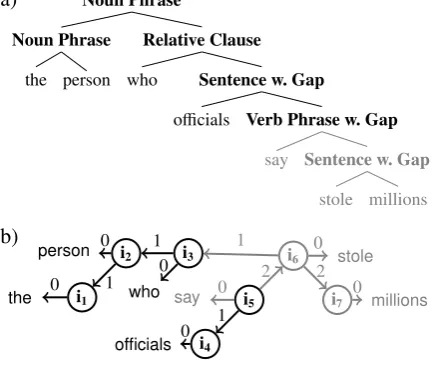
Figure 1: Graphical representation of (a) a single connected component of surface syntactic phrase structure corresponding to (b) two connected com-ponents of deep syntactic dependency structure for the noun phrasethe person who officials say stole
millions, prior to the word say. Connections
es-tablished prior to the wordsayare shown in black; subsequent connections are shown in gray.
erations in filler-gap constructions as hypothesized by Gibson (2000) and others. Then, in order to control for possible confounds due to modifier-induced center embedding, this refined model is applied to two partitions of an eye-tracking cor-pus (Kennedy et al., 2003): one consisting of sen-tences containing only non-modifier center em-beddings, in which dependencies are deferred, and the other consisting of sentences containing no center embeddings or containing center embed-dings arising from attachment of final modifiers, in which no dependencies are deferred. Processing this partitioned corpus with deep syntactic con-nected components reveals a significant increase in facilitation in the non-modifier partition, which lends credibility to the observation of negative integration cost in processing naturally-occurring sentences.
2 Connected Components
The experiments described in this paper evalu-ate whether inhibition and facilitation in reading correlate with operations in a hierarchic sequen-tial prediction model that initiate and integrate connected components of hypothesized syntactic structure during incremental parsing. The model used in these experiments refines previous
con-nected component models by allowing fillers and gaps to occur in separate connected components of a deep syntactic dependency graph (Mel’ˇcuk, 1988; Kintsch, 1988), even when they belong to the same connected component when defined on surface structure.
For example, the surface syntactic phrase struc-ture and deep syntactic dependency strucstruc-ture for the noun phrasethe person who officials say stole
millions are shown in Figure 1.2 Notice that
af-ter the wordofficials, there is only one connected component of surface syntactic phrase structure (from the root noun phrase to the verb phrase with gap), but two disjoint connected components of deep syntactic dependency structure (one ending ati3, and another ati5). Only the deep syntactic
dependency structure corresponds to familiar (Just and Carpenter, 1992; Gibson, 1998) notions of how memory is used to store deferred dependen-cies in filler-gap constructions. The next section will describe a generalized categorial grammar, which (i) can be viewed as context-free, to seed a latent-variable probabilistic context-free grammar to accurately derive parses of filler-gap construc-tions, and (ii) can be viewed as a deep syntactic dependency grammar, defining dependencies for connected components in terms of function appli-cations.
3 Generalized Categorial Grammar
In order to evaluate memory effects for hypothe-sizing unbounded dependencies between referents of fillers and referents of clauses containing gaps, a memory-based processor must define connected components in terms of deep syntactic dependen-cies (including unbounded dependendependen-cies) rather than in terms of surface syntactic phrase structure trees. To do this, at least some phrase structure edges must be removed from the set of connec-tions that define a connected component.
Because these unbounded dependencies are not represented locally in the original Treebank for-mat, probabilities for operations on these modified
2Following Mel’ˇcuk (1988) and Kintsch (1988),
connected components are trained on a corpus an-notated with generalized categorial grammar de-pendencies for ‘gap’ arguments at all categories that subsume a gap (Nguyen et al., 2012). This representation is similar to the HPSG-like repre-sentation used by Hale (2001) and Lewis and Va-sishth (2005), but has a naturally-defined depen-dency structure on which to calculate connected components. This generalized categorial grammar is then used to identify the first sign that introduces a gap, at which point a deep syntactic connected component containing the filler can be encoded (stored), and a separate deep syntactic connected component for a clause containing a gap can be initiated.
A generalized categorial grammar (Bach, 1981) consists of a set U of primitive category types; a setOof type-constructing operators allowing a recursive definition of a set of categoriesC =def
U ∪(C × O× C); a set X of vocabulary items; a mapping M from vocabulary items in X to se-mantic functions with category types in C; and a set R of inference rules for deriving functions with category types inCfrom other functions with category types in C. Nguyen et al. (2012) use primitive category types for clause types (e.g. V
for finite verb-headed clause, N for noun phrase or nominal clause, D for determiners and pos-sessive clauses, etc.), and use the generalized set of type-constructing operators to characterize not only function application dependencies between arguments immediately ahead of and behind a functor (-aand-b, corresponding to ‘\’ and ‘/’ in Ajdukiewicz-Bar-Hillel categorial grammars), but also long-distance dependencies between fillers and categories subsuming gaps (-g), dependencies between relative pronouns and antecedent modif-icands of relative clauses (-r), and dependencies between interrogative pronouns and their argu-ments (-i), which remain unsatisfied in derivations but function to distinguish categories for content and polar questions. A lexicon can then be de-fined in M to introduce lexical dependencies and obligatory pronominal dependencies using num-bered functions for predicates and deep syntactic arguments, for example:
the⇒(λi (0i)=the) :D
person⇒(λi (0i)=person) :N-aD
who⇒(λk i(0i)=who∧(1i)=k) :N-rN
officials⇒(λi (0i)=officials) :N
the D
person N-aD
N Aa
who N-rN
officials N
say V-aN-bV
stole V-aN-bN
millions N V-aN Ae V-gNGa V-aN-gN Ag
V-gN Ac
V-rN Fc
N R
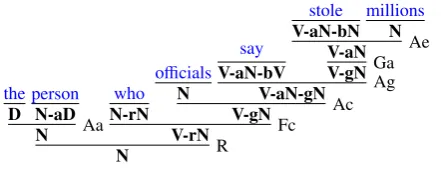
Figure 2: Example categorization of the noun phrasethe person who officials say stole millions.
say⇒(λi(0i)=say) :V-aN-bV
stole⇒(λi(0i)=stole) :V-aN-bN
millions⇒(λi(0i)=millions) :N
Inference rules in R are then defined to com-pose arguments and modifiers and propagate gaps. Arguments g of type d ahead of functors h of typec-ad are composed by passing non-local de-pendencies ψ ∈ {-g,-i,-r} ×C from premises to conclusion in all combinations:
g:d h:c-ad ⇒(fc-adg h):c (Aa)
g:dψ h:c-ad ⇒λk(fc-ad(g k)h):cψ (Ab)
g:d h:c-adψ⇒λk(fc-adg(h k)):cψ (Ac)
g:dψ h:c-adψ⇒λk(fc-ad(g k) (h k)):cψ (Ad)
Similar rules compose arguments behind functors:
g:c-bd h:d ⇒(fc-bdg h):c (Ae)
g:c-bdψ h:d ⇒λk(fc-bd(g k)h):cψ (Af)
g:c-bd h:dψ⇒λk(fc-bdg(h k)):cψ (Ag)
g:c-bdψ h:dψ⇒λk(fc-bd(g k) (h k)):cψ (Ah)
These rules use composition functions fc-ad
and fc-bdfor initial and final arguments, which
de-fine dependency edges numberedvfrom referents of predicate functorsito referents of arguments j, where v is the number of unsatisfied arguments
ϕ1...ϕv∈ {-a,-b} ×Cin a category label:
fuϕ1..v−1-ac def
= λg h i∃j(v i)=j∧(g j)∧(h i) (1a)
fuϕ1..v−1-bc def
= λg h i∃j(v i)=j∧(g i)∧(h j) (1b)
Ralso contains inference rules to compose mod-ifier functors g of type u-ad ahead of modifi-candshof typed:
g:u-ad h:c⇒(fIMg h):c (Ma)
[image:3.595.308.529.61.146.2]∃i1j1..iℓjℓ ... ∧ (gℓ:c/d{jℓ}iℓ) xt
∃i1j1..iℓ... ∧ ((gℓf):c iℓ)
xt ⇒ f:d (–Fa)
∃i1j1..iℓjℓ ... ∧ (gℓ:c/d{jℓ}iℓ) xt
∃i1j1..iℓjℓiℓ+1 ... ∧ (gℓ:c/d{jℓ}iℓ) ∧ (f:e iℓ+1)
xt ⇒ f:e (+Fa)
∃i1j1..iℓ−1jℓ−1iℓ... ∧ (gℓ:d iℓ)
∃i1j1..iℓjℓ... ∧ ((f gℓ):c/e{jℓ}iℓ)
g:d h:e⇒(f g h):c or
g:d h:e⇒λk(f(g k)h):c or
g:d h:e⇒λk(f g(h k)):c or
g:d h:e⇒λk(f(g k) (h k)):c
(–La)
∃i1j1..iℓ−1jℓ−1iℓ... ∧ (gℓ−1:a/c{jℓ−1}iℓ−1) ∧ (gℓ:d iℓ)
∃i1j1..iℓ−1jℓ−1 ... ∧ (gℓ−1◦(f gℓ):a/e{jℓ−1}iℓ−1)
g:d h:e⇒(f g h):c or
g:d h:e⇒λk(f(g k)h):c or
g:d h:e⇒λk(f g(h k)):c or
g:d h:e⇒λk(f(g k) (h k)):c
(+La)
Figure 3: Basic processing productions of a right-corner parser.
g:u-adψ h:cψ⇒λk(fIM(g k) (h k)):cψ (Md)
or for modifier functors behind a modificand:
g:c h:u-ad ⇒(fFMg h):c (Me)
g:cψ h:u-ad ⇒λk(fFM(g k)h):cψ (Mf) g:c h:u-adψ⇒λk(fFMg(h k)):cψ (Mg) g:cψ h:u-adψ⇒λk(fFM(g k) (h k)):cψ (Mh)
These rules use composition functions fIMandfFM
for initial and final modifiers, which define depen-dency edges numbered ‘1’ from referents of mod-ifier functorsito referents of modificands j:
fIM def
= λg h j∃i(1i)=j∧(g i)∧(h j) (2a)
fFM def
= λg h j∃i(1i)=j∧(g j)∧(h i) (2b)
Ralso contains inference rules for hypothesiz-ing gaps-gdfor arguments and modifiers:3
g:c-ad⇒λk(fc-ad{k}g):c-gd (Ga)
g:c-bd⇒λk(fc-ad{k}g):c-gd (Gb)
g:c⇒λk(fIM{k}g):c-gd (Gc)
and for attaching fillerse,d-re,d-ieas gaps-gd:
g:e h:c-gd⇒λi∃j(g i)∧(h i j):e (Fa)
g:d-re h:c-gd⇒λk j∃i(g k i)∧(h i j):c-re (Fb)
g:d-ie h:c-gd⇒λk j∃i(g k i)∧(h i j):c-ie (Fc)
3Since these unary inferences perform no explicit
compo-sition, they are defined to use only initial versions composi-tion funccomposi-tions fc-adand fIM.
and for attaching modificands as antecedents of relative pronouns:
g:e h:c-rd⇒λi∃j(g i)∧(h i j):e (R)
An example derivation of the noun phrasethe
per-son who officials say stole millions using these
rules is shown in Figure 2. The semantic expres-sion produced by this derivation consists of a con-junction of terms defining the edges in the graph shown in Figure 1b.
This GCG formulation captures many of the in-sights of the HPSG-like context-free filler-gap no-tation used by Hale (2001) or Lewis and Vasishth (2005): inference rules with adjacent premises can be cast as context-free grammars and weighted us-ing probabilities, which allow experiments to cal-culate frequency measures for syntactic construc-tions. Applying a latent variable PCFG trainer (Petrov et al., 2006) to this formulation was shown to yield state-of-the-art accuracy for recovery of unbounded dependencies (Nguyen et al., 2012). Moreover, the functor-argument dependencies in a GCG define deep syntactic dependency graphs for all derivations, which can be used in incremen-tal parsing to calculate connected components for memory-based measures.
4 Incremental Processing
∃i1j1..injn..iℓjℓ... ∧ (gn:y/zψ{jn}in) ∧ ... ∧ (gℓ:c/d{jℓ}iℓ) xt
∃i1j1..injn..iℓ... ∧ (gn:y/zψ{jn}in) ∧ ... ∧ ((gℓ(f′{jn}f)):c iℓ)
xt ⇒λk(f′{k}f):d
(–Fb)
∃i1j1..injn..iℓjℓ... ∧ (gn:y/zψ{jn}in) ∧ ... ∧ (gℓ:c/d{jℓ}iℓ) xt
∃i1j1..injn..iℓjℓiℓ+1 ... ∧ (gn:y/zψ{jn}in) ∧ ... ∧ (gℓ:c/d{jℓ}iℓ) ∧ ((f′{jn}f):e iℓ+1)
xt ⇒λk(f′{k} f):e
(+Fb)
∃i1j1..injn..iℓ−1jℓ−1iℓ ... ∧ (gn:y/zψ{jn}in) ∧ ... ∧ (gℓ:d iℓ)
∃i1j1..injn..iℓjℓ... ∧ (gn:y/zψ{jn}in) ∧ ... ∧ ((f gℓ)◦(f′{jn}):cψ/e{jℓ}iℓ)
g:d h:e⇒λk(f g(f′{k}h)):cψ (–Lb)
∃i1j1..injn..iℓ−1jℓ−1iℓ... ∧ (gn:y/zψ{jn}in) ∧ ... ∧ (gℓ−1:a/cψ{jℓ−1}iℓ−1) ∧ (gℓ:d iℓ)
∃i1j1..injn..iℓ−1jℓ−1 ... ∧ (gn:y/zψ{jn}in) ∧ ... ∧ (gℓ−1◦(f gℓ)◦(f′{jn}):a/e{jℓ−1}iℓ−1)
g:d h:e⇒λk(f g(f′{k}h)):cψ (+Lb)
Figure 4: Additional processing productions for attaching a referent of a filler jnas the referent of a gap.
productions, similar to those of the ‘right corner’ parser of van Schijndel and Schuler (2013), ex-cept that instead of recognizing shallow hierarchi-cal sequences of connected components of surface structure, the parser recognizes shallow hierarchi-cal sequences of connected components of deep syntactic dependencies. This parser exploits the observation (van Schijndel et al., in press) that left-corner parsers and their variants do not need to ini-tiate or integrate more than one connected compo-nent at each word. These two operations are then augmented with rules to introduce fillers and at-tach fillers as gaps.
This parser is defined onincomplete connected
component states which consist of anactive sign
(with a semantic referent and syntactic form or category) lacking anawaited sign(also with a ref-erent and category) yet to come. Semantic func-tions of active and awaited signs are simplified to denote only sets of referents, with gap arguments (λk) stripped off and handled by separate
con-nected components. Incomplete concon-nected com-ponents, therefore, always denote semantic func-tions from sets of referents to sets of referents.
This paper will notate semantic functions of connected components using variablesgandh, in-complete connected component categories asc/d
(consisting of an active sign of categoryc and an awaited sign of categoryd), and associations be-tween them as g:c/d. The semantic representa-tion used here is simply a deep syntactic depen-dency structure, so a connected component
func-tion is satisfied if it holds for some output ref-erent i given input referent j. This can be no-tated∃i j(g:c/d{j}i), where the set{j}is
equiva-lent to (λj′ j′=j). Connected component functions that have a common referent jcan then be com-posed into larger connected components:4
∃i jk(g{j}i) ∧ (h{k}j) ⇔ ∃i j (g◦h{k}i) (3)
Hierarchies of ℓ connected compo-nents can be represented as conjunctions:
∃i1j1...iℓjℓ(g1:c1/d1{j1}i1)∧...∧(gℓ:cℓ/dℓ{jℓ}iℓ). This allows constraints such as unbounded depen-dencies between referents of fillers and referents of clauses containing gaps to be specified across connected components by simply plugging vari-ables for filler referents into argument positions for gaps.
A nondeterministic incremental parser can now be defined as a deductive system, given an input sequence consisting of an initial connected com-ponent state of categoryT/T, corresponding to an existing discourse context, followed by a sequence of observationsx1,x2, . . ., processed in time order.
As eachxtis encountered, it is connected to an
ex-isting connected component or it introduces a new disjoint component using the productions shown in Figures 3, 4, and 5.
4These are connected components of dependency
∃i1j1..iℓ−1jℓ−1iℓ ... ∧ (gℓ:d iℓ)
∃i1j1..iℓjℓ ... ∧ ((f gℓ)◦(λh k i(h k)):a/eψ{jℓ}iℓ)
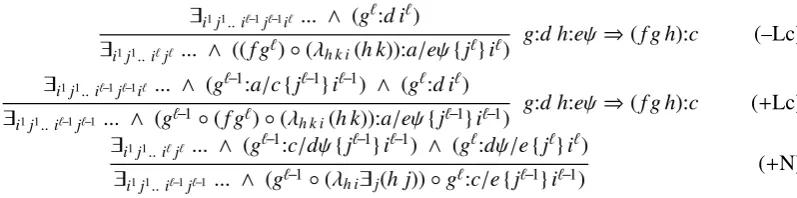
g:d h:eψ⇒(f g h):c (–Lc)
∃i1j1..iℓ−1jℓ−1iℓ ... ∧ (gℓ−1:a/c{jℓ−1}iℓ−1) ∧ (gℓ:d iℓ)
∃i1j1..iℓ−1jℓ−1 ... ∧ (gℓ−1◦(f gℓ)◦(λh k i(h k)):a/eψ{jℓ−1}iℓ−1)
g:d h:eψ⇒(f g h):c (+Lc)
∃i1j1..iℓjℓ ... ∧ (gℓ−1:c/dψ{jℓ−1}iℓ−1) ∧ (gℓ:dψ/e{jℓ}iℓ)
∃i1j1..iℓ−1jℓ−1 ... ∧ (gℓ−1◦(λh i∃j(h j))◦gℓ:c/e{jℓ−1}iℓ−1)
[image:6.595.124.523.73.172.2](+N)
Figure 5: Additional processing productions for hypothesizing filler-gap attachment.
Operations on dependencies that can be derived from surface structure (see Figure 3) are taken directly from van Schijndel and Schuler (2013). First, if an observation xt can immediately fill
the awaited sign of the last connected component
gℓ:c/d, it is hypothesized to do so, turning this incomplete connected component into a complete connected component (gℓf):c(Production –Fa); or if the observation can serve as an initial sub-sign of this awaited sign, it is hypothesized to form a new complete sign f:ein a new component withxt
as its first observation (Production +Fa). Then, if either of these resulting complete signs gℓ:d
can immediately attach as an initial child of the awaited sign of the most recent connected com-ponent gℓ−1:a/c, it is hypothesized to merge and extend this connected component, with xt as the
last observation of the completed connected com-ponent (Production +La); or if it can serve as an initial sub-sign of this awaited sign, it is hypoth-esized to remain disjoint and form its own con-nected component (Production –La). The side conditions of La productions are defined to unpack gap propagation (instances of λk that distinguish
rules Aa–h and Ma–h) from the inference rules in Section 3, because this functionality will be re-placed with direct substitution of referent variables into subordinate semantic functions, below.
The Nguyen et al. (2012) GCG was defined to pass up unbounded dependencies, but in in-cremental deep syntactic dependency processing, unbounded dependencies are accounted as sepa-rate connected components. When hypothesizing an unbounded dependency, the processing model simply cues the active sign of a previous connected component containing a filler without completing the current connected component. The four +F, –F,+L, and –L operations are therefore combined with applications of unary rules Ga–c for hypoth-esizing referents as fillers for gaps (providing f′
in the equations in Figure 4). Productions –Fb and+Fb fill gaps in initial children, and Produc-tions –Lb and+Lb fill gaps in final children. Note that the Fb and Lb productions apply to the same types of antecedents as Fa and La productions re-spectively, so members of these two sets of pro-ductions cannot be applied together.
Applications of rules Fa–c and R for introduc-ing fillers are applied to store fillers as existentially quantified variable values in Lc productions (see Figure 5). These Lc productions apply to the same type of antecedent as La and Lb productions, so these also cannot be applied together.
Finally, connected components separated by gaps which are no longer hypothesized (ψ) are reattached by a +N production. This +N pro-duction may then be paired with a –N propro-duction which yields its antecedent unchanged as a conse-quent. These N productions apply to antecedents and consequents of the same type, so they may be applied together with one F and one L production, but since the+N production removes in its conse-quent a ψ argument required in its antecedent, it may not apply more than once in succession (and applying the –N production more than once in suc-cession has no effect).
An incremental derivation of the noun phrase
the person who officials say stole millions, using these productions, is shown in Figure 6.
5 Evaluation
∃i0 (..:T/T{i0}i0) the
∃i0i2 (..:T/T{i0}i0) ∧ (..:N/N-aD{i2}i2)
+Fa,–La,–N person
∃i0i2 (..:T/T{i0}i0) ∧ (..:N/V-rN{i2}i2)
–Fa,–La,–N who
∃i0i2i3 (..:T/T{i0}i0) ∧ (..:N/V-gN{i3}i2)
+Fa,+Lc,–N officials
∃i0i2i3i5 (..:T/T{i0}i0) ∧ (..:N/V-gN{i3}i2) ∧ (..:V-gN/V-aN-gN{i5}i5)
+Fa,–La,–N say
∃i0i2i6 (..:T/T{i0}i0) ∧ (..:N/V-aN{i6}i2)
+Fb,+La,+N stole
∃i0i2i7 (..:T/T{i0}i0) ∧ (..:N/N{i7}i2)
+Fa,+La,–N millions
∃i0 (..:T/T{i0}i0)
[image:7.595.72.525.65.177.2]–Fa,+La,–N
Figure 6: Derivation ofthe person who officials say stole millions,showing connected components with unique referent variables (calculated according to the equations in Section 4). Semantic functions are abbreviated to ‘..’ for readability. This derivation yields the following lexical relations: (0i1)=the,
(0i2)=person, (0i3)=who, (0i4)=officials, (0i5)=say, (0i6)=stole, (0i7)=millions, and the following
argument relations: (1i2)=i1, (1i3)=i2, (1i5)=i4, (2i5)=i6, (1i6)=i3, (2i6)=i7.
(Petrov et al., 2006). When applied to the output of this trainer, this transform has been shown to produce comparable accuracy to that of the origi-nal Petrov et al. (2006) CKY parser (van Schijn-del et al., 2012). The transform used in these ex-periments diverges from that of Schuler (2009), in that the probability associated with introducing a gap in a filler-gap construction is reallocated from a –F–L operation to a+F–L operation (to encode the previously most subordinate connected com-ponent with the filler as its awaited sign and be-gin a new disjoint connected component), and the probability associated with resolving such a gap is reallocated from an implicit –N operation to a+N operation (to integrate the connected component containing the gap with that containing the filler).
In order to verify that the modifications to the transform correctly reallocate probability mass for gap operations, the goodness of fit to reading times of a model using this modified transform is compared against the publicly-available base-line model from van Schijndel and Schuler (2013), which uses the original Schuler (2009) transform.5 To ensure a valid comparison, both parsers are trained on a GCG-reannotated version of the Wall Street Journal portion of the Penn Treebank (Mar-cus et al., 1993) before being fit to reading times using linear mixed-effects models (Baayen et al., 2008).6 This evaluation focuses on the process-ing that can be done up to a given point in a sen-tence. In human subjects, this processing includes both immediate lexical access and regressions that
5The models used here also use random slopes to reduce
their variance, which makes them less anticonservative.
6The models are built usinglmerfrom thelme4R package
(Bates et al., 2011; R Development Core Team, 2010).
aid in the integration of new information, so the reading times of interest in this evaluation are log-transformed go-past durations.7
The first and last word of each line in the Dundee corpus, words not observed at least 5 times in the WSJ training corpus, and fixations af-ter long saccades (>4 words) are omitted from the evaluation to filter out wrap-up effects, parser in-accuracies, and inattention and track loss of the eyetracker. The following predictors are centered and used in each baseline model: sentence posi-tion, word length, whether or not the previous or next word were fixated upon, and unigram and bi-gram probabilities.8 Then each of the following predictors is residualized offeach baseline before being centered and added to it to help residualize the next factor: length of the go-past region, cumu-lative total surprisal, total surprisal (Hale, 2001), and cumulative entropy reduction (Hale, 2003).9 All 2-way interactions between these effects are
7Go-past durations are calculated by summing all
fixa-tions in a region of text, including regressions, until a new region is fixated, which accounts for additional processing that may take place after initial lexical access, but before the next region is processed. For example, if one region ends at word 5 in a sentence, and the next fixation lands on word 8, then the go-past region consists of words 6-8 while go-past duration sums all fixations until a fixation occurs after word 8. Log-transforming eye movements and fixations may make their distributions more normal (Stephen and Mirman, 2010) and does not substantially affect the results of this paper.
8For the n-gram model, this study uses the Brown corpus
(Francis and Kucera, 1979), the WSJ Sections 02-21 (Mar-cus et al., 1993), the written portion of the British National Corpus (BNC Consortium, 2007), and the Dundee corpus (Kennedy et al., 2003) smoothed with modified Kneser-Ney (Chen and Goodman, 1998) in SRILM (Stolcke, 2002).
9Non-cumulative metrics are calculated from the final
included as predictors along with the predictors from the previous go-past region (to account for spillover effects). Finally, each model has sub-ject and item random intercepts added in addition to by-subject random slopes (cumulative total sur-prisal, whether the previous word was fixated, and length of the go-past region) and is fit to centered log-transformed go-past durations.10
The Akaike Information Criterion (AIC) indicates that the gap-reallocating model (AIC = 128,605) provides a better fit to reading times than the original model (AIC=128,619).11
As described in Section 1, previous findings of negative integration cost may be due to a confound whereby center-embedded constructions caused by modifiers, which do not require deep syntac-tic dependencies to be deferred, may be driving the effect. Under this hypothesis, embeddings that do not arise from final adjunction of mod-ifiers (henceforth canonical embeddings) should yield a positive integration cost as found by Gib-son (2000).
To investigate this potential confound, the Dundee corpus is partitioned into two parts. First, the model described in this paper is used to anno-tate the Dundee corpus. From this annoanno-tated cor-pus, all sentences are collected that contain canon-ical embeddings and lack modifier-induced em-beddings.12 This produces two corpora: one con-sisting entirely of canonical center-embeddings such as those used in self-paced reading exper-iments with findings of positive integration cost (e.g. Gibson 2000), the other consisting of the remainder of the Dundee corpus, which contains sentences with canonical embeddings but also in-cludes modifier-caused embeddings.
The coefficient estimates for integration oper-ations (–F+L and +N) on each of these corpora are then calculated using the baseline described above. To ensure embeddings are driving any ob-served effect rather than sentence wrap-up effects, the first and last words of each sentence are ex-cluded from both data sets. Integration cost is measured by the amount of probability mass the parser allocates to –F+L and+N operations,
accu-10Each fixed effect that has an absolute t-value greater than
10 when included in a random-intercepts only model is added as a random slope by-subject.
11The relative likelihood of the original model to the
gap-sensitive model is 0.0009 (n=151,331), which suggests the improvement is significant.
12Modifier-induced embeddings are found by looking for
embeddings that arise from inference rules Ma-h in Section 3.
[image:8.595.323.508.62.107.2]Model coeff std err t-score Canonical -0.040 0.010 -4.05 Other -0.017 0.004 -4.20
Table 1: Fixed effect estimates for integration cost when used to fit reading times over two partitions of the Dundee corpus: one containing only canon-ical center embeddings and the other composed of the rest of the sentences in the corpus.
mulated over each go-past region, and this cost is added as a fixed effect and as a random slope by subject to the mixed model described earlier.13
The fixed effect estimate for cumulative inte-gration cost from fitting each corpus is shown in Table 1. Application of Welch’s t-test shows that the difference between the estimated distri-butions of these two parameters is highly signif-icant (p < 0.0001).14 The strong negative corre-lation of integration cost to reading times in the purely canonical corpus suggests canonical (non-modifier) integrations contribute to the finding of negative integration cost.
6 Conclusion
This paper has introduced an incremental parser capable of using GCG dependencies to distinguish between surface syntactic embeddings and deep syntactic embeddings. This parser was shown to obtain a better fit to reading times than a surface-syntactic parser and was used to parse the Dundee eye-tracking corpus in two partitions: one consist-ing of canonical embeddconsist-ings that require deferred dependencies and the other consisting of sentences containing no center embeddings or center em-beddings arising from the attachment of clause-final modifiers, in which no dependencies are de-ferred. Using linear mixed effects models, com-pletion (integration) of canonical center embed-dings was found to be significantly more nega-tively correlated with reading times than comple-tion of non-canonical embeddings. These results suggest that the negative integration cost observed in eye-tracking studies is at least partially due to deep syntactic dependencies and not due to con-founds related to surface forms.
13Integration cost is residualized offthe baseline before
be-ing centered and added as a fixed effect.
14Integration cost is significant as a fixed effect (p=0.001)
References
Steven P. Abney and Mark Johnson. 1991. Memory requirements and local ambiguities of parsing strate-gies.J. Psycholinguistic Research, 20(3):233–250.
R. Harald Baayen, D. J. Davidson, and Douglas M. Bates. 2008. Mixed-effects modeling with crossed random effects for subjects and items. Journal of
Memory and Language, 59:390–412.
Emmon Bach. 1981. Discontinuous constituents in generalized categorial grammars. Proceedings of the Annual Meeting of the Northeast Linguistic So-ciety (NELS), 11:1–12.
Douglas Bates, Martin Maechler, and Ben Bolker, 2011. lme4: Linear mixed-effects models using S4 classes.
BNC Consortium. 2007. The british national corpus.
Stanley F. Chen and Joshua Goodman. 1998. An em-pirical study of smoothing techniques for language modeling. Technical report, Harvard University.
Vera Demberg and Frank Keller. 2008. Data from eye-tracking corpora as evidence for theories of syntactic processing complexity.Cognition, 109(2):193–210.
W. Nelson Francis and Henry Kucera. 1979. The brown corpus: A standard corpus of present-day edited american english.
Edward Gibson. 1998. Linguistic complexity: Local-ity of syntactic dependencies. Cognition, 68(1):1– 76.
Edward Gibson. 2000. The dependency locality the-ory: A distance-based theory of linguistic complex-ity. InImage, language, brain: Papers from the first mind articulation project symposium, pages 95–126, Cambridge, MA. MIT Press.
John Hale. 2001. A probabilistic earley parser as a psycholinguistic model. InProceedings of the sec-ond meeting of the North American chapter of the
Association for Computational Linguistics, pages
159–166, Pittsburgh, PA.
John Hale. 2003. Grammar, Uncertainty and Sentence
Processing. Ph.D. thesis, Cognitive Science, The
Johns Hopkins University.
Philip N. Johnson-Laird. 1983. Mental models: to-wards a cognitive science of language, inference,
and consciousness. Harvard University Press,
Cam-bridge, MA, USA.
Daniel Jurafsky. 1996. A probabilistic model of lexical and syntactic access and disambiguation. Cognitive
Science: A Multidisciplinary Journal, 20(2):137–
194.
Marcel Adam Just and Patricia A. Carpenter. 1992. A capacity theory of comprehension: Individual diff er-ences in working memory. Psychological Review, 99:122–149.
Fred Karlsson. 2007. Constraints on multiple center-embedding of clauses. Journal of Linguistics, 43:365–392.
Alan Kennedy, James Pynte, and Robin Hill. 2003. The Dundee corpus. InProceedings of the 12th
Eu-ropean conference on eye movement.
Walter Kintsch. 1988. The role of knowledge in dis-course comprehension: A construction-integration model. Psychological review, 95(2):163–182.
Nayoung Kwon, Yoonhyoung Lee, Peter C. Gordon, Robert Kluender, and Maria Polinsky. 2010. Cog-nitive and linguistic factors affecting subject/object asymmetry: An eye-tracking study of pre-nominal relative clauses in korean. Language, 86(3):561.
Richard L. Lewis and Shravan Vasishth. 2005. An activation-based model of sentence processing as skilled memory retrieval. Cognitive Science, 29(3):375–419.
Mitchell P. Marcus, Beatrice Santorini, and Mary Ann Marcinkiewicz. 1993. Building a large annotated corpus of English: the Penn Treebank. Computa-tional Linguistics, 19(2):313–330.
Igor Mel’ˇcuk. 1988. Dependency syntax: theory and practice. State University of NY Press, Albany.
Luan Nguyen, Marten van Schijndel, and William Schuler. 2012. Accurate unbounded dependency recovery using generalized categorial grammars. In
Proceedings of the 24th International Conference on
Computational Linguistics (COLING ’12), Mumbai,
India.
Slav Petrov, Leon Barrett, Romain Thibaux, and Dan Klein. 2006. Learning accurate, compact, and in-terpretable tree annotation. In Proceedings of the 44th Annual Meeting of the Association for Compu-tational Linguistics (COLING/ACL’06).
R Development Core Team, 2010. R: A Language and
Environment for Statistical Computing. R
Foun-dation for Statistical Computing, Vienna, Austria. ISBN 3-900051-07-0.
William Schuler. 2009. Parsing with a bounded stack using a model-based right-corner transform. In
Pro-ceedings of NAACL/HLT 2009, NAACL ’09, pages
344–352, Boulder, Colorado. Association for Com-putational Linguistics.
Damian G. Stephen and Daniel Mirman. 2010. Inter-actions dominate the dynamics of visual cognition.
Cognition, 115(1):154–165.
Andreas Stolcke. 2002. Srilm – an extensible language modeling toolkit. In Seventh International
Confer-ence on Spoken Language Processing.
Marten van Schijndel, Andy Exley, and William Schuler. 2012. Connectionist-inspired incremental PCFG parsing. InProceedings of CMCL 2012. As-sociation for Computational Linguistics.
Marten van Schijndel, Andy Exley, and William Schuler. in press. A model of language processing as hierarchic sequential prediction.Topics in Cogni-tive Science.