Male gametes of high quality are necessary to increase the outcomes of assisted reproduction technology. Sperm separation methods based on the quality parameters utilise different movement characteristics and sperm plasma membrane in-tegrity.
Bangham and Hancock (1955) used the effect of separation by sperm filtration through fine glass beads to obtain ejaculates free of dead and abnormal sperm. The filtration process through sephadex columns was tested by various authors (Graham et al., 1976; Landa et al., 1980; Graham and Graham, 1990; Samper et al., 1991; Veznik and Svecova, 1992; Anzar and Graham, 1995). Further procedures were developed with the purpose to yield ejaculate fractions with high proportions of functionally competent sperm. They are applied above all in the process of sperm preparation for assisted reproduction where the swim up method is commonly used; that results in obtaining a higher proportion of motile and intact sperm and is sup-plemented with the Percoll gradient method. The gradient centrifugation technique that uses Percoll or another matrix is an alternative to semen
filtra-tion and is one of the assisted reproducfiltra-tion meth-ods used above all in human medicine. Parrish et al. (1995) applied these protocols for the in vitro fertilisation with bull semen. Somfai et al. (2002) reviewed the results obtained with the swim up and Percoll gradient methods by various authors and compared them. Majority of authors preferred the use of Percoll gradient centrifugation. Brandeis and Manuel (1993) reported that the swim up methods selected preferably motile sperm, while a higher percentage of sperm with intact acrosomes was ob-tained by Percoll. Parrish et al. (1995) and Somfai et al. (2002) focused on these methods with the aim to prepare bull sperm for in vitro fertilisation. The purpose of the present study to evaluate quality pa-rameters concerning cell functions of spermatozoa before and after separation.
MATERIAL AND METHODS
Frozen semen samples from 27 bulls of Czech Pied breed aged two years with fertility level of 52.3–67.3% tested by 56-day non-return rate were
The interrelationship between quality parameters
of sperm before and after separation by gradient
centrifugation
Z. Veznik, D. Svecova, A. Zajicova, Z. Reckova, J. Rubes
Veterinary Research Institute, Brno, Czech Republic
ABSTRACT: Significance of a short-time survival test for the prediction of quality parameters of sperm obtained by gradient centrifugation was evaluated from an aspect of their functional resistance. Frozen semen samples from 27 bulls before and after separation were assessed by a 120-min survival test. The evaluation of morphological examination of ejaculates was carried out using the SASMO computer program. Statistically significant inter-relationship between sperm quality parameters in the initial insemination doses, the amounts of obtained sperm after separation and their functional and vital resistance in the survival test was documented.
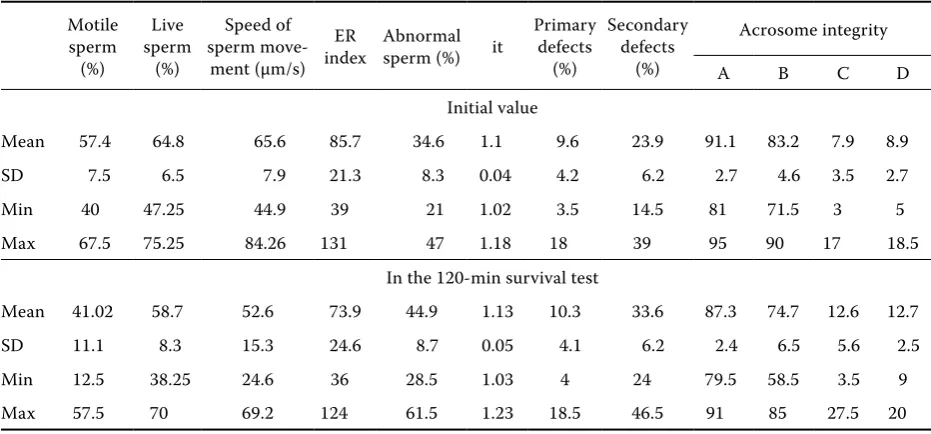
Table 1. Sperm analysis after thawing of pellets from 27 bulls with an average concentration of 45 970 spermato-zoa/mm3. Mean values of evaluated criteria after thawing of pellets and in the 120-min survival test
Motile sperm
(%)
Live sperm
(%)
Speed of sperm
move-ment (µm/s) ER
index Abnormal sperm (%) it
Primary defects
(%)
Secondary defects
(%)
Acrosome integrity
A B C D
Initial value
Mean 57.4 64.8 65.6 85.7 34.6 1.1 9.6 23.9 91.1 83.2 7.9 8.9
SD 7.5 6.5 7.9 21.3 8.3 0.04 4.2 6.2 2.7 4.6 3.5 2.7
Min 40 47.25 44.9 39 21 1.02 3.5 14.5 81 71.5 3 5
Max 67.5 75.25 84.26 131 47 1.18 18 39 95 90 17 18.5
In the 120-min survival test
Mean 41.02 58.7 52.6 73.9 44.9 1.13 10.3 33.6 87.3 74.7 12.6 12.7
SD 11.1 8.3 15.3 24.6 8.7 0.05 4.1 6.2 2.4 6.5 5.6 2.5
Min 12.5 38.25 24.6 36 28.5 1.03 4 24 79.5 58.5 3.5 9
Max 57.5 70 69.2 124 61.5 1.23 18.5 46.5 91 85 27.5 20
A = Pisum sativum bound sperm; B = strong binding; C = weak binding; D = no binding; it = teratospermia index investigated in the present study. All bulls
origi-nated from one AI station.
Qualitative assessment of semen after thawing of the pellets was based on the evaluations during the short-time survival test.
Methods. Besides conventional examination, the
ejaculates were tested at initial time (IH) and in the 120-min survival test (2H):
sperm motility was determined by microscopy at 200 to 400× magnification
percentages of live spermatozoa were evaluated by differential counts after supravital staining with primulin
speed of sperm movement was assessed by the pro-pulsivity test according to Baker et al., modified by Hynie (1960)
mitochondrial activity was manifested after the re-action with nitrotetrazolium blue and expressed by an index according to Veznik (1970)
sperm morphology was evaluated by the SASMO programme based on a multiparametric diagnos-tic method (Veznik et al., 2001)
the response to hypoosmotic conditions was tested by HOS test according to Jeyendran et al. (1984)
Pisum sativum lectin binding to acrosomal mem-brane was assessed as described by Sirivaidya- pong et al. (2000)
Thawed pellets were subjected to the separation process through gradient media so as to obtain func-tionally and morphologically high quality sperm.
Percoll concentrations for bull semen were 90% and 45%. The following components according to Parrish et al. (1995) and Somfai et al. (2002) were used for preparation of 90% Percoll: 10 ml 10× concentrated Sp-TALP medium, 90 ml concentrated Percoll, 29 mg CaCl2, 8 mg MgCl2(6H2O), 109 mg NaHCO3.
Isotonic solution of 45 % Percoll was obtained by dilution of 25 ml of 90% Percoll and 25 ml of Sp-TALP medium.
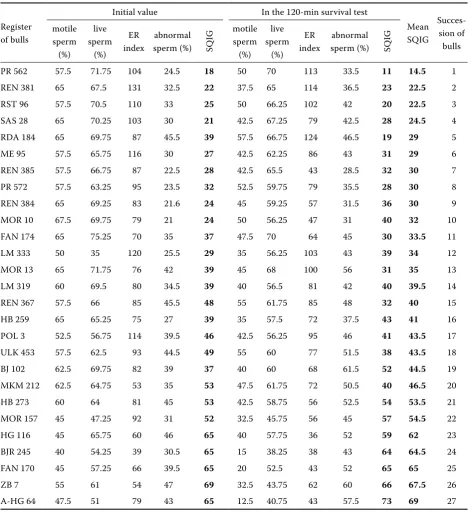
Sperm quality index (SQIG – sperm quality index of groups according to Veznik et al., 2006) calcu-lated by a summation of scores obtained for respec-tive characteristics of ejaculates from individual animals, was used for the assessment of relation-ships between semen quality parameters and sperm counts in fractions obtained by separation. The fol-lowing parameters were compared:
sperm motility
percentage of live sperm index of mitochondrial activity percentage of abnormal sperm
Twenty-seven ejaculates and sperm fractions re-covered from Percoll separation were analysed by dynamic tests; thawed pellets were subjected to the 120-min survival test, and in the sperm fractions, the initial values and values after 3 and 6 h incuba-tions were determined.
rela-tive to the sperm count in the original pellet with the aim to highlight differences in quality of sperm from respective ejaculates. Fractions reaching val-ues (1) less than 19% and (2) more than 35% were assigned to the two groups, respectively. Of the 27 analysed animals, nine and six individuals were included in these two groups, respectively.
Statistical analyses were performed with the use of Stat-Plus programme (Matouskova et al., 1992).
RESULTS
[image:3.595.64.535.241.760.2]Sperm analysis of pellets from 27 AI bulls gave evidence of a good quality of insemination doses. The detected initial values generally ranged within conventional limits (Table 1). Except three bulls, motility of sperm was maintained within these lim-its after the 120-min test, even though it decreased by 41.0% in comparison with the initial value. Sperm motility decreased below 30% in three bulls after Table 2. List of ejaculates aligned according to the sperm quality index of groups (SQIG)
Register of bulls
Initial value In the 120-min survival test
Mean SQIG
Succes-sion of bulls motile
sperm (%)
live sperm
(%)
ER index
abnormal sperm (%) SQIG
motile sperm (%)
live sperm
(%) ER index
abnormal sperm (%) SQIG
PR 562 57.5 71.75 104 24.5 18 50 70 113 33.5 11 14.5 1
REN 381 65 67.5 131 32.5 22 37.5 65 114 36.5 23 22.5 2
RST 96 57.5 70.5 110 33 25 50 66.25 102 42 20 22.5 3
SAS 28 65 70.25 103 30 21 42.5 67.25 79 42.5 28 24.5 4
RDA 184 65 69.75 87 45.5 39 57.5 66.75 124 46.5 19 29 5
ME 95 57.5 65.75 116 30 27 42.5 62.25 86 43 31 29 6
REN 385 57.5 66.75 87 22.5 28 42.5 65.5 43 28.5 32 30 7
PR 572 57.5 63.25 95 23.5 32 52.5 59.75 79 35.5 28 30 8
REN 384 65 69.25 83 21.6 24 45 59.25 57 31.5 36 30 9
MOR 10 67.5 69.75 79 21 24 50 56.25 47 31 40 32 10
FAN 174 65 75.25 70 35 37 47.5 70 64 45 30 33.5 11
LM 333 50 35 120 25.5 29 35 56.25 103 43 39 34 12
MOR 13 65 71.75 76 42 39 45 68 100 56 31 35 13
LM 319 60 69.5 80 34.5 39 40 56.5 81 42 40 39.5 14
REN 367 57.5 66 85 45.5 48 55 61.75 85 48 32 40 15
HB 259 65 65.25 75 27 39 35 57.5 72 37.5 43 41 16
POL 3 52.5 56.75 114 39.5 46 42.5 56.25 95 46 41 43.5 17
ULK 453 57.5 62.5 93 44.5 49 55 60 77 51.5 38 43.5 18
BJ 102 62.5 69.75 82 39 37 40 60 68 61.5 52 44.5 19
MKM 212 62.5 64.75 53 35 53 47.5 61.75 72 50.5 40 46.5 20
HB 273 60 64 81 45 53 42.5 58.75 56 52.5 54 53.5 21
MOR 157 45 47.25 92 31 52 32.5 45.75 56 45 57 54.5 22
HG 116 45 65.75 60 46 65 40 57.75 36 52 59 62 23
BJR 245 40 54.25 39 30.5 65 15 38.25 38 43 64 64.5 24
FAN 170 45 57.25 66 39.5 65 20 52.5 43 52 65 65 25
ZB 7 55 61 54 47 69 32.5 43.75 62 60 66 67.5 26
2H; however, the percentage of live sperm did not fall below this limit. Membrane integrity, which was demonstrated by supravital staining for live and dead sperm, was declined by 9.7% in average versus initial value. Membrane integrity decreased less than by 8.3% was maintained in 62.9% ejacu-lates after 2H 37.1% of ejacuejacu-lates showed a decrease in live sperm percentage by 11.8% to 29.5% (about 18% in average).
Morphological analysis of spermatozoa stained according to Hancock at the initial time point showed a total of 34.6% abnormal sperm; among these, 9.6% were developmental defects. After the survival test, the percentage of total defects in-creased to 44.9% due to an increase of acquired defects to 33.6% in average.
[image:4.595.65.532.386.735.2]Mitochondrial activity evaluated by the ER in-dex showed low values that varied between re-spective ejaculates (average index values: IH 85.7, 2H 73.9).
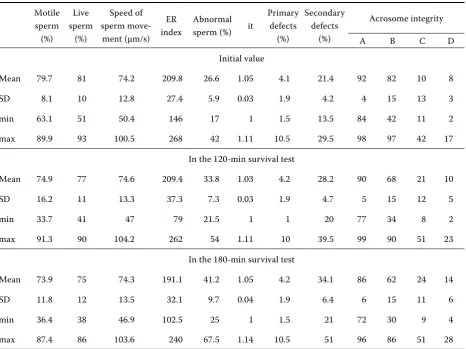
Table 3. Sperm analysis of thawed pellets after separation by gradient centrifugation
Motile sperm (%)
Live sperm (%)
Speed of sperm
move-ment (µm/s) ER index
Abnormal sperm (%) it
Primary defects
(%)
Secondary defects
(%)
Acrosome integrity
A B C D
Initial value
Mean 79.7 81 74.2 209.8 26.6 1.05 4.1 21.4 92 82 10 8
SD 8.1 10 12.8 27.4 5.9 0.03 1.9 4.2 4 15 13 3
min 63.1 51 50.4 146 17 1 1.5 13.5 84 42 11 2
max 89.9 93 100.5 268 42 1.11 10.5 29.5 98 97 42 17
In the 120-min survival test
Mean 74.9 77 74.6 209.4 33.8 1.03 4.2 28.2 90 68 21 10
SD 16.2 11 13.3 37.3 7.3 0.03 1.9 4.7 5 15 12 5
min 33.7 41 47 79 21.5 1 1 20 77 34 8 2
max 91.3 90 104.2 262 54 1.11 10 39.5 99 90 51 23
In the 180-min survival test
Mean 73.9 75 74.3 191.1 41.2 1.05 4.2 34.1 86 62 24 14
SD 11.8 12 13.5 32.1 9.7 0.04 1.9 6.4 6 15 11 6
min 36.4 38 46.9 102.5 25 1 1.5 21 72 30 9 4
max 87.4 86 103.6 240 67.5 1.14 10.5 51 96 86 51 28
A = Pisum sativum bound sperm; B = strong binding; C = weak binding; D = no binding; it = teratospermia index
After the calculation of the sperm quality index (SQIG), the distribution of individual bulls was obtained and presented in Table 2.
Thawed pellet spermatozoa were separated using density gradient media to obtain sperm of good function and morphology. The results of qual-ity assessment of sperm fractions are shown in Table 3.
An extremely high variability in percentages of sperm obtained after separation of thawed pellets was noted. The average sperm recovery (± SD) from thawed pellets after separation was 26.6 ± 16.9% of original sperm count. The linear regression of SQIG to sperm counts with the correlation coef-ficient –0.5753 was significant.
Categorization of samples according to sperm recovery as minimum and maximum values to the average 26.6%, documented significant differences in sperm motility, percentages of live and abnormal sperm in these two categories.
A significant correlation between the results of the survival test and sperm recovery after sepa-ration was documented for thawed pellets in the present study (Spearman correlation coeffi-cient 0.638). Comparison of the calculated SQIG values with sperm recovery after separation also showed a significant correlation; that documented positive correlation between ejaculate quality and sperm recovery after separation.
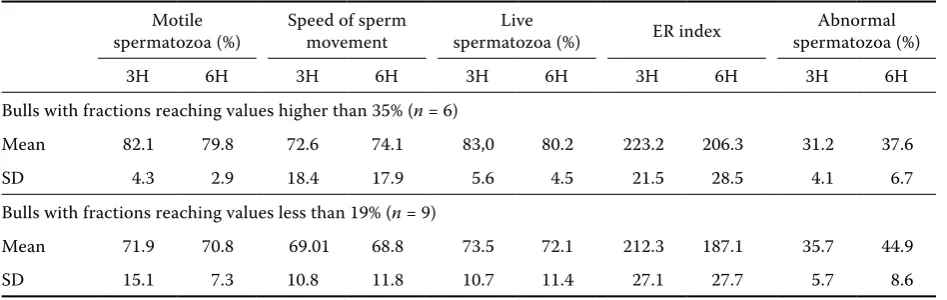
Table 4 shows a lower functional resistance of sperm in small versus large volumes. Even though the differences in the investigated criteria were non-significant, a tendency to a lower potential to survive was evident.
DISCUSSION
Analysis of 27 deep-frozen ejaculates from AI bulls with the use of methods tested by various authors and standard evaluation of sperm docu-mented that the level of the initial parameters af-ter thawing was generally good (Rasul et al., 2001; Januskauskas et al., 2003; Martinez et al., 2006).
The survival test indicated differences in quali-ties between respective ejaculates, and consistent findings by various authors showed its importance (Kozumplík and Sosnova, 1985 and other authors). A higher resistance of the structures and functions of organelles in contrast to fluid cytoplasmic sur-face membranes was documented by a significant
during this test in contrast to the decrease of bind-ing capacity of Pisum sativum to sperm acrosome, which was non-significant. Similar findings were obtained when dog ejaculates were examined (Veznik et al., 2003). Due to a limited time of the survival test (120 min), no marked individual dif-ferences in structural changes of acrosomes were found in sperm from thawed pellets; that was in-dicated by relatively low SD values.
Gradient centrifugation of ejaculates was used to obtain good-quality sperm fractions. Sperm motility in the obtained fractions reached almost 80% (79.7%) and likewise membrane integrity that gives evidence of live spermatozoa gave comparable results (81.0%). These findings are in accordance with Brandeis and Manuel (1993), Parrish et al. (1995) and Somfai et al. (2002). The index of mito-chondrial activity showed marked alterations as it reached an average value of 209.8 ± 27.4 in contrast to initial values obtained by analysis of pellets after thawing. The conventional value of the index (180) was not obtained in two fractions only. The per-centage of abnormal spermatozoa was in average 26.6 ± 5.9 %. Developmental defects were found in 4.1 ± 1.9% of sperm in average, while acquired defects were detected in 21.4 ± 4.2%.
[image:5.595.63.537.101.251.2]The above mentioned differences of sperm counts in fractions obtained from respective ejaculates were associated with a quality of thawed pellets. Minimum and maximum recovery in fractions was 2.7% (in bull HG 64) and 73.9% (in bull MOR 10), respectively. The relationship between sperm quality parameters and the recovery after the separation process is evident from the values of quality parameters for thawed pel-lets from bulls HG 64 and MOR 10 as follows: sperm motility – initial value (%) 47.5, 67.5; sperm Table 4. Characteristics of separated spermatozoa after the 3 h (3H) and 6 h (6H) survival test
Motile
spermatozoa (%) Speed of sperm movement spermatozoa (%)Live ER index spermatozoa (%)Abnormal
3H 6H 3H 6H 3H 6H 3H 6H 3H 6H
Bulls with fractions reaching values higher than 35% (n = 6)
Mean 82.1 79.8 72.6 74.1 83,0 80.2 223.2 206.3 31.2 37.6
SD 4.3 2.9 18.4 17.9 5.6 4.5 21.5 28.5 4.1 6.7
Bulls with fractions reaching values less than 19% (n = 9)
Mean 71.9 70.8 69.01 68.8 73.5 72.1 212.3 187.1 35.7 44.9
live spermatozoa – initial value (%) 51.0, 69.7; live spermatozoa after 120-min survival test 40.7, 56.2 abnormal spermatozoa – initial value (%) 43.0, 21.0;
abnormal spermatozoa after 120-min survival test 57.5, 31.0
Differences in quality were manifested particu-larly by lower percentages of live spermatozoa and a lower morphological resistance of sperm surface structures, confirmed by a higher increase in ab-normal spermatozoa.
Average percentages of live sperm were 64.8%, 68.4% and 60.8% in all thawed pellets, in the group of ejaculates with sperm recovery of more than 35% and in the group with recovery less than 19%, re-spectively. The percentage of live sperm in fractions at the initial time point was 83.8% and 72.7% in groups with a higher and lower recovery, respec-tively. During the 6 h incubation, the percentage of live spermatozoa decreased to 80.2% in the group with a higher recovery and to 72.1% in the group with a lower recovery. A significant effect of separa-tion on increased percentage of live spermatozoa was evident in both groups; however, the level of sperm survival was lower in the group with lower sperm counts. A decreased ability to survive was also confirmed by increased percentages of abnor-mal sperm. The average percentage of abnorabnor-mal sperm at the beginning was 34.6%. The average per-centages of abnormal sperm in the groups of ejacu-lates were 28.3% and 41.1% in group with a higher and lower recovery, respectively. The separation process resulted in a decrease of abnormal sperm to 24.6% and 28.7%, respectively. The percentage of abnormal sperm increased to 37.6% and 44.9% within 6 h, respectively. Increased percentages of abnormal sperm could result from increased num-bers of sperm with disturbed membrane structures and hence lower morphological resistance.
A relatively low index of mitochondrial activity (av-erage index values: IH 85.7, 2H 73.9) indicates that not all spermatozoa that showed motility and membrane integrity after thawing were fully functional. That was documented by comparison of sperm motility dur-ing the survival test and mitochondrial activity index (i. ER); the agreement of these parameters was docu-mented by a significant regression function (P = 0.05) when interrelationships between motility and ER in-dex were evaluated after 2H.
It follows that the examination of sperm function in ejaculates brings important information for the prediction of their ability to survive. This infor-mation is not only important for the assessment
of sperm recovery after the separation based on their quality, but above all it can indicate their vital resistance. The levels of functional parameters of separated spermatozoa were always good, but per-sistence of their functions was different depending on the quality of respective ejaculate as a whole.
REFERENCES
Anzar M., Graham E.F. (1995): Effect of filtration on post-thaw quality of bull semen. Theriogenology, 43, 439–449.
Bangham A.D., Hancock J.L. (1955): A new method for counting live and dead spermatozoa. Nature, 176, 656. Brandeis V.T., Manuel M.T. (1993): Effects of four
meth-ods of sperm preparation on the motile concentration, morphology, and acrosome status of recovered sperm from normal semen samples. Journal of Assisted Re-production and Genetics, 10, 409–416.
Graham E.F., Graham J.K. (1990): The effect of whole ejaculate filtration on the morphology and fertility of bovine semen. Journal of Dairy Science, 73, 91–97. Graham E.F., Vazquer I.A., Schmehl K.M.L., Evensen
B.K. (1976): An assay semen quality by use of Sephadex filtration. In: VIIIth International Congress on Animal Reproduction and Artificial Insemination, Krakow. Hynie J. (1960): Index propulsivity spermií. Ceska
Der-matologie, 35, 11–16.
Januskauskas A., Johannisson A., Rodriguez-Martinez H. (2003): Subtle membrane changes in cryopreserved bull semen in relation with sperm viability, chromatin struc-ture, and field fertility. Theriogenology, 60, 743–758. Jeyendran R.S.H., Van der Ven H., Perez-Pelaez M.,
Grabo B.G., Zaneveld L.J.D. (1984): Development of an assay to assess the functional integrity of the human sperm membrane and its relatinship to other semen characteristics. Journal of Reproduction and Fertility, 70, 219–228.
Kozumplik J., Sosnova J. (1985): The thermoresistance test of spermatozoa and fertility in bulls (in Czech). Veterinarni Medicina, 30, 385–392.
Landa C.A., Almquist J.O., Amann R.P. (1980): Factors influencing Sephadex separation of bovine and ovine spermatozoa. Journal of Dairy Science, 63, 277. Martinez C.O., Juarez-Mosqueda M.D., Hernandez J.,
Valencia J. (2006): Cryopreservation of bull sperma-tozoa alters the perinuclear theca. Theriogenology, 66, 1969–1975.
Parrish J.J., Krogenaes A., Susko-Parrish J.L. (1995): Ef-fect of bovine sperm separation by either swim-up or Percoll method on success of in vitro fertilization and early embryonic development. Theriogenology, 44, 859–869.
Rasul Z., Ahmad N., Anzar M. (2001): Changes in motion characteristics, plasma membrane integrity, and acro-some morphology during cryopreservation of buffalo spermatozoa. Journal of Andrology, 22, 278–283. Samper J.C., Hellander J.C., Crabo B.G. (1991):
Relation-ship between the fertility of fresh and frozen stallion semen and semen quality. Journal of Reproduction and Fertility, 44 Suppl., 107–114.
Sirivaidyapong S., Cheng F.P., Arks A., Voorhout W.F., Bevers M.M., Colebrander B. (2000): Effect of sperm diluents on the acrosome reaction in canine sperm. Theriogenology, 3, 798–802.
Somfai T., Bodo S., Nagy S., Papp A.B., Ivancsics J., Bara-nyai B., Gocza E., Kovacs A. (2002): Effect of swim up and Percoll treatment on viability and acrosome inte-grity of frozen-thawed bull spermatozoa. Reproducti-on in Domestic Animals, 37, 285–290.
Corresponding Author:
Prof. MVDr. Zdenek Veznik, DrSc., Veterinary Research Institute, Hudcova 70, 621 00 Brno, Czech Republic Tel. +420 533 331 413, fax +420 541 211 229, e-mail: [email protected]
Veznik Z. (1970): Laboratory Methods (in Czech). Institute of Agricultural and Food Information, Prague. 24 pp. Veznik Z., Svecova D. (1992): Methods for evaluation of
sexual functions in bulls (in Czech). UVO, Pardubice. 184 pp.
Veznik Z., Matouskova O., Svecova D., Zajicova A. (2001): The use of the computer technology for the evaluation of the strict morphological sperm analysis. Veterinarni Medicina, 46, 35–40.
Veznik Z., Svecova D., Zajicova A., Prinosilova P. (2003): Functional evaluation of dog ejaculates with a priority aspect of acrosome integrity. Veterinarni Medicina, 48, 221–228.
Veznik Z., Svecova D., Zajicova A., Slavikova M. (2006): Importance of universal ejaculate quality index (UKIE) for its evaluation and evidence (in Czech). Report of the VIth workshop Laboratory Techniques in Andrology, May 18, 2006, Veterinary Research Institute, Brno.