Changes of sperm quality parameters in Caspian roach
(Rutilus rutilus caspicus) during spawning migration
A. Golpour
1, M. Akhoundian
2, H. Khara
3,
M. Rahbar
1, H. Dadras
3 1Young Researchers Club, Islamic Azad University, Lahijan, Iran2Khorramshahr Marine Science and Technology University, Khorramshahr, Iran
3Department of Fishery and Aquaculture, Faculty of Natural Resources, Islamic Azad University, Lahijan, Iran
ABSTRACT: In this study, changes of pH, ionic (Na+, K+, Ca2+,and Mg2+), biochemical (total protein, glucose,
and cholesterol) compositions of seminal plasma, sperm motility traits (percentage of motile spermatozoa and sperm movement duration), and sperm production characteristics (sperm volume, spermatocrit, and sperm density) were studied in Caspian roach, Rutilus rutilus caspicus, during spawning migration. Sperm of 10 males was collected three times during the spawning migration (in February, March, and April). The results showed that sperm motility parameters (percentage of motile spermatozoa and sperm movement duration) changed sig-nificantly (P < 0.05) during the reproductive season, but sperm density, spermatocrit, and sperm volume did not show significant differences during spawning migration. Analyses performed at each sampling time (February, March, and April) showed significant differences (P < 0.05) in calcium, magnesium, potassium, and cholesterol, whereas there were no significant changes in Na+, pH, total protein, glucose, and cholesterol.
Keywords: spawning season; spermatological parameters; biochemical parameters; semen; roach
The Caspian roach (Rutilus rutilus caspicus) belonging to the family of Cyprinidae has been considered in fishery in the southern part of the Caspian Sea (Coad, 1980; Abdoli, 2000). Due to good taste and culinary customs of local people there has been a great demand for this fish. The population of the Caspian roach has been de-creased due to overfishing and deterioration of its spawning ground and it is therefore considered a threatened species (Kiabi et al., 1999). The roach is a migratory fish which enters the border river Atrak and other Iranian rivers (e.g. the Gharesoo and the Gorganrood) for spawning. The repro-duction migration in the southern Caspian Sea starts from January–February and continues until April. The fish travel about 70–80 km upriver (Petr, 1987). Most migration takes place at water temperature of 10–12°C. Gamete quality in spe-cies with annual spawning cycles varies during the spawning season (Buyukhatipoglu and Holtz,
2006). In cyprinids, because of high osmolality, spermatozoa are immotile in the seminal plasma (Morisawa et al., 1983). Also, osmolality of seminal plasma differs significantly during reproductive season (Alavi et al., 2008a). The parameters like seminal plasma composition, spermatozoa con-centration, spermatocrit, and sperm motility traits have been used for evaluating the quality of sperm (Alavi and Cosson, 2006). Assessment of sperm quality based on these parameters provides us with applied approaches to improve methods for artificial reproduction by developing immobiliz-ing or activatimmobiliz-ing media for fertilization (Rodina et al., 2004). Studying the effects of these factors on sperm quality can help establish good activa-tion and/or immobilizing media for improving either artificial fertilization or cryopreservation protocols. It has been already shown the sperm quality parameters change during the spawning season in carp (Cyprinus carpio), tilapia ( Oreo-chromis mossambicus) (Kruger et al., 1984), rain-bow trout (Onchorhynchus mykiss) (Munkittrick and Moccia, 1987), and common barbel (Barbus barbus) (Alavi et al., 2008a). The changes could be in terms of spermatozoa concentration, sperm volume, seminal plasma composition, pH or sperm motility parameters such as percentage of motile spermatozoa and sperm velocity (Billard et al., 1995; Alavi et al., 2008a). Sperm characteristics also differ among species especially in terms of seminal plasma composition (Ciereszko, 2008) or sperm motility (Alavi et al., 2008a). These differ-ences should be considered for developing artificial fertilization or sperm cryopreservation (Billard et al., 1995; Linhart et al., 2003). In this study, we determined pH, ionic (K+, Na+, Ca2+,and Mg2+),
biochemical (total protein, glucose, and choles-terol) composition of the seminal plasma, sperm production characteristics (spermatocrit, sperm density, and sperm volume), and sperm motility parameters (sperm movement duration and per-centage of motile spermatozoa) during spawning migration in the Caspian roach.
MATERIAL AND METHODS
Brood fish were caught in the Gorganrood River (36°44' to 37°49'N latitude and 54°42' to 56°28'E longitude) three times during the spawning season – at its beginning (February 10th), in the middle
(March 3rd), and at the end (April 5th). Sperm of
10 mature males was collected by pressing gentile of the abdomen at each sampling time (male mean weight ± SE: 52.57 ± 9.8 g, 56.78 ± 11.4 g, and 51.12 ± 6.5 g at each sampling time respectively). Attention was taken to avoid contamination of sperm with blood, urine, and faeces. Sperm was kept on ice and immediately transported to the laboratory for analyses. According to procedure of Bozkurt et al. (2008) sperm motility was triggered directly in activation medium of 0.3% NaCl at ratio 1 : 1000 and immediately recorded with a 3 CCD video camera Panasonic WV-CP240 (Panasonic Corp., Osaka, Japan) mounted on a dark-field microscope (Leica Camera, Allendale, USA). The duration of sperm motility was measured imme-diately after initiation of sperm activation until 100% of the spermatozoa were immotile. The per-centage of motility was defined as the perper-centage of progressively motile spermatozoa within each activated sample. Progressively motile spermatozoa were defined as actively swimming in a forward motion. Only forward moving sperm was judged motile and sperm cells that vibrated at the place were considered motile. Observations were made within 2 h of semen collection. The spermatocrit was defined as the ratio of volume of white packed material to the total volume of semen × 100 (Ru-rangwa et al., 2004). Microhaematocrit capillary tubes (75 mm in length, 1.1–1.2 mm in diameter) were filled with semen and the end of each tube was sealed with clay. The capillary tubes were cen-trifuged at 3000 g for 8 min (Sigma, Washington, USA). Measurements were taken in triplicate for each sample, and the average of the three meas-urements was used for the results. Spermatozoa density was calculated using the haemocytometer method. With this aim, semen was diluted with a saline solution (0.07 NaCl) (Alavi et al., 2009) and then a droplet (1 µl) of diluted semen was placed on a Thomas haemocytometer slide (depth 0.1 mm) with a coverslip and counted using light microscopy. After a few minutes (to allow sperm sedimentation), the number of spermatozoa was counted at magnification 200× and expressed as spermatozoa × 109/ml. Sperm volume was
possible contamination with spermatozoa. The seminal plasma pH was determined immediately before freezing using a Micro pH meter 762 (Saba Co., Tehran, Iran) and then samples were frozen at –20°C until analysis. Two minerals (Ca2+ and
Mg2+) and three biochemical parameters (total
protein, glucose, and cholesterol) of the seminal plasma were measured using the spectropho-tometer S2000-UV/VIS (Ocean Optic Company, Edinburgh, UK). Potassium and sodium were de-termined with a flamephotometer Jenway PFP7C (Triad Scientific Co., New Jersey, USA) (Standard kits from Parsazmoon Co., Tehran, Iran). Sta-tistical data were analyzed using SPSS software (Version 11.5, 1996). One-way analysis of variance (ANOVA) was carried out to determine varia-tion on sperm movement duravaria-tion, percentage of motile spermatozoa, sperm density, spermatocrit, semen volume, seminal plasma pH, Na+, K+, Ca2+,
Mg2+, total protein, glucose, and cholesterol during
spawning season. Before data analysis by ANOVA, Duncan test was used for normality of data distri-bution and homogeneity of variance. The Duncan test was used for comparison between means at a 0.05 significance level. All values were expressed as mean ± standard error (SE).
RESULTS
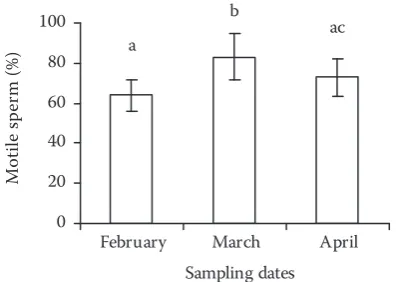
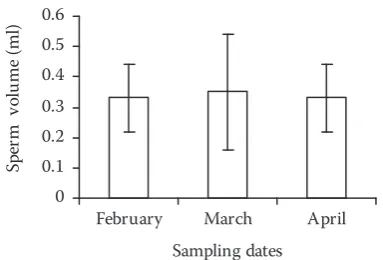
[image:3.595.318.518.84.225.2]The spermatological parameters of the semen are presented in Figures 1–5. Sperm movement duration and percentage of motile spermatozoa increased from the beginning to the middle of the spawning period, towards the end of the re-productive season the values decreased (P < 0.05; Figures 1 and 2). On the other hand, no signifi-cant differences were observed in sperm density, Figure 1. Changes in sperm movement duration of
Cas-pian roach during spawning period. Different superscripts indicate means that were significantly different (P < 0.05,
n = 30 males) a
b
bc
0 20 40 60 80 100
February March April Sampling dates
Sp
er
m
m
ov
em
en
t d
ur
at
io
n
(S
)
a
b
ac
0 20 40 60 80 100
[image:3.595.74.274.89.225.2]February March April Sampling dates
Figure 2. Changes in percentage of motile spermatozoa of Caspian roach during spawning period. Different su-perscripts indicate means that were significantly different (P < 0.05, n = 30 males)
0 20 40 60 80
February March April
Sampling dates
Sp
er
m
at
oc
rit
(℅
)
0.0 0.5 1.0 1.5 2.0
February March April Sampling dates
Sp
er
m
d
en
sit
y (
m
l ×
10
[image:3.595.86.260.589.719.2]9 )
Figure 4. Sperm density of Caspian roach at different sampling times during the spawning season (n = 30 males) Figure 3. Spermatocrit of Caspian roach at different
sam-pling times during the spawning period (n = 30 males)
M
otile sp
er
spermatocrit, and sperm volume during spawning migration (Figures 3–5). As shown in Table 1, higher values of Ca2+, Mg2+, and cholesterol were
recorded in the middle of the spawning period compared to its beginning or the end. K+ ion
con-centration decreased gradually from the beginning of the spawning period towards its middle and terminal part. The pH of seminal plasma did not show significant change during spawning season. No significant changes were observed in terms of the seminal plasma organic composition (total protein and glucose) during spawning migration.
DISCUSSION
Fish spermatozoa are different in the initiation (Cosson et al., 1995), duration (Billard and Cosson, 1992), and pattern of motility (Boitano and Omoto, 1992) among species. Changes in the quality of se-men during spawning season have been reported in teleost fish (Billard et al., 1977). In this study, significant changes were observed in the
[image:4.595.81.273.83.213.2]percent-age of motile spermatozoa and sperm movement duration, results are similar to those reported in rainbow trout (Onchorhynchus mykiss), brook trout (Salvilenus alpinus), and Atlantic salmon (Salmo salar) (Benau and Terner, 1980). No significant changes were reported in percentage of motile spermatozoa of Barbus (Barbus barbus) during the reproductive season (March–May) (Alavi et al., 2008a). Decreases in sperm motility have been documented in several fish species such as rainbow trout (Munkittrick and Moccia, 1987), turbot (Su-quet et al., 1998), sea bass (Dicentrarchus labrax) (Dreanno et al., 1999), haddock (Melanogrammus aeglefinus) (Rideout et al., 2004), Atlantic halibut (Hippoglossus hippoglossus) (Babiak et al., 2006), cod (Gadus morhua) (Rouxel et al., 2008), and perch (Perca fluviatilis) (Alavi et al., 2010) as the repro-ductive season progressed. Decrease in percentage of sperm motility might be related to the osmolality of semen (Alavi et al., 2010). Several studies have revealed that decrease in sperm motility is due to ATP content which is necessary for sperm motility (Perchec et al., 1995). Nevertheless, more stud-ies are needed to find correlations between ATP content and sperm motility parameters (Alavi et al., 2009). Lahnsteiner et al. (2004) demonstrated that sperm motility pattern changed during spawn-ing season. Differspawn-ing results on changes of sperm motility over the reproductive season may be due to changing endocrine performance involved in sperm maturation (Rideout et al., 2004; Alavi et al., 2008b). Sperm motility and sperm density are often used to estimate sperm quality (Krol et al., 2006). Seasonal variation of sperm density depends on fish species – a decrease was observed in sea bass (Dreanno et al., 1999; Fauvel et al., 1999)
Table 1. Changes in compositions of the seminal plasma of thirty male Caspian roach during the reproductive season
Parameter February 10th March 3rd April 5th Statistics
Na+ (mM/ml) 200.05 ± 2.10 200.01 ± 3.01 200.70 ± 3.01 ns K+ (mM/ml) 34.40 ± 4.80a 23.96 ± 1.50b 23.73 ± 3.30c P < 0.05 Ca2+ (mM/ml) 10.29 ± 0.56C 14.13 ± 0.70a 12.27 ± 0.34b P < 0.05 Mg2+ (mM/ml) 3.96 ± 0.46b 4.05 ± 0.38a 2.47 ± 0.25C P < 0.05
Protein (mg/dl) 2.48 ± 0.48 2.67 ± 0.79 3.30 ± 0.19 ns
Glucose (mg/dl) 4.30 ± 0.71 4.95 ± 0.12 4.95 ± 0.45 ns
Cholesterol (mg/dl) 27.60 ± 0.39b 62.45 ± 2.37a 25.21 ± 0.71b ns
pH 7.45 ± 0.07 7.60 ± 0.14 7.95 ± 0.07 ns
a–c, Cdifferent letters correspond to significantly different results
ns = nonsignificant 0 0.1 0.2 0.3 0.4 0.5 0.6
February March April Sampling dates
Sp
er
m
v
ol
um
e (
m
[image:4.595.64.532.582.726.2]l)
while an increase was recorded in Atlantic salmon (Piironen, 1985), turbot (Suquet et al., 1998), and Atlantic halibut (Babiak et al., 2006). There was no significant change in sperm density of roach during spawning migration. A decrease in sperm density towards the end of spermiation period has been reported in many teleosts such as tench (Zuromska, 1981), rainbow trout (Buyukhatipoglu and Holtz, 1984; Munkittrick and Moccia, 1987), turbot (Suquet et al., 1998), seabass (Dreanno et al., 1999), cod (Rouxel et al., 2008), and Barbus barbus (Alavi et al., 2008b). The mechanism regu-lating semen hydration during spermiation plays a major role in determining the sperm volume in fish (Alavi et al., 2008a, b). It has already been claimed that the sperm volume changes from the beginning to the end of spermiation (reproductive season). In this study no significant change was observed during spawning migration for sperm volume. In landlocked salmon (Salmo salar m. sebago Girard), sperm volume increased during the reproductive season (Piironen, 1985). Endo-crinological events that regulate spermiation and milt hydration make the comparisons difficult (Mylonas et al., 1997; Vermeirssen et al., 2004). Also Campos-Mendoza et al. (2004) noted that variation in day length during spawning period af-fected the sperm volume in males. Seminal plasma not only maintains immobility of spermatozoa but also protects them (Cosson et al., 1997); this is the case, for example, in the common carp Cypri-nus carpio (Toth et al., 1995) and in the rainbow trout Oncorhynchus mykiss (Billard, 1986). The ionic composition may change during the spawn-ing season (Alavi and Cosson, 2006). Significant changes were observed in ionic composition (K+,
Ca2+, and Mg2+) of seminal plasma in this study.
Similar results have shown significant variation in seminal plasma composition at different times of the reproductive season in common carp (Koldras et al., 1996), landlocked salmon (Piironen, 1985), rainbow trout (Munkittrick and Moccia, 1987), Per-sian sturgeon (Alavi et al., 2006), and cod (Rouxel et al., 2008). In fish, several factors have been reported that regulate the composition of seminal plasma (Ciereszko, 2008; Alavi et al., 2008b). It has already been shown in the literature that there are several correlations between seminal plasma composition and sperm motility in some species:
Salmo salar (Hwang and Idler, 1969), Cyprinus carpio (Kruger et al., 1984), rainbow trout (Lahn-steiner et al., 1998), Persian sturgeon, Acipenser
persicus (Alavi et al., 2004), and Oncorhynchus tshawytscha (Rosengrave et al., 2009). Lahnsteiner et al. (1996) reported a correlation between sperm motility and seminal plasma composition in bleak
Alburnus alburnus, a cyprinid, and suggested that this correlation might indicate which components of the seminal plasma influence sperm motility. Seminal plasma pH may affect final maturation of spermatozoa. Also, duration of sperm motility in males could be influenced by the changes of semen pH (Sahinoz et al., 2008). In cyprinids, it has been shown that extracellular and intracellular pH as well as the ionic composition of the seminal plasma influence the initiation and duration of sperm motility (Marian et al., 1997). The pH of the seminal plasma of roach during breeding season ranged from 7.45 ± 0.07 to 7.95 ± 0.07. The high-est sperm pH was observed in males in April (the end of reproductive season). Limit information is available on the organic composition of the carp semen. No significant changes were observed in terms of the seminal plasma organic composition in this study. Some energetic substrates such as glucose are found in the seminal plasma and the sperm but in small amounts (Kruger et al., 1984). The presence of glucose in seminal plasma was associated with high energy demand of the tests during spermatogenesis or with lipid synthesis of spermatozoa (Soengas et al., 1993). The protein content highly varied during the year (Billard and Cosson, 1990). White and Macleod (1963) indi-cated that protein has a protective role. During spawning period lower protein concentrations have been observed in seminal plasma of rainbow trout (Ciereszko et al., 1996). Seminal plasma lipids are associated with metabolism in spermatozoa (Piiro- nen, 1994). While cholesterol was found in the seminal plasma of freshwater fish (Billard et al., 1995), there is not enough information about its role. Lipid and cholesterol might have a protective effect against environmental changes (especially temperature) when semen is released.
CONCLUSION
The results indicate that sperm movement du-ration, percentage of motile spermatozoa, Ca2+,
Mg2+,and cholesterol were comparatively higher
on the spermatological and biochemical charac-teristics of Rutilus rutilus caspicus presented in this study will help in optimizing the selection of high-quality male donors for aquaculture and artificial spawning performance.
Acknowledgement
The authors are grateful for the collection of roach in good condition by fishermen of Golestan province in Iran. The authors wish to thank the staff of the central lab at Gorgan University.
REFERENCES
Abdoli A. (2000): The inland water fishes of Iran. 1th Ed. Iranian Museum of Nature and Wildlife, Tehran, Iran. (in Persian)
Alavi S.M.H., Cosson J. (2006): Sperm motility in fishes. II. Effects of ions and osmolality: a review. Cell Biology International, 30, 1–14.
Alavi S.M.H., Cosson J., Karami M., Amiri B.M., Ak-houndzadeh M.A. (2004): Spermatozoa motility in the Persian sturgeon, Acipenser persicus: effects of pH, di-lution ratio, ions and osmolality. Reproduction, 128, 819–828.
Alavi S.M.H., Cosson J., Kazemi R. (2006): Semen charac-teristics in Acipenser persicus in relation to sequential stripping. Journal of Applied Ichthyology, 22, 400–405. Alavi S.M.H., Psenicka M., Rodina M., Policar T., Linhart O.
(2008a): Changes of sperm morphology, volume, density
and motility and seminal plasma composition in Barbus
barbus (Teleostei: Cyprinidae) during the reproductive
season. Aquatic Living Resource,21, 75–80.
Alavi S.M.H., Linhart O., Coward K., Rodina M. (2008b): Fish spermatology. In: Alavi S.M.H, Cosson J., Coward K., Rafiee G. (eds): Implication for Aquaculture Management. Alpha Science International Ltd., Oxford, UK, 397–460. Alavi S.M.H., Rodina M., Policar T., Linhart O. (2009):
Re-lationships between semen characteristics and body size in Barbus barbus L. (Teleostei: Cyprinidae) and effects of ions and osmolality on sperm motility. Comparative Biochemistry and Physiology A, 153, 430–437.
Alavi S.M.H., Rodina M., Hatef A., Stejskal V., Policar T., Hamáčková J., Linhart O. (2010): Sperm motility and monthly variations of semen characteristics in Perca fluviatilis (Teleostei: Percidae).Czech Journal of Animal Science,55, 174–182.
Babiak I., Ottesen O., Rudolfsen G., Johnsen S. (2006): Quantitative characteristics of Atlantic halibut,
Hippo-glossus hippoHippo-glossus L., semen throughout the reproduc-tive season. Theriogenology, 65, 1587–1604.
Benau D., Terner C. (1980): Initiation prolongation and reactivation of the motility of Salmonidae spermatozoa. Gamete Research, 3, 247–257.
Billard R. (1986): Spermatogenesis and spermatology of some teleost fish species. Reproduction Nutrition De-velopment,2, 877–920.
Billard R., Cosson M.P. (1990): The energetic of fish sperm motility. In: Gagnon C. (ed.): Controls of Sperm Motility: Biological and Clinical Aspects. CRC Press, Boca Raton, USA, 153–173.
Billard R., Cosson M.P. (1992): Some problems related to the assessment of sperm motility in freshwater fish. Journal of Experimental Zoology, 261, 122–131.
Billard R., Dupont J., Barnabe G. (1977): Diminution de la motile et la durce le conservation du sperm de Dicentra-chus labrax L. (Poison, teleosteen) pendant la period de spermiation. Aquaculture, 11, 363–367.
Billard R., Cosson G., Perchec G., Linhart O. (1995): Biology of sperm and artificial reproduction in carp. Aquaculture, 129, 95–112.
Boitano S., Omoto C.K. (1992): Trout sperm swimming pattern and role of intracellular Ca+2. Cell Motile Cy-toskeleton, 21, 74–82.
Bozkurt Y., Ogretmen F., Ercin U., Yildiz U. (2008): Seminal plasma composition and its relationship with physical spermatological parameters of Grass carp ( Ctenophar-yngodon idella) semen: with emphasis on sperm motility. Aquaculture Research, 39, 1666–1672.
Buyukhatipoglu S., Holtz W. (1984): Sperm output in rain-bow trout (Salmo gairdneri). Effect of age, timing and frequency of stripping and presence of females. Aqua-culture, 37, 63–71.
Campos-Mendoza A., McAndrew J.B., Coward K., Bro-mage N. (2004): Reproductive response of Nile tilapia (Oreochromis niloticus) to photoperiodic manipulation; effects on spawning periodicity, fecundity and egg size. Aquaculture, 231, 299–314.
Ciereszko A. (2008): Chemical composition of seminal plas-ma and its physiological relationship with sperm motility, fertilizing capacity and cryopreservation success in fish. In: Alavi S.M.H., Cosson J., Coward R., Rafiee G. (eds): Fish Spermatology. Alpha Science, Oxford, UK, 215–240.
Ciereszko A., Liu L., Dabrowski K. (1996): Effect of season
and dietary ascorbic acid on some biochemical charac-teristics of rainbow trout (Onchorhynchus mykiss) semen. Fish Physiology and Biochemistry, 15, 1–10.
demem-branated trout spermatozoa. Cell Motile Cytoskeleton, 31, 159–176.
Cosson J., Billard R., Cibert C., Dreanno C., Linhart O., Su-quet M. (1997): Movements of fish sperm flagella studied by high speed video microscopy coupled to computer assisted image analysis. Polish Archives of Hydrobiology, 44, 103–113.
Crim L.W. (1982): Environmental modulation of annual and daily rhythmus associated with reproduction in teleost fishes. Canadian Journal of Fish and Aquatic Science, 39, 17–21.
Dreanno C., Cosson J., Suquet M., Dorange G., Fauvel C., Cibert C., Billard R. (1999): Effects of osmolality, mor-phology and intracellular nucleotide content during the movement of sea bass (Dicentrarchus labrax) spermato-zoa. Journal of Reproduction and Fertility,116, 113–125. Fauvel C., Savoye O., Dreanno C., Cosson J., Suquet M.
(1999): Characteristics of sperm of captive seabass ( Di-centrarchus labrax L.) in relation to its fertilization po-tential.Journal of Fish Biology,54, 356–369.
Hwang P.C., Idler D.R. (1969): A study of major cations, osmotic pressure and pH in seminal components of At-lantic salmon. Journal of the Fisheries Research Board of Canada,26, 413–419.
Kiabi B., Abdoli A., Naderi M. (1999): Status of fish fauna in the southern Caspian Basin of Iran. Zoology in the Middle East, 18, 57–65.
Koldras M., Loir M., Maisse G., Le Gac F. (1996): Study of the composition of seminal fluid and sperm motility along the genital tract, during a spawning season in the rainbow trout (Onchorhynchus mykiss). Aquatic Living Resource, 9, 337–345.
Krol J., Kowalski R.K., Hliwa A., Dietrich G.J., Stabin-ski R., Ciereszko A. (2006): The effects of commercial preparations containing two different GnRH analogues and dopamine antagonists on spermiation and sperm characteristics in the European smelt Osmerus eperlanus. Aquaculture, 286, 328–331.
Kruger J.C. De W., Smit G.L., Van Vuren J.H.J., Ferreira J.T. (1984): Some chemical and physical characteristics of the semen of Cyprinus carpio L. and Oreochromis mossam-bicus. Journal of Fish Biology, 24, 263–272.
Lahnsteiner F., Berger B., Weismann T., Patzner R.A. (1996): Motility of spermatozoa of Alburnus alburnus (Cyprini-dae) and its relationship to seminal plasma composition and sperm metabolism. Fish Physiology and Biochemis-try,15, 167–179.
Lahnsteiner F., Berger B., Weismann T., Patzner R.A. (1998): Determination of semen quality of the rainbow trout,
Oncorhynchus mykiss, by sperm motility, seminal plasma parameters, and spermatozoa metabolism. Aquaculture, 163, 163–181.
Lahnsteiner F., Mansour N., Berger B. (2004): Seminal plasma proteins prolong the viability of rainbow trout (Onchorhynchus mykiss) spermatozoa. Theriogenology, 62, 801–808.
Linhart O., Mims S.D., Boris Gomelsky B., Hiott A.E., Shelton W.L., Cosson J. (2003): Ionic composition and osmolality of paddlefish (Polyodon spathula, Acipenseri-formes) seminal fluid. Aquaculture International, 11, 357–368.
Marian T., Krasznai Z., Balkay L., Emri M., Tron L. (1997): Role of extracellular and intracellular pH in carp sperm motility and modifications by hyperosmosis of regulation of Na+/H+ exchanger. Cytometry,27, 374–382.
Morisawa M., Suzuki K., Shimizu H., Morisawa S., Yasuda K. (1983): Effect of osmolality and potassium on motility of spermatozoa from freshwater cyprinid fishes. Journal of Experimental Zoology, 107, 95–103.
Munkittrick K.R., Moccia R.D. (1987): Seasonal changes in the quality of rainbow trout (Salmo gairdneri) semen: effect of a delay in stripping on spermatocrit, motility, volume and seminal plasma constituents. Aquaculture, 64, 147–156.
Mylonas C.C., Gissis A., Magnus Y., Zohar Y. (1997): Hor-monal changes in male white bass (Morone chrysops) and evaluation of milt quality after treatment with a sustained-release GnRHa delivery system. Aquaculture, 153, 301–313.
Perchec G., Jeulin C., Cosson J., Andre F., Billard R. (1995): Relationship between sperm ATP content and motility of carp spermatozoa. Journal of Cell Science,108, 747–753. Petr T. (1987): Observation on prospects for further inland fisheries development in Iran. FAO Field Document 2, 53–64. Available from www.fao.org/docrep/field/003/ S6312E/S6312E00.htm (accessed Dec 1987).
Piironen J. (1985): Variation in the properties of milt from the Finnish landlocked salmon (Salmo salar m. sebago Girard) during a spawning season. Aquaculture, 48, 337–350. Piironen J. (1994): Composition and cryopreservation of
sperm from some Finnish freshwater teleost fish. Finnish Fish Research, 15, 27–48.
Rideout R.M., Trippel E.A., Litvak M.K. (2004): Relationship between sperm density, spermatocrit, sperm motility and spawning date in wild and cultured haddock. Journal of Fish Biology, 65, 319–332.
Rodina M., Cosson J., Gela D., Linhart O. (2004): Kurokura solution as immobilizing medium for spermatozoa of
tench (Tinca tinca L.). Aquaculture International, 12,
119–131.
motility traits. Comparative Biochemistry and Physiol-ogy, 152, 123–129.
Rouxel C., Suquet M., Cosson J., Severe A., Quemener L., Fauvel C. (2008): Changes in Atlantic cod (Gadus morhua
L.) sperm quality during the spawning season. Aquacul-ture Research, 39, 434–440.
Rurangwa E., Kime D.E., Olevier F., Nash J.P. (2004): The measurement of sperm motility and factors affecting sperm quality in cultured fish. Aquaculture, 234, 1–28. Sahinoz E., Aral F., Dogu Z. (2008): Determination of
sper-matological properties of male Liza abu (Heckel, 1843) in Ataturk Dam Lake Sanlıurfa. Fish Physiology and Bio-chemistry, 34, 71–76.
Soengas J.L., Sumatran B., Barciella P., Aldegunde M., Ro-zas J. (1993): Changes in carbohydrates metabolism in domesticate rainbow trout, Onchorhynchus Mykiss re-lated to spermatogenesis. Comparative Biochemistry and Physiology, 105, 665–671.
Suquet M., Dreanno C., Dorange G., Normant Y., Quemener L., Gaignon J.L., Billard R. (1998): The ageing phenom-enon of turbot, Scophthalmus maximus, spermatozoa: effects on morphology, motility and concentration,
intra-Corresponding Author
Amin Golpour, MSc., Islamic Azad University, Young Researchers Club, Lahijan Branch, P.O. Box 1616, Lahijan, Iran Tel. +989 118 077 442, e-mail: [email protected]
cellular ATP content, fertilization and storage capacities. Journal of Fish Biology, 52, 31–41.
Toth G.P., Christ S.A., McCarthy H.W., Torsella J.A., Smith M.K. (1995): Computer-assisted motion analysis of sperm from the common carp. Journal of Fish Biology, 47, 986–1003.
Vermeirssen E.L.M., Mazorra de Quero C., Shields R., Norberg B., Kime D.E., Scott A.P. (2004): Fertility and motility of sperm from Atlantic halibut (Hippoglossus hippoglossus) in relation to dose and timing of gonado-tropin-releasing hormone agonist implant. Aquaculture, 230, 547–567.
White I., Macleod J. (1963): Mechanism concerned with conception. In: Hartman C.G. (ed.): Composition and Physiology of Semen. Pergamon Press, London, UK, 135–172.
Zuromska H. (1981): Effect of different thermal regimes on reproductive cycles of tench (Tinca tinca). Part VI. Estimation of milt quality. Polish Archives of Hydrobiol-ogy, 28, 229–241.