
Methyl
5-chloro-2-hydroxy-3-(4-methoxyphenyl)-4,6-dimethylbenzoate
Muhammad Adeel,a* Irshad Ali,aPeter Langerb,cand Alexander Villingerb
aGomal University, Department of Chemistry, Dera Ismail Khan (NWFP), Pakistan, b
Universita¨t Rostock, Institut fu¨r Chemie, Abteilung fu¨r Anorganische Chemie, Albert-Einstein-Strasse 3a, 18059 Rostock, Germany, andc
Leibniz-Institut fu¨r Katalyse e.V. an der Universita¨t Rostock, Albert-Einstein-Strasse 29a, 18059 Rostock, Germany Correspondence e-mail: [email protected]
Received 23 July 2009; accepted 11 August 2009
Key indicators: single-crystal X-ray study;T= 173 K; mean(C–C) = 0.002 A˚; Rfactor = 0.040;wRfactor = 0.125; data-to-parameter ratio = 19.1.
In the title compound, C17H17ClO4, the dihedral angle
between the mean planes of the two benzene rings is 65.92 (5). The methyl ester group lies within the ring plane
[deviations of O atoms from the plane = 0.051 (2) and 0.151 (2) A˚ ] due to an intramolecular O—H O hydrogen bond. In the crystal, molecules are held together by rather weak non-classical intermolecular C—H O hydrogen bonds, resulting in dimeric units about inversion centers, forming eight- and ten-membered ring systems as R2
2
(8) and R2 2
(10) motifs.
Related literature
For the pharmacological relevance of 3-arylsalicylates, see: Buchanan et al.(1997); Huanget al.(1999); Lin, Lin & Kuo (1997); Lin, Wu & Kuo (1997). For the synthesis, see: Adeelet al. (2009); For hydrogen-bond motifs, see: Bernstein et al.
(1994).
Experimental
Crystal data
C17H17ClO4
Mr= 320.76 Triclinic,P1
a= 6.534 (4) A˚
b= 9.574 (6) A˚
c= 12.694 (8) A˚
= 100.56 (2) = 96.042 (14)
V= 767.3 (8) A˚3
Z= 2
= 0.26 mm
T= 173 K
0.550.270.01 mm
Data collection
Bruker APEXII CCD diffractometer
Absorption correction: multi-scan (SADABS; Sheldrick, 2004)
Tmin= 0.868,Tmax= 0.997
14947 measured reflections 3964 independent reflections 3091 reflections withI> 2(I)
Rint= 0.024
Refinement
R[F2> 2(F2)] = 0.040
wR(F2) = 0.125
S= 1.09 3964 reflections 207 parameters
H atoms treated by a mixture of independent and constrained refinement
max= 0.31 e A˚
3 min=0.23 e A˚
3
Table 1
Hydrogen-bond geometry (A˚ ,).
D—H A D—H H A D A D—H A
O1—H1 O2 0.94 (2) 1.63 (2) 2.5061 (18) 153 (2)
C10—H10A Cl1 0.98 2.45 3.003 (2) 115
C9—H9A O2i
0.98 2.73 3.242 (3) 113
C15—H15 O4ii
0.95 2.50 3.437 (2) 170
Symmetry codes: (i)x1;yþ2;zþ1; (ii)xþ1;yþ1;z.
Data collection:APEX2(Bruker, 2003); cell refinement:SAINT (Bruker, 2003); data reduction:SAINT; program(s) used to solve structure:SHELXS97(Sheldrick, 2008); program(s) used to refine structure: SHELXL97 (Sheldrick, 2008); molecular graphics: ORTEP-3(Farrugia, 1997) and DIAMOND (Brandenburg, 2005); software used to prepare material for publication:SHELXL97.
Financial support for MA from the Higher Education Commission of Pakistan (HEC) under the IPFP programe is gratefully acknowledged.
Supplementary data and figures for this paper are available from the IUCr electronic archives (Reference: PV2189).
References
Adeel, M., Rashid, M. A., Rasool, N., Ahmad, R., Villinger, A., Reinke, H., Fischer, C. & Langer, P. (2009).Synthesis, pp. 243–250.
Bernstein, J., Etter, M. C. & Leiserowitz, L. (1994).Structure Correlation, edited by H.-B. Bu¨rgi & J. D. Dunitz, Vol. 2, pp. 431–507. New York: VCH. Brandenburg, K. (2005).DIAMOND. Crystal Impact GbR, Bonn, Germany. Bruker (2003).APEX2andSAINT. Bruker AXS Inc., Madison, Wisconsin,
USA.
Buchanan, M. S., Gill, M. & Yu, J. (1997).J. Chem. Soc. Perkin Trans. 1, pp. 919–926.
Farrugia, L. J. (1997).J. Appl. Cryst.30, 565.
Huang, P.-L., Won, S.-J., Day, S.-H. & Lin, C.-N. (1999).Helv. Chim. Acta,82, 1716–1720.
Lin, Y.-L., Lin, T.-C. & Kuo, Y.-H. (1997).J. Nat. Prod.60, 368–370. Lin, Y.-L., Wu, Y.-M. & Kuo, Y.-H. (1997).Phytochemistry,45, 1057–1061. Sheldrick, G. M. (2004).SADABS. University of Go¨ttingen, Germany. Sheldrick, G. M. (2008).Acta Cryst. A64, 112–122.
Structure Reports Online
supporting information
Acta Cryst. (2009). E65, o2176 [doi:10.1107/S1600536809031614]
Methyl 5-chloro-2-hydroxy-3-(4-methoxyphenyl)-4,6-dimethylbenzoate
Muhammad Adeel, Irshad Ali, Peter Langer and Alexander Villinger
S1. Comment
Functionalized biaryls containing a 3-arylsalicylate substructure occur in a variety of pharmacologically relevant natural
products. The simple biaryls cynandione A—C have been isolated from many plant sources and show a considerable in
vitro activity against hepatocytes, human bladder carcinoma T-24 cells, epidermoid carcinoma KB cells, and human
hepatoma PLC/PRF/5 cells. For data on the pharmacological relevance of 3-arylsalicylates, see: Buchanan et al., (1997),
Huang et al., (1999), Lin, Lin & Kuo (1997) and Lin, Wu & Kuo (1997). The sterically encumbered and functionalized
biaryl, the title compound (I), was synthesized from 4-(4-methoxyphenyl)-1,3-bis(trimethylsilyloxy)-1,3-butadiene which
is not readily available by other methods. In this paper, the crystal structure of (I) has been presented.
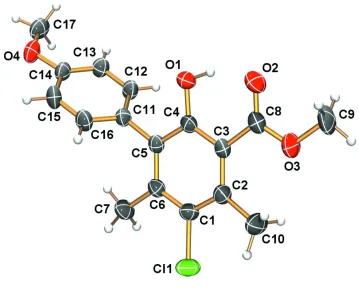
In the title compound (Fig. 1), the the dihedral angle between the mean planes of the two benzene rings is 65.92 (5)°.
The methoxy group and the methylester group lie within the planes of the benzene rings to which they are bonded
(deviation from mean planes: O2, -0.051 (2); O3, 0.151 (2); (??), 0.143 (2) Å; the torsion angles are: C2—C3—C8—O2
-174.47 (12) and C17—O4—C14—C15 -176.38 (12)°). There is an intramolecular hydrogen bond between the hydroxyl
group and the carbonyl O atom of the methylester group. There are weak intramolecular interactions of the types C—
H···O between atom O3 of the ester group and the adjacent methyl group (C10) and C—H···Cl between Cl1 and the
adjacent methyl groups (C7/C10).
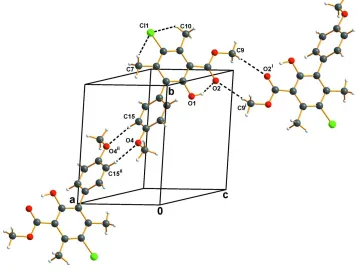
In the crystal structure, the molecules of (I) are held together by rather weak intermolecular C—H···O type non-classical
hydrogen bonds resulting in dimeric units about inversion centers, forming eight and ten membered ring systems which
may be described in terms of graph set notations (Bernstein et al. 1994) as R22(8) and R22(10) motifs for the hydrogen
bonds: C15–H15···O4ii and C9–H9A···O2i, respectively (details are given in Table 1 and Figure 2); leading to a zigzag
chain arrangement.
S2. Experimental
The title compound was prepared according to a previously published procedure (Adeel et al., 2009) using
3-chloro-4-tri-methylsiloxy-pent-3-en-2-one (450 mg, 2.2 mmol), 4-(4-methoxyphenyl)-1,3-bis(silyloxy)-1,3-diene (806 mg, 2.2
mmol), and TiCl4 (0.241 ml, 2.2 mmol). (I) was isolated as a colourless crystalline solid. Re-crystallization from a
saturated dichloromethane/methanol (9:1) solution at ambient temperature gave colourless crystals suitable for
crystallographic studies.
S3. Refinement
The H atom bonded to O1 was located in a difference map and refined freely. Other H atoms were positioned
geometrically and refined using a riding model, with C—H = 0.98 (methyl groups) or 0.95 Å (aryl CH) and with Uiso(H)
= 1.5 times Ueq(C) (methyl groups) or with Uiso(H) = 1.2 times Ueq(C) (aryl CH). Torsion angles of all methyl groups were
Figure 1
Molecular structure of (I), showing the atomic numbering scheme and displacement ellipsoids drawn at the 50%
Figure 2
Part of the packing diagram of (I). Unique O—H···O, C—H···O and C—H···Cl interactions represented by dashed lines
are shown.
Methyl 5-chloro-2-hydroxy-3-(4-methoxyphenyl)-4,6-dimethylbenzoate
Crystal data
C17H17ClO4 Mr = 320.76 Triclinic, P1 Hall symbol: -P 1
a = 6.534 (4) Å
b = 9.574 (6) Å
c = 12.694 (8) Å
α = 97.420 (15)°
β = 100.56 (2)°
γ = 96.042 (14)°
V = 767.3 (8) Å3
Z = 2
F(000) = 336
Dx = 1.388 Mg m−3 Melting point: 367 K
Mo Kα radiation, λ = 0.71073 Å Cell parameters from 7750 reflections
θ = 6.4–59.5°
µ = 0.26 mm−1 T = 173 K Plate, colourless 0.55 × 0.27 × 0.01 mm
Data collection
Bruker APEXII CCD diffractometer
Radiation source: sealed tube Graphite monochromator
ω scans
Absorption correction: multi-scan (SADABS; Sheldrick, 2004)
Tmin = 0.868, Tmax = 0.997
14947 measured reflections 3964 independent reflections 3091 reflections with I > 2σ(I)
Rint = 0.024
θmax = 29.0°, θmin = 4.4° h = −8→8
k = −13→13
Refinement on F2 Least-squares matrix: full
R[F2 > 2σ(F2)] = 0.040 wR(F2) = 0.125 S = 1.09 3964 reflections 207 parameters 0 restraints
Primary atom site location: structure-invariant direct methods
Secondary atom site location: difference Fourier map
Hydrogen site location: inferred from neighbouring sites
H atoms treated by a mixture of independent and constrained refinement
w = 1/[σ2(F
o2) + (0.073P)2 + 0.0592P] where P = (Fo2 + 2Fc2)/3
(Δ/σ)max < 0.001 Δρmax = 0.31 e Å−3 Δρmin = −0.23 e Å−3
Special details
Experimental. Yield: 241 mg, 38%. m.p. = 367 (2) K. 1H NMR (250 MHz, CDCl
3): δ = 2.10 (s, 3H, CH3), 2.56 (s, 3H, CH3), 3.77 (s, 3H, OCH3), 3.89 (s, 3H, OCH3), 6.89 (d, 2H, J = 8.8 Hz, ArH), 7.03 (d, 2H, J = 8.8 Hz, ArH), 10.54 (s, 1 H, OH). 13C NMR (62 MHz, CDCl
3): δ = 19.0, 19.4 (CH3), 51.4, 54.2 (OCH3), 111.5 (C), 112.9 (2 C, CH), 126.8, 127.6, 128.3 (C), 129.9 (2 C, CH), 135.3, 140.8, 156.1, 157.8 (C), 170.5 (C=O). IR (KBr, cm -1): ~ν = 3430 (m), 3050 (w), 3002 (w), 2959 (m), 2931 (m), 2837 (m), 1653 (s), 1607 (m), 1572 (w), 1514 (s), 1444 (s), 1373 (m), 1361 (s), 1297 (s), 1253 (s), 1220 (s), 1176 (m), 1092 (m), 1036 (m) 810 (m), 686 (m). GC—MS (EI, 70 eV): m/z (%): 322 (M+, 37Cl, 16), 320 (M+, 47), 288 (100), 260 (11), 245 (27), 225 (29), 181 (7), 152 (12). HRMS (EI, 70 eV): calcd for C17H17O4Cl [M, 35Cl]: 320.08099; found 320.08088.
Geometry. All s.u.'s (except the s.u. in the dihedral angle between two l.s. planes) are estimated using the full covariance matrix. The cell s.u.'s are taken into account individually in the estimation of s.u.'s in distances, angles and torsion angles; correlations between s.u.'s in cell parameters are only used when they are defined by crystal symmetry. An approximate (isotropic) treatment of cell s.u.'s is used for estimating s.u.'s involving l.s. planes.
Least-squares planes (x,y,z in crystal coordinates) and deviations from them (* indicates atom used to define plane) - 3.7416 (0.0035) x + 4.8249 (0.0051) y - 7.9961 (0.0069) z = 2.4746 (0.0052)
* 0.0019 (0.0009) C1 * -0.0098 (0.0009) C2 * 0.0101 (0.0008) C3 * -0.0023 (0.0008) C4 * -0.0059 (0.0008) C5 * 0.0061 (0.0008) C6 0.0307 (0.0018) C8 - 0.0505 (0.0021) O2 0.1508 (0.0021) O3 0.1865 (0.0030) C9
Rms deviation of fitted atoms = 0.0068
3.1094 (0.0040) x + 6.1432 (0.0055) y - 9.0638 (0.0075) z = 4.7524 (0.0041) Angle to previous plane (with approximate su) = 65.92 (0.05)
* 0.0117 (0.0009) C11 * -0.0089 (0.0009) C12 * -0.0016 (0.0009) C13 * 0.0091 (0.0009) C14 * -0.0060 (0.0010) C15 * -0.0043 (0.0010) C16 0.0476 (0.0018) O4 0.1434 (0.0024) C17
Rms deviation of fitted atoms = 0.0077
Refinement. Refinement of F2 against ALL reflections. The weighted R-factor wR and goodness of fit S are based on F2, conventional R-factors R are based on F, with F set to zero for negative F2. The threshold expression of F2 > 2σ(F2) is used only for calculating R-factors(gt) etc. and is not relevant to the choice of reflections for refinement. R-factors based on F2 are statistically about twice as large as those based on F, and R- factors based on ALL data will be even larger.
Fractional atomic coordinates and isotropic or equivalent isotropic displacement parameters (Å2)
x y z Uiso*/Ueq
O1 −0.09153 (15) 0.87698 (10) 0.26779 (8) 0.0377 (2)
H1 −0.175 (3) 0.892 (2) 0.3196 (17) 0.067 (6)*
O2 −0.25708 (18) 0.99014 (12) 0.41459 (9) 0.0505 (3)
O3 −0.16796 (18) 1.21628 (12) 0.48417 (9) 0.0491 (3)
O4 0.23627 (16) 0.52864 (10) −0.09022 (8) 0.0405 (2)
Cl1 0.48249 (6) 1.39934 (4) 0.30599 (3) 0.05110 (15)
C1 0.3067 (2) 1.24545 (14) 0.29830 (10) 0.0313 (3)
C2 0.1636 (2) 1.24546 (14) 0.36668 (10) 0.0310 (3)
C4 0.03415 (19) 1.00141 (13) 0.27908 (10) 0.0272 (3)
C5 0.18323 (18) 1.00544 (13) 0.21221 (9) 0.0265 (3)
C6 0.32076 (19) 1.12961 (13) 0.22127 (9) 0.0282 (3)
C7 0.4785 (2) 1.14192 (16) 0.14895 (11) 0.0386 (3)
H7A 0.4538 1.0572 0.0937 0.058*
H7B 0.6207 1.1501 0.1925 0.058*
H7C 0.4637 1.2265 0.1136 0.058*
C8 −0.1451 (2) 1.10217 (14) 0.41965 (10) 0.0318 (3)
C9 −0.3311 (3) 1.20118 (19) 0.54694 (14) 0.0515 (4)
H9A −0.4673 1.1710 0.4978 0.077*
H9B −0.3346 1.2925 0.5910 0.077*
H9C −0.3018 1.1298 0.5945 0.077*
C10 0.1683 (3) 1.37309 (18) 0.45028 (13) 0.0513 (4)
H10A 0.2995 1.4367 0.4576 0.077*
H10B 0.1599 1.3421 0.5202 0.077*
H10C 0.0487 1.4235 0.4275 0.077*
C11 0.18957 (19) 0.87662 (13) 0.13357 (9) 0.0277 (3)
C12 0.0254 (2) 0.82784 (14) 0.04645 (10) 0.0310 (3)
H12 −0.0962 0.8750 0.0389 0.037*
C13 0.0333 (2) 0.71183 (14) −0.03026 (10) 0.0320 (3)
H13 −0.0805 0.6811 −0.0899 0.038*
C14 0.2094 (2) 0.64160 (13) −0.01864 (10) 0.0312 (3)
C15 0.3732 (2) 0.68633 (15) 0.06955 (11) 0.0366 (3)
H15 0.4927 0.6372 0.0785 0.044*
C16 0.3628 (2) 0.80242 (15) 0.14448 (11) 0.0348 (3)
H16 0.4760 0.8322 0.2046 0.042*
C17 0.0787 (3) 0.48428 (16) −0.18492 (11) 0.0427 (3)
H17A −0.0537 0.4516 −0.1644 0.064*
H17B 0.1213 0.4064 −0.2306 0.064*
H17C 0.0596 0.5642 −0.2252 0.064*
Atomic displacement parameters (Å2)
U11 U22 U33 U12 U13 U23
O1 0.0325 (5) 0.0332 (5) 0.0465 (5) −0.0037 (4) 0.0149 (4) −0.0005 (4)
O2 0.0459 (6) 0.0494 (7) 0.0592 (7) −0.0045 (5) 0.0307 (5) −0.0012 (5)
O3 0.0522 (7) 0.0473 (6) 0.0545 (6) 0.0061 (5) 0.0337 (5) −0.0003 (5)
O4 0.0479 (6) 0.0350 (5) 0.0402 (5) 0.0133 (4) 0.0143 (4) −0.0022 (4)
Cl1 0.0526 (3) 0.0427 (2) 0.0526 (2) −0.01755 (17) 0.02060 (18) −0.00782 (16)
C1 0.0298 (6) 0.0316 (7) 0.0294 (6) −0.0037 (5) 0.0050 (5) 0.0013 (5)
C2 0.0305 (7) 0.0336 (7) 0.0270 (6) 0.0029 (5) 0.0054 (5) −0.0007 (5)
C3 0.0247 (6) 0.0327 (6) 0.0268 (6) 0.0058 (5) 0.0056 (5) 0.0045 (5)
C4 0.0221 (6) 0.0296 (6) 0.0289 (6) 0.0029 (5) 0.0032 (4) 0.0039 (4)
C5 0.0236 (6) 0.0299 (6) 0.0256 (5) 0.0056 (5) 0.0030 (4) 0.0034 (4)
C6 0.0246 (6) 0.0345 (7) 0.0246 (5) 0.0022 (5) 0.0042 (4) 0.0040 (5)
C7 0.0358 (7) 0.0452 (8) 0.0354 (7) −0.0010 (6) 0.0149 (6) 0.0024 (6)
C8 0.0274 (6) 0.0408 (7) 0.0293 (6) 0.0080 (6) 0.0074 (5) 0.0075 (5)
C11 0.0268 (6) 0.0287 (6) 0.0282 (6) 0.0045 (5) 0.0072 (5) 0.0032 (5)
C12 0.0291 (6) 0.0308 (6) 0.0325 (6) 0.0086 (5) 0.0040 (5) 0.0023 (5)
C13 0.0337 (7) 0.0318 (7) 0.0292 (6) 0.0058 (5) 0.0038 (5) 0.0016 (5)
C14 0.0370 (7) 0.0267 (6) 0.0336 (6) 0.0071 (5) 0.0152 (5) 0.0046 (5)
C15 0.0317 (7) 0.0418 (8) 0.0401 (7) 0.0154 (6) 0.0108 (6) 0.0061 (6)
C16 0.0274 (7) 0.0412 (8) 0.0348 (6) 0.0082 (6) 0.0038 (5) 0.0027 (5)
C17 0.0569 (9) 0.0345 (7) 0.0368 (7) 0.0054 (6) 0.0154 (6) −0.0030 (5)
Geometric parameters (Å, º)
O1—C4 1.3495 (17) C7—H7C 0.9800
O1—H1 0.94 (2) C9—H9A 0.9800
O2—C8 1.2205 (18) C9—H9B 0.9800
O3—C8 1.3170 (18) C9—H9C 0.9800
O3—C9 1.4496 (19) C10—H10A 0.9800
O4—C14 1.3678 (16) C10—H10B 0.9800
O4—C17 1.4169 (19) C10—H10C 0.9800
Cl1—C1 1.7510 (16) C11—C12 1.3850 (18)
C1—C2 1.3870 (19) C11—C16 1.3937 (19)
C1—C6 1.4033 (18) C12—C13 1.3914 (18)
C2—C3 1.417 (2) C12—H12 0.9500
C2—C10 1.505 (2) C13—C14 1.3869 (19)
C3—C4 1.4121 (18) C13—H13 0.9500
C3—C8 1.4821 (19) C14—C15 1.387 (2)
C4—C5 1.4052 (18) C15—C16 1.382 (2)
C5—C6 1.3913 (19) C15—H15 0.9500
C5—C11 1.4925 (18) C16—H16 0.9500
C6—C7 1.5061 (19) C17—H17A 0.9800
C7—H7A 0.9800 C17—H17B 0.9800
C7—H7B 0.9800 C17—H17C 0.9800
C4—O1—H1 104.4 (13) O3—C9—H9C 109.5
C8—O3—C9 116.73 (12) H9A—C9—H9C 109.5
C14—O4—C17 118.03 (11) H9B—C9—H9C 109.5
C2—C1—C6 124.48 (12) C2—C10—H10A 109.5
C2—C1—Cl1 118.94 (10) C2—C10—H10B 109.5
C6—C1—Cl1 116.58 (10) H10A—C10—H10B 109.5
C1—C2—C3 116.76 (12) C2—C10—H10C 109.5
C1—C2—C10 120.28 (13) H10A—C10—H10C 109.5
C3—C2—C10 122.94 (12) H10B—C10—H10C 109.5
C4—C3—C2 119.62 (12) C12—C11—C16 117.68 (12)
C4—C3—C8 116.31 (12) C12—C11—C5 121.30 (11)
C2—C3—C8 124.06 (12) C16—C11—C5 121.01 (11)
O1—C4—C5 115.99 (11) C11—C12—C13 121.91 (12)
O1—C4—C3 122.28 (12) C11—C12—H12 119.0
C5—C4—C3 121.72 (12) C13—C12—H12 119.0
C6—C5—C11 121.90 (11) C14—C13—H13 120.4
C4—C5—C11 119.13 (11) C12—C13—H13 120.4
C5—C6—C1 118.42 (12) O4—C14—C15 115.94 (12)
C5—C6—C7 121.32 (12) O4—C14—C13 124.23 (12)
C1—C6—C7 120.25 (12) C15—C14—C13 119.83 (12)
C6—C7—H7A 109.5 C16—C15—C14 120.05 (12)
C6—C7—H7B 109.5 C16—C15—H15 120.0
H7A—C7—H7B 109.5 C14—C15—H15 120.0
C6—C7—H7C 109.5 C15—C16—C11 121.29 (12)
H7A—C7—H7C 109.5 C15—C16—H16 119.4
H7B—C7—H7C 109.5 C11—C16—H16 119.4
O2—C8—O3 120.57 (12) O4—C17—H17A 109.5
O2—C8—C3 123.38 (12) O4—C17—H17B 109.5
O3—C8—C3 116.05 (12) H17A—C17—H17B 109.5
O3—C9—H9A 109.5 O4—C17—H17C 109.5
O3—C9—H9B 109.5 H17A—C17—H17C 109.5
H9A—C9—H9B 109.5 H17B—C17—H17C 109.5
C6—C1—C2—C3 −1.3 (2) Cl1—C1—C6—C7 −1.06 (16)
Cl1—C1—C2—C3 178.26 (9) C9—O3—C8—O2 −0.3 (2)
C6—C1—C2—C10 177.07 (13) C9—O3—C8—C3 179.38 (12)
Cl1—C1—C2—C10 −3.41 (19) C4—C3—C8—O2 4.94 (19)
C1—C2—C3—C4 1.98 (18) C2—C3—C8—O2 −174.47 (12)
C10—C2—C3—C4 −176.30 (12) C4—C3—C8—O3 −174.73 (10)
C1—C2—C3—C8 −178.63 (11) C2—C3—C8—O3 5.86 (19)
C10—C2—C3—C8 3.1 (2) C6—C5—C11—C12 −113.50 (15)
C2—C3—C4—O1 177.11 (11) C4—C5—C11—C12 66.49 (17)
C8—C3—C4—O1 −2.32 (17) C6—C5—C11—C16 65.53 (17)
C2—C3—C4—C5 −1.34 (18) C4—C5—C11—C16 −114.48 (14)
C8—C3—C4—C5 179.22 (10) C16—C11—C12—C13 −2.1 (2)
O1—C4—C5—C6 −178.70 (10) C5—C11—C12—C13 176.99 (12)
C3—C4—C5—C6 −0.15 (18) C11—C12—C13—C14 0.9 (2)
O1—C4—C5—C11 1.31 (16) C17—O4—C14—C15 −176.38 (12)
C3—C4—C5—C11 179.86 (10) C17—O4—C14—C13 2.97 (19)
C4—C5—C6—C1 0.91 (17) C12—C13—C14—O4 −178.45 (11)
C11—C5—C6—C1 −179.10 (10) C12—C13—C14—C15 0.87 (19)
C4—C5—C6—C7 −177.74 (11) O4—C14—C15—C16 178.07 (12)
C11—C5—C6—C7 2.25 (18) C13—C14—C15—C16 −1.3 (2)
C2—C1—C6—C5 −0.19 (19) C14—C15—C16—C11 0.0 (2)
Cl1—C1—C6—C5 −179.72 (9) C12—C11—C16—C15 1.6 (2)
C2—C1—C6—C7 178.47 (12) C5—C11—C16—C15 −177.44 (12)
Hydrogen-bond geometry (Å, º)
D—H···A D—H H···A D···A D—H···A
O1—H1···O2 0.94 (2) 1.63 (2) 2.5061 (18) 153 (2)
C7—H7C···Cl1 0.98 2.74 2.957 (2) 93
C10—H10C···O3 0.98 2.57 2.662 (2) 85
C9—H9A···O2i 0.98 2.73 3.242 (3) 113
C9—H9C···O2i 0.98 2.96 3.242 (3) 98
C15—H15···O4ii 0.95 2.50 3.437 (2) 170
![Crystal structure of (S) 5 chloro N ({2 oxo 3 [4 (3 oxomorpholin 4 yl)phenyl]oxazolidin 5 yl}methyl)thiophene 2 carboxamide](data:image/gif;base64,R0lGODlhAQABAIAAAP///wAAACH5BAEAAAAALAAAAAABAAEAAAICRAEAOw==)