ADDRESSING CHALLENGES TO BUILDING INFORMATION
MODELLING IMPLEMENTATION IN UK: DESIGNERS'
PERSPECTIVES
Abdul-Majeed MAHAMADU1, Dharshana NAVENDREN 2, Patrick MANU2, Rotimi
JOSEPH2and Krzysztof DZIEKONSKI2
1Department of Architecture and the Built Environment, Faculty of Environment and Technology, University of the West of England, Bristol, BS16 1QY, UK, PH (+44) -117 -965-6261 Email: [email protected]
2Department of Architecture and the Built Environment, Faculty of Environment and Technology, University of the West of England, Bristol, BS16 1QY, UK, PH (+44) -117 -965-6261
ABSTRACT
Building information modelling (BIM) has been proposed as a technology-enabled process for more efficient and effective management of information in digital and virtual environments. Many challenges, however, exist and undermine its effective implementation within the construction industry. The identification of these challenges is critical to the successful implementation and adoption of BIM, especially in view of many implementation risks. Despite the critical role of the design phase to project delivery and BIM usage, few studies have sought to interrogate the challenges faced by designers and the solutions that are being applied to address them. To address this gap, this study aimed to identify and classify challenges faced by designers with particular focus on proposed solutions for alleviating the identified challenges. Through a qualitative research strategy, semi-structured interviews were used to solicit perspectives of UK design professionals on design profession-specific BIM implementation challenges and solutions. Findings reveal that challenges are mostly organisational and external environmental issues with rather cursory allusion to technological challenges which are widely reported in the literature. The solutions identified for alleviating designers’ BIM implementation challenges include earlier input and integration from whole supply chain as well as more support institutional support and facilitation. The promotion of open-BIM standards, tailored insurance as well as principal supplier leadership were also proposed as viable solutions to BIM implementation challenges. Variations in the challenges and proposed solutions appear to differ across different categories of firms investigated in this study, particularly in relation to the cost of implementation.
Keywords: BIM, challenges, designers, qualitative research, solutions, UK
1. INTRODUCTION
inability to meet performance targets as a result of fragmentation and information management challenges (Cabinet Office, 2011; Egan, 1998; Latham, 1994). Some of the most referenced performance issues in the construction industry include: lack of cost and time certainty in the delivery process; poor quality; adversarial culture; and badly delegated risks and rewards (Egan, 1998; Latham, 1994). The levels of fragmentation in the construction project delivery process prevent effective communication and collaboration as well as alignment of often diverse interests of project stakeholders. This inhibits effectiveness and efficiency as a result of the inability to streamline the project delivery process into a single well-co-ordinated endeavour (Egan, 1998). In order to achieve such a coordinated delivery process, there is a need for effective information and knowledge sharing, primarily through information and communication technology (ICT) systems. Currently, ICT is being promoted as a key catalyst towards improvements within the construction industry in general (Saxon, 2014; Arayici et al., 2012a). A new technologically-driven process underpinned by virtual communications has emerged, promising to transform information management and communication processes in construction (Arayici et al., 2012a; Eastman et al., 2011; Sebastian and Van Berlo, 2010). This is referred to as Building Information Modelling (BIM), defined as a process for structured sharing and coordinating of digital information about a facility during its entire lifecycle (Eastman et al., 2011).
BIM is regarded as central to the attainment of the UK Government construction strategy and visions (BIS, 2013; Cabinet Office, 2011). This has provided a greater impetus for BIM adoption with the expectation of performance improvements in key areas including cost savings, quality and sustainability. According to the BIM Task Group (2013), the adoption of BIM will lead to a more modern and highly automated construction industry. BIM benefits cannot, however, be realised if the challenges of adoption are not addressed. The wider adoption of BIM is reported as slow within certain segments of the industry as a result of several challenges. This study looks into the challenges to BIM usage and ways of addressing them from the perspective of designers. In the sections that follow, a background literature review covering developments on BIM, its benefits and implementation challenges is presented. The research method adopted for this study is also presented together with a summary of findings, discussions and conclusions.
2. LITERATURE REVIEW
mandated BIM level 2 implementation on all government projects since 2016. Government's BIM expectations include the delivery of efficiency, improved carbon performance and significant cost reduction on public projects (BIS, 2013; Cabinet Office, 2011). The realisation of these benefits is, however, being undermined by several barriers. The following sections discuss these issues together with the benefits of BIM.
2.1 BIM benefits
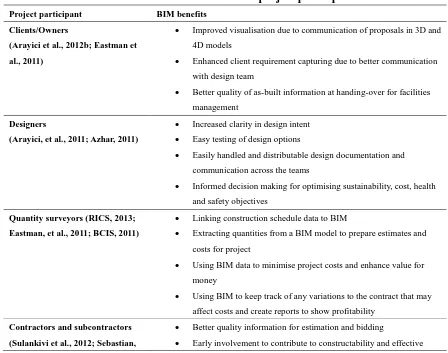
[image:3.595.69.517.382.735.2]There are several benefits associated with the implementation and use of BIM in a construction project. These include early collaborative decision making, better design clarity, a stronger link between the design and costs, virtual mock-ups and models, improved visual projections and simulations, optimal asset performance, decreased waste, fewer document errors, reduced costs, improved construction outcomes, higher predictability of performance, increased understanding of the entire lifecycle and data sharing between all disciplines from cradle to grave (Bryde et al., 2013; Barlish and Sullivan, 2012; Azhar, 2011; Suermann, 2009). Beyond these are also other benefits that are specific to various project participants. These have been summarised in Table 1.
Table 1: BIM benefits to various project participants
Project participant BIM benefits
Clients/Owners
(Arayici et al., 2012b; Eastman et
al., 2011)
Improved visualisation due to communication of proposals in 3D and
4D models
Enhanced client requirement capturing due to better communication
with design team
Better quality of as-built information at handing-over for facilities
management
Designers
(Arayici, et al., 2011; Azhar, 2011)
Increased clarity in design intent
Easy testing of design options
Easily handled and distributable design documentation and
communication across the teams
Informed decision making for optimising sustainability, cost, health
and safety objectives
Quantity surveyors (RICS, 2013;
Eastman, et al., 2011; BCIS, 2011)
Linking construction schedule data to BIM
Extracting quantities from a BIM model to prepare estimates and
costs for project
Using BIM data to minimise project costs and enhance value for
money
Using BIM to keep track of any variations to the contract that may
affect costs and create reports to show profitability
Contractors and subcontractors
(Sulankivi et al., 2012; Sebastian,
Better quality information for estimation and bidding
2010; Suermann, 2009; ) scheduling
Clash-free construction due to ability to simulate before actual
construction
Manufacturers
(Arayici et al., 2012b; Azhar; 2011)
Ease of usage of model data for downstream activities (i.e.
manufacturing/assembling)
Product specification compliance during design stage
Better coordination and incorporation of product data for operation
and maintenance
Facilities managers
(Arayici et al., 2012b; Azhar; 2011)
Enhanced quality of as-built and handing over information and easier
integration into computer aided facilities management (CAFM) systems
Easy post-occupancy evaluations for analysis of current use, space
and energy assessments
Easier communication of maintenance requirements during design
Despite these benefits, there are several socio-technical challenges which continue to decelerate the industry's ability to maximise the potential of BIM (Arayici et al., 2012a; Bernstein and Pittman, 2005).
2.2 BIM challenges
Many of the challenges contributing to the slow adoption of BIM have been widely reported from various viewpoints. These challenges can be classified as technological, organisational and environmental (Mahamadu et al., 2013). This categorisation is consistent with a technology-organisational-environmental (TOE) framework, which has been previously used in information technology (IT) studies to categorise implementation factors (Tornatzky and Fleischer, 1990). The technology factors refer to technical issues regarding the characteristics and capabilities of the technology (BIM), while organisational factors refer to internal organisational issues (i.e. structure, resources, leadership and people) as well as to the social stimulus of technology adoption (Davies and Harty, 2013; Mahamadu et al., 2013). Finally, the environmental factors refer to all other issues, mainly macro level facilitating conditions such as the industry and market environments provided by governments, professional institutions and software vendors to facilitate ease of BIM implementation (Mahamadu et al., 2013; Sargent et al., 2012).
2.2.1 Technological
Interoperability of software and systems has also been cited as one of the most prominent technical challenges. This inhibits the effective transfer and sharing of data across diverse proprietary information systems and software amidst a lack of standards and vendor-neutral data formats to facilitate this (Gu and London, 2010). There is also significant security risk as well as issues regarding accessibility of the pervasive open virtual environment BIM introduces (Mahamadu et al, 2013; Singh et al., 2011).
2.2.2 Organisational
A high degree of organisational interoperability is required to facilitate effective information sharing as well as mitigating possible legal challenges and disputes (Eastman et al., 2011). Such disputes may, however, be caused by ambiguity about data ownership, copyright and data protection in the common data environment that BIM imposes on project organisations (Azhar, 2011). Some of the other reported BIM challenges include: overcoming the endemic resistance to change; adaptation (from traditional and existing) to new processes; tasks and workflows; and awareness and clear understanding of the responsibilities of different actors in a typical project organisation (Elmualim and Gilder, 2014; Arayici et al., 2012a; Arayici et al., 2011; Eastman et al., 2011). Disputes may also arise as a result of a perceived loss of authority and control over information due to the participation of different stakeholders in the information delivery process (Mahamadu et al., 2013; McAdam, 2010). There is also uncertainty about the costs of BIM implementation and who is best suited to pay for any resultant increases in the project cost (Azhar, 2011).
2.2.3 Environmental
From the above discussions, it is clear that BIM implementation challenges have been a subject of considerable attention. However, most of the studies have reported on BIM implementation challenges without an in-depth focus on a specific profession or phase of the construction process. Beyond that, most studies reporting challenges have often not deliberated adequately the solutions to the challenges identified.
2.3 Solutions to BIM challenges
Similar to the BIM challenges, the solutions that have been proposed in the literature for addressing challenges could also be similarly categorised under technological, organisational, and environmental (TOE).
2.3.1 Technological
Technology is a main driver behind the BIM process and organisations need to address related issues in order to successfully maximise the benefits of BIM (Sawhney et al., 2014). There needs to be investment in technological advancements through the necessary hardware, software and network systems so that that there is a high level of interoperability (Eastman et al., 2011; Gu and London, 2010). A BIM business strategy should not only include these technical changes, but also the administrative, functional and operational changes to support the new technology artefacts, infrastructure and processes (Khosrowshahi and Arayici, 2012).
2.3.2 Organisational
A clear vision within organisations implementing BIM is essential in preventing waste of resources (Autodesk, 2012). There is therefore a need for careful supervision of implementation in order to minimise resistance to change (Sackey, 2013). Dinesen (2010) suggests that the principal consideration when implementing change within an organisation should be people rather than the technology. The construction team must work collaboratively and share information transparently to tackle organisational and cultural change associated with new technology implementation (Sackey, 2013). This is often viewed as the most difficult aspect of technology implementation within organisations. Glennon et al. (2014) suggest that open communication is key to change in culture. Burnes (2009) proposes management mechanisms for employees to become aware of company performance, competitors and legal requirements or they are unlikely to recognise the need for change. Sackey (2013) states that a combination of both top-down levels of support and bottom-up involvement should be developed and followed to establish feasibility, targets in budget, timelines and a clear BIM implementation plan.
BIM uptake has consistently been on the rise in the UK since 2011 (Waterhouse et al., 2014). Some have attributed this to the high level of government promotion of BIM, including the clear mandate for universal adoption of public projects from 2016 (Cabinet Office, 2011). Others are of the view that many of the implementation challenges will be alleviated by the free availability of standards, protocols and templates of technical documents, including Employers Information Requirements (EIR), BIM Execution Plans (BEP), contracts (e.g. CIC protocol) and PAS documents (PAS1192:2, 2013; RICS 2013; Mahamadu et al., 2017). RICS (2013) and NBS National BIM reports (Waterhouse et al., 2014) highlight that there has been a change in attitude towards BIM in the industry as the condition of being BIM literate is now becoming a sought-after competency. There is an increase in the number of courses available in educational institutions aimed at developing capacity of individuals and organisations’ BIM proficiency (Underwood and Ayoade, 2015).
2.4 Towards interrogating profession-specific challenges and solutions of BIM implementation
Whereas the BIM benefits for various construction professions have been widely reported (see Table 1), not many studies have focused on the challenges specific to these professions. A few studies such as BCIS (2011) and Williams (2013) provide some insights from the perspective of facilities managers, quantity surveyors and building surveyors. There is a need for sustained contextual exploration of profession-specific challenges and apposite solutions given differences in industrial norms and environmental settings within which these construction professions operate. According to Davies and Harty (2013), the individual disposition of each discipline may affect their attitude towards change, invariably including BIM adoption. From survey evidence (see the NBS National BIM Report, 2014), the technological readiness and skills and competencies of various disciplines differ and thus may affect the type of challenges they face in their bid to implement BIM. This further affects the approaches needed for overcoming the challenges each profession faces in their BIM implementation.
regarded as among the early adopters of BIM in the UK, making any studies within this sector worthwhile (see the NBS National BIM Report, 2014). The need for exploring BIM implementation challenges and solutions among designers cannot be overemphasised since their adoption of BIM is crucial to BIM success in the industry in general. Therefore this research investigated the challenges faced by designers (i.e. design firms) in the implementation of BIM and, most importantly, outlines solutions to these challenges from the perspective of design firms currently implementing BIM in UK.
3. METHODOLOGY
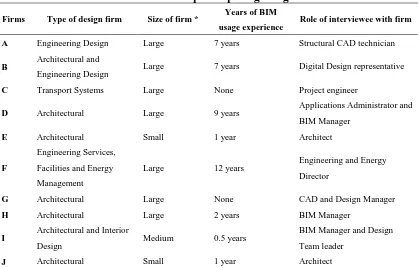
The research aim was to explore BIM implementation challenges and solutions from the perspective of design firms. Qualitative research was deemed the most appropriate for exploring these issues. Qualitative methods are regarded as appropriate for investigating issues in-depth in order to identify peculiarities from the perspectives of individuals with knowledge of the phenomenom (Hartmann et al., 2009). According to Adriaanse (2007), the over-reliance on quantitative and positivist perspectives for technology adoption research is not adequate for deeper exploration. Thus, qualitative research methods are regarded as more appropriate, particularly in view of the ‘novelty’ of BIM as a concept. More recently, several studies are employing qualitative approaches in order to explore more detailed perspectives of information technology adoption based on experience of early adoption (e.g. Wilde, 2015; Harty, 2012; Shen and Issa, 2010; Adriaanse, 2007). These (qualitative) approaches are better positioned to aid inductive development of theory and conceptual propositions for further exploration (Hartman et al., 2009). For this study, qualitative interviews (semi-structured) were used to collect data from design firms.
Table 2: Profile of participating design firms
Firms Type of design firm Size of firm * Years of BIM
usage experience Role of interviewee with firm
A Engineering Design Large 7 years Structural CAD technician
B Architectural and
Engineering Design Large 7 years Digital Design representative
C Transport Systems Large None Project engineer
D Architectural Large 9 years Applications Administrator and BIM Manager
E Architectural Small 1 year Architect
F
Engineering Services, Facilities and Energy Management
Large 12 years Engineering and Energy Director
G Architectural Large None CAD and Design Manager
H Architectural Large 2 years BIM Manager
I Architectural and Interior
Design Medium 0.5 years
BIM Manager and Design Team leader
J Architectural Small 1 year Architect
*Firm size: micro < 10, small < 50 employees, medium < 250 employees, and large ≥ 250 employees (European Commission, 2005).
As shown in Table 2, the firms included architectural and engineering design firms. The firms vary in size and they also have varying years of experience of BIM usage. These variations enriched the data in terms of providing the opportunity to explore differences in the perceptions or experiences of BIM challenges and ways of addressing these challenges across a spectrum of firm types
4. RESEARCH ANALYSIS FINDINGS
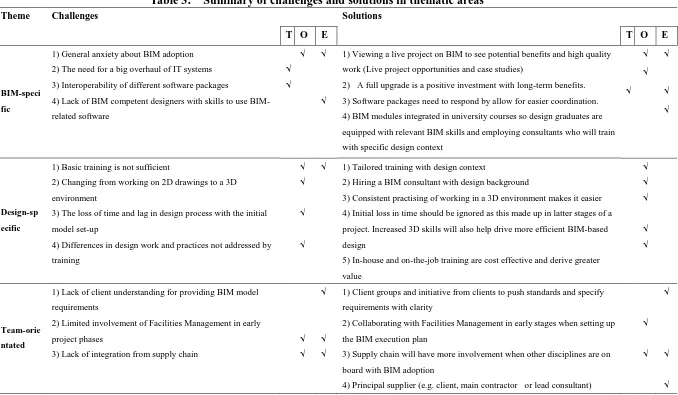
The qualitative data was carefully coded for subsequent thematic analysis. The data analysis resulted in the classification of challenges and their solutions in seven key thematic areas. The themes for the challenges and solutions are then categorised in relation to the Technology-Organisational-Environmental (TOE) framework which was used for secondary coding of data.
4.1 Thematic areas of BIM challenges and solutions
challenges being faced by designers are discussed in these thematic areas before discussing suggested solutions with sample quotations. The challenges and solutions are summarised in Table 3.
4.1.1 BIM-specific challenges and solutions (Theme 1)
There were challenges faced by the designers that are specifically related to BIM as a technology as commented on by one interviewee: “...there is still anxiety generally for
people to use it" [Firm J - Architect]. Coordination and interoperability issues continue to hamper effective BIM use as mentioned by an interviewee: “…there are a lot of different
disciplines that use different bits of software. The barrier is getting the completely different bits of software to talk to each other effectively"[Firm A - Structural CAD technician].
The consensus on solving the technical BIM specific issues was mainly the need for more investment, industry efforts towards open standards and skill development. There is a high expectation for open standards (i.e. Industry Foundation Classes [IFC], International Framework for Dictionaries Library [IFDs], Model View Definition [MVDs]) at the macro level as opposed to micro level implementation of data exchange protocols.
Table 3: Summary of challenges and solutions in thematic areas
Theme Challenges Solutions
T O E T O E
BIM-speci
fic
1) General anxiety about BIM adoption 2) The need for a big overhaul of IT systems 3) Interoperability of different software packages
4) Lack of BIM competent designers with skills to use BIM- related software
√ √
√ √
√
1) Viewing a live project on BIM to see potential benefits and high quality work (Live project opportunities and case studies)
2) A full upgrade is a positive investment with long-term benefits. 3) Software packages need to respond by allow for easier coordination. 4) BIM modules integrated in university courses so design graduates are equipped with relevant BIM skills and employing consultants who will train with specific design context
√ √ √ √ √ √ Design-sp ecific
1) Basic training is not sufficient
2) Changing from working on 2D drawings to a 3D environment
3) The loss of time and lag in design process with the initial model set-up
4) Differences in design work and practices not addressed by training
√ √
√
√
√ 1) Tailored training with design context
2) Hiring a BIM consultant with design background
3) Consistent practising of working in a 3D environment makes it easier 4) Initial loss in time should be ignored as this made up in latter stages of a project. Increased 3D skills will also help drive more efficient BIM-based design
5) In-house and on-the-job training are cost effective and derive greater value √ √ √ √ √ Team-orie ntated
1) Lack of client understanding for providing BIM model requirements
2) Limited involvement of Facilities Management in early project phases
3) Lack of integration from supply chain
√ √
√
√ √
1) Client groups and initiative from clients to push standards and specify requirements with clarity
2) Collaborating with Facilities Management in early stages when setting up the BIM execution plan
3) Supply chain will have more involvement when other disciplines are on board with BIM adoption
4) Principal supplier (e.g. client, main contractor or lead consultant)
√
√ √
√
leadership
Project-re
lated
1) Uncertainty of procurement routes for implementing BIM 2) Insurance to cover collaborative working practices, overlaps and sharing of risks and responsibilities
√
√
1) Looking at previous exemplary projects that have adopted BIM and hiring specialists to provide guidance
2) Insurers need to adapt to cover new legal risks brought about by collaborative working on BIM
√ √
√
Organisat
ional
1) Changing the way people work in an organisation 2) Changing the way firms do business and adaptation to the new process
√
√ √
1) Setting up a BIM working group for people to direct their questions towards and receive answers
2) Setting up a BIM/digital design group that addresses issues, creates documentation, provides guidance and gains consistency with BIM work
√
√ √
Industry-Related
1) Deliverables have not changed from a contractual perspective
2) Standardisation is difficult for multinational companies owing to different requirements in different countries 3) Lack of adequate feedback on projects that have used BIM 4) Government publications do not provide enough
information to aid successful implementation within design firms
√ √
√
1) The industry needs to respond according to BIM requirements by adapting contract deliverables
2) Multinational companies can form their own standards that suit their way of working. Plus, stakeholder engagement also helps with such a large transition
3) Attending information seminars and lectures, although more project feedback need to be publicly released
4) The government and professional bodies need to address this by updating publications or releasing new ones that provide more detail and guidance
√ √ √ √ √ BIM Cost
1) Costs related to BIM include: software, hardware, hiring new employees with BIM competence, hiring a BIM consultant to train existing employees. The cost of reduced employee productivity and the learning curve is difficult to quantify.
√ 1) The initial investment cannot be reduced: however, choosing to invest in
BIM leads to numerous savings in the long term and other benefits that will give the company future opportunities and an advantageous position in the industry.
√
The need for broad industry commitment to open standards is highlighted by the quote: "As there are more and more companies using these pieces of software, there is a need for them to be coordinated. The people that make the software have to respond to the market otherwise people will just use something else" [Firm A - Structural CAD technician].
There is a clear need for BIM proficiency and skills development within design practices with designers favouring the use of BIM consultants with architectural (design) backgrounds: “…having consultants who have an architectural background
would be of great help" [Firm B - Digital Design Representative] to aid BIM implementation.
4.1.2 Design-specific challenges and solutions (Theme 2)
One of the critical design-specific challenges identified is the loss of time and lag in the design process resulting from setting up the BIM model initially and passing it between different team members. Some participants expressed the view that the design team needed considerably more time to build up the model with much more information upfront. Furthermore, a challenge regarding training not addressing the specific needs of 3D and information-oriented BIM design workflows also emerged as shown in the quote: "Different practices, different CAD standards, different ways of producing and displaying drawings - therefore we tend to stay away from going to training companies as they only give a blanket overview of what the software can do" [Firm A - Structural CAD technician].
Basic training to accommodate the necessary process redesign was thus viewed as a key issue as highlighted in interviewees’ comments: "…the standard training is for three days and in that time, you learn basic things.” “It is a big difference working from 2D drawings to 3D environment, I personally think even with that basic training, you would struggle to produce information for a project" [Firm J - Architect].
Participants recommended employing consultants who deliver training in the context that suits the design professional’s expectations as shown in the quote: “…a BIM consultant that is very much in demand if he comes from an architect's background" [Firm H - BIM Manager]. Findings also support the reliance on informal networks to enhance knowledge and skill acquisition in addition to formal education and training. Participants from larger companies are more inclined towards in-house and on-the-job training as a cost-effective means. According to interviewees, the challenge of designing in 3D environments can be addressed through practice and learning. Participants suggested that as designers become accustomed to working in a 3D environment, BIM becomes easier to use. The loss of time and lag in the design process may be frustrating, yet this investment in effort and time in the early stages reaps benefits in later stages of the project as highlighted by an interviewee: “…early
design phase and schematics is a bit slow but that time is then made up later on”
[Firm A - Structural CAD technician].
4.1.3 Team-orientated challenges and solutions (Theme 3)
The challenges reported included the lack of understanding by clients regarding their requirements for BIM, problems with facilities management, and supply chain congruence on the manner in which to engage with BIM. Interviewees noted that
currently they don't understand enough” [Firm D - Applications Administrator and BIM manager]. A participant agreed that “…the facilities management side of BIM is
not that well understood at the moment” [Firm J - Architect] and designers are yet to
fully comprehend the role of COBie, PAS1192:4 and Government Soft Landings (GSL) issues. According to one interviewee: “There is certainly a lack of understanding of how FM and BIM work together from a designers perspective" [Architect], giving credence to the perception of making designing more difficult and less creative as a result of the need to review too many pieces of information. Another challenge is the lack of integration of the supply chain. Some manufacturers are not ready to provide BIM objects for use by designers in the UK because they are from parts of the world where they are not required to be BIM compliant. Thus some manufacturers are not convinced that investing in BIM for the UK market will be a worthwhile investment, making their involvement as part of an integrated supply chain difficult. One of the interviewees delved further into this as highlighted in quote: “…the UK is a fairly small proportion of their (manufacturers) business,
therefore for them to invest in UK-centric BIM (objects/libraries) would not add value to them" [Firm F - Engineering and Energy Director]. This is indicative of the existence of commercial imperatives and industrial norms that impede the effective integration of some aspects of the supply chain in order to leverage the integrative and communication capabilities of BIM.
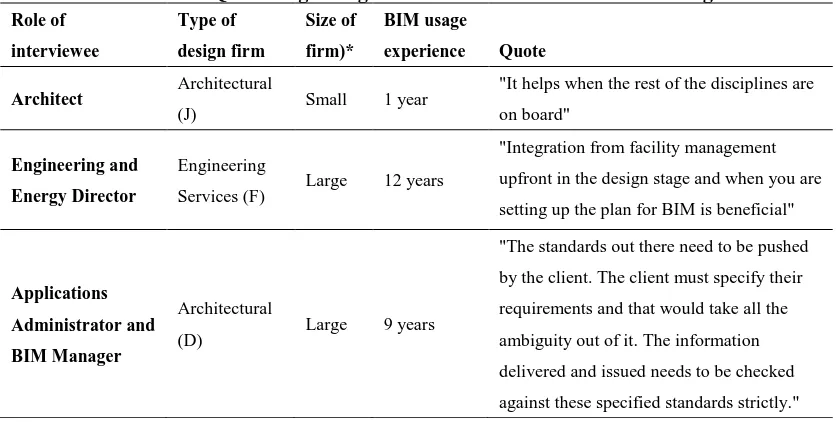
[image:14.595.92.510.413.624.2]The following views, as shown in Table 4, were recommendations by interviewees to overcome the team-orientated challenges.
Table 4:Quotes regarding solutions for team-orientated challenges
Role of
interviewee
Type of
design firm
Size of
firm)*
BIM usage
experience Quote
Architect Architectural
(J) Small 1 year
"It helps when the rest of the disciplines are on board"
Engineering and
Energy Director
Engineering
Services (F) Large 12 years
"Integration from facility management upfront in the design stage and when you are setting up the plan for BIM is beneficial"
Applications
Administrator and
BIM Manager
Architectural
(D) Large 9 years
"The standards out there need to be pushed by the client. The client must specify their requirements and that would take all the ambiguity out of it. The information delivered and issued needs to be checked against these specified standards strictly."
to the rest of the supply chain through implementation guidance and provision of training and other resources.
4.1.4 Project-related challenges and solutions (Theme 4)
The project-related challenges that surfaced from the interviews are insurance and uncertainty of the chosen route to implement BIM through existing project procurement strategies. This is highlighted by the following participant’s comment:
"Intellectual property, who owns the risks and responsibilities, can be difficult to determine due to the level of sharing on BIM. We find ourselves outside our level
of insurance at times just because the insurance hasn't adapted to the new ways
by which people are having to work". [Firm I - BIM Manager]
To address the uncertainty regarding appropriate procurement arrangements for BIM projects, interviewees were of the opinion that this can be solved by understudying happenings on previous projects that have adopted BIM. Additionally, experts and external assistants are usually brought in to help in designing project structures: “…we contact specialists outside of the office to get some input" [Firm D - Applications Administrator and BIM Manager]. Interview participants recommended that the challenge regarding insurance and liabilities can only be addressed by the insurers’ development of new types of cover that reflect professional indemnity risks imposed by BIM. This is highlighted in the following quote: "Assistance from the insurers is definitely needed…We need the insurers to adapt the cover so that we are able to insure ourselves whilst working on BIM" [Firm I - BIM Manager].
4.1.5 Organisational challenges and solutions (Theme 5)
Authors are not advised to use more than three levels of subsections’ nesting. The use of too many nesting levels will reduce clarity and may be confusing for the readers of the article. According to the participant firms, adopting BIM affects the systems, structure and working ethos of an organisation. Changing the way people work when an organisation adopts BIM is a challenge as exemplified in the following comment: “…getting people to work in a different way is tough: people
tend to work in a certain way and that works for them and they are quite happy to keep doing that so to come out of their comfort zone and do something different is difficult to break through" [Firm A - Structural CAD technician]. Further comments show that variations in the approaches to work within different segments of the same company also pose significant challenges: "There are several branches of the company that are all trying to implement BIM in the best way. Everyone is using different software packages, different management structures and separate standards, which in theory all do the same thing” [Firm A - Structural CAD technician].
have set up their own BIM working group [Firms A, B, D, F, H, I and J]. Another participant also describes the benefits gained by setting up a BIM design group across the whole organisation: “…this group addresses issues that come up with BIM
and gets consistency with our BIM work. The group analyses the issues and create the documentation and standards, which provide (specific) guidance” [Firm B - Digital Design Representative]. Finally, multinational companies need to evolve in-house standardisation of processes and other technical requirements to ensure in-house interoperability, not only for systems, but also for intra-organisational interoperability.
4.1.6 Industry-related challenges and solutions (Theme 6)
The view was expressed that project deliverables (i.e. drawings) need to be modified from a contractual perspective and that there is lack of clear universal guidelines and standards for implementing BIM. A participant commented that
“…one of the larger issues for the industry is that the requirements are changing
but the deliverables haven't changed from a contractual perspective. Until 2D
deliverables are gone or at least refined, we are going to have a lot of problems.
Until the system changes, the deliverables change, and it is contractually
obligated to use BIM, there will be a challenge". [Firm D - Applications Administrator and BIM Manager]
The latter challenge was even more pronounced among large multinational firms who are under pressure to develop different requirements in the various countries in which they work, which has made it difficult for them to standardise their work procedures. Another challenge brought to light during interviews was the lack of adequate learning feedback from projects on which BIM has been used. It was felt that such feedback is important in improving the understanding of BIM amongst project participants and that it is also important in informing investment decisions regarding BIM. One participant commented that.
“the BS and PAS publications set out the ethos of BIM but do not give you hard
and fast rules and regulations as to how the correct BIM system should be
achieved. There are some fairly distinct guidelines in there but it could be
achieved in 50 different ways to get the same type of result". [Firm A - Structural CAD Technician]
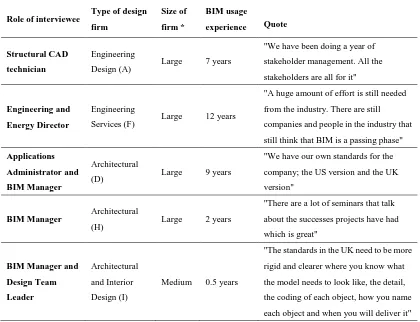
Table 5, participants suggested a number of approaches to assist in delivering the necessary change in the industry: taking steps to ensure a more effortless transition, including stakeholder engagement and addressing the lack of feedback about BIM projects by attending informative seminars and lectures. Nevertheless, further information needs to be publicly released or published from case studies. In addition, : existing guidelines and standards require further clarity although it was also acknowledged that they have some usefulness; and the lack of distinct profession specific guidelines and standards must be addressed by the government and professional bodies.
4.1.7 Cost-related challenges and solutions (Theme 7)
[image:17.595.91.511.377.699.2]The cost of implementing BIM by the participants’ firms was considered to include software cost; hardware cost; training cost; hiring new employees with BIM competence; and hiring external BIM consultants. Participants explained that whilst some of these costs (e.g. software cost) are easy to quantify in monetary terms, costs relating to the process of up-skilling employees are more difficult to estimate. They stressed that it is difficult to quantify the cost relating to the reduction in employees’ productivity as they learn to become conversant with BIM in particular.
Table 5: Quotes regarding solutions for industry-related challenges
Role of interviewee Type of design firm
Size of
firm *
BIM usage
experience Quote
Structural CAD
technician
Engineering
Design (A) Large 7 years
"We have been doing a year of stakeholder management. All the stakeholders are all for it"
Engineering and
Energy Director
Engineering
Services (F) Large 12 years
"A huge amount of effort is still needed from the industry. There are still companies and people in the industry that still think that BIM is a passing phase"
Applications
Administrator and
BIM Manager
Architectural
(D) Large 9 years
"We have our own standards for the company; the US version and the UK version"
BIM Manager Architectural
(H) Large 2 years
"There are a lot of seminars that talk about the successes projects have had which is great"
BIM Manager and
Design Team
Leader
Architectural and Interior Design (I)
Medium 0.5 years
"The standards in the UK need to be more rigid and clearer where you know what the model needs to look like, the detail, the coding of each object, how you name each object and when you will deliver it"
be applied on design work in a project that is lost. The cost of the learning curve is difficult to quantify" [Firm I -BIM Manager and Design Team Leader]. However, whilst the cost of implementing BIM appeared to be a main concern for the small firms, cost did not seem a prioritised challenge for the large firms.
Interviewees were generally of the opinion that there are significant returns on investment, thus cost should not be viewed as a major challenge. Participants stressed that the initial investment in BIM results in long-term savings and benefits, including time saved during latter project stages, faster working processes as employees become familiar with working with BIM, more collaborative decision-making processes that improve communication and reduce mistakes/errors, increased opportunity to work on bigger projects, increased interest from graduates to work for the organisation, and enhanced reputation in the industry as the BIM agenda continues. A participant commented that “…the costs of our involvement in
BIM is fairly low because the man-hours we use gets charged to individual contracts with individual clients. It is not a significant portion of our capital expenditure"
[Firm F - Engineering and Energy Director].
4.1.8 The technological, organisational and environmental dimensions of challenges and solutions
The TOE framework was used as a secondary coding structure for reclassification of the sub-themes (reported challenges and solutions). From the analysis, the most frequently reported challenges are organisational (code frequency of 11) and environmental in nature (code frequency of 11) with technological challenges being the least reported (code frequency of 2) so far as the TOE framework is concerned. Furthermore, most of the solutions proposed by participants for designers implementing BIM were organisational (code frequency of 15) followed by environmental (institutional/industry) (code frequency of 12) level solutions that need to be driven by institutions such as professional bodies, software vendors and government.
5. DICUSSION OF FINDINGS
The findings have highlighted the prevalence of many of the previously reported BIM challenges among designers. However, while most previous studies have reported several technological challenges (Arayici et al., 2012a; Harty, 2012; Newton and Chileshe, 2012), the findings in this study reveal that design professionals are faced with more organisational and environmental issues than technological. Furthermore, most solutions are organisational in nature followed by the need for enabling external environment. Very few of solutions proposed were technological in nature, indicating possible lower levels of organisational maturity as compared to maturity of existing BIM technology. Furthermore, this aligns with Sackey (2013) and Adriaanse,’s (2007) view that BIM is a socio-technical system which requires a soft technology deterministic view (where the focus must be on the people and organisational process facilitators) rather than very hard technical systems view.
interoperability through recommendation of the need for macro scale open standards (i.e. IFC, IFDs, MVDs) development (see Harty, 2012). While these are generally regarded as future level 3 BIM requirements (PAS1192:2, 2013), the findings are indicative of an immediate concern among designers for the evolution of these standards. Furthermore, designers support macro-level open-BIM standard interventions to alleviate technical challenges as opposed to micro-level adoption of standards, a solution which is also promoted for a more localised resolution of interoperability problems (Yousefzadeh et al., 2015). The academic curriculum changes following the UK Construction Strategy (2011) were expected to deliver more BIM ready graduates going into the design firms from UK educational institutions (Underwood and Ayoade, 2015). However, the findings highlight a lack of BIM readiness among graduates. This study further highlights the need for specific and basic training to accommodate the necessary process re-design within design practice as opposed to the generic focus and cursory reliance on training in software such as Autodesk Revit (Underwood and Ayoade, 2015). Similarly, Newton and Chileshe (2012) recommend tailored training to overcome skill issues. Findings are indicative of a preference for in-house and on-the-job training as a cost-effective means of acquiring tailored skills for design professionals.
The findings are consistent with literature regarding supplier integration through BIM (Gu and London, 2010). The findings also support the notion that principal suppliers (e.g. main contractors) must provide leadership and support to the rest of the supplier chain through implementation guidance, training and BIM promotion groups as proposed in current BIM strategy documents (i.e. BIS, 2013; Cabinet Office, 2011).
The Government has provided significant leadership and promotion of BIM through frameworks, protocols and guidance documents (NBS, 2012; Cabinet Office, 2011). The UK is, therefore, generally regarded as a leader owing to the availability of several protocols. While the study acknowledges the importance of these protocols, it further highlights the vagueness and lack of specificity which is making their use challenging, especially for smaller firms with less BIM experience. Given the fact that this study focused on designers, it can be inferred that existing protocols are not suitable for the current workflow adopted by designers for executing BIM and thus are limited in guiding firms through the process re-design required and similarly acknowledged in the literature (Elmualim and Gilder, 2014; Arayici et al., 2011; 2012a;). These studies have not, however, highlighted the role of Government-developed protocols in supporting designers’ process re-engineering for BIM in the UK context. The findings in this study, however, highlight the role of Government and professional bodies (e.g. RIBA) in helping designers to understand the process re-engineering required through regular updated publications or release of new ones that provide more tailored solutions. The study therefore highlights the inadequacy of BIM protocols and standards which have been specifically developed for designers and this must be considered in future development of policy.
6. CONCLUSION
changes to existing ways/processes of designing; process lag and loss of time due to the creation of the BIM model and passing it among other project participants; lack of understanding by clients and resultant poor definition of BIM requirements; lack of learning and feedback; issues of interoperability; lack of supply chain integration; and lack of clear and specific guidelines and standards.
The findings also highlight ways of addressing the significant barriers associated with BIM implementation as becoming familiar with working directly in a BIM-enabled 3D environment; working collaboratively; further training; employing external parties and consultants with design backgrounds; setting up company BIM working groups; adjustments of company culture and working processes; formulating company standards to provide consistency; obtaining earlier input and integration from whole supply chain; maximising the use of BIM client groups; modifying insurance to include collaborative BIM work; ensuring more support from software companies and standards institutions with regard to open standards; obtaining more information provided by the UK Government and professional bodies, especially updating protocols to suit various professions, and establishing tailored BIM education for the process changes associated with 3D modelling and BIM design.
This study provides further understanding on the subject of BIM for designers in particular by highlighting a unique categorisation of challenges and their solutions. Whilst some of these challenges share similarity with challenges reported in previous studies, the profession-specific (i.e. designers) focus given by this study provides understanding from a new perspective, highlighting the need for focus on organisational solutions as well as facilitating conditions provided at the macro implementation level. Future research should explore challenges and solutions for non-design professions in order to draw parallels. Furthermore, longitudinal studies should be conducted to assess the efficacy of the solutions proffered as well as investigating the phenomenon within geographic jurisdictions which were not covered in this study.
7. REFERENCES
Adriaanse A (2007). The use of interorganisational ICT in construction projects: a critical perspective.PhD thesis, University of Twente, The Netherlands.
Arayici Y et al. (2011). Technology adoption in the BIM implementation for lean architectural practice. Automation in Construction. 20(1):189–195.
Arayici Y et al. (2012a). Building information modelling (BIM) implementation and remote construction projects: Issues, challenges and critiques. Journal of Information Technology in Construction (ITcon). 17:75-92.
Arayici, Y et al.. (2012b). Building information modelling (BIM) for facilities management (FM): the Mediacity case study approach. International Journal of 3-D Information Modeling. 1(1): 55-73.
mationmodeling/get-started/autodesk-project-transformer-whitepaper.pdf [Accessed 10 September 2015].
Azhar S (2011). Building information modelling (BIM): trends, benefits, risks, and challenges for the AEC industry. Leadership and Management in Engineering. 11(3): 241-252.
Barlish K, Sullivan K (2012). How to measure the benefits of BIM - a case study approach. Automation in Construction. 24(0):149-159
Bernstein PG, Pittman JH (2005). Barriers to the adoption of building information modelling in the building industry. CA: Autodesk Inc. (Adobe Digital Editions
version). Available online at:
http://academics.triton.edu/faculty/fheitzman/Barriers%20to%20the%20Adoption
%20of%20BIM%20in%20the%20Building%20Industry.pdf [Accessed 12 January
2013].
Bryde D et al. (2013). The project benefits of building information modelling (BIM). International Journal of Project Management. 31(7): 971-980.
Building Cost Information Service (BCIS). (2011). Royal Institute of Chartered Surveyors (RICS) 2011 Building information modelling (BIM) survey report. London: BCIS.
Building Information Modelling (BIM) Task Group (2013). Welcome to the BIM task group website. Available online at: http://www.bimtaskgroup.org/ [Accessed 01 March 2015].
Burnes B (2009). Managing change. (5th ed.). Essex: Pearson Education.
Business, Innovation and Skills (BIS). (2013). Industrial strategy: Government and industry in partnership: Construction 2025. Report number: URN BIS/13/955.London, U.K: Department for Business, Innovation and Skills. Davies R, Harty C (2013). Measurement and exploration of individual beliefs about
the consequences of building information modelling use. Construction Management and Economics.31(11): 1110-1127.
Dinesen B (2010). Investing in BIM competence. Available online at: http://www.buildingsmart.org.uk/investing-in-bim-confidence/view [Accessed 11 September 2015].
Eadie R et al. (2015). An investigation into the legal issues relating to building information modelling (BIM). The Construction, Building and Real Estate Research Conference of the Royal Institution of Chartered Surveyors (RICS COBRA) / The Australasian Universities’ Building Educators Association Conference (AUBEA), 8 -10 July 2015. Sydney, Australia.
Eastman C et al. (2011). BIM handbook: a guide to building information modelling for owners, managers, designers, engineers and contractors. Hoboken: Wiley.
Egan J (1998). Rethinking construction: the report of the Construction Task Force.
London: HMSO.
Elmualim A, Gilder J (2014). BIM: innovation in design management, influence and challenges of implementation. Architectural Engineering and Design Management. 10:3-4, 183-199, DOI: 10.1080/17452007.2013.821399
European Commission (2005). The new SME definition. Available online at:
http://ec.europa.eu/enterprise/policies/sme/facts-figures-analysis/sme-definition/. [Accessed 01 June2013].
Fischer M, Kunz J (2006). The scope and role of information technology in construction. (Adobe Digital Editions version). Available online at:
http://cife.stanford.edu/online.publications/TR156.pdf [Accessed 24 March 2013]. Glennon D et al. (2014). The route to BIM in 10 steps. Available online at:
http://www.building.co.uk/the-route-to-bim-in-10-steps/5049305.article [Accessed 23 September 2015].
Gu N, London K (2010). Understanding and facilitating BIM adoption in the AEC. Automation in Construction. 19(8): 988-999.
Hartmann T et al. (2009). Implementing information systems with project teams using ethnographic-Action research. Advanced Engineering Informatics, 23(1): 57-67. Harty J (2012). The impact of digitalisation on the management role of architectural
technology. PhD thesis, Robert Gordon University. Available online at:
http://openair.rgu.ac.uk [Accessed 21 April 2013].
Jacobsson M, Linderoth C J H (2010). The influence of contextual elements, actors’ frames of reference, and technology on the adoption and use of ICT in construction projects: a Swedish case study. Construction Management and Economics, 28(1): 13-23.
Khosrowshahi F, Arayici Y (2012). Roadmap for implementation of BIM in the UK construction industry. Engineering, Construction and Architectural Management. Bingley, UK: Emerald Group Publishing.
Lam T et al. (2016) A framework to assist in the analysis of risks and rewards of adopting BIM for SMES in the UK. Journal of Civil Engineering and Management. ISSN 1392-3730. Available online at: http://eprints.uwe.ac.uk/30337
Latham M (1994). Constructing the eam. London: HMSO.
Mahamadu A et al. (2013). Challenges to digital collaborative exchange for sustainable project delivery through building information modelling technologies. In: Zubir S S, Brebbia C A (Eds.). Proceedings of 8th International Conference on Urban Regeneration and Sustainability, Putrajaya, Malaysia, 2013, pp. 547-557. Mahamadu A et al. (2017) Critical BIM qualification criteria for construction
pre-qualification and selection. Architectural Engineering and Design Management. DOI: 10.1080/17452007.2017.1296812.
Manu P et al. (2012). Investigating the multi-causal and complex nature of the accident causal influence of construction project features. Accident Analysis and Prevention. 64(2012): 126-133.
Mathieson K, Keil M (1998). Beyond the interface: ease of use and task/technology fit. Information and Management 34(4): 221-230.
McAdam B (2010). The UK legal context for building information modelling. In: Barrett P et al. (Eds.). Proceedings W113 - Special Track 18th CIB World Building Congress, Salford, United Kingdom, 2010: 269-286.
McGraw-Hill Construction (2010). SmartMarket Report. The business value of BIM in Europe - getting building information modelling to the bottom line in the United Kingdom, France and Germany. McGraw-Hill Construction. (Adobe Digital
Editions version). Available online at:
http://images.autodesk.com/adsk/files/business_value_of_bim_in_europe_smr_fin al.pdf [Accessed 30 August 2013].
Mileham A R et al.., (1992). Conceptual cost information as an aid to the designer. In: Proceedings of 7th Annual Conference of the OMAUK, 1992-01-01, UMIST. NBS (2012). National BIM report. BIM task group. (Adobe Digital Editions version).
Available online at:
http://www.bimtaskgroup.org/wp-content/uploads/2012/03/NBS-NationalBIMRe port12.pdf [Accessed 19 April 2012].
Newton K L, Chileshe N (2012). Awareness, usage and benefits of BIM adoption - the case of South Australian construction organizations. In: Smith SD (Ed.). Proceedings of 28th Annual ARCOM Conference, Edinburgh, UK, 2012, pp. 3–12. Osmani M et al. . (2008). Architects’ perspectives on construction waste reduction by
design. Waste Management. 28(7):1147–1158.
Royal Institute of Chartered Surveyors (RICS). (2013). BCIS on BIM. Retrieved from
http://www.rics.org/uk/knowledge/bcis/about-bcis/bcis-onbim/ [Accessed 15
October 2015].
Sackey E et al. (2013). BIM implementation: from capability maturity models to implementation strategy. Sustainable Building Conference 2013. Coventry, 3-5 July. Leicestershire, Loughborough University. pp.196-207.
Sawhney A et al. (2014). International BIM implementation guide: RICS guidance note. London: RICS.
Saxon R (2014). Two missing pieces in the BIM puzzle. Building. Available online at: http://www.building.co.uk/two-missing-pieces-in-the-bim-puzzle/5066572.article [Accessed 09 October 2014].
Sebastian R (2010). Integrated design and engineering using building information modelling: a pilot project of small-scale housing development in The Netherlands. Architectural Engineering and Design Management. 6(2): 103-10.
Sebastian R, Van Berlo L (2010). Tool for benchmarking BIM performance of design, engineering and construction firms in the Netherlands. Architectural Engineering and Design Management. 6(4): 254-263.
Singh V et al. (2011). A theoretical framework of a BIM-based multi-disciplinary collaboration platform. Automation in Construction. 20(2): 134-144.
Suermann, PC (2009). Evaluating the impact of building information modeling (BIM) on construction.Doctoral dissertation, University of Florida.
Sulankivi K et al. (2012). Framework for integrating safety into building information modeling. In: Proceedings of CIB W099 International Conference on “Modelling and Building Health and Safety”, 10-12 September 2012, Singapore.
Uher, T E, Loosemore M (2004). Essentials of construction project management. Sydney: University of New South Wales.
Underwood J, Ayoade O (2015). Current position and associated challenges of BIM education in UK higher education. The BIM Academic Forum, 2015.
United Kingdom. Cabinet Office. (2011). Government construction strategy. London: BIS Report. (Adobe Digital Editions version) Available online at:
http://www.cabinetoffice.gov.uk/sites/default/files/resources/Government-Constru ction-Strategy.pdf [Accessed 23 January 2013].
United Kingdom. Office for National Statistics (ONS). (2015). Construction statistics - 15(2014 ed.). London: ONS.
Van Nederveen G A, Tolman F P (1992). Modelling multiple views on buildings. Automation in Construction. 1(3): 215-224.
Waterhouse R. et al. (2014). NBS national BIM report 2014. Newcastle upon Tyne: RIBA Enterprises.
Wilde D (2015). To analyse how building information modelling (BIM) can diminish change-related delays throughout the construction phase. Unpublished BEng Thesis, University of Portsmouth, Portsmouth, UK.