University of Windsor University of Windsor
Scholarship at UWindsor
Scholarship at UWindsor
Electronic Theses and Dissertations Theses, Dissertations, and Major Papers
2012
Mathematical Modelling and Optimization of Flexible Job Shops
Mathematical Modelling and Optimization of Flexible Job Shops
Scheduling Problem
Scheduling Problem
Vahid Roshanaei
University of Windsor
Follow this and additional works at: https://scholar.uwindsor.ca/etd
Recommended Citation Recommended Citation
Roshanaei, Vahid, "Mathematical Modelling and Optimization of Flexible Job Shops Scheduling Problem" (2012). Electronic Theses and Dissertations. 157.
https://scholar.uwindsor.ca/etd/157
This online database contains the full-text of PhD dissertations and Masters’ theses of University of Windsor students from 1954 forward. These documents are made available for personal study and research purposes only, in accordance with the Canadian Copyright Act and the Creative Commons license—CC BY-NC-ND (Attribution, Non-Commercial, No Derivative Works). Under this license, works must always be attributed to the copyright holder (original author), cannot be used for any commercial purposes, and may not be altered. Any other use would require the permission of the copyright holder. Students may inquire about withdrawing their dissertation and/or thesis from this database. For additional inquiries, please contact the repository administrator via email
i
Mathematical Modelling and Optimization of
Flexible Job Shops Scheduling Problem
by
Vahid Roshanaei
A Thesis
Submitted to the Faculty of Graduate Studies
through Industrial & Manufacturing Systems Engineering
in Partial Fulfillment of the Requirements for
the Degree of Master of Science at the
University of Windsor
Windsor, Ontario, Canada
ii
Mathematical Modelling and Optimization of
Flexible Job Shops Scheduling Problem
by
Vahid Roshanaei
APPROVED BY
Dr. Richard Caron
Department of Mathematics and Statistics
Dr. Fazle Baki
Odette School of Business
Dr. Hoda ElMaraghy, Co-supervisor
Department of Industrial & Manufacturing Systems Engineering
Dr. Ahmed Azab, Co-supervisor
Department of Industrial & Manufacturing Systems Engineering
Dr. Shervin Erfani, chair of thesis defense
iii
Author's Declaration of Originality/Previous
Publications
This thesis includes two original papers that have been previously published in peer
reviewed conferences as follows:
Thesis
Chapter
Publication title/full citation Status
Chapter 3 V. Roshanaei, H. ElMaraghy, A. Azab, 2012, Sequence-based MILP
Modeling for Flexible Job Shop Scheduling. Proceedings of IIE
Conference & Expo 2012, Orlando, Florida, USA, May 19-23, 2012.
Published
Chapter 3 V. Roshanaei, H. ElMaraghy, A. Azab, 2012, Enhanced Mixed Integer
Linear Programming for Flexible Job Shop Scheduling, Proceedings
of the 4th CIRP Conference on Assembly Technologies & Systems
(CATS), and 195-198. Ann Arbor, Michigan, USA, May 21-22, 2012
Published
I hereby certify that I have obtained a written permission from the copyright owner(s) to
include the above published material(s) in my thesis. I certify that the above material
describes work completed during my registration as graduate student at University of
Windsor.
I declare that, to the best of my knowledge, my thesis does not infringe upon anyone’s
copyright nor violate any proprietary rights and that any ideas, techniques, quotations, or
any other material from the work of other people included in my thesis, published or
otherwise, are fully acknowledged in accordance with the standard referencing practices. Furthermore, to the extent that I have included copyrighted material that surpasses the
bounds of fair dealing within the meaning of the Canada Copyright Act, I certify that I have
obtained a written permission from the copyright owner(s) to include such materials in my
major paper and have included copies of such copyright clearances to my appendix.
I declare that this is a true copy of my thesis, including any final revisions, as approved by
my committee and the Graduate Studies office, and that this major paper has not been
iv
Abstract
The flexible job shop scheduling problem (F-JSSP) is mathematically formulated. One novel
position-based and three sequence-based mixed integer linear programming models are
developed. Since F-JSSPs are strongly NP-hard, MILPs fail to solve large-size instances
within a reasonable timeframe. Thus, a meta-heuristic, a hybrid of artificial immune and
simulated annealing (AISA), is developed for use with larger instances of the F-JSSP.
To prove the efficiency of developed MILPs and AISA, they are compared against
state-of-the-art MILPs and meta-heuristics in literature. Comparative evaluations are
conducted to test the quality and performance of the developed models and solution
technique respectively. To this end, size complexities of the developed MILPs are
investigated. The acquired results demonstrate that the proposed MILPs outperform the
state-of-the-art MILP models in literature. Likewise, the proposed AISA outperforms all the
previously developed meta-heuristics. The developed AISA has successfully been applied to
v
Dedication
To Akram
who optimally covers my heart with no absolute
vi
Acknowledgments
I would like to express my deepest gratitude to my supervisors-Professor Hoda ElMaraghy
and Dr. Ahmed Azab for their unmitigated and immense support and guidance during my
graduate study and thesis preparation. It is quite gratifying to work under their supervision.
I will eternally remember this life-changing experience to work with them.
Special thanks go to Professor Richard Caronand Dr. Fazle Bakifor their careful reading of
my thesis and provision of valuable comments on my thesis.
Thanks to my supervisors for the Research Assistantship (RA) they provided and to the
Department of Industrial & Manufacturing Systems Engineering (IMSE) for the Graduate
Assistantship I received during my graduate study. I specifically offer my outmost gratitude
to Professor Wagiuh ElMaraghy-Head of IMSE department- for his professional guidance
and unbiased comments.
I also thank my all course instructors who qualified me to accomplish this research. Their
generosity in transferring their knowledge is massively appreciated.
My unconditional and undying appreciation rests with my best friend and mentor- Dr.
Bahman Naderi from Amirkabir University of Technology in Iran who helped me write
CPLEX codes of my mathematical models and meta-heuristic.
Last but not least, my unending appreciation goes out to Lana Saifalla- Editor, student in
English Literature in the University of Windsor who substantially helped enhance the
readability of 87 pages to their last bit. To her generous favor, I stay indebted forever.
vii
Table of contents
Authors’ declaration of originality/previous publications...iii
Abstract...iv
Dedication...v
Acknowledgements ...vi
List of tables... ix
List of figures...x
List of Abbreviations...xi
List of nomenclatures for position-based MILP models...xii
List of nomenclatures for sequence-based MILP models...xiii
CHAPTER 1: ENGINEERING PROBLEM...1
1.1Background of production scheduling...1
1.2Introduction to Job Shop Scheduling Problem...1
1.3Sources of flexibility in manufacturing systems...2
1.4Introduction to flexible job shop scheduling problem...3
1.5Mechanics of F-JSSP...3
1.6Assumptions of F-JSSP...4
1.7Representation of F-JSSP by standard triplet...5
1.8Graphical representation of TF-JSSP...5
1.9Graphical representation of PF-JSSP...6
1.10 Size complexity of F-JSSP...6
1.11 General approaches to F-JSSP...7
1.12 Proposed solution methodologies for the F-JSSP...7
1.13 Objective function...7
CHAPTER 2: REVIEW OF PREVIOUS SOLUTION METHODOLOGIES...8
2.1
Review of mathematical programming formulations...82.2 Review of meta-heuristics for flexible job shop scheduling………...15
2.3 Gap analysis and contribution to the field...23
CHAPTER 3: PROPOSED SOLUTION METHODOLOGIES...24
viii
3.2 Classification of production scheduling modeling paradigms...24
3.3 Guideline for formulating production scheduling paradigms...25
3.4 Enhanced position-based MILP (MILP-2)...26
3.5 Sequence-based MILPs……….……….27
3.5.1 Enhanced Ozguven’s hierarchical MILP (MILP-4)………..…...28
3.5.2 Novel hierarchical sequence-based MILP (MILP-5)………..………...29
3.5.3 New reduced hierarchical sequence-based MILP (MILP-6)…………...…………..31
3.6 Proposed solution methodology (A hybrid meta-heuristic)...34
3.6.1 Brief introduction to Artificial Immune Algorithm...34
3.6.2 Antibody (feasible schedule) representation...35
3.6.3 Cloning selection procedure...38
3.6.4 Affinity maturing procedure via SA...39
CHAPTER 4: COMPARATIVE EVALUATIONS AND DISCUSSIONS...42
4.1Numerical size complexity measurement of MILPs...41
4.2 Measuring numerical size complexity of position-based MILPs...42
4.3. Measuring numerical size complexity of sequence-based MILPs...45
4.4 Comparative evaluations between position-based and sequence-based MILPs...51
4.5. Performance evaluation of the proposed meta-heuristic (AISA)...57
4.6. Significance of improved results...61
CHAPTER 5: CASE STUDY………...………62
CHAPTER 6: Conclusions an future studies...68
6.1.Conclusions......68
6.2. Future studies...69
References...71
ix
List of Tables
2.1 Review of mathematical models for F-JSSP
3.1 Differences between proposed mathematical models
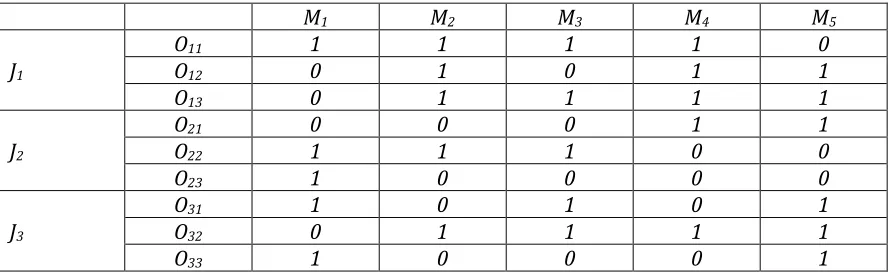
3.2 Operation-machine eligibility
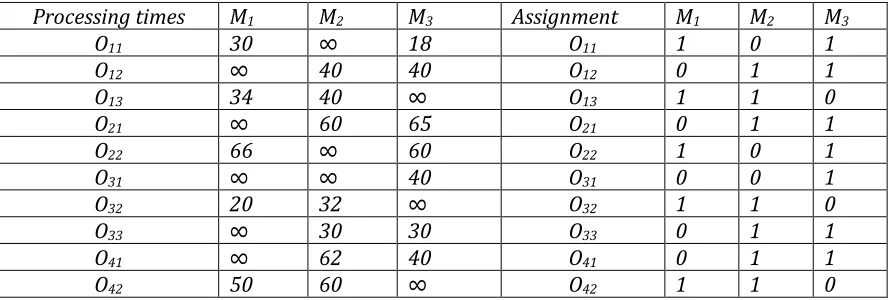
3.3 Processing times of operations and operation-machine assignment
3.4 Initially generated solution
3.5 Sorted initial solution
3.6 Newly generated sequence via initial solution
3.7 Representation of an antigen (a feasible schedule)
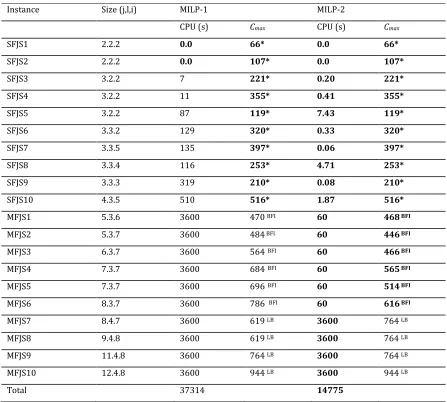
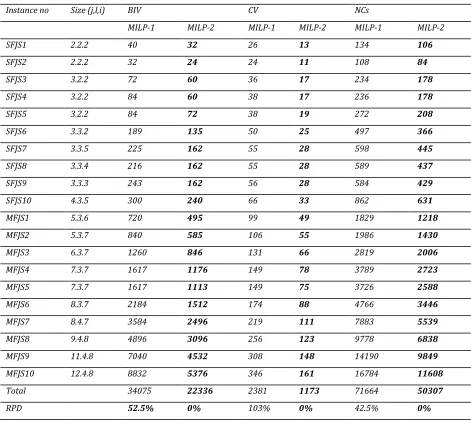
4.1 Comparisons of MILP-1 and MILP-2 on schedules quality and computational time
4.2 Comparative evaluation of MILP-1 and MILP-2 based on their constituents
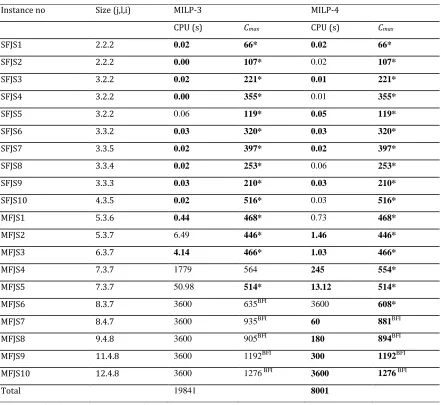
4.3 Comparisons of MILP-3 and MILP-4 on quality of schedules and CPU time
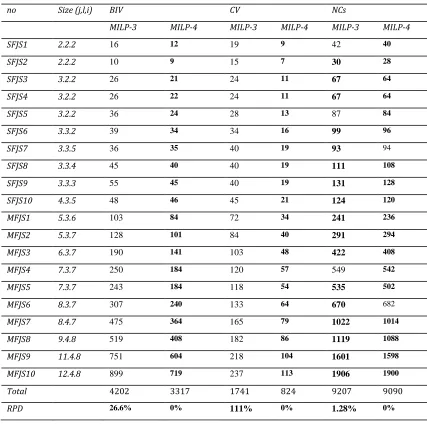
4.4 Comparative evaluation of MILP-3 and MILP-4 based on their constituents
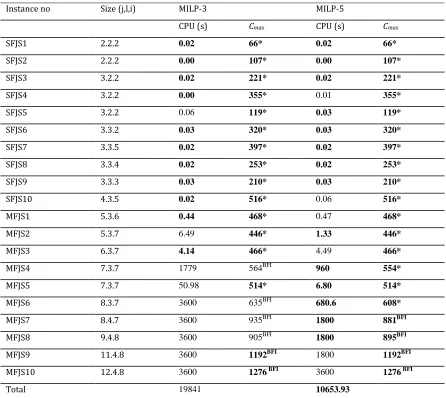
4.5 Comparisons of MILP-3 and MILP-5 on quality of schedules and CPU time
4.6 Comparative evaluation of MILP-3 and MILP-5 based on their constituents
4.7 Comparative evaluation of MILP-3 and MILP-6 on quality of schedules and CPU time
4.8 Comparative evaluation of MILP-3 and MILP-6 based on their constituents
4.9 Comparisons of all MILPs based on their number of binary integer variables
4.10 Comparative evaluation of MILPs based on their number continuous variables
4.11 Comparative evaluation of MILPs based on their number of constraints
4.12 Comparative evaluation of MILPs based on their computational time
4.13 Comparative evaluation of MILPs based on their quality of generated schedules
4.14 Comparison between AISA and MILP-6
4.15 Comparison with the state-of-the-art integrated approaches on F-data 4.16 Comparison with the state-of-the-art integrated approaches on F-data
5.1 Operational coding and requirement of different parts
5.2 List of machine capabilities
5.3 Priority coefficient assigned to machines in shop floor
x
List of Figures
1.1 Schematic representation of TF-JSSP
1.2 Schematic representation of PF-JSSP
3.1 Equivalent Gantt chart of the decoded feasible solution
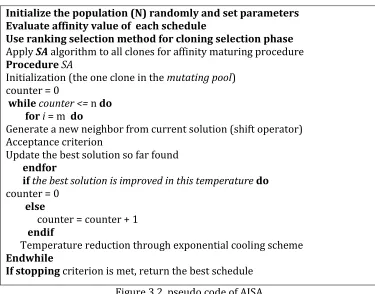
3.2 Pseudo code of AISA
5.1 A picture of one half/side of a mould
xi
List of Abbreviations
BFI: best feasible integer
BIV: number of integer variables
CV: number of continuous variables
F-JSSP: flexible job shop scheduling problem
JSSP: job shop scheduling problem.
LB: lower bound
MILP: mixed integer linear programming
MINLP: mixed integer non-linear programming
NC: number of constraints
PF-JSSP: partially flexible job shop scheduling problem
SDST: Sequence-dependent set-up times
SIST: Sequence-independent set-up times
TF-JSSP: totally flexible job shop scheduling problem
AIA: Artificial immune algorithm
SA: Simulated Annealing
TS: Tabu Search
xii
List of nomenclatures for position-based MILP models
Subscript for parts where
Subscript for machines where
Subscript for operations of part where
Eligibility parameter that takes value 1 if machine is able to process operation and 0 otherwise.
Processing time of operation on machine i
, -th operation of job
Subscript for processing positions of machine where ( )
M A large positive number
Binary decision variable taking value 1 if l-th operation of part j is processed on the
f-th position of machine i
Continuous decision variable for starting time of operation
Continuous decision variable for beginning time of each processing position
List of nomenclatures for sequence-based MILP models
, Indices for jobs where
Indices for machines where
, Indices for operations of job
, The set including machines eligible to process
,, Processing time of -th operation of job on machine , -th operation of job
,, Parameter that takes value 1 if machine can process , and 0 otherwise.
M A large positive number
,, , Binary variable taking value 1 if , is processed after , ; and 0 otherwise. 1, 2, … , 1 ,
,, , , Binary variable taking value 1 if , is processed after , on machine i; and 0 otherwise. 1, 2, … , 1 ,
,, Binary variable taking value 1 if , is processed on machine . , Continuous variable for the completion time of ,.
, Continuous variable for the starting time of ,.
1
CHAPTER 1
ENGINEERING PROBLEM
1.1
Background of production scheduling
Thirst for increased productivity in the modern business world has spurred manufacturing
practitioners to seek every single opportunity for cost reduction and profit generation
(Roshanaei et al. 2012a). Over the last six decades, effective production scheduling
mechanisms have been recognized to be increasing productivity and machine utilization
(Roshanaei et al. 2012b). The importance of scheduling as a logical enabler in manufacturing
systems has increased recently due to the growing consumer demand for variety, reduced
product life cycles, changing markets with global competition, and rapid development of
new processes and technologies (Ho, Tay et al. 2007). These economic and market
pressures stress the need for minimizing inventory while maintaining customer satisfaction
of production and delivery; Thus, this requires efficient, effective and accurate scheduling.
Algorithmic and scientific production scheduling came to existence once the first production
scheduling heuristic technique was proposed by (Johnson 1954). Research in the area of
production scheduling usually starts with single machine scheduling and is extended to
scheduling of highly complex shop floors like changeable, reconfigurable, and flexible
manufacturing systems abbreviated as (CMS), (RMS) and (FMS) respectively.
The scheduling problem studied in this thesis is a special case of FMS referred to as flexible
job shop scheduling problem (F-JSSP) which is usually encountered in industries with high
product variety and medium demand for each product. F-JSSP extends classical job shop
scheduling problem (JSSP) by assuming that each machine is flexible and able to offer more
than one particular capability. Therefore, in order to better understand the F-JSSP, introductory definitions of JSSP are required.
1.2 Introduction to job shop scheduling problem
In order to outline the problem studied in this thesis, certain definitions are required.
Therefore, the main production configuration- Job Shop- is first addressed, and then
clarified as to how a generalization of the main problem is created and solved. Hence, this
2
In the JSSP, there are n jobs (J1, ..., Jn) with varying sizes and each job needs to be scheduled
on m (m1,..., mm) machines each job follows a predetermined operational route until all
the operational requirements of all jobs are fulfilled. In the classical JSSP, the process plan of
a part consists of the sequence of the machines the part must visit: there is an a priori
assignment of operations to machines. Therefore, the process plan is fixed and no process
plan flexibility is associated.
In order to explain how F-JSSP works, all sources of flexibilities in manufacturing systems
are reviewed. Eventually, the related flexibility is addressed and the rest of details of F-JSSP
are given.
1.3
Sources of flexibility in manufacturing systems:
Review of literature identifies at least ten types of manufacturing systems flexibilities
(ElMaraghy 2005). They are as follows:
1. Machine flexibility: Various operations performed without set-up change,
2. Material handling flexibility: Number of used paths / total number of possible paths between all machines,
3. Operational Flexibility: Number of different processing plans available for part fabrication, 4. Process Flexibility: Set of part types that can be produced without major set-up changes, i.e. part-mix flexibility,
5. Product Flexibility: Ease (time and cost) of introducing products into an existing product mix. It contributes to agility,
6. Routing Flexibility: Number of feasible routes of all part types/Number of part types, 7. Volume Flexibility: The ability to vary production volume profitably within production capacity,
8. Expansion Flexibility: Ease (effort and cost) of augmenting capacity and/or capability, when needed, through physical changes to the system,
9. Control Program Flexibility: The ability of a system to run virtually uninterrupted (e.g. during the second and third shifts) due to the availability of intelligent machines and system
control software,
10. Production Flexibility: Number of all part types that can be produced without adding major capital equipment.
This classification promotes better understanding of various types of flexibility although
3
were addressed above. Among previously enumerated sources of flexibility in
manufacturing systems, machine and routing flexibility are incorporated into classical JSSP.
Taking into account the before-cited sources of flexibility, the considered problem is
transformed from classical JSSP to F-JSSP.
1.4 Introduction to flexible job shop scheduling problem
Flexible Job shop scheduling problem (F-JSSP) is challenging due to expanding machine
tools capabilities and increased products variety. Full utilization of added capabilities,
versatilities and increased flexibilities in job shops makes scheduling these resources
extremely challenging. The growing competition in international markets has generated
demand for faster and more versatile machine tools, while preserving or improving the final
product quality. The emergence of multi-purpose machineries provided manufacturers with
competitive capabilities. However, managing changes in products and markets requires
adaptation at two levels by developing physical enablers of change such as reconfigurable
machines and systems and logical enablers including adaptable and re-configurable
controls, process planning, production planning and scheduling (Wiendahl, ElMaraghy et al.
2007). Production planning and scheduling (PPS) map the production load of a factory to its
capabilities and capacities in different time horizons and levels of detail. The two levels of
PPS are coupled since planning sets the goals, as well as the resource and temporal
constraints for scheduling (Vancza, Kis et al. 2004). Scheduling is responsible for unfolding a plan into detailed resource assignments and sequences. Scheduling the production in real
industrial environment presents additional challenges of size, which is normally larger than
the capabilities of most existing algorithms and typical benchmarks in literature.
1.5 Mechanics of F-JSSP
The manufacturing setting studied in this paper is a generalized variant of the classical job
shop production systems known as F-JSSP. F-JSSP extends the job shop production systems
by assuming that each machine is capable of offering more than one operation. According to
(Kacem, Hammadi et al. 2002), flexibility in job shop, which refers to machine flexibility,
may be partial or total - referred to as Partially Flexible Job Shop Scheduling Problem
(PF-JSSP) and Totally Flexible Job Shop Scheduling Problem (TF-(PF-JSSP) respectively. PF-JSSP is a
special case of F-JSSP wherein the preferences or feasibility of using some machines for
4
distributed throughout the facility, the versatility and flexibility of which are not identical.
This feature enables a certain part to be processed by at least one machine out of the
available feasible machines. The routing flexibility of parts permits dynamic re-assignment
of parts to other available machines in case of facing any dynamic event in the shop floor
like machine breakdowns, order cancellation or arrival etc. Alternate routing is useful where
capacity problems arise. In PF-JSSP, there are m machines in the system and n jobs to be processed. Each job j requires njprecedence-constrained operations to be performed. Each
operation Oj,l can be processed on a number of non-identical or identical machines and the
processing time differs based on the machine characteristics. This addresses the existence of
multiple routings for some jobs. An alternate routing could be used if one machine tool is
temporarily overloaded while another feasible one is available. Therefore, based on
(Brandimarte 1993), in F-JSSP, two distinct decisions have to be made:
Assigning Operations to Machines: in this stage, operations are assigned to their respective feasible machines. In TF-JPPS, any arbitrary assignment of operations to
available machines is feasible as all the machines in the shop floor possess the same
operational capabilities. But, in the PF-JSSP which represents the structure of our
industrial problem as well, attention should be paid to the feasibility of machine
assignments as machines do not possess identical tool-magazines.
Sequencing of operations: once assignment decisions were made, sequencing decision is triggered. It goes without saying that sequencing decision is made for
those operations whose processing route entails sharing the same machine, i.e.,
those operations that are not assigned to the same machine are not considered for
sequencing with respect to each other on that particular machine. Therefore,
sequencing decision is made for those operations sharing the same subset of
machines. In other words, there is no justification to sequence operations while they
have not been assigned to the same machine.
1.6 Assumptions for solving F-JSSP
The following assumptions are used for all mathematical formulations and meta-heuristics
developed in this thesis:
Optimal singular process plan is determined a priori for each part type. i.e., no
5
Certain operations can be processed on more than one machine, i.e., there exists
routing flexibility.
Jobs are independent and no priorities are assigned.
Pre-emption or cancellation of jobs is not considered.
Each machine can only process one job at a time.
Each job can be processed by only one machine at a time.
Processing times are deterministic and include set-up, operations, transportation and inspection (approval).
All jobs are inspected a priori i.e., no defective part is considered.
The orders volume is known a priori and jobs are simultaneously available at time
zero because the purchase of raw material is done at the same time.
Breakdowns are not considered.
1.7 Representation of F-JSSP using standard triplet
In order to facilitate the solution, the PF-JSSP is transformed to the TF-JSSP by adding
“infinite processing times” referred to as big M to the incapable machines. Scheduling
problems are usually represented by a standard triplet (α | β | γ). According to (Pinedo
2002), the TF-JSSP can be denoted by FJc|Cmax but the PF-JSSP is represented as follows:
FJc|Mi |Cmax. The first symbol indicates the type of shop which is F-JSSP, while the second
symbol indicates machine eligibility issue. Finally the third symbol denotes the objective
function which is make-span. The problem studied in this paper encompasses both TF-JSSP
and PF-JSSP.
1.8 Graphical representation of TF-JSSP
In Figure1.1, as an example of TF-JSSP, the assignment of three jobs to three multi-purpose
machines is depicted. As can be seen, all jobs have total routing flexibility to be assigned to
any machine in the shop floor. This total flexibility is made possible if all machines have identical operational capabilities. In Figure 1.1, all machines have the same operational
6
Figure 1.1, schematic representation of TF-JSSP
1.9 Graphical representation of PF-JSSP
In Figure 1.2, the assignment of three jobs to three multi-purpose machines is illustrated. As
can be seen in Figure 1.2, functionalities and versatilities of different machines are not
identical. This simply means that not all jobs have total routing flexibility to be processed by
any available machine in the shop floor. The difference in operational capabilities among
machines culminates in a phenomenon known as partial routing flexibility.
Figure 1.2, Schematic representation of PF-JSSP
1.10 Size complexity of F-JSSP
In TF-JSSP, there exist certain numbers of multi-purpose machines (m) in the shop floor. On any of these multi-purpose machines as many feasible schedules as the factorial of number
J1
J2
J3
M1
M2
M3
M1
M2
M3
J
1J
27
of jobs (n!) can be generated. This is equivalent to the complexity of the single machine
scheduling. Since there is more than one machine in the shop floor, parts have to be
considered for sequencing on other flexible machines as well. This issue begets tremendous
complexity for F-JSSP and makes its complexity rise to (n!)m. The classical JSSP has proven
to be strongly NP-hard by (Garey, Johnson et al. 1976). Therefore, the F-JSSP is also NP-hard
in strong sense.
1.11 General approaches to F-JSSP
Due to the tremendous complexity of the F-JSSP, meta-heuristics are utilized. Two
established frameworks for meta-heuristics have been proposed (Brandimarte 1993): Hierarchical: the assignments of operations to their respective machines are
initially made and well after that sequencing procedure starts.
Integrated: both assigning and sequencing decisions are made concurrently.
A hierarchical approach has been adopted in this work.
1.12 Proposed solution methodologies for the F-JSSP
As was mentioned in the abstract, this paper utilizes two widely known solution
methodologies to fulfil the scheduling requirements of the industrial problem at hand: Mathematical modelling: four effective mathematical formulations are presented
in form of Mixed Integer Linear Programming (MILP) for both TF-JSSP and PF-JSSP.
The MILPs presented in this work follow both the integrated and hierarchical
approaches to solve the problem at hand. The used approach by each MILP is
explained in Chapter 3.
Hybrid meta-heuristic: a hybrid meta-heuristic algorithm resulted from hybridization of Artificial Immune Algorithm (AIA) and Simulated Annealing (SA)
referred to as AISA is presented.
1.13 Objective function:
Since the chief purpose of this paper is to solve the F-JSSP, several objective functions were
examined. Among, all objective functions existent in literature, make-span (Cmax) or
maximum was chosen. The significance of this objective function in production scheduling
8
CHAPTER 2
REVIEW OF PREVIOUS SOLUTION METHODOLOGIES:
This thesis is aimed at employing two classes of solution methodologies comprising
mathematical programming and hybrid meta-heuristics for tackling F-JSSP. Therefore, the
literature survey is divided into two subsections:
a) Review of mathematical models which have thus far been proposed for F-JSSP and
other related manufacturing environments.
b) Review of original and hybrid meta-heuristics in literature which have been
designed for F-JSSP.
2.1 Review of mathematical programming formulations:
Mathematical modelling as a solution technique for production scheduling problems
founded its application after the seminal work of (Wagner 1959). Ever since, researchers
have employed wide variety of objective functions, assumptions, and solution techniques in
their studies to formulate and solve production scheduling problems. Ozguven, Yavuz et al.
(2012) in their lately complied literature survey, have garnered all the relevant
mathematical models for F-JSSP. Below, the updated version of literature survey compiled
by (Ozguven, Yavuz et al. 2012) is given. The gap between the first MILP for JSSP and that
for F-JSSP is because flexible manufacturing systems (FMS) came to existence in early 90s.
Seven years after the advent of multi-purpose machines, the first MILP was proposed by
(Jiyin and MacCarthy 1997) for FMSs. They proposed a mixed-integer linear programming
model (MILP) for FMS scheduling to minimize mean completion times of operations. The
model took into consideration practical constraints on storage and transportation. The
complexity of the proposed MILP was also discussed. Two MILP-based heuristic procedures
were additionally developed. In their work, the development of iterative global heuristics
based on mathematical programming formulations was advocated for a wide class of FMS
scheduling problems. Brandimarte (1999) dealt with the machine loading problem in job
shop scheduling environment with process and routing flexibility. Two different heuristics
were proposed: one based on surrogate duality theory, and one based on a genetic descent
algorithm. Kim and Egbelu (1999) addressed the problem of scheduling multiple jobs with
9
and tackled using a mathematical approach. Because of the high computational effort
required to solve the model using an exact solution procedure, they developed two
algorithms and computed their optimality gap by comparing them with an optimum-finding
technique. The results of the test problems showed that one of the algorithms, referred to as
the pre-processing algorithm, found the optimal solution in all problem cases. The second
algorithm, referred to as the iterative algorithm, was also effective in finding good solutions;
however, its overall performance was lower than that of the first algorithm. Low and Wu
(2001) studied an operation scheduling problem with the objective of minimizing total
tardiness in an FMS with set-up time consideration. The considered problem was first
formulated as a binary integer programming model, and was then solved optimally.
Subsequently, a heuristic was proposed to solve the problem in an acceptable running time.
Computational experiments showed that the proposed SA-based heuristic performed well
with respect to solution accuracy and efficiency. Thomalla (2001) proposed a Mixed Integer
Non-Linear Programming (MINLP) for scheduling jobs in a just-in-time environment. The
non-pre-emptive case where each job consisted of a distinct number of operations to be
processed in a specified order was considered. The objective function was to minimize the
sum of the weighted quadratic tardiness of the jobs. A fast near-optimal algorithm with
guaranteed bounds for the distance to the optimum by using Lagrangian relaxation was
proposed and also shown that only one relaxation sufficed to solve the problem. Choi and
Choi (2002) proposed an MILP formulation to solve the F-JSSP with alternative operations
and sequence-dependent set-up time. They also presented an effective greedy local search
which was computationally effective. Make-span is optimized as their objective function.
Gomes, Barbosa-Povoa et al. (2005) presented two new MILP models for F-JSSP. The model
considered groups of parallel homogeneous machines, limited intermediate buffers and
negligible set-up effects. The model allowed re-circulation to take place. As their objective
functions, they minimized costs associated with just-in-time due-dates and in-process
inventories. Gao, Gen et al. (2006) studied the F-JSSP with machine availability constraints.
A novel MINLP was proposed to optimize make-span in F-JSSP. They introduced a hybrid GA
to solve the F-JSSP with non-fixed availability constraints (F-JSSP-nfa). Imanipour and
Zegordi (2006) addressed the F-JSSP with two types of flexibility in process and sequence
planning. He also formulated the F-JSSP with sequence-dependent set-up times as an MINLP.
The objective function was the make-span optimization. To solve the model, an effective
10
algorithm was shown via numerical experiments. Low, Yukling et al. (2006) proposed a
multi-objective framework For solving FMS scheduling problems with consideration of
three performance measures, namely minimum mean job flow time, mean job tardiness, and
minimum mean machine idle time. In addition, hybrid heuristics which were combinations
of two common local search methods, SA and TS, were also developed for solving the
addressed FMS scheduling problems. The feasibility and adaptability of the proposed
heuristics were demonstrated through experimental results. Fattahi, Mehrabad et al. (2007)
developed the first position-based MILP model based on Wagner’s definition of integer
variables for F-JSSP. They also proposed six heuristic approaches for F-JSSP. Mathematical
model was used to achieve optimal solutions for small-size instances of the problem. Since
F-JSSP is an NP-hard problem, two heuristic approaches including integrated and
hierarchical ones were developed to solve the real-size problems. Six different hybrid
searching structures were presented. Numerical experiments were used to evaluate the
performance of the developed algorithms. Saidi-Mehrabad and Fattahi (2007) presented a
TS algorithm for F-JSSP to minimize the make-span. They presented a model for the F-JSSP
considering alternative operation sequences and sequence-dependent set-ups. The purpose
of their paper was to minimize the make-span and find the best sequence of operations and
the best choice of machine alternatives simultaneously. Then the computational results
were presented and results showed that the proposed algorithm could produce optimal
solutions in a reasonable computational time for small-to medium size instances of the
problem. Moreover, it could be applied easily in real factory conditions and for large-size
problems. Fattahi, Jolai et al. (2009) considered an F-JSSP with a new approach (overlapping
in operations). Since this problem is recognized as NP-hard class, a hierarchical approach
based on SA was developed to solve large problem instances. Moreover, an MILP method
was presented. To validate the proposed SA algorithm, the results were compared with the
optimal solution obtained with the traditional optimization technique (Branch and Bound
method). The computational results validated the efficiency of the proposed algorithm. Also
the computational results show that the consideration of overlapping operations can
improve the make-span and machines utilization measures. Ozguven, Ozbakir et al. (2010)
dealt with two NP-hard optimization problems: 1) F-JSSP that encompassed routing and
sequencing sub-problems and 2) the F-JSSP with process plan flexibility (FJSP-PPFs). The
latter additionally included the process plan selection sub-problem. The study was carried
11
variables was developed for F-JSSPs and compared to an alternative model in the literature
(Fattahi, Mehrabad et al. 2007) in terms of computational efficiency and solution
effectiveness. In the second step, another MILP model, a modification of the MILP-1, for the
FJSP-PPFs was presented along with its computational results on hypothetically generated
test problems. Moradi, Fatemi Ghomi et al. (2011) investigated integrated F-JSSP with
preventive maintenance (PM) activities under the multi-objective optimization approaches.
They attempted to simultaneously optimize two objectives: 1) the minimization of the
make-span for the production part, and 2) the minimization of the system unavailability for
the maintenance part. Ozguven, Yavuz et al. (2012) studied an advanced form of the F-JSSP
which also covered process plan flexibility and separable/ non-separable
sequence-dependent set-up times in addition to routing flexibility. Two MILP models were formulated.
In the first model (Model A) the sequence-dependent set-up times were non-separable. In
the second one (Model B) they were separable. Model B was constructed based on Model A
with a minor modification. Finally, computational results were obtained on test problems.
The updated tabular version of the literature survey carried out by Ozguven, Yavuz et al.
12
Table2.1. Review of mathematical models for F-JSSP
Reference Math models Problem addressed Objectives
(Jiyin and MacCarthy
1997) MILP
F-JSSP with SDST*, transportation times and limited buffers
Mean completion time, Make-span and Maximum tardiness
(Brandimarte 1993)
Bi-Criterion MILP F-JSSP with process plan and routing flexibility
Machine load Cost
(Kim and Egbelu 1999)
MILP JSSP with alternative
process plans Make-span
(Tamaki, Ono et al.
2001) MILP F-JSSP with SIST** Make-span, Total tardiness
(Low and Wu 2001) MILP F-JSSP with SIST Total tardiness
(Thomalla 2001) MINLP F-JSSP Weighted quadratic tardiness
(Choi and Choi 2002) MILP F-JSSP with SDST Make-span
(Lee, Jeong et al. 2002; Low, Yukling et al. 2006))
MINLP F-JSSP with due dates
and outsourcing Make-span
(Gomes, Barbosa-Povoa
et al. 2005) Two MILPs F-JSSP with and without
recirculation
Costs related to just in time due dates, in-process inventories and orders not fully completed
(Gao, Gen et al. 2006)
MINLP F-JSSP with preventive
maintenance tasks
Make-span, Maximal workload at any machine, Total workload overall machines
(Low, Yukling et al.
2006) MILP F-JSSP with SIST
Mean flow time, Mean job tardiness, Mean machine idle time
(Fattahi, Mehrabad et al.
2007) MILP F-JSSP Make-span
(Ozguven, Ozbakir et al.
2010) MILP F-JSSP Make-span
(Saidi-Mehrabad and
Fattahi 2007) MILP F-JSSP with SDST Make-span
(Fattahi, Jolai et al.
2009) MILP
F-JSSP with overlapping
in operations Make-span
(Ozguven, Yavuz et al.
2012) MIGP
F-JSSP with process plan and routing flexibility with SDST &SIST
Make-span & balancing the workloads of the machines
(Moradi, Fatemi Ghomi
et al. 2011) Bi-criterion MILP
F-JSSP with preventive maintenance task
Make-span & minimization of system unavailability
Among proposed the MILPs for different variants of FMS, only the MILPs proposed by
Fattahi, Mehrabad et al. (2007) and (Ozguven, Ozbakir et al. 2010) are relevant to the
13
Regretfully, there are certain technical inaccuracies associated with the MILP proposed by
(Fattahi, Mehrabad et al. 2007) which are addressed by the proposed MILP-2 model in
section 3.4.
MILP model proposed by (Fattahi, Mehrabad et al. 2007) (MILP-1):
Parameters and decision variables
Subscript for parts where
Subscript for machines where
Subscript for operations of part where
Eligibility parameter that takes value 1 if machine is able to process operation and
0 otherwise.
Subscript for processing positions of machine where ( )
M A large positive number
Binary decision variable taking value 1 if on the f-th position of machine i l-th operation of part j is processed
Binary decision variable taking value 1 If machine i is selected to process operation (
Processing time of operation after selecting a machine for processing it Continuous decision variable for starting time of operation
Continuous decision variable for beginning time of each processing position
A decision variable deciding number of assigned operations to machine i
Min Cmax
The MILP-1:
Min Cmax
= 1 (2-1)
(2-2)
(2-3)
(2-4)
(2-5)
(2-6)
(2-7)
(2-8) (2-9) (2-10) (2-11)
14
Descriptions of the model:
Constraint sets (2-1) and (2-2) force each operation can be performed only on one machine
and at one priority. The values that take determine assignments of operations to
machines and sequence assigned operations on all machines. Constraint sets (2-3) and (2-4)
ensure feasible assignments of operations to machines. Constraint set (2-5) determines the
processing time of operation Oj,l by selected machine. Constraint set (2-6) enforces each job
to follow a specified operation sequence. Constraint set (2-7) forces each machine to
process one operation at a time. Constraint sets (2-8 and 2-9) force each operation Oj,l can be
start after its assigned machine is idle and previous operation Oj,l−1 is completed. Constraint
set (8) assigns the operations to a machine and sequence assigned operations on all
machines. Constraint set (2-10) determines the make-span. Constraint sets (2-11, 2-12)
show the natures of decision variables used in the MILP-1.
Technical issues:
In abovementioned model, there are three technical errors which are addressed in the
following subsections.
(Number of assigned operations to machine
i
)
The first error is that the authors have claimed that is a decision variable the value of
which is determined by their proposed MILP model. Their claim is invalid since has been
used as a parameter inside their mathematical model meaning that the value for is a priori
known. Number of operations assigned to each machine, which is equivalent to the processing positions in that machine is calculated as such ( ). Therefore, this
value is known a priori. This invalid claim is present in almost all equations.
Constraint sets (2-5) and (2-7)
The second error is even more technically critical from the standpoint of linear
programming modelling principles. Constraint sets (2-5) and (2-7) in the MILP-1 are
directly related to each other. If attention is paid to constraint set (5), it is realized that
is obtained from the following equation . Likewise, is used in
constraint set (2-7) as the processing time of operation once machine i is selected as
eligible machine to process it. Therefore, if the right hand side of the equation in constraint set (2-5) which calculates the , is substituted in constraint set (2-7), the subsequent
15
easily noticed that is being multiplied by . From the combined equation, it is
simply understood that two binary decision variables are multiplied to one another which
turns constraint set (2-7) into non-linear equation. Apart from non-linearity that violates
the basic principles of MILP models, this issue does not communicate any practical
interpretation. In other words, even if non-linearity could be solved by different
optimization software, it would not express any meaning in the context of scheduling.
Missing constraints
In F-JSSP, for each available machine in the shop floor as many as ,
processing positions are considered. Therefore, if is multiplied by the number of available
machines in the shop floor, the following number ( is obtained. This number (
which is equivalent to the number of all available processing positions of all machines in the
shop floor, far exceeds the number of available operations for all jobs which is shown by
. Therefore, some processing positions remain unallocated. This imbalance in F-JSSP has to be represented by a constraints set. Otherwise, when the output from the MILP model is
obtained, a situation happens that the numbers of binary decision variables taking value 1
exceeds the total number of operations ( and become equal to the total number of processing positions ( . In this case, an operation is allocated to more than one processing position so that all the processing positions are filled by existing numbers of
operations. This issue also renders the developed MILP infeasible.
Therefore, based on foregoing explanations, the mathematical representation of the MILP-1
is wrong. In chapter 3, existing issues in the MILP-1 is remedied and more efficient
mathematical models are proposed.
2.2 Review of meta-heuristics for flexible job shop scheduling
Brucker and Schlie (1990) are pioneers in presenting a polynomial algorithm for two jobs in
the generalization of the classical job-shop scheduling problem in which a set of machines
are associated with each operation of a job. Brandimarte (1993) proposed a hierarchical
algorithm for the F-JSSP based on TS. He employed a hierarchical strategy to decompose the
F-JSSP into two levels of decisions: routing and scheduling which was obtained by assigning
each operation of each job to one among the equivalent machines. Both sub-problems are
16
and show that their newly devised TS could yield excellent results for benchmark problems.
Dauzere-Peres and Paulli (1997) considered an F-JSSP to minimize the make-span as the
objective function. He introduced an extended version of the disjunctive graph model that
was able to take into account the fact that operations had to be assigned to machines. This
enabled them to present an integrated approach, by defining a neighbourhood structure for
the problem where there is no distinction between re-assigning or re-sequencing an
operation. Finally, a TS procedure was proposed and the computational results proved its
effectiveness. Hussain and Joshi (1998) analyzed JSSP with alternate routing. To attack this
problem, a two-pass genetic algorithm was used. The first pass picks the alternatives using a
genetic algorithm; the second pass provides the order and start time of jobs on the selected
alternatives by solving a non-linear program. A non-linear constraint reduces the
dimensional complexity of the best known formulation for a job shop problem, and is used
in the second pass of the algorithm. Preliminary results of this algorithm were encouraging
and the algorithm solved small test problems to optimality. Dauzere-Peres, Roux et al.
(1998) tackled a practical problem in which an operation could have more than one
predecessor and/or more than one successor on the routing. To minimize the make-span,
they made use of hierarchical approach to both assign operations to resources and sequence
operations on the resources. A disjunctive graph representation of this problem is offered
and a connected neighbourhood structure was proposed. They demonstrated the
effectiveness of their algorithm by applying it to benchmarks. Brucker and Neyer (1998)
studied the make-span optimization for a multi-mode JSSP (MMJSSP). For the MMJSSP, a
novel TS algorithm was presented and its effectiveness was established by certain
numerical experiments. Chen, Ihlow et al. (1999) presented a new genetic algorithm (GA) to
solve the F-JSSP with make-span criterion. They encoded their problem by chromosomes
consisting of two parts: a) the first part defines the routing policy and b) the second part the
sequence of the operations on each machine. New genetic operators were used to the
reproduction process of the algorithm. Numerical experiments showed that GA was able to
find high-quality schedules. Mastrolilli and Gambardella (2000) optimized the make-span
for F-JSSP. A local search technique along with two neighbourhood functions (Nopt1, Nopt2)
was presented. Their main contribution was the reduction of the set of possible neighbours
to a subset for which it always contained the neighbour with the lowest make-span.
Eventually, an efficient approach (TS) to compute such a subset of feasible neighbours was
17
Kacem, Hammadi et al. (2002) proposed a Pareto approach based on the hybridization of
fuzzy logic (FL) and evolutionary algorithms (EAs) to solve the F-JSSP. This hybrid approach
exploits the knowledge representation capabilities of FL and the adaptive capabilities of
EAs. The objectives considered were to minimize the make-span, the total workload of
machines, and the workload of the most loaded machine. Many examples were presented to
illustrate some theoretical considerations and to show the efficiency of the suggested
methodology. Kacem (2003) presented two new integrated approaches to solve jointly the
assignment and JSSP (with total and partial flexibility). The first one is the approach by
localization (AL). It made it possible to solve the problem of resource allocation and built an
ideal assignment model (assignments schemata). The second one was an evolutionary
approach controlled by the assignment model. They applied advanced genetic
manipulations in order to enhance the solution quality. They also explained some of the
practical and theoretical considerations in the construction of a more robust encoding that
enabled them to solve the F-JSSP by applying the GAs. Two examples were presented to
show the efficiency of the two suggested methodologies. Abdallah, Elmaraghy et al. (2002)
addressed the deadlock-free scheduling problem in Flexible Manufacturing Systems. An
efficient deadlock-free scheduling algorithm was developed, using timed Petri nets, for a
class of FMSs called Systems of Sequential Systems with Shared Resources. The algorithm
generates a partial reachability graph to find the optimal or near-optimal deadlock-free
schedule. The objective is to minimize the mean flow time.
Ho and Tay (2004) offered an efficient methodology called GENACE for solving the F-JSSP
with recirculation. They showed how CDRs could be used to solve the F-JSSP with
recirculation to provide a bootstrapping mechanism to initialize GENACE. Then, they
adapted a cultural evolutionary architecture to maintain knowledge of schemata and
resource allocations learned over each generation. Experimental results showed that
GENACE could obtain better upper bounds when compared to results of other algorithms in
the literature. Scrich, Armentano et al. (2004) presented two heuristics based on TS for
F-JSSP to minimize total tardiness. Xia and Wu (2005) developed a hybrid algorithm resulted
from the synthesis of Particle Swarm Optimization (PSO) and S SA for the multi-objective
F-JSSP. The results obtained from the computational study established that the proposed
algorithm was a viable and effective approach for the multi-objective F-JSSP, especially for
large-scale problems. The considered objectives were to minimize make-span, the total
18
(2006) addressed the minimization of Total Weighted Earliness/Tardiness (TWET) of jobs
in an F-JSSP. They proposed an MILP formulation for their F-JSSP with a TWET criterion.
Due to the NP-hardness of the F-JSSP, the MILP formulation could not solve the problem in
large-size instances. Therefore, they proposed an algorithm based on TS. The proposed
algorithm employed TS to find the best routing of each job. Then they made use of backward
procedure to find the best operations sequencing. The numerical experiments showed the
effectiveness of the suggested algorithm to solve F-JSSP in a reasonable CPU time. Gao, Gen
et al. (2006) considered the F-JSSP with three objectives: min make-span, min maximal
machine workload and min total workload. They developed a new genetic algorithm
hybridized with an innovative local search procedure (bottleneck shifting) for the problem.
The GA used two representation methods to depict solution candidates of the
F-JSSP. Advanced crossover and mutation operators were proposed to adapt to the special
chromosome structures and the characteristics of the problem. The bottleneck shifting
worked over two kinds of effective neighbourhood using interchange of operation
sequences, and assignment of new machines for operations on the critical path. In order to
strengthen search ability, the neighbourhood structure was adjusted dynamically in the
local search procedure. The performance of the proposed method was tested by numerical
experiments on a large number of representative problems. Ho, Tay et al. (2007) proposed
architecture for learning and evolving F-JSSP schedules called LEarnable Genetic
Architecture (LEGA). LEGA provided an effective integration between evolution and
learning within a random search process. Unlike the canonical evolution algorithm, where
random elitist selection and mutational genetics were assumed; through LEGA, the diversity
and quality of offspring were influenced by the knowledge extracted from previous
generation by its schemata learning module. In addition, the architecture specified a
population generator module that generated the initial population of schedules and also
trained the schemata learning module. A large range of benchmark data taken from
literature and some generated benchmark were used to analyze the efficacy of LEGA.
Saidi-Mehrabad and Fattahi (2007) presented a TS algorithm that could solve the F-JSSP to
minimize the make-span. They presented a mathematical model for F-JSSP. They also
presented a TS for the same problem. Randomly generated test problems were used to
evaluate the performance of the proposed algorithm. Results of the algorithm were
compared with the optimal solutions using a mathematical model solved by the traditional
19
that the proposed algorithm could produce optimal solutions in a short computational time
for small and medium sized problems. Moreover, it could be applied easily in real factory
conditions and for large size problems. Rossi and Dini (2007) proposed an ant colony
optimisation-based (ACO) for solving flexible manufacturing system (FMS) scheduling in a
job-shop environment with routing flexibility, sequence-dependent set-up, and
transportation time. In particular, the optimisation problem for a real environment,
including parallel machines and operation lag times, was approached by means of an
effective pheromone trail coding and tailored ant colony operators for improving solution
quality. The method used to tune the system parameters was also described. The algorithm
was tested by using standard benchmarks and problems, specifically designed for a typical
FMS layout. The effectiveness of the proposed system was verified in comparison with
alternative approaches. A mathematical model and heuristic approaches were proposed by
(Fattahi, Mehrabad et al. 2007) for F-JSSP. Mathematical model was used to achieve optimal
solution for small-size problems. Since F-JSSP is an NP-hard problem, two heuristic
approaches comprised of integrated and hierarchical approaches were developed to solve
the real-size problems. Six different hybrid searching structures were presented. Numerical
experiments were used to evaluate the performance of the developed algorithms. Finally, it
was concluded that, the hierarchical algorithms could outperform integrated algorithms.
Pezzella, Morganti et al. (2008) designed a GA for the F-JSSP. The GA integrated different
strategies for generating the initial population, selecting the individuals for reproduction
and reproducing new individuals. Computational result showed that the integration of more
strategies in a genetic framework could lead to better results as opposed to other GAs. Gao,
Sun et al. (2008) addressed the F-JSSP with three objectives: min make-span, min maximal
machine workload and min total workload. A hybrid genetic algorithm (HGA) was
developed for the problem. The GA used two vectors to represent solutions. Advanced
crossover and mutation operators were used to adapt to the special chromosome structure
and the characteristics of the problem. In order to strengthen the search ability, individuals
of GA were first improved by a variable neighborhood descent (VND), which involved two
local search procedures: local search of moving one operation and local search of moving
two operations. An extensive computational study on benchmark problems showed the
high-performance of their approach. Liu, Abraham et al. (2009) formulated the scheduling
problem for the multi-objective F-JSSP and attempted to solve the problem using a Multi
20
particles, which searched for the operation order update and machine selection. All the
swarms search the optima synergistically and maintain the balance between diversity of
particles and search space. They theoretically proved that the multi-swarm synergetic
optimization algorithm could converge with a probability of one towards the global optima.
The results indicated that the proposed algorithm was an efficient approach for the
multi-objective F-JSSP, especially for large-scale problems. Girish and Jawahar (2009) proposed a
particle swarm optimization (PSO) based heuristic for solving the F-JSSP for minimum
make-span criterion. They, by means of comparative evaluations proved the effectiveness of
the proposed PSO for solving F-JSSP instances. A PSO algorithm and a TS algorithm were
combined to solve the multi-objective F-JSSP with several conflicting and incommensurable
objectives by (Zhang, Shao et al. 2009). Through reasonably hybridizing the two
optimization algorithms, an effective hybrid approach for the multi-objective FJSP was
proposed. The computational results proved that the proposed hybrid algorithm was an
efficient and effective approach to solve the multi-objective F-JSSP, especially for the
problems on a large-scale. Bagheri, Zandieh et al. (2010) addressed the F-JSSP to minimize
make-span. To tackle this problem, an artificial immune algorithm (AIA) based on integrated
approach was proposed. The algorithm used several strategies for generating the initial
population and selecting the individuals for reproduction. Different mutation operators
were also utilized for reproducing new individuals. They, finally, showed the effectiveness of
the proposed method via numerical experiments by applying it to benchmark problems.
Consequently, the computational results validated the quality of the proposed approach.
Wang, Gao et al. (2010) considered a special case of F-JSSP in which each machine is subject
to preventive maintenance during the planning period and the starting times of
maintenance activities were either flexible in a time window or fixed beforehand. Moreover,
two cases of maintenance resource constraint were considered: sufficient maintenance
resource available or only one maintenance resource available. To deal with this variant of
F-JSSP with maintenance activities, a filtered beam search (FBS) based heuristic algorithm
was proposed. With a modified branching scheme, the machine availability constraint and
maintenance resource constraint were easily incorporated into the proposed algorithm.
Simulation experiments were conducted on some representative problems. The results
demonstrated that the proposed FBS-based heuristic algorithm was a viable and effective
approach for the F-JSSP with maintenance activities. De Giovanni and Pezzella (2010)
21
With respect to the solution representation for non-distributed JSSP, gene encoding is
extended to include information on job-to-FMU assignment, and a greedy decoding
procedure exploited flexibility and determined the job routings. Besides traditional
crossover and mutation operators, a new local search based operator was used to improve
available solutions by refining the most promising individuals of each generation. The
proposed approach was compared with other algorithms for distributed scheduling and
evaluated with satisfactory results on a large set of distributed-and-flexible scheduling
problems derived from classical job-shop scheduling benchmarks. Ben Hmida, Haouari et al.
(2010) suggested a variant of the climbing discrepancy search approach for solving F-JSSP.
They also presented various neighbourhood structures related to assignment and
sequencing problems. They reported the results of extensive computational experiments
carried out on well-known benchmarks for F-JSSP. The results demonstrated that the
proposed approach could outperform the best-known algorithms for the F-JSSP on some
types of benchmarks. A parallel variable neighbourhood search (PVNS) is utilized by
Yazdani, Amiri et al. (2010) to tackle the F-JSSP to minimize make-span. They use the
concept of multiple independent searches (parallelization procedure) in their algorithm to
increase the exploration in the search space. The proposed PVNS used various
neighborhood structures which carried out the responsibility of making changes in
assignment and sequencing of operations for generating neighbouring solutions. The results
obtained from the computational study revealed that the proposed algorithm is a viable and
effective approach for the F-JSSP. Adibi, Zandieh et al. (2010) proposed a VNS algorithm for
dynamic F-JSSP. A trained artificial neural network (ANN) was utilized to update parameters
of VNS at any rescheduling points. Additionally, a multi-objective performance measure is
applied consisting of make-span and tardiness. The proposed method is compared with
some common dispatching rules that have been widely used in the literature for dynamic
F-JSSP. Results illustrated the remarkable effectiveness and efficiency of the proposed method
in a variety of shop floor conditions. Bozejko, Uchronski et al. (2010) proposed a parallel
approach to F-JSSP. Two double-level parallel meta-heuristic algorithms based on the new
method of the neighbourhood determination were introduced by them. The proposed
algorithms possess two primary modules: the machine selection module refers to executed
sequentially, and the operation scheduling module executed in parallel. In order to prove
the efficiency of their algorithm, they conducted a computational experiment using Graphics