Temporal Representations in Human
Computer Interaction
Designing for the lived experience of time
By
DANIELBUZZO
Department of Computer Science and Creative Technology UNIVERSITY OF THE WEST OF ENGLAND
A dissertation submitted to the University of the West of England in accordance with the requirements of the degree of DOCTOR OF PHILOSOPHYin the Faculty of Environment and Technology.
APRIL 2017
T
emporal representations in Human Computer Interaction:is a portfolio of peer reviewed papers and media artworks representing several years of investigation, experimental mak-ing, and study into the perceptions and representation of time in digital media and Human Computer Interaction (HCI). The lived experience of time is fundamental to our understanding of the world and the work investigates the complex and contradictory nature of time and the powerful effect temporal representations have on health, well-being and perception.The investigation, methodology and outputs are based in the traditions of interdisciplinary electronic arts, technology research and digital culture. Practice-led, research through design techniques, are used as a means to explore alternative framings of temporal processes. I discuss the importance of temporal experience as a concern for contextual design and consider the models and lived experiences of time and how system-centric representations alter our perceptions of time.
The papers and works (discussed in chapters 4, 5 and 6 and included in full in appendix a) cover three broad areas:
Analysis and discussion of practice and language in HCI related to time; Experimental designs for temporal objects and media artworks;
Finally through critical artefacts, media art and publications I discuss a new perspective on temporality in design and representation and present a framework for re-assessing how we include time in interaction design.
Published works and peer reviewed papers
Title Author(s) Type Year Publication
Lost Time Never Buzzo Conferencepaper 2013
Proceedings of the 2013 Inputs-Outputs Conference: An Interdisciplinary Confer-ence on Engagement in HCI and Performance
The Shape of Time: Recon-sidering Time in the Con-text of Pervasive Media
Buzzo Conferencepaper 2013
Proceedings of the 1st Fas-cinate Conference Thought-ful Technology and Beauti-ful Interfaces
Time Travel: Time Dilation Buzzo,Jonas Conferencepaper 2014 Proceedings of British Com-puter Society, Electronic Vi-sualisation in the Arts Designing for the
Impossi-ble: Creating a Mobile Ap-plication to Track Time Di-lation
Buzzo, Jonas
Conference
paper 2015
Proceedings of British Com-puter Society, Electronic Vi-sualisation in the Arts Time Travel software for
AndroidOS
Buzzo, Jonas
Open source
Software 2015
http://timetravel-app.
com and https://github.
com/danbz/timetravel
Not all Days are Equal: In-vestigating the Meaning in the Digital Calendar
Buzzo,
Merendino Conferencepaper 2015
Proceedings of the SIGCHI conference on Human fac-tors in computing systems Time Travel: Time Dilation
and a Year of Airflight -
Re-cent Photographic Work Buzzo
Artists
Book 2015 Forlaegger Fabrik20
’What do we Know of Time When all we can Know for
real is Now’ Buzzo
Generative Video In-stallation 2016
’Digital Futures’ British Computer Society and Vic-toria and Albert Museum Perfect Days. A Benevolent
Calendar to Take Back Your Time
Hassenzahl, Buzzo, Neuhaus
Conference
paper 2016
Celebration and Contem-plation, 10th International Conference on Design and Emotion
JourneyMap: Visualising the Time-bound Student Journey
Buzzo, Phelps
Conference
paper 2016
Proceedings of British Com-puter Society, Electronic Vi-sualisation in the Arts ’Making a Time Machine’ Buzzo Generativevideo
Instal-lation 2017
’Digital Futures’ British Computer Society and Vic-toria and Albert Museum Arguing for Temporality in
HCI: A Guide for User
Cen-tred Temporal Design’ Buzzo
Journal Pa-per
2017 (in press)
Interacting with Comput-ers, Oxford University Press
T
hanks go to many people who have been supportive, and contributed to this body of work, at different points over the past several years. I would specifically like to acknowledge and thank:The generous support of the Department of Computer Science and Creative Technology in the Faculty of Environment and Technology at University of the West of England.
The patience, guidance and timely, reasoned advice of my supervisors, Richard McClatchey and Robert Stephens.
My co-creators and collaborators, Marc Hassenzahl, David Jonas, Nicolo Merendino, Robin Neuhaus and Phil Phelps. With gratitude for the advice and dry humour of Frank Nack. Semay Wu for patience while proofreading. Any remaining mistakes are mine alone. My external examiners Joel Ryan and Mark Blythe who so graciously gave up their time. The editors, curators, chairs, reviewers and readers of my published work. Thank you for your support, positive feedback and advice. Yes,including you, reviewer number 3.
A
UTHOR’
S DECLARATIONI
declare that the work in this dissertation was carried out in accordance with the requirements of the University’s Regulations and Code of Practice for Research Degree Programmes and that it has not been submitted for any other academic award. Except where indicated by specific reference in the text, the work is the candidate’s own work. Work done in collaboration with, or with the assistance of, others, is indicated as such. Any views expressed in the dissertation are those of the author.Page
List of Figures vii
1 Introduction, Motivation and Methodology 1
1.1 Introduction . . . 1
1.2 Motivation . . . 2
1.3 Methodology . . . 7
1.3.1 Reading strategies . . . 8
2 The research context 13 2.1 The contribution . . . 13
2.2 The research context . . . 15
2.3 The practice led doctoral process as Dphil . . . 17
3 What is it we talk of when we talk of time? 20 3.1 Perception and representation and cognitive artefacts . . . 21
3.2 Temporality, visualisation and representation . . . 26
4 Discussion of published papers part 1: Foundation and mapping works 30 4.1 Lost Time Never: Paper . . . 32
4.2 The Shape of Time: Reconsidering Time in the Context of Pervasive Media: Paper 34 5 Discussion of published papers part 2: Design led investigations 36 5.1 Time Travel: Time Dilation: Paper . . . 37
5.2 Time Travel: Time Dilation and a Year of Airflight - Recent Photographic Work . . 39
TABLE OF CONTENTS
6 Discussion of published papers part 3:
Experimental tests for deeper study 46
6.1 What Do We Know Of Time When All We Can Know For Real Is Now? A Generative
Video Installation . . . 47
6.2 Making a Time Machine: A Multiscreen Generative Video Installation . . . 49
6.3 Perfect Days. A Benevolent Calendar to Take Back Your Time: Paper . . . 51
6.4 JourneyMap: Visualising the Time-Bound Student Journey: Paper . . . 53
6.5 Arguing for Temporality in HCI: A Guide for User Centred Temporal Design: Paper 56 6.5.1 Ten points for designers . . . 58
6.5.2 Representing time . . . 63
7 Reflection, conclusions and future work 65 7.1 Reflection . . . 65
7.2 Future work . . . 67
7.3 Conclusion . . . 68
A Appendix A 71
FIGURE Page
1.1 Panoramic, time-shifted, multi-element video, San Francisco, 2001. Assembled from individual video clips shot over a ten minute period, the final piece runs to 60 seconds. https://www.youtube.com/watch?v=A0ihIDMpkYU . . . 3 1.2 Multi-frame, panoramic, extended-exposure composite image. Walking the Dragon’s
Back trail, Hong Kong, 1998 . . . 3 1.3 Multi-frame, panoramic, long exposure image, Devon, 2005 . . . 4 1.4 Multi-frame, panoramic, extended exposure composite image, Hong Kong, 2000 . . . 5 1.5 Multi-frame, panoramic, long exposure composite image, M4 motorway, Bristol, 2005 6
1.6 Still from panoramic, time-shifted video, Glastonbury festival, 2009. https:
//www.youtube.com/watch?v=231ZP5UaHB8 . . . 6 1.7 Panoramic, time shifted video, assembled still, Los Angeles freeway, 2001 . . . 7 3.1 The flip-clock, explicitly slicing moments with physical and metaphorical regularity
into pieces ofnow. This retro-style clock may be explicitly what Kevin Birth calls a ’necromantic device’. A cognitive artefact designed in the past doing some part of our thinking for us. . . 22 3.2 The Hanke Henry permanent calendar, each day and date of each year remains
consis-tent and constant. Contrasted with the current Gregorian calendar this reinforces the notion of calendars as cognitive artefacts. Presenting pre-calculated reasoning about the world in convenient, but arbitrary, measures. This and other similar, historical, cal-endar experiments reveal the artificial, structured calculations contained in artefacts
we often take as ’natural’.
Im-age, by Steve Hanke and Richard Henry at en.wikipedia [Public domain], via Wikimedia Commons . . . 23 3.3 McTaggart and the dualities of time. Above: A-series, below B-series of time. Showing
LIST OFFIGURES
3.4 One of the actual cesium beam atomic clock units used in the 1960’s ’flying clocks’ exper-iment the synchronise time around the world. And later in the Hafele-Keating experi-ment to prove relativity theory. Currently kept at Agilent (formally Hewlett Packard)
Melbourne headquarters.
Im-age CC BY-SA 3.0https://commons.wikimedia.org/wiki/File:HP_5061A_Cesium_Beam_Frequency_Standard.JPG?uselang=
en-gb. . . 25 3.5 Three metaphysical philosophies of time, showing the three main conflicting views of
how time is constructed. . . 25 3.6 Baronet, engraved by George Townly Stubbs. Published, London, 20 February, 1794.
The horse in motion in what was known as ’The flying gallop’. The representation of speed and motion is informed by understanding we could now callpre-camera. Image: [Public Domain] . . . 26 3.7 The Horse in Motion by Eadweard Muybridge. ’Sallie Gardner’, owned by Leland
Stan-ford; running at a 1:40 pace over the Palo Alto track, 19 June 1878. Less than 100 years after Stubbs (see figure 3.6), works such as this from Muybridge opened the general consciousness to new representations of time and conversely new perceptions of how
time may be.
Im-age: Library of Congress Prints and Photographs Division [Public Domain] . . . 27 3.8 The score by John Cage for the seminal composition 4:33.This composition with no
notes, only pausesis explicity bound by time, where the audience hear the sounds of the environment, has been performed around the world. interviewed in 1982, Cage stated that 4’33" was, in his opinion, his most important work. (Brooks and Kostelanetz, 1989) 28 3.9 Nude Descending a Staircase, No. 2 (French: Nu descendant un escalier no. 2). Marcel
Duchamp 1912. From the Louise and Walter Arensberg Collection of the Philadelphia
Museum of Art.
Im-age: Guillaume Apollinaire, Les Peintres cubistes, Méditations esthétiques, Eugéne Figuiére & Cie, Èditeurs, 1913 [Public Domain]. 28 4.1 ’Electronic super Highway’ by Media artist and theoretician Nam June Paik. Paik’s
ob-servations of the dualities of time, particularly as they are expressed in contemporary media, were an early inspiration and access point to alternative readings of media
tem-poralities.
Im-age CC BY-SA 3.0https://commons.wikimedia.org/wiki/File:Electronic_Superhighway_by_Nam_June_Paik.jpg . . . . 33 4.2 Visualising spatial dimensions to time, buildingcognitive artefacts. Here
illustrat-ing temporal, two dimensional representations of a three dimensional space, through
which explicit, time bound, lines are drawn.
5.1 The Hafele Keating Experiment of 1971, showing a caesium beam clock aboard a com-mercial jet airliner. This simple but pivotal experiment gave concrete evidence to the
predicted effects of time dilation.
Im-age: Original publication: From Popular Mechanics, January 1972, p. 30. . . 38 5.2 Clouds over Oxford, UK. Still from artists book ’Time Travel’ 2014: The book produced
as a research output from the project, based on a year of photographic observation from
air-planes. http:
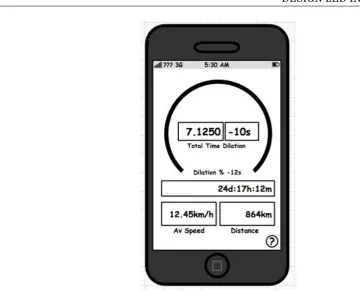
//www.blurb.com/b/5405590-time-travel . . . 39 5.3 Refined design visualisation showing velocity implicitly linked to instantaneous
di-lation. Showing speed, distance, elapsed time, instantaneous dilation (compared to theoretical norm), etc. . . 41 5.4 Time dilation tracking software prototype running on Android smartphone hardware,
visualising instantaneous dilation, accrued dilation and velocity. See
video of the prototype in action:https://www.youtube.com/embed/MGbGSHMkcu8?autoplay=
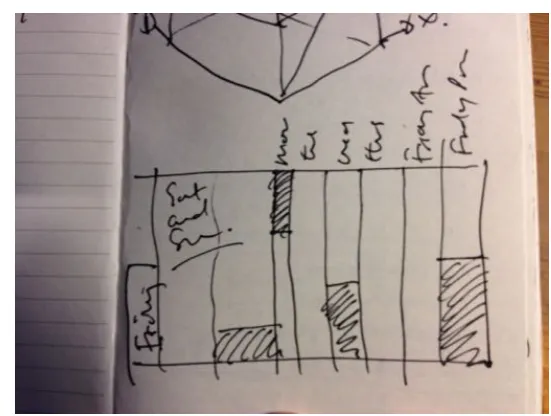
1&rel=0 . . . 42 5.5 Early sketch work for experimental calendar development in the ’Not all Days are
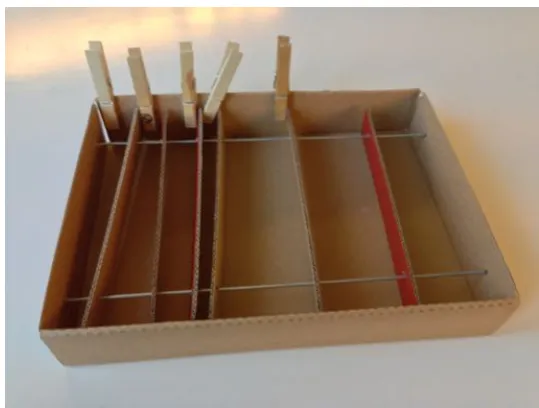
equal’ project showing days of the week from a personal perspective. Monday is the thinnest day of the week, Friday afternoon and Monday morning are blank and the weekend represents the largest area of all. . . 44 5.6 Physical prototyping work for experimental calendar development. Creating physical
models with movable day divisions allowing days of the week to assume different and changeable sizes. . . 45 6.1 Details of dual screen generative installation "What Do We Know Of Time When All We
Can Know For Real Is Now?" London, July 2016. https:
//vimeo.com/181406611 . . . 47
6.2 Video still from ’Walks’ recorded over the period of 2 weeks in Hong Kong https:
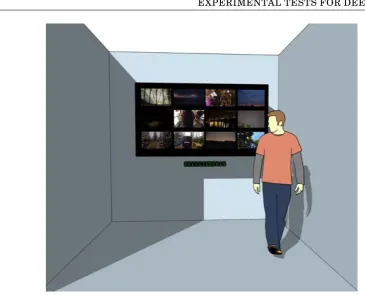
//vimeo.com/album/3101717/video/117094667 . . . 48 6.3 Technical installation detail of 12 screen installation of ’Making a Time Machine’
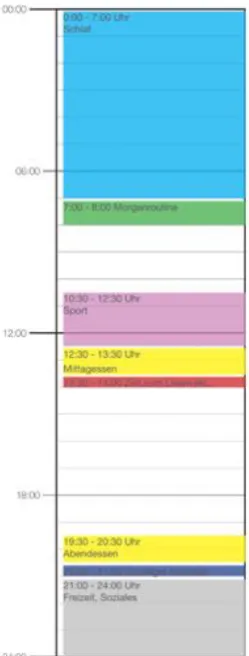
of time-lapse generative video work. Each palindromic video clip is chosen through generative selection by one of 12 separate processors. . . 50 6.4 Details of single-calendar-day example a ’Perfect Day’, showing a balance of
pre-planned activities alongside ’work’ . . . 52 6.5 Details of a ’Perfect Day’ -influenced calendar showing a balance of pre-planned
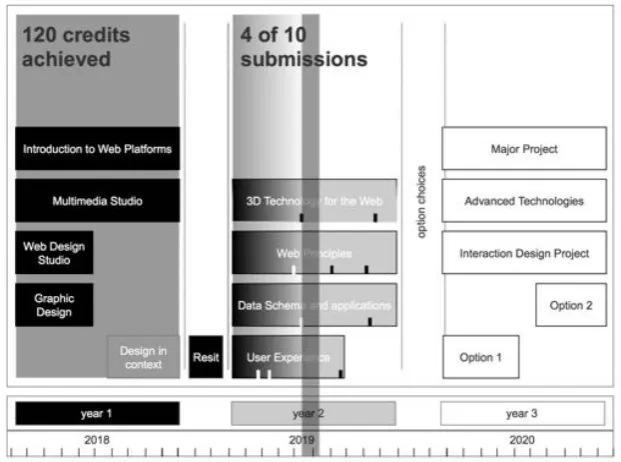
activities alongside ’work’ in a 7 day view. . . 53 6.6 Details of early wireframe of data and temporalities in the student journey. Illustrating
LIST OFFIGURES
6.7 Details of early timeline prototype of data and temporalities in the student journey, built using HTML, CSS, JavaScript and the JS Calendar framework and extracting live iCal timetabling data. . . 55 6.8 How can designers address temporal elements of a proposed experience and fit them
together to form a coherent whole? Explicitly following the experience design frame-work diagram from Wright and McCarthy, the frameframe-work goes through four themes centred around a common concern (temporality) to generate insights into the temporal worlds of the user of a proposed system or design . . . 59 6.9 Temporal design themes follow the central process of the framework, identifying
C
HA
PTER
1
I
NTRODUCTION, M
OTIVATION ANDM
ETHODOLOGY1.1 Introduction
TIME
has traditionally been measured in relation to physical phenomenawitnessed in our environment, or our internal perception of it. On one hand we look to the transit of heavenly bodies across prehistoric skies, the distance to walk from here to there or the arrival of birds on the wing from other continents. Observable, predictable, cyclic, physical phenomena have shaped our understanding of, and brought about, the standardisation of time. The drive to measure in increasingly precise incre-ments has led us to the fundamental building blocks of our physical world. Observing emissions of particles from the predictable decay of isotopes in devices such as caesium beam clocks takes our traditional, anecdotal measurement of the physical nature of time, to its ultimate root in the very fabric of matter. On the other we see an increasingly sophisticated set of models analysing what it is to experience time, and how we may describe what we feel and perceive.
New definitions and descriptions of time are evolving from the numerical digital reality we exist in, that bear little relation to the physical and mental ones we have come from. The fabric of which is built of significantly different fundamental elements. Old presumptions that time is immutable, of its relation to space, that it moves in one direction, no longer maintain significance.
CHAPTER 1. INTRODUCTION, MOTIVATION AND METHODOLOGY
Peer-reviewed publications and outputs in the body of work build on a foundation of work that describes the area of temporal studies in human computer interaction and digital media. Specific ideas have been investigated in depth through design works (Dourish et al., 2004, Simonsen and Robertson, 2012, Wallace et al., 2013), peer-reviewed publications, and thecritical making(Ratto, 2011) and publication, or public exhibition, of a series of digital, time based, lens media pieces. Each of these works or publications explore a given aspect and angle of the tension that exists between theexternally mediatedandinternally livedperceptions of time.
The individual creative pieces complete a larger statement as a coherent, interrelated body of work. This work seeks to analyse the representations of macro and micro time-scales in digital media, with specific interventions into areas of the debate from a personal and phenomenological perspective. Written papers and media artefacts, as two complementary strands of material, represent a sustained critical contribution to the ongoing academic, design and artistic debate on the elusive nature of the experience of time. While definitive answers, in an epistemological sense, are beyond the scope of this work, and possibly beyond the scope of any research discipline, I provide context and grounded contribution to this complex debate. As Stappers and Giarcardi (2013) point out in their work onDesigning for temporal context; (Stappers and Giaccardi, 2013)
’The most important thing designers should know is that there is no such single thing as time’
1.2 Motivation
T
ime, its presence and absence, and the effects and evidence of its influence has been central to my work - academic, industrial and artistic - for nearly three decades. Observing my industrial and artistic output, the repeating theme of how time is both represented and perceived, has occurred over and over. This is apparent within interaction design, published commercial products, photographic work, video installation and interactive media art. More recently within formal academic research the question of the influence and awareness of time and temporality in interaction design and human computer interaction has come to the fore, both within my research focus and published outputs.The body of work presented here represents only a small portion of work undertaken over the past several years as part of more formal investigations into time and temporality: undertaking studies in the intersecting contexts of media, technology, HCI, research and media art practice. As can be expected, the work has continuously crossed disciplinary boundaries often finding that the boundaries are largely imagined in day to day practice, sometimes only becoming apparent when choosing fora within which to disseminate outputs and findings.
Figure 1.1: Panoramic, time-shifted, multi-element video, San Francisco, 2001. Assembled from individual video clips shot over a ten minute period, the final piece runs to 60 seconds. https://www.youtube.com/watch?v=A0ihIDMpkYU
an often practice-led context ofmaking, the process of assembling this body of work has been a rewarding, and at times eye opening opportunity that has enabled me access to a deeper way of working and thinking.
Figure 1.2: Multi-frame, panoramic, extended-exposure composite image. Walking the Dragon’s Back trail, Hong Kong, 1998
The process of relating a wider narrative around my work has enabled me to see it within a formative rather than summative context. There are now clearer, more direct links between the topics and themes presented here. These form a consistent, coherent body of work, underpinned by a deeper understanding and wider knowledge of both practice and theory.
CHAPTER 1. INTRODUCTION, MOTIVATION AND METHODOLOGY
Figure 1.3: Multi-frame, panoramic, long exposure image, Devon, 2005
or as Paik, and others would call it,input time and output time(Paik, 1976). Later on, alongside new perspectives in media and philosophy, access to digital imaging equipment and computer hardware - for flexible, fast, processing of images - brought me new ways of perceiving, capturing and representing time.
Through the period spanning 1987-2000 my work developed from a passionate involvement in early video art, creating non-narrative video pieces using VHS and later U-matic tape and edit facilities. The video camera, initially the classic Sony Porta-pak, was a means to capture materials to feed the edit suite process: one that was occasionally assisted by the Fairlight CVI, a hybrid Analog Digital video processor designed by Australian engineers Peter Vogel and Kim Ryrie.1 Released in 1984 it was the video cousin to the iconic Fairlight CMI computer music workstation.2
The edit suite soon became, for me, solely about manipulating the abstract conceptual space inside a VHS tape cassette. The cassette, and the arrangement of magnetic particles on the tape itself, has always contained the potential of an image, (a conceptual, transitory space that comes to life when activated as the glowing phosphor dots on a visual display monitor). Wipe a magnet over the tape and realign the ferrous dots, it destroys your original image, but the electronic space is still there, full of possibility, waiting to be manipulated and activated at the moment of pressing ’play’. In this respect, the jog and shuttle, time-code punch in and punch out, became a pair of tongs with which to reach inside this transient electronic space: a space that seemed one of limitlesspotential. First and foremost, it was one of temporal potential, of multiple temporalities, from recording to re-ordering, to repetition to replay. The arrival of the early days of scratch video and artists such as the Duvet Brothers, Rik Lander and Peter Boyd Maclean,3 called into question the linear nature of TV, of visual materials, and the primacy of mass media.
1http://www.audiovisualizers.com/toolshak/vidsynth/fair_cvi/fair_cvi.htm 2http://petervogelinstruments.com.au
’Scratch video establishes a radical new approach to television itself. It abandons the idea that TV images are mere representations of what’s real. It starts to disassemble the images themselves by indulging in orgies of editing. In a sense scratch is the epitome of what professional broadcasters would call irresponsible television.’4
This disruption in visual media was occurring just as the audio sampler was enabling the same to happen within popular and experimental music (Cunningham, 1998). Timothy Taylor, author of ’Strange Sounds: Music, Technology and Culture’ (Taylor, 2001) acknowledges the sampler as being:
’...the most fundamental change in the history of Western music since the invention of music notation in the 9th Century’
Bridging the gap from Paik and the passage into modern media of Dada via Fluxus5, my early work grew against this upheaval in art, media and access to means of production. In retrospect it all hinged on the need for investigation, to comprehend the ontological space around me, through tools that allowed the moulding and reworking of time.
Figure 1.4: Multi-frame, panoramic, extended exposure composite image, Hong Kong, 2000
Later work, from the period 1998-2001 in Hong Kong explicitly plays with the collision between space and time, with pieces such as Hong Kong bus track. (see figure 1.4) originating from a hand held DVCAM video recording, and being assembled as one image from a tracking shot of horizon, buildings and landscape. Each frame of video was taken as a spatially congruent but temporally unique period, and each of these short periods could be seen as discrete slices in the assembled larger whole.
Work from 1998-2001, contrasts with subsequent bodies of work such as the series of long exposure, traveling, composite images, created in 2001-2004 (see figure 1.3 and figure 1.5). These are multi-frame panoramic photographs held static as two dimensional images, with elapsed time stretching away in three dimensions. This sense of time in the images moves (not only) into each frame as the vehicles, from which they were shot, record the passage forward, spatially,
CHAPTER 1. INTRODUCTION, MOTIVATION AND METHODOLOGY
Figure 1.5: Multi-frame, panoramic, long exposure composite image, M4 motorway, Bristol, 2005
and temporally through the blurred, over-run lines; they move also as measures of different discrete moments. This process of travelling long exposure is repeated again and again, and finally assembled as a spatially coherent but temporally exotic panorama.
Figure 1.6: Still from panoramic, time-shifted video, Glastonbury festival, 2009. https://www.youtube.com/watch?v=231ZP5UaHB8
Later works, such as the series of travelling, tracking shots from Los Angeles (see figure 1.7), both mirror and complement the works from Hong Kong (see figures 1.4 and 1.2). Conceptually they expand further as the spatial dimension is compressed and overlaid in new extremes, and where kilometres of horizon are compressed into meters, and the integral durations are overlaid and made static.
From 2000 onward, static photographic work was complemented by an increased number of video pieces, such asSan Francisco Street Corner, 20016(see figure 1.1), which took extended video sequences and composited them to create spatially contiguous video panoramas, that were explicitly temporally non-contiguous. When viewing, the buildings and environment of the street corner make sense, but the moving people, cars, cyclists and traffic appear and disappear from temporal slice to slice. The elements in the video appear to move across the scene, appearing to
weave in and out of existence, at least in the idea of the’now’existence of time. This dynamic contrast between observation and temporal representation could be seen as the keystone to much of my later work. In the work’s explicit, confrontational depiction of temporal discontinuity, the observer has to contend with the complexity of what we see as time, and what we see as now.
Figure 1.7: Panoramic, time shifted video, assembled still, Los Angeles freeway, 2001
1.3 Methodology
Aligning with the interdisciplinary nature of the investigatory area and process: The methodology has been suitably diverse, from mark making with ink on paper, to the non verbal investigations that cameras and lens based media allow. Much of the work presented here in the portfolio of papers and writing, originates in the tools I use to comprehend the world around me.
As Blevis notes in ’Digital Imagery as Meaning and Form in HCI and Design’ (Blevis, 2011) visual thinking, and digital imagery directly, is particularly salient for HCI and interaction design. The descriptions of ontological design and transdisciplinarity in this and other works is particularly relevant. As Blevis and Stolterman note in ’Transcending disciplinary boundaries in interaction design’:
’Transdisciplinarity is an approach that focuses neither on particular collection of methods nor on particular bodies of knowledge,but rather focuses on a broader goal.’ (Blevis and Stolterman, 2009)(emphasis added)
The wide variety of projects undertaken in this body of work utilised a range of methodologies, such as qualitative, quantitative or comparative approaches. Some projects used visual thinking and tools such as camera or video to support non-verbal investigation, with a grounded or mixed methods approach. Other projects have combined quantitative data from sources such as web servers, calendar logfiles or other technical means, to record and subsequently analyse participant or subject actions and interactions.
CHAPTER 1. INTRODUCTION, MOTIVATION AND METHODOLOGY
emergent coding served to help label, compile and organize the gathered information. Coding in this way facilitated more relevant summary and synthesis of the observations or recordings. This was usually supported by contemporaneous notes or self-reported materials from participants in the style of design probe artefacts. eg, diaries, sketches, recordings etc.
Some projects have combined quantitative methods allied with qualitative ones, for example, analysing system usage and accesses by subjects, during observation sessions or in some instances longer adoptive studies. Data was derived from interactions with systems and the generation of system and server logs, combined with usage analysis of the selected information. The qualitative data often became extremely useful in gauging the accuracy of self-reporting by participants. This gave a new level of insights, particularly in work such as ’Perfect Day’ project (see section 6.3) (Hassenzahl et al., 2016). In this instance, trends seen in server and quantitative usage data appeared to conflict with what participants self-reported of their usage; however, by using deeper analysis of the qualitative data, and also by taking onboard ideas of ’reactance’ (Brehm, 1966)7, we were able to propose alternative explanations. These appear to reconcile the apparent differences between the quantitative and qualitative data observed.
1.3.1 Reading strategies
Background literature searches and reading, have been wide-ranging and intently cross disci-plinary. Contextual and primary research has covered mathematics, physics, art, philosophy, linguistics, cultural theory, design, and interaction design. To cover this seemingly diverse mate-rial, the reading and background research approach has taken what Iris Van der Tuin, taking from Bergson, calls ’diffractive reading’ (van der Tuin, 2013). Popularised by other notable writ-ers and theorists, such as Karen Barad and Donna Haraway, diffractive or diffraction reading addresses the problems and highlights, of reading and working in a cross disciplinary sense. It emphasises the great benefits to be gained after revealing insights not readily available to a single discipline or research context. In fact, the broad reading strategies cross disciplinary work requires, can actually work effectively in finding new areas of knowledge or confluence.
The metaphor of dropping stones across a pond, and seeing where the expanding ripples combine to create peaks of interest, is commonly cited as a strong visualisation for the diffractive reading argument. Both Barad and Haraway describe how diffraction is a method for reading and writing, and is a way of coping with some of the epistemological challenges of representation.
As Iris van der Tuin notes (van der Tuin, 2013):
’Diffraction is meant to disrupt linear and fixed causalities, and to work towardmore promising interference patterns’ (emphasis added)
From the wide range of background materials gathered, influences identified include fun-damentals of process and practice. Proven and evidential research techniques are illuminated, such as the experimental design probes of Dunne and Raby (Dunne and Raby, 2007), and the critical design approaches of Bardzell and Bardzell (Bardzell and Bardzell, 2013) rooted in Re-search through Design. This is complemented by working in media with an understanding of the lessons in media art from Paik and Fluxus, (Friedman, 2011) the deep maps and founding psychogeographic work of William Least Heat Moon (Gregory-guider, 2004), Guy deBord (Debord, 1956), and Situationist International (Jakovljevic, 2003). The lessons to be learned come as much from the deliberate use (and abuse) of technology as from the political questioning of the nature of technology, especially in relation to the individual and society as a whole. Technology often being seen as artefacts from a controlling society, mediating the experience of the indi-vidual (Dunne and Raby, 2007). Critical and provocative designs are but one response to that hegemonic proposal. Historical influences are considered against a backdrop of contemporary Human Computer Interaction (HCI), User Experience (UX), and Interaction Design (ID) practice. In the visualisation of any time series data it may be useful to maintain an awareness of the contradictory or even the possibly imaginary nature of time. The discourse here is explicitly at the intersection of art, design, science and technology: that which observes and measures, records and creates; exploring both from the rationalist, external view and also the internal, lived one.
Amongst the numerous disciplines and areas that address the complex aspects of time that I have found central to my research and underpinning much of this project have been;
• The work of Speed (Speed, 2013) and more recently of Pschetz (Pschetz, 2014, 2015) and Huang and Stolterman (Huang and Stolterman, 2011) all investigate aspects of temporal influence in HCI. Notable here is the proposed framework from Karapanos et al (Kara-panos et al., 2009) which represents how experience changes over time. The 2012 SIGCHI workshop ’Changing Perspectives of Time in HCI’ organised by Lindley et al (Lindley et al., 2013), of which I was honoured to be invited to present my work (Buzzo, 2013a), brought together researchers from around the world to discuss what time may be in the context of HCI (Lindley, 2015).
CHAPTER 1. INTRODUCTION, MOTIVATION AND METHODOLOGY
and in itsweakinterpretations are still very much current. The principle appears to be supported by experimental evidence (Cibelli et al., 2016) showing that language, at the very least, influences thought; and that linguistic categories limit and determine cognitive categories, thought and decisions. In my analysis of how temporal representation and perception are intimately linked, this appears to align with Kevin Birth’s (Birth, 2012, 2013) ideas of cognitive artefacts, such as clocks and calendars, and how they may ’think’ on our behalf.
• Marx, Booth et al. (Booth, 1991, Tombazos, 2013) and the discussion of the socio-economic and cultural factors involved in the exchange of a person’stimefor monetary or social gain or value.
As Booth writes in Chapter II of ’Gone Fishing: Making sense of Marx’s concept of commu-nism’ (Booth, 1989):
’Time is the "space" (Raum) of human development, the forum of one’s "active existence."" A person’s wealth, Marx adds, does not consist in the objects he or she accumulates, but rather in the time freely available to him or her. That is, wealth is not the sum of embodied past activity, of "dead labor" as Marx calls it, but time yet to be shaped’ (emphasis added)
Tombazos investigates this area further in ’Time in Marx: The Categories of Time in Marx’s Capital’ (Tombazos, 2013) where he expands not on the political or economic social but on the socio-temporal. Where he writes of both of timerepresentedin capital but also of the timeperceivedwithin it.
• Husserl and the complex discussion of phenomenology and how one can articulate and quantify the lived experience ofbeing(Husserl, 1991). This extends directly into discussions of time and the bodily experience of it. Husserl proposes thatbeingmust not be taken physically, but as directly experienced from within, making "the body as directly experi-enced by the embodied experiencer concerned": a theme for the investigation of temporal phenomenology.
• Kevin Birth (Birth, 2012, 2013, 2004) and his insightful writing on the phenomenon of cognitive artefacts, describing hownecromantic8objects (designed in the past) have become things which we rely on to effectivelythinkfor us. His particular focus on clocks, calendars and timepieces of all descriptions is clear, thought provoking and provides a welcome perspective against which to work. Though as he cautions, time is not easy to think about, let alone talk about:
’Time is a fundamental dimension of human experience, but its study presents special challenges, including the methodological problems of how to get people to talk about time and how to recognize discourse and actions that reveal cultural conceptions of time.’ (Birth, 2004)
• Wolfgang Aigner - and his work on the technical visualisation of time series data (Aigner et al., 2007, 2011): particularly that which involves multi-dimensional aspects such as time, task and resource allocation. Of use are his thoughtful descriptions and experiments with three dimensional graphing of temporal data. This combines with work from writers such as Tufte (Tufte, 2001) and Boyd-Davis (Boyd Davis, 2012), who are investigating the foundations of recording time visually. While they do not specifically discuss the nature of time they take one epistemological approach totime as a problem of time-series dataand their work is invaluable in illuminating practical strategies for temporal visualisation. • Dagfin Aas et al. working within the area of time use of individuals and populations:
specifically in surveying and understanding theactualuse to which people put their time, and in what greater capacity it can be seen. Aas’sTime Use Surveyactivity classification built a conceptual framework, which is still used by many countries in their statistical survey and census work. Practical examples of how this work can give insight en massse include Hancock’s work in New Zealand, discussing how time use studies ’categorises different activities into groups thus providing a picture of how people lead their lives,’ (Hancock, 2011). This work provides insights not commonly available when observing individuals at ’ground level’.
• Physicist Craig Callender, (amongst numerous other writers on contemporary physics): his lucid descriptions of the physical science background to temporal theory and comparisons of conflicting theories of time has been particularly enlightening (Callender, 2000, 2008, 2010). As Carl Sagan says"[Time] is profoundly resistant to simple definition."
Discussing the nature of time, Sagan, in an interview during the making of NOVA’s TV program ’Time Travel’, goes on to note (Sagan, 1999):
’Ever since St. Augustine, people have wrestled with this, and there are all sorts of things it isn’t. It isn’t a flow of something, because what does it flow past? We use time to measure flow. How could we use time to measure time?’
CHAPTER 1. INTRODUCTION, MOTIVATION AND METHODOLOGY
an ontological issue rather than an epistemological one. Simply put, the challenge may be more a question of asking what time is than of measuring its effect.
C
HA
PTER
2
T
HE RESEARCH CONTEXTT
his portfolio of work contributes to the shared body of knowledge of the representations and perceptions of time within arts, design and HCI. Advancing the discussion of tem-porality and interaction with electronic systems, and specifically in how we comprehend and embody the complexities of time in designs for digital media and HCI.2.1 The contribution
As published, peer-reviewed works (included in appendix a), the contents of this portfolio have been accepted as individual contributions by the HCI community. Brought together here as a body of work, they contribute a critical context within an artistic and in a formal research capacity. The primary arena for the peer-reviewed outputs from this work are published within the HCI research community, as exemplified by the Association for Computing Machinery Special Interest Group on Computer-Human Interaction (ACM SIGCHI)1 and the British Computer Society Electronic Visualisation and the Arts2.
Designs and artistic outputs have been peer-reviewed and selected for exhibition internation-ally in and by the interdisciplinary community in arts, science and technology. Fora for the work includes the Victoria and Albert Museum, London, the International Society for the Electronic Arts (ISEA)3, The Computer Arts Congress4 and artistic tracks associated with conferences such as ACM Multimedia5.
1http://www.sigchi.org 2http://www.eva-london.org 3http://www.isea-web.org
CHAPTER 2. THE RESEARCH CONTEXT
Each of the published papers, and works included in this portfolio, are brought together to pursue individual questions or investigations in one of the three identified, main phases:
• Foundation and Mapping (chapter 4) • Design led investigations (chapter 5) • Deeper study and conclusions (chapter 6)
Following these phases, I present Chapter 7, containing a brief discussion, conclusions and thoughts for future work. In the conclusion, I re-iterate the main points of the final journal paper in the series of publications, ’Arguing for temporality in HCI: A guide for user centred temporal design’(Buzzo, 2017)6. This paper is a summation of several years of research work and is informed by the significant elements of the overall contribution. In it I discuss new perspectives on the nature of user centred design and the importance of temporality in designing for users. The significant contribution of this final paper, is the presentation of an experimental framework for investigatinguser centred temporal designto the interaction design community for consideration and usage. The intention of the paper is build on the ideas of contextual design into the explicitly temporal: to extend understanding and meaning. As Dourish writes (Dourish, 2001):
’Meaning arises in the course of action ... the meaning of a technology is not inherent in the technology, but arises from how that technology is used. Meaning is something that comes about through an encounter with the technology.’
I would argue that, what Dourish refers to, as thehowof use, is not the only element of great significance to the meaning of our interactions with technology, but also thewhenof use. In our context, as I will go on to show, we meanwhenin all its manifold forms. Dourish, discussing why this understanding of thecontext of useis so important, goes on to note:
’The significance of this for design is that, in designing interactive systems, we typically take the meaning of the elements of the system - its components, processes and representations - to be given or static within the frame of the application. What an action in the interface ’means’ is something that we typically imagine to be determined by the designer.’
Here staticis used in contrast to dynamic, in the sense of action. However, all dynamic systems change, i.e., they are timely and time-full. As I discuss in the next chapter, as long ago as Aristotle, it was understood that time and change are intimately linked. In this body of work I approach this explicit point, that of the static nature of systems framing and design, and investigate what it means to embrace timeliness within design for interactive systems.
The concluding paper is written explictly to allow scrutiny of ideas, methods and proposals and to encourage other designers and researchers to use, critique and improve upon the framework
presented. The temporal design framework builds upon existing work in the field (Dourish, Wright and McCarthy et al.) and extends the vocabulary of contextual design tools and processes available to designers and researchers alike, who seek to improve the design of interactive experiences with electronic systems.
2.2 The research context
The generation of portfolios of work, commonly illustrating the process, theoretical underpinnings and outcomes of research probes, is a common format within exploratory HCI design research (Gaver et al., 1999). This ’annotated portfolio’ (Gaver and Bowers, 2012) approach is considered as particularly useful in our context: both as a suitable format to contain a variety of materials in a balanced and coherent way; but especially through clearly communicating research, of work undertaken, and of the context in which the interdisciplinary body of work should be received and read. When presenting work for peer scrutiny the challenges and rewards of interdisciplinary and transdisciplinary research approaches, are a complex conundrum. Whilst approaches within transdisciplinary research, are widely discussed and the benefits of such an approach are lauded: presenting interdisciplinary or transdisciplinary work and results in an inter- or trans- disciplinary context is often received in a less positive light. As Nicolescu argues in ’The Need for Transdisciplinarity in Higher Education in a Globalized World’ (Nicolescu and Ertas, 2013) (Chapter 2):
’The new production of knowledge implies a necessary multidimensional opening of the process of learning’
In the undertaking of a body of work for doctoral consideration, especially one such as this - a practice orientated work, and being presented as a Doctor of Philosophy, by publication (DPhil), there are certain risks and unknowns when presenting transdisciplinary work. Within this bounding portfolio I will show an introduction to the peer-reviewed work (relevant publications are included in the appendix), and illustrate context for my work and discuss methodology, findings and conclusions. The central approach to this body of work is rooted in the process of research through design, using design as a generative process to investigate the lived experience of time. I explicitly rely on the exploratory and generative nature of design to investigate the complex interdisciplinary world of temporality, often using an ethnographic approach (McCarthy and Wright, 2004) to gathering and evaluating research data. This ethnographic approach is to be seen as firmly embedded in the recent ’turn to practice’ - witnessed across Human Computer Interaction (HCI) and design research (McCarthy and Wright, 2004). Lens based media art practices are also used in an auto ethnographic fashion to facilitate non verbal, phenomenologically orientated investigation.
CHAPTER 2. THE RESEARCH CONTEXT
manifold (Gaver and Bowers, 2012, Sas et al., 2014, Zimmerman et al., 2010). At its heart, is the argument between: the rationalist, what Morozov calls ’solutionism’ or ’solutionist’, approach of a belief in optimal, linear answers being definable to every problem; and the alternative generative approach of design processes (Morozov, 2013). Blythe articulates this clearly, and deftly puts the commonalities and conflicts between commercial and deliberately provocative designs in the discussion ofBinCam, an internet camera-connected solution to reducing waste, seemingly by social media shaming (Comber and Taylor, 2013)7:
’If BinCam were a prototype of a commercial product such criticism might be justified. But research prototypes are intended to generate knowledge not products. As a research prototype BinCam was all the more interesting because it generated such a furious backlash in the media.’ (Blythe, 2014)
Underpinning part of this argument against optimal, single solutions, are the insights first documented by Rittel and Weber at the beginning of the 1970’s (Rittel and Webber, 1973), when dealing with what they termed thewicked problem. This is the awareness of seemingly intractable problems containing many variable factors, especially relating to human behaviour, with no single optimal solution, has been widely recognised. Many HCI and creative technologies researchers have embraced the generative nature of design as an effective counter to this challenge (Buchanan, 1992, Gleasure and Road, 2013).
These investigations have been used in manifold ways as start-points into formal investigation, as beginnings of iterative design work and for the generation of hermetic artefacts developed as part of a wider artistic and philosophical discourse on time. The expanding world of research through design, and the myriad sub-divisons and interpretations of this approach is fertile ground in the arena of visualisation and human-centred design. Intimately tied up with the core idea of applying generative processes to research, are historical roots of critical thinking, participation in the design process and interdisciplinary and trans-epistemological working.
Bytrans-epistemological approachI mean the process, that many artists use quite naturally, of taking the epistemologies of different disciplines, the core foundations of what these disciplines hold to be true of how the world is, and using what is useful from each one. Utilising the differing approaches and beliefs of how the world is made up as I see fit for different tasks, projects and problems. Allowing the deployment of these varying epistemologies and their encumbentjustified true beliefsto give a different perspective or view point onto any particular problem or idea, the better to reveal more of the nature of the ideas, areas or problems at hand.
Whilst the idea of using central values, tools and approaches from one discipline to re-appraise another is not particularly new or novel, it is notably less common than one might expect. This approach of trans-epistemological working features strongly in much new thinking globally (Max-Neef, 2005). As Carlos Brand¯o writes (Brandão, 2007):
’Transdisciplinarity is not in one of those poles but the space between them, in the oscillation from one to another, and in its interchange and contagion. Contagions result in profound modifications to the structure of knowledge, and to methods and principles of disciplines, which are not often found in multi- and inter- disciplinary approaches. Transdisciplinarity transfigures disciplines internally to bring them closer’
2.3 The practice led doctoral process as Dphil
Founded in media art and interaction design, the Doctoral process undertaken in this body of work is based around a critically situated, practice led approach. It combines ’critical design’, in the context of the work of Dunne and Raby et al. (Bronner and Kellner, 1989, Dunne and Raby, 2007, Dunne and Martin, 2006) with ’making as research’ (Wallace et al., 2013), and alternative, peer-reviewed, creative outputs that complement more formal publishing activity. Often referred to as ’Research through Design’ (RtD) and tracing its roots to Corbusier and architecture, and industrial design in 1920’s and earlier, the approach is discussed in detail by Frankel and Racine in their 2003 paper, ’The Complex Field of Research: for Design, through Design, and about Design’ (Frankel and Racine, 2010). The RtD approach has gained widespread acceptance within the fields of human computer interaction (HCI) and interaction design over the last four decades (Bardzell, 2011, Gaver and Bowers, 2012, Zimmerman et al., 2007). The interdisciplinary worlds of creative technologies, digital and media art, and user centred design processes have all informed each other to create the cross disciplinary world of art, design and technology practice we see today.
It is important to clarify at this stage the context in which I use the expression’critical design’. Whilst there has been much written and spoken about what critical design is and may constitute in the arenas of design theory and design criticism I take my understanding from Dunne and Raby’s original FAQ list where point 1 states:
1. What is Critical Design?
Critical Design uses speculative design proposals to challenge narrow assumptions, preconceptions and givens about the role products play in everyday life. It is more of an attitude than anything else, a position rather than a method. There are many people doing this who have never heard of the term critical design and who have their own way of describing what they do. Naming it Critical Design is simply a useful way of making this activity more visible and subject to discussion and debate.
CHAPTER 2. THE RESEARCH CONTEXT
This last point being the most crucial in my interpretation, I believe it can be assumedall design is automatically affirmative, by nature of it being a process serving, and a product of, the socio-political industrial complex, ie the status quo. If a design is intended or designed to question, subvert or challenge this status quo, the established way of doing or thinking things, then it may bethe alternative, critical design.
The practice led approach is contrasted against a ’practice based’ approach to Doctoral study, wherein a practitioner of a particular craft or activity, may root their study and research into furthering that particular craft, through the production of a new range of exemplary artefacts. There is a wide range of, often somewhat polarised, discussion on what the basis of a practice based or practice led approach is, regards research efficacy, at a Doctoral level. As Andrew McGettigan discusses in the article ’Art practice and the Doctoral Degree’ (McGettigan, 2011), although the UK leads the world in practice led and practice based doctoral study (with fifteen years or more of successful candidates), there are a number of unresolved arguments on process, content and assessment. Significant progress has been made since the turn of the century, driven particularly from schools such as Goldsmiths and the Royal College of Art in London, where design, technology and culture, and critical theory intermix in an industrially focussed discourse. When considering practice based rather than practice led, the argument behind the ’50:50’ model holds true. This is a model where two components (theory and practice) are separately assessed and where theory is the route through which the practice is presented. However, for a practice led or RtD approach, this is not necessarily the case.
McGettigan goes on to note:
’...one of the ’characteristic outcomes of the research degree’, as suggested by the Quality Assurance Agency for UK higher education is that those who hold them are able to demonstrate ’the general ability to conceptualise, design and implement a project for the generation of new knowledge, applications or understanding at the forefront of the discipline, and to adjust the project design in the light of unforeseen problems.’ (McGettigan, 2011)
Contrasting this discussion of the practice led doctoral study, I have undertaken the process as a DPhil of works and publications, centred on a theme, explored through writing and making. I have published a body of peer-reviewed works contained within this narrative portfolio rather than the production of a single thesis.
From: Art practice and the Doctoral Degree (McGettigan, 2011)
vague, it reflects the flexibility of the model: the individual’s research project sets the test it is to undergo and effectively determines the specific criteria which are brought into play at final assessment. Accordingly the ’art practice’ submitted can be of any kind, media or form (whether artefact or documentation of processes or events) depending on what is held to be at stake. It may, for example, function as evidence for the overall claim, a method underpinning that evidence, or in itself as work somehow instantiate the claim. Christopher Frayling’s distinction between researchthrough art or researchasart reflects this varying role, but also indicates that the artefacts produced are judged in relation to the thesis advanced, and may therefore assume a subsidiary or instrumental role, or at least primarily reflect a focus on the something other than the aesthetic or art experience. (Frayling, 1993) Thus it is the originality of the claims that is at stake rather than the originality of the work submitted -derivative work may support an original thesis.’ (emphasis added)
C
HA
PTER
3
W
HAT IS IT WE TALK OF WHEN WE TALK OF TIME?
’What then is time? If no one asks me, I know:
If I wish to explain it to one that asketh, I know not’
St Augustine’s Confessions, Book IX
I
n any discussion that begins with ’What is time?’, it must be remembered that the question itself pre-supposes that time exists in some ’real’ sense. Much like the idea of ’common sense’, the idea that weunderstandtime in any meaningful way is elusive when put under scrutiny. Moving from one discipline to another exposes differing epistemological thinking on what time is. I argue that, historically, there have been three significant phases in the understanding and common comprehension of time:1. The time of Aristotle.
Time exists because things change, where there is much change there is much time. Aristotle claims that time and change are intimately related, and that time is something dependent on change. (Coope, 2005)
2. The time of Newton.
3. The time of Einstein.
Time is relative, malleable and everywhere. It is universal but seemingly not uniform from any human perspective. It is a world where time becomes a dimension alongside space, where it warps, folds and stretches depending upon how we each move through the world. It can be argued that these three significant phases have shaped successive popular thought. Ideas, expressions and phrases from high scientific and philosophical thought, filter into popular culture and consciousness. With the adoption of ideas and language having long shaped the ideas and artefacts of each age in history, I would venture that we may be witnessing the beginning of a fourth phase:
4. The time ofquantuum.
A time when the strangeness and uncertainty of the world becomes part of main stream consciousness, with fresh perspectives and appraisals of what time may be and how we may talk of it. As Karen Barad puts it; ’The past is yet to come’ (Barad, 2016) 1, she argues that time may be an ontological issue, butting between physics and metaphysics. Experimental evaluation provides insights formed from such ideas as entanglement - what Einstein apparently referred to as ’spooky action at a distance’ (Bell p143) (Bell, 1989); and experimental observation such as the temporal slit experiment, first theorised by Moshinsky in 1952 (Moshinsky, 1952), show that time may be stranger than anyone expected. The time slit experiment investigatesthe time-energy uncertainty principle(Szriftgiser et al., 1996) and is almost a parallel to the classic particle/wave double slit experiment2. It appears to show in practical experimentationtime diffraction, evidence that events can occur that only resolvewhenthey occurred in time, when observed after the event has occurred. Perhaps described as the Schrödinger’s cat paradox with a clock instead of a cat.3
3.1 Perception and representation and cognitive artefacts
There have been a number of studies of the effect of the passage of time within HCI (Karapanos et al., 2008, 2009, 2010) and its influence on factors such as memory or adoption of products (Stappers and Giaccardi, 2013). These studies commonly focus on the influence of single elements 1Troubling Time/s, Undoing the Future; Lecture June 2, 2016 at The School of Culture and Society, Aarhus University, Denmark.https://www.youtube.com/watch?v=dBnOJioYNHU
2http://micro.magnet.fsu.edu/primer/java/interference/doubleslit/
CHAPTER 3. WHAT IS IT WE TALK OF WHEN WE TALK OF TIME?
Figure 3.1: The flip-clock, explicitly slicing moments with physical and metaphorical regularity into pieces ofnow. This retro-style clock may be explicitly what Kevin Birth calls a ’necromantic device’. A cognitive artefact designed in the past doing some part of our thinking for us.
or effects of time. The approach to this range of studies, of examining the perceptions and repre-sentation of time, has several levels as a holistic, practice-led research approach. Consideration has been paid to:
• The nature of constructed media, specifically time-based media, its history and its cultural properties and implications.
• The philosophy of time and what it means to conceive of time, and to be aware of the nature of the passing of time. How we may represent time, and what it means to represent such an intangible idea.
• The impact of differing cultural, linguistic and perceptual factors and their influence on time as a lived experience.
• The mathematical usage and descriptions of time, both as a theoretical measure and in its application to everyday lived experience.
• The current state of arguments within physics of the nature of time, and by direct implica-tion, space, the universe and causality.
• What exactly is it that we are attempting to represent when we talk of representations of time, as Le Poivin (Poidevin, 1997) asks: ’does time pass in reality, or is the division of events into past, present, and future simply a reflection of our temporal perspective - a result of the interaction between a ’static’ world and minds capable of representing it’. • The personal and socio-economics of time. When we talk of time having value, of spending
time, of saving time, how and where is this transference occurring?
Figure 3.2: The Hanke Henry permanent calendar, each day and date of each year remains consistent and constant. Contrasted with the current Gregorian calendar this reinforces the notion of calendars as cognitive artefacts. Presenting pre-calculated reasoning about the world in convenient, but arbitrary, measures. This and other similar, historical, calendar experiments reveal the artificial, structured calculations contained in artefacts we often take as ’natural’. Image, by Steve Hanke and Richard Henry at en.wikipedia [Public domain], via Wikimedia Commons
Within the literature relating to mathematics, physics and philosophy concerned with time, often referred to as ’Time Studies’ there appears to be a strong consensus on the validity of the Minkowski Space-Time model. This model, popularised by the work of Einstein, treats time as an additional dimension alongside depth, width and height. Making ablock stateuniverse of x, y, z and t, allows time as a dimension that can be sliced at any point to reveal the spatial arrangement of matter in its entirety at any instant. It is sometimes argued that this leaves time only appearing to ’flow’ as one moves through successive slices of the time axis, like pages of a book. This model can be argued as negating the ideal of’now’as a special moment particular to humans. It changes the notion of the ’unfolding’ of the universe and shows time as a static continuum. Convention may dictate how we travel along this because, as Augustine of Hippo postulated in 400AD, humans have fallible perception and cannot see the world as it truly is. This block state or ’static universe’ is also a popular and well reasoned end conclusion, in the arguments of many current philosophers of time, answering many of the ancient paradoxes of time. Not least of which also comes from Augustine, when he asks:
’How can that which is not real (the Future), become real(the present), and then become unreal again(the past)?’
CHAPTER 3. WHAT IS IT WE TALK OF WHEN WE TALK OF TIME?
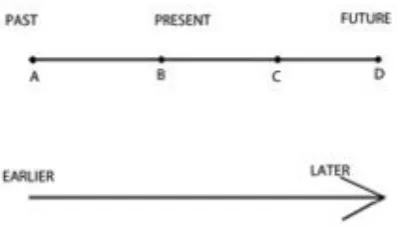
Figure 3.3: McTaggart and the dualities of time. Above: A-series, below B-series of time. Showing the argument between a tensed and tense-less universe.
infallibility and omniscience of God and the question of what caused his/her decision to create the universe as we perceive it. Put broadly, his conclusion was that the universe has always existed in all space and time, with God seeing all times at once. Humanity, being flawed of vision and able to see only the ’now’ of the universe, only seeing a small portion of an unending reality across all time. This dilemma was more recently described by McTaggart (McTaggart, 1908) in his postulation of A series vs B series time as a way to encapsulate the argument for and against a tensed versus tense-less universe (see figure 3.3). The main tenet of McTaggart’s argument is succinctly put by Kris McDaniel in the Stanford encyclopedia of Philosophy thus; (McDaniel, 2015):
’McTaggart distinguished two ways of ordering events or positions in time. First, they might be ordered by the relation of earlier than. This ordering gives us a series, which McTaggart calls the B-series. A second ordering is imposed by designating some moment within the B-series as the present moment. This second ordering gives us a series that McTaggart calls the A-series. According to McTaggart, in order for time to be real both series must exist, ’
The adoption of the Static universe vs the Dynamic - where now is a real moment and the future is unwritten - solves many problems and provides a common and easily comprehended model for time. The Static universe model however, brings problems in a tense-less block state universe. In such a universe every event and position of everything is predictable, and from a tensed perspective, has (or is currently) already happening/happened.
Everywhere and nowhere is now.
Figure 3.4: One of the actual cesium beam atomic clock units used in the 1960’s ’flying clocks’ exper-iment the synchronise time around the world. And later in the Hafele-Keating experexper-iment to prove relativity theory. Currently kept at Agilent (formally Hewlett Packard) Melbourne headquarters. Image CC BY-SA 3.0https://commons.wikimedia.org/wiki/File:HP_5061A_Cesium_Beam_Frequency_Standard.JPG?uselang=en-gb
Figure 3.5: Three metaphysical philosophies of time, showing the three main conflicting views of how time is constructed.
personal perspective it could appear to negate concepts of free will, leaving only determinism and fate. The three philosophical models, believing in the now(Presentism), the past and now (Possibilism)and the unending block universes of past present and future(Eternalism)(see figure 3.5) are still essentially unanswerable.
From a scientific perspective any adoption of a block state approach (Eternalism) could be argued to call causality into question, leaving only correlation available for any theory or experiment. Commonly these two points are not received well in either community. To enable science, as we generally conceive of it, to continue to work, and individuals to continue to live understandable, functional lives, both physics and philosophy appear, at the culmination of many arguments, to adopt the idea of a dynamic universe. This adoption is seemingly from a pragmatic, work-ability point of view. After-all, who is able to stretch their philosophical convictions to find comfort on the death of a loved one to be told:
CHAPTER 3. WHAT IS IT WE TALK OF WHEN WE TALK OF TIME?
There are new arguments occurring in the fertile ground between physics and philosophy. Figures such as Smolin and Barad, are looking to the work of both quantum physics and philosophers such as Bergson - and his ideas of time and life as indescribable as other than duration (Bergson, 1910). They question the current orthodoxy of the fundamentals of being, and of our view of what the universe is. Seemingly pivotal in this discussion is a re-evaluation of the relevance of the Newtonian notion of experimentation(in a box), and the implication that time is a phenomena rather than a fundamental force. Smolin argues (Smolin, 2013) that the current arrangement puts time external to experimentation and thinking in science. His conclusions bring a new approach to the idea ofnowas fundamentally real. These underlying arguments, and potential scene changers, bring into question what it is we perceive and attempt to represent when, we talk of ’time’ in any meaningful way. As Smolin writes:
’How we think about the future and the past determines everything about how we think about our situation as human beings.’
3.2 Temporality, visualisation and representation
When investigating visualisation and perception of time, discrete media arts practice is an ideal companion research tool to more formal methods (Boyd Davis, 2012). The practice and theoretical discourse around media art, and particularly contemporary digital media creation is intimately concerned with the manipulation of time, with representation, identity, perception and temporality.
Figure 3.7: The Horse in Motion by Eadweard Muybridge. ’Sallie Gardner’, owned by Leland Stanford; running at a 1:40 pace over the Palo Alto track, 19 June 1878. Less than 100 years after Stubbs (see figure 3.6), works such as this from Muybridge opened the general con-sciousness to new representations of time and conversely new perceptions of how time may be. Image: Library of Congress Prints and Photographs Division [Public Domain]
The balance of temporalities in digital media, as distinct from analogue media, brings to the fore what Le Poidevin (Poidevin, 1997) points to as theintimate collision of the problems resolving subjective and egocentric representation when ’recording’ time. This collision underpins the argument that modern media taunts us with its illusion of reality, capture and permanence. Illustrating an unresolvable conflict between McTaggart’s A series vs B series model of time (McTaggart, 1908), the example of recorded digital media giving an excellent example of the abstraction of mechanical time vs the actual realisable, lived experience of time. According to McTaggart (pp. 9-10) (McTaggart, 1927):
’Positions in time, as time appears to us prima facie, are distinguished in two ways. Each position is Earlier than some and Later than some of the other positions. In the second place, each position is either Past, Present, or Future. The distinctions of the former class are permanent, while those of the latter are not. If M is ever earlier than N, it is always earlier, But an event, which is now present, was future, and will be past.’
CHAPTER 3. WHAT IS IT WE TALK OF WHEN WE TALK OF TIME?
Figure 3.8: The score by John Cage for the seminal composition 4:33. This composition with no notes, only pauses is explicity bound by time, where the audience hear the sounds of the environment, has been performed around the world. interviewed in 1982, Cage stated that 4’33" was, in his opinion, his most important work. (Brooks and Kostelanetz, 1989)
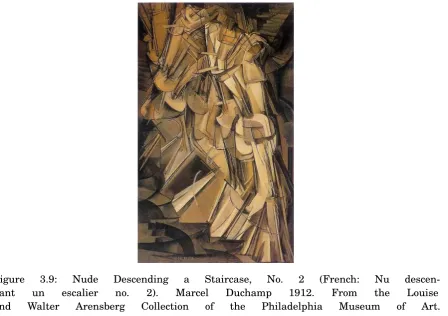
Figure 3.9: Nude Descending a Staircase, No. 2 (French: Nu
descen-dant un escalier no. 2). Marcel Duchamp 1912. From the Louise
and Walter Arensberg Collection of the Philadelphia Museum of Art.
Muybridge (1830-1904) (see figure 3.7), to avant garde composer John Cage (see figure 3.8) et al. have all questioned, challenged and investigated the notion of the temporality, and found diverse means to discuss their findings, in research, literature, design, art, music and musical score. E. Ray Lankester (1847-1929), at that time Jodrell Professor of Zoology at University College London, notes the impact of the Muybridge photographic studies. Particularly in relation to ’the flying gallop’, less than 100 years after Stubbs (see figure 3.7 3.6) the representation is transformed by the visual comprehension of the camera and new language of time Muybridge brings (see figure 3.7)
’Two very interesting questions arise in connection with the discovery of instanta-neous photography of the actual positions successively taken up by the legs of a galloping horse. The first is one of historical and psychological importance, viz. why and when did artists adopt the false but generally accepted attitude of the ’flying gallop’? The second is psychological and also physiological, viz. if we admit that the true instantaneous phases of the horse’s gallop (or of any other rapid movement of anything) can not be seen separately by the human eye, but can only be separated by instantaneous photography, ought an artist introduce into a picture, which is not intended to serve merely as a scientific diagram, an appearance which has no actual existence so far as his or other human eyes are concerned....? And further, if he ought not to do this, what ought he to do...?’ (Lankester, 1915)
Duchamp spoke about his painting ’Nude Descending a Staircase’ (see figure 3.9), and directly acknowledged its relation to the photographic work of Muybridge and the new language for representation it afforded:
’In 1912 ... the idea of describing the movement of a nude coming downstairs while still retaining static visual means to do this, particularly interested me. The fact that I had seen chronophotographs of fencers in action and horse galloping (what we today call stroboscopic photography) gave me the idea for the Nude ... And of course the motion picture with its cinematic techniques was developing then too. The whole idea of movement, of speed, was in the air.’ (Kern, 1985)
C
HA
PTER
4
D
ISCUSSION OF PUBLISHED PAPERS PART1:
F
OUNDATION AND MAPPING WORKSA
gainst the background of cross disciplinary, diffractive reading in physics, philosophy, art, design, data visualisation and critical thinking, there is a clear thread of using research through design to examine the context of how people exp