CHILDREN AND FAMILIES’ SERVICES
REPORT 21A
JuNE 2009
Follow up work to support
implementation of the NICE/ SCIE
guidance on parenting programmes
(CSDI)
REP21A
tel 020 7089 6840
fax 020 7089 6841
textphone 020 7089 6893
www.scie.org.uk
Social Care
Institute for Excellence
Goldings House
2 Hay’s Lane
Follow up work to support implementation
of the NICE/ SCIE guidance on parenting
programmes (CSDI)
This report describes the findings of a follow-up
study to support the implementation of the National
Institute for Clinical Excellence (NICE)/Social Care
institute for Excellence (SCIE) guidance on parenting
programmes. The first part of this report provides
some background to the current study; including an
outline of the recommendations and a brief review of
what is already known about the factors that increase
the likelihood of uptake and completion of parenting
programmes.
All SCIE publications and resources are free.
Follow-up work to support the mplementaton of
NICE/SCIE gudance on parentng programmes
Frst publshed n Great Brtan n June 2009 by the Socal Care Insttute for Excellence
© SCIE 2009 All rghts reserved
Wrtten by Helen Barrett
this report is available online www.scie.org.uk
Socal Care Insttute for Excellence Goldngs House
2 Hay’s Lane London SE1 2HB tel 020 7089 6840 fax 020 7089 6841
textphone 020 7089 6893 www.sce.org.uk
Contents
1 Introducton 1
2 Background 2
2.1 NICE/SCIE gudance 2
2.2 The need for follow-up work 2
2.3 Fndngs from a scopng study 3
3 Methods 5
3.1 Practce stes 5
3.2 Intervews 5
3.3 Data analyss 6
4 Characterstcs of the practce stes and ntervewees 7
4.1 Characterstcs of the practce stes and the programmes they offered 7
4.2 Characterstcs of the ntervewees 9
5 Summary of fndngs from the ntervews 10
5.1 How to make parentng programmes accessble and acceptable to 10
all parents
5.2 How programme facltators ensure ther work s effectve and engages a 31
wde range of parents
5.3 Vews of frontlne practtoners on NICE/SCIE gudance 33
6 Summary and conclusons 39
6.1 How to make parentng programmes accessble and acceptable to 39
all parents
6.2 How programme facltators ensure ther work s effectve and engages 42
a wde range of parents
6.3 Vews of frontlne practtoners on NICE/SCIE gudance 44
6.4 Conclusons 46
7 References 47
Appendx 1: Attrbutes assocated wth accessblty and acceptablty 48
1 Introduction
Ths report descrbes the fndngs of a follow-up study to support the
mplementaton of the Natonal Insttute for Health and Clncal Excellence (NICE)/ Socal Care Insttute for Excellence (SCIE) gudance on parentng programmes (NICE/ SCIE, 2006). The orgnal gudance made recommendatons for good practce n the delvery of programmes for parents of chldren aged 12 or younger wth a conduct dsorder.
The follow-up study nvolved carryng out a practce survey, talkng to a wde range of frontlne practtoners about ther experence of provdng a varety of parentng programmes. The am was to address three major questons:
1. How are parentng programmes made accessble and acceptable to all parents? 2. How do programme facltators check that ther work s effectve and that they
are successful n engagng a wde range of parents?
3. What are the vews of frontlne practtoners on the standards set by NICE/SCIE gudance?
The frst part of ths report provdes some background to the current study. Ths ncludes an outlne of the recommendatons made by the NICE/SCIE gudance and a bref revew of what s already known about the factors that ncrease the lkelhood of uptake and completon of parentng programmes.
2 Background
2.1
NICE/sCIE guidance
The NICE/SCIE gudance (2006) was nformed by a lterature revew whch focused on evaluatons of parentng programmes for famles wth chldren aged 12 and under (or wth a developmental age of 12 and under) wth a conduct dsorder.
One of the man recommendatons was that parentng programmes should be group-based. One-to-one tranng should only be provded when there were partcular dffcultes n engagng parents or where a famly’s needs were very complex. The gudance also recommended that provders should make addtonal support avalable to enable all parents to access and take part n these programmes.
Wth respect to programme content and format, the gudance recommended that programmes should:
•
be structured and have a currculum nformed by the prncples of socal learnngtheory
•
nclude strateges for mprovng famly relatonshps•
offer a suffcent number of sessons, wth an optmum of 8–12•
enable parents to dentfy ther own parentng objectves•
ncorporate role-play durng sessons, as well as settng ‘homework’ betweensessons, to help establsh new behavours at home
•
be delvered by approprately traned and sklled facltators, who are ableto establsh therapeutc relatonshps wth parents and receve hgh-qualty supervson wth access to ongong professonal development
•
adhere to the programme developer’s manual and employ all of the necessarymaterals to ensure consstent mplementaton of the programme.
It also recommended that programmes should demonstrate proven effectveness, based on the evdence from randomsed controlled trals (RCTs) or other sutable rgorous, ndependent evaluaton methods.
2.2 the need for follow-up work
The lterature revew that formed the bass of the NICE/SCIE gudance was lmted to an apprasal of programmes that targeted a specfc group of parents. For ths reason, there has been some queston as to whether the conclusons are useful to a wder range of programmes desgned for parents wth dfferent needs. There have also been concerns about whether programmes are successfully meetng the needs of parents of chldren wth more complex problems or wth dfferent cultural backgrounds. SCIE therefore commssoned further follow-up work to fnd out:
•
whether and how programmes could be made more accessble and acceptable to awde range of parents
•
whether facltators were evaluatng ther mpact and were successfully engagng•
whether the NICE/SCIE gudance was useful to facltators delverng a varety of parentng programmes.2.3 findings from a scoping study
There have been several revews of parentng programmes publshed n the UK over the past decade (for example, Barlow, 1997, 1999; Barlow and Stewart-Brown, 2000; Coren et al, 2002; Sherman et al, 2002; Barnes and Freude-Lagevard, 2003; Barrett, 2003; Barlow et al, 2004, 2005; Hallam et al, 2004; Moran et al, 2004; Uttng et al, 2007; and other Cochrane revews, for example, Barlow and Coren, 2002; Barlow and Parsons, 2002). An ntal revew of ths lterature was carred out to fnd out what was already known about the accessblty and acceptablty of parentng programmes and how they have been adapted to meet the needs of dfferent groups of parents.
The factors that nfluence accessblty and acceptablty of programmes are lsted n Appendx 1. The man conclusons are summarsed below.
A number ofevaluaton reports (both publshed and unpublshed) dentfed a
wde range of problems wth access to parentng programmes causng low levels of uptake and hgh rates of drop-out. These problems were most acute for socally dsadvantaged famles and chldren wth complex needs. The most common reason for rregular attendance was ‘competng commtments’. For example, parents on Income Support found t dffcult to commt to regularly attendng a course because they must be avalable for work at all tmes to be elgble for benefts. These barrers to access have to be overcome to ensure parentng programmes are avalable to the famles who are most lkely to beneft.
At a general level, t s crtcal that a relatonshp of trust and respect s frst establshed wth ‘hard-to-reach’ famles (Barrett, 2008). Ths makes t safe for parents to engage, wthout feelng stgmatsed. It requres long, persstent, labour-ntensve preparatory outreach work. Attendance rates could be mproved f there was capacty for follow-up of ndvduals who mssed sessons. However, lack of fundng often lmted both outreach actvty and follow-up of non-attendees.
More specfcally t has been found that:
•
parents on compulsory orders dd not requre qualtatvely dfferent support fromother parents
•
famles wth complex needs often requred more ndvdual preparaton to enablethem to attend.
Experenced facltators also developed ther own strateges for recrutment and retenton. Ths often nvolved assessng parents before they joned a programme, to ensure they enrolled on a course that was lkely to meet ther needs.
In summary, there are three man factors that nfluence the extent to whch parents can access and engage wth parentng programmes:
•
the sklls and experence of the facltator•
the content and practcal delvery of specfc parentng programmes3 methods
Ths project conssted of a practce survey at eght dfferent stes across England and Wales. Three experenced practtoners (one manager and two facltators) were ntervewed at each ste, and between them, those ntervewed had extensve experence of delverng a number of programmes to a wde range of parents, n a varety of locatons and venues. They were asked specfcally about the group-based parentng programmes they offered.
3.1 practice sites
SCIE sent an emal nvtaton va exstng UK parentng networks to nvte both ndvdual and umbrella parentng organsatons to take part n ths study. The nvtaton was also posted on the SCIE webste.
All nterested organsatons were asked to complete a form that asked a seres of questons about ther parentng programmes. Ths ncluded questons about the:
•
settng (school, communty, clnc, etc)•
locaton (urban or rural area)•
ages of chldren•
target audence (for example, famles wth chldren wth dsabltes, famles fromblack and mnorty ethnc [BME] communtes)
•
type of programme provded•
attendance by parents at rsk of socal excluson, or wth parentng orders.A total of 50 organsatons responded. Eght stes were selected to nclude as wde a range of organsatons as possble, operatng n a varety of settngs and locatons, usng a varety of approaches and methods, and offerng servces to parents at rsk of socal excluson.
3.2 Interviews
The ntervewees were offered the choce of beng ntervewed by telephone or face to face. They all chose to take part by telephone. Intervews lasted between 30–60 mnutes and, wth the ndvdual’s permsson, were tape-recorded and transcrbed n full.
A sem-structured ntervew schedule was used for all the ntervews (see Appendx 2). Ths ncluded questons about:
•
the challenges of workng wth a wde range of parents•
how practtoners montor the work they do and what steps they take to ensurether programmes are beng effectve
The ntervewees were also asked about specfc elements of ther practce, ncludng:
•
strateges used to ensure that programmes were easy to access•
strateges for nvolvng parents n programmes and for makng sure that theprogrammes addressed ther dfferent needs and nterests
•
practcal aspects of programme delvery and evaluaton.3.3 Data analysis
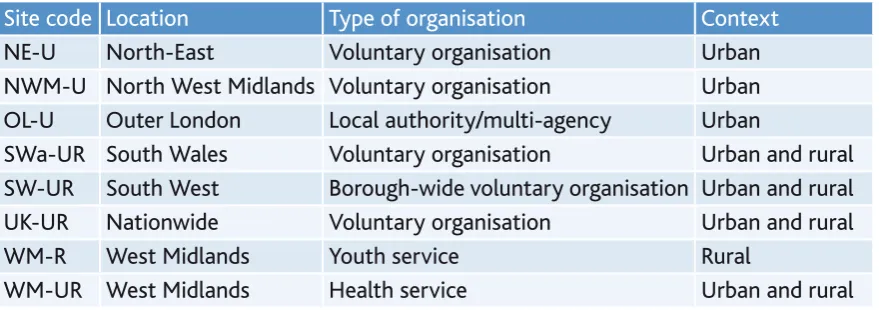
Ste code Locaton Type of organsaton Context
NE-U North-East Voluntary organsaton Urban
NWM-U North West Mdlands Voluntary organsaton Urban
OL-U Outer London Local authorty/mult-agency Urban
SWa-UR South Wales Voluntary organsaton Urban and rural
SW-UR South West Borough-wde voluntary organsaton Urban and rural
UK-UR Natonwde Voluntary organsaton Urban and rural
WM-R West Mdlands Youth servce Rural
WM-UR West Mdlands Health servce Urban and rural
4 Characteristics of the practice sites and interviewees
4.1 Characteristics of the practice sites and the programmes they
offered
Table 1 shows the locaton, type, and context of organsaton n each ste. At seven stes programmes were run n an urban settng, although at four of these stes programmes were also run n rural areas. In two of these stes programmes had been adapted to sut the needs of parents lvng n more remote locatons.
At seven of the stes programmes were hosted at communty and voluntary sector venues (communty centres and schools, the voluntary organsatons’ own premses, churches and mosques). Four stes also ran programmes n publc sector venues ncludng schools and health servce settngs. One voluntary organsaton offered tranng and co-facltaton of courses at a varety of venues around the country.
[image:12.595.101.541.351.506.2]table 1: organisation location, type, and context
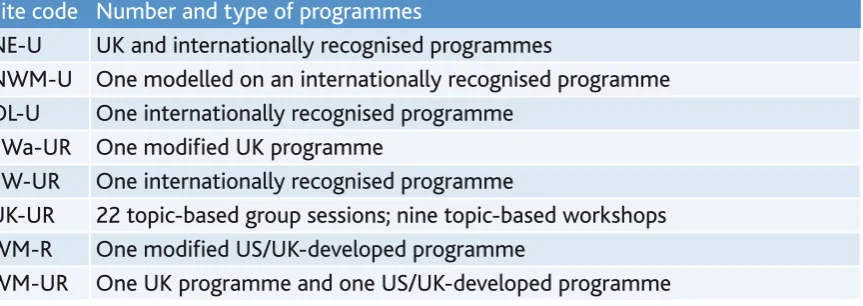
Table 2 shows the number and type of parentng programmes offered at each ste
table 2: parent skills-training programmes available at each site
The status of the programmes s shown n Table 3 n terms of whether the
programme came wth a manual and whether post-tranng supervson was avalable (from ether programme developers or accredted supervsors).
table 3: status of the programmes
There was consderable varaton among the programmes n terms of how well they had been evaluated. Most had been evaluated externally, although the adapted programmes had not undergone any form of rgorous assessment. In some cases, the programme had been evaluated for use wth a dfferent parent group to the group that was currently enrolled. In general, programmes from abroad tended to have been more extensvely tralled. Ths appears to reflect the general lack of fundng n the UK, whch lmts the capacty of programme provders to carry out n-depth evaluatons.
Ste code Number and type of programmes
NE-U UK and nternatonally recognsed programmes
NWM-U One modelled on an nternatonally recognsed programme
OL-U One nternatonally recognsed programme
SWa-UR One modfed UK programme
SW-UR One nternatonally recognsed programme
UK-UR 22 topc-based group sessons; nne topc-based workshops
WM-R One modfed US/UK-developed programme
WM-UR One UK programme and one US/UK-developed programme
Ste code Whether manualsed Ongong supervson
NE-U Yes, both UK and nternatonal Yes
NWM-U Yes Yes
OL-U Yes Yes, expensve
SWa-UR Indvdual sessons photocopable Yes
SW-UR Yes Yes, expensve
UK-UR Yes Yes
WM-R Adapted from a programme wth a manual Yes
WM-UR UK programme: Yes Yes
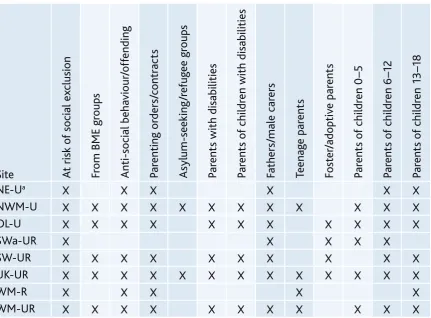
table 4: parent groups in receipt of programmes at each site
Note:a Informaton s provded about only one of the programmes on offer, a
programme for parents of chldren dagnosed wth attenton-defct hyperactvty dsorder (ADHD).
Table 4 ndcates the populatons of parents targeted at each ste. Groups at all stes ncluded parents at rsk of socal excluson, and most programmes also ncluded fathers (or male carers) and parents on parentng orders or contracts.
4.2 Characteristics of the interviewees
All the practtoners who were ntervewed had receved tranng n, or had recent experence of, facltatng parentng programmes. Four of the managers were not currently delverng programmes: two were nvolved n tranng facltators whle the other two were nvolved at a more strategc level n commssonng parentng servces and n montorng delvery; the other four managers were co-facltatng programmes.
The ntervewees came from a range of professonal backgrounds: the majorty had socal work backgrounds; three had health work backgrounds (one was a clncal psychologst); three were traned as youth workers; one was an educatonal psychologst; one facltator worked prmarly n a medaton servce but also ran parent sklls-tranng; and two were former parent partcpants who were now workng as facltators (one was salared).
Ste At r
sk o f s oc a l e xc lu s on Fr om B M E g ro up s A nt -soc a l be ha v ou r/ of fe nd n g Pa re nt n g o rd er s/ co nt ra ct s A syl um -s ee k ng /r ef ug ee g ro up s Pa re nt s w t h d s ab l t es Pa re nt s o f c h ldr en w t h d s ab l t es Fa th er s/ m al e c ar er s Tee na ge p ar en ts Fo st er /a do pt v e p ar en ts Pa re nt s o f c h ldr en 0 –5 Pa re nt s o f c h ldr en 6 –1 2 Pa re nt s o f c h ldr en 1 3 –1 8
NE-Ua X X X X X X
NWM-U X X X X X X X X X X X X
OL-U X X X X X X X X X X X
SWa-UR X X X X X
SW-UR X X X X X X X X X X
UK-UR X X X X X X X X X X X X X
WM-R X X X X X
5 summary of findings from the interviews
The fndngs from the ntervews are summarsed under the followng themes:
•
How to make parentng programmes accessble and acceptable to all parents•
How programme facltators ensure ther work s effectve and engages a wderange of parents
•
Vews of frontlne practtoners on NICE/SCIE gudance5.1 How to make parenting programmes accessible and acceptable
to all parents
The strateges that practtoners used to make parentng programmes accessble and acceptable to all parents related to the followng aspects of programme delvery:
a. Recrutng parents
b. Matchng parents to programmes c. Preparng parents
d. Overcomng barrers to access and attendance e. Creatng a safe space for parents
f. Provdng addtonal support
g. Adoptng a facltatve style and a collaboratve approach h. Talorng the programme
At a more strategc level, ncreasng the accessblty and acceptablty of parentng programmes requres:
. Increasng provson of parentng programmes j. Partnershp workng wth other agences
k. Offerng dfferent knds of support n a varety of ways l. Ensurng facltators are hghly sklled
m. Recrutng volunteers to help run and support programmes
These wll now be dscussed n turn.
5.1.1 Changes to programme delivery to increase the accessibility and acceptability of parenting programmes
a. Recruiting parents
The ntervewees dentfed a number of ways of recrutng parents that ncluded:
Marketing courses or programmes
All the ntervewees agreed that marketng was essental to encourage parents to attend a course. They descrbed a wde range of approaches they had found useful. Most adopted a mult-pronged approach, ncludng:
•
leafletng all the places that parents routnely vsted•
networkng and dsplayng/sharng nformaton at parentng forums, conferences,etc
•
holdng open days at communty venues•
regularly updatng nformaton about courses n local servce drectores and on thecouncl webste
•
encouragng enthusastc parents to pass on nformaton through nformal andmore formal channels
•
provdng clear nformaton about the types of programmes on offer•
producng vdeos llustratng programmes n acton•
more rarely, gvng press or local rado presentatons.Most of the ntervewees produced wrtten leaflets and ensured these were wrtten n plan Englsh: “We do a malshot three tmes a year, and that’s to all the professonal agences. We nclude a leaflet for professonals, whch has some basc detals of the courses and what we are hopng to acheve and how long the courses last.… But we also put n a very user-frendly parent-orented pamphlet … that’s accessble to all parents regardless of ther lteracy sklls” (voluntary organsaton, North East).
Some practtoners produced vdeos as these were more accessble to parents unable to read: “We produced a vdeo to show n people’s houses, to show what a group s lke … because I thnk you have to respond to people’s dfferent learnng styles” (voluntary organsaton, South Wales).
Many of the ntervewees found that ‘word of mouth’ cost relatvely lttle and was often the most effectve method of spreadng the word about the benefts and avalablty of programmes: “They’re sayng … f t’s done that for my neghbour, I want a pece of that acton” (voluntary organsaton, South Wales).
They also commented that t was very mportant to market programmes n a way that meant t dd not mply that courses were only sutable for parents who were not copng. The name of the programme could be very mportant for ths reason.
A key feature of any publcty materal s that t contans all the nformaton that parents need to decde whch programme s best for them, so they know who the programme s amed at, how long t lasts and what topcs t covers. Ths makes t easer for parents to self-refer to programmes. It also ensures that staff who make referrals can make better choces.
Developing effective referral mechanisms
Referrals came from a varety of sources, across voluntary, communty and publc sectors. However, the general pcture that emerged from ths study s that referral routes were rather haphazard and would beneft from beng more effcently organsed.
makng referrals and ther lack of understandng of dfferent programmes. Ths often led to a msmatch between programme and parent.
The way that some professonals referred parents to courses often made parents feel that they were to blame:
“The way that other professonals sell t, s qute often n a very puntve way whch sn’t helpful … there’s a large pece of work that needs dong wth professonals to get them to encourage parents … around t not beng seen as they are the bad parents.” (voluntary organsaton, South West)
“I’ve just come away from a mother now where a GP told her that there was nothng wrong wth the chld, t was her, and she had to be sorted out.” (voluntary organsaton, South West)
Some staff also referred parents napproprately. Some of the most wdely used programmes were not geared for parents wth very complex needs or for parents needng a crss nterventon. Referrng such parents was therefore problematc: “We actually need a lot more work to be done wth professonals’ understandng of what parents need … we cannot have someone put on the Chld Protecton Regster one day and sent off to Famly Parentng programme [the next]. They need an awful lot more before they go to the parentng programme” (voluntary organsaton, South West).
Educatng the staff who make referrals was an effectve way of preventng these problems. Many facltators therefore hosted short nformaton sessons for professonals:
“We advertse; we do taster sessons; we nform. We do professonal workshops.” (voluntary organsaton, South West)
“Now what we’re dong s … awareness rasng and we get … parents to come along to the tranng to talk to the professonals about what t’s about, so that they understand … and that ncreases ther confdence to refer.” (natonal voluntary organsaton)
Offering access to programmes via other services
Offerng access to courses va more general communty actvtes helped avod parents feelng blamed or stgmatsed: “We put on events that are not actually blled as offerng support … as a result of that, wth all our leaflets there, maybe there’s a parent who goes to an event and says ths s my stuaton, I desperately could use some help” (natonal voluntary organsaton).
b. matching parents to programmes
All of the facltators n ths study emphassed the value of outreach n helpng recrut the rght people to the rght courses. Most facltators routnely set up pre-group meetngs wth parents, where they made careful assessments of parents’ readness to engage wth a programme: “[Parents] have to be n the rght place at the rght tme … they have to be n a place where they actually have the understandng and awareness that they need to change somethng n order to help ther chld…. And f t’s all just locatng the problem n the chld then they probably won’t change” (voluntary organsaton, South West).
It also helped to ensure that parents who were not elgble for a course, or who were unlkely to beneft from a programme, were not napproprately offered a place: “Parents wll not be ready to partcpate n a parentng programme f they have drug, alcohol or domestc volence problems, court proceedngs or chldren n care. They just won’t have the emotonal and ntellectual capacty to make the changes” (voluntary organsaton, South West).
The pre-group assessment vst therefore plays an essental role n checkng the sutablty of a programme for a parent (and vce versa) as well as startng the process of developng a good workng relatonshp. Ths makes a bg dfference to gettng people through the door and paves the way for successful engagement: “That’s really the key to gettng people who’ve got complex needs nvolved n a parentng programme, they have to do all the extra work beforehand and then ganng ther trust and stuff. And f you just offered a programme wthout dong that … they won’t come” (voluntary organsaton, South West).
c. preparing parents
Almost all parents need reassurance at the pont of recrutment and there s a very real need for careful preparatory work pror to startng a course:
“Some famles mght fnd t dffcult to do wthout havng had the opportunty to ask questons frst and to engage n a trust relatonshp.” (voluntary organsaton, Mdlands)
“We would always engage wth the parent pror to them comng on the
groupwork. We wouldn’t expect them to come n cold because I thnk t’s totally unrealstc, to be honest.” (voluntary organsaton, North East)
Ths pre-group preparaton also ncreased attendance levels and prevented drop-out. The pont at whch parents were most lkely to drop out was generally between the referral and the frst week or so of a group. If facltators were able to encourage parents to attend the frst sesson, then they usually stayed for the duraton: “We’ve found by ntroducng the pre-group meetng s that we’ve actually had much more consstency of attendance” (natonwde voluntary organsaton).
The assessment vst also helped dentfy whether parents had any specal needs, as well as how they mght cope wth the group settng. Facltators could then respond by provdng any addtonal support that parents needed to help overcome any physcal or psychologcal barrers:
“I thnk there has to be an awful lot of prep work before a group takes place n order to encourage people to attend.… [I] almost do motvatonal ntervewng before the group takes place, and examne … what’s gong to stop you from comng on the day? Do you have any anxetes about comng along?” (health servce organsaton, West Mdlands)
“It’s about assessng the needs of parents before they come to t. Because what we don’t want them to do s to fal. So f they need extra support, we try and look at that. So we wll dscuss ths wth them at the assessment.” (voluntary organsaton, South West)
Some facltators developed short courses whch were found to help parents prepare for a full programme: “We have actually ntroduced a four-week taster course, one for parents of pre-teens, one for parents of teenagers.… It’s very much about startng the atttudnal shft, and what we fnd s the parents who have attended the taster course are fully tuned n for the 10-week course and they ht the ground runnng and they get the maxmum out of t” (voluntary organsaton, South Wales).
d. overcoming barriers to access and attendance
Identifying barriers
Some ntervewees descrbed the benefts of consultng local groups of parents to help dentfy barrers to access. For example, one facltator who consulted a group of young parents was surprsed to learn how much lack of transport, age and class dfferences had deterred young parents from accessng servces n the past: “They were very open, very good, sad what the ssues were and I’d never thought transport was [a problem].… They sad they don’t access servces because they feel ntmdated because parents are older … the health vstor s mddle class … they feel very ntmdated by that, so half of them sad they ddn’t attend baby clncs” (youth servce, West Mdlands).
Overcoming physical barriers to access
To overcome problems wth physcal access, some facltators were consderng takng ther programmes out to parents n rural areas: “We are talkng about dong satellte outreach courses, where we vst some solated areas wthn our county, because … tme restrants just don’t allow them [parents] to make the journey. So we are lookng at gong out to these outlyng areas and delverng the 10-week groups n ther communtes” (voluntary organsaton, South Wales).
Another facltator workng wth young, socally solated parents was expermentng wth runnng telephone-based parentng courses. Although these courses have not been evaluated, the facltator beleves they were successful n reachng people who mght otherwse be dffcult to access. Ths mode of delvery appears to “fll a gap and reach where other parent support programmes struggle” (natonwde voluntary organsaton).
Many ntervewees also commented on the value of offerng free transport: “We’ve found n the past that leavng transport to … the parents themselves, whether that be buses, taxs, walkng, just doesn’t work. I don’t thnk we would run the groups that we do f we ddn’t put the transport on alongsde of t” (voluntary organsaton, South Wales).
As well as addressng the more common concerns, t s also mportant to check wth each ndvdual whether they have any specfc problems wth access. Ths helps wth fndng more talored solutons: “Thngs lke … s the venue on a bus route, can they get the bus … can they get the buggy on the bus … do they need assstance wth those knds of thngs, what’s gong to prevent them from comng to servces” (youth servce, West Mdlands).
Overcoming psychological barriers to engagement
The bggest challenge for programme provders s engagng the parents who were very lkely to beneft, but who dd not beleve they needed support, or who were wary of attendng. Some ntervewees felt that puttng parents under an oblgaton to attend a parentng programme ran counter to the underpnnng phlosophy of self-drected learnng. Others felt that parentng orders could be of beneft: “You can go so far wth de-stgmatsng servces and makng them very famly-frendly, and we work really hard on that, but I do thnk there may be a group of famles that wll never come voluntarly … and you mght actually be dong them and ther kds a favour f you compel them to come … I thnk there mght be some real benefts from usng parentng orders” (voluntary organsaton, Mdlands).
Some parents on orders may even beneft more than others:
“We actually fnd we get as good outcomes and as good attendance, n fact better attendance for parents on programmes on orders than we do on a voluntary bass.” (voluntary organsaton, North East)
“Most parents who come on an order and engage – and I would say that’s probably n the hgh 70% – actually engage very well, complete and are very postve about havng been on the programme.” (voluntary organsaton, North East)
“We’ve had some fantastc results wth parents on parentng orders, who ddn’t want to be there but then sad that they thought t was the best support that they had ever had.” (health servce organsaton, West Mdlands)
There are a number of strateges that facltators used to help ths group of parents overcome ther psychologcal barrers to engagement. These ncluded:
•
ensuring that parents did not perceive that the programme was only aiming to improve their parenting skills: “Any programme … has to meet ther own needs frst.... Efforts to help ther own self-esteem and confdence need to be made and they ought to be valued” (voluntary organsaton, South Wales)•
keeping the sessions informal: “If t’s structured and formal they would feel lke they’re at school beng told off, and I thnk t’s mportant that that s not the case at all, partcularly wth parents that are made to come” (local authorty organsaton, Outer London)•
using the parent’s anger to build a working alliance, because “They are usually really feelng angry and resentful, but actually not towards you, t’s amed at the courts” (voluntary organsaton, North East)•
letting the individual choose whether to tell the other parents about their parenting order.Helping parents complete a programme
Other famly or work commtments could make t dffcult for parents to attend sessons consstently. Although facltators often helped parents who mssed sessons to catch up, ths was not possble for everyone. Sometme parents mght need to attend a second tme to complete the programme: “If they need to devote tme to … a chld or a partner or whatever, then t’s gong to mean that the course sort of gets put on hold for a whle. And that actually doesn’t stop them from re-enterng the next group” (voluntary organsaton, South Wales).
Some parents took tme to become psychologcally ready to take n a learnng
experence and so could not take n the nformaton the frst tme round: “Sometmes we get famles comng along, t’s not the rght tme for them, and they wll actually dp out and say I want to come back n the autumn or I want to come back next year” (voluntary organsaton, South Wales).
mssed too much and they haven’t got t all. They mssed a bt, or somethng … they found that those parents got a bgger beneft” (voluntary organsaton, South Wales).
However, offerng repeat courses mght not always be possble gven the general lack of fundng: “We would let them f we had spaces but we’ve such a long … such a bg watng lst … and [wth only] 12 people on a group, you can’t have people keep repeatng t. But … when t has been repeated, t has been extremely successful, and t’s usually been people that have been n very, very desperate stuatons … who got to a better place by the end of the frst course and were [then] ready to take t on board” (voluntary organsaton, South West).
e. Creating a safe space for parents
A safe space s created for parents by choosng the rght venue, settng up the rght group dynamc, makng parents feel welcome and by establshng ground rules rght at the start. These are dscussed n turn below.
A familiar venue
The most successful courses are typcally run n venues that are already well used by parents. Parents often access other servces at the same place and may have already developed relatonshps wth the staff:
“People say that they wouldn’t access the course, they wouldn’t be wllng to commt once a week, but they have, because the agency that’s runnng the course s an agency that they already use as a support.” (voluntary organsaton, Mdlands)
“We ran t n a communty centre where there’s already lots of parents attendng, parents wth chldren of varous ages.” (voluntary organsaton, Mdlands)
Facltators often nvted parents to become more famlar wth a venue (for example through attendng coffee mornngs and ‘stay and plays’) to encourage them to sgn up to a programme. Ths also helped parents begn to develop relatonshps before decdng whether to get more nvolved: “We … say, well, ths s what’s gong on, we’ve got a trp comng up…. Maybe you could [come and] get to know the people? We do thngs lke that to try and get them to come n” (voluntary organsaton, South West).
Another mportant consderaton was whether the venue was located n a safe area. Even f a buldng had all the rght facltes, f t was located n a run-down area, some parents mght not be wllng to attend.
There was some dsagreement among the ntervewees as to whether schoolswere
a good place to hold parentng programmes. Some facltators found t to be a problem: “We haven’t had a great deal of success, and we beleve part of that mght be … [from] holdng a group n school. Some of our parents have had such negatve experences … that to actually come nto a school s too much to ask” (voluntary organsaton, Mdlands).
Other facltators found there could be benefts to runnng programmes n schools, partcularly f the teachers were engaged: “For me dong t n schools was great because actually the messages got out to the teachers, who were very ambvalent ntally” (youth servce, West Mdlands).
Setting up the right group dynamic
Some ntervewees beleved t was mportant to set up groups wth parents who all had smlar experences: “Some thngs can upset the balance, when you go nto a group and there’s mostly [parents of] 14-, 15-, 16-year-olds, and they’re talkng about drug-takng, stealng cars, or breakng and enterng … other poor parents mght be sttng there thnkng, oh my God, that’s gong to happen to my nne-year-old, so we’ve got to be very careful … placement … could be crucal” (voluntary organsaton, South Wales).
However, others beleved that groups were better f they were mxed. To some extent ths depends on the partcular group of parents nvolved. The ssues affectng the dfferent groups are now dscussed n turn.
Fathers
Most ntervewees experenced some dffculty n recrutng fathers. Ths could mean that the men who dd attend then found themselves outnumbered, whch could be off-puttng: “We dd try to get males nvolved, but they ddn’t seem nterested … they ddn’t really want to get nvolved” (youth servce, West Mdlands).
In general, most of the ntervewees beleved that men and women needed separate groups, or at least needed to spend some tme n separate same-sex groups. Ths was because:
•
men and women often had dfferent knds of conversatons•
there could be problems n a mxed group f a parent had a background of domestcvolence or other serous relatonshp dffcultes
•
men and women often had dfferent parentng roles and therefore rarely sharedOthers suggested that where the focus of concern was a chld’s behavour t could be helpful to have mxed mother and father groups, but where the focus was on famly relatonshps, then t would be more helpful to have sngle-sex groups.
Opnon was also dvded on whether t was necessary to have male facltators of fathers’ groups: “Fve years ago, people sad f you want to work wth men, you should have a male worker. And people aren’t sayng that anymore. They’re sayng that you need a worker who can engage wth men, but t doesn’t matter about ther gender” (voluntary organsaton, North East).
Parents on parenting orders
Most of the ntervewees beleved that t would be better not to have groups exclusvely for parents on orders. Ths was because t was mportant to am for ncluson of ths group and because mxed groups enabled a rcher exchange of nformaton as well as greater opportuntes for relatonshps and socal support systems to develop.
Some facltators also thought t mportant that not all parents n a group came va referrals as ths could have an adverse effect on the group dynamc: “At the tme they come, they do feel judged because t’s a referral only group” (local authorty, Outer London).
Parents of children with disabilities
Parents of chldren wth dsabltes tended to prefer beng n a group wth ther peers: “I thnk t’s better that they all have dsabltes because … you need to handle t very, very dfferently. It’s not the same … where they’re wth … other parents n exactly the same stuaton as them … t’s qute comfortng I thnk” (local authorty, Outer London).
Deaf parents
There were mxed vews about whether t mght be preferable for deaf parents to be offered specfc groups. There are pros and cons, as one facltator descrbed havng run a group that ncluded a small number of deaf parents: “They enjoyed t. I don’t thnk they moved as far as the other parents and the dffculty s the amount of tme t takes … t was often hard to get meanngs across…. I thnk t would be better to have a group for deaf parents. Except, havng sad that, they dd apprecate fndng out that there were other parents n the hearng world that had these problems too” (voluntary organsaton, South West).
Teenage parents
Grandparents
It was generally thought that grandparents dd not need a separate group, partly because many of them were qute young, but also because they often had a lot to contrbute to groups of less experenced parents.
Making parents feel welcome
If parents had already met and establshed a relatonshp wth the facltator, they found t much easer to enter nto the groupwork. It was also the responsblty of every programme facltator to make all parents feel welcome: “It’s very mportant. Groupwork for anybody, for most people s pretty dauntng.… So, I thnk a famlar face, someone they connect to as soon as they walk through the door, s gong to make t much easer for them to settle down, to come n the frst place and then to feel comfortable whle there”. (voluntary organsaton, North Mdlands)
Establishing ground rules
Establshng ground rules of respect, a non-judgemental approach and confdentalty was consdered essental f parents were to feel safe enough to partcpate n a group:
“We strve to be non-judgemental … so that what we are dong s actually
provdng a very safe arena for parents where they can be open and they can share. I thnk that the level of trust that’s establshed rght from the start s a key factor n the success of the programme.” (voluntary organsaton, South Wales)
“We begn the sesson wth ground rules and stress confdentalty, and we actually get one of the volunteers to talk about that and how mportant t was to them and what a dfference t made to them.” (voluntary organsaton, South Wales)
“I thnk that we provde … a safe envronment for them to come and talk … and they don’t feel that they are beng judged ether by the workers or by the other parents … people feel safe to say thngs and they do talk about some … stuff that s really qute close to the bone.” (voluntary organsaton, North East)
It was also mportant that parents were gven tme to get a feel for ther group before any challengng materal was ntroduced: “You start off gently, you don’t start off wth the bgger topcs” (health servce organsaton, West Mdlands).
f. providing additional support
Ths type of support could be vtal for parents who mssed a sesson to help them contnue wth the programme:
“I’m maybe dealng wth parents that are depressed, and one week, lfe has got too much for them and they can’t come. And f we don’t engage wth them, they won’t come back. Whereas f you gve them … tme to go through the prevous week’s sesson. That makes t easer for them to come back.” (voluntary organsaton, South West)
“We just say, you know, are you okay, and we … mssed you, or the group were concerned about you and just wondered f you’re all rght and to see f there’s anythng we can do to help them … access the group.” (youth servce, West Mdlands)
If parents had more complex problems, the facltator would usually ensure that these famles receved addtonal support n parallel wth the sessons. Ths s often crucal to ensure that these parents benefted:
“We’re really clear … that a parentng course on ts own sn’t a sort of magc fx.” (voluntary organsaton, North West Mdlands)
“Certanly, n terms of parents wth more complex needs, you would have to put extra resources n terms of maybe one-to-one support.” (voluntary organsaton, Mdlands)
Parents wth more complex needs were sometmes only offered a place that was condtonal on other agences workng alongsde them: “We would [offer] ntensve one-to-one support f there were more complex needs … t would need to be part of a package” (voluntary organsaton, Mdlands).
Some groups of parents, for example parents wth learnng dffcultes, mght need addtonal home vsts to help them understand and make use of the course materal: “They would have a key worker who s ther worker all of the tme … and t mght be that f they wanted … to cover that sesson, then ther key worker would go and do a home vst and cover that sesson wth them” (voluntary organsaton, North East).
Extra vsts could also beneft ndvduals who became dstressed or dsclosed serous problems durng a group. Ths was not uncommon: “I mght actually say, there’s a lot more to cover here, sn’t there, can we just possbly follow ths outsde of today? And I mght go and do a home vst or talk to the person on the phone and sgnpost [them to other servces]” (youth servce, West Mdlands).
those questons or have that reassurance and they need somebody there” (voluntary organsaton, North East).
Some facltators set up addtonal systems of support that enabled the parents to contnue meetng and learnng from each other:
“Every sngle parent that does t, they then become part of a sort of network that we keep n touch wth. The parents can contact us, and often do, f anythng s changng or they’re not copng.” (youth servce, West Mdlands)
“The parents … ddn’t want t to end they just found t so useful … what we have done from there, whch has gone on now for about three years, s a parents and carers of teenagers support group, and we run that every eght weeks … just so they’ve stll got that contact and support of each other.” (local authorty, Outer London)
Some programme provders also offered refresher courses, for example: “an open nvtaton for people who have completed programmes to come back to the centre to go over the materals agan” (voluntary organsaton, South West).
Others encouraged parents to make the most of ther newly developed sklls and confdence to go on to other courses: “We’re workng wth our Adult Educaton department and we’re tryng to get them to come at the end of our courses and do some sgnpostng because, for a lot of the parents, ths wll be the frst course that they’ve ever done and they wll have really bult ther confdence about workng n a group so we really want to buld on that” (voluntary organsaton, Mdlands).
g. adopting a facilitative style and a collaborative approach
The ntervewees dentfed a good facltatve style as beng non-judgemental, collaboratve (rather than ddactc) and respectful:
“You’ve got to be frendly, non-judgemental, and you’ve got to make t clear that that’s the way you work.” (youth servce, West Mdlands)
“If they feel lke they’re respected by you, they gve and they get a lot more from the group than f they don’t feel lke they’re respected.” (youth servce, West Mdlands)
“We respect ther pont of vew and ther feelngs … we offer suggestons about how thngs can be done dfferently and then t’s up to them to decde.… Even f we don’t agree we can say … I have respect for what you’re sayng [but] f t’s not workng, how about tryng ths?” (voluntary organsaton, West Mdlands)
The process nvolves workng n partnershp and recognsng the parent’s own expertse:
“It’s not a model where the facltator teaches or advses. It’s around the parent … pullng out the prncples, and beng the expert, and comng up wth the deas.” (voluntary organsaton, South West)
“We … say … that we are not experts here, we have some deas but you know what wll work for your chld.” (voluntary organsaton, North East)
Ths approach s fundamental to programmes beng acceptable to a wde range of parents: “I thnk what I lke about our approach s that t encourages parents to reflect on ther own lfe stores and ther own hstory of beng parented, and how that affects how they want thngs to be or not to be for ther chldren.… And t’s not about tellng them how t should be … and that’s very acceptable to our parents” (health servce organsaton, West Mdlands).
h. tailoring the programme
Many of the ntervewees adapted the programmes they ran to make them more sutable for certan audences. Importantly, ths dd not nvolve radcally changng the content, but makng changes to the delvery and format to ensure the content was accessble: “You don’t adapt the model but t’s all about talorng the course to the experences of the famles … t’s qute subtle, you don’t change the order n whch you teach the sklls or what you teach.… The talorng s about makng t relevant to them and to buld on what they brng wth them” (voluntary organsaton, Mdlands).
Ths seems to be partcularly mportant for young parents, parents whose frst language s not Englsh, parents from dfferent BME communtes and parents wth specal needs. It ensures the programme focuses not only on parentng sklls but also on the needs of the ndvduals. The ssues for dfferent groups wll now be dscussed n turn.
Young parents
Facltators who work wth young parents tended to nclude more unstructured sessons allowng the young people to have more of a say n what was covered. (Ths appears to be the excepton to the rule, as most facltators dd not feel t was necessary, or approprate, for other groups of parents to have control over the topcs dscussed.) However, young people were more lkely to engage f they had more of an nput: “Allowng them to have an nput nto what they want to do. I thnk that works really well rather than sayng to them, you’re dong ths, you’re dong that … f they’ve had an nput, they’re more lkely to say, oh, rght, we’ll do ths, then, and they’ll get more nvolved” (youth servce, West Mdlands).
Parents whose first language is not English
Parents whose frst language s not Englsh tended to cope wth courses farly well because often the materal was provded n dfferent formats and they were also able to work at ther own pace. However, some of the ntervewees found that nvolvng an nterpreter dd not work well. Ths was because of problems wth ensurng an accurate translaton and the adverse effect of the extra person on the group dynamc. For ths reason, many of the stes were makng efforts to tran same-language speakers to delver the programmes: “One of the mothers, a Somal lady, s gong to be runnng t, so they have found a way that they can address [ths problem]” (local authorty, Outer London).
Parents from BME communities
Many of the ntervewees beleved that all programmes were accessble and acceptable to parents from dfferent BME communtes. Ths was because all
programmes encouraged parents to brng ther own experences to the group and the ground rules always stpulated that parents should respect each other’s opnons. In
effect, ths makes all programmes culturally senstve: “We try to treat everybody the
same. Equalty wthn dversty” (voluntary organsaton, South Wales).
And agan, t s possble to hghlght or play down dfferent topcs to reflect the nterests of the group: “So f you’re workng wth a certan communty, some of the nformaton s more relevant to that communty than other bts” (voluntary organsaton, Mdlands).
Parents with special needs
Facltators usually adapted materals (usng dfferent font szes, dfferent colours, smpler language and pctures) for parents wth learnng dffcultes. However, most of the ntervewees also sad that as a matter of standard practce, they tred to make sure that parents dd not have to rely on the wrtten word. Ths benefted a wde range of parent groups: “The onus s on the facltator to have everythng spoken out and to make sure that the parents understand t. And we’ve had many parents wth low lteracy, or no lteracy n terms of accessng the programme, because the facltator s traned to make sure that they read everythng out and explan everythng, and there’s a lot of dscusson. So the parents don’t have to read or wrte” (voluntary organsaton, Mdlands).
5.1.2 Changes at a strategic level to increase the accessibility and acceptability of parenting programmes
i. Increasing provision of parenting programmes
Many were also concerned about beng able to sustan programme provson, gven the unpredctable nature of fundng: “Sometmes t feels lke the whole parentng strategy s lke ths house of cards, bult on tny bts of temporary fundng that could all come crashng down at any mnute” (voluntary organsaton, South Wales).
Short-term, central fundng was thought to undermne the qualty of local
programmes as well as local parentng strateges. Ths s because fundng decsons were often made wthout the experence of people ‘on the ground’: “How could they know what was needed locally? They would fund thngs that … looked very good on paper, but some of us were thnkng I wouldn’t gve money to them!” (voluntary organsaton, West Mdlands).
The general pcture s that there are not enough resources to provde courses for all parents who could beneft, partcularly n areas of hgh deprvaton, as one manager descrbed: “We thnk probably around 50% of our parents, gven the levels of
deprvaton, would beneft from the course. I can’t see how we could resource 20,000 places … t’s always a compromse … tryng to get better at gettng the most needy famles onto the courses … actually we’re reachng about half to three percent… And yet we have more provson than most ctes.… I don’t thnk there have been any dscussons natonally about that” (voluntary organsaton, Mdlands).
There s therefore a lot of nterest n fndng ways to ncrease provson of parentng programmes, ncludng workng wth other agences (see below).
j. partnership working with other agencies
The ntervewees dentfed several benefts to workng closely wth other agences. These ncluded:
Better access to target groups of parents, particularly groups that were ‘hard to reach’:
“We’re gettng them [the Youth Drug and Alcohol Projects and Youth Offendng Teams] to help us to recrut the [teenage] parents because they’re … dealng wth those parents specfcally.… And they’ve gone to ther clents and … bascally sold the course to them.” (voluntary organsaton, North East)
“What works really well, s when the statutory agences work n partnershp wth the voluntary agences, partcularly n a group that s deemed hard to reach, lke fathers, lke parents wth a low ncome and ethnc mnorty parents.” (voluntary organsaton, Mdlands)
Earlier intervention for families who were in trouble, which helped avoid crisis situations. For example, specalst parent support workers located wthn housng departments were able to help famles at rsk of beng made homeless:
“The most vulnerable famles are presentng to them as homeless or comng to ther attenton because of ant-socal behavour … so they can access some famles before other servces perhaps know there’s a problem.” (voluntary organsaton, Mdlands)
Making it easier for parents to find out about the support available, for example through mproved telephone access:
“We’ve got, wth three of them, a specal arrangement so that we can put parents through drectly … so that parents don’t have to put down the phone and rng another organsaton and go through all the processes agan … t’s about makng t easer for parents.” (voluntary organsaton, natonwde)
Increasing local capacity to deliver parenting programmes. Ths has nvolved tranng staff n other organsatons n the use of programme materals:
“Bascally what t means s that you allow another organsaton to use your
materals and brand … and we would tran ther people as we mght tran out own people … and they would go out and run our courses.” (voluntary organsaton, natonwde)
Ths has extended the reach of programmes to groups that mght not have otherwse attended courses:
“The foster carers all feel that for every foster carer … they should all have the opportunty to have t [parentng tranng]. We’d lke to do t … but fundng s an ssue. So what has happened now s that staff from the fosterng and adopton team … are comng to tran wth us so that they are better able to support those foster carers … and the fundng les wth the fosterng and adopton team.” (voluntary organsaton, South West)
“You would go to small communty organsatons that are set up specfcally to work wth and support asylum-seekng groups, and they mght just be offerng advce but not specfcally parentng support.” (voluntary organsaton, natonwde)
Increasng the sklls of staff n other organsatons could also brng other benefts. For example, t could help parents who were not elgble for parentng programmes to receve some basc level of support. In one ste, an Ant-socal Behavour Order offcer undertook group-based tranng and then shadowed a worker provdng support through outreach. He was then able to use these sklls to work wth parents who could not attend the courses: “He s most effectve n that … very, very successful” (voluntary organsaton, Mdlands).
It can also extend the reach of programmes by provdng support for chldren and/or parents n other settngs. For example, workng wth the teachers who are teachng the chldren of parents on courses has proved very effectve: “We’ve had examples where the teachers have changed what they’re dong n the whole class stuaton, and t’s made thngs better for the [chld and the] other chldren as well” (voluntary organsaton, Mdlands).
However, some practtoners were concerned about workng wth other agences. They worred about qualty control and ensurng that tranng and programme delvery met the requred standards: “There are some groups that are run at arm’s length and we can’t be 100% sure what they are dong” (voluntary organsaton, Mdlands).
For ths reason, some facltators also stressed the value of spendng tme negotatng boundares and makng formalsed agreements about roles and responsbltes when workng n partnershp wth other organsatons:
“There are very clear SLAs [servce level agreements] for that. And the work s very controlled, to a very hgh qualty … we’re workng wth a coalton of voluntary groups and there would be ssues about accountablty and gvng consstent messages and so on, and we’re tryng to work through that.” (health servce organsaton, West Mdlands)
“I thnk qute a lot of work has to be put nto t and nto understandng each other and there are ptfalls. It’s terrbly mportant to try to thnk of t as a partnershp and not for one partner to mpose ts agenda on another.” (voluntary organsaton, natonwde)
k. offering different kinds of support in a variety of ways
Often the parents n most need of support had the greatest dffculty n accessng servces. It s therefore essental to offer dfferent knds of support n a varety of ways, so that all parents can fnd a servce suted to them: “We’re talkng about a menu of servces wth dfferent entry ponts” (voluntary organsaton, natonwde).
Ths could mean offerng more than one programme and/or dfferent formats, for example one-to-one support as well as groupwork:
“What we have found are some people are dong the one-to-one and then go on and do the group, so we offer that … sort of have a double dose whch s probably qute effectve.” (voluntary organsaton, South West)
“A lot of parents do beneft from the group stuaton and learn a lot from other parents…. However, for some parents, they are not the most approprate form of
nterventon.” (health servceorgansaton, West Mdlands)
“They accessed the course when ther chldren were young – fve, sx, seven years old – and they’ve wated a few years, and now they’re gong to go on a course because they’re gettng to teenagers and they’re dsplayng dfferent behavour and they just need… dfferent sklls or to re-affrm the sklls they’ve already got.” (voluntary organsaton, Mdlands)
“Sometmes parents need to do more than one parentng programme because all parentng programmes don’t am to acheve the same thng. I would use [a] programme … about what beng a good parent, a carng, nurturng parent looks lke, [to help them] buld relatonshps wth ther chldren … but you mght want to come back sx months later and do a programme that s more around boundary settng. It’s very hard to do a programme around boundary settng f you haven’t got a relatonshp wth your chld. So sometmes you would want to have a parent do two dfferent programmes at dfferent stages.” (voluntary organsaton, North East)
l. Ensuring facilitators are highly skilled
Havng a hghly sklled facltator was wdely agreed to be essental to guarantee a good outcome from parentng courses: “It’s about the relatonshps, the ntensty, a very sklled way of engagng the parents and makng them want to be there” (voluntary organsaton, Mdlands). Ensurng facltators were hghly sklled requres provson of adequate tranng, access to contnung professonal development (CPD) and hgh-qualty supervson, and provson of both
emotonal and practcal support. These ssues wll be dscussed n turn.
Training facilitators
The ntervewees were unanmous that good tranng was fundamental to ensure facltators possessed the degree of skll requred to run effectve groups:
“You wll get some knd of dsclosure … from some parents somewhere along the way, and ths s why t’s really mportant for the facltators to be traned, and not
to be phased by … these dscussons.” (health servceorgansaton, West Mdlands)
“My last group … we had a heron addct … how do you manage somebody who’s dsclosng that n a group of people who aren’t heron addcts?... t requres a lot
of senstvty on the part of the facltators.” (health servceorgansaton,West
Mdlands)
There was consderable varety among even the few programmes that were ncluded n ths study, n terms of how much tranng was nvolved. Some programmes
only requred two or three days ntal tranng, although most also ensured that practtoners observed sklled facltators and then co-facltated a group, before runnng a group on ther own.
Short tranng courses that focused only on the delvery of parentng programmes were thought to be nadequate. On top of the specalst programme tranng,
of parentng. One ntervewee also thought that facltators needed to have relevant experence f they were to be suffcently aware of parents’ stuatons and nsghtful enough to work sympathetcally wth them. She beleved that the fact she was a young, mxed-race parent helped to make her courses much more acceptable to the young parents she worked wth: “t’s probably better f you have the lfe experences so you can empathse wth the people that you’re wth” (youth servce, West
Mdlands).
CPD
There was consderable varaton among even the small number of stes n ths study n terms of the scope for personal and professonal development. All the ntervewees felt that ths was mportant and some felt they needed more opportuntes to extend ther theoretcal knowledge and to keep up to date wth developments n the feld.
Providing high-quality supervision
Most facltators receved supervson, ether from colleagues or from lne managers. If not sklled n programme delvery, these managers usually had experence of workng wth parents.
Supervson was hghly valued by facltators because t provded:
•
Much needed emotional support:“Because of the nature of the group, sometmes you get somethng dsclosed whch s qute horrfc and you need to talk t out before you go home really.” (youth servce, West Mdlands)
•
An opportunity for reflection on practice:“It’s very easy to drft nto your own style of workng, and t [supervson] just keeps … the programme fdelty true. I thnk t’s vtal for that, really.” (voluntary organsaton, South West)
•
Personal and professional development:“It’s beng a way of supportng our development. It’s a way of beng us beng accountable to somebody…. They can also assess our abltes to present these programmes and offer tranng where t’s needed.” (voluntary organsaton, Mdlands)
Some facltators receved addtonal specalst support and supervson from the people nvolved n developng and/or rollng out the programmes. Ths could be expensve: “I’m very lucky where I am at the moment because we’ve got a budget that offers us a chance to go for supervson.… Where I worked before, we ddn’t have these … budgets” (voluntary organsaton, South West).
One form of supervson/tranng that some facltators found benefcal nvolved vdeotapng sessons and then revewng the tapes wthn a group supervson settng. Agan ths was expensve whch may have lmted ts take-up on a wder scale.
However, t has proved very successful: “For me, t was the most postve learnng experence … that process of watchng yourself on vdeotape, perhaps sensng that somethng wasn’t qute rght and then realsng why t wasn’t” (voluntary organsaton, South West).
Providing support through co-facilitation
Many ntervewees commented that workng wth other facltators worked well because t provded both emotonal and practcal support. It also helped to reflect on practce:
“I thnk t’s nvaluable for many reasons, because f … there’s lots of ssues n that group, t can be very dranng. It’s good to provde emotonal support for each other.” (voluntary organsaton, Mdlands)
“We talk together a lot, so f I’m feelng a bt unhappy about somethng, or she s, we’ll talk about t.” (youth servce, West Mdlands)
Some stes also ncluded a thrd facltator to help practcally manage groups wth more complex needs. Ths extra person could gve more ntensve support to a parent who mght otherwse fnd t dffcult to stay n the group or to meet the demands of group tasks, or who mght dsrupt the group: “We’ve actually put n a … sort of a thrd standby facltator who, f there was any dffcultes, f a parent was strugglng … can go and gve assstance wthout t beng extremely obvous … also, f a parent… became upset … they could then go out of the room wth the thrd facltator who would be on … the sdelnes to help” (voluntary organsaton, North East).
m. Recruiting volunteers to help run and support programmes
Many ntervewees commented on the value of recrutng volunteer parents ether to provde addtonal support or to help co-delver programmes.
Parents who had been through the programme also proved to be very nfluental and effectve co-facltators:
“To actually have a parent sttng there and sayng do you know, last year I was exactly lke you … but hey, you can put effort n and we can turn ths around, and the power of actually hearng another parent say that outweghs anythng we can say.” (voluntary organsaton, South Wales)
“Someone sayng the course worked for them s worth eght tmes what anythng I mght say.… You can see people lookng at people lke me and thnkng, well, you would say that. Once a volunteer gets up and says, you thnk your Johnny has problems, god, my Leanne, she was dong x, y, and z and, you know, we turned t around.… That’s fantastc. That’s really powerful stuff.” (voluntary organsaton, South Wales)
They were also more accessble and less ntmdatng to the other parents: “I thnk I may be more of a grassroots knd of person than a lot of the professonals that delver the courses. I don’t even look lke one. I’m bg and hary but I’m not scary. I look lke an average Joe off the street” (voluntary organsaton, South Wales)
Becomng a parent facltator was sometmes a natural next step for parents who ncreased ther sklls and self-confdence through a parentng programme. To encourage parents to develop further many stes provde accredted tranng:
“All our volunteers have been checked, and … we have volunteer tranng that s accredted by the OCN [Open College Network] as well.” (voluntary organsaton, South Wales)
“We felt that the parents were workng hard and … t would be fantastc for them to actually have a qualfcaton n the end. Some of our parents have never had a qualfcaton before, so t really begns to open up the whole dea of returnng to educaton, whch agan s a form of empowerment.” (youth servce, West Mdlands)
5.2 How programme facilitators ensure their work is effective and
engages a wide range of parents
Whle all of the ntervewees were convnced that parentng programmes were rewardng, both for parents and for provders, few were certan that the methods used to montor and evaluate ther work reflected the true pcture. Most of the methods generated quanttatve data, whch mght not capture the changes that were actually mportant to measure: “I thnk [we] should be evaluated by our lne managers, and the whole thng should be evaluated by the parents…. But t’s easy enough to come out wth a load of fgures … but t’s how people feel about themselves that actually helps them parent better” (voluntary organsaton, South Wales).
Recording attendance and progress
Some of the ntervewees keep systematc records on the numbers of referrals, patterns of attendance and parents’ progress, but there was consderable varaton n the knd of nformaton that was kept. Few stored the nformaton electroncally or carred out any form of analyss, manly because of a lack of admnstratve capacty. Ths made t dffcult to obtan a comprehensve pcture of the populatons beng served by parentng programmes.
Monitoring parents’ experiences of programmes
Most of the ntervewees asked for feedback from parents, and agan used a varety of approaches to do ths. Some obtaned feedback sesson by sesson and others at the end of a programme. One organsaton held a focus group at the end of the course, led by an ndependent facltator, but most asked for some form of wrtten feedback, typcally va questonnares: “We’re takng feedback all the tme from parents and carers as to what’s effectve about what we’re delverng” (voluntary organsaton, Mdlands).
Many used ths feedback to mprove ther delvery and develop the programme content:
“We get feedback from the parents on how they fnd the sessons…. Then we … would st down and do a sesson-by-sesson evaluaton … and marry the two up to fnd out sort of areas where there was any problems.” (voluntary organsaton, North East)
However, some were more sceptcal about the value of feedback from satsfacton questonnares:
“So you get what we call a ‘happy evaluaton’ but that sn’t the measure of change or effectveness; that just means that … [t’s] been qute a pleasant experence. And I don’t thnk that’s suffcent … to make the knd of nvestment that you make to delver a parentng programme.” (voluntary organsaton, North East)
“The [programme] I used before was lovely and t made the parents feel absolutely wonderful, but I ddn’t have any evdence that t was actually effectng much change.” (local authorty, Outer London)
Assessing the impact of programmes
A number of the ntervewees were usng standardsed measures, often pre- and post-nterventon questonnares, to assess mpact. Some were sceptcal as to
It s also mportant to assess the long-term mpact of programmes to be certan that any change s sustanable. A lack of resources makes ths dffcult: “We do a sx-month follow-up, whch s one of the areas where we’ve had dffculty because we haven’t had the capacty to do that” (local authorty, Outer London).
External evaluations
Several of the programmes were n the process of beng evaluated externally at the tme of the ntervews, some nvolvng RCTs. However, few of the ntervewees were convnced that ths was the best method of obtanng evdence of benefts (see also Secton 3). But they also recognsed that parent feedback alone mght not provde robust evdence of effectveness. Whle most facltators were tryng to montor the mpact of ther work (often wth very lmted resources), there was no agreed best practce approach. Many would welcome clearer gudance n ths area and the development of more user-frendly evaluaton tools.
5.3 Views of the frontline practitioners on NICE/sCIE guidance
Most of the recommendatons n the NICE/SCIE gudance were well receved and, wth mnor modfcatons for certan groups of parents, consdered very helpful. More detaled feedback on each of the recommendatons s provded below.
Programmes should be group-based
The ntervewees dentfed the man benefts of workng n a group as beng able to:
•
share concerns wth other parents•
make new supportve relatonshps wth other parents•
learn from your peers as opposed to professonals•
be challenged n a safe space“The most powerful learnng from t, wth any group of parents, s what they get from ther peers and from other people who have been through smlar stuatons because … t knd of carres extra weght.” (voluntary organsaton, North East)
“Also parents team up wth each other to help each other … f you�