A thesis
submitted in partial fulfilment of the requirements for the Degree
of
Master of Arts in Education in the
University of Canterbury
by
NORMAN FREDERICK DANIELS
TABLE OF CONTENTS Chapter
I
II
THE ENQUIRY
(a) General Introduction
(b) The Specific Aims of the Study (c) Summary of Aims
(d) Outline of the Study REVIEW OF THE LITERATURE
(A) A Review of the Research on Classroom Interaction Studies
(a) The development of research on teaching and classroom interaction (b) Reviews of research on teaching
and classroom interaction
(c) Research on classroom cognitive and linguistic behaviours
i. Studies primarily concerned with cognitive and linguistic
1 2 11 13 13 15 16 16 18 20
variables 21
ii. Studies of questions used
by teachers 27
iii. Studies of explaining
in teaching 30
iVa Studies of cognitive and
linguistic variables of teacher
behaviour and pupil achievement 31 v. Studies of discourse "style"
and discourse "relevance" 32 (B) A Review of the Literature Concerning
Instruments used in the Study 35 (a) The word association test 35 (b) The assessment of vocabulary levels 36 (c) The measurement of social status 37 (C) A Review of Literature Related to the
Linguistic Theory Underlying the
Linguistic Analyses used in the Study 37
(a) Various grammar systems 38
(b) Chomskian transformational grammar 39 i. A summary of Chomsky's linguistic
theories to 1973 40
ii. Chomsky's psychological theories 42 i i i . Empirical validation of
Chomsky's psychological theories 43 iv. The Chomskian theory of phrase
nesting constructions 46
Chapter
III THE DESIGN OF THE STUDY 49
IV
(A) Procedures 49
(a) The preparatory period 49
(b) The programme 51
(c) Methods of recording and transcribing 52
(B) Research Samples 53
(a) The schools (b) The teachers
53 53
(C) The Instruments Used 54
(D)
THE
(a) The pre-test 54
(b) The post-test 55
(c) The Children's Associative Reasoning
Test 56
(d) The attitude questionnaire 56
The Independent Variables
(a) The teacher variables
i. Questions, episodes and monologues
i i . Lexicon, structure, in teacher language
(b) The pupil variables
RESULTS OF THE STUDY
and style
57 57 57 62 68 72
(A) The Teacher Variables 72
- Questions, Episodes and Monologues
(a) Questions
i. Types of questions ii. Questions per hour
i i i . The use of questions: summary of results and general notes
(b) Episodes
i. Episode relevance i i . Episode length
i i i . A general note on episodes in the classroom discourse
(c) Monologues
i. Monologue design ii. Monologue type
i i i . Monologue length and frequency
Chapter
V
iv. A general note on teacher monologues
Lexicon, Structure and Style in Teacher Language
(d) The lexicon
(e) The morphemic structure and phrase subordination of teacher language
i. Morphemes per group ii. Phrase subordination iii. A general note on phrase
subordination in the teachers' classroom language
(f) The voice system and negation (g) The phrase structure
(h) General notes on voice system, negation and phrase structure of teacher classroom language in this study
(i) Style in teacher classroom language A general note on style indices in teacher classroom language
(B) The Pupil Variables
93 94 94 97 97 98 102 102 104 106 107 113 114 (a) The predictor variables 114 (b) Use of pupil reference materials 119 (c) Pupil judgments on the value, interest
and difficulty of Social Studies
generally and the experimental lessons in particular including judgments on
the amount learned 119
STATISTICAL PROCEDURES AND ANALYSIS OF RESULTS 128 (A) A General Note Concerning the Procedures 129 (B) The Relationships Between the
Independent Variables 130
(a) Correlations among teacher questions 130 (b) Correlations of types of episodes
and other teacher variables 131 (c) Correlations between teacher questions
per hour and other teacher language
variables 133
(d) Correlations between episode length
and other teacher language variables 133 (e) A general note concerning the
relationship between teacher questions and episodes and other teacher
Chapter
(f) Correlations between teacher language phrase subordination,
structure and language style 135 (C) The Relationships Between Selected
Independent Pupil Variables 139 (D) The Relationship Between Pupil Achievement
and Certain Independent Pupil and Teacher
Variables 139
(a) A general note on the nature
of residual scores 140
(b) The procedures employed to obtain
pupil achievement residual scores 141 (c) The relationship between achievement
and the predictor variables 142 (d) The analysis of variance of pupil
achievement scores 147
(e) The relationship between achievement and various pupil predictor variables divided into equal groups of three
ability levels 148
(f) The class average residual
achievement scores 152
(g) The relationship between class
average residual achievement scores
and selected teacher variables 155 i. The relationship between pupil
achievement and teacher questions 155
ii. The relationship between pupil
achievement and episodes in the
classroom verbal interaction 156
iii. The relationship between pupil
achievement and teacher
monologues 157
iv. The relationship between pupil achievement and teacher
language variables 158
(h) The relationship between class average residual achievement scores and
selected pupil variables 161 (E) Selected Pupil Variables from the
Attitude Questionnaire Related to the
Experimental Lessons 162
(a) Level of pupil interest in lessons 162 (b) Level of difficulty in understanding
the lessons 165
(c) Pupil estimates on 'How much was
Chapter
VI
(F) Factor Analysis of Teacher Language Variables
(a) Factor One (b) Factor Two (c) Factor Three (d) Factor Four (e) Factor Five
(f) Factors Six, Seven and Eight (g) A general note on the results
of the factor analysis DISCUSSION AND CONCLUSIONS
(A) Descriptions of Teachers' Classroom Language Behaviour
i. The structure of the classroom
170
171 173 175 176 178 180 180 181
181
verbal interaction 181
ii. The content-relevance of the units
of classroom verbal discourse 182
iii. The pedagogical purpose and
content-relevance of teacher monologues 183 iVa The linguistic structure of
teacher monologues 184
v. Style in teacher classroom language 185 vi. Pupil achievement in classroom
lessons 187
vii. Pupil attitudes and achievement 188
viii. Future research 188
APPENDICES 189
1. Extracts from the University of Canterbury's Teaching Research Project's Manual "System for
Analysis of Verbal Interaction in Class Lessons" 189
2. Pupil Booklet 195
3. Teacher's Notes: Extract from Mayhill & Bawden,
"New Zealand Geography", Chapter XIII 'Northland' 201 4. Notes to Teachers: An Explanation and Outline
of the Research Investigation for Headmasters
and Teachers 220
5. Topic Outlines for Teachers 226
6. Sample Tape Transcript 231
7. Pre-Test: Northland - Test One 236 8. Post-Test: Northland - Test Two 246
9. Test of Verbal Ability: Children's Associative
APPENDICES continued
10. Pupil Attitude Questionnaire: Northland - Question Paper 'AI
11. Intercorrelation Tables for Teacher and Pupil Variables
270
Table I II III IV V VI VII VIII IX X XI XII XIII XIV XV XVI XVII
LIST OF TABLES
Analysis of Teacher Sample
Item Analysis Statistics on Preliminary Form of Northland Pre-test, as determined
from proportions of correct responses in upper and lower thirds of the group
Percentage of Types of Teacher Questions in all Tapescripts
Percentage Scores for all Teacher Question Types in Groups
Primary Questions per hour
Percentage Scores for Episode Relevance Types in all Tapescripts
Percentage Scores for Episode Length Categories in all Tapescripts
Percentage Scores for Teacher Monologue Design (pedagogical purpose)
Percentage Scores for Teacher Monologue Type (relevance to prescribed content) Percentage Scores for Teacher Monologue Length and Number Score for Monologue Frequency
Percentage Scores for Lexicon Categories in Teacher Monologues
Percentage Scores on Categories of Size of Lexical Unit (morphemes per group) in
Teacher Monologues
Percentage Scores for Phrase Subordination in Teacher Monologue Samples
Scores for Voice System and Negation Analyses of Teacher Monologues
Percentage Scores for Phrase Structure in Teacher Monologues
Grouped Percentage Scores for Phrase Structure in Teacher Monologues
Scores for Style Indices in Teacher
Monologues. Frequency per hundred lines of tapescript.
Table
XVIII Class Mean Scores and Standard Deviations
for Pupil Variables 1-10 115
XIX Pupils' Social Class: Ratings assigned
on the basis of judgment 116
XX Pupil Use of Reference Material. Class
Mean Scores for Pupil Variables 11-31 120 XXI Pupil Judgments on Social Studies.
Class Mean Scores and Form Mean Scores
for Pupil Variables 32-46 121
XXII Class Mean Scores and Form Mean Scores
for Pupil Variables 47-67 124
XXIII Intercorrelations among Teacher Primary
Questions which correlate p
=
~.10 131 XXIV Intercorrelation among Teacher Variables19-25 Episode Types, and between Episode Types and Variables 32-44 Monologue Design, Type, Length and Frequency which correlate
p
=
~.10 132XXV Intercorrelations between Teacher Variable 26 Questions Per Hour, and Teacher Variables 19-25 Episode Types, and 32-44 Monologue Types, Design and Length which correlate
p
=
<.10 133XXVI Intercorrelation between Teacher Variables 27-31 Episode Length, and Teacher Variables 42-44 Monologue Length and Frequency which
correlate p
=
<.10 133XXVII Intercorrelation between Variables 55-74
Phrase Subordination and Phrase Structure 136 XXVIII Intercorrelations among Selected Teacher
Variables 78-97 Language Style Indices 137 XXIX Intercorrelation among Eleven Selected
Pupil Predictor Variables which correlate
p
=
<.10 139XXX The Averaged Residual Scores, Means, Standard Deviations and Rank Orders of
Predictor Variables for Each Class 143 XXXI Class Averaged Residual Achievement
Scores and Rank Order 144
XXXII Form Averaged Pupil Predictor Variable
Table
XXXIII Intercorrelations between the Ten Pupil
Predictor Variables (Pupil Variables 1-10) 146 XXXIV Analysis of Variance of Total Pupil
Achievement Scores 147
XXXV Multiple Regression Analysis for all
Pupils (Achievement) 148
XXXVI Multiple Regression Analysis for High
Ability Pupils 149
XXXVII Analysis of Variance of High Ability
Pupil Achievement Scores 150
XXXVIII Multiple Regression Analysis for Middle Ability Pupils
XXXIX Analysis of Variance of Middle Ability
150
Pupil Achievement Scores 151
XL Multiple Regression Analysis for Low
Ability Pupils 151
XLI Analysis of Variance of Low Ability
Pupil Achievement Scores 152
XLII Class Average Residual Achievement Scores 153 XLIII Rank Order of Class Average Residual
Achievement Scores 153
XLIV Rank Orders of Class Average Residual Achievement Analysed According to Teacher
Experience and Form Taught 154
XLV Correlation between Class Average Residual Achievement Scores, Teacher Primary
Questions and Questions Per Hour 155
XLVI Intercorrelations between Types and Length of Episodes in the Classroom Verbal
Inter-action and Pupil Achievement 156 XLVII Intercorrelations between Monologue Design,
Relevance to the Prescribed Content,
Monologue Length, and Monologues Per Hour 158 XLVIII Correlations between the Lexical Level in
Teacher Monologues and Pupil Achievement 158 XLIX Intercorrelations between Morphemic
Structure of Teacher Monologues and Pupil
Table L LI LII LIII LIV LV LVI LVII LVIII LIX LX LXI LXII LXIII LXIV LXV LXVI
Intercorrelations between Phrase Structure of Teacher Monologues and Pupil
Achievement
Intercorrelations between Selected Pupil Attitude Variables and Pupil Achievement Multiple Regression Analysis of Pupil
Interest in Lessons
Class Average Residual 'Interest in Lessons' Scores
Rank Orders of Pupil Residual 'Interest in Lessons' Scores Analysed According to
Teacher Experience and Form Taught Analysis of Variance of 'Interest in Lessons' Scores
Multiple Regression Analysis of 'Difficult to Understand' Scores Class Average Residual 'Difficult to Understand' Scores
Rank Order of Class Average Residual Lesson Difficulty Scores Analysed According to Teacher Experience and Form Taught
Analysis of Variance of 'Difficulty of Understanding What Was Said' Scores
Multiple Regression Analysis of 'How much did you learn?' Scores
Class Average Residual 'How much did you learn?' Scores
Rank Order of Class Residual Scores for 'How much did you learn?' Analysed
According to Teacher Experience and Form Taught
Analysis of Variance of 'How much did you learn?' Scores
Significant Language Data for Factor One T Scores for Significant Language Data Variables in Factor Analysis : Factor One Significant Language Data for Factor Two
Table
LXVII T Scores of Significant Language Data
Variables in Factor Analysis : Factor Two 174 LXVIII Significant Language Data for Factor Three 175 LXIX T Scores for Significant Language Data
Variables in Factor Analysis : Factor Three 176 LXX Significant Language Data for Factor Four 177 LXXI T Scores for Significant Language Data
Variables in Factor Analysis : Factor Four 178 LXXII Significant Language Data for Factor Five 178 LXXIII T Scores for Significant Language Data
Variables in Factor Analysis : Factor Five 179 LXXIV Intercorrelations among Teacher Variables
1-31 280
LXXV Intercorrelations between Teacher Variables
1-31 and Teacher Variables 32-54 281 LXXVI Intercorrelations among Teacher Variables
55-74, Phrase Subordination, Phrase Structure, Vagueness and the
Scientific-Emotive Dimension 283
LXXVII Intercorrelations among Teacher Variables
69, 78-97 Style Indices 284
LXXVIII Intercorrelations among Selected Pupil
CHAPTER I THE ENQUIRY
This study is an exploratory investigation into certain aspects of classroom verbal interaction by means of an analysis, description and comparison of teacher language and certain pupil differences found during six Form II and eight Form III classes in the course of 42 prescribed social studies lessons.
Transcriptions of recorded lessons were analysed to obtain certain language variables and the resulting measures were related to pupil variable measures. The teacher language variables were:
1. the logical structure of units of the verbal inter-action as indicated by question types,
2. the content relevance of these units,
3. the purpose and content relevance of teacher monologue explanations,
4. the linguistic structure of teacher monologues, 5. the discourse style employed.
The pupil variables were:
1. measures of intelligence and associative reasoning, 2. attainment in terms of understandings acquired in
the course of the three lessons and tested by means of a pretest and a post-test,
3. attitudes toward and interests in school subjects as indicated in questionnaires,
availability of resource mate ale
The prime interest which motivated the study and the significance of research such as this are outlined in the following general statement.
(a) GENERAL INTRODUCTION Teacher Language
Language is the basic means of communication in the classroom. It models and moulds the thinking of the participants in the activities of the classroom; i t conveys ideas and experiences, both trivial and profound; i t regulates the behaviour of both teacher and pupil; i t is creative, productive and expressive. But the language of the classroom is a unique subsystem within the general language communications system.
1
Gilbert Ryle suggested "no one could follow or use didactic discourse who had not already learned to follow or use conversational talk ... Didactic discourse is itself a species of studied discourse ... in which schooling is given . . . and is itself, in some degree, the product of schooling ... Even if a bright conversa-tional style is affected a merely conversaconversa-tional
reception of i t is known to be inappropriate, so the conversational style is recognised to be fraudulent. The teacher is pretending that he and the pupil are not really working."
Classroom discourse has been likened to a
"language" game2 in which each "move", a language unit in the lesson, is directed and restrained by rules pertain-ing to the participant's classroom role. According to Bellack the "fundamental pedagogical pattern" in class-room discourse consists of a sequence of teacher question, pupil response, and usually a teacher reaction. The
initiation of these "moves" is the function mainly of the teacher.
Perhaps the teacher determines also the discourse "styles", that is the modes and levels of expression created by syndromes of oral language mannerisms. If
3
Ryle is correct, then a feature of the classroom
language game may be that the language style employed by the teacher has a markedly different nature from that used by the pupil. Not only could the linguistic action and style be teacher generated and controlled; the linguistic structure and the vocabulary could be teacher-oriented in their complexities and levels of difficulty or conversely the teacher may employ pupil-oriented, simple language structures and vocabulary levels.
The fact that the teacher may have a "dialect" would add a priestly quality to his classroom role. Although he and the pupils probably have a common social-class origin in New Zealand, the teacher's educational and experiential background could allow a
2
Arno Bellack et ale 1965. The Language of the Class-room. Parts 1 and 2. Co-operative Research Project, Columbia University.
"language-class" difference to develop which makes the teacher, in this respect, of higher rank.
The teachers in New Zealand primary schools
receive their academic education concurrent with or after their professional education. From the time of entry into a teachers' college after secondary education, their professional education includes the experience of
teaching and observation in primary school classrooms. The normal method of secondary-teacher education in New Zealand is by means of a "bridge" professional course subsequent to a secondary and tertiary academic education.
It is not unreasonable to assume that beginning teachers in secondary school classrooms may employ teacher-talk beyond the verbal experience and under-standing of the new entrant to the secondary school. Analyses of secondary teachers' and pupils' classroom discourse could show that the teacher-talk was
constructed of inordinately more erudite, sophisticated vocabularies, and linguistic structures, and inappropri-ately higher cognitive levels than the pupil-talk.
grades is a smooth, progressive one; the pupils have not found this to be so. Administrators and teachers have observed that there are problems of adjustment for such pupils. The nature of classroom discourse could be a factor contributing to the difficulties and disillusion-ment experienced by some secondary school entrants. Teaching Research and Theories of Teaching
The discourse style is one activity in that set of teacher behaviours which constitutes good teaching. The last two decades have seen the development of new
insights and new techniques in teaching research, but relatively little research has been carried out on the linguistic nature of classroom language.
Most analyses of classroom discourse have tended to focus on wide, salient phenomena. Martln . 4 . ln a
review of teaching research concluded that "if we are to get to the heart of the teaching act we must finally cope with its subtlety".
The macro-analytic approach taken in most studies of classroom interaction has contributed much to the increasing body of knowledge on teaching. Descriptions of classroom behaviour have been richly provided but generally there has been a focus upon the gross overt behaviours, which do not lend themselves to fine
analyses and interpretations.
Having outlined significant current teaching 4 R. G. Martin. 1971. "Communication and the Act of
Teaching: A Footnote to Models of Teaching". Journal of Teacher Education, Volume XXII, No.4, Winter, 1971,
models of communication in the classroom, MartinS concluded that little is yet known about classroom language.
There is no generally accepted theory of language communication, and research findings have provided no resolution of the related problems. There are,
however, many accepted linguistic techniques available which could be employed for the analyses of classroom discourse.
Biddle has suggested that the "major field as yet untapped in classroom research is that of linguistics,,6 and considers that i t is possible to study the
vocabulary, grammar, and lexicon of classroom language. The results of such research would contribute to the body of descriptive knowledge about teaching but they would also add a new dimension to the development of a
theory of teaching if their micro-analytic elements were related to pupil variables.
The current models of teaching are products of various theories of learning, counselling, general psychology, or are eclectic, multi-dimensional models. Although components in these models may have some
empirical support, none possesses validation obtained from classroom application of the relevant paradigms. A scientifically-based theory of teaching is needed but
1971. Op.cit., pp. 418-424. R.G. Martin.
has yet to develop. Biddle7 observes that this lack of a general scientific theory of classroom behaviour exists despite the efforts to utilise traditional theories, or the results of small group research. These have been used for the building of prescriptive theories of
teaching but until the full range of behaviours contained within them can be subject to validation we must admit to operating from non-scientific premises.
Teaching Research and Curriculum Development
The changes and developments in curriculum fields tend to follow a classical form:
(a) dissatisfaction is expressed concerning the inade-quacies of the current curriculum,
(b) a new curriculum is developed or an old curriculum is modified, or one is borrowed and adapted,
(c) the new curriculum is tested in restricted pilot schemes and either rejected or adopted.
Often disenchantment follows the romantic phase, particularly if the new curriculum has contained
seemingly more effective material. It is unusual for curriculum innovations to have suggestions detailing teaching behaviours which have been shown to be
effective for use within the new curriculum.
Curriculum development and evaluation of its effectiveness can be facilitated by the use of descrip-tive data obtained in classroom observations. The
results of analytical treatment of the data could provide 7B.J . Biddle. 1965. "Systematic Studies in Classroom
a needed means of describing and understanding the
teaching behaviours in relation to pupil achievement and attitude within micro-trial, experimental and
post-implementation periods.
Barak Rosenshine8 reviewed studies which used available classroom observation instruments to evaluate curricula. He found that most studies reported that teachers who used the material employed traditional means of instruction; few used special teaching behaviours within the context of the curriculum package. He inferred that descriptions and low-inference measures relating teaching behaviours to student achievement were needed for investigations into the effectiveness of
experiments into new curricula. None of the studies included linguistic teaching behaviours.
Probably the paucity of research into such
variables in general teaching research explains why they have not been brought into focus in evaluation of methods of instruction in new curricula. For comprehensive and reliable evaluation of these innovations, appropriate observational systems and analytical descriptions are needed. These would enable the identification of
critical verbal and non-verbal behaviours needed for new curricula to have potency and for the achievement of curricular objectives.
Teaching Research in Programmes of Teacher Education It has been suggested that research concentrated 8Barak Rosenshine. 1970. "Evaluation of Classroom
on verbal and linguistic variables would be a fruitful field for contributing to the understanding of the
problems found in junior secondary classrooms, and also would make important contributions to the development of a theory of teaching and for curriculum development and evaluation.
Because such research can contribute to these areas i t could also furnish materials and methods for teacher education programmes.
The lack of adequate programmes in teacher education is attributable in part to the insufficient information available on the significant and crucial behavioural components of effective teaching. Rosen-shine and Furst observe that there is a new focus on denotable actions in performance criteria9 in the training of teachers which is indicative of a shift from traditional broad and vague objectives such as 'providing meaningful experiences' and 'providing for individual differences'.
Investigations indicate that those training procedures reviewed by Rosenshine and FurstlO which concentrated on distinguishable, specific behaviours were more effective than courses employing traditional methods for changing the behaviours of teachers in training. The reviewers see the need for an emphasis on specific performance criteria in the planning of 9Barak Rosenshine and Norma Furst. 1971. "Research on
Teacher Performance Criteria" in Research in Teacher Education: A Symposium, edited by B.O. Smith, for American Educational Research Association. Prentice-Hall Inc., New Jersey.
model programmes of teacher education. However, there are no repertoires of teaching skills which have been shown from research to produce severally, or in combina-tion, the desirable changes in the cognitive 0 affective
performance of the students. Such research findings would provide the performance criteria needed in teacher education programmes.
Many teacher education courses use the available observational category and rating systems and
findings in these areas for aiding teachers whose sensi-tivity is already high.
(b) THE SPECIFIC AIMS OF THE STUDY
The study began with the intention of particularly ascertaining:
(1) If there was any significant difference between the vocabulary levels in the classroom language of a group of teachers as shown in judgments obtained from the pupils and from a panel of experts, and (2) exploring the relationship between teacher
effect-iveness from measures of pupil achievement and samples of each teacher's classroom lexical level as obtained from word frequency lists.
After a preliminary trial these aims were modified because the following specific variables appeared to be significant on the basis of the author's intuitive
judgments:
(1) The number and types of questions in classroom verbal interaction.
(2) The classification of the units of verbal inter-action "episodes"ll according to their relevance and purpose in relationship with the generally prescribed lesson content, and the length of episodes.
(3) The classification of the teacher explanation "monologues",ll according to their relevance, 11
G.A. Nuthall et ale 1970. System for Analysis of Verbal Interaction in Class Lessons - 1970 Revision, University of Canterbury Teaching Research Project
purpose, and design in relationship with the prescribed lesson content.
(4) A determination of the variations between the teachers in the research sample of the lexical levels of monologues.
(5) The analysis of samples of teacher monologues to obtain a description of the "surface" linguistic structure of each teacher's classroom language by obtaining measures of:
(a) the number of morphemes per group, and (b) the various types of phrase subordination
structures.
(6) An analysis to provide a description of the "deep structure" of each teacher's classroom language through measures of:
(a) the frequency of the use of negation,
(b) the frequency of the use of the passive voice, (c) the phrase structure, that is the degree of
phrase embedding and branching structures. (7) A description and comparison of the styles employed
by the teachers in their oral language. The "style" of the language being characterised by
variables such as the use of idiomatic, figurative, pedantic, and other distinctive features of oral
language.
(8) The frequency of the use of vague expressions in teacher explanations.
(c) SU~1ARY OF AIMS
These specific aims resulted in the development of the general intentions in this exploratory study:
(1) The description of the patterns of teachers'
language; its linguistic structure, vocabulary and style.
(2) The nature of the verbal interaction in the particular type of lesson used in this study. (3) An examination of the relationship between a
selection of these variables and the following: Pupil achievement.
Pupil interest in this subject and type of lesson.
Pupil assessment of the general difficulty, in understanding these lessons.
Pupil assessment of their ability to understand the language employed by the teachers in these lessons.
(4) Because of the classroom problems experienced by new entrants in secondary schools, to determine any differences there were between the language and aspects of verbal interaction in Form II and Form III classes in the sample used for this study.
(d) OUTLINE OF THE STUDY
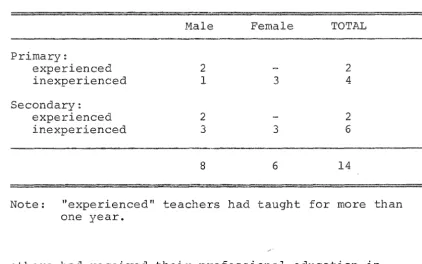
The secondary and primary school teachers were matched as much as possible for experience, sex, and type of school.
The lessons were tape-recorded then transcribed. The tape-scripts were analysed to isolate ninety-four teacher differences and sixty-seven pupil differences. Measures were obtained of these differences for each teacher and each class respectively and attempts were made to identify relationships between these.
CHAPTER II
REVIEW OF THE LITERATURE
This chapter presents firstly an outline of the
development of research in teaching, in particular the
development of research in classroom interaction in
which cognitive and linguistic behaviours have been
studied.
The studies reviewed are those in which
investi-gations were made of questions, teacher explanations,
discourse styles, and content relevance in teaching.
Reviews are also given of studies which relate cognitive
and linguistic dimensions of teacher behaviour with
pupil achievement.
Secondly, a summary is provided of the literature
concerning the tests and other means of measurement used
in this investigation.
Finally, there is a presentation and discussion
on the theories underlying the linguistic analysis
employed. Reasons are given for the choice of the
Chomskian transformational grammar together with a
summary of Chomsky's linguistic theories up to the end
of 1973, his psychological theory and the empirical
validation of those theories. The chapter concludes
with notes on the significance of the theories for
INTERACTION STUDIES
(a) The development of research on teaching and classroom interaction
The questions related to what constitutes a good teacher and good teaching have been asked from classical times. However i t is only of recent years that studies in teaching have investigated objective measures of
teacher behaviours and employed scientific methods in research.
Medleyl traced the influence of various trends in previous educational research upon modern teaching
research. He found investigations into the psychology of learning dominated educational research from the turn of this century and controlled most teaching practices and much of the theory of teaching. Many experiments compared the effectiveness of various methods but not specific teaching behaviours.
Medley considered that the child study movement of the 1930s produced the pioneer work in observational methodology.
During the 1940s, researchers, particularly
2 3 4 Olson et al., University of Iowa, Thomas, Anderson,
IDonald M. Medley. 1972. "Early History of Research on Teacher Behaviour", University of Virginia, in Inter-national Review of Education, Vol. 18, No.4 (Special Number), UNESCO Institute for Education.
201son, University of Iowa (undated). (Mimeographed material.)
3Dorothy S. Thomas et ale 1929. "Some New Techniques for Studying Social Behaviour". Child Development Monograph No.1.
and Jayne,5 provided the trends toward, and techniques for, objective methods of classroom observation.
These led in the 1950s to teaching research such as that of Withall's investigations into "Classroom Climate",6 and Flanders' "Interaction Analysis",7 the most generally used method of analysing classroom behaviour. Medley and Mitze18 developed the "OScAR" method of recording observations of behaviour in the classroom.
These were the most influential among the reported 9
studies up to the beginning of the 1960s. Medley notes that of reported studies less than 20 used objective procedures for analysing the classroom behaviours of teachers.
In the past decade there has been a marked development in teaching research in these directions: 1. the general directions possible in the study of
classroom behavioural processes,
2. the variables selected within the processes studied, 3. the depth of focus in research,
4. the techniques, instruments, and methods of
5
C.D. Jayne. 1945. "A Study of the Relationship between Teaching Procedures and Educational Outcomes". Journal of Experimental Education, 14, pp. 101-134.
6J . Withall. 1951. "The Development of the Climate Index". Journal of Educational Research, XLV, pp. 93-100.
7
N.A. Flanders. 1960. "Teacher Influence, Pupil Atti-tudes and Achievement". Final Report. Co-operative Research Project No. 397, U.S. Office of Education, The University of Minnesota.
8D. M. Medley and H.E. Mitzel. 1958. "A Technique for Measuring Classroom Behaviour" in Journal of Educational Psychology, 49, pp. 86-92.
9
observation, data collection and treatment of data, 5. methods of analysis, statistical procedures and
interpretation,
6. the philosophical, sociological, and psychological implications and problems of empirical studies of interaction in the classroom.
(b) Reviews of research on
teaching and classroom interaction
The research studies which have produced these developments have been comprehensively reviewed by
10 11 12 13
Biddle, Meux, Campbell, Nuthall, Westbury and
14 . 15
Bellack, and Slmon.
Biddle confined his review first to the specific problems related to the variables covered in classroom research. He suggested that most studies give
seriously limited coverage to the various types of classroom and the specific variables investigated.
He reviewed, secondly, the methodology of data 10B.J. Biddle. June 1967. "Methods and Concepts in
Classroom Research" in Review of Educational Research, Vol. XXXVII, No.3, pp. 337-357.
IlM.O. Meux. December 1967. "Studies of Learning in the School Setting" in Review of Educational Research, Vol. XXXVII, No.5, pp. 539-562.
12
W. J. Campbell. November 1968. "Studies of Teaching I. Classroom Practices" in NeZ. Journal of Educational Studies, Vol. 3, No.2, pp. 97-124.
13G. A. Nuthall. November 1968. "Studies of Teaching II. Types of Research on Teaching" in NeZ. Journal of
Educational Studies, Vol. 3, No.2, pp. 125-147. 14 1 . Westbury and A.A. Bellack (editors). 1971.
Research into Classroom Processes: Recent Develop-ments and Next Steps. Teachers' College Press, Columbia University, New York.
1 5 . Anlta Slmon , (d' e ltor . ) 1968 . Mlrrors . f or Be aVlour: h ' An Anthology of Classroom Observation Systems.
collection. Nonparticipant observation was considered useful if the need was for development of the new
concepts and relationships within the classroom social system but, because the observer was required to operate from his own insights, there could be no closer investi-gation into the variables operating in the classroom nor replication of results. When a rating system was used, there was opportunity for replication but not for closer scrutiny of other than those variables the observer was able to focus upon.
Behavioural recording by means of audio or audio-visual devices allowed for more detailed investigations into the interacting variables of the classroom. Biddle considered that for deep analytical study of classroom processes, audio-visual recording was necessary.
The third problem which was covered in Biddle's review concerned the choices of analytic units. He commended the use of short episodic units for the analysis of classroom processes; irrespective of the model adopted for research purposes, a short analytic unit was employable. The units used in the various classroom observation systems have been described in
16
Meux. He noted that most analytic units were analogous to stimulus-response relations, apart from those systems which had arbitrary time units, for
17
example Flanders' system. But these systems aimed at analyses of classroom behavioural processes other than 16 M. O. Meux. 1967. Op.cit.
the cognitive processes.
In Biddle's review, the fourth problem "conceptual posture", classified research investigations according to focus in the behaviour observation: intent, effects or objective characteristics of the classroom partici-pants' behaviour. The reviewer considered that any or all of these could be coded legitimately at the individual level but if a broader stance was needed, because social factors are to be investigated, then the emphasis should be on an analysis of the objective characteristics of behaviour.
In the final specific problem, Biddle noted that there was lack of agreement between research workers regarding their underlying conceptual structures. The idiosyncratic nature of analytical systems has been
18
discussed by Nuthall, who suggested that theoretical justification must be provided for any system of
analysis.
(c) Research on classroom cognitive and linguistic behaviours
Meux19 recommended the use of "multi-aspect class-room observation systems" for research in classclass-room
learning. Included in this, he suggested, should be indications of various "thinking" processes, particularly concerning the fundamental problem of conceptualisation. He saw the need for new systems to index attributes of this behaviour, amongst which he included
psycho-linguistic factors .
20
Nuthall's review indicated that an insignificant number of studies had endeavoured to examine cognitive or linguistic variables; most studies were devoted to descriptions of ecological, teacher or pupil, and
classroom management variables. Although the orienta-tion in the majority of studies had been pedagogical, the cognitive and linguistic variables within the class-room verbal interaction had received little attention.
i. Studies primarily concerned with cognitive and linguistic variables. Bellack et al. 21 directed their research to the analysis and description of the verbal behaviour of teachers and students in high school Social Studies lessons. Part of their reference was the
determination of the way language was employed in structuring pedagogical roles.
The analysis of classroom discourse in the study reported by Nuthall and Lawrence22 was directed to the identification of the cognitive structure and style in molecular verbal events of classroom lessonsi however, the concern was with linguistic style rather than its constituent elements as in this research investigation.
h ' 23 . d h h h' h
Rosens lne pOlnte out t at t ere was a 19 20 G. A. Nuthall. 1968. Op.cit., pp. 544-558.
21Bellack, Davitz et ale 1965. The Language of the Classroom, Parts I and II. Co-operative Research Project, Columbia University.
22 G. A. Nuthall and P.J. Lawrence. 1965. Thinking in the Classroom. The Development of Method Analysis. N.Z. Council for Educational Research.
correlation between the "readability" of classroom material and "listenability". He found that most investigations of reading difficulty contained three steps which provided a paradigm for his investigations:
(a) investigators ordered materials according to a criterion of difficulty, usually comprehension; then
(b) analysed the materials for internal, linguistic factors which predict variations in difficulty; and
(c) combined the factors most predictive of difficulty into a multiple regression formula.
Rosenshine showed by the use of this paradigm objectively that difficult language contains longer words and longer units of thought.
From this Rosenshine, Gage and others were able to combine a variety of linguistic variables which were useful in studies of comparison among teachers, the
traditional type of research. These studies could have significance for studies in teachers' oral linguistic behaviour where comparisons are made of the behaviours at different grade levels.
However, Rosenshine considered that the studies
24 25
across a period of time by Peterson, Funkhouse and 24 E . M. Peterson. 1969. "Aspects of Readability in
25
Social Studies". Columbia University Teachers' College, in B. Rosenshine. 1969. Op.cit.
Rosenshine26 showed that different uses of language produced differences of effectiveness because of these variables:
(i) vagueness
(ii) explaining links
(iii) frequency of examples (iv) rule-example-rule pattern
(v) irrelevancy.
Hiller et al.27 found that the incidence in the teacher's vocabulary of fluency and vagueness had a positive correlation with pupil achievement.
In Dell and Hiller's28 analysis of teachers' explanations there was found again a negative relation-ship between "vagueness" and explaining effectiveness.
Rosenshine29 analysed social studies lectures of ten teachers (five "high-scoring", five "low-scoring") in each of three samples: a "hypothesis", a "valida-tion" and a "cross-valida"valida-tion" sample. The variables were classified in nine linguistic categories:
1. Word length
26 B. Rosenshine. 1969. "Behavioural Predictors of Effectiveness in Explaining Social Studies Material". Unpublished Doctoral Dissertation in (23) op.cit. 27J . E . Hiller, G. Fisher and W. Kaess. 1969. "A
Computer Investigation of Verbal Characteristics of Effective Classroom Lecturing" in American Educational Research Journal, Vol. 6, No.4, November 1969, pp. 661-675.
28 D. Dell and J. Hiller. 1968. Computer Analysis of Teachers' Explanations. Original Mimeographed Report. 29 B. Rosenshine. 1968. Objectively Measured Behavioural
Predictors of Effectiveness in Explaining. (Mimeo-graphed material.) Presented to American Educational Research Association Symposium on Explaining in
2. Words related to the ten criterion questions 3. Length and structure of independent clause
units
4. Use of prepositional phrases 5. Readability estimate
6. Personal references (counts of first and second person pronouns)
7. Negative sentences
8. Passive verbs
9. Elongated and fragmented sentences.
For the hypothesis sample only were there any significant relationships; the high-scoring lectures contained fewer syllables per word, more words and
phrases per independent clause unit, more prepositional phrases, and more words relevant to the criterion
questions used.
B erns eln s t ' I 30 au lO- lngulstlc researc, d' l' " h b y t e h
analysis of tape-recorded data collected under differing circumstances and environments, investigated the
difference between different language registers of the 30 B. Bernstein. 1961. "Social Structure, Language and
Learning" in Journal of Educational Research, Vol. 3, No.3, pp. 163-76; and also Primary Socialisation, Language and Education. University of London Institute of Education Sociological Research Unit.
Note: The development of this research is found in Primary Socialisation, Language and Education. University of London Institute of Education Socio-logical Research Unit. Research Reports, B. Bern-stein (editor), Routledge & Kegan Paul, London:
(1) W. Brandl-s and D. Henderson. 1970. "Social Class, Language and Communication"; (2) G.J. Turner and
B.A. Mohan. 1970. "A Linguistic Description and Computer Programme for Children's Speech"; (3) D. &
J. Gahagan. 1970. "Talk Reform: Explorations in Language for Infant School Children" i (4) W.P.
British working-class and the middle-class. He described these registers as "restricted code" and
"elaborate code".
This research, which is still being reported, using very sophisticated techniques, indicated that the whole nature of learning and environmental orientation was restructured when there were fundamental changes in
a child's speech patterns. It would appear that
similar environments were interpreted differently by the users of the different codes. It was found that greater attention was given to, and greater gain was made by, the users of elaborate code in the classrooms. The teachers were mainly of middle-class origin and used language with "elaborate code".
An outline of the main characteristics of these codes has significance for this present study:
In Restricted Code the sentences had these features:
Limited length
Simple and loose syntactic structure Frequent use of the active voice Limited range of adverbs
Limited range of adjectives but frequent use of a few simple adjectives
A significant use of interrogative and imperative structures
Impersonal pronouns had little use but subjective purpose was not presented explicitly.
Highly complex syntactic structures Complex phrase subordination
Significant use of the passive voice
Careful selection from a varied range of adverbs, adjectives and prepositions
The frequent employment of impersonal pronouns but subjective purpose is by explicit means. Barnes et ale Is31 research used a general
approach covering the full range of types of English secondary schools with twelve lessons in all. Using a mixture of high-inference and low-inference measures the teachers' questions and language register were categorised. Vocabulary level was treated on a
specialist/non-specialist dimension. Barnes suggested that a "more sophisticated insight into the implications of their own use of language and into the part i t plays in pupils' learning would be of advantage to the
teacher" .
32
Cambourne's progress reports also have
relevance to this study. His research was based on a comparison between different verbal strategies in the classroom, and into the surface-structure/deep structure linguistic analysis of classroom discourse.
31D. Barnes et ale 1969. "Language in the Secondary Classroom" in Language, the Learner and the School. London Association for Teaching of English. In Penguin Papers in Education Series, Penguin Books, Middlesex, England.
33
A study by Kean employed three coders (relia-bility .89-.99) to:
Provide segmentation of teacher talk (syntactic units, partials, images)
Analyse the structural patterns of main clauses and functions of subordinate clauses
Index vocabulary diversification.
Findings indicated firstly that there appeared to be little difference in teachers' language between grade levels.
Secondly, findings on teachers' language "calling for speculation" by the pupil showed that while second grade teachers used almost the same percentage of
partials as their pupils, fifth grade teachers used more than their pupils; nouns and pronouns were almost the only nominals used by all teachers as sentence subjects but clauses and infinitives were used substantially for nominal complements; words and phrases were used more than were clauses and combinations in adverbial
elements by all teachers.
ii. Studies of questions used by teachers. There has been a large number of surveys on questioning in the classroom since 1912 when Stevens34 found that 80% of classroom time was spent in the asking and answering of 33
J.M. Kean. 1968. "Linguistic Structure of Second and Fifth Grade Teachers' Oral Classroom Language" in the American Educational Research Journal, Vol. 5, No.4, November 1968.
questions.
Studies undertaken in the last decade have indicated that the questioning practices of teachers not changed radically in the last half century.
35
The reviews of Von Balzer, Hoetker and
36 37
Ahlbrand, and Gall of studies on teacher questions indicated that most research found that about 50% at least of teachers' questions required the statement of facts; about 25% asked questions demanding some sort of reasoning skill; the remainder concerned classroom
management and procedures.
Classification of types of questions
The reviewers named above, and Rosenshine and Furst38 found that the research studies which used types of questions either classified the questions into two broad categories or into divisions based on varieties of types.
Two-type classification of questions
Studies which classified questions into two types used either high-low cognitive operations or open-closed dimensions. The studies did not produce "consistent 35 L . Von Balzer. 1970. Review, Appraisal and
Recommen-dations Concerning Classroom Behaviour in Science. Report to Annual Meeting of National Association for Research in Science Teaching, Minneapolis, March 1970.
(Mimeographed. )
36 J . Hoetker and W.P. Ahlbrand, Jr. 1969. "The Persis-tence of Recitation" in American Educational Research Journal, No.6.
37
M.D. Gall. 1970. "The Use of Questions in Teachingll
in Review of Educational Research, VoL 4 0 , No.5. 38 B. Rosenshine and N. Furst. 1971. "Research on
significant results or any discernible trend". 39 Multiple classification of questions
Rosenshine's review above stated that only two studies have been found which used this type of classifi-cation. S 1 o omon et a . 1 40 an d C d ' b onners an Elsen erg 41 reported studies which, although differing in intentions and procedures, presented significant results. Rosen-shine considered that studies which used multiple
classifications of questions would be profitable for research.
The Canterbury Teaching Research Project System of Classification
The method of analysis42 involved a three stage process:
Stage One Discourse was separated into verbal moves and classified.
Stage Two Verbal episodes were identified on the basis of the verbal move classification. Stage Three The leading questions of each episode were
classified on the basis of their dominant logical-cognitive meaning.
The classification of questions into fifteen categories is presented in Appendix 1, page 189. 39Rosenshine and Furst. 1971. Op.cit.
40
D. Solomon, W.E. Bezdek and L. Rosenberg. 1963.
Teaching Styles and Learning. Centre for the Study of Liberal Education for Adults, Chicago.
41C. K. Conners and L. Eisenberg. 1966. The Effect of Teacher Behaviour on Verbal Intelligence in operation Headstart Children. John Hopkins University of
Medicine, Baltimore.
This method was adopted for use in this study. Research studies which compared questioning
behaviours of teachers across Form II and Form III classes (Grades 6 to 8 approximately)
43
Godbold compared the questioning practices of elementary and high school teachers who had different qualifications and teaching experience. This sample was composed of 32 teachers from four junior high schools and four elementary schools in a large metro-politan area. Each question used was categorised
according to Sanders' classification44 by two observers analysing taped 50-minute lessons.
The statistical comparisons revealed that:
1. There was a difference between the number and the cognitive level of the questions asked.
2. At least 54% of questions were in the "memory" category.
Elementary school teachers asked 33.66% more questions than high school teachers; experienced
elementary teachers asked 14.2% more questions than the experienced high school teachers but less experienced elementary teachers asked 6.59% more questions than their more experienced colleagues. Experienced high school teachers asked 31.12% more questions than did the less experienced.
iii. Studies of explaining in teaching. Reviews 43J .V. Godbold. 1970. "Oral Questioning Practices of
Teachers in Social Studies Classes" in Educational Leadership, Research Supplement to Vol. 1, October 1970.
of research into the teacher's ability to explain have been reported by various writers.
Rosenshine45 noted that the research in this area had been primarily exploratory, but that results showed significant correlations between effectiveness of
explanations and teacher variables, such as gestures, use of explaining links, and incidence of vague words.
Most research studies on the teacher's ability to explain have been conducted either by or under the
supervision of N.L. Gage and/or B. Rosenshine. Hiller et al. 46 under Gage's direction analysed 35 categories of significant verbal characteristics in teachers'
lecturing behaviours. These were consolidated, on the intuitive judgments of the authors, into a set of five factors: verbal fluency, optional information amount, knowledge structure cues, interest, vagueness.
Statistical analysis found the vagueness factor to be strongest in measures of effectiveness related to lecturing effectiveness criteria.
Vagueness was defined as "an excessive proportion of qualification, haziness and ambiguity". The "Vague-ness Dictionary" constructed during that research was used in this present study to provide guidance in selecting the "vagueness" words for frequency counts.
iv. Studies of cognitive and linguistic variables of teacher behaviour and pupil achievement. Reviews of 45 B. Rosenshine. 1968. "To Explain: A Review of
Research" in Research in Review, in Educational Leader-ship, Vol. 26, No.3, December 1968.
research and certain research studies which related cognitive and linguistic variables to pupil achievement are considered in this section. Rosenshine's two
. 47 48 49
reVlews ' and Soar's review indicated that more research had been conducted into the affective than into the cognitive areas of teachers' classroom behaviours. Many studies revealed significant positive correlations between the frequency of teacher questions and pupil achievement. Wright and Nuthal150 found a positive relationship between achievement and the percentage of closed questions. Rosenshine reported that research using other two-dimensional or multi-dimensional classi-fications of questions had indicated that significant positive relationships existed between types of questions used and pupil achievement.
51
Von Balzer reported that in some research in science teaching a direct relationship was found between lecturing effectiveness and student achievement.
v. Studies of discourse "style" and discourse
"relevance". No reported research studies have employed 47 B• Rosenshine. 1968. Teaching Behaviours Related to
Pupil Achievement. (Cyclostyled research paper.)
48 B . Rosenshine. 1971. Teaching Behaviours and Student Achievement, published by National Foundation for
Educational Research in England and Wales.
49 R. Soar. 1970. "Teacher Behaviour Related to Pupil Growth" in The Classroom Behaviour of Teachers, No.7, 1970.
50
c .
J . Wright and G.A. Nuthall. 1970. Relationship Between Teacher Behaviours and Pupil Achievement in Three Experimental Elementary Science Lessons.American Educational Research Journal, No.7, 1970. 5lL . Von Balzer. 1970. "Review, Appraisal and
variables similar to "style" and "relevance" which were used for this exploratory study.
Darbyshire52 in discriminating between dialect and register defined a dialect as language usage
determined by the environment or the social status of a group. Cutting across this is the register of a
language, that is the situational context or set of circumstances which elicits it. The context will determine the concern or subject-matter of the
utterances constituting the discourse and this dictates the lexis and often the syntactic structures used.
It should be noted that there is overlap between studies of teacher language which deal with the psycho-linguistic and the sociopsycho-linguistic investigations.
However, the purpose of the discourse analysis in style of teacher language was to describe the differences, if any, between the styles used by teachers of the teacher sample and to describe the common denominators of those teachers' discourse styles.
As with all native speakers of a language,
teachers will use a delicate control over their manner of discourse. Here the aim was to describe the style which these teachers found appropriate in the classroom
lessons of this study.
As the only language medium concerned in this exploratory study is spoken language, the stylistic features of only spoken English were investigated as examined and specified by some writers on English 52 A. E . Darbyshire. 1968. Exercises in Linguistics.
stylistics. 53
Joos specified five arbitrary style divisions in English usage:
1. Frozen 2. Formal
3. Consultative 4. Casual
5. Intimate.
He considered the "frozen" style was that type of English usage which was formal and did not employ any
conven-tional conversaconven-tional utterances; i t was the language of scientific, written prose. Because i t was thus
constituted i t was not expected to be found in the original data of this study.
For the purpose of determining the specific
characteristics of each of the other divisions of style
. . . 54-59 I' h I ' d d
var10US wr1t1ngs on Eng 1S stye were exam1ne an 53
M. Joos. 1962. "The Five Clocks", and in the Inter-national Journal of American Linguistics, Vol. 28, No.2.
54 A. Wilkinson et ale 1965. "Spoken English". Educational Review Occasional Publications No.2. Supplement to the Educational Review, Vol. 17, No.2, February 1965.
55 D. Crystal and D. Davy. 1969. "Investigating English Style". English Language Series. R. Quirk (General Editor). Longmans, London.
56 C.p • Fries. 1958. The Structure of English. Long-mans, London.
57A. E . Darbyshire. 1967. A Description of English. Edward Arnold Ltd., London.
58
B.M.H. Strang. 1962. Modern English Structure. 59
Edward Arnold Ltd., London.
from them "style constellations", arbitrary sets of characteristics, were compiled.
In this study another variable of spoken English was measured in the samples of teacher language.
60
Flower's description of "emotive juxtaposition" was used for a count of emotive words in the original transcribed data. Flower stated that such words may have a lack of precision in context having been selected with the incident to give "aura of meaning".
(B) A REVIEW OF THE LITERATURE CONCERNING INSTRUMENTS USED IN THE STUDY
(a) The word association test
The Children's Associative Responding Test devised 61 62
by Achenbach ' was used in this study. Some minor modifications on procedures were necessary. These modifications are described in the next chapter.
The CART is a multiple-choice analogy test which can be used to provide a measure of general intelligence, but the test was specifically designed to identify
children who were dependent upon free association rather than analogical reasoning. Half of the test items had a foil response item which was frequently associated 60 F.D. Flower. 1966. Language and Education. Longmans,
London, p. 9l.
61L . M. Achenbach. 1970. "Standardisation of a Research Instrument for Identifying Associative Responding in Children" in Developmental Psychology, No.2, 1970.
62
L .M. Achenbach. 1970. "The Children' s Associative Responding Test: A Possible Alternative to Group I.Q. Tests". Journal of Educational Psychology, Vol.