composition operators.
Teun van Hemert
June 17, 2013
A dissertation submitted to the University of Twente
for the degree of Master of Science.
UNIVERSITY OF TWENTE.
Faculty of Electrical Engineering, Mathematics and Computer Science.
Chair Software Engineering
Supervisors:
Dr. Ing. C.M. Bockisch
S. te Brinke, MSc
1 Introduction 2
1.1 Background . . . 3
1.2 Problem analysis . . . 4
1.3 Approach . . . 6
1.4 Outline . . . 7
2 Co-op/III 8 2.1 Messages . . . 10
2.2 Bindings . . . 11
2.3 Constraints . . . 14
2.4 Implicit parameters . . . 21
3 Implementation 22 3.1 ALIA4J . . . 23
3.2 Common prototype features . . . 25
3.3 Tree-based prototype . . . 35
3.4 ALIA4J-based prototype . . . 47
4 Evaluation 58 5 Conclusion 62 5.1 Conclusion . . . 62
5.2 Future work . . . 65
One of the most important design principles in modern software engineering
is the separation of concerns. A concern in computer programming is a feature
or behavior of a computer program. Examples of such concerns are computa-tions, business logic, security, database access, and logging. The idea behind the separation of concerns is that a software engineer should in general only have to focus on one concern at a time, under the assumption that the other concerns ‘just work’. In addition, these concerns are often separately devel-oped and evolved . In software engineering, separation of concerns is achieved by decomposing applications into separate entities, often called modules. This concept is referred to asmodularity.
Programming paradigms and design patterns exist to aid programmers in
achieving modularity in computer programs. For example, object-oriented
pro-gramming languages such as C++, C#, and Java support modularity through in-heritance, whileaspect-oriented[5, 12] languages such as AspectJ separate cross-cutting concerns into aspects. Examples of crosscross-cutting concerns are logging and security, which tend to scatter throughout an entire application and are hard to separate using object-oriented techniques. Design patterns aid the
pro-grammer in separating concerns as well. For example, the
model-view-controller pattern [8] separates the concerns of data presentation, data manip-ulation, and data itself. On the architectural level, concerns can be separated through architectural patterns. For example, Service-oriented architectures [16] separate architectural concerns into services.
The mechanisms introduced in the previous paragraph are called tion operators. Typically, languages support only a limited amount of composi-tion operators, while solucomposi-tions to software problems (in particular with respect to modularity) will often benefit from multiple, flexible composition operators. While some of these shortcomings can be alleviated by using design patterns, these patterns often require repetitious boilerplate code to implement.
Ideally, composition operators can be defined by programmers themselves. By allowing this, programmers will always have access to the right
tion tools. The goal of this master thesis is to implement a powerful, flexible execution framework for programmer-defined composition operators.
1.1
Background
1.1.1
Co-op
The Co-op approach attempts to address the issue of having only a limited num-ber of composition operators in a programming language. At its core, Co-op is a dynamically typed, object-based language with its syntax derived from Java. Co-op only provides objects and function application (which is also a composi-tion operacomposi-tion). It achieves flexibility in composicomposi-tion operators by reifying func-tion applicafunc-tions as messages. Conceptually this is similar to languages such as SmallTalk. By providing programmers with primitives that let them manipu-late these messages, it allows programmers to design and implement their own composition operators. The Co-op approach describes two types of primitives
for manipulating these messages: bindingsand constraints. A binding rewrites
a message, and a constraint imposes some constraint on a pair of bindings, for example, the order in which they are executed.
There have been several prototype implementations of the Co-op approach. The first prototype implementation of Co-op – Co-op/I – was developed by Havinga [11]. Co-op/I provides expressive, first-class, composable composi-tion operators. A second prototype – Co-op/II – was developed by Te Brinke [18]. Co-op/II builds upon the concepts of Co-op/I and improves some of the core concepts related to message selection and constraints. It also provides ad-ditional capabilities such as unifying method invocations and field lookups, ac-cess to dynamic message properties, and avoidance of infinite recursion. With these improvements, Co-op/II allows for the implementation of a wide range of composition operators.
1.1.2
ALIA4J
In software engineering,dynamic dispatchis the process of selecting and calling
pro-gram where such method selection and calling takes place is called a dispatch
site. Most conventional languages support single dispatch. When using single
dispatch, the selection of the method that will be called is performed by using one special argument of the method call. Usually this special argument is the object that is the receiver of the method call. This special argument tends to be indicated by using special syntax. Many programming languages, such as the aforementioned C++, Java, and C#, indicate the target object by placing it in front of the method to be called, separated by a dot. Other arguments of the method call are not used when selecting a method.
There are, however, languages that support other forms of dispatching.
Mul-tiple dispatching[13], for example, uses not only the target object, but also one
or more of the other arguments of a method call. Aspect-oriented programming
[5, 12] lets programmers include additional behavior at dispatch sites, with-out modifying the code at those dispatch sites. We call dispatching techniques
such as multiple dispatch and aspect-oriented programmingadvanced
dispatch-ing. The concepts from the Co-op approach can also be considered as a form of
advanced dispatching.
Advanced-dispatching languages share various concepts. In a related litera-ture study, various frameworks for advanced-dispatching languages were stud-ied. From this study we concluded that the Advanced-Dispatching Language-Implementation Architecture (ALIA) [19] is a suitable candidate for the imple-mentation of bindings and constraints. ALIA is a language-independent archi-tecture that comprises a meta-model [1] of the common concepts of advanced-dispatching languages, as well as execution environments for instances of the meta-model. ALIA lets developers define dispatching concepts declaratively. It allows for modularization of the implementation of the semantics of
dispatch-ing, as well as optimizations. Advanced-dispatching Language-Implementation
Ar-chitecture for Java(ALIA4J) [2] is an implementation of the ALIA architecture for
advanced-dispatching languages that extend Java.
1.2
Problem analysis
was done for the Co-op/II language. Currently, development on the Co-op/III language is in progress. This language does not yet support bindings and con-straints, but it should do so in the future. Therefore, it should be possible to easily integrate the binding and constraint implementation we develop for this thesis into Co-op/III. As Co-op/III code is transformed to Java code, the imple-mentation of the binding and constraint mechanism should also use Java.
The performance of the binding and constraint implementation is a relevant issue, as potentially every method invocation and member access in Co-op/III is influenced by it. In Co-op/II the evaluation of bindings and constraints are treated as entirely separate concerns. While conceptually a good idea, imple-menting them as such, in some cases has a significant negative performance im-pact. For example, Te Brinke [18] describes the evaluation of a complex function call when using multiple inheritance. Separating binding and constraint eval-uation causes the processing of bindings to generate a lot of messages that will be unreachable due to constraint evaluation later on. To optimize this behavior, as well as other potential problems, a large degree of modularity is desirable. A modular system allows for the implementation of optimizations without ne-cessitating change in other parts of the system. These optimizations should be implementable without requiring changes to the Co-op/III code generation process.
Additionally, while the work by Nagy [14] and Te Brinke [18] shows that the constraints used in Co-op/II are sufficient to implement a large range of compo-sition operators, future research might reveal the necessity for other constraints. The implementation of constraints should be sufficiently flexible to support (rel-atively) easy implementation of new constraints. Similarly, the binding mecha-nism must be flexible as well. Supporting this flexibility requires the implemen-tation to be sufficiently expressive.
In summary, the implementation should provide:
R1: easy integration with the existing Co-op/III code base.
R2: binding and constraint semantics compatible to those found in Co-op/II.
R3: a reasonably performing implementation of bindings and constraints.
R5: the possibility to implement new types of bindings and constraints.
1.3
Approach
We will prototype two implementations of bindings and constraints. The pro-totypes will both be implemented in Java, but one will be built using only core Java concepts, while the second one will be developed using the ALIA4J frame-work. Co-op/II was implemented as an interpreter in Haskell. This decision was made because the goal of the implementation was to develop and show the semantics of Co-op/II without being concerned with performance. Func-tional languages such as Haskell lend themselves very well to the rapid de-velopment of interpreters. However, interpreted code in general tends to have (much) worse performance characteristics when compared to compiled code. Message reification in Java can be implemented using aspect-oriented concepts. As ALIA4J makes it easy to implement aspect-oriented concepts, we will be using ALIA4J for message reification in both prototypes.
We will need to ensure that the semantics of the two prototype implemen-tations are the same. To do so, we will develop a precise specification of the semantics of bindings and constraints in Co-op/III. This specification is then used to derive test cases for both prototypes.
One implementation will resemble the implementation of Co-op/II [18], us-ing almost exclusively core Java concepts (the only exception is message in-terception). The purpose of this implementation is to improve upon the im-plementation of Co-op/II by removing unnecessary message generation, and to provide a reference implementation of the semantics of Co-op/III bindings and constraints. As this implementation generates a tree of messages, in the remainder of this thesis this implementation will be referred to as thetree-based prototype.
provide benefits, both when considering ease of implementation and perfor-mance. The advantage of this approach is that, since ALIA4J provides primi-tives for ordering and composition, it should allow for a simple implementation of bindings and constraints that is already optimized. Also, as the performance of ALIA4J improves, so will the performance of this implementation. However, the meta-model of ALIA4J is not expressive enough to completely implement the semantics of bindings and constraints in Co-op/III. We will investigate what is lacking in the ALIA4J meta-model. For the remainder of this thesis, this im-plementation will be referred to as theALIA4J-based prototype.
The implementations will be compared based on their code quality, exten-sibility, and modularity. Directly comparing the performance of the implemen-tations is unfeasible, as the implemenimplemen-tations are executed using the interpreted execution environment of ALIA4J. This interpreted execution environment per-forms several extra method calls whenever the program running on top of the execution environment performs a method call. This has a significant negative performance impact on both prototypes. However, the impact is different for each prototype, as it is likely that a large part of the implementation of ALIA4J itself is not subject to this method call overhead.
1.4
Outline
The outline of the remainder of this thesis is as follows:
• Chapter 2 describes the relevant areas of the Co-op/III language. In this
chapter we also develop a detailed specification of the semantics of bind-ings and constraints, and we show how they relate to the work performed by Nagy [14].
• In chapter 3 we discuss the implementations of the prototypes in detail,
and elaborate the design decisions that were made.
• Chapter 4 discusses the differences between the the prototype
implemen-tations and the consequences of those differences.
• Finally, in chapter 5 we conclude the thesis and discuss the results and
In this chapter we describe the Co-op/III language. After giving a short over-view of the language, we will focus on those language features relevant to our problem analysis and solution.
Co-op/III is a programming language that syntactically resembles languag-es such as C# and Java. Furthermore, it borrows some of its core concepts from such languages. The language is based around the concept of classes encap-sulating data and operations (i.e. methods), and objects, which are instances of those classes.
Method calls and field accesses are treated as being the same in Co-op/III. Field accesses are considered either (1) a method call without a return value, and one parameter (setting the value of a field), or (2) a method call with a return value and without parameters (getting the value of a field). In the future when we refer to method calls we will mean both ‘ordinary’ method calls and field accesses.
Method calls in Co-op are represented bymessage sends. Messages are sent
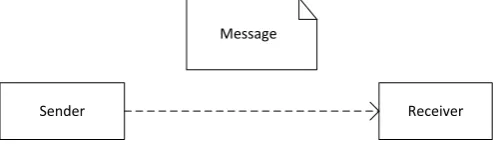
from asenderto areceiver. Figure 2.1 shows how a simple message is sent.
Pro-grammers do not directly access messages in Co-op, instead, messages
gener-ated by Co-op can be manipulgener-ated using bindings and constraints. Properties
of messages can be made accessible in method bodies usingimplicit parameters.
These messages, bindings, constraints, and implicit parameters will be elabo-rated on in the following sections.
Co-op/III uses classes and objects, just like e.g. Java. However, the core lan-guage is class-based, not object-oriented [21], and does not support inheritance
Message
[image:10.595.174.423.661.733.2]Sender Receiver
Figure 2.1: Simple message send.
(which we consider a composition operator) as a built-in concept. There are no global variables or methods in Co-op. Also, Co-op/III provides no access modifiers for classes, fields or methods (e.g. protected, private, public). Every member in a class is considered public. Classes in Co-op can have the following members:
Variables are used to define fields, similiar to languages such as Java. Variables can also be local to methods.
Methods are used to define operations on instances of classes, again similar to languages such as Java.
Bindings are used to rewrite messages.
Constraints are used to provide a binary relationship between binding classes1.
For example, they can be used to provide an execution order between two binding classes.
Variables are used to define fields. Fields in Co-op are scoped per object, there is no concept of class fields. All variables are typed dynamically in Co-op. The reason for this is that composition operators can change the behavior of a Co-op class. For example, composition operators can be used to change which methods can be called on an instance of a class. This makes static type checking inappropriate, as information about these modified classes is not available at compile-time. Therefore, static analysis will either be unable to guarantee type safety, or it will disallow invoking methods that it can not determine to be avail-able at compile-time. A variavail-able definition in Co-op is shown in listing 2.1 on line 2, and assigment to a variable is shown on line 5.
Method definitions in Co-op/III are similar to those in Java. They define a method signature and body. The same scoping rules as in Java apply. Method definitions in Co-op differ slightly from those in Java, as Co-op allows for the definition ofimplicit parameters. These are parameters that are not passed explic-itly to a method, but instead are assigned the values of message properties. The
this-keyword in Java needs to be specified as an implicit parameter in Co-op/III. Lines 4-9 in listing 2.1 show method definitions in Co-op. Implicit parameters are described in more detail in section 2.4.
1the difference between bindings, binding classes, and binding instances will be elaborated
Co-op supports annotations on method calls as well. Listing 2.2 shows how method calls are annotated. These annotations become properties of messages. As all built-in operations are method calls (and therefore messages) as well, arithmetic operations such as +, - and * can be annotated as well.
Messages, bindings and constraints will be elaborated on in the following sections.
1 classsomeClass {
2 varsomeVariable;
3
4 methodsetSomeVariable[this](someVariable) {
5 this.someVariable = someVariable;
6 }
7 methodgetSomeVariable[this]() {
8 returnthis.someVariable;
9 }
10 }
Listing 2.1: A simple class definition in Co-op/III
1 someVariable.@ParameterlessAnnotation someMethod();
2 someOtherVariable.@ParametrizedAnnotation(parameter) someOtherMethod(); Listing 2.2: Annotated method calls
2.1
Messages
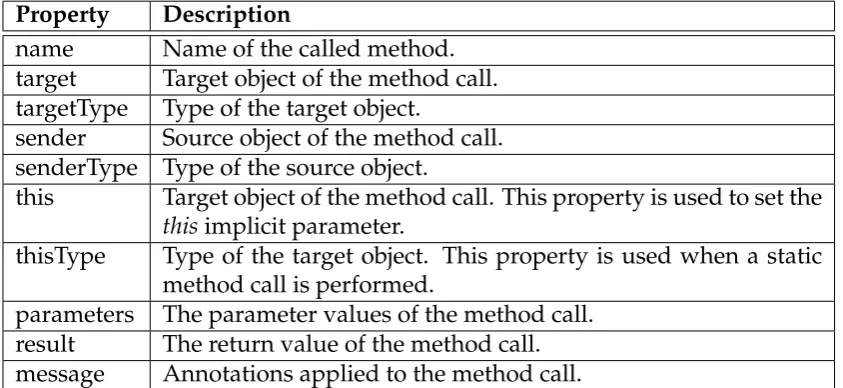
In Co-op/III messages are an abstraction of the concept of method invocation. Each method invocation in Co-op/III initially generates one message, that con-tains information about the sender of the message (i.e. the caller of a method), the target of the message (i.e. the receiver object, as well as the name of the called method), the passed parameters, and afuture2-like object [7] for the return value
of the called method. Table 2.1 gives an overview of common message proper-ties.
There are no syntactical elements in Co-op/III just to handle messages, as there is no explicit representation of messages in the language.
2In short, a future (or promise) is an object that acts as a proxy for a computation that is
Property Description
name Name of the called method.
target Target object of the method call.
targetType Type of the target object.
sender Source object of the method call.
senderType Type of the source object.
this Target object of the method call. This property is used to set the
thisimplicit parameter.
thisType Type of the target object. This property is used when a static
method call is performed.
parameters The parameter values of the method call.
result The return value of the method call.
[image:13.595.88.510.89.283.2]message Annotations applied to the method call.
Table 2.1: Message properties
2.2
Bindings
Bindings are used to rewrite messages. Bindings consist of aselectorandrewrite
rules. The selector is used to match a binding to a specific message. The rewrite
rules are then used to rewrite certain properties of a message, and generate a
newmessage with the rewritten properties.
1 bindingmyBinding = (mySelectorExpression) {
2 // rewrite rules
3 }
Listing 2.3: Binding syntax
A bindings is always a member of a class, and, as such, can access any other member of that class. It is important to note that for each instance of a class, a separate instance of a binding defined in that class exists. We call
this instance the binding instance. When we consider the definitions in
list-ing 2.4, we can distlist-inguish between MyClass.myBindlist-ing, which is a binding
class, and myObject.myBinding, which is a binding instance. The difference is
that MyClass.myBinding refers toall instances of myBinding, while myObject
.myBinding only refers to the particular instance of myBinding that is part of the myObject object.
1 classMyClass {
2 // other members
3 bindingmyBinding = (mySelectorExpression) {
4 // rewrite rules
5 }
7
8 // an instance of MyClass
9 varmyObject = MyClass.new();
Listing 2.4: Binding classes and instances
Binding instances can be activated and deactivated programmaticaly. List-ing 2.5 shows this. By default, bindList-ing instances are not active, so after defini-tion they have to be activated to have any effect.
1 // binding activation
2 myBinding.activate();
3
4 // binding deactivation
5 myBinding.deactivate();
Listing 2.5: Binding activation and deactivation
2.2.1
Selectors
Each binding instance uses aselectorto determine to which messages it applies.
Selectors are binary expressions over the properties of messages. Selectors sup-port the binary operations shown in table 2.2. Listing 2.6 gives an example of a selector expression.
matching type operators lhs rhs
lazy &, | object object
normal ==, !=, <, >, <=, >= object object
annotation presence @==, @!= message annotation matching
[image:14.595.93.506.467.579.2]expression
Table 2.2: Selector operators
1 bindingmyBinding = (name == "a" &message@== @MyAnnotation) {
2 // rewrite rules
3 }
Listing 2.6: Binding classes and instances
2.2.2
Message rewriting
Message properties are rewritten using rules. The rules can be used to either as-sign a new value to a property, or, in the case of annotations, to add or remove annotations. Assignments always have a message property on the left-hand side and an expression on the right-hand side. The annotation operations
al-ways have the keyword message on the left-hand side, and an expression that
returns an annotation on the right-hand side. Examples of rewrite rules are given in listing 2.7.
1 // assignment of a new value to a property
2 messageProperty = newValue;
3 // assignment of the value of an existing message property
4 parameters =message.result;
5
6 // adding an annotation
7 message@+= @MyAnnotation;
8 // removing an annotation
9 message@−= @MyOtherAnnotation;
Listing 2.7: Message rewrite rules
Similar to selectors, rewrite rules can call methods on the object containing the binding. The same caveat as with method calls in selectors applies.
2.2.3
Default binding
The default binding is used to perform the final step in delivering a message to its target object. The execution of the default binding for a given message causes the method represented by that message to be executed. The default binding is applicable whenever the current message represents a method that exists on an existing object3. The default binding cannot be disabled, and is always active.
3Te Brinke [18] elaborates on this in more detail. Summarizing, the default binding selector
2.3
Constraints
Constraints are used to express the relations between binding classes that ap-ply to the same message. The constraints used in Co-op/III are based on the constraints as implemented in Co-op/II [18]. The constraints in Co-op/II are in turn based on the model of constraints as presented by Nagy [14].
As the constraints of Co-op/III are derived from Nagy’s model for con-straints at shared join points, we will first discuss Nagy’s model. Afterwards, the model used by Co-op/III will be discussed, and differences between the models will be elaborated. It is interesting to see how these models are differ-ent, and what the consequences of these differences are.
2.3.1
Nagy’s model of constraints
In Nagy’s model, constraints apply to actions. Actions represent behavior that
is executed at ajoin point [12]. Nagy distinguishes betweenaction presence and
action execution. An action is present at a join point whenever, before the
evalu-ation of any constraints, its behavior will be executed. An action is said to have been executed whenever the behavior it represents has actually been executed. Using constraints, both the presence and execution of actions can be controlled.
Whenever an action in Nagy’s model is executed, it may have a Boolean
resultvalue. These result values are independent of the return type of the action,
and indicate if the execution of an action was successful. In this discussion we are only concerned with this result value, and not the return value of an action. When an action does not have a Boolean result value, Nagy considers the result to bevoid. An action that has no result (i.e. the result of the funtion is void) is considered to have been executed4.
Nagy defines three types of constraints:
• Structural constraints specify what actions can be present at a shared join
point.
• Ordering constraints specify a partial order of execution of actions.
4The absence of a result has some consequences for constraints, which will be discussed later
• Control constraints specify conditional execution of actions.
Ordering and control constraints are also calledbehavioral constraints. They are similar to the constraint types in Co-op. As Co-op does not support structural constraints, we will not discuss those further.
Nagy’s model defines one ordering constraint, thepre-constraint. This
con-straint is used to specify a partial ordering between actions. The semantics are as follows:
pre(x, y) – Actions x and y are executed in an order such that action y is never executed before action x. Therefore, action y must be executed after action x has been executed. This constraint is not transitive.
Control constraints in Nagy’s model have the following form: constraint
(condition, constrained action). Thecondition-part of the constraint is represented
by either a single action, or a Boolean expression composed of actions and
log-ical connectors (AND, OR and NOT). When using a Boolean expression, each
action in it has to have a result value of eithertrueorfalse, i.e. methods without a result are not allowed in such expressions. Control constraints use the result values of the actions specified in theconditionto control the execution of the
con-strained action. It is important to note that this automatically specifies a partial
ordering for the execution of actions as well, as the result values of the actions
in the condition must be known (and therefore the actions must be executed)
before theconstrained actioncan be executed.
Nagy defines two control constraints, thecondand theskip-constraint:
cond(x, y) - Action y can only be executed if the result value of expression x is true. For this constraint a result value of void is considered to be false, i.e. when the result of x is void, y will not be executed.
skip(x, y, R) - The execution of action y is skipped, and action y is marked as
executedwith result value R, if the result of expression x is true. R
substi-tutes the original return value of y only if y is skipped. This constraint is not transitive.
con-straints. This means that, whenever an action that is part of thecondition5 is not
present at the join point, the execution of theconstrained action is not allowed.
For example, consider a constraintpre(x, y), wherexand yare actions. Then, if actionx is not present at the join point, the execution of actionyis prohibited.
Conversely,soft constraints allow for the absence of an action in the condition
of a constraint. To support soft constraints, Nagy definessoft converter functions. These functions substitute a return value whenever an action is absent. There are three soft converter functions6:
%(action) - ifactionis absent, the result valuevoidis substituted. Short notation: %action.
%t(action) - ifactionis absent, the result valuetrueis substituted.
%f(action) - ifactionis absent, the result valuefalseis substituted.
As an example, consider the constraint pre(%x, y), where x and y are actions.
Now, if actionxis not present at the join point, the soft converter function will
produce avoidresult and actionxwill be considered as executed anyway.
Con-sequently, actionyis allowed to execute as well. Note that whether a constraint
ishardorsoft, presence of theconstrained actionis not required.
When dealing with multiple constraints that apply to the same action, Nagy states that certain precedence rules must be followed. The constraints should be evaluated in the order pre, skip, cond, but it is not made explicit why this ordering is important. However, it can be partially deduced from the semantics of the constraints.
Let us assume that the constraints arehard. Futhermore, we know that the
condandskipconstraints require the execution of actions in the condition before the execution of the constrained action, and thus they specify a partial ordering.
Consider the ordering of thehard skip,preandcond-constraints. The
impor-tant difference is that the cond-constraint can actually prevent an action from
having a result value, while the skip-constraint ensures that there is a result
value, even when theconstrained actionis not actually executed. The implication
5We consider the first argument of the pre-constraint to be the condition as well, for the
purpose of this discussion.
6Nagy also defines a hard converter function (#), but as constraints are hard by default in
of this is that, if we evaluate cond-constraints beforeskip-constraints, the cond -constraint can ‘violate’ the hardness of the skip--constraint by removing one or more of the actions in its condition. For example, if we have the constraints
cond(a,b) and skip(b,c,F)7, then, if a evaluates to false, b will not be executed at
all. When this happens, b will have no result value, and the skipwill fail (i.e.
c will not be executed and have no result value). When evaluatingskipbefore
cond, this will not be an issue, as a skip will always provide a result value for
its constrained action. When acond-constraint does not remove its constrained
action, it can be executed before askipconstraint without any problem. The
rea-soning for thepreandcondconstraints is the same. However, as askiporprecan
always go beforecond, andcondonly sometimes before askiporpre, evaluating
skipandprebeforecondis the most convenient solution.
It is unclear why the pre constraint has to be evaluated first. Nagy does
not provide a justification for this choice. The algorithms provided by Nagy simply evaluate thepre-constraints first, but there is no reason why they cannot be evaluated last.
In summary, there are two reasons for needing precedence rules for constraints in Nagy’s model:
N1: Both the ordering and control constraints specify a partial ordering of ac-tions, and the control constraints require this ordering.
N2: The fact that the constraints in the Nagy model are hard, and the cond-constraints can prevent a result value from being generated.
When we also take into consideration soft constraints, the issue with cond
described above can be resolved by using either the %t or %f soft converter
functions in the pre and skip-constraints. When cond-constraints then remove
the presence of actions, their results will be replaced by either trueorfalse,
re-spectively, when used in acondition. Note however, that this may have
conse-quences for the semantics of a program.
2.3.2
Co-op/III constraints
Now we first discuss the semantics of Co-op/III constraints, and relate them to Nagy’s model. Then we will briefly discuss the syntax of constraints in Co-op/III.
Semantics
Each constraint in Co-op/III expresses a binary relation betweenbinding classes.
Co-op provides two categories of constraints: ordering and control constraints.
As Co-op/III constraints apply to entire binding classes, and not individual in-stances, we consider the actions here to represent entire binding classes. In
con-trast to Nagy’s model, the actions in the Co-op model do not have aresultvalue.
In Co-op, we do not need this special result value for actions. As discussed by Te Brinke [18], binding presence and success in Co-op are closely related, and we can consider them identical for the purpose of constraints in Co-op. As a conse-quence of this, control constraints influence only the application of actions, but
do not impose an ordering on the actions, as they do not require theconditionto
have executed to determine aresultvalue. This is in contrast to Nagy’s model,
where control constraints impose a partial ordering as well.
We now discuss the semantics of Co-op/III constraints in detail. We will
use the Greek letters α, β, and γ to refer to binding instances, and the Roman
lettersA,B, andCto refer to the binding classes of these instances, respectively. Furthermore, unless we specify otherwise, we assume every binding instance of a binding class is applicable. Note that, as constraints apply to binding classes, and not to specific binding instances, there is no need for a distinction between constraint classes and instances.
Co-op/III provides the following ordering constraints:
primitive pre(A, B) (short notation: p_pre) orders the application of binding in-stances in such a way that allβ ∈Bare applied after allα ∈Aare applied. This constraint is not transitive. Assume we have defined the constraints
p_pre(A, B) andp_pre(B, C). Then ifα, β, and γ are all applicable, the
ap-plication order of the bindings would be α → β → γ. However, if no
γ is undefined. It could be either α → γ orγ → α. The semantics of this constraint are very similar to the softpre-constraint of the Nagy model.
pre(A, B) has semantics similar top_pre(A, B), but is transitive. Assume we have defined the constraintspre(A, B) and pre(B, C). Then if α, β, andγ are all
applicable, the semantics are the same as those of p_pre. However, if no
bindingβ is applicable, the application order is guaranteed to beα→γ.
Control constraints in Co-op/III take the same form as control constraints in
Nagy’s model. They have the formconstraint(condition, constrained action).
How-ever, the condition in a Co-op/III is always a single action, and the condition is evaluated based on the presence of that action. This is in contrast to Nagy’s control constraints, where a condition can be a Boolean expression. While this makes the constraint mechanism of Co-op/III less expressive, Te Brinke [18] has shown that a large class of well-known composition operators can be expressed using these constraints. Co-op/III provides the following control constraints:
cond(A, B) only allows the application of β ∈ B when ∃α ∈ A such that α is applicable. This constraint is transitive by definition.
primitive skip(A, B) (short notation: p_skip) only allows the application ofβ ∈
B when@α∈Asuch thatαis applicable. This constraint is not transitive.
Assume we have defined constraintsp_skip(A, B)andp_skip(B, C), thenα
will be applied,βwill be skipped (due to the first constraint), andγwill be applied, because the condition of the second constraint is no longer satis-fied. The semantics of this constraint are very similar to theskip-constraint of the Nagy model.
skip(A, B) has semantics similar to p_skip(A, B), but is transitive. Assume we
have defined constraintsskip(A, B) andskip(B, C), thenαwill be applied,
and bothβ andγ will be skipped.
In Co-op/III we use the softpre-constraint. It is not possible to express the Co-op/IIIskip and cond-constraints in Nagy’s terms ofhard andsoft, as the se-mantics of these constraints are different. Co-op/III constraints depend on the presence of actions, and not the execution result.
Constraints of the same type are always evaluated in topological order. For
then the constraint p_skip(A, B) will be evaluated beforep_skip(B, C), because the condition of the latter constraint depends on the evaluation of the former.
At the end of subsection 2.3.1 we discussed the two reasons why Nagy’s model requires a certain order of precedence for its constraints. In Co-op/III, the first reason (N1) is not a factor, as execution order is only specified by the or-dering constraint. The control constraints merely depend on binding presence, and not on a result of executing the binding. Similarly, the second reason (N2) is no factor either, as the conditions of control constraints in Co-op/III evaluate if a binding is present, and not its result value.
As ordering and control are entirely decoupled in Co-op/III, the evaluation of precedence constraints can take place before, in-between, and after the eval-uation of control constraints, without any semantic difference. Therefore we do not explicitly define when evaluation of precedence rules has to take place.
Syntax
Constraints use the syntax as shown in listing 2.8. In this listing,constraintType
must be one of the constraints discussed in subsection 2.3.2.
1 constraintmyConstraint =constraintT ype(myBindingClass, myOtherBindingClass); Listing 2.8: Constraint syntax
Constraints, analogous to bindings, can be activated and deactivated. The syntax is similar, as listing 2.9 shows. In general, constraints should be acti-vated before the bindings they constrain are actiacti-vated, as unconstrained bind-ings might have undesirable side-effects.
1 // constraint activation
2 myConstraint.activate();
3
4 // constraint deactivation
5 myConstraint.deactivate();
2.4
Implicit parameters
Implicit parameters are parameters that are passed implicitly to a method. An
example of an implicit parameter is thethisvariable, that is commonly used in
programming languages to refer to the object enclosing the current method. In Co-op/III, implicit parameters are used to access message properties. All used implicit parameters in Co-op/III must be defined in the method definition.
List-ing 2.10 shows the definition of a methodadditionwith the implicit parameter
this.
1 methodaddition[this](varnumber){
2 //method body
3 }
Listing 2.10:Implicit parameter definition
Implicit parameters have the same scope and use as explicit parameters. Listing 2.11 shows how the addition method uses both its explicit and implicit param-eter. As can be seen, from the point of view of the method body, there is no difference between using an explicit or implicit parameter.
1 methodaddition[this](varnumber){
2 this.value = this.value + number.value;
3 returnthis.value;
4 }
Listing 2.11: Implicit parameter usage
The compiler will check if every implicit parameter used in a method body is actually defined. If this is not the case, a compile-time error will be generated.
When a method declares the use of an implicit parameter, the value of the message property with the same name as the implicit parameter is bound to that parameter. No explicit argument is provided for the implicit parameter. The caller of a method does not explicitly provide a value for the parameter.
Listing 2.12 shows how a callsite of the methodaddition on some object could
look.
1 varresult = someInteger.addition(3);
Listing 2.12: Calling the addition method
In this chapter, ALIA4J and the two prototypes of binding and constraint im-plementations that we developed are described in detail.
We can implement the prototypes entirely separately, or have them imple-ment a common interface. The advantage of using separate impleimple-mentations is that each implementation can be as expressive as possible. Using a common interface, it is easier to determine if the semantics of the implementations are equivalent. As the latter is one of our goals, we decide that the prototypes share a common interface. Test applications are programmed only against this in-terface, the specific prototype implementation is hidden from the application. Furthermore, the prototypes share some functionality, such as the classes repre-senting messages and selector expressions. The dependencies between applica-tions and the prototypes are shown in figure 3.1.
The two prototypes take different approaches. The tree-based prototype re-sembles the approach taken in Co-op/II [18] by generating a tree of messages, recursively applying bindings and constraints to an initially generated message. This leads to a tree with messages that should be deliverable to objects at its leaves. These leaves are then ’executed’ by the default binding.
The ALIA4J-based protoype is very close to the conceptual model of Co-op/III, where each applied binding generates a new message dispatch. It uses ALIA4J attachments for its implementation of bindings, and uses the ordering and composition mechanisms of ALIA4J to implement constraints.
The rest of this chapter is structured as follows: in section 3.1 we give a short overview of ALIA4J. In section 3.2 we describe the modules that are shared by both prototypes, and the interface both prototypes implement. Finally, in
sec-tions??and??we discuss the tree-based and ALIA4J-based prototypes
respec-tively.
Runtime
Public API / Common prototype functionality
TreePrototype AliaPrototype Test application
[image:25.595.208.387.89.311.2]Application Classes
Figure 3.1: Overview of dependencies between prototypes and ap-plications
3.1
ALIA4J
The Advanced-dispatching Language Implementation Architecture for Java (ALIA4J) approach [2] provides a meta-model for dispatching as a high-level intermedi-ate language. It also supplies a framework for execution environments for the intermediate representation, and a visual debugger for programs that use the advanced-dispatching meta-model of ALIA4J.
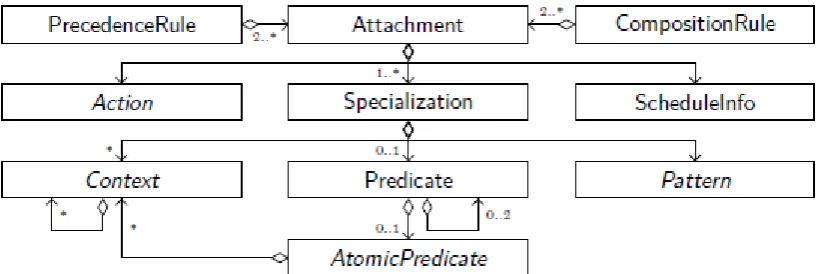
ALIA4J’s metamodel is captured in the Language-Independent Advanced-dispatching Meta-model (LIAM). The entities in LIAM capture the core con-cepts underlying various dispatching mechanisms in a fine-grained manner. Figure 3.2 gives an overview of the meta-model entities and their relations. Most of the entities in this meta-model are abstract Java classes that can be re-fined. Refinement of these entities is often necessary when mapping a language to LIAM. When an appropriate default is not available, refinement is required to define language-specific semantics. The only exceptions are the Attachment, Specialization and Predicate entities, since their function is only to group other meta-model entities together. The meta-model entities fulfill the following roles:
Pattern Patterns are used to quantify over the signatures of dispatch sites1.
1Dispatch sites are points in the execution flow of a program where a dispatch is performed.
Figure 3.2:The LIAM meta-model of advanced dispatching.
Context The context entity models runtime context that is available during dis-patch, such as argument values or the receiver object.
Atomic Predicate Atomic predicates can be used to test the current context dur-ing a dispatch. Atomic predicates are parametrized usdur-ing Context entities.
Predicate Predicates are used to compose multiple atomic predicates together. They are trees where the inner nodes are conjunctions or disjunctions, and the leaves are (possibly negated) atomic predicates. The tree represents a Boolean formula in negation normal form.
Action After evaluating all predicates at a dispatch, the Action entity is used to define the actions that must be performed at a dispatch, such as calling a method or throwing an exception.
Specialization Specializations are used to select specific dispatches by associ-ating Patterns with Predicates. In addition a specialization has a list of Context entities. These Context entities determine which runtime values are to be exposed to the Actions at the selected dispatches.
Attachment and Schedule Information Specializations are associated with an Action by the Attachment meta-model entity. Schedule information deter-mines when the Action should be executed in relation to the dispatch (i.e. before, after, around).
defines how Attachments should be composed at a shared dispatch. This can be used to define for example mutual exclusion or overriding.
ALIA4J provides a framework for execution environments, Framework for Im-plementing Advanced-Dispatching Languages (FIAL), that defines workflows that are common to all execution environments that can execute LIAM models. Based on this framework, ALIA4J provides the following execution environ-ments:
NOIRIn NOIRIn (Non-Optimizing Interpretation-based Reference Implemen-tation) is an interpreter for programs using LIAM models. It replaces ev-ery dispatch site in the executing program with an invocation to a callback that evaluates the appropriate attachments.
SiRin SiRIn (Site-based Reference Implementation) is a portable compile-time execution environment that inserts dispatch logic at each dispatch site.
SteamloomALIA is an extension of the Jikes Research Virtual Machine that rei-fies dispatches during Just-In-Time compilation. It does not always gener-ate bytecode at each dispatch, but instead it can directly genergener-ate (poten-tially optimized) machine code using the Jikes RVM JIT compiler.
The NOIRIn execution environment is usually the most up-to-date execution environment for ALIA4J. It is the execution framework we use for the develop-ment of the prototypes.
3.2
Common prototype features
While both prototypes take a different approach in their implementation, they share a common interface for the Co-op/III language elements. Also, the pro-totypes share some parts of the implementation. The interfaces and shared
elements are grouped together in the common package of the prototype. This
3.2.1
Design goals
While we do not implement actual code generation from Co-op/III code to Java code, we do want to make such generation relatively easy. Therefore, the first design goal for the package is to make mapping Co-op/III language elements to the prototypes easy.
The second design goal is to support testing and comparing the semantics of the implementations, to support our problem statement.
The third design goal of this package is to maximize the reuse of code when possible, while still providing flexibility in the prototype implementations.
3.2.2
Shared interfaces
To support the first two design goals, we provide a set of shared interfaces.
They mainly serve to define and create thebindingsandconstraintsas described
in chapter 2, while hiding the prototype implementations. The goal is to ensure that when generating code or creating test cases, no knowledge about these implementations is needed.
This goal is achieved by developing interfaces for operating the bindings and constraints, as well as interfaces forfactories[8] to obtain implementations of the binding and constraint interfaces. The bindings, constraints, and their
fac-tories are contained in the subpackagescommon.bindingsandcommon.constraints.
Bindings and the binding factory
To define an appropriate interface for bindings, we have to consider the oper-ations that are applied to bindings from a Co-op/III program. From chapter 2 we know that a binding definition consists of the following:
• a selector expression;
• a set of rewrite rules.
• activate;
• deactivate.
Once a binding is defined, the selector expression and rewrite rules cannot be modified anymore. Furthermore, a binding needs both a selector and a set of rewrite rules to be in a consistent state. This makes them likely candidates as parameters for the constructor of a binding. As interfaces in Java do not support the definition of constructors [10], we cannot guarantee that a selector expres-sion is provided when directly creating a binding instance. A unified way to provide a selector expression and rewrite rules must be enabled in a different manner. For the selector expression, we decided to make this a parameter for the factory method to create a binding. We will discuss this in a moment. For the rewrite rules, we moved these to the factory method as well. The rewrite
rules can be nicely expressed using a Java Map. Thekeysof the Map represent
the properties of the message that are to be rewritten, and thevaluesare the ex-pressions for the new values of the properties. However, providing a method that takes a Map of rewrite rules requires the use of some unwieldy Java syntax. Modifying the rewrite rules repeatedly to develop test cases proved to be rather error-prone, so we decided to also add a method to add a single rewrite rule to
our interface for bindings. Theactivateanddeactivateoperations are candidates
for the interface as well. As activate and deactive are only invoked on existing instances of bindings, they are added to the binding interface. The interface for bindings can be seen in listing 3.1.
1 public interfaceBinding {
2 publicBinding activate();
3 publicBinding deactivate();
4 publicBinding addRewriteRule(finalString property,
5 finalUnaryExpression newValue);
6 }
Listing 3.1: The Binding interface.
Note that each operation returns an instance ofBinding. Implementations of this
interface must returnthis(i.e. the binding that was modified by the operation).
This technique is calledfluent interfaces [6]. We also use fluent interfaces for the constraint-interface and messages later on. Fluent interfaces lets programmers (or code generators) write more concise and elegant code. An example of it can be seen in listing 3.2
2 )
3 .addRewriteRule("name",newObjectConstantExpression("after"))
4 .addRewriteRule("target",newObjectConstantExpression(receiver))
5 .activate();
Listing 3.2: The fluent Binding interface in action
The implementation of theBindingFactoryinterface is responsible for the
cre-ation of new bindings. In addition, it provides access to the default binding. The BindingFactory interface is shown in listing 3.3.
1 public interfaceBindingFactory {
2 publicBinding getDefaultBinding();
3 publicBinding createRewriteBinding(
4 finalString name,
5 finalBinaryExpression selector,
6 finalCoopObject containingObject);
7 publicBinding createRewriteBinding(
8 finalString name,
9 finalBinaryExpression selector,
10 finalMap<String, UnaryExpression> rewriteRules,
11 finalCoopObject containingObject);
12 }
Listing 3.3: The BindingFactory interface
As described in chapter 2, binding instances are part of a binding class. The
nameargument that is provided is the name of this binding class. As discussed
earlier, the selector expression is passed as an argument as well. Furthermore,
binding instances often require access to the object that contains them. The
con-tainingObject argument is used to provide a reference to this containing object
to the binding instance.
The common.bindingspackage also contains a class to detect2 infinite
recur-sion. It maintains a stack of messages currently being processed, and generates a notification whenever a message is generated that was already on the stack. Such an event indicates a likely case of possibly infinite recursion. Prototype implementations can determine what to do with such an event, for example, they can decide to warn the programmer, or stop processing of messages for the specific method call that generated the initial message.
Constraints and the constraint factory
The motivation for theConstraintinterface is largely the same as those for bind-ings. Again we consider which operations we need to support. Constraints always operate on two binding classes, and these binding classes are supplied to a constraint when it is defined. As such, the creation of constraints is best facilitated by a factory. The only operations supported by constraints are simi-lar to that of a binding, i.e. activate anddeactivate. This makes the interface for constraints very simple, as listing 3.4 shows.
1 public interfaceConstraint {
2 publicConstraint activate();
3 publicConstraint deactivate();
4 }
Listing 3.4: The Constraint interface
Co-op/III supports 5 types of constraints, and each of these constraints requires a factory method. The ConstraintFactory-interface is shown in listing 3.5. Each factory method refers to the binding classes that it constrains by name.
1 publicConstraint createCondConstraint(
2 finalString prerequisiteBinding,
3 finalString conditionalBinding);
4 publicConstraint createPrimitivePreConstraint(
5 finalString preceedingBinding,
6 finalString preceededBinding);
7 publicConstraint createPreConstraint(
8 finalString preceedingBinding,
9 finalString preceededBinding);
10 publicConstraint createPrimitiveSkipConstraint(
11 finalString prerequisiteBinding,
12 finalString skippableBinding);
13 publicConstraint createSkipConstraint(
14 finalString prerequisiteBinding,
15 finalString skippableBinding);
16 }
Listing 3.5: The ConstraintFactory interface
3.2.3
Shared functionality
Aside from the common interfaces, the prototypes share functionality as well. The CoopObject class is necessary to implement the dynamic typing in
Co-op/III. The classes in the common.expressions package implement selector
interception mechanism and Co-op/III messages. Finally, the common.graph
package provides the implementation of a directed graph and some operations on such graphs that are used by both prototype implementations.
The CoopObject class
The CoopObject class (contained in thecommonpackage) is used to simulate
dy-namic typing in Co-op/III. The Java language is statically typed [10]. However, by ‘abusing’ the inheritance mechanism in Java, and using the fact that we use
code generation3, we can emulate dynamic typing.
As a statically typed language, Java needs to know at compile-time which methods can be called on a certain type. As discussed in chapter 2, Co-op/III lets programmers modify the methods that can be called on a type at runtime. To overcome this incompatibility, we introduce the CoopObject class. For a
given Co-op/III program, this class contains a stub method for every method
that is called by said program. These stub methods throw a runtime exception when invoked.
Now, by having all classes extend the CoopObject class, overriding just the methods they implement, we can emulate dynamic typing. Listing 3.6 gives an example of this concept. This approach cannot be used to emulate access to instance fields in a dynamic language (as they cannot be overridden). However, as we discussed in chapter 2, we always access instance fields through getters and setters, so this is not an issue. It is now possible to call any method defined in CoopObject on instances of SomeClass and SomeOtherClass, without getting compile-time errors. At runtime, when a class does not actually implement the method, a runtime exception gets thrown and the program will terminate.
1 // CoopObject.java
2 public classCoopObject {
3 // stub method
4 publicCoopObject someMethod() {
5 throw newRuntimeException("Method not implemented");
6 }
7
8 // stub method
9 publicCoopObject someOtherMethod() {
10 throw newRuntimeException("Method not implemented");
11 }
3The prototypes described in this thesis do not actually use code generation, so some manual
12 }
13
14 // SomeClass.java
15 public classSomeClassextendsCoopObject {
16 publicCoopObject someMethod() {
17 // actual implementation
18 }
19 // someOtherMethod() is not implemented here!
20 }
21
22 // SomeOtherClass.java
23 public classSomeOtherClassextendsCoopObject {
24 // someMethod() is not implemented here!
25 publicCoopObject someOtherMethod() {
26 // actual implementation
27 }
28 }
Listing 3.6: Emulating dynamic typing using the CoopObject class
Expressions
Thecommon.expressionspackage contains all classes necessary to define selector
expressions. Selector expressions are binary expressions that are used to select messages.
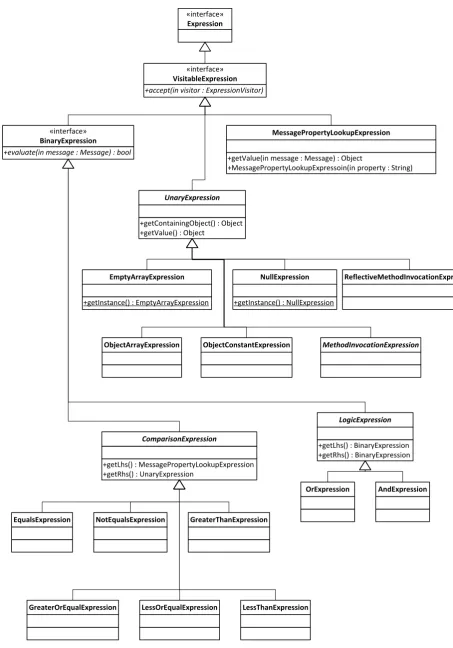
We implemented the selector expressions as trees. Each inner node in the tree is a binary node (i.e. it has two children). Binary nodes represent the op-erators as discussed in subsection 2.2.1. The leaf nodes of the tree represent operands: either message properties or unary expressions (i.e. a constant prim-itive or composite value, a field lookup, or a message property lookup). Listing 3.7 gives an example of an expression definition.
1 // this represents the following Co−op/III selector expression:
2 // name == m && targetType == ReceiverA
3 Expression ex =
4 newAndExpression(
5 newEqualsExpression(
6 newMessagePropertyLookupExpression("name"),
7 newObjectConstantExpression("m")),
8 newEqualsExpression(
9 newMessagePropertyLookupExpression("targetType"),
10 newObjectConstantExpression(ReceiverA.class)));
Listing 3.7: Selector expression definition
theBinaryExpressioninterface (Listing 3.8). Theevaluate-method defined by this interface requires the implementor to apply the operator represented by the binary node to its subexpressions and return the TernaryValue result.
1 public interfaceBinaryExpressionextendsVisitableExpression {
2 publicTernaryValue evaluate(Message message);
3 }
Listing 3.8: The BinaryExpression interface
Similarly, each unary expression implements the UnaryExpression interface
(Listing 3.9). The getValue-method of this method requires the implementor to
return the value encapsulated by the node.
1 public interfaceUnaryExpressionextendsVisitableExpression {
2 publicCoopObject getValue(Message message);
3 }
Listing 3.9: The UnaryExpression interface
The prototypes might need to apply certain operations (such as transforma-tions) to the expression tree. To support this, the tree implementation supports the visitor pattern [8] through theVisitableExpressioninterface.
Most of these nodes represent the operators that can be used in expressions. Important to note are that there are two types of nodes to perform method in-vocations:
MethodInvocation can perform a non-reflective method invocation. To do so, an anonymous instance of this abstract class has to be created, and
im-plement thegetValue() method to non-reflectively call the method on the
containing object. By doing so, a new message will be generated, as dis-cussed in chapter 2.
ReflectiveMedhodInvocationExpression can perform a reflective method in-vocation on the object containing the binding instance. By performing a reflective method invocation, no message will be generated (as ALIA4J does not intercept reflective method calls).
UnaryExpressions are also used by the message rewrite rules to perform field
«interface» Expression
+accept(in visitor : ExpressionVisitor) «interface»
VisitableExpression
+getContainingObject() : Object +getValue() : Object
UnaryExpression
+getInstance() : EmptyArrayExpression EmptyArrayExpression
+getValue(in message : Message) : Object
+MessagePropertyLookupExpressoin(in property : String) MessagePropertyLookupExpression
+evaluate(in message : Message) : bool «interface»
BinaryExpression
+getLhs() : MessagePropertyLookupExpression +getRhs() : UnaryExpression
ComparisonExpression
+getLhs() : BinaryExpression +getRhs() : BinaryExpression
LogicExpression
OrExpression AndExpression
EqualsExpression NotEqualsExpression
LessThanExpression GreaterOrEqualExpression LessOrEqualExpression
GreaterThanExpression
+getInstance() : NullExpression NullExpression
MethodInvocationExpression ObjectArrayExpression ObjectConstantExpression
[image:35.595.88.542.87.736.2]ReflectiveMethodInvocationExpression
Messages and message handling
The common.messaging package contains the Message class, used to represent
messages, as well as the MessageGenerator class and MessageHandler interface
that are used to generate the messages.
TheMessageclass uses a Map to implement message properties. It provides
methods to retrieve the value of a property, to rewrite properties, and to remove properties. Adding a property to a message is done by performing a rewrite on a non-existant property.
The interface for the Message class is shown in listing 3.10. Note that the in-terface is fluent again. Also, instances of message are immutable. The message class has a private constructor. To create a new message, the empty message is ‘rewritten’, resulting in a new message with the desired properties. An example of message creation is shown in listing 3.11.
1 public final classMessage {
2 // retrieve the empty message
3 public static finalMessage empty();
4
5 publicObject readProperty(finalString name);
6 publicMessage rewriteProperty(finalString name,finalObject newValue);
7 publicMessage removeProperty(finalString name);
8
9 public booleanhasProperty(finalString name);
10 publicMap<String,Object> getProperties();
11 }
Listing 3.10: The Message class
1 // create a message with the properties ’name=m’ and ’targetType=SomeClass’
2 Message myMessage = Message.empty()
3 .rewriteProperty("name", "m")
4 .rewriteProperty("targetType", SomeClass.class);
Listing 3.11: Message creation
1 public interfaceMessageHandler {
2 public voidhandle(Message message);
3 }
Listing 3.12:Message handler interface
Message creation is only performed by an instance of theMessageGenerator
call, it creates an instance of the Messageclass with the properties as discussed in section 2.1.
For each method call, an emptyResultWrapperobject is created and set as the
resultproperty of the message. The MessageGenerator maintains a reference to
thisResultWrapperobject. This is necessary to be able to return the result of the
method call to the caller when the message has been processed.
TheMessageGeneratorpasses the message on to thehandlemethod of the
Mes-sageHandler implementation that was passed to the MessageGenerator when it
was constructed. The MessageHandler interface is shown in listing 3.12. The
MessageHandlerthen further processes the message. Once theMessageHandleris
done processing the message, it will return, and theResultWrapperwill contain
the final return value of the method call. This return value is then returned to the caller.
In the prototype this interception is done using an ALIA4J attachment (see section 3.1 for details). In this case the choice for ALIA4J for message reification was done out of convenience: ALIA4J is suitable for the task, and we are already using it for one of our prototype implementations. Message reification could also be performed using other tools or frameworks, such as AspectJ [20]. A more mature framework, that is not performing interpretation, could provide performance benefits.
Graphs
The common.graph package provides the implementation of a directed graph.
The graph package supports a graph with vertices containing Java objects, and both labeled and unlabeled edges. It also supports the calculation of the transi-tive closure of a graph, using the Floyd-Warshall algorithm [4].
3.3
Tree-based prototype
pat-Node<T>
+accept(inout visitor : MessageNodeVisitor) +MessageNode(inout value : Message)
MessageNode
+accept(inout visitor : MessageNodeVisitor) RewriteBindingNode
+accept(inout accept : MessageNodeVisitor) DefaultBindingNode
+visit(inout node : RewriteBindingNode) +visit(inout node : DefaultBindingNode)
MessageNodeVisitor
+visit(inout node : RewriteBindingNode) +visit(inout node : DefaultBindingNode)
DefaultBindingVisitor
+visit(inout node : RewriteBindingNode) +visit(inout node : DefaultBindingNode)
[image:38.595.137.457.84.432.2]BindingAndConstraintVisitor
Figure 3.4: treeprototype.tree package class hierarchy
tern [8]. Using this approach, the binding and constraint semantics as described in chapter 2 are implemented. The remainder of this section discusses the im-plementation details of this protoype, as well as the design decisions that were made.
3.3.1
Overview of message processing in the tree-based
proto-type
The tree used by this prototype is implemented in thetreeprototype.treepackage.
The class hierarchy for the most important classes (with their most important methods) in the tree package is shown in figure 3.4.
Every node in the tree encapsulates one message. RewriteBindingNodes
that has an implementation of the appropriate method). The root node and
in-termediate nodes of a tree are alwaysRewriteBindingNodes, and the leaves of the
tree are usuallyDefaultBindingNodes4.
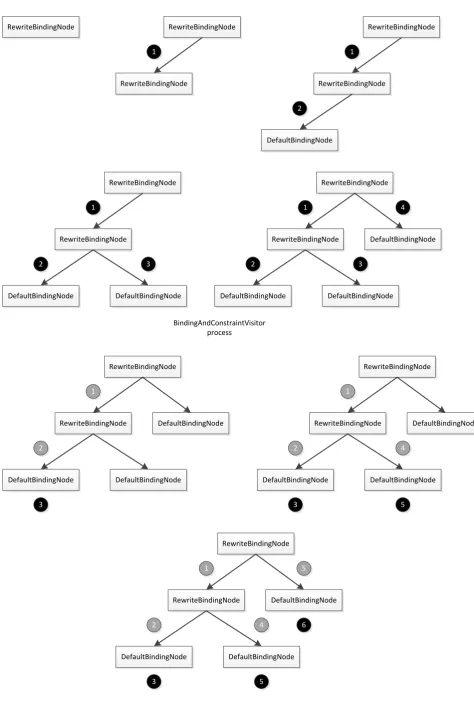
Initially, a message tree consists of only oneRewriteBindingNode. This initial
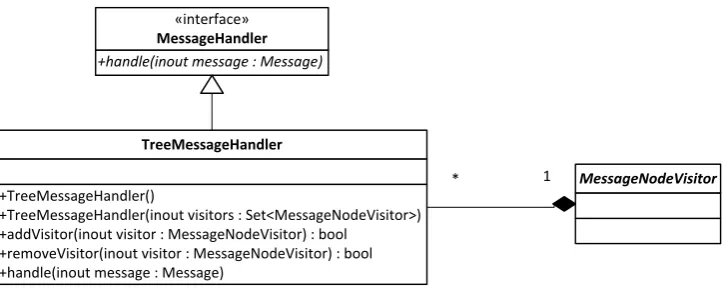
node is generated by the TreeMessageHandler, which will be discussed shortly.
This single node is visited by the BindingAndConstraintVisitor. Whenever this
visitor encounters a RewriteBindingNode, it applies the applicable constraints
and bindings, creating new child nodes. It then visits each of these child nodes depth-first, eventually generating a tree with the properties mentioned above
(intermediateRewriteBindingNodes, andDefaultBindingNodes at the leaves). Once
this process is completed, an instance of theDefaultBindingVisitorvisits the tree.
When this visitor encounters aRewriteBindingNode, it simply visits the children
of said node. When it encounters aDefaultBindingNode, it delivers the message
by reflectively invoking the method that is represented by the message. It does so for all DefaultBindingNodes in the tree, in depth-first order. Figure 3.5 illus-trates this process.
Details about how theBindingAndConstraintVisitorexactly interacts with the
classes of thetreeprototype.bindingsandtreeprototype.constraints packages is dis-cussed in subsections
It is possible to implement other visitors, for example, to generate a graph-ical representation of the message tree for debugging purposes. Supporting
new node types is also possible, by implementing a new subclass of
MessageN-ode. Furthermore, a new visitor needs to be defined for the new node type.
This requires creating a new subclass ofMessageNodeVisitor, as well as adding
a new visit(..) method to MessageNodeVisitor and all its subclasses. As can be
seen, adding a new node type involves modifying several existing classes, be-sides adding new subclasses. This is a known downside of the visitor pattern [8]. However, adding new node types is expected to happen only on very rare occasions, and therefore we consider this trade-off acceptable.
4The exception being when a message ends up matching no selector expressions of a rewrite
RewriteBindingNode RewriteBindingNode 1 RewriteBindingNode DefaultBindingNode 2 RewriteBindingNode 1 RewriteBindingNode RewriteBindingNode 1 RewriteBindingNode DefaultBindingNode 2 DefaultBindingNode 3 RewriteBindingNode 1 RewriteBindingNode DefaultBindingNode 2 DefaultBindingNode 3 DefaultBindingNode 4 BindingAndConstraintVisitor process RewriteBindingNode 1 RewriteBindingNode DefaultBindingNode 2 DefaultBindingNode DefaultBindingNode RewriteBindingNode 1 RewriteBindingNode DefaultBindingNode 2 DefaultBindingNode 4 DefaultBindingNode 3 3 5 RewriteBindingNode 1 RewriteBindingNode DefaultBindingNode 2 DefaultBindingNode 4 DefaultBindingNode 3 5 5 6 DefaultBindingVisitor process