http://wrap.warwick.ac.uk/
Original citation:Rytter, W. (1986) On the complexity of parallel parsing of general context-free languages. University of Warwick. Department of Computer Science. (Department of Computer Science Research Report). (Unpublished) CS-RR-075
Permanent WRAP url:
http://wrap.warwick.ac.uk/60774
Copyright and reuse:
The Warwick Research Archive Portal (WRAP) makes this work by researchers of the University of Warwick available open access under the following conditions. Copyright © and all moral rights to the version of the paper presented here belong to the individual author(s) and/or other copyright owners. To the extent reasonable and practicable the material made available in WRAP has been checked for eligibility before being made available.
Copies of full items can be used for personal research or study, educational, or not-for-profit purposes without prior permission or charge. Provided that the authors, title and full bibliographic details are credited, a hyperlink and/or URL is given for the original metadata page and the content is not changed in any way.
A note on versions:
The version presented in WRAP is the published version or, version of record, and may be cited as it appears here.For more information, please contact the WRAP Team at:
R.esearch
report
OH TnE CotupuexmY oF PRnauleu PARSING
OF GENERAL CONTEXT.FREE LANGUAGES
by
Wojciech Rytter
(RR75)
Abstract
Let T(n) be the time to recognize context-free languages on
a parallel random access machine without write conflicts (P-RAM) using
a
polynomial numberof
processors. Weassume that T(n) = Q(log n). Let P(n) be the time to compute
a
representation of a parsing tree tor strings of length nusing a polynomial number of processors. Then we prove:
P(n) = O(T(n)). A related result is
a
parallel time log ncomputation of the transitive closure of directed graphs having special structure.
Department of Computer Science
University of Warwick
@I{TEff.FREE IAI{GUAGES
Wojciech Rytter,
University of Warwick ,Department of Comp.Science
Coventry CV47AL
and
Warsaw University, Institute of Informatics
Abstract
Let T(n) be the time.to recognize context{ree languages on a parallel random access machine without write conflicts (p-nnrrrrl using a
polynomial number of processors.
we
assume that T(n) =Cl(lo6 n). Let P(n) be the timeto
compute a representation of a parsing tree for strings o_flenglll
using a polynomiai number of processors.Then we
prove:
P(n)= O(T(n)).A related result is a parallel time tog n computation of the transitive closure of directed graphs having special structure.
The problem of parsing for context-free tanguages (cfl's,shor1y) seems to be harder than the problem of recognition. lt was proved by Ruzzo [ 1 ] that
if
r'(n)
is the time to recognize cft's on a RAM (sequentially)then
the time needed to parse cfl's on a RAM is o(T'(n)logn)). we
show that when one considers parallel time then parsing is not harder than recognition(however the number of processors can grow considerably, though
Our model of parallel computation is a parallel random access machine without write conflicts (known also as a CREW p-RAM). Such a machine
consists of a number of synchronously working processors (RAM's) which
are using a common memory . No two processors can attempt to write in the same step into the same location, however many processors can read
from the same location. Such a modet corresponds to bounded fan-in
circuits.
The best algorithms for parallel general context-free recognition on a P-RAM work in log2 (n) time using o(n6) processors, see
[2,3]
(such complexity can even be achieved on much weaker models of parallelcomputations, cube connected computers and perfect shuffle computers, see
[4]).
lt is a hard open problem whether general context-freerecognition can be done in parailel time log(n) on a p-RAM.
For
unambiguous languages log n time is enough,see [5], and if the language is
a bracket cfl then the number of processors can be linear,see
[6]. Optimal (log n time and n/rog(n) processors) parartet parsing and recognition
algorithms can be constructed for one-sided Dyck languages.
The algorithms for generat context-free recognition use the parsing
matrix (to be defined later). We show that using this matrix a parsing tree
can be constructed in log (n) time using a cubic number of processors. Even
if
the
recognition does not construct the parsing matrixthen we can
construct it by executing simultaneously o(n2) parallel recognizing algorithms. The parallel time does not increase, however the number of processors should be multiplied by n2 in this case.
Throughout the paper we assume (for ease of exposition)
that the
grammars are in Chomsky normal form. Let G be a context-free grammar in
Chomsky normal form, let N , Ter, denote the set of nonterminal, terminal symbols, respectively.
we
write A - >B if the grammar has sucha
production, and
A->*w
iff the string w3
starting symbol of the grammar.
Let w=a[1]a[2]....a[n] be a given input string of length n. The recognition
problem is: decide whether A->*w, where A e N
The parsing problem is: construct a parsing tree PT.
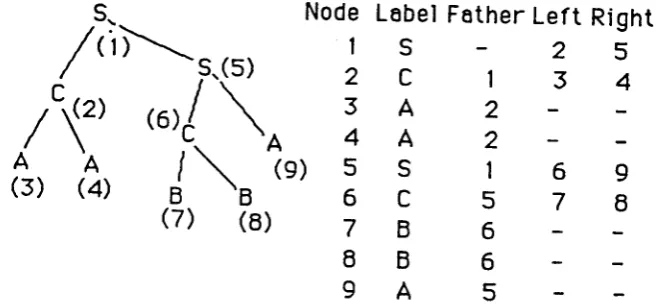
This tree has 2n-1 nodes numbered 1..2n-1. With each node x there is
associated the following information :
Father[x], Left[x],Right[x], (left and right sons, if x is not a leaf) and
Label[x] (an element of N).
The tree should satisfy locally the rules of the grammar:
Label[root]=S;
Label[x]->Label[Left[x]lLabel[Right[x]l if x is not a leaf ;
Label[x]->alil if x is the
ith
leaf, (from the left).Fathe r[Left[x]l= Father[Right[x]l=y.
It is enough to compute only the tables Father and Label. Left and Right can
be computed then easily on a P-RAM in log(n) time using a small number of
processors. On the other hand, if we have Left and Right then
this does not determine Father,
since
PT might be any directed acyclicgraph whose nonleaf nodes have outdegree 2.
The parsing table Tab is of the type array[0..n,0..n] of subsets of N,
Tab[i,i]=if icj then { A : A->.a[i+1]...a[i]]
else
s.Example.
Let G be the following grammar:
S->CS S->AS S->CA S.>DD S->AC
C->AA C->BB
D->AA D->DC
A->a
B->b.4
Let w=aabba.
The parsing table is presented in Fig.2, and the parsing tree in
Fig.1 .
S..
Node/"*r.t,
)
/'f,
G)!_\^
io&,
,X,
j
\u
tn'
:
(7) (B)
,,9
Lobel Father Left
S2
c13
A2
A2
st6
c57
B6
B6
A5
Right 5
:
9
[image:6.595.99.429.153.307.2]:
[image:6.595.146.341.415.593.2]Fig.l.Porsing tree and
its
representotionFig.2. The persing table for G end w=E6bbo.
Let G be a directed acyclic graph given by the relation
R, where R(u,v)
holds whenever (u,v) is an edge of G.
we
say that G satisfies theunique path condition
(upc,
shorily) iff for every two nodesv, u there is at most _
2
3
4
q
5
one path from u to v. (Equivalenily, one can say that G is weakly
acyclic,after removing orientation the undirected graph is acyclic). The best known upper bound to compute the transitive closure R" of
directed graphs is log2n, however if the graph satisfies UpC then it can be
improved
Lemma.
lf the directed graph G with m nodes satisfies UPC
then
the transitiveclosure of G can be computed in log(m) parallel time on a P-RAM using
m3 processors.
Proof .
Let R be the relation corresponding to a directed acyclic graph G satisfying
UPC, and V be the set of nodes. Assume that the nodes are numbered 1..m.
We say that a node is a sink iff it has outdegreezero. Let
s=
log m . Firstwe compute the tables R1[vl (corresponding to some
relations),
for g<k<s.fo,=R;
for each sink v
do
in parallel Rg[v,v]:=true;for k:=1 to s do
for
each
v1 ,v2,v3 such that R6_1[v1,v2] and Rp_1[v2,v3]do in
parallel
R1[v1 ,v3]:=true;We claim that there are no write conflicts in the above algorithm and
Rr[v1 ,v21 holds iff there is a path from v1 to v2 and v2
is a sink.
(-)
if
Rp[v,v1] and Rp[v,v2l and v, v1, vz are lying on the same path in Gthen v1=v2, for k=0..s.
This invariant implies that whenever we have Rt_t [v1 ,v2] and Rp_1
[v2,v3]
and Rp-1[v1,v2'] and Rp-1[v2',v3] then v2:v2', because
upc
guarantees thatall the nodes involved lie on the same path.
The second fact follows from our doubling technique. We are doubling the
distances between v1, v2tor
which
Rp[v1,v2] hotds , until ultimately vzbecomes a sink. The foilowing invariant can be easily proved:
(**)
lf Rp[x,yl and y is not a sink then dist(x,y)=2k(dist is the length of the path from x to y in the graph G).
we
have computed a part of R*, if y is a sink then R.(x,y)=pr[x,yl. Now wecompute
R*
for all nonsink nodes.we
introduce two relations R';, and Dp (k=0..s), represented bytwo-dimensional tables with the same names.
R'p[x,yl holds
iff
R1[x,yJ holds and y is not a sink.Dp[x,yl holds iff dist(x,y).2k*1, for nonsink nodes X,y .
Let lD denote the identity relation and . denote the composition of
relations, we consider only the nodes which are not sinks. The retations D1
can be computed using the following recurrence formula (following from
invariant (*-)):
DO= R+lD; Dk+1 =Dk+Dk.R'k*1.
we
can easily compute R'g ?nd Dg , n€xt we apply the recurrence equationlog(n) times.
fork:=1
bsdg
for each x,z do in parallel
jI
Df_t [x,z] then D1[x,z]:=true;for each x,y,z such that Dg_1[x,y] and R'p[y,zl do in parallel D1[x,z]:=true
end
There are no write conflicts here because it x,y,z are lying on the same
path and R'1[y,z] holds then y is uniquely determined by x, z (as a node lying
on the path from x to z, whose distance to z is zk \. observe that in this
algorithm Dp could be replaced by D (in fact the subscript k is not needed,
though it helps to apply the recurrence formula direcily).
Now we can compute R*=
Rs*D,
in one parallel step. This completes theproof .
Theorem
Assume that context-free recognition can be done in the parallel time
T(n) using R(n) processors of a p-RAM, and T(n)=911sg n).
Then the representation of a parsing tree (if there is any) can be
constructed in parallel time o(T(n)) using o(R(n) n2*n3) processors.
lf the recognition procedure constructs the parsing table then O(R(n)+n3)
processors are enough.
Proof .
First we construct the parsing table Tab for a given input string
w=a[1]a[2]...a[n], and a given grammar G in Chomsky normal form. This can
be done in parallel time T(n) using n2 R(n) processors. For each
A,i.j,
simultaneously we check whether A->*a[i+1 ]...atil.
lf s->"w then we start to compute a parsing tree etse we stop here, because we know that in such case there is no parsing tree.
We construct now the following acyclic directed graph
G
represented bythe relation R (the relation:to be a possible father). The set of nodes is
I
for
each
node (A,i,j),i<j,
do in parallel find ickcj, B,C such thatthere is a production A->Bc and B e Tab[i,k] and
c
eTab[k,i]; R[( B, i, k), (A, i,j)] := R[(C, k,j), (A, i,j)] :=tru e ;((A,i,i) becomes a possible father of (B,i,k),(c,k,i), the number k and nonterminals B, C can be found using a tinear number
of processors for fixed i,j,these processors coutd be organized into the tree to search
i-th
row and j-th column (simultaneously) of Tab for suitable B,C.
There can be
many k's possible, but we choose any one of them and it is then fixed ). The graph corresponding to our exampte grammar and the string aabba
is
shown in Fig.3. observe that the tree from Fig.1 corresponds to a subgraph
of this graph.
s,0,5
_
\
4,4,5
4,1 ,2 8,2,3 8,3,4
Fig.3. The groph G.
Next we compute the transitive closure R*. The graph G satisfies
upc
and
we can use algorithm from the lemma. Let vg =(s,O,n). The parsing tree
pr
consists of all nodes v such that R-(v,vg) holds .The root ofpr
is vg . TheI
function Father is computed as follows:
for
each
u, V ePT
do in parallel if R(u,v) then Father[u]:=v;The tables Left and Right can be computed in parallel time log n using the
table Father.so far the nodes are not numbered (from 1 to 2n,1) as
required, each node is a triple of the form (A,i,j) ,and all the tables have
entries indexed by such triples. The set of such triples belonging to pT can
be numbered from 1 to 2n-1 using the algorithm of Tarjan and Vishkin [ 7 ]
for preorder (or postorder) numbering of trees.This can be done also by
arranging all possible triples in any initiat order (e.g. lexicographically), and then the final number of a triple belonging to PT could be obtained by
counting the number of preceding triples which are elements of pT (using a prefix computation). lf num is the numbering obtained , then
Label [n u m (A, i,j)] :=A.
The constructed tree now satisfies all the requirements. This completes
the
proof.
LIt was proved in [5] that every unambiguous cft can be recognized in log(n)
time on a P-RAM using a polynomial number of processors. Now we can
strengthen the result of [5].
Corollary.
Every unambiguous cfl can parsed on a P-RAM in log n time using
polynomial number of processors.
Acknowledgments.
References.
11l W. Ruzzo. On the complexity of general context free language parsing
and recognition. Automata, languages and programming. Lect.Notes in
Computer Science,1979
tzl
W.Ruzzo. Tree-size bounded alternation. Journal of Comp. andSyst.Sciences 21, 218-235, 1 980
t3l
W.Rytter. The complexity of two way pushdown automata and recursive'
programs. NATO Advanced Research Workshop "Combinatorial algorithms onwords" (ed.A.Apostolico,Z.Gal i l),Spri n ger-Ve rlag 1 985
t4l
W.Rytter. On the recognition of context free languages. Computation Theory, Lect.Notes in Comp.S'cience,springer Verlag 1985tsl
W.Rytter. Parallel time log n recognition of unambiguous cfl's. Fund.of Computation Theory, Lect.Notes in Computer Science 198516l W.Rytter,R.Giancarlo. Parallel parsing of bracket and recognition of
-
input driven languages. manuscript,1985