Munich Personal RePEc Archive
Intergenerational Transfers, Lifetime
Welfare and Resource Preservation
Valente, Simone
CER ETH Zurich
3 October 2006
Online at
https://mpra.ub.uni-muenchen.de/1042/
CER-ETH - Center of Economic Research at ETH Zurich
Economics Working Paper Series
Eidgenössische Technische Hochschule Zürich
Intergenerational Transfers,
Lifetime Welfare and Resource Preservation
Simone Valente
Intergenerational Transfers, Lifetime Welfare and
Resource Preservation
Simone Valente
Center of Economic Research, ETH Zurich.
October 3, 2006.
Abstract
This paper analyzes overlapping-generations models where natural capital is owned by sel…sh agents. Transfers in favor of young agents reduce the rate of depletion and increase output growth. It is shown that intergenerational transfers may be preferred to laissez-faire by an inde…nite sequence of generations: if the resource share in production is su¢ciently high, the welfare gain induced by preser-vation compensates for the loss due to taxation. This conclusion is reinforced when other assets are available, e.g. man-made capital, claims on monopoly rents, and R&D investment. Transfers raise the welfare of all generations, except that of the …rst resource owner: if resource endowments are taxed at time zero, all successive generations support resource-saving policies for purely sel…sh reasons.
Keywords Distortionary Taxation, Intergenerational Transfers, Overlapping
Genera-tions, Renewable Resources, Sustainability, Technological Change.
JEL Codes H30, Q01, Q20
1
Introduction
Preserving intergenerational equity has become a worldwide political concern, and achieving sustainability is increasingly considered a relevant social goal. A major source of intergenerational con‡ict is represented by the intensive use of natural resources in the production process, since over-exploitation represents a threat for the ability of future generations to meet their own needs. Since Hotelling’s (1931) seminal work, economists have pointed out several potential sources of the problem: over-exploitation may result from market incompleteness, excessive competition, myopic behavior, and the lack of incentives for investment in preservation. Accordingly, public intervention may be called for either to restore e¢ciency (Toman, 1987) or sette con‡icts between intertemporal e¢ciency and intergenerational fairness (Howarth and Norgaard, 1990).1 In recent times, the attribution of property rights over natural resources has gained much attention in the policy debate. However, neither sustainability nor resource preservation are guaranteed when natural capital is private property. This result holds in general equilibrium models with in…nitely-lived agents (Pezzey, 1992), and is fur-thermore valid when assuming sel…sh agents with …nite lifetimes (Mourmouras, 1993): market valuation of resource assets can only limit the depletion rate to the extent that preserving natural capital is pro…table to agents currently alive. Consequently, achiev-ing intergenerational fairness requires a system of transfers that redistributes income among generations: examples in the recent literature on resource economics include Howarth (1991), Mourmouras (1993), Krautkraemer and Batina (1999), Gerlagh and Keyzer (2001). The logic underlying these contributions is that of pursuing intergen-erational fairness while preserving intertemporal e¢ciency, and this typically implies considering lump-sum transfers. However, the welfare e¤ects of transfers can also be investigated from a di¤erent perspective, which is alternative to (but not con‡icting with) the e¢ciency-and-equity logic. Real-world policymaking is often constrained by institutional feasibility: lump-sum taxes have a limited application, and policies involv-ing intergenerational transfers likely need the support of the constituency. Buildinvolv-ing on this point, this paper poses the following question. Consider an economy with overlap-ping generations where natural capital is essential for production. Suppose that, under laissez-faire conditions, lifetime utility of future generations will be lower than current welfare levels. Would sel…sh agents agree on a system of intergenerational transfers implying a lower rate of resource depletion?
Postulating a direct link between political support and individual welfare, this pa-per tackles the issue by characterizing individual payo¤s in a regime-contingent fashion - that is, lifetime utility levels of a given generation under alternative policy regimes - assuming that transfers are implemented through distortionary measures. The cru-cial result is that a higher degree of resource preservation may be strictly preferred by private agents, provided that a critical condition on technological parameters is satis-…ed. More precisely, it is shown that if the resource-share in production is su¢ciently high, taxing natural capital incomes to subsidize young generations guarantees higher lifetime utility for all newborn generations. The reason for this result is that a lower rate of depletion increases the growth rate of the economy in the subsequent period: if
1Bromley (1990) forcefully argues that environmental policy should not be restricted to e¢ciency
resource productivity is su¢ciently high, this positive e¤ect on second-period income more than compensates the negative e¤ect of taxation, and agents will prefer non-zero transfers to laissez-faire conditions for purely sel…sh reasons. Moreover, this mechanism is enhanced by the presence of other assets representing individual wealth. Extending the model to include man-made capital, monopoly rents and R&D sectors, it is shown that the critical condition becomes less restrictive because the returns from these assets also bene…t from the positive growth e¤ect induced by a higher degree of preservation. From a policymaking perspective, the private desire for resource-saving policies unfolds if young generations are credibly pre-committed. In this regard, it is shown that permanent transfers may arise as an inde…nite sequence of lifetime contracts: if young agents were asked to choose between permanent transfers and permanent laissez-faire, the former option would be preferred. In the absence of commitment de-vices, transfers may arise as political equilibria in sequential voting games when young agents have majority power or old agents are induced to cooperate by the presence of regime-switching costs. In all the above cases, the intergenerational distribution of bene…ts under resource-saving policies is not Pareto comparable with that obtained under laissez-faire, since resource owners at time zero bear the burden of initial tax-ation: similarly to Gale (1973), if the …rst resource owner partially renounces to his claim over initial endowments, the transmission of this credit forward in time yields welfare gains for all successive generations.
2
The basic model
In line with recent literature, asustainable pathis de…ned as a path along which welfare is non-declining over time. The economy has an overlapping-generations structure: each agent lives for two periods, and enjoys utility from consumption when young (c) and consumption when old (e). Population in period t consists of Nt young and Nt 1 old individuals, with a constant rate nof population growth: Nt+1=Nt(1 +n).
Denoting byUt the lifetime utility of an agent born in periodt, sustainability requires
Ut+1(ct+1; et+2) Ut(ct; et+1); 8t2[0;1): (1)
Denoting by Rt the stock of natural resources available in the economy, we also de…ne
no depletion paths as those paths satisfying
Rt+1 Rt; 8t2[0;1): (2)
Our formal analysis draws on Mourmouras (1993) and Krautkraemer and Batina (1999): in this section, we augment the Mourmouras (1993) model by considering ex-ogenous technical progress; further extensions regarding man-made capital, monopoly rents and endogenous technical change are developed later in section 4.
Prospects for sustainability and natural preservation depend on the intergenera-tional distribution of entitlements, which a¤ects the time-path of resource use, and in turn, the production frontier and consumption possibilities of generations yet to be born. In this regard, we assume a grandfathering process à la Krautkraemer and Batina (1999): at the beginning of periodt, the whole stock of natural resources in the economy Rt is held by old agents. Part of R is used as natural capital in production (X), while the remaining stock constitutes resource assets (A):
Old agents sell resource assetsAtto young agents at unit price qt, and receive a gross marginal rent pt for each unit of natural capital Xt supplied to …rms. Quantities of
resource assets and natural capital per young individual are denoted by at = At=Nt
and xt = Xt=Nt, respectively. While natural capital is destroyed in the production process, resource assets sold to newborn generations are brought forward in time: in each period, the resource grows at constant regeneration rate ", implying
Rt+1= (1 +") (Rt Xt) = (1 +")At: (4)
Only young agents work, supplying one unit of labor services. The consumption good is produced by means of natural capital and labor, according to technology
Yt = (mtXt) (Nt)1 ; (5)
mt = mt 1(1 + ); (6)
where Yt is aggregate output, Nt equals total labor units supplied by the currently young, and mt is the state of technology, representing a process that enhances the productivity of natural capital in each period: >0is the rate of resource-augmenting
technological progress.2 Denoting byw the wage rate, pro…t maximization implies
pt = ytxt1 = mtxt 1; (7)
wt = (1 )yt= (1 )mtxt; (8)
where y=Y =N is output per worker.
Intergenerational transfers take the following form: young agents’ investment is subsidized by taxing the income from natural capital of old agents, and …scal authorities keep a balanced budget in each period. Formally,
ct = wt qt(1 dt)at; (9)
et+1 = [pt+1(1 t+1)xt+1+qt+1at+1] (1 +n); (10)
pt tXt = qtdtAt; (11)
yt = ct+et(1 +n) 1: (12)
Equations (9) and (10) represent budget constraints faced by each individual born in period t, wheredis the subsidy rate on investment in resource assets, and is the tax rate on natural capital income. Equation (11) is the government budget constraint, and equation (12) is the aggregate constraint of the economy. Agents are homogeneous and have logarithmic preferences: lifetime utility isUt= logct+ loget+1, where 2(0;1)
is the individual discount factor. Equilibrium in the resource market requires
qt=pt(1 t) (13)
in each period. The consumer problem consists of choosing ct and et+1 in order to
maximize lifetime utility subject to (9)-(10): …rst order conditions read
et+1
ct =
qt+1(1 +")
qt(1 dt) : (14)
2In general, technical progress in Cobb-Douglas technologies is input neutral, and (5) may be
rewritten as Y =X L1 m^, where the growth rate ofm^ =m is the Hicks-neutral rate of technical
progress. Speci…cation (5) is chosen to emphasize that prospects for sustainability depend on the resource-saving e¤ect of technical progress ( ), and not on its global e¤ect of on output levels (m^t+1=m^t)
The temporary equilibrium of the economy is characterized by the following relations (see Appendix): the natural capital-resource asset ratio (z) equals
zt xt at =
(1 + )
(1 )(1 t) (1 dt); (15)
and the dynamics of the economy are described by3
R t+1 =
1 +"
1 +zt; (16)
x t+1 =
zt+1(1 +")
zt(1 +zt+1) (1 +n)
; (17)
y t+1 =
zt+1(1 + )
zt(1 +zt+1)
; (18)
where vt+1 = (vt+1=vt)for the generic variablevt. Note that in equation (18) we have
de…ned the augmentation rate as
1 + = (1 +") (1 + ) (1 +n) 1: (19)
In the following subsections we describe the laissez-faire equilibrium, and analyze the implications of intergenerational transfers.
2.1 The laissez-faire economy
Setting tax-subsidy rates equal to zero, it follows from (15) that the natural capital-resource asset ratio is constant over time:
zt= (1 + )
(1 ) = ~z for all t. (20)
The laissez-faire economy exhibits the knife-edge property: setting zt+1 = zt = ~z in
(18), the net growth rate of output per worker is constant over time, and it can be posi-tive, negaposi-tive, or equal to zero, depending on parameters. With respect to Mourmouras (1993), the presence of technological progress crucially modi…es the link between re-source depletion and sustainability, determining possible con‡icts among alternative social objectives. In fact, a necessary and su¢cient condition for no depletion in the laissez-faire economy is4
~
z "; (21)
whereas
Proposition 1 A necessary and su¢cient condition for sustainability in the
laissez-faire economy is
~
z ; (22)
or equivalently
1 + 1 (1 + ) (1 +")
(1 +n) 1 1; (23)
where = 1 1 is the individual pure rate of time preference.
3Substituting (15) in (3) and (4) yields (16) and (17). From (5) and (6), y = m x so that y= [(1 + ) x] , which implies (18) by (17).
Figure 1: The basic model. From (21) and (22), the sustainability threshold zsus =
increases with , while the no depletion locus zndp = " is horizontal in the ( , z)
plane. if < n, the laissez-faire economy may exhibit no depletion together with unsustainability; if > n, the economy may exhibit resource depletion together with sustainability.
Expression (23) is conceptually analogous to the long-run sustainability condition which holds in economies with in…nitely-lived agents: in the standard capital-resource model, optimal consumption per capita is asymptotically non-decreasing if the social discount rate does not exceed the sum of the rates of technical progress and natural regeneration (Valente, 2005). Similarly, (23) shows that sustainability obtains provided that the joint e¤ect of and "is not o¤set by the impatience to consume ( ).
Whether sustainability conditions are more restrictive than conditions for no deple-tion depends on the rates of technological progress and populadeple-tion growth: no depledeple-tion per se does not guarantee sustained utility, and di¤erent combinations of parameters may determine sustainability, no depletion, both, or none of the two. The interre-lations, and possible con‡icts, between alternative social objectives are described in Figure 1. Note that if z~ = " and = n, lifetime utility and the resource stock are both constant over time. This special case, represented by pointS in Figure 1, satis…es most conventional notions of sustainability: utility is non-declining (standard de…n-ition), each generation enjoys the same welfare level (intergenerational equity), and natural capital as such is preserved over time (strong sustainability).
2.2 The economy with transfers
Proposition 1 suggests that if the economy is unsustainable under laissez-faire, aceteris paribus reduction in zt due to intergenerational transfers will bring the economy
ratio at time tequals
zt= ~z(1 t) (1 dt): (24)
Assume that the policymaker aims at achieving a pre-determined levelz0
. Substituting (24) in the government budget constraint (11), the target level zt =z0
is obtained by setting dt=d0
and t= 0, where (see Appendix)
d0
= ~z z0
(1 + ~z) 1 and 0
= ~z z0
~
z 1 +z0 1
: (25)
For example, setting z0
="in (25) yields tax-subsidy rates that implement zero deple-tion of the resource stock. By the same reasoning,
Lemma 2 Setting dt = z1+~~ z and t = z~(1+ )z~ for each t 2 [0;1) implies zt = and Ut+1 =Ut for each t2[0;1).
More generally, any …scal intervention that keeps zt below the laissez-faire level z~
constitutes a resource-saving policy: lowering the natural capital-resource assets ratio corresponds to lower rates of resource use in production, or equivalently, to a higher degree of preservation.
3
Resource-saving transfers and lifetime welfare
We now compare the e¤ects of laissez-faire and transfers on individual welfare in each period: in this regime-contingent formulation, individual payo¤s represent the potential political support for resource-saving measures, as if agents were asked to choose be-tween laissez-faire and intergenerational transfers during their life. Assuming that each newborn agent takes the history of previous regimes as given, we show that resource-saving transfers in both periods of life may yield higher payo¤s with respect to persistent laissez-faire if a precise condition regarding technological parameters is satis…ed.
3.1 Regime-contingent payo¤s
Denote by tthe outcome of an unspeci…ed political process, indicating whether laissez-faire or resource-saving transfers are implemented in periodt :
t=
0, zt= ~z (laissez-faire)
1, zt=z0
<z~ (res.-saving transfers) (26)
The individual payo¤ Vt of each agent born in t 0 depends on the two outcomes
realized during his lifetime ( t and t+1) as well as on the whole history of previous
outcomes Ht= 0; 1; :::; t 1 :
Vt t; t+1; Ht =Ut ct( t; Ht); et+1 t; t+1; Ht : (27)
Since agents cannot modify previous outcomes,Htis taken as given and the individual
payo¤ of an agent born in T 0 can be written as (see Appendix)
VT T; T+1; HT = T (HT) + log
(
zT
1 +zT
(1 + )zT+1
(1 +zT) (1 +zT+1)
)
Suppressing argument H, we set VT T; T+1; HT =VT T; T+1 and compute all possible payo¤s on the basis of (28). In particular, we will refer toVT (0;0)andVT (1;1)
as payo¤s yielded by life-persistent regimes ( t = t+1). In the Appendix, we show that for any value of z0
<z~,
VT(0;0) > VT (0;1) (29) VT(1;0) > VT (1;1): (30)
On the one hand, this result is intuitive: inequalities (29) and (30) imply that if agents could modify T+1 while taking T as given, they would have an incentive to avoid taxation in the second period of life. On the other hand, (29) and (30) do not rule out situations where sel…sh agents would prefer persistent transfers to persistent laissez-faire: VT (1;1) and VT (0;0) cannot be ranked a priori, so it is possible to have the interesting case
VT(1;0)> VT (1;1)> VT(0;0)> VT (0;1): (31)
The explicit condition for obtaining (31) is derived below.
Proposition 3 Individual payo¤s are ranked as in (31) if and only if
1 + +
1+
1
+ <
z0
1 +z0 1+
1 +z0
: (32)
Condition (32) is necessary and su¢cient to haveVT(1;1)> VT (0;0), i.e. private agents strictly prefer life-persistent transfers to persistent laissez-faire. For a given discount factor , inequality (32) de…nes the set of all possible combinations of and z0
implying VT (1;1) > VT (0;0). This set can be characterized by de…ning the policy index z0
=z~, which is determined by …scal authorities through the level of tax-subsidy rates: from (24), the policy index equals = (1 ) (1 d), and < 1
indicates a resource-saving policy. As shown in the Appendix, the welfare gap =
V (0;0) V (1;1)can be written as
= log (
1 + (1 ) + (1 + ) (1 ) + (1 + )
+2 )
; (33)
For given discount factors and policy targets, the gap function ( ) has an inverted-U shape: as shown in Figure 2.a, there exists a critical value such that ( ) = 0, with being negative (positive) when the resource share exceeds (falls short of) this threshold level. In other words, if the resource share exceeds the threshold value, lifetime utility is higher with persistent transfers than under laissez-faire conditions. The economic interpretation of this result is as follows: reducing the rate of resource depletion intimplies higher output growth int+1; if resource productivity is su¢ciently high, this favorable e¤ect on second-period income o¤sets the negative e¤ect due to taxation.
Figure 2: Graph (a): …xing = 0:95 and = 0:9, the gap = V (0;0) V (1;1)
is an inverted-U function of . Condition (32) de…nes the interval ( ;1) over which V(1;1) > V (0;0). Graph (b): the welfare gap as a parametric function of
=f0:7;0:8;0:9g. The critical threshold increases as declines.
( close to 0), persistent transfers are more demanding and condition (32) is more restrictive.
From a policymaking perspective, the result that permanent transfers may be wel-fare improving forpresent generations is relevant. In particular, ranking (31) suggests that while individual preferences about policy regimes can be in favor of intergener-ational transfers, this private desire for resource-saving policies unfolds if generations are credibly pre-committed. This statement is investigated in section 3.3 and is similar to a standard result in the literature on pension funding: in the absence of commitment technologies, sel…sh agents would not implement pay-as-you-go social security systems (Browning, 1975; Hammond, 1975). An important di¤erence, however, is that resource-saving policies involve an opposite direction of transfers (old-to-young) with respect to social security systems (young-to-old), so that commitment technologies must take a di¤erent form. In social security systems, young agents agree on …rst-period taxa-tion only if convinced that they will receive second-period transfers; in the present model, instead, resource-saving measures gain unanimous support only if young agents receiving subsidies in the …rst period are induced to pay second-period taxes. As a consequence, full political support for resource-saving transfers requires either credible pre-commitment, or cooperation among adjacent generations. An example of a commit-ment device is provided by lifetime contracts (sec.3.3). In a sequential choice setting, instead, cooperation can be induced by positive costs of regime-switching (sec.3.4). Before discussing these issues, we complete the analysis of distortionary transfers by comparing …rst-best and second-best policies for intergenerational equity.
3.2 First-best and second-best policies
satis…ed: …rst, all generations enjoy the same utility level U ; second, U must be the maximum utility level that can be sustained inde…nitely. The …rst condition requires constant income per capita, and hencemtxtconstant over time (see Appendix):
xt = 1 1 +
t
1 + r0; rt = 1 1 +
t
r0: (34)
The depletion path (34) implies a constant output levely =h (1 + ) 1m0r0
i
. The second condition requires (see Appendix)
ct=c = (1 + ) 1y ; et=e = (1 +n) (1 + ) 1y : (35)
Hence, along the …rst-best path, utility equals
U = log [ (1 +n)] hy (1 + ) 1i1+ (36)
for all agents born in t 0. If the government aims at implementing the Rawlsian optimum, a …rst-best policy is one that decentralizes the allocation described by (34)-(35). A crucial feature of this economy is that the …rst-best policy cannot rely on a lump-sum transfer scheme alone, due to the asymmetric intergenerational distribution of property rights over natural resources. Exactly as in Mourmouras (1993), achieving the …rst-best requires expropriating natural capital of the initial old generation: at
t = 0 the whole resource stock is nationalized; old agents at t = 0 receive a stock of …at currency that will be transferred to successive generations when acquiring output units; at each t 0, the government sells xt units of resources to …rms, and rebates the proceeds to the young generation via lump-sum transfers. This policy decentralizes the Rawls-optimal allocation, and lifetime welfare of all agents born in t 0 is given by (36).5
The fact that, under the …rst-best policy, the initial old generation is expropriated is of particular interest here. In section 3.1, distortionary policies aimed at reducing the rate of resource use also imply a welfare reduction for the initial old. In order to compare the two policies, consider a couple of tax-subsidy rates that implements a constant-utility path. Such a policy is that considered in Lemma 2: authorities set
z0
= in each period, and obtain the same depletion paths (34). With xt = xt, output equalsyt=y in each period. However, with respect to the Rawlsian optimum,
consumption is lower in the …rst period and higher in the second:6
ct = c = (1 ) (1 + ) 1y < c ; (37) et = e = ( + ) (1 +n) (1 + ) 1y > e : (38)
5See proof in the Appendix. With respect to Mourmouras (1993), this Rawls-optimal program
di¤ers because of the presence of technical progress, which has two interrelated implications: …rst, natural capital per capitaxt declines over time, instead of being constant; second, while utility is kept
at constant level, the resource stockRt can be either declining, constant, or increasing: as explained
in section 2.1, when production possibilities are increased through m, intergenerational equity and resource preservation are distinct concepts, and the long-run value of the resource stock depends on the gap between the rates of technical progress and population growth (cf. Figure 1).
From (36) and (37)-(38), lifetime welfare U (c ; e ) under this policy is lower with respect to the …rst-best:
U U = logn(1 ) 1[ =( + )] o>0: (39)
Expression (39) is the welfare loss experienced by every agent born in t 0 under second-best policies. However, the two policies cannot be Pareto ranked: from (38), the utility level of the …rst old generation is higher under the second-best policy. Put di¤erently, if agents face an exclusive choice between the two policies, the young prefer the …rst-best scheme with nationalization of the resource stock, whereas the old are better o¤ under distortionary transfers.
3.3 Lifetime contracts
It follows from Proposition 3 that, when (32) is satis…ed, if agents are asked at birth to sign a lifetime contract requiring them to choose between persistent transfers and persistent laissez-faire, every agent born in t 0 chooses resource-saving transfers. With respect to this result, three main points should be emphasized. First, lifetime contracts embody a notion of credible commitment: under ranking (31), agents prefer resource-saving transfers as long as no regime switch is allowed during the life-cycle. Second, private agents would not enforce such contracts by themselves because resource owners at t = 0 receive no compensation: this is the ’…rst-father problem’ discussed below. Third, whether a sustainable path would be supported depends on the whole set of parameters. Suppose that lifetime contracts include the optionsz >~ andz0
= . If condition (32) holds, agents choose z0
and lifetime contracts support a constant utility path. As shown in Figure 2.b, the technological condition is more restrictive the lower is : that is, the threshold is very high when the ’sustainability gap’ (~z ) is substantial, whereas conditions for an agreement on sustainability are less restrictive when z~ is relatively close to . However, section 4 shows that when other …nancial assets exist in the economy, the critical threshold for the resource share is reduced, and its sensitivity to policy targets becomes less critical in this regard.
When considering an in…nite time horizon, the individual …rst-best payo¤ cannot be assigned to each generation, since implementing Vt(1;0) in each t is impossible.
From a social-planning perspective, the relevant inequality in (31) is thus the cen-tral one, V (1;1) > V (0;0), which refers to life-persistent regimes. This in turn sug-gests studying the welfare time-paths implied by the sequencesf t= 0; dt= 0g
1
t=0 and
f t= 0; dt=d0g
1
t=0. We refer to these sequences as permanent laissez-faire and
claim to its successor, and so on. In our setting, transfers work in a similar way: the initial tax 0p0X0 amounts to the share of claims over natural capital not received by
the …rst owner, and subsidies to the newborn bring the associated credit forward in time.
3.4 Sequential voting and induced cooperation
With lifetime contracts, resource-saving policies are supported by successive genera-tions because agents are credibly committed to pay second-period taxes. An alternative interpretation of Proposition 3 derives from assuming a sequential process generating political decisions. Suppose that …scal authorities act in a representative democracy, and implement the regime voted by the citizens in each period: in this case, all in-dividuals alive in period t face a discrete choice between laissez-faire (zt = ~z), and a
certain amount of transfers corresponding to the policy proposed by …scal authorities (zt=z0
<z~). For a given voting rule, the sequence of depletion rates is determined by the outcomes of an inde…nitely repeated game. Similar games are used in the recent literature on social security systems and political economy (Cooley and Soares, 1998; Boldrin and Rustichini, 2000; Azariadis and Galasso, 2002). These contributions study whether pay-as-you-go social security systems may result from political equilibria when private agents choose to create, maintain, or dismantle intergenerational transfers. A similar reasoning will be followed here, the main di¤erence being that the direction of transfers implied by pension …nancing (young-to-old) is opposite to that implied by resource-saving policies (old-to-young). In particular, the di¤erent con…guration of payo¤s in the present model implies the following
Lemma 4 If (32) holds, agents support transfers in their …rst period of life in any
subgame perfect equilibrium sequence.
The intuition for this result follows immediately from (31): in the …rst period, laissez-faire choices are ruled out by the fact that young agents prefer resource-saving transfersirrespective of second-period outcomes. The di¤erence with respect to social-security games is twofold. On the one hand, Lemma 4 departs from the result, es-tablished by Boldrin and Rustichini (2000: p.51), that laissez-faire outcomes can be part of an equilibrium sequence in pension games (see Appendix). On the other hand, Lemma 4 implies that in a growing economy (n > 0), simple-majority rules su¢ce to obtain permanent transfers ( t = 1 in each t 0) as a political equilibrium,7 in contrast with the standard result that the open-loop equilibrium in pension games fea-tures permanent laissez-faire (Hammond, 1975; Sjoblom, 1985; Azariadis and Galasso, 2002).8 More generally, the con…guration of payo¤s in (31) implies that coexisting generations never cooperate. To see this, consider a quali…ed-majority rule - that is,
7As in Azariadis and Galasso (2002), consider a simple-majority rule operating among homogeneous
agents within each cohort: if the net rate of population growth is positive (negative), the majority of citizens is constituted by young (old) agents. Sincere voting thus implies that the political outcome t
coincides with the action of the young whenn >0. As a consequence, when the critical condition (32) is satis…ed, ifn >0resource-sacing transfers are voted into existence from t= 0onward, whereas, if
n <0, the political outcome is permanent laissez-faire.
8The intuition for this result is that, in pension games, young agents - the majority of citizens
if both cohorts vote for a given regime in t, this regime will be established; otherwise, the previous regime is maintained ( t= t 1).9 In this case, any regime established at
t= 0 becomes a self-sustained regime irrespective of the population growth rate:
Lemma 5 Under quali…ed-majority voting, if (32) holds then t= 0 in each t >0.
It follows from the above discussion that intergenerational compromise lacks as long as old agents have no incentives to cooperate with the currently young. In this regard, it is worth noting that cooperative voting may be induced by a positive cost of regime-switching. More precisely, in the present model, a transfer regime already in place is sustained inde…nitely with unanimous consensus, provided that a regime switch involves a relevant cost for all agents. Note that the presence of regime-switching costs is consistent with two alternative interpretations: it may re‡ect an exogenous (e.g. administrative) cost of reforms, or represent an ’over-rule tax’. In either case, the analysis of payo¤s is identical: assume that t 1 = 1 at some t > 0, and denote by
t t 1 the welfare cost of a regime switch in period t. The new lifetime payo¤s for
young agents in period t, conditional on t 1= 1, are denoted byVt and read
Vt(0;0) = Vt(0;0) t(1);
Vt(0;1) = Vt(0;1) t(1) t+1(0);
Vt(1;0) = Vt(1;0) t+1(1); (40)
Vt(1;1) = Vt(1;1);
and the following result can be established:
Lemma 6 If
t(1)> (41)
and
t+1(1)>log
1 + ~z
+ ~z ; (42)
agents born in tsupport transfers in both periods of life. If (41)-(42) hold at all t 0, setting 0 = 1 implies unanimous support for transfers at all future dates.
The reasoning behind Lemma 6 is that when the loss implied by a regime switch is su¢ciently high, permanent transfers become the …rst-best individual payo¤: in fact, satisfying condition (42) implies Vt(1;1) > Vt(1;0), so that agents will vote for resource-saving transfers not only when young (in t), but also when old (in t+ 1). With respect to this result, we can make three remarks. First, Lemma 6 does not assume that the usual critical condition be satis…ed, since condition (41) is su¢cient to have Vt(1;1) > Vt(0;0), and is less restrictive than (32).10 Second, the cost of
regime-switching is assumed to be time-varying and regime-contingent for the sake of generality: if it is interpreted as an exogenous administrative cost, further assumptions
9This voting mechanism is used in many countries, e.g. while voting to modify constitutional norms,
in order to guarantee that speci…c norms are also accepted by at least a fraction of parties that usually oppose the ’standard majority’.
1 0In fact, the critical condition (32) implies <0, but (41) can be satis…ed even if >0. That
yield symmetry in states (i.e. going from laissez-faire to transfers is as costly as do-ing the opposite reform) and stationary costs, in which case conditions (41)-(42) can be expressed in terms of exogenous parameters. Third, the cost of regime-switching can be alternatively interpreted as an over-rule tax, which essentially constitutes a commitment technology for young generations.
More generally, in the vast majority of sequential games, a paternalistic action at t = 0 is required to induce permanent resource-saving transfers . It should be stressed, however, that this variant of the ’…rst-father problem’ does not originate in the distortionary character of transfers: recalling the results of section 3.2, the amount of resources subtracted from the initial old is even higher under a …rst-best policy: if the …rst father faced an exclusive choice between …rst- and second-best policies, he would vote for distortionary transfers, in order to avoid expropriation of his natural capital.
4
Capital, monopoly rents and R&D activity
The basic model is now extended to include other assets, in addition to natural capital, which represent individual wealth. In this section, we derive critical conditions that are conceptually analogous to (32), in the presence of (i) man-made capital, (ii) monopo-listic sectors, and (iii) R&D …rms developing innovations. For simplicity, we rule out population growth (n= 0) and normalize total labor supply to unity (Nt= 1). Exoge-nous technical progress is also ruled out ( = 0), since we will introduce endogenous technical change under a slightly di¤erent production function.
4.1 Man-made capital
With = 0, the model with man-made capital is essentially that in Mourmouras (1993: sect.6), with the only addition of distortionary transfers. Aggregate output is now given by Y =X 1N 2K 3 with constant returns to scale (
1 + 2+ 3 = 1). Output per
capita equals
yt=x 1
t kt3; (43)
where k K=N is individual capital. Agents born in tmay allocate savings in assets representing either natural or man-made capital, with budget constraints
ct = wt qtat(1 d) kt+1; (44)
et+1 = qt+1at+1+pt+1(1 )xt+1+ikt+1kt+1; (45)
where ik
t+1 is the interest factor received when adult. Tax and subsidy rates (d, )
are constant and set compatibly with balanced budget in each period, implying the aggregate constraint
kt+1 =yt ct et: (46)
Utility maximization yields the standard Euler condition
et+1 = ctikt+1; (47)
whereas maximization of lifetime income requires
and the Hotelling rule
qt+1
qt =i k t+1
1 d
1 +" (49)
be satis…ed. The equilibrium propensity to invest is now a¤ected by the capital share
3, which in turn modi…es the depletion index zt = xt=at. Assuming a sequence of
constant tax-subsidy rates, zt is constant over time, and given by (see Appendix)
3
1 d
1 +z +
1
z (1 d) (1 )
2
1 + = 0: (50)
Expression (50) is a quadratic equation in z with only one admissible (positive) root. With d = = 0, the same procedure gives the laissez-faire value z~. As in the basic model, equilibrium dynamics of natural capital and resource assets imply a constant rate of depletion of the resource stock
x
t+1= at+1 = tr+1= (1 +") (1 +z) 1;
whereas output and man-made capital evolve according to11
k
t+1 = 3 1 d
1 +z x 1
t kt3 1; (51)
y
t+1 = xt+1
1 k t+1
3
: (52)
As shown in the Appendix, man-made capital and output converge to the same (con-stant) growth rate in the long run
lim
t!1
y
t = [(1 +")=(1 +z)] 1
1 3 ; (53)
and the interest factor approaches the steady-state value
lim
t!1it= (1 +z) [(1 +")=(1 +z)]
1
1 3 : (54)
Expression (53) shows that a reduction in z increases the long term growth rate more intensively the higher the capital share 3. This suggests that the presence of capital
improves the e¤ectiveness of resource-saving policies in sustaining welfare over time. To address this point, consider a policy target = z0
=z <~ 1 which corresponds to a couple of tax-subsidy rates satisfying the government budget constraint (11). As shown in the Appendix, the condition for obtaining <0is now
1 + ~z
+ ~z
1+ 1 (1+ 3) 1 + ~z
1 + ~z 1
<1: (55)
With respect to the basic model of section 3.1, a slight complication is that z~ is not linear in 1, and the critical condition for the resource share must be obtained
nu-merically. Results di¤er substantially from the predictions of the basic model: in the labor-resource economy of section 3.1, condition (32) is usually met for values of the resource share exceeding 0.5 - a rather high value, from an empirical perspective. In the
1 1Equation (51) is obtained by substitutingy
t=xt1k
3
t in equation (A36) in the Appendix.
Equa-tion (52) follows fromyt=xt1k
3
present model, instead, capital productivity a¤ects condition (55) through 3, and the
critical threshold is far below 0.5 under reasonable parameters. In the example reported in Table 1, we …x 2= 0:4 and let 1 and 3 vary with a 5% discount rate ( = 0:95).
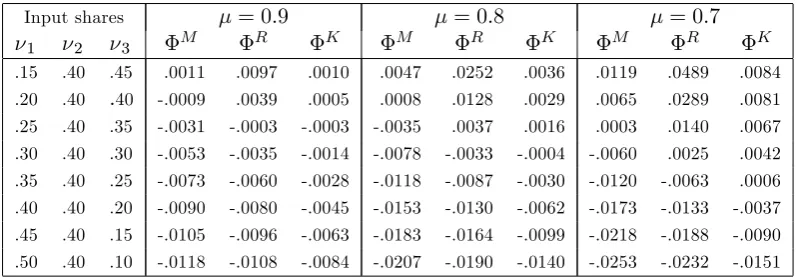
The critical resource share is 1 ' 0:23 with ’light policies’ ( = 0:9), and increases with heavier tax-subsidy rates ( 1 ' 0:37 with = 0:7). The interpretation of this result is that the presence of capital enhances the mechanism via which …rst-period subsidies may compensate, in terms of utility, the negative e¤ects of second-period taxation: the reduction in resource depletion in tincreases output levels int+ 1, with a positive level e¤ect on private returns from naturaland man-made capital. The next section shows that this conclusion is robust to alternative assumptions regarding the nature of …nancial assets held by private agents.
4.2 Monopoly rents
In this section we substitute man-made capital with assets representing claims over fu-ture monopoly rents. This framework will be extended in sec.4.3 to include endogenous technical change generated by R&D activity. The supply side of the economy now con-sists of producers of …nal output (Y) and …rms producing intermediate products (B). Final output is obtained by means of natural capital, labor and a number g(assumed exogenous, for the moment) of intermediate goods’ varieties. Assuming constant pop-ulation, and denoting by B(j) the quantity of the j-th variety of intermediate inputs
(j= 1; :::; g), output equals
Yt=X 1 t N 2
g
X
j=1
B 3
(j);t; (56)
where 1+ 2+ 3= 1. Each variety is produced by a monopolist with unit production
cost. Denoting by pb
(j) the price of intermediates, each monopolist maximizes pro…ts (j) = B(j)pb(j) B(j) taking the demand schedule of …nal producers as given. First
order conditions implypb
(j) = 31 in each period, so that prices and quantities of
inter-mediates are invariant across varieties. As a consequence, each monopolist produces
Bt=B(j);t= 23Xt1N 2 1
1 3 : (57)
Monopolistic …rms are owned by the currently old generation. Old agents in period t
thus receive the per capita pro…t rate
g t= (g= 3) (1 3)bt; (58)
where t= =N and bt Bt=N. Note that (57) and (58) imply that output grows at
the same rate as intermediate quantities and monopoly pro…ts:
yt= 32gbt; yt = bt = t: (59)
monopoly pro…ts. Denote by v(j);t the forward patent value, i.e. the value in period t of a patent exploitable to produce the j-th variety in period t+ 1. Since pro…ts are invariant across varieties, v(j);t =vt for any j 2 [1; g]. The aggregate value of all
patents in the intermediate sector is Ft gvt, and individual budget constraints read
ct = wt qtat(1 d) ft; (60)
et+1 = pt+1xt+1(1 ) +qt+1at+1+g t+1+ft+1; (61)
where f F=N is the per capita cost of patents. The aggregate constraint of the economy is (see Appendix):
yt=ct+et+gbt: (62)
Optimality conditions for consumers imply the Hotelling condition
qt+1
qt
1 +"
1 d =i f
t+1; (63)
where the implicit interest factor is de…ned as the gross return on assets
ift+1 = ( t+1+ft+1)=ft: (64)
As shown in the Appendix, the natural capital-resource asset ratio is constant in equi-librium, and equals
z= (1 d) 1 23 (1 + ) 2 ( 2 ) 1 1: (65)
A constant propensity to invest in resources implies a knife-edge equilibrium: the economy displays constant rates of resource use and output growth. In particular, since yt = bt, we have
y
t = ( xt) 1 bt 3
= ( xt)1 13 = [(1 +")=(1 +z)]1 13 : (66)
Similarly to the model with capital - see (53) - the presence of intermediates contributes to the magnitude of the growth e¤ects induced by resource-saving policies: transfers increase y by reducing z, and the exponent in (66) is increasing in the intermediates
share 3. The dynamic interaction between resource use and investment in intermediate
…rms is as follows. The rate of depletion x determines output growth y, which is in turn the rate at which monopoly rents develop over time - see (59). Hence, reducing the rate of resource use sustains not only output, but also the pro…tability of monopolistic …rms that represent investment opportunities for young agents. We thus expect a positive in‡uence of 3 on the critical condition for <0. As shown in the Appendix,
the welfare gap V (0;0) V (1;1)now reads
= log 8 <
:
1 1(1+ )1 3 1 + ~z
1 + ~z
1(1+2 ) 1 3
9 =
;; (67)
4.3 R&D activity
The previous model is now extended to include a third sector which develops innova-tions: R&D …rms invent new varieties of intermediates, thereby increasing the number of monopolistic …rms operating in the economy. We thus obtain a variant of the expanding-varieties model (see Barro and Sala-i-Martin, 2004), which includes over-lapping generations and resource extraction. Aggregate output equals
Yt=Xt1N 2 gt
X
j=1
B 3
(j);t; (68)
where the number of intermediates’ varieties, gt, is now endogenous and generally time-varying. The behavior of monopolistic …rms is as before, with pro…t-maximizing conditions implyingpbt= 1= 3 and
Bt=B(j);t= 23Xt1N 2 1
1 3 : (69)
From (68) and (69), equilibrium output per capita now reads
yt=gtx 1
t bt3 = 32gtbt; (70)
and equilibrium dynamics imply
y t+1=
g
t+1 bt+1; bt+1= xt+1
1
1 3 : (71)
R&D …rms operating in periodtinvent new varieties that monopolistic …rms will exploit at t+ 1. In order to develop (gt+1 gt) new varieties, the R&D sector consumes ht
units of output, and the innovation technology takes the form
gt+1 gt= tht; (72)
where t, the marginal productivity of R&D expenditure, is a¤ected by aggregate spillovers generating endogenous growth. In the R&D literature, spillovers are typically formalized as knowledge-stock externalities, implying that current R&D activity is more productive the better the state-of-the-art at the aggregate level. In the present model, a convenient index for the state-of-the-art in producing new intermediates is the number of existing varieties in relation to output levels. Assuming a linear relation between the marginal productivity of R&D …rms and the state of technology index, the aggregate productivity of the R&D sector increases with the economy-wide rate of R&D investment:
t= gt yt ;
g
t+1 = 1 + hm; (73)
where >0is a proportionality factor, andhm ht=ytis the rate of R&D investment
determining, by (72), the rate of expansion in intermediates’ varieties. Since pro…ts are invariant across varieties, the value of each new blueprint equals the forward value of a patent vt, and equilibrium in the R&D sector requires12
vt= 1= t: (74)
1 2Condition (74) maximizes pro…ts v
t(gt+1 gt) ht and implies zero extra pro…ts in the R&D
From the households’ point of view, R&D …rms represent an additional asset: R&D investment in periodt allows young agents to run(gt+1 gt)new monopolistic …rms in
the subsequent period, obtaining higher second-period income through (i) additional monopoly pro…ts from intermediates’ production, and (ii) additional patent sales to newborn generations in t+ 1. This mechanism is summarized by the individual con-straints
ct = wt qtat(1 d) ft ht; (75) et+1 = pt+1xt+1(1 ) +qt+1at+1+gt+1 t+1+ft+1; (76)
where ht is R&D investment per capita, and equals agents’ expenditure to obtain patents for new intermediates: from (74), in aggregate we have
ht=ht= (1= t) (gt+1 gt): (77)
As regards revenues, non-resource income in (76) can be decomposed as
gt+1 t+1+ft+1 = [(gt+1 gt) ( t+1+vt+1)] +gt( t+1+vt+1): (78)
The last term in (78) is the sum of current pro…ts and patent sales of the gt …rms
that already existed in t, while the term in square brackets is the additional income (pro…ts plus patents) generated by new blueprints, and thus represents the gross return to R&D investment. In equilibrium, the two returns must be equal, and the implicit interest factor is
iht+1 = gt( t+1+vt+1)
ft
= (gt+1 gt) ( t+1+vt+1)
ht
: (79)
From (68), (75) and (76), the aggregate constraint now reads (see Appendix)
yt=ct+et+gtbt+ht: (80)
Optimality conditions for consumers yield the Hotelling rule
qt+1
qt
1 +"
1 d =i h
t+1; (81)
and the standard Euler condition et+1 = ctiht+1. As shown in the Appendix, the
propensity to invest in resources is constant, and the depletion index z is recursively determined by (the unique positive root of) the system
z = (1 d) [1 + 3(1 3)] [1 + hm] 1 1; (82)
hm = 2 (1 + ) 1 1 1(1 d) (1 )z 1; (83)
where the marginal propensity to invest in R&D, hm, is constant as well. Hence, the
equilibrium features balanced growth, and output per capita grows at the constant rate13
y = g( x)1 13 = (1 + hm) [(1 +")=(1 +z)] 1
1 3 : (84)
1 3Rewriting the innovation frontier as g
t+1= 1 + h
Since consumption is proportional to output levels, the necessary and su¢cient condi-tion for non-declining welfare is now
(1 + hm) [(1 +")=(1 +z)]1 13 1; (85)
which con…rms that prospect for sustainability are improved by endogenous technical change - here represented by the rate of expansion in intermediate varieties gt+1 = (1 + hm). The e¤ect of intergenerational transfers on the growth rate is twofold. On
the one hand, positive tax-subsidy rates reduce the depletion index z, implying the usual mechanism: from (84), a reduction in z directly increases the output growth rate y, and this e¤ect is stronger the higher are the shares of resources (
1) and
intermediates ( 3) in production. On the other hand, taxes and subsidies also a¤ect the
marginal propensity to invest in R&D, and thereby the rate of expansion in intermediate varieties (1 + hm). This second e¤ect is generally ambiguous, but rather unlikely to
imply a reduction of output growth following a decrease in the resource depletion rate.14 As shown in the Appendix, the critical condition for <0is now
1 1 + ~z
1 + ~z 1+2
1+
>1; (86)
with numerical results reported in Table 1. For the di¤erent policy targets consid-ered, the critical levels of the resource share in the R&D model occupy intermediate positions if compared with previous models: with R&D activity, the critical thresh-old 1 is slightly higher than that obtained with monopoly rents, but lower than that obtained in the model with man-made capital (cf. Table 1). Notice, however, that a sustainability-targeted policy is more politically feasible with R&D activity: the rea-son is that sustainability conditions di¤er between the present model and that with monopoly rents - see (66) and (84) - and the growth rate in the economy with R&D is generally higher. Hence, achieving sustainability in the R&D economy involves a smaller deviation from laissez-faire (that is, a higher ) with respect to the economy with monopoly rents, which grows less and must …ll a bigger sustainability gap (that is, requires a lower ). As a consequence, the critical threshold becomes less restrictive for the economy with R&D …rms.15
1 4The e¤ect of a variation in tax-subsidy rates on hm is generally ambiguous since a variation in
d and modify both the numerator and denominator in the last term in (83). However, an interior equilibrium with positive R&D activity requires >1(see Appendix: eq.A55), and this implies that possible reductions inhmwould not reduce the rate of expansion1 + hmsubstantially. The net e¤ect
of a reduction inzon output growth thus remains largely determined by the usual mechanism induced by resource preservation.
1 5For example, set
1= 0:25, 3= 0:35, and suppose that the R&D economy requires a reduction of
the depletion index corresponding to = 0:9. Recalling (66) and (84), the R&D economy can be safely assumed to be growing faster than a no-R&D economy with monopoly rents. The latter economy thus requires higher levels of tax-subsidy rates to achieve sustainability, corresponding to (e.g.) = 0:7. Under these parameters ( 1 = 0:25, 3= 0:35), Table 1 shows that the sustainability policy would be
politically supported in the R&D economy ( R = :0003with = 0:9) while it would not be in the
Input shares = 0:9 = 0:8 = 0:7
1 2 3 M R K M R K M R K
[image:23.595.98.497.120.259.2].15 .40 .45 .0011 .0097 .0010 .0047 .0252 .0036 .0119 .0489 .0084 .20 .40 .40 -.0009 .0039 .0005 .0008 .0128 .0029 .0065 .0289 .0081 .25 .40 .35 -.0031 -.0003 -.0003 -.0035 .0037 .0016 .0003 .0140 .0067 .30 .40 .30 -.0053 -.0035 -.0014 -.0078 -.0033 -.0004 -.0060 .0025 .0042 .35 .40 .25 -.0073 -.0060 -.0028 -.0118 -.0087 -.0030 -.0120 -.0063 .0006 .40 .40 .20 -.0090 -.0080 -.0045 -.0153 -.0130 -.0062 -.0173 -.0133 -.0037 .45 .40 .15 -.0105 -.0096 -.0063 -.0183 -.0164 -.0099 -.0218 -.0188 -.0090 .50 .40 .10 -.0118 -.0108 -.0084 -.0207 -.0190 -.0140 -.0253 -.0232 -.0151
Table 1. The welfare gap under di¤erent policy targets (and = 0:95) in the
three variants of the model: monopoly rents ( M), R&D …rms ( R), and man-made
capital ( K: in this case, input shares read
1; 2; 3). The welfare gap becomes
negative when the resource share (…rst column) reaches a critical threshold.
5
Remarks
The connections between the present analysis and related literature can be summa-rized as follows. Mourmouras (1993) uses the basic model of section 2 to show that competition may lead to over-exploitation of privately-owned renewable resources, and describes a set of conservationist policies implementing the Rawlsian optimum. A ma-jor di¤erence is the aim of the present analysis: our focus is the existence of situations where agents prefer transfers to laissez-faire for purely sel…sh reasons, without assum-ing a predetermined social objective. Second, we have studied individual payo¤s in a regime-contingent formulation in order to investigate under what technological and institutional circumstances agents would agree on a higher rate of natural preservation. Third, we have extended the model to include technical progress, monopoly rents, and R&D activity, obtaining insights about the intensity of the welfare e¤ects induced by a higher degree of resource preservation. All the above di¤erences also apply with respect to Krautkraemer and Batina (1999), where the basic model is extended to include a stock-dependent rate of resource regeneration.
may be achieved through policies that also preserve e¢ciency, in line with the view that intergenerational equity and intertemporal e¢ciency are distinct, and not necessarily con‡icting, objectives (Howarth and Norgaard, 1990)).17 As noted in the Introduction, this view is not challenged by the present analysis, which focuses on the di¤erent issue of individual motives for supporting resource-saving policies. In this model, distor-tionary measures bear an e¢ciency loss with respect to the …rst-best policy discussed in Mourmouras (1993) - see sect.3.2. This policy can be easily reinterpreted as an implicit redistribution of property rights across generations operated in each period by …scal authorities, in line with the main …ndings of Howarth and Norgaard (1990).
Emphasizing the role of sel…sh behavior, our analysis is close to the view that intergenerational exchange need not be linked to parental altruism, as recently argued by Boldrin and Rustichini (2000) and Rangel (2003). The general question asked by these authors is: why should present generations invest in assets that are valuable only to future ones? Boldrin and Rustichini (2000) and Rangel (2003) use game-theoretical arguments to show that intergenerational transfers may arise as voting equilibria when dynastic altruism is absent.18 In particular, Boldrin and Rustichini (2000) show that pay-as-you-go social security can be voted into existence by the majority, because the reduction in current saving implied by taxation raises future returns on capital, thus compensating the negative e¤ect of pension …nancing. Recalling Proposition 3, our main result hinges on a di¤erent mechanism: the reduction in the rate of resource use implied by resource-saving transfers improves production possibilities in the future, and the positive e¤ect on second-period output more than compensates for the negative e¤ect of taxation (provided that resource productivity is su¢ciently high).19
With respect to models of social security, the opposite direction of transfers in the present analysis (old-to-young) implies substantial di¤erences also from a policymaking perspective, since commitment technologies change. A social security system is sup-ported only if young generations believe that they will receive second-period transfers (Browning, 1975), and this generally requires anintergenerational commitment device -i.e. an institutional arrangement that binds generations yet to be born; in the literature on social security, this device takes various forms, such as social contracts (Hammond, 1975; Sjoblom, 1985), reputational mechanisms (Kotliko¤ et al. 1988; Cooley and Soares, 1998), or constitutional norms (Azariadis and Galasso, 2002). Resource-saving policies, instead, are supported when young individuals who receive subsidies accept
plays a crucial role in Howarth, 1991) and non-essentiality of the resource for producing output (Gerlagh and Keyzer, 2001). In particular, the fact that natural capital is not essential allows Gerlagh and Keyzer (2001) to consider zero-extraction paths with positive output, a possibility that is ruled out in our model.
1 7Related approaches to …scal policy with overlapping generations are also considered in the related
literature on environmental degradation. In a continuous-time setting, Marini and Scaramozzino (1995) derive the optimal abatement program assuming the Calvo-Obstfeld criterion for intergenerational equity. In a similar model, Bovenberg and Heijdra (1998) show that public debt policy can be used to redistribute in a ’fair’ manner across generations the burden of taxation implied by e¢cient abatement programs.
1 8Rangel (2003) shows that positive expenditures in goods that only bene…t the elderly (such as
social security) are necessary to achieve an equilibrium with e¢cient investment in goods that bene…t future generations (such as clean environment and education).
1 9Notice that the ampli…cation of the growth e¤ects of transfers, induced by the presence of additional
to pay second-period taxes: this requires an intertemporal commitment device that binds a given generation in the subsequent period, such as lifetime contracts (sect.3.3). Further di¤erences with respect to the social security literature arise, as already noted (sect.3.4), in the context of sequential voting games due to the particular con…guration of payo¤s in our model (cf. Proof of Lemma 4).
Due to the …rst-father problem, enacting permanent transfers involves a paternal-istic action at time zero, as no generation would sel…shly make the initial gift. As already noted, the logic is similar to Gale (1973), with the major di¤erences that transfers are distortionary and yield welfare gains only if the critical condition is satis-…ed. Nonetheless, Gale’s conclusion can be readapted to the present context as follows: resource-saving transfers begin after the economy
"has been running along for some time in the [no-transfers] equilibrium, but at time t = 0 some of the old people realize that if they are willing to give up ever so little of their second-period consumption, the economy in the future will move up toward [higher welfare for future generations]. (...) If this altruistic scenario sounds too unrealistic, one can instead imagine a central authority which levies an income tax on the old people in period zero and then sells this income back to the young." (ibid., p.29).
Alternatively, we can imagine a privatization scenario where natural resources pre-viously owned by the State are sold at a lower-than-e¢ciency price to young generations in period zero, and permanent transfers are then implemented.20
6
Conclusions
This paper analyzed the welfare properties of distortionary transfers in a growth model with overlapping generations and privately-owned natural capital. In this framework, unsustainability and resource depletion are a likely outcome of excessive competition, and implementing father-to-son transfers generates a higher degree of resource preser-vation. Our main result is that all newborn agents prefer intergenerational transfers in both periods of life to persistent laissez-faire conditions, provided that the resource share exceeds a critical threshold level. The reason is that the reduction in the rate of depletion implied by transfers improves production possibilities in the future: if resource productivity is relatively high, the positive e¤ect on second-period output more than compensates (in welfare terms) for the negative e¤ect of taxation. This mechanism is enhanced by the presence of other assets, in addition to natural capital. Extending the model to include man-made capital, monopoly rents and R&D sectors, it is shown that the critical condition becomes less restrictive because the returns from these assets also bene…t from the positive growth e¤ect induced by a higher degree of preservation.
The welfare time-path implied by resource-saving policies is not Pareto comparable with that obtained under laissez-faire, because resource owners at time zero su¤er a welfare loss due to taxation of the initial stock. The private desire for resource-saving
2 0In this case, the initial selling price (determined by the government) is equivalent to a proportional
policies unfolds only if agents are either subject to credible pre-commitment, or induced to cooperate with adjacent generations. In the …rst regard, a succession of lifetime contracts would allow a central authority to implement resource-saving policies in the inde…nite future: if young agents are asked to choose between permanent transfers and permanent laissez-faire, the former option is strictly preferred. In a sequential-choice context, the lack of intergenerational cooperation implies that alternative commitment devices must be set,e.g. in the form of positive costs of regime-switching. In both cases, agents support resource-saving policies for purely sel…sh reasons, and a paternalistic action is required at time zero. These two features recall the logic of intergenerational transfersà la Gale (1973): if the …rst resource owner partially renounces his claim over initial endowments, the transmission of this credit forward in time yields welfare gains for all successive generations.
Appendix
A. The basic model
The consumer problem. By (3), (13) and (4), the second-period individual
con-straint (10) can be rewritten as et+1 =qt+1(1 +")at;which can be substituted in (9)
to obtain
ct=wt qt(1 dt)et+1 qt+1(1 +")
: (A1)
The individual problem consists of choosing ct and et+1 in order to maximize lifetime
utility subject to (A1): …rst order conditions for an interior solution imply (14). Sub-stituting equilibrium prices (8)-(7) and condition (14) in individual budget constraints (9) and (10), equilibrium consumption levels are
ct = wt 1 + =
1
1 + (1 )yt; (A2)
et+1 =
1 +n
1 + ( + )yt+1: (A3)
Deriving equation (15). Substituting et+1 =qt+1(1 +")at in (A3) gives
at= (1 +n) ( + )
qt+1(1 + ) (1 +")
yt+1: (A4)
From (7) and (13), qt+1= mt+1xt+11(1 t+1) can be substituted in (A4) to obtain
at=
(1 +n) ( + ) (1 + ) (1 +") (1 t+1)
xt+1: (A5)
Now consider the system
qt+1
qt =
et+1(1 dt)
ct(1 +") ; (A6)
qt+1
qt = pt+1
pt
1 t+1
1 t
where (A6) is the optimality condition (14), and (A7) is implied by no-arbitrage con-dition (13). Substituting (A2)-(A3) in (A6), and (7) in (A7) respectively gives
qt+1
qt =
(1 +n) ( + ) (1 dt) (1 ) (1 +")
yt+1
yt ; (A8)
qt+1
qt
= xt
xt+1
1 t+1
1 t yt+1 yt ; (A9) implying xt+1 xt =
(1 ) (1 +") (1 t+1)
(1 +n) ( + ) (1 dt) (1 t)
: (A10)
Substituting (A10) in (A5) gives eq.(15) in the text.
Proof of Proposition 1. Under laissez-faire zt+1 = zt = ~z, which implies that
Ut is proportional to yt (see equation (A14) derived below). Hence, satisfying the
sustainability condition (1) in the laissez-faire economy requires y 1. Settingzt+1=
zt = ~z in (18) it follows that y 1 if and only if (22) is satis…ed. Substituting (15) and = 1 1in (22) yields (23).
Deriving tax-subsidy rates in (25). Setting zt = z0
, t = 0 and dt = d0 in
equations (24) and (11) gives
z0
= ~z 1 0
1 d0
; (A11)
0
z0
= 1 0
d0
; (A12)
respectively. Substituting (A12) in (A11) gives 0
= d0
~
z(1 d0), which can be substituted back in (A11) to obtaind0
= z z~ 0
1+~z, which is the subsidy rate level in (25). The tax rate
level in (25) then follows from 0
= d0
~
z(1 d0) as obtained above.
Proof of Lemma 2. It follows from (A2)-(A3) that
Ut= log
1
1 + + log (1 +n) +
1 + + logyt+ logyt+1: (A13)
By (18), logyt+1= logyt+ logzztt(1++1(1+ )zt+1), and (A13) can be rewritten as
Ut= log (
1 1 +
(1 +n) ( + ) 1 +
zt+1(1 + )
zt(1 +zt+1)
y1+t
)
: (A14)
If the policymaker setszt= in each period, (18) implies ytbe constant over time and (A14) implies Ut be constant over time. More generally, from (A14), any path with constant utility requires
zt+2
1 +zt+2
= zt+1 (1 + )
zt(1 +zt+1)
zt+1(1 + )
1
for each t2[0;1): (A15)
Deriving expression (28). Given the initial endowmentR0 r0N0, solving (16)
and (17) backward yields
xt=r0
1 +"
1 +n t
zt
1 +zt t 1
Y
j=0
1 1 +zj
Substituting (A16) in yt=mtxt gives
yt= zt
1 +zt t
; (A17)
where
t
r0m0(1 + )t
Qt 1
j=0(1 +zj)
(A18)
is a function of Ht and is therefore taken as given by the agent born in period t.
Expression (A18) implies that t+1 = t(1 + ) (1 +zt) 1, thus
yt+1 =
(1 + )zt+1
(1 +zt) (1 +zt+1) t
: (A19)
Substituting (A17) and (A19) in (A13) yields
Ut= log (
1 1 +
zt
1 +zt t
(1 +n) ( + ) 1 +
(1 + )zt+1
(1 +zt) (1 +zt+1) t
)
:
Setting t log 11+ t
h
(1+n)( + )
1+ t
i
yields expression (28) in the text.
Deriving expressions (29) and (30). It follows from (28) that
V (0;0) = + log (
~
z
1 + ~z
1 1 + ~z
(1 + ) ~z
1 + ~z
)
; (A20)
V (0;1) = + log (
~
z
1 + ~z
1 1 + ~z
(1 + )z0
1 +z0
)
; (A21)
V (1;0) = + log (
z0
1 +z0
1 1 +z0
(1 + ) ~z
1 + ~z
)
; (A22)
V (1;1) = + log (
z0
1 +z0
1 1 +z0
(1 + )z0
1 +z0
)
: (A23)
Expressions (29) and (30) in the text are proved as follows: z > z~ 0
implies
z0
~
z
1 + ~z
1 +z0 <1: (A24)
Hence, from (A20)-(A21) we have V(0;0) > V (0;1), because hzz~(1+0(1+~zz0))
i
> 1; from
(A22)-(A23) we have V (1;0)> V (1;1), because hzz~0(1+(1+~zz0))i >1.
Proof of Proposition 3. By (A20) and (A23), V (0;0)< V (1;1)if and only if
~
z
1 + ~z
(1+ )
1
1 + ~z < z0
1 +z0
(1+ )
1
1 +z0 :
Deriving expression (33). From (A20) and (A23), the gap =V (0;0) V (1;1)
equals
= log (
~
z z0
+
1 +z0
1 + ~z
+2 )
:
Substituting z0
= z~ and eq.(15) in the above expression yields equation (33) in the text.
The Rawls-optimal path. Along a Rawls-optimal path, (i) utility per capita
must be constant through generations born in any t 0 and (ii) the constant utility level must be the maximum that can be sustained inde…nitely. As regards the …rst point, utility per capita is constant through generations ifyt=y at anyt 0, implying
mtxt = y . De…ning x~t mtxt, the Rawls-optimal path requires x~t = ~x = (y ) 1
constant. Multiplying by mt the resource constraint rt+1(1 +n) = (1 +") (rt xt),
and de…ning rt~ rtmtwe obtain
~
rt+1= (1 + ) (~rt x~ ): (A25)
Equation (A25) displays a unique steady-state point,
~
r = 1 + x :~ (A26)
Since > 0, this equilibrium is unstable. As a consequence, if x >~ r~0 1+ then
~
rt diverges to minus in…nity: in this case, the Rawlsian path is unfeasible since the
resource stock becomes negative in …nite time. If set x <~ r~0 1+ then rt~ diverge to plus in…nity, which is feasible but technologically ine¢cient, since there would be waste of productive resources. As a consequence, the Rawls-optimal plan is to chose
~
x = 1+ r~0, which impliesx0= 1+ r0. Sincext must decline geometrically at rate to
ensure constancy of x~ , natural capital and the resource stock evolve according to (34) along a Rawls-optimal path, and output per capita is y = 1+ m0r0 at each t 0.
Given y , lifetime utility is maximized by consumption bundlesc and e satisfying
(c ; e ) = arg maxnlogc + loge suby =c +e (1 +n) 1o:
Assuming an interior solution, the …rst-order condition e = c (1 +n) and the ag-gregate constraint imply conditions (35).
First-best policy. The …rst-best policy is the same described in Mourmouras
(1993). At time zero, the resource stock is expropriated and a stockJ0 of …at currency
is introduced in the economy as a lump-sum transfer to the initial old. Denoting the quantity of money per young individual as jt = J0=Nt, the …rst father receives (and
consumes)
jt(1 +n)
pyt =e0;
where pyt is the price index of the economy. All successive generations face individual constraints
ct = wt+st (jt=pyt); (A27)