http://dx.doi.org/10.4236/ape.2015.54029
How to cite this paper: Lee, H.-I., Park, S., Lim, J., Chang, S. H., Ji, J.-H., Lee, S., & Lee, J. (2015). Influence of Driver’s Career and Secondary Cognitive Task on Visual Search Behavior in Driving: A Dual-Task Paradigm. Advances in Physical Education, 5, 245-254. http://dx.doi.org/10.4236/ape.2015.54029
Influence of Driver’s Career and Secondary
Cognitive Task on Visual Search Behavior in
Driving: A Dual-Task Paradigm
Hye-In Lee1, Seungha Park2*, Jongil Lim3, Seung Ho Chang4, Jung-Hyun Ji2, Seungmin Lee5,
Jihye Lee2
1Chonnam National University, Gwangju, Korea 2Ewha Womans University, Seoul, Korea
3University of Massachusetts, Amherst, MA, USA 4Sam Houston State University, Huntsville, TX, USA 5Chungnam National University, Daejeon, Korea
Received 14 August 2015; accepted 15 November 2015; published 18 November 2015 Copyright © 2015 by authors and Scientific Research Publishing Inc.
This work is licensed under the Creative Commons Attribution International License (CC BY).
http://creativecommons.org/licenses/by/4.0/
Abstract
The purpose of this study was to investigate the effect of driving career and secondary cognitive task on dual-tasking performances and visual search behavior. Twenty male participants were grouped in the following two groups: the experienced group and the novice group. All participants were asked to drive at a speed of 120 km/h while keeping to a lane on the highway and engaging with the following three levels of secondary cognitive task: no cognitive task, easy level, and hard level. The results showed significantly lower correct response rates in the dual task condition (driving + cognitive task) than in the driving only task condition. Novice drivers showed greater decrements in cognitive task performance, particularly in the dual task condition, as compared to the experienced drivers. The total fixation duration decreased as the level of the secondary task increased in difficulty. Experienced drivers showed significantly longer fixation duration on the far-area of the road, and also on specific areas, whereas novice drivers fixated longer on the near- area of the road. In conclusion, we suggest that the importance of perceptual skills in driving should be emphasized and effective training methods need to be applied, especially among high- risk drivers.
Keywords
Driving, Dual-Task, Visual Search, Cognitive-Task
1. Introduction
Driving is a very complex motor task that requires the driver to constantly monitor the inside and outside of the car and to react appropriately. The information required to drive is acquired from the sensorimotor system, and comprehensive processing of that information is essential for safe driving. Optimal driving depends on the de-gree of attention allocated to the information necessary to drive due to the limited information processing capac-ity of the given driver. It is important to separately allocate the attention, especially when additional tasks are imposed while driving.
The dual-task paradigm has been applied previously to assess both attentional demand and the allocation of attentional resources when carrying out several motor tasks simultaneously. The dual-task approach provides an indirect measure of performance associated with a primary task by comparing performance on a secondary task. The dual-tasking effect has primarily been examined with the stroop task (Liotti, Woldorff, Perez, & Mayberg,
2000; Most, Sorber, & Cunninghan, 2007), arithmetic task (Springer, Giladi, Peretz, Yogev, Simon, & Hausdorf,
2006), and memory task (Krampe, Schaefer, Lindenberger, & Baltes, 2011; Lőevdén, Schaefer, Pohlmeyer, &
Lindenberger, 2008). The dual-task paradigm has been used to compare performance with the amount of
atten-tion applied to primary motor tasks such as gait or posture control during dual tasking, particularly in the elderly
(Schrager, Kelly, Price, Ferrucci, & Shumway-Cook, 2008) or among clinical populations such as Parkinson’s
disease patients (Bloem, Grimbergen, van Dijk, & Munneke, 2006). Recently, studies have been actively inves-tigating the potential effects of in-vehicle sources of distraction such as using a cell phone or watching digital multimedia broadcasting (DMB) technologies on driving performance. These studies provide evidence of the relationship between the secondary task and the risk of a motor vehicle accident while driving (Horberry, An-derson, Regan, Triggs, & Brown, 2006; Shiohara, Nakamura, Tatsuta, & Iba, 2010; Gable, Walker, & Moses,
2012; McKeever, Schultheis, Padmanaban, & Blasco, 2013; Strayer & Drews, 2007).
Distracted driving is caused by losing two primary functions necessary for drivers. First, one of the leading causes of vehicle crashes is when the driver’s visual attention is away from the primary task of driving. As more technologies are becoming available in personal vehicles to enhance convenience, there are also negative effects such as inattention and distraction during driving performance. Object manipulations when driving, for example, such as using a hand held cell phone or tuning the radio, also potentially increase the probability of an accident
(McKnight & McKnight, 1993; Reed & Green, 1999). According to a study released by the U.S. National
Highway Traffic Safety Administration in 2013, over 21,000 fatal crashes were reported to have involved using a cell phone while driving. In other words, these drivers were using their cell phone at the time of the crash. This indicates that object manipulation while driving is considered as a secondary task, constraining the driver to si-multaneously allocate attentional resources to both tasks (Shiohara et al., 2010). Such distracted driving activity has been associated with increased risk of traffic accidents due to drivers’ delayed reactions in unexpected situa-tions and the resulting increases in distances traveled before braking (Kunar, Carter, Cohen, & Horowitz, 2008).
Second, increases in cognitive demand resulting from tasks such as talking with a passenger in the car while driving have also been associated with distraction. Springer et al. (2006) reported degraded motor performance (e.g., decreased gait speed) and cognitive performance when participants walked while performing serial sub-tractions of seven, starting from 500. In particular, age-associated changes in cognitive decline were more ob-vious. Moreover, significant detrimental effects on safety also resulted from hands-free cell phones or verbal conversation with a passenger, as well as from the direct manipulation of in-vehicle devices (Strayer & Drews,
2007). That is, driving performance could be degraded merely as result of a driver being cognitively distracted
even when not directly manipulating in-vehicle devices (Horberry et al., 2006).
Studies of driving performance that have utilized the dual-task paradigm have concentrated on measuring the extent to which the driver’s attention is allocated or distracted based on changes in primary driving and second-ary cognitive task performance. One stream of recent research studies, however, has focused on a measure of the visual search patterns in order to construct associations between gaze behavior and attention level (Harbluk, Noy,
Trbrovich, & Eizenman, 2007; Konstantopoulos, Chapman, & Crundall, 2010). Visual search behavior refers to
the way in which the eyes are used to search the display or scene for relevant information to guide action
(Hen-derson, 2003), and is therefore considered an indicator of the performer’s attentional cue usage. Gaze behavior
has been observed in activities needed for daily life as well as sports situations. Such studies have consistently showed that skilled performers exhibit visual search patterns that differ from those of novices (Vickers, 1996;
where essential visual cues are located (Chapman & Underwood, 1998;Underwood, 2007). These gaze control strategies were considered more efficient as a consequence of receiving less interference from other task-irre-levant external cues.
Visual search behavior is one of the most important cognitive sub-tasks for driving (Shiohara et al., 2010). Furthermore the search behavior changes whether or not the secondary task is presented or matches the level of complexity of the secondary task (Harbluk et al., 2007). To date, although a few studies have examined the ef-fect of performing dual-tasks on visual search behavior while driving, its association with driving experience has not been examined. The present study was therefore designed to address whether visual search strategy is influ-enced by drivers’ expertise under the dual-task paradigm. This study proposed the following three hypotheses: (1) the dual-tasking effect on driving performance and/or cognitive task is observed as indicated by decreased level of performance; (2) the effect is larger in novice drivers than experienced drivers; (3) the dual-tasking ef-fects on visual search behavior are associated with driving career as well as the difficulty of the secondary task. The results can be provide implications for the risk factors of driving that distract a driver’s attention, and may also prove useful in informing training interventions.
2. Method
2.1. ParticipantsTwenty male participants were recruited for participation in the study. Participants were grouped into expe-rienced (25.9 ± 1.7 years; 170 ± 11 cm; 69.8 ± 13.7 kg) and novice drivers (24.6 ± 2.0 years; 168 ± 9 cm; 67.3 ± 9.4 kg) based on their driving careers. Ten participants were experienced drivers. Experienced drivers were de-fined as having a driving career of 5 years (mean = 5.6 years and more than 10,000 km/year), whereas novice divers had less than 6 months of driving experience (mean = 2.1 months) (Harbluk et al., 2007). Participants had normal or corrected-to-normal vision (equal to or better than 0.7 decimal acuity) without any known oculomotor abnormalities. Each participant provided written informed consent prior to beginning the experiment.
2.2. Apparatus
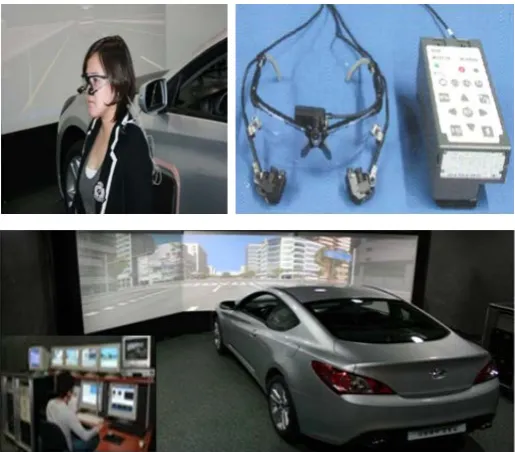
[image:3.595.184.442.474.700.2]A computerized driving simulator with 4-channel projection system (3 in front and 1 in back) displaying images on a screen in front (and back) of the driver and providing a 130˚ × 35˚ front and 60˚ × 40˚ rear field of view was used. A lightweight (75 g) head-mounted eye tracking system (EMR-9, NAC Inc., Tokyo, Japan) sampled participants’ eye movements at 30 Hz (see Figure 1).
2.3. Task and Experimental Procedure
Participants were introduced to the experimental protocol and equipment (e.g., driving simulator and eye tracker) and required to complete a survey which collected basic personal information and driving their history. Partici-pants took a 5-minute practice drive with the eye tracker to help ensure that they were accustomed to the expe-rimental environment.
A baseline measure of cognitive task performance was conducted under no-driving task situation. Math prob-lems used in Harbluk et al.’s study (Harbluk et al., 2007) were employed as a task. Single-digit addition prob-lems (e.g., 6 + 9) were used for the easy cognitive task, while the hard cognitive task required participants to add double-digit numbers (e.g., 77 + 25). Twenty questions were given for both conditions; each question was pro-vided every 2 seconds for the easy condition and every 6 seconds for the hard condition, respectively. Partici-pants were asked to answer each question as quickly as possible.
The following three driving (primary) task sessions were performed with different levels of cognitive (sec-ondary) task difficulty: 1) no cognitive task, 2) easy level, and 3) hard level. The characteristics (e.g., display interval, hard level, and total number) of the math questions were identical to those of the baseline measure. However, the number of combinations was varied. All participants were instructed to drive safely at speeds of 120 km/h while keeping to the lane on highways. Each driving distance was approximately 8 km with the same conditions, including curving and hazardous factors. All participants performed within the context of the same driving conditions and were given a 10 min break between tasks.
2.4. Measures and Data Analysis
The following two measures of task performance were recorded in each drive: average driving speed (km/h) and correct answer rate (%) of the cognitive secondary task. Visual behaviors were analyzed at every 1/30 second for the straight course of the road where the secondary task was provided. The total fixation duration and fixa-tion durafixa-tion per area were the data of interest. A fixafixa-tion was defined as an eye movement of less than 1˚ of visual angle for 100 ms or longer in which the cursor was located in the same space in the visual environment
(Vickers, 1996; Williams et al., 2002). The total fixation duration (%) was measured as the relative fixation
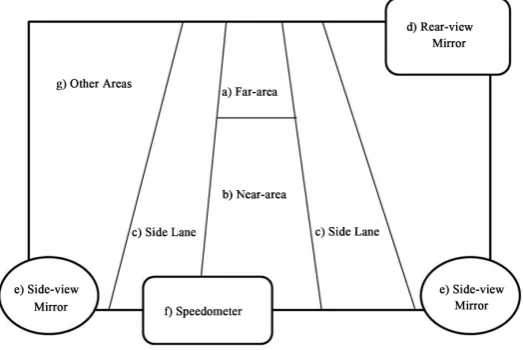
du-ration for the total of fifteen seconds of the driving route where the cognitive task was provided. For the fixation location, we examined the fixation durations allocated to the following six areas of interest: near- and far-area of the road, side road, rear-view mirror, side-view mirror, and speedometer. Any remaining fixations were defined in a category labeled other areas (see Figure 2).
[image:4.595.184.446.531.706.2]Driving performance, cognitive task performance, and visual search variables was analyzed using a factorial ANOVA with repeated measures. Driving career was a between subject factor, whereas secondary task level and visual areas were within subject factors. When the interaction effect between independent variables was signifi-cant, simple main effects for each variable were performed. Scheffé’s post hoc tests were also used. The level of significance for all statistical tests was set at p < 0.05.
3. Results
3.1. Primary (Driving) Task Performance
The mean and standard deviation of driving performance (average driving speed) in secondary task level (no task, easy task, and hard task) are provided in Table 1. A 2 (driving career) × 3 (secondary task level) ANOVA with repeated measure indicated no significant main effects for driving career [F(1, 18) = 1.690, p > 0.05], and secondary task level [F(2, 26) = 0.001, p > 0.05]. An interaction between driving career and secondary task level was not significant [F(2, 36) = 0.373, p > 0.05].
3.2. Secondary (Cognitive) Task Performance
The mean and standard of deviations of the correct response rate on secondary cognitive task is provided in Ta-ble 2. A 2 (driving career) × 2 (driving task: no driving, driving) × 2 (secondary task level) ANOVA with re-peated measure on the last two factors indicated significant main effects of driving task [F(1, 18) = 33.975, p < 0.01], and secondary task level [F(1, 18) = 85.939, p < 0.01]. There was also significant driving career × driving task interaction [F(1, 18) = 5.761, p < 0.05], and driving task × secondary task level interaction [F(1, 18) = 11.654, p < 0.01], for cognitive task performance, respectively. Follow-up tests on interaction effect indicated that all participants showed significantly lower correct response rates in the dual task condition (driving + cogni-tive task) than the only driving task condition. Novice drivers showed greater decrements in cognicogni-tive task per-formance, particularly in the dual task condition, as compared to the experienced drivers.
3.3. Total Fixation Duration
For total fixation duration during fifteen seconds driving in secondary test route, we conducted a 2 (driving ca-reer) × 3 (secondary task level) ANOVA with repeated measure. A significant main effect for secondary task level was found [F(2, 36) =6.601, p < 0.01]. As the level of secondary task became increasingly difficult, the to-tal fixation duration decreased (no task: 83.95%; easy level: 81.85%; hard level: 77.42%). However, toto-tal fixa-tion durafixa-tion did not differ between the driving career groups. No significant driving career × secondary task level interaction was found.
3.4. Average Fixation Duration per Visual Area
[image:5.595.85.538.523.600.2]A 2 (driving career) × 3 (secondary task level) × 7 (visual area) ANOVA with repeated measures on the last two factors indicated significant main effects for secondary task level [F(2, 36) = 7.056, p < 0.01], and visual area [F(6, 108) = 22.347, p < 0.01]. A significant interaction effect was found between driving experience and visual
Table 1.Mean and standard deviation of average driving speed for novice and experienced drivers with three levels of cog-nitive task (km/hr).
Secondary task level
Only-driving Easy Hard
Mean SD Mean SD Mean SD
Novice 113.90 5.97 126.11 10.31 120.24 14.35
Experienced 122.13 12.29 124.31 6.72 121.75 12.70
Table 2. Mean and standard deviations of correct response rate on secondary cognitive task for novice and experienced driv-ers while driving and no driving (%).
Driving task Cognitive task level
No driving Driving
Easy Hard Easy Hard
Mean SD Mean SD Mean SD Mean SD
Novice 100.00 0.00 90.00 8.16 96.00 6.15 76.00 7.64
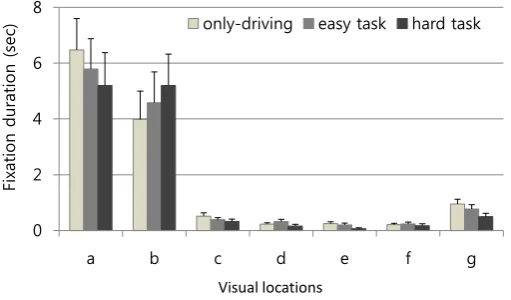
[image:5.595.87.539.635.721.2]area [F(6, 108) = 10.198, p < 0.01]. Experienced drivers showed significantly longer fixation duration on the far- area of the road and also on specific areas, such as the rear-view mirror, both side-view mirrors, and the spee-dometer, whereas novice drivers fixated longer at the near-area of the road (Figure 3). There was also a signifi-cant secondary task level × visual area interaction effect [F(12, 216) = 3.252, p < 0.01]. As the secondary task difficulty level increased, the fixation duration increased on the far-area of the road but decreased on the near-area of the road (Figure 4).
4. Discussion
Previous research has demonstrated that humans are limited in their ability to perform two or more tasks con-currently as a result of limited attention capacity (Abernethy, 2001). In other words, people can perform two or more tasks simultaneously as long their capacity of resource is not exceeded; however once the attentional level required for the task exceeds the individual’s capacity, he or she will experience difficulty. Therefore, perfor-mers allocate attention to two or more tasks to be accomplished concurrently within the limit of their overall at-tentional capacity.
In this study, all participants were required to simultaneously carry out both a primary driving task and a sec-ondary cognitive task that requires arithmetic calculations in two levels of difficulty. In previous studies, the primary driving task performance decreased when the secondary cognitive task was introduced (Consiglio,
[image:6.595.188.440.322.486.2]Driscoll, Witte, & Berg, 2003; Strayer & Drews, 2004). On the contrary, in this study, the performance decre-
Figure 3.Interaction effects of driving career and visual location (a: far- area, b: near-area, c: side lane, d: rear-view mirror, e: side-view mirror, f: speedometer, g: other areas).
Figure 4.Interaction effects of secondary cognitive task and visual loca-tion (a: far-area, b: near-area, c: side lane, d: rear-view mirror, e: side-view mirror, f: speedometer, g: other areas).
0 2 4 6 8 10 12
a b c d e f g
Novice Experienced
Fi
xa
tio
n d
ur
ati
o
n
(s
ec
)
Visual locations
0 2 4 6 8
a b c d e f g
only-driving easy task hard task
Fi
xa
ti
o
n d
ur
ati
o
n
(s
ec
)
[image:6.595.186.442.534.684.2]ment was observed in the secondary cognitive task rather than the driving task. The differences in correct an-swer rate were larger especially when a more difficult level of cognitive task was given. The arithmetic calcula-tion task used in this study is associated with placing demands on short-term memory (Harbluk et al., 2007). Secondary task performance such as arithmetic calculation would be a reflection of allocating attentional re-sources to the secondary task, after first assigning attention to the primary driving task. Therefore, poorer sec-ondary task performance indicates that a large amount of attention allocation would be required to maintain their performance for the primary task (Abernethy, 2001).
Although not statistically significant, the correct answer rate of the secondary task tended to be lower in less skilled drivers than in experienced drivers. Presumably, this could have occurred because less skilled drivers are more susceptible to the increased level of task difficulty than experienced drivers. Beilock, Bertenthal, Mccoy,
& Carr (2004) also reported that the effect of attention-distracting circumstances on task performance varied
depending upon the performers’ skill level. This was especially the case for the novices whose cognitive capaci-ties for the dual task are limited. A similar effect of the cognitive task complexity has also been reported in people with cognitive impairment, representing a highly vulnerable population (Montero-Odasso, Muir, &
Speechley, 2012).
Regarding visual search strategies, the fixation duration is associated with the amount of information ex-tracted by performers. It is generally considered that the longer fixation duration is required as the amount of information needed to perform the task increases (Williams, Davids, & Williams, 1999). For both groups, the total fixation duration was shorter when the secondary task was provided. In particular, the total fixation dura-tion decreased as the difficulty of the secondary task increased. The shorter fixadura-tion duradura-tion indicates a reduced amount of information for the driver to achieve and process while driving (Williams et al., 1999). The gaze con-trol strategy that reduces the fixation frequency but increases its duration has also been emphasized as an ap-proach that utilizes the information efficiently (Williams et al., 2002).
The mean fixation duration per location might provide an indication of how performers selectively regarded each of the visual locations in the decision-making process as environmental situation changes (Park, 2007). The location of a point of gaze is typically assumed to index the focus of attention (Duchowski, 2007), when a visual fixation occurs. Therefore the fixation location is often assumed to include the most important task-relevant in-formation, where the performers’ attention is allocated (Hamid, Stankiewicz, & Hayhoe, 2010; Scott, Hall,
Lit-chfield, & Westwood, 2013). As such, the quality and quantity of information to be obtained is dependent on
when (or how long) and where the gaze is fixated at.
An interesting finding in this study is that the fixation locations on a specific area varied significantly accord-ing to the level of drivaccord-ing experience. The experienced drivers fixated longer on the distant area whereas the less skilled drivers gazed for longer durations at the close area in front of the vehicle. Klauer (2006) reported that fixating gaze and allocating more attention to a wide range and a distant area are associated with a reduced risk of traffic accidents. Scott et al. (2013) also showed remarkable differences in gaze behavior between young no-vice drivers and young experienced drivers. The experienced drivers showed visual fixations covering a wider range when entering crossroads than those of less experienced drivers. However, as we cannot extrapolate re-sults from one gender in the present study, future experiments should explore changes in association between gaze behavior and driving experience under various population and/or socio-cultural characteristics.
There were differences in fixation duration distributed on area of interests as a function of secondary task dif-ficulty. The fixation duration decreased on the far-area of the road but increased on the near-area of the road as the difficulty of the arithmetic calculation increased. This corresponds to the results of Harbluk et al. (2007), who reported a narrowed focus of attention as the cognitive demand of the task increased. A similar result, nar-rowing field of vision, has also been reported in driving circumstances, particularly under a risky situation
(Chapman & Underwood, 1998). Consequently, a narrow field of view would arise from additional cognitive
demands imposed by a secondary task while driving, and this would increase the risk of accident.
re-spond faster to risky situations (Klauer, 2006; Mourant, & Rockwell, 1972; Recarte, & Nunes, 2000). A superior ability in visual processing in lower visual field compared to upper visual field has been confirmed in many be-havioral and neurophysiological studies, including higher sensitivity in motion processing (Christman &
Nie-bauer, 1997), higher attentional resolution (He et al., 1997), and higher spatial resolution (Carrasco et al., 2002;
Rezec & Dobkins, 2004). These location-dependent asymmetries in processing visual information highlight the
efficient gaze control strategy adopted by experienced drivers.
5. Implications for Future Research
Careless driving can cause serious safety-related accidents (Strayer et al., 2006). Such inattention can be ex-amined with changes in drivers’ gaze behaviors that are characterized by the increased (or decreased) fixation duration and fixation frequency on a particular location. When an additional cognitive task was given, the less skilled drivers switched fixation locations gradually to the closer in front of the vehicle as cognitive task diffi-culty increased, while no significant differences in driving speed were observed. This indicates that the span of attention gradually narrows down and thus the risk of accident becomes greater.
The effects of training using a driving simulator to improve drivers’ visual search strategy have already been demonstrated in a few studies (Chapman, Underwood, & Roberts, 2002; Seya, Nakayasu, & Patterson, 2008). These studies suggest a significant relationship between gaze control strategy and driving performance and un-derscore the necessity of related training. Therefore, as demonstrated in many sports studies, the importance of perceptual skills in driving should be emphasized and effective training methods need to be applied especially to high-risk drivers.
References
Abernethy, B. (2001). Attention. In R. N. Singer, H. A. Hausenblas, & C. M. Janelle (Eds.), Handbook of Sport Psychology
(2nd ed., pp. 53-85). New York: John Wiley & Sons, Inc.
Beilock, S. L., Bertenthal, B. I., Mccoy, A. M., & Carr, T. H. (2004). Haste Does Not Always Make Waste: Expertise, Di-rection of Attention, and Speed versus Accuracy in Performing Sensorimotor Skills. Psychonomic Bulletin and Review, 11,
373-379. http://dx.doi.org/10.3758/BF03196585
Bloem, B. R., Grimbergen, Y. A. M., van Dijk, J. G., & Munneke, M. (2006). The “Posture Second” Strategy: A Review of Wrong Priorities in Parkinson’s Disease. Journal of the Neurological Sciences, 248, 196-204.
http://dx.doi.org/10.1016/j.jns.2006.05.010
Carrasco, M., Williams, P. E., & Yeshurun, Y. (2002). Covert Attention Increases Spatial Resolution with or without Masks: Support for Signal Enhancement. Journal of Vision, 2, 467-479. http://dx.doi.org/10.1167/2.6.4
Chapman, P. R., Underwood, G, & Roberts, K. (2002). Visual Search Patterns in Trained and Untrained Novice Drivers.
Transportation Research Part F: Traffic Psychology and Behavior, 5, 157-167.
http://dx.doi.org/10.1016/S1369-8478(02)00014-1
Chapman, P. R., & Underwood, G. (1998). Visual Search of Driving Situation: Danger and Experience. Perception, 27,
951-964. http://dx.doi.org/10.1068/p270951
Christman, S. D., & Niebauer, C. L. (1997). The Relation between Left-Right and Upper-Lower Visual Field Asymmetries: (Or: What Goes up Goes Right, While What’s Left Lays Low). Advances in Psychology, 123, 263-296.
http://dx.doi.org/10.1016/S0166-4115(97)80076-3
Consiglio, W., Driscoll, P., Witte, M., & Berg, W. P. (2003). Effects of Telephone Conversations and other Potential Inter-ference on Reaction Time in a Braking Response. Accidental Analysis and Prevention, 35, 495-500.
http://dx.doi.org/10.1016/S0001-4575(02)00027-1
Duchowski, A. T. (2007). Eye Tracking Methodology: Theory and Practice (2nd ed.). London: Springer.
Gable, T. M., Walker, B. N., & Moses, H. R. (2012). Effects of Audio Cues for a Song Searching Task on Cell Phone While Driving. Adjunct Proceedings of the 4th International Conference on Automotive User Interfaces and Interactive Vehicu-lar Applications, Portsmouth, 17-19 October 2012, 28-29.
Hamid, S. N., Stankiewicz, B., & Hayhoe, M. (2010). Gaze Patterns in Navigation: Encoding Information in Large-Scale Environment. Journal of Vision, 10, 1-11. http://dx.doi.org/10.1167/10.12.28
Harbluk, J. L., Noy, Y. I., Trbovich, P. L., & Eizenman, M. (2007). An On-Road Assessment of Cognitive Distraction: Im-pacts on Drivers’ Visual Performance. Accident Analysis & Prevention, 39, 372-379.
He, S., Cavanagh, P., & Intriligator, J. (1997). Attentional Resolution. Trends in Cognitive Sciences, 1, 115-121.
http://dx.doi.org/10.1016/S1364-6613(97)89058-4
Henderson, J. M. (2003). Human Gaze Control during Real-World Scene Perception. Trends in Cognitive Sciences, 7, 498- 504. http://dx.doi.org/10.1016/j.tics.2003.09.006
Horberry, T., Anderson, J., Regan, M. A., Triggs, T. J., & Brown, J. (2006). Driver Distraction: The Effects of Concurrent In-Vehicle Tasks, Road Environment Complexity and Age on Driving Performance. Accident Analysis and Prevention, 38,
185-191. http://dx.doi.org/10.1016/j.aap.2005.09.007
Klauer, S. G. (2006). The Impact of Driver Inattention in Near-Crash/Crash Risk: An Analysis Using the 100-Car Naturalis-tic Driving Study Data. Report No. DOT HS 810 594. Washington DC: National Highway Traffic Safety Administration.
Konstantopoulos, P., Chapman, P., & Crundall, D. (2010). Driver’s Visual Attention as a Function of Driving Experience and Visibility. Using a Driving Simulator to Explore Driver’s Eye Movements in Day, Night and Rain Driving. Accident Analysis & Prevention, 42, 827-834. http://dx.doi.org/10.1016/j.aap.2009.09.022
Krampe, R. T., Schaefer, S., Lindenberger, U., & Baltes, P. B. (2011). Lifespan Changes in Multi-Tasking: Concurrent Walking and Memory Search in Children, Young, and Older Adults. Gait & Posture, 33, 401-405.
http://dx.doi.org/10.1016/j.gaitpost.2010.12.012
Kunar, M. A., Carter, R., Cohen, M., & Horowitz, T. S. (2008). Telephone Conversation Impairs Sustained Visual Attention via a Central Bottleneck. Psychonomic Bulletin & Review, 15, 1135-1140. http://dx.doi.org/10.3758/PBR.15.6.1135
Liotti, M., Woldorff, M. G., Perez, R., & Mayberg, H. S. (2000). An ERP Study of the Temporal Course of the Stroop Col-or-Word Interference Effect. Neuropsychologia, 38, 701-711. http://dx.doi.org/10.1016/S0028-3932(99)00106-2
Lőevdén, M., Schaefer, S., Pohlmeyer, A. E., & Lindenberger, U. (2008). Walking Variability and Working-Memory Load in Aging: A Dual-Process Account Relating Cognitive Control to Motor Control Performance. Journal of Gerontology: Psychological Sciences, 63, 121-128. http://dx.doi.org/10.1093/geronb/63.3.P121
McKeever, J. D., Schultheis, M. T., Padmanaban, V., & Blasco, A. (2013). Driver Performance While Texting: Even Little Is Too Much. Traffic Injury Prevention, 14, 132-137. http://dx.doi.org/10.1080/15389588.2012.699695
McKnight, A. J., & McKnight, A. S. (1993). The Effect of Cellular Phone Use upon Driver Attention. Accident Analysis and Prevention, 25, 259-265. http://dx.doi.org/10.1016/0001-4575(93)90020-W
Montero-Odasso, M., Muir, S. W., & Speechley, M. (2012). Dual-Task Complexity Affects Gait in People with Mild Cogni-tive Impairment: The Interplay between Gait Variability, Dual Tasking, and Risk of Falls. Archives of Physical Medicine and Rehabilitation, 93, 293-299. http://dx.doi.org/10.1016/j.apmr.2011.08.026
Most, S. B., Sorber, A. V., & Cunningham, J. G. (2007). Auditory Stroop Reveals Implicit Gender Association in Adults and Children. Journal of Experimental Social Psychology, 43, 287-294. http://dx.doi.org/10.1016/j.jesp.2006.02.002
Mourant, R. R., & Rockwell, T. H. (1972). Strategies of Visual Search by Novice and Experienced Drivers. Human Factors, 14, 325-335.
Park, S. (2007). Perceptual Skills in Sports. In Korean Society of Sport Psychology (Ed.), Motor Learning & Control (pp. 79-114). Seoul: Rainbow Books.
Recarte, M. A., & Nunes, L. M. (2000). Effects of Verbal and Spatial-Imagery Tasks on Eye Fixations While Driving. Jour-nal of Experimental Psychology: Application, 9, 119-137. http://dx.doi.org/10.1037/1076-898x.6.1.31
Reed, M. P., & Green, P. A. (1999). Comparison of Driving Performance On-Road and in a Low Cost Simulator Using a Concurrent Telephone Dialing Task. Ergonomics, 42, 1015-1037. http://dx.doi.org/10.1080/001401399185117
Rezec, A., & Dobkins, K. R. (2004). Attentional Weighting: A Possible Account of Visual Field Asymmetries in Visual Search. Spatial Vision, 17, 269-293. http://dx.doi.org/10.1163/1568568041920203
Schrager, M. A., Kelly, V. E., Price, R., Ferrucci, L., & Shumway-Cook, A. (2008). The Effects of Age on Medio-Lateral Stability during Normal and Narrow Base Walking. Gait Posture, 28, 466-471.
http://dx.doi.org/10.1016/j.gaitpost.2008.02.009
Scott, H., Hall, L., Litchfield, D., & Westwood, D. (2013). Visual Information Search in Simulated Junction Negotiation: Gaze Transitions of Young Novice, Young Experienced and Older Experienced Drivers. Journal of Safety Research, 45,
111-116. http://dx.doi.org/10.1016/j.jsr.2013.01.004
Seya, Y., Nakayasu, H., & Patterson, P. (2008). Visual Search of Trained Drivers in a Driving Simulator. Japanese Psycho-logical Research, 50, 242-252. http://dx.doi.org/10.1111/j.1468-5884.2008.00380.x
Shiohara, K., Nakamura, T., Tatsuta, S., & Iba, Y. (2010). Detailed Analysis of Distraction Induced by In-Vehicle Verbal Interaction on Visual Search Performance. IATSS Research, 34, 42-47. http://dx.doi.org/10.1016/j.iatssr.2010.06.004
Springer, S., Giladi, N., Peretz, C., Yogev, G., Simon, E. S., & Hausdorff, J. M. (2006). Dual-Tasking Effects on Gait Varia-bility: The Role of Aging, Falls, and Executive Function. Movement Disorders, 21, 950-957.
Strayer, D. L., & Drews, F. A. (2004). Profiles in Driver Distraction: Effects of Cell Phone Conversations on Younger and Older Drivers. Human Factors, 46, 640-649. http://dx.doi.org/10.1518/hfes.46.4.640.56806
Strayer, D. L., & Drews, F. A. (2007). Cell Phone Induced Driver Distraction. Current Directions in Psychological, 16, 128- 131. http://dx.doi.org/10.1111/j.1467-8721.2007.00489.x
Strayer, D. L., Drews, F. A., & Crouch, D. J. (2006). A Comparison of the Cell Phone Driver and the Drunk Driver. Human Factors: The Journal of the Human Factors and Ergonomics Society, 48, 381-391.
http://dx.doi.org/10.1518/001872006777724471
Underwood, G. (2007). Visual Attention and the Transition from Novice to Advanced Driver. Ergonomics, 50, 1235-1249.
http://dx.doi.org/10.1080/00140130701318707
Vickers, J. N. (1996). Visual Control When Aiming at Far Target. Journal of Experimental Psychology: Human Perception and Performance, 22, 342-354. http://dx.doi.org/10.1037/0096-1523.22.2.342
Williams, A. M., Davids, K., & Williams, J. G. (1999). Visual Perception and Action in Sport. New York: Taylor & Francis.