http://dx.doi.org/10.4236/jacen.2015.43008
Effect of Polyacrylamide Application on
Water and Nutrient Movements in Soils
Minyoung Kim1, Inhong Song2, Minkyeong Kim3, Seounghee Kim1, Youngjin Kim1, Younghun Choi1, Myungchul Seo4
1Department of Agricultural Engineering, National Academy of Agricultural Science, Rural Development
Administration, Jeonju, Korea
2Research Institute for Agriculture and Life Sciences, Seoul National University, Seoul, Korea
3Department of Agricultural Science, National Academy of Agricultural Science, Rural Development
Administration, Jeonju, Korea
4Crop Production and Physiology Research Division, National Institute of Crop Science, Rural Development
Administration, Jeonju, Korea Email: [email protected]
Received 19 August 2015; accepted 28 August 2015; published 31 August 2015
Copyright © 2015 by authors and Scientific Research Publishing Inc.
This work is licensed under the Creative Commons Attribution International License (CC BY).
http://creativecommons.org/licenses/by/4.0/
Abstract
An understanding of nutrient movement in soil is important for developing management strate- gies to minimize nutrient leaching and surface movement, thus improving nutrient uptake by plants, maintaining a sustainable soil system, and even protecting groundwater quality. Polya- crylamide (PAM) is known as one of soil conditioner that functions to stabilize soil structure, in- crease infiltration, and reduce surface runoff. This study assesses the effects of PAM on the vertic- al movement of soil-water and major/minor nutrients (NO3-N, NH3-N, T-N, PO4-P, T-P, K, Ca, Mg,
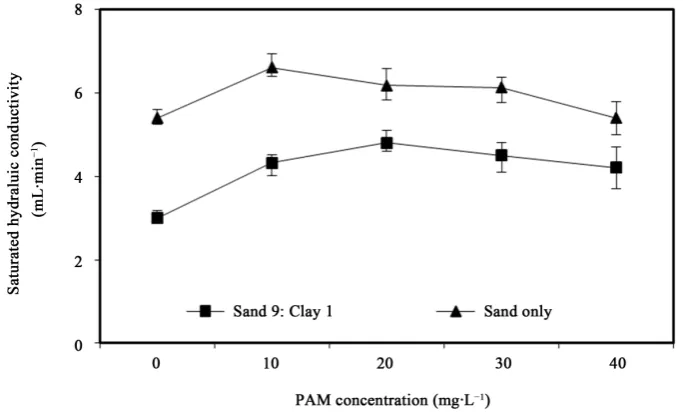
and Fe) in soils. Saturated hydraulic conductivity (Ksat) increases with increasing PAM concen- trations up to 10 mg∙L−1 for sand and 20 mg∙L−1 for a mixture of sand and clay. Decreases in the
loss of soluble nutrients, particularly NH3-N, PO4-P and T-P, are observed as PAM concentrations
increase. In contrast, PAM concentration has no effect on nitrate and minor nutrient levels. These results indicate that the application of PAM may be a viable method for protecting water bodies from excessive nutrients and improving nutrient availability for plants.
Keywords
subsurface losses of plant nutrients; and 3) contouring, terracing, sod-based rotation, conservation tillage, no-tillage, and other practices using soil conditioners, e.g. polyacrylamide, gypsum, etc. [3].
Water-soluble polyacrylamide (PAM) is known as one of effective treatments for enhancing infiltration, re-ducing runoff and soil loss, and in some cases rere-ducing nutrient losses from soils [4]-[6]. PAMs are inexpensive and can be applied to the soil surface quickly before irrigation [5]. In column experiments in which the surfaces of dry soils are treated with PAM, infiltration rates are reduced more in soil with a finer texture (silt loam) than in loamy sand soil [7]. In other column experiments using sandy loam soil, higher PAM concentrations result in lower infiltration rates, and solutions dominated by Na resulted in lower infiltration rates than solutions domi-nated by Ca (as gypsum) [8] [9].
In South Korea, previous studies have investigated to evaluate the applicability of PAM in soil erosion pre-vention and surface runoff reduction [10]-[12]. However, there have been no studies on the effects of PAM on factors other than soil erosion and runoff. In order to establish more optimal practices for PAM use, this study aims to quantify the effects of PAM application on the vertical movement of soil-water and major/minor nu-trients.
2. Materials and Methods
2.1. Experimental Procedure: Soil Column Experiment
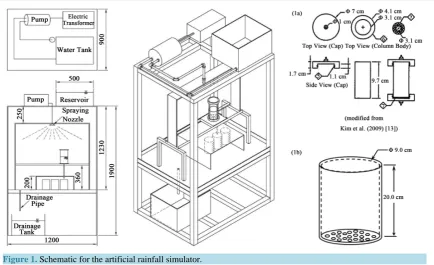
This study conducted two soil column experiments to evaluate the effects of PAM on the saturated hydraulic conductivity and nutrient leaching through soils. To cope with it, two different size of soil columns were used, one column of 9.7 cm in length and 3.1 cm in diameter for the saturated hydraulic conductivity experiment and the other column of 20.0 cm in length and 9.0 cm in diameter for the tracer and nutrient leaching experiment [13] (Figure 1(a) and Figure 1(b)). The soils used in these experiments consisted of Jumunjin standard sand (Ju-munjin, South Korea) with a particle size of 0.718 ± 0.123 mm. The sand-clay mixture was a 9:1 mix of sand and clay containing 70% - 90% kaolin (Source Clay Minerals Repository, Columbia, MO, USA).
Samples were air-dried and slowly poured into a sterilized Plexiglas acrylic column in 1 cm increments. The columns were pre-filled with sterilized tap water, and stirred or tapped to prevent layering and air entrapment. The lower end of the columns were fitted with an end cap with a hole to allow the drainage water to pass through, and a filter paper was placed over the hole in each end cap. The filter paper facilitated uniform distribu-tion of water over the entire surface of the column, so that the waterfront moved slowly through the soil column. An artificial rainfall simulator was designed to generate the precipitation event (Figure 1). PAM solution was prepared by slowly pouring 5 g of PAM (Magnafloc 336, BASF Korea, Korea) powder into 1 L of tap water and stirring overnight for complete mixing.
The first column study was conducted to evaluate the effect of texture type on saturated hydraulic conduc- tivity. Water was applied from below to soil columns packed with sand and the sand-clay mixture until near- saturated conditions were attained. PAM solution in concentrations of 0, 10, 20, 30 and 40 mg∙L−1
Figure 1.Schematic for the artificial rainfall simulator.
2.2. Experimental Procedure: Nutrient Leaching Experiment
A non-reactive tracer test using sodium chloride (NaCl) was conducted by injecting a non-reactive tracer up-stream and measuring its concentration downup-stream as a function of time. Predefined concentrations of NaCl, PAM, and fertilizer were injected into columns packed with sand, and leachate samples were collected over time to investigate the passage of tracer and nutrients.
For the nutrient leaching experiment, saturated columns packed with sand were sprayed with tap water for 2 min, followed by PAM solution for 1 min and liquid fertilizer for 2 min. Columns were then sprayed with tap water for 15 min. PAM solutions consisted of a control (0 mg∙L−1
PAM) and two treatment concentrations (5 and 10 mg∙L−1 PAM). The injection rate for all solution was 178 mL∙min−1
. Leachate samples were collected every minute and kept at 4˚C prior to chemical analysis. Experimental duration of 20 min was decided by moni-toring the change of nutrient concentration (time with no further change). All experiments were repeated three times. The nutrient recovery rate was calculated as the total effluent amount of nutrients divided by the total in-fluent amount of nutrients.
2.3. Chemical Analysis
Prior to nutrient leaching experiment, the tracer test with 200 mg∙L−1
of NaCl was injected and all effluent chlo-ride concentrations were measured using ion chromatography (ICS-1500, Dionex Corp., Sunnyvale, CA, USA). After that, all nutrient leachates over time were used to quantify the concentrations of NO3-N, NH3-N, T-N, T-P, PO4-P, K, Ca, Mg, and Fe. NO3-N and PO4-P were quantified using a Metrohm 881 Compact Ion Chromato-graph (IC) pro with 858 samplers (Metrohm, Herisau, Switzerland). For NH3-N quantification, the residual dye concentration was analyzed by a GBC Cintra 202 UV-Vis spectrophotometer (GBC Scientific, Hampshire, USA) at 630 nm after each adsorption operation. Total N and P were independently analyzed using alkaline persulfate digestion followed by colorimetric detection using continuous flow analysis (BLTEC Korea Limited, Korea). The concentrations of K, Na, Ca, Mg, Fe, Mn, and B were determined through inductively coupled plasma opti-cal-emission spectrometry (ICP-OES) using a PerkinElmer Optima 8300 spectroscope (PerkinElmer, Massa-chusetts, USA). All analyses followed standard methods [15].
3. Results and Discussion
In Figure 3, the breakthrough curves of nitrate as nitrogen (NO3-N) with and without PAM treatment were compared with the breakthrough curve of NaCl for flow pattern analysis. Without PAM, the rising limb, plateau portion and no tailing limb of the breakthrough curve suggest quicker solute transport paths. As PAM increases, it leads to a low peak concentration and a late tail of the breakthrough curve. This indicates that PAM applica-tion affects solute transport and retenapplica-tion in soil.
The SiAlO4 −
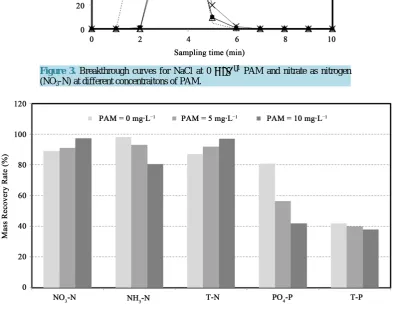
in clay has a negative charge, but sand (Si2O4) particles have no charge and do not retain ca-tions [17]. However, the addition of PAM to soil changes the charge of the soil surface, which becomes some-what negative [18]. This explains the high solubility and mobility of NO3-N with increasing application of PAM. A similar pattern is seen for T-N (Figure 4) because NO3− is the primary form of nitrogen. As PAM concen-trations increased 0 up to 10 mg∙L−1
, the recovery rates were increased 9.2% for NO3-N and 11.5% for T-N, re-spectively. In contrary, the recovery rates for NH3-N, PO4-P and T-P were decreased to 18.0%, 48.3%, and 9.5%, respectively. In the case of minor nutrients, there were no statistically significant increase or decrease as PAM was applied (p > 0.05).
4. Conclusions
This study found that an increase in PAM concentration increased Ksat to some degree, depending upon the soil type. However, at higher PAM concentration (10 mg∙L−1 PAM for the sand-clay soil and 20 mg∙L−1
[image:4.595.143.485.487.695.2]for sand alone), the saturated conductivity was decreased and this could be explained by viscous effect of PAM which might clog larger soil pores or form a distinct layer on the soil surface.
Figure 3. Breakthrough curves for NaCl at 0 mg∙L−1 PAM and nitrate as nitrogen (NO3-N) at different concentraitons of PAM.
Figure 4. Mass recovery of major nutrients at different concentrations of PAM.
The findings of this study further indicated that PAM was capable of reducing the loss of major nutrients as water flowed through soil. Although our study results were encouraging, laboratory conditions limited by the vertical movement of nutrients along with soil-water did not represent field conditions. Therefore, further study was required to determine the optimal dose and application strategy for PAM under various field conditions.
Acknowledgements
This study was carried out with the support of the Research Program for Agricultural Science & Technology Development (Project No. PJ0100832015), National Academy of Agricultural Science (NAAS), Rural Devel-opment Administration, Republic of Korea.
References
[image:5.595.117.516.205.514.2]ging Polyacrylamide Technology. Journal of Environmental Quality, 27, 305-312.
http://dx.doi.org/10.2134/jeq1998.00472425002700020009x
[9] Lentz, R.D., Sojka, R.E. and Robbins, C.W. (1998) Reducing Soil and Nutrient Losses from Furrow Irrigated Fields with Polymer Applications. Advances in GeoEcology, 31, 1233-1238.
[10] Jung, Y., Yang, J., Park, C., Kwon, Y. and Joo, Y. (1998) Changes of Stream Water Quality and Loads of N and P from the Agricultural Watershed of the Yulmunchon Tributary of the Buk-Han River Basin. Korean Journal of Soil Science and Fertilizer, 41, 83-93.
[11] Heo, S., Jun, M., Park, S., Kim, K., Kang, S., Ok, Y. and Lim, K. (2008) Analysis of Soil Erosion Reduction Ratio with Changes in Soil Reconditioning Amount for Highland Agricultural Crops. Journal of Korean Society on Water Quality, 24, 185-194.
[12] Choi, B., Lim, J., Choi, Y., Lim, K., Choi, J., Joo, J., Yang, J. and Ok, Y. (2009) Applicability of PAM(Polyacrylamide) in Soil Erosion Prevention: Rainfall Simulation Experiments. Korean Journal of Environmental Agriculture, 28, 249- 257. http://dx.doi.org/10.5338/KJEA.2009.28.3.249
[13] Kim, M., Boone, S.A. and Gerba, C.P. (2009) Factors That Influence the Transport of Bacillus cereus Spores through Sand. Water, Air, and Soil Pollution, 199, 151-157. http://dx.doi.org/10.1007/s11270-008-9867-9
[14] Oosterbaan, R.J. and Nijland, H.J. (1994) Determining the Saturated Hydraulic Conductivity. Chapter 12, In: Ritzema, H.P., Ed., Drainage Principles and Applications, International Institute for Land Reclamation and Improvement (ILRI), Wageningen, 1125.
[15] American Public Health Association (APHA) (2012) Standard Methods for the Examination of Water and Wastewater. 22nd Edition, Washington DC, 4-156.
[16] Silva, L., Almeida, B., Melo, D., Marques, K. and Almeida, C. (2013) Polyacrylamide Effect on Hydraulic Conductiv-ity of Hardsetting Soils in Northeast of Brazil. Geophysical Research Abstracts, 15, EGU2013-13309-2.
[17] Ketterings, Q., Reid, S. and Rao, R. (2007) Cation Exchange Capacity (CEC), Agronomy Fact Sheet Series (22). Cor-nel University Cooperative Extension.