_____________________________________________________________________________________________________
*Corresponding author: E-mail: [email protected];
23(2): 1-7, 2018; Article no.CSIJ.39672 ISSN: 2456-706X
(Past name: American Chemical Science Journal, Past ISSN: 2249-0205)
Effect of Turbidity and Contact Time on the Rate of
Biosorption of Ni
2+
, Pb
2+
, Cr
3+
and Cu
2+
from
Wastewater Using
Moringa oleifera
Chavaregi Geoffrey
1*, J. L. Kituyi
1and S. Lutta
11
Department of Chemistry and Biochemistry, University of Eldoret, Kenya.
Authors’ contributions
This work was carried out in collaboration between all authors. All the authors managed the analyses of the study and literature searches. Also, the authors read and approved the final manuscript.
Article Information
DOI: 10.9734/CSJI/2018/39672
Editor(s):
(1)Akmal S. Gaballa, Professor, Faculty of Specific Education, Zagazig University, Zagazig, Egypt. (2)Felix Odame, Department of Chemistry, Nelson Mandela Metropolitan University, South Africa.
Reviewers:
(1)Chadetrik Rout, Maharishi Markandeshwar University, India. (2)Imran Ali, Jamia Millia Islamia, India. (3)Mohammad Isa Mohamadin, MARA University of Technology, Malaysia. (4) Sukhada Akole, Modern College of Arts, Science and Commerce, India. Complete Peer review History:http://www.sciencedomain.org/review-history/25173
Received 26th January 2018 Accepted 6th June 2018 Published 18th June 2018
ABSTRACT
Heavy metals in water have been a major preoccupation for researchers for many years due to their toxicity towards aquatic life, human beings and the environment. As they do not degrade biologically like organic pollutants, their presence in industrial effluents and drinking water is a public health problem. Consequently, there is need to come up with novel methods of heavy metals remediation which are more effective and reliable. The biosorption processes using biosorbents like
Moringa oleifera have been found to be affected by various physical and chemical factors. Therefore, the present study sought to determine the effect of turbidity and contact time on the rate of biosorption of Ni2+, Pb2+, Cr2+ and Cu2+ from wastewater using Moringa oleifera. Atomic absorption spectrometer (AAS) was used to analyse samples for levels of massive metal species; Pb2+, Cr3+, Cu2+ and Ni2+ before and after treatment with oleifera biosorbent. The effect of turbidity and contact time on the biosorption of the heavy metals by the Moringa oleifera biosorbent was
Geoffrey et al.; CSIJ, 23(2): 1-7, 2018; Article no.CSIJ.39672
studied by varying these parameters. Results obtained in the study showed that percentage adsorption decreased from 99, 96, 95 and 87% in 20 ml of turbid solution to 70, 92, 93 and 60% in 50 ml cloudy solution for Pb2+, Cr3+, Cu2+ and Ni2+ respectively. Sixty minutes of equilibration time was found to be adequate for adsorption of the considered metal ions. Several kinetic models were applied to the adsorption data, and it was found that pseudo-second order fitted well with the adsorption data. It was therefore concluded that M. oleifera could be used as a low-cost adsorbent for the removal of heavy metals from aqueous solutions.
Keywords: Turbidity; contact time; Moringa; heavy metals; biosorption.
1. INTRODUCTION
According to Allitt [1], environmental pollution is one of the pressing global concerns in the 21st century. Anthropogenic activities mainly agricultural, industrial and domestic wastes discharge their wastewaters containing pollutants including toxic heavy metals into the environment. Heavy metals are amongst the most dangerous pollutants of both surface and groundwater [2]. Because metal ions are not degradable, they have a tendency to accumulate in water streams, endangering human health. Therefore, removal of such metals from the environment is necessary. Various techniques have been employed in the removal of heavy metal ions from the environment. These include chemical precipitation, ion-exchange, adsorption, membrane filtration and electrochemical treatment technologies. Most of these methods have been used with some limitations such as high costs of maintenance which have affected their efficiency in removal of heavy metals. Therefore, a cost-effective and reliable treatment method that is capable of removing heavy metals from aqueous solutions [3] is needed. Biosorption of heavy metals from aqueous solutions is a relatively new process that is proven very promising in the removal of contaminants from aqueous effluents. The biological materials that have been investigated for heavy metal uptake include bacteria, fungi, yeast and algae [4]. The major advantages of this method over the other conventional ones include not only its low cost, but also its high efficiency, the minimization of chemical or biological sludges, the ability to regenerate biosorbents, and the possibility of metal recovery following adsorption.
Moringa oleifera is also known horseradish tree or drumstick tree is a fast-growing, drought tolerant, deciduous tree plant of the genus
Moringa [5]. Traditional cultures in various parts of the world have long used Moringa in their
herbal medicine repertoire for ailments ranging from gout to various inflammations and fevers [6]. The powdered seed of the plant Moringa oleifera has coagulating properties that have been used for various aspects of water treatment such as turbidity, alkalinity, total dissolved solids and hardness. However, its biosorption behaviour for the removal of toxic metals from water bodies has not been given adequate attention [7]. The biosorption processes using biosorbents like Moringa oleifera have been found to be affected by various physical and chemical factors [8]. These factors determine the overall biosorption performance of a given biosorbent, that is its uptake rate, its specificity for the target, and the quantity of target removed. Various studies have been carried out on the effect of solution temperature, pH, ionic strength, initial pollutant concentration biosorbent dosage, biosorbent size, contact time and agitation speed [7,9,10,11]. However, there is scanty information on the effect of turbidity on the rate of biosorption of Ni2+, Pb2+, Cr2+ and Cu2+ from wastewater using Moringa oleifera. Therefore, this study sought to fill this lacuna.
2. MATERIALS AND METHODS
2.1 Moringa oleifera Seed Biomass
Moringa oleifera seeds were collected from the environs of Usage town, Kenya. The leaves were transported to the University of Eldoret Chemistry lab where they were washed thoroughly with distilled water and then dried under shade for a week. The dry seeds were then crushed into a fine powder using mortar and pestle. A half-kilogram of the powder was added to 2 litres of 0.1M HNO3 for acid treatment and
2.2 Preparation of Cr3+, Ni2+, Pb2+ and Cu2+ Ion Solutions
Stock solutions of Cr2+, Ni2+, Pb2+ and Cu2+ were prepared bydissolving 3.05g of Cr(NO3)2, 2.10g
of Ni(NO3)2, 1.59g of Pb(NO3)2 and 2.67 g of
Cu(NO3)2 in 10 mL of 1:1 nitric acid and then
diluted to 1 L to give 1000 ppm of the metals. A working solution of 100 ppm was prepared by pipetting 10 mL from 1000 ppm stock solution into 100 mL volumetric flask then made to the mark using distilled water for each metal.
2.3 Biosorption Studies
A batch method was employed for studying the biosorption of Cr2+, Ni2+, Pb2+ and Cu2+ by
Moringa oleifera seed biomass. A set of 250 mL Erlenmeyer flask containing 50 mL of metal solution (5 ppm) was used, and 0.4 g of biosorbent (Moringa oleifera seeds powder) was added followed with shaking after which the contents of the flask were filtered and filtrates analysed. To study the effect of variation of contact time on the rate of biosorption, experiments were carried out with an optimum initial concentration of the heavy metals (5 ppm), pH (6.8) and optimum dose of the biosorbent (0.4 g). Then the optimum dose of biosorbent was added and immediately subjected to biosorption. A stopwatch to note the time was started simultaneously. Samples for determination of the extent of biosorption were drawn from the biosorption vessel at different time intervals 1, 2, 3 and 4hrs. On the other hand, the turbidity of the model wastewaters was varied from 5 NTU to 50 NTU by 5 NTU intervals. This was done using soil particles which were washed thoroughly to avoid contamination of the sample wastewaters. The wastewater samples with different turbidity levels than were exposed to the Moringa Oleifera
biosorbent for a fixed time and the extent of biosorption studied for each sample to determine the effect of variation of turbidity of the wastewater on the size of biosorption.
2.4 Analytical Procedures
Atomic Absorption Spectrophotometer (AAS)
was used to determine the concentrations of the biosorbed metals. To achieve this, a
reagent blank sample was first taken through the method, analysed and subtracted from the samples to correct for reagent impurities and other sources of errors from the environment. The concentrations of the metals were then
determined in triplicates to ensure accuracy and precision of the analytical procedure.
After biosorption, the concentrations of these metal ions were analysed. The extent of biosorption regarding percentage removal was calculated using the following relationship.
% Removal = 100
Where C1 = Initial concentration
C2 = Final concentration
3. RESULTS AND DISCUSSION
3.1 Effect of Turbidity of Wastewater on the Rate of Biosorption of Pb, Cu, Cr and Ni by Moringa oleifera
Results in Fig. 1 indicate that turbidity affected the adsorption of the considered metals. Generally, % adsorption of the metal ions decreased with increase in turbidity.
Geoffrey et al.; CSIJ, 23(2): 1-7, 2018; Article no.CSIJ.39672
Fig. 1. Effect of turbidity on percentage sorption of Pb2+, Cu2+, Cr 2+ and Ni 2+ ions onto
M. oleifera
3.2 Effect of Contact Time
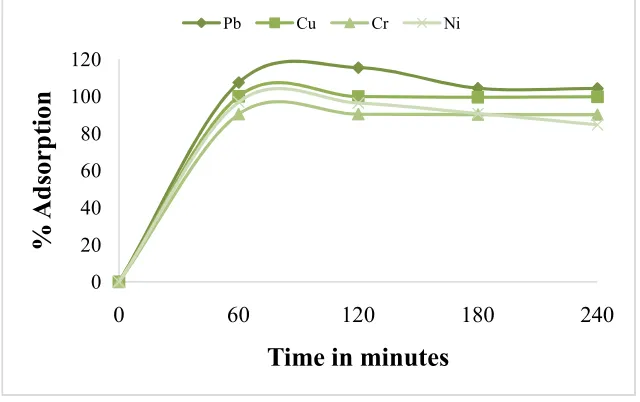
The minimum time required for quantitative uptake of metal ions from solution was determined and the results recorded in Fig. 2. Useful contact times were obtained by plotting the % adsorption of metal ions against time. The adsorption process was found to be rapid with higher percentage of adsorption noted immediately the metal ions came in contact with the adsorbent. However, the percentage adsorption reduced and later remained almost constant after 2 hrs of contact time.
Among the four metals, Pb recorded higher percentage of adsorption in all the four test periods than Ni, Cu and Cr. All the four metal ions attained equilibrium within the first 60-120 minutes. Hence the useful contact times for the selected metals were found to be 120 minutes. This can be attributed to the fact that all the binding sites have been occupied by the metal ions hence the plateau nature of all the three graphs in the Fig. 2. The binding sites become saturated and cannot take any more of the metal ions or all the metal ions have been removed and there are no more ions to be adsorbed.
Fig. 2. Effect of contact time on sorption of Pb2+, Ni2+, Cu2+ and Cr3+ ions by 5 g of M. oleifera
0
20
40
60
80
100
2 0
3 0
4 0
5 0
%
A
d
so
rp
ti
o
n
Turbidity in NTUs
Pb
Cu
Cr
Ni
0 20 40 60 80 100 120
0
60
120
180
240
%
A
d
so
rp
ti
o
n
Time in minutes
Similar results have been reported by other workers. Masamba et al. [16] reported a
Fig. 3. First and second order linearity test for Pb
Similar results have been reported by other workers. Masamba et al. [16] reported a
decrease in % of adsorption of metals ions using algae due to the saturation of adsorption sites.
a
b
c
d
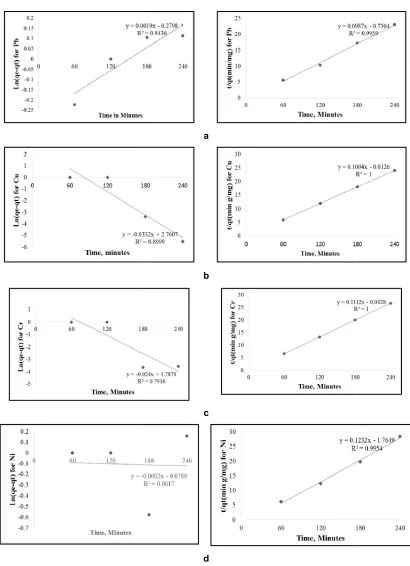
First and second order linearity test for Pb2+ (a), Cu2+ (b), Cr2+ (c) and Ni2+(d) adsorption on M. oleifera
decrease in % of adsorption of metals ions using algae due to the saturation of adsorption sites.
Geoffrey et al.; CSIJ, 23(2): 1-7, 2018; Article no.CSIJ.39672
Table 1. Kinetic parameters for Pb, Cu, Cr and Ni metal adsorption on M. oleifera
Metal Initial
concentration (mg/L)
Calculated metal uptake at equilibrium between me, (mg/g)
R2 value for first-order linearity test
R2 value for second order linearity test
Pb 10 1.12 0.8636 0.9959
Cu 10 0.4 0.8999 1.0000
Cr 10 0.28 0.7916 1.0000
Ni 10 1.17 0.0017 0.9954
The researchers further elaborated that the high charge density and small size of the metal ions results in them being strongly hydrolysed by water. Thus the solution will compete with the binding sites for the metal ions resulting in the slow release with time. A study by Salehzadeh [17] reported that most of the maximum percent Pb2+, Cu2+, Zn2+, Cd2+, Ni2+, Co2+ and Fe3+ removal using Xanthium Pensylvanicum was attained after about 90 min of shaking time. In addition, in biosorption of selected heavy metal ions using Spirogyra species, biosorption increases with increase of contact time from 0- 120 minutes [18]. Results reported by Nuhoglu and Oguz [19] showed that the biosorption efficiency of selected ions increased by increasing contact time. The study further revealed that using cone biomass, adsorption occurred in two steps and equilibrium was reached after 60 minutes.
3.3 Order of Reactions
The mass qt of metal adsorbed after time t is
related to the equilibrium metal uptake meby the
integrated first and second order equations. A plot of ln( age - qt) against time (minutes) was used
for the first order linearity test, while a parcel ofqt (ming/mg) against time (minutes) was used for the second order linearity test and the calculation of age, which is the metal uptake in milligrams per gram of biosorbent at equilibrium. The order of reaction for each metal was deduced from the linearity of the respective plots. Fig. 3 and gives the slopes and the R2 values from which heand the linear correlation coefficients may be obtained.
The second order plots for all metals have higher R2 values than the corresponding first-order plots as shown in Table 1. The process is, therefore, the second order for all metals.
The prediction of adsorption rate gives essential information for designing batch adsorption systems. Information on the kinetics of solute uptake is required for selecting optimum operating conditions for the full-scale batch
process. The kinetics of the adsorption data was analysed using two kinetic models, pseudo-first-order and pseudo-second-pseudo-first-order dynamic model. Results obtained in the present study showed that the pseudo-second-order plot for displayed higher correlation coefficient (R2 ≥0.99) on adsorption of Pb, Cr, Cu and Ni ions onto M. oleifera biomass than the pseudo-first-order kinetic model. The process is, therefore, second order for all the metals. This agrees with literature [20,21,22].
4. CONCLUSION
Results obtained from the present study recorded high % removal of the studied metals from wastewater at optimum conditions using M. oleifera. Results further showed that the removal of metal ions was affected by turbidity. Increased turbidity reduced the % removal of the considered metals. Also, contact time was reported to affect metal ions’ removal with maximum removal of metals attained within the first 60 minutes. The adsorption data fitted well for pseudo-second-order mode for all the alloys under study. The study concluded that M. oleifera biomass could be used as a natural sorbent for the removal of heavy metals from aqueous solutions.
COMPETING INTERESTS
Authors have declared that no competing interests exist.
REFERENCES
1. Allitt P. A climate of crisis: America in the age of environmentalism. Penguin; 2014. 2. Ali I, Aboul-Enein HY, Gupta VK.
Nanochromatography and nanocapillary electrophoresis: Pharmaceutical and environmental analyses. John Wiley & Sons; 2009.
adsorption. Journal of Molecular Liquids. 2017;236:205-213.
4. Sharma S, Imran ALI. Adsorption of Rhodamine B dye from aqueous solution onto acid activated mango (Mangifera indica) leaf powder: Equilibrium, kinetic and thermodynamic studies. Journal of Toxicology and Environmental Health Sciences. 2011;3(10):286-297.
5. Anwar F, Latif S, Ashraf M, Gilani AH.
Moringa oleifera: A food plant with multiple medicinal uses. Phytotherapy Research. 2007;21(1):17-25.
6. Fahey JW. Moringa oleifera: A review of the medical evidence for its nutritional, therapeutic, and prophylactic properties. Part 1. Trees for Life Journal. 2005;1(5): 1-15.
7. Kumari P, Sharma P, Shalini S, Srivastava MM. Arsenic removal from the aqueous system using plant biomass: A bioremedial approach, J. Ind Microbiol Biotechnol. 2005;32:521–526.
8. Vijayaraghavan K, Yun YS. Bacterial biosorbents and biosorption. Biotechnology Advances. 2008;26(3):266-291.
9. Chen C, Wang J. Influence of metal ionic characteristics on their biosorption capacity by Saccharomyces cerevisiae. Applied Microbiology and Biotechnology. 2007; 74(4):911-917.
10. Reddy KL, Kannamba B, AppaRao BV. Removal of Cu (II) from aqueous solutions using chemically modified chitosan. Journal of Hazardous Materials. 2010; 175(1):939-948.
11. Ongulu AR, Lusweti KJ, Morang’a GZ. Biosorption of Pb 2 and Cr 2 Using Moringa Oleifera and Their Adsorption Isotherms. Science. 2015;3(6):100-108. 12. Schnitzer M, Schuppli P. The extraction of
organic matter from selected soils and particle size fractions with 0.5 M NaOH and 0.1 M Na4P2O7 solutions. Canadian Journal of Soil Science. 1989;69(2):253-262.
13. Sen TK, Afroze S, Ang HM. Equilibrium, kinetics and mechanism of removal of
methylene blue from aqueous solution by adsorption onto pine cone biomass of Pinus radiata. Water, Air, & Soil Pollution. 2011;218(1-4):499-515.
14. Park D, Yun YS, Park JM. The past, present, and future trends of biosorption. Biotechnology and Bioprocess Engineering. 2010;15(1):86-102.
15. Huang SH, Radosz M. Equation of state for small, large, polydisperse, and associating molecules. Industrial & Engineering Chemistry Research. 1990; 29(11):2284-2294.
16. Masamba WRL, Mataka LM, Mwatseteza JF, Sajidu SMI. Cadmium sorption by Moringa stemopetala and Moringa oleifera seed powders: Batch, time, temperature, pH and adsorption isotherm studies; 2010. 17. Salehzadeh J. Removal of Heavy Metals
Pb 2, Cu 2, Zn 2, Cd 2, Ni 2, Co 2 and Fe 3 from Aqueous Solutions by using Xanthium Pensylvanicum. Leonardo Journal of Sciences. 2013;23:97-104. 18. Gupta VK, Agarwal S, Saleh TA.
Chromium removal by combining the magnetic properties of iron oxide with adsorption properties of carbon nanotubes. Water Research. 2006;45(6):2207-2212. 19. Nuhoglu Y, Oguz E. Removal of copper (II)
from aqueous solutions by biosorption on the cone biomass of Thuja orientalis. Process Biochemistry. 2003;38(11):1627-1631.
20. Gupta VK, Rastogi A. Biosorption of lead from aqueous solutions by green algae Spirogyra species: kinetics and equilibrium studies. Journal of Hazardous Materials. 2008;152(1):407-414.
21. Patel R, Suresh S. Kinetic and equilibrium studies on the biosorption of reactive black 5 dye by Aspergillus foetidus. Bioresource Technology. 2008;99(1):51-58.
22. Mata YN, Blazquez ML, Ballester A, Gonzalez F, Munoz JA. Characterization of the biosorption of cadmium, lead and copper with the brown alga Fucus vesiculosus. Journal of Hazardous Materials. 2008;158(2):316-323.
_________________________________________________________________________________
© 2018 Geoffrey et al.; This is an Open Access article distributed under the terms of the Creative Commons Attribution License (http://creativecommons.org/licenses/by/4.0), which permits unrestricted use, distribution, and reproduction in any medium, provided the original work is properly cited.
Peer-review history: