http://dx.doi.org/10.4236/msce.2015.39009
How to cite this paper: Ohtake, T. and Iijima, K. (2015) Li4Ti5O12 Synthesis with High Specific Surface Area and Single Phase. Journal of Materials Science and Chemical Engineering, 3, 68-73. http://dx.doi.org/10.4236/msce.2015.39009
Li
4
Ti
5
O
12
Synthesis with High Specific
Surface Area and Single Phase
Toshihito Ohtake
*, Ken-ichiro Iijima
Department of Mechanical Systems Engineering, Faculty of Engineering, Aich University of Technology, Gamagori, Japan
Email: *[email protected]
Received 2 September 2015; accepted 21 September 2015; published 24 September 2015
Copyright © 2015 by authors and Scientific Research Publishing Inc.
This work is licensed under the Creative Commons Attribution International License (CC BY).
http://creativecommons.org/licenses/by/4.0/
Abstract
We have investigated a novel Li4Ti5O12 synthesis with high specific surface area, high crystalliza-tion and single phase and its mechanism. The method was performed with a solid phase synthesis by using CH3COOLi∙2H2O and anatase TiO2 via Li2TiO3 as an intermediate in pre-sintering at 500˚C and sintering at 750˚C. This result showed specific surface area of 12 m2/g and single phase-Li4Ti5O12 by applying the high specific surface anatase TiO2 as a precursor.
Keywords
Li4Ti5O12, Solid Phase Synthesis, Specific Surface Area, SEM, TEM
1. Introduction
A negative electrode in lithium ion secondary battery has applied C6 graphite to intercalate lithium ions. The
graphite expands by overcharge to intercalate them more than stoichiometry. To solve the expansion, materials with keeping a crystal structure have been developed [1]. Hence, Li4Ti5O12 consisting of a spinel structure has
been expected for not changing the structure or size by intercalating the lithium ion [2] [3]. Furthermore, it is superior to the graphite in stability of charge capacitance under a high temperature or fast charge-discharge cycle [4]-[6]. On the other hand, an electrical conductivity is low like an insulator, and effects of a carbon dop-ing or metal ions by adddop-ing V5+, Mn4+, Fe3+, Mg2+ and Ag+ have been investigated for the higher conductivity
[7]-[14]. Especially the carbon doping has been available, and attempted by a sol-gel or spray-dry method in a liquid phase [15]-[17].
Li4Ti5O12 synthesis methods have been known as solid phase, sol-gel, hydrothermal or co-precipitation
me-thod. The solid phase method has surpassed others in industrialization to be easy and controllable for the
sis, while it is difficult to obtain homogeneous grain size. The small grain size needs lower sintering temperature, but the higher crystallization requires the higher sintering temperature. Furthermore, the solid phase method has been studied for the improvement in these points [18] [19].
Li4Ti5O12 for the negative electrode requires high crystallization, single phase, small grain size and high
spe-cific surface area to perform an excellent property. Especially, the high spespe-cific surface area is important to in-tercalate many lithium ions into the crystal efficiently. We have investigated the synthesis method for the high specific surface area with Li4Ti5O12 of the completely single phase by the solid phase reaction. In this study, we
attempted the synthesis by applying anatase TiO2 of the different specific surface area via a pre-sintering.
2. Experimental
Li4Ti5O12 synthesis was carried out by using CH3COOLi∙2H2O (Wako Pure Chemical Industries, Ltd.) as a Li
source that was melted with low temperature at about 300˚C, and 30 or 50 m2/g anatase TiO
2 (Toho Titanium
Co., Ltd.) as a Ti source. The first synthesis process was mixed with the CH3COOLi∙2H2O and TiO2 with Li:Ti
= 4:5 by ball milling (Fritsch, Pulversitte 7) at 1 h, rotating speed at 320 rpm and orbital speed at 110 rpm in agate mortar and balls. The mixed powder was pre-sintering at 500˚C with 10˚C/min, 1 h in air, and an interme-diate was formed. Furthermore, the intermeinterme-diate was mixed by the ball milling for rotating speed at 320 rpm and orbital speed at 110 rpm at 1 h similarly, and was sintered at 700˚C and 750˚C with 10˚C/min at 1 h in air.
The obtained powder was identified by XRD (Rigaku Corp., Rint 2000) at scanning step 0.02 deg and scan-ning speed 5 deg/min by CuKα, and was also measured by BET specific surface area (Shimadzu Corp., Flow-Sorb III 2305) at 0.1 g sample, gas flow rate 80 cm3/min in N2 and current 50 mA, after degassing the sample
with heating at 160˚C at 2 h. Particle size of the obtained sample was observed by FE-SEM (Hitachi, Ltd., S-4200), and crystalline estimation tried with TEM (JEOL Ltd., JEM-2100).
3. Results and Discussion
3.1. XRD Measurements
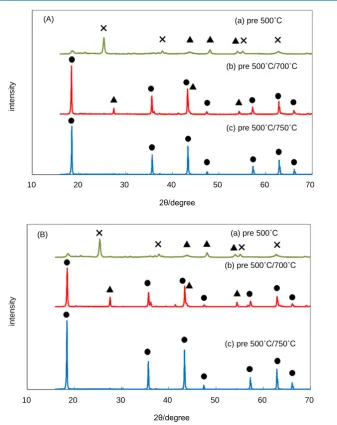
We yielded the intermediate by pre-sintering a mixture of CH3COOLi∙2H2O and anatase TiO2 at 500˚C, and
showed XRD patterns as (a); a green line in Figure 1(A)and Figure 1(B) by applying the 30 m2/g and 50 m2/g anatase TiO2 respectively. The intermediate was identified with unreacted TiO2 and Li2TiO3 known as a sub-
phase of Li4Ti5O12. Li2TiO3 has been understood by a phase diagram of Li2O-TiO2 among TiO2, Li2TiO3 and
Li4Ti5O12, which shows an accurate mixed rate at Li and Ti atoms [20]. A Ti site of Li2TiO3 and Li4Ti5O12 is
common in center of an octahedron, while a Li site exists in a tetrahedron in the case of Li2TiO3. Li2TiO3 show
inactivity as the electrode not to charge and discharge Li ions [21].
To obtain Li4Ti5O12, the intermediate was sintered at 700˚C, and the identification was shown as (b); a red
line in the XRD patterns, which obtained main Li4Ti5O12 peaks and slight peaks of Li2TiO3, and was not able to
confirm the unreacted TiO2. This result is not enough to obtain a single phase Li4Ti5O12 at the sintering
temper-ature although all unreacted TiO2 is consumed. Then, effect of the specific surface area by applying the 30 m2/g
or 50 m2/g anatase TiO2 was not confirmed in Figure 1(A)and Figure 1(B). In the sintering temperature at
750˚C, the single phase Li4Ti5O12 was obtained by applying either specific surface area of the anatase TiO2 as
shown in (c); a blue line in the patterns. On the other hand, the peak intensity was strong by applying the anatase TiO2 of 50 m2/g than that of 30 m2/g, which would be superior to the crystallization.
Now, to estimate the synthesized rate of the single phase Li4Ti5O12, we defined a single phase rate in a
fol-lowing equation.
Single phase rate (%) = [S(Li4Ti5O12)/{S(Li2TiO3) + S(Li4Ti5O12)}] × 100
Here, “S” shows area of the peaks. The value was nearly same in 86% in Figure 1(A)and 89% in Figure 1(B) at 700˚C, and was 100% at 750˚C in any cases. Consequently, the effect of the specific surface area in the ana-tase TiO2 does not be indicated by the single phase rate, while the sintering temperature gave the great effect.
3.2. SEM Observation
The intermediate was produced by the pre-sintering the mixture of CH3COOLi·2H2O and anatase TiO2 at 500˚C,
10 20 30 40 50 60 70
2θ/degree
(a) pre 500˚C
(b) pre 500˚C/700˚C
(c) pre 500˚C/750˚C (A)
int
ens
it
y
10 20 30 40 50 60 70
2θ/degree
(a) pre 500˚C
(b) pre 500˚C/700˚C
(c) pre 500˚C/750˚C (B)
int
ens
it
[image:3.595.150.488.77.503.2]y
Figure 1.XRD patterns of (A) applying the (30 m2/g); and (B) 50 (m2/g) anatase TiO 2 respectively, addition to (a) pre-sintering temperature at 500 (˚C); (b) sintering tem-perature at 700 (˚C); and (c) at 750 (˚C) after the pre-sintering. The mark shows ●: Li4Ti5O12; ▲: Li2TiO3; and ✕: TiO2.
Figure 2.SEM images of the intermediate synthesized by applying (A) 30 (m2/g); (B) 50 (m2/g) anatase TiO
[image:3.595.160.466.560.695.2]grain species to differ from contrast, which will indicate the unreacted TiO2 and Li2TiO3 as shown in the XRD
pattern. The intermediate would consist of the heterogeneous parts by them. The average grain size of the inter-mediate was different from 60 nm at Figure 2(A)and 30 nm at Figure 2(B), and the specific surface area was about 26.6 m2/g and 33.0 m2/g respectively. The specific surface area of the applying anatase TiO2 will give the
effect to the average grain size and specific surface area of the intermediate.
Figure 3 showed homogeneous grains without almost the contrast by the sintering at 700˚C or 750˚C, espe-cially the heterogeneous parts was not observed at 750˚C at all. In fact, the single phases rate is 100%, which would support acquisition of the single phase Li4Ti5O12. While the average grain size trended for greater with
the high temperature about Figure 3(A); 101 nm, Figure 3(B); 83 nm, Figure 3(C); 124 nm and Figure 3(D): 87 nm, it will show no much change by applying the 50 m2/g anatase TiO2. Similarly, the specific surface area
was about (a); 8.3 m2/g, (b); 14 m2/g, (c); 5.1 m2/g and (d): 12 m2/g, hence the single phase Li4Ti5O12 was
ob-tained with high specific surface area by the 50 m2/g anatase TiO2 at sintering temperature of 750˚C.
Further-more, the crystallization will be higher by the grain of a horned shape.
3.3. TEM Observation
Figure 4shows TEM images at pre-sintering temperature of 500˚C. The minute TiO2 particles will encircle the
Li2TiO3 at the 50 m2/g anatase TiO2 specially, which may take advantage of the Li4Ti5O12 synthesis by the
fol-lowing sintering. These images did not indicate a clear morphology like a facet in this pre-sintering, and would show a very low crystallization.
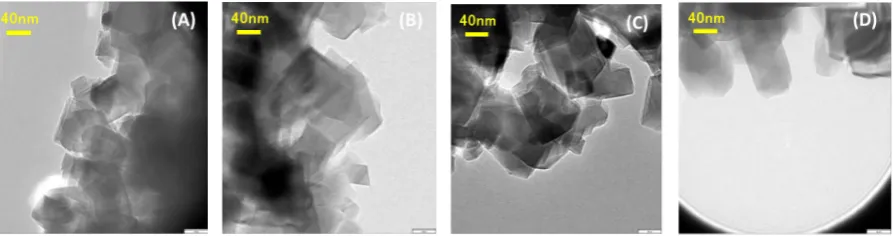
TEM images show the samples by the sintering temperature of 700˚C or 750˚C in Figure 5. The Li4Ti5O12
particles would be the higher crystallization to form at an angular grain which included the facets in the mor-phology, while the sintering temperature and the specific surface area of the anatase TiO2 would hardly give the
effect for the synthesized Li4Ti5O12 not to be obtained about the clear differences. The morphology have been
reported about the synthesis by using nano-particle or nano-wire TiO2, which have described that the nano-particle
or nano-wire Li4Ti5O12 was obtained on keeping the TiO2 morphology like a mold [22] [23]. This knowledge
will suggest the synthesis mechanism for the solid phase synthesis of Li4Ti5O12, which the (002) face of Li2TiO3
Figure 3. SEM images of the synthesized Li4Ti5O12 which is (A) 700 (˚C), by the 30 (m2/g); (B) 700 (˚C), by the 50 (m2/g); (C) 750 (˚C), by the 30 (m2/g); (D) 750 (˚C), by the 50 (m2
Figure 4.TEM images of the intermediate synthesized by applying (A) 30 (m2/g); (B) 50 (m2/g) anatase TiO2 after pre- sintering at 500 (˚C).
Figure 5. TEM images of the synthesized Li4Ti5O12 which is (A) 700 (˚C), by the 30 (m2/g); (B) 700 (˚C), by the 50 (m2/g); (C) 750 (˚C), by the 30 (m2/g), (D); 750 (˚C), by the 50 (m2/g) anatase TiO2.
plays a role of the mold in the spinel structure. These may show that the mobility of titanium ions is improved to close to the (002) Li2TiO3 and the (111) Li4Ti5O12.
4. Conclusion
We attempted the single phase Li4Ti5O12 synthesis with the higher specific surface area by using CH3COOLi∙2H2O
as a Li source that was melted with low temperature at about 300˚C, and 30 or 50 m2/g anatase TiO
2 as a Ti
source. The synthesis method obtained Li4Ti5O12 by the sintering at 700˚C or 750˚C via Li2TiO3 as the
interme-diate in pre-sintering at 500˚C. Then, the single phase Li4Ti5O12 was obtained with 12 m2/g specific surface area
and the higher crystallization at 750˚C. The mechanism may give a suggestion as the improvement of mobility for the titanium ions.
References
[1] Tsutomu, O., Atsushi, U. and Norihiro, Y. (2005) Zero-Strain Insertion Material Insertion Material of Li[Lil/3Ti5/3]O4 for Rechargeable Lithium Cells. Journal of the Electrochemical Society, 142, 1431-1435.
[2] Masataka, W. (2001) Recent Developments in Lithium Ion Batteries. Materials Science and Engineering: R: Reports, 33, 109-134. http://dx.doi.org/10.1016/S0927-796X(01)00030-4
[3] Leonidov, I.A., Leonidova, O.N., Perelyaeva, L.A., Samigullina, R.F., Kovyazina, S.A. and Patrakeev, M.V. (2003) Structure, Ionic Conduction, and Phase Transformations in Lithium Titanate Li4Ti5O12. Physics of the Solid State, 45, 2183-2188. http://dx.doi.org/10.1134/1.1626760
[4] Belharouak, I., Sun, Y.-K., Lu, W. and Amine, K. (2007) On the Safety of the Li4Ti5O12 ∕ LiMn2O4 Lithium-Ion Battery System. Journal of the Electrochemical Society, 154, A1083-A1087. http://dx.doi.org/10.1149/1.2783770
[image:5.595.91.538.289.407.2]Power Sources, 128, 308-318. http://dx.doi.org/10.1016/j.jpowsour.2003.09.068
[6] Abraham, D.P., Roth, E.P., Kostecki, R., McCarthy, K., MacLaren, S. and Doughty, D.H. (2006) Diagnostic Examina-tion of Thermally Abused High-Power Lithium-Ion Cells. Journal of Power Sources, 161, 648-657.
http://dx.doi.org/10.1016/j.jpowsour.2006.04.088
[7] Gao, J., Ying, J., Jiang, C. and Wan, C. (2007) High-Density Spherical Li4Ti5O12/C Anode Material with Good Rate Capability for Lithium Ion Batteries. Journal of Power Sources, 166, 255-259.
http://dx.doi.org/10.1016/j.jpowsour.2007.01.014
[8] Huang, J. and Jiang, Z. (2008) The Preparation and Characterization of Li4Ti5O12/Carbon Nano-Tubes for Lithium Ion Battery. Electrochimica Acta, 53, 7756-7759. http://dx.doi.org/10.1016/j.electacta.2008.05.031
[9] Hao, Y.-J., Lai, Q.-Y., Lu, J.-Z., Liu, D.-Q. and Ji, X.-Y. (2007) Influence of Various Complex Agents on Electro-chemical Property of Li4Ti5O12 Anode Material. Journal of Alloys and Compounds, 439, 330-336.
http://dx.doi.org/10.1016/j.jallcom.2006.08.082
[10] Pierre, K., Aurélie, G., Manfred, W., Laurent, A., Josette, O.-F., Pierre-Emmanuel, L. and Jean-Claude, J. (2003) Phase Transition in the Spinel Li4Ti5O12 Induced by Lithium Insertion: Influence of the Substitutions Ti/V, Ti/Mn, Ti/F.
Journal of Power Sources, 119, 626-630.
[11] Chen, C.H., Vaughey, J.T., Jansen, A.N., Dees, D.W., Kahaian, A.J., Goacher, T. and Thackeray, M.M. (2001) Studies of Mg-Substituted Li4−xMgxTi5O12Spinel Electrodes (0≤x≤1) for Lithium Batteries. Journal of The Electrochemical
Society, 148, A102-A104. http://dx.doi.org/10.1149/1.1344523
[12] Robertson, A.D., Trevino, L., Tukamoto, H. and Irvine, J.T.S. (1999) New Inorganic Spinel Oxides for Use as Nega-tive Electrode Materials in Future Lithium-Ion Batteries. Journal of Power Sources, 81, 352-357.
http://dx.doi.org/10.1016/S0378-7753(98)00217-1
[13] Mukai, K., Ariyoshi, K. and Ohzuku, T. (2005) Comparative Study of Li[CrTi]O4, Li[Li1/3Ti5/3]O4 and Li1/2Fe1/2 [Li1/2Fe1/2Ti]O4 in Non-Aqueous Lithium Cells. Journal of Power Sources, 146, 213-216.
http://dx.doi.org/10.1016/j.jpowsour.2005.03.019
[14] Huang, S.H., Wen, Z.Y., Zhang, J.C., Gu, Z.H. and Xu, X.H. (2006) Li4Ti5O12/Ag Composite as Electrode Materials for Lithium-Ion Battery. Solid State Ionics, 177, 851-855. http://dx.doi.org/10.1016/j.ssi.2006.01.050
[15] Gao, J., Jiang, C.Y., Ying, J.R. and Wan, C.R. (2006) Preparation and Characterization of High-Density Spherical Li4Ti5O12 Anode Material for Lithium Secondary Batteries. Journal of Power Sources, 155, 364-367.
http://dx.doi.org/10.1016/j.jpowsour.2005.04.008
[16] Hao, Y.J., Lai, Q.Y., Lu, J.Z., Wang, H.L., Chen, Y.D. and Ji, X.Y. (2006) Synthesis and Characterization of Spinel Li4Ti5O12 Anode Material by Oxalic Acid-Assisted Sol-Gel Method. Journal of Power Sources, 158, 1358-1364.
http://dx.doi.org/10.1016/j.jpowsour.2005.09.063
[17] Hao, Y.J., Lai, Q.Y., Xu, Z.H., Liu, X.Q. and Ji, X.Y. (2005) Synthesis by TEA Sol-Gel Method and Electrochemical Properties of Li4Ti5O12 Anode Material for Lithium-Ion Battery. Solid State Ionics, 176, 1201-1206.
http://dx.doi.org/10.1016/j.ssi.2005.02.010
[18] Kosovaa, N.V., Anufrienkob, V.F., Larinab, T.V., Rougierc, A., Aymardc, L. and Tarasconc, J.M. (2002) Disordering and Electronic State of Cobalt Ions in Mechanochemically Synthesized LiCoO2. Journal of Solid State Chemistry, 165, 56-64. http://dx.doi.org/10.1006/jssc.2002.9493
[19] Balaz, P. (2004) Mechanochemistry of Sulphides. Journal of Materials Science, 39, 5097-5102.
http://dx.doi.org/10.1023/B:JMSC.0000039190.72325.cf
[20] Georgina, I. and Anthony, R.W. (1980) Phase Equilibria in the System Li2O-TiO2. Materials Research Bulletin, 15, 1655-1660. http://dx.doi.org/10.1016/0025-5408(80)90248-2
[21] Leonidov, I.A., Leonidova, O.N., Perelyaeva, L.A., Samigullina, R.F., Kovyazina, S.A. and Patrakeev M.V. (2003) Structure, Ionic Conduction, and Phase Transformations in Lithium Titanate Li4Ti5O12. Physics of the Solid State, 45, 2183-2188. http://dx.doi.org/10.1134/1.1626760
[22] Lee, S.S., Byun, K.T., Park, J.P., Kim, S.K., Kwak, H.Y. and Shim, I.W. (2007) Preparation of Li4Ti5O12 Nanoparticles by a Simple Sonochemical Mehod. Dalton Transactions, 37, 4182-4184. http://dx.doi.org/10.1039/b707164g
[23] Kim, J. and Cho, J. (2007) Spinel Li4Ti5O12 Nanowires for High-Rate Li-Ion Intercalation Electrode. Electrochemical