A Novel Task Scheduling Algorithm for Heterogeneous
Computing
Vinay Kumar C. P.Katti P. C. Saxena
SC&SS SC&SS SC&SSJawaharlal Nehru University Jawaharlal Nehru University Jawaharlal Nehru University New Delhi, INDIA New Delhi, INDIA New Delhi, INDIA
ABSTRACT
The grid computing system can support the execution of
computationally intensive parallel and distributive
applications. The main characteristics of grid computing and heterogeneous computing system are similar. A novel scheduling algorithm, called NHEFT is proposed in this paper to enhance the functions of heterogeneous Earliest-Finish time (HEFT) algorithm. The NHEFT algorithm works for a bounded number of heterogeneous processors, the main objective of NHEFT is getting high performance and fast scheduling. The algorithm selects the tasks with a rank system at each step of execution of algorithm, which minimize earliest finish time with the minimization of cost.
General Terms
Distributed Computing, Heterogeneous Computing, Grid Computing.
Keywords
Task Scheduling Problem, NP Problems, Dynamic
Scheduling.
1.
INTRODUCTION
Most of previous research in parallel and distributive computing was focused on homogeneous computing system. In recent years, most of the research on scheduling algorithm can support the heterogeneous computing system [1], [2]. In a heterogeneous environment, it is assumed that the bandwidth of every communication channel and computing power of every processor can be different. A task scheduling problem can be represented by a direct acyclic graph (DAG) [3], in which tasks are represented by nodes and inter-task data dependencies are represented by edges. Each node label shows expected computation time of the task and each edge label shows inter-task expected communication time between tasks. The objective function of this problem is to map task onto processors and order their executions so that the task precedence requirements are satisfied and a minimum overall completion time is obtained. In general case a task scheduling problem is NP-complete problem [4].
In this paper, a new scheduling algorithm is proposed for a bounded number of fully connected heterogeneous processors. The motivation behind algorithm is to deliver good quality of schedule with lower costs. In this study the NHEFT algorithm selects the task with highest sum of top rank and down rank at each step. The selected task is assigned to processor which minimizes its earliest finished time with an insertion based approach [5].
The remainder of this paper is organized as follows: section 2 defines task scheduling problem and related terminology. Section 3 introduces proposed scheduling algorithm. Section 4 presents a comparison study of proposed algorithm with the related algorithms like MH [3], DLS [6], LMT [6] and HEFT [14]. The comparison study is based on randomly generated
task graphs which have several real applications. The summary of the research is presented in section 5.
2.
TASK SCHEDULING PROBLEM AND
RELATED WORK
The application of task scheduling system is represented by a directed acyclic graph, G= (V, E) where V is the set of tasks and E is the set of edges between tasks. Each edge (i, j) E represents the constraint such that the task should complete its execution before task start. Here data is a v × v matrix of communication data, where v is total number of tasks. In a task graph, a task without any parent is called an entry task (
) and a task without any child is called an exit task ( ).
In the target computing environment it is assumed that the set Q of q number of heterogeneous processors connected in a
fully connected topology, so all inter-processor
communications are assumed to be performed without contention. It is also assumed that computation can be overlapped with communication. As in previous terminology on task scheduling problem [6], W is a v × q computation cost matrix in which each gives the estimated execution time
to complete task on processor . Before scheduling, the tasks are labeled with the average execution cost.
The average computation cost of a task is defined as [5]
(1) The data transfer rates between the processors are stored in matrix B of size q × q. The communication startup cost of processor is given as a q-dimensional vector L. The communication cost of the edge (i, k) which is for transferring data from task (scheduled on ) to task (scheduled on ) by transfer rate is defined by
= +
(2)
where is communication startup cost of processor .
If task and are on the same processor, then = 0. The
average communication cost of an edge (i, k) is defined by
= + (3)
where is the average communication startup time.
EST ( , ) and EFT ( , ) are the earliest execution start time and the earliest execution finish time of task on
processor respectively. The EST and EFT values are
computed recursively, starting from the entry task as shown in equation (4) and (5). In order to compute the EFT of a task
, all immediate predecessor task of must have been
36
EST( , ) =
max (4)
EFT ( , ) = + EST ( , ) (5)
For the entry task
EST ( , ) = 0 (6)
Where avail (j) is the time that processor is free and it is ready to execute task , the inner max block in equation (4) returns the ready time i.e., the time when all data needed by task has arrived at processor . After all tasks in a graph are scheduled, the scheduled length (overall completion time) will be the AFT of the exit task ( ). If there are multiple
exit tasks and the convention of inserting a pseudo exit task is not applied, the schedule length, called makespan, is defined as
makespan = max [AFT ] (7)
The next section presents the task scheduling algorithms that support heterogeneous processors. In Dynamic level scheduling (DLS) algorithm [6], at each step, algorithm selects the pair that maximizes the value of the dynamic level which is equal to
DL ( , ) = ( ) - EST ( , ). The computation cost of a task is the median value of the computation costs of the task on the processors. In this algorithm upward rank calculation does not consider the communication costs.
In mapping heuristic (MH) [3], the communication cost of a task on a processor is computed by the number of instructions to be executed in the task divided by the speed of processor.
The algorithm uses static upward ranks to assign priorities. The Levelized-Min Time (LMT) algorithm [6] is a two phase
algorithm [8], The first phase groups the tasks that can be executed in parallel using level attribute. The second phase assigns each task to the fastest available processor. A task in lower level has higher priority than a task in a higher level. Within the same level, the task with the highest computation cost has the highest priority. Each task is assigned to a processor that minimizes the sum of the task’s computation cost and the total communication cost with tasks in the
previous levels. These results can be modified by applying a new approach to
calculate the rank of tasks. With the new upper rank and lower rank, the minimum makespan is achieved as compare to previous algorithms like DLS, MH, LMT and HEFT.
3.
NEW HETROGENEOUS
EARLIEST-FINISH TIME (NHEFT) ALGORITHM
In this proposed algorithm, tasks are ordered by scheduling priorities that are based on top ranking and down ranking. The top ranking of a task is recursively defined as( ) = ( (8)
where is average communication cost between node
and . The suc( ) is the set of immediate successors of task . The is the average communication cost of task . For exit task, top rank value is equal to
( ) = 0 (9)
Top rank computed recursively by traversing the task group upward. Similarly, down rank of a task is recursively define as
( ) = + ( (10) Where pred( ) is the set of immediate predecessor of task .
Down ranks are calculated recursively by traversing the task graph downward starting from entry task. The down rank of entry task is equal to
( ) = (11)
This algorithm has two phases, first is task prioritizing phase that calculate priority of all tasks. Second phase is processor selection phase, in which scheduling each selected task on its best processor. In task prioritizing phase, priority of each task is sum of its top rank and down rank, which is based on mean computation and mean communication costs. Arrange all tasks in a queue in decreasing order of its priorities. A tie-breaking is done randomly.
This algorithm has insertion based policy as defined in HEFT algorithm, which considers the possible insertion of NHEFT Algorithm
a task in an earliest idle time slot between already schedule tasks on a processor. In the processor selection phase, the search of an appropriate idle time slot of a task on processor , i.e. the time when all input data of task that were sent by ’s immediate predecessor task have arrived at processor . The search continue until finding the first idle time slot that is capable of holding the computation cost of
task . The NHEFT algorithm has an O(e × q) time
complexity for e edges and q processors. For a dense graph, number of edges replace by . Thus for a dense graph time complexity is O( × q), where v is a total number of tasks.
4.
EXPERIMENTAL RESULTS
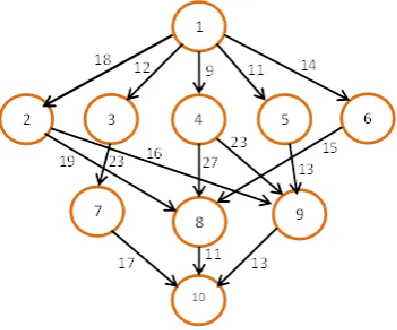
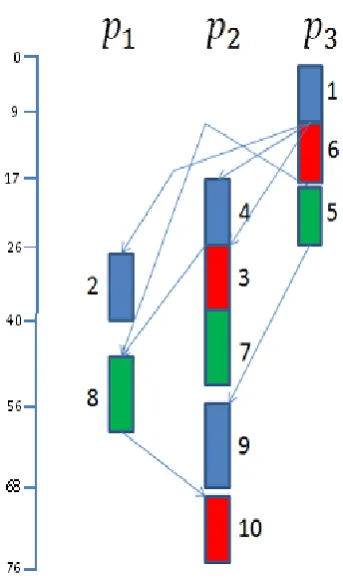
An example given in Figure 1 that presents a scheduling problem in Directed acyclic graph (DAG) form. Table 1 represent a computation cost matrix W of order v × q. The top rank and down rank for each tasks are given in Table 2. The task schedules obtained by NHEFT algorithm for this DAG present in Figure 2.
1) set the mean comp. cost of tasks and mean
comm. cost of edges
2) compute sum of and of all tasks by
traversing graph 3) sort tasks in a scheduling queue by
decreasing order of tasks
4) while there are unscheduled tasks in the queue
5) do select first task, from queue
6) for (each processor in the processor set do compute EFT ( , ) value using insertion
based policy)
7) assign task to processor that minimize
EFT of task .
The first phase of algorithm is task prioritizing, for this calculate the top rank and down rank from (8) and (10). Because initially take the top rank of exit task is zero and down rank of entry task is mean computation cost of entry
task, then and is calculated by recursively. A complete
list is given in Table 2. Now sort the task in decreasing order
of rank ( + ) and tie-breaking solve by randomly chosen.
For given example scheduling queue is as [ , , , ,
, , , , , ].
[image:3.595.345.509.89.280.2]
Fig 1: DAG form of a task scheduling problem
Table 1: Computation Cost Matrix
[image:3.595.63.262.188.353.2]
Table 2: Ranks for given directed acyclic graph
For the second phase of algorithm, select the unscheduled tasks from scheduling queue one by one. In our example first select . Then compute EFT of this task for each processor by (6), take minimum EFT for this task and schedule it that processor.
For given example
EFT ( , ) = 14 EFT ( , ) = 16
EFT ( , ) = 9
So select here on , then recursively execute algorithm
for all unscheduled tasks from scheduling queue. This example takes schedule length 76. This is better than other algorithms like HEFT, DLS, MH and LMT.
The NHEFT algorithm is applied on five standard examples given by Siegel [9]. It can be easily seen that in Table 3 that scheduling length for NHEFT algorithm is better than other algorithms like HEFT, DLS, MH and LMT. A graph representation of these examples is shown in Figure 3.
P1 P2 P3
14 16 9
13 19 18
11 13 19
13 8 17
12 13 10
13 16 9
7 15 11
5 11 14
18 12 20
21 7 16
+
94.8 13 107.8
60.2 47.6 107.8
67.2 39.3 106.5
67.2 34.6 101.8
57.2 35.6 92.8
50.6 39.6 90.2
31.6 73.3 104.9
25.6 76.6 102.2
27.6 80.2 107.8
38
[image:4.595.60.232.71.361.2]
Fig 2: Tasks schedule length for given DAG
Table 3: Comparison with various algorithms
Fig 3: Comparison of HNEFT with various algorithms
5.
CONCLUSION
The paper presented a new algorithm called NHEFT for scheduling graphs onto a system of heterogeneous processors. Experimental work shows that the NHEFT algorithm significantly outperformed the other algorithms like MH, DLS, LMT and HEFT. Because of its robust performance and low running time, the NHEFT algorithm is a viable solution for the DAG scheduling problem on heterogeneous systems. The NHEFT algorithm can be extended in future for rescheduling task in response to changes in processor and network loads. Although given algorithm assume a fully connected network. It is also extend this algorithm for arbitrary-connected networks.
6.
REFERENCES
[1] Foster I and Kesselman C (editors), 1999, The Grid: Blueprint for a Future Computing Infrastructure, Morgan Kaufmann Publishers, USA.
[2] Braun R, Siegel H, Beck N, Boloni L, Maheswaran M, Reuther A, Robertson J, Theys M, Yao B, Hensgen D and Freund R, 2001, A Comparison of Eleven Static Heuristics for Mapping a Class of Independent Tasks onto Heterogeneous Distributed Computing Systems, International Journal of Parallel and Distributed Computing, Vol.61(6): 810-837.
[3] Maheswaran M, Ali S, Siegel H.J, Hensgen D. and Freund R. F,1999, Dynamic Matching and Scheduling of a Class of Independent Tasks onto Heterogeneous Computing Systems, International Journal of Parallel and Distributed Computing,Vol. 59(2):107-131.
[4] Casanova H, Legrand A, Zagorodnov D and Berman F,(2000), Heuristics for Scheduling Parameter Sweep Applications in Grid Environments, In. Proc. Of the 9th
heterogeneous Computing Workshop: 349-363,
Cancun,Mexico.
[5] Stone H S,1977, Multiprocessor Scheduling with the aid of network flow algorithms, IEEE Trans. Software Eng. 3:85-93.
[6] Stone H S, Bukhara S H,1978, Control of distributed Processes, Computer: 97-106.
[7] M. M. Eshaghian, ed., 1996, Heterogeneous Computing, Artech House, Norwood, MA.
0 20 40 60 80 100 120 140 160
DAG 1 DAG 2 DAG 3 DAG 4 DAG 5
[image:4.595.317.565.71.259.2][8] A. Khokhar, V. K. Prasanna, M. Shaaban, and C. L Wang, 1993, Heterogeneous computing: Challenges and opportunities, IEEE Computer, Vol. 26, No. 6, pp. 18-27. [9] H. J. Siegel, J. K. Antonio, R. C. Metzger, M. Tan, and Y. A. Li, 1996, Heterogeneous computing, in Parallel and Distributed Computing Handbook, A. Y. Zomaya, ed., McGraw-Hill, New York, NY, pp. 725-761.
[10] H. J. Siegel, H. G. Dietz, and J. K. Antonio, 1997, Software support for heterogeneous computing, in The Computer Science and Engineering Handbook, A. B. Tucker, Jr., ed., CRC Press, Boca Raton, FL, pp. 1886-1909.
[11]G.C. Sih and E. A.Lee, 1994, A Compile-Time Scheduling Heuristic for Interconnection-Constrained Heterogeneous Processor Architectures, IEEE Trans.
Parallel and Distributed System vol. 5, no. 2, pp. 113-120.
[12] H. El-Rewini and T.G. Lewis, 1999, Scheduling Parallel Program Tasks onto Arbitrary Target Machines, Journal of Parallel and Distributed Computing, vol. 9, pp. 138-153.
[13] M. Iverson, F. Ozguner, and G. Follen, 1995, Parallelizing Existing Applications in a Distributed Hetrogeneous Environment”, Proc. Hetrogeneous Computing Workshop, pp 93-100.
[14] Topcuoglu, H. Hariri, S. Min-You Wu, 2002,
Performance effective and low complexity task