© Global Society of Scientific Research and Researchers
http://ijcjournal.org/
Smart Touch Attendance Management System Using NFC
Tag: Improving Learning Outcomes
Olorunfemi Temitope Oluwaseun
a*, Aworinde Halleluyah Oluwatobi
b, Jesutoye
Boluwatife
ca,bDepartment of Computer Science and Information Technology,Bowen University, Iwo, Osun State, Nigeria
c
Computer Science and Engineering Department, The University of Salford, Greater Manchester, UK
a
Email:[email protected]
bEmail: [email protected]
cEmail: [email protected]
Abstract
Given the need to maximize information technology to optimize attendance management systems, based on its
apparent shortcomings, the aim of the study is to develop, test, appraise and analyze a NFC tag automated
attendance system in an educational learning environment to improve learning outcomes. We used unified
modeling language, PHP and Aptana Studio to develop a system based on the Radio Frequency Identification
(RFID) technology. It operates at 13.56 MHz and relies on ISO14443 and ISO 18092 for low level data
exchange between two NFC devices to automate attendance, which can be used by educational institutions and
other organizations for efficient, effective and sustainable attendance database management. It was discovered
that variables such as time, cost, and energy inherent in the use of traditional systems were not significant
factors as they were optimized to add value to the organization. This work adds value to the management of
organizations’ processes, people and product affording them opportunity to maximize time, cost, effort and
energy.
Keywords: Smart slide; Attendance; NFC Tag.
1. Introduction
Some of the goals of education is to foster technical skills and other pervasive skills such as critical thinking and
negotiation and this can be achieved in formal, informal and non-formal arenas. For most formal settings,
attendance is a significant variable and it carries certain marks in some jurisdictions.
---
To maximize this phenomenon, educators have developed a monitoring system that gives account of student
participation in form of class attendance. The traditional forms of attendance monitoring use manual system
which may require especially for large classes the use of paper copy attendance sheet with the information of
students, such as their full names, probably their primary identification number (in most cases in tertiary
institutions, their Matriculation numbers), and columns for their signature for each class time of the week
throughout the entire semester. This method relies heavily on students’ trust, since monitoring may be weak. In
a one-hour class of say more than 100 students, how would an educator identify class members present? This
allows friends and associates to falsify the attendance records. Attendance management system is a system that
can capture the dynamics of processes, people and products in a chain, an event and a location. With the advent
of new technology, data entry, storage and processing is experiencing unprecedented new waves giving ways to
improve traditional manual systems. We are motivated to explore the use of IT to develop an attendance
management system using NFC tag for educational institutions, because of its overarching imperatives on
improving learning outcomes[1,2]. Based on people management, the traditional system that employs the use of
paper signing is fraught with errors as it is significantly dependent on the integrity of the person, especially in
cases of inadequate supervision. One area of use is educational. Many tertiary institutions insist that a factor of
eligibility to sit for an examination ranges from 75-80% class attendance, which is based on manual paper
system. This allows fraudulent practices among students who feel a sense of responsibility to sign for their
friends and allies. Time, cost (inherent and others, energy, concentration, students can then focus on other
issues.
2. Literature Review
Attendance management system is useful in tracking, planning, reviewing and controlling time in an
organization. A good attendance system supports quality learning. It helps create conditions for staff and
students to work together effectively, collecting attendance and absence data is a daily chore that involves every
member of the school community. In schools where the average presence is consistently higher than 90 per cent,
attendance checks are easier. Where average presence drops into the 80–90 per cent range, they can take more
time [3]. The traditional way for taking attendance has drawback, which is the data of the attendance list cannot
be reused and tracking attendance record is difficult to do. Attendance Management System facilitates the
attendance information of a particular person in a particular event. The information is sorted by the operators,
which will then provide them to the authority on need basis. This system will also help in evaluating attendance
eligibility criteria of a student [3].
Traditionally, time and attendance tracking has been a labor-intense and manual process, with students filling
out timesheets by hand and turning them in to the Records department. Records staff would then re-enter the
information into attendance systems for processing and issue checks. This method of time tracking and reporting
is fraught with error, because it relies on the accuracy of individual employees who manually transcribe
information from one system to another.
Automated attendance system is the best replacement to time consuming manually fed attendance system.
security purposes. Automated attendance system is considered to be the most efficient and trustworthy
invention and has a noteworthy impact on large and small scale industries [3].
Near Field Communication (NFC)
Near Field Communication (NFC) is a short-range (usually < 10cm) wireless communication standard similar to
RFID (Radio Frequency Identification). NFC uses electromagnetic induction to bridge the space between an
active NFC device (such as a Smartphone) and another active or passive device or passive device (NFC tag) to
transfer data, (source http://gototags.com/nfc). NFC can be widely used in many different application areas,
such as: product tracking through manufacturing and assembly, control of inventory, parking lot access and
control, container tracking, equipment tracking in hospitals, etc.
NFC is based on the Radio Frequency Identification (RFID) technology. It operates at 13.56 MHz and relies on
ISO14443 and ISO 18092 for low level data exchange between two NFC devices. Specifically, these two ISO
standards specify the operating frequency, modulation, coding schemes, anti-collision routines, and
communication protocols. NFC data exchange formats and NFC tag formats are defined by the NFC Forum, [4].
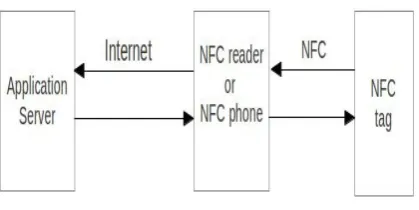
A typical NFC system consists of three main components, mainly NFC tags, readers and online servers (see
Figure 1).
Figure 1: Architecture of an NFC-enabled system (source: Pham, 2013)
Recent versions of BlackBerry devices have embedded NFC tags that can be used to perform varieties of NFC
related tasks, such as file sharing, barcode transfer, etc. In Nigeria a deposit money bank (DMB) developed a
payment solution that uses a custom NFC tag to validate transaction payments.
A lot of literature exists in the area of Attendance system. In an effort to improve attendance registration system,
researchers worked on the improvement from different perspectives. Some systems are computer-based which
may be online or offline system.
Reference [5] proposed an Automated Attendance Management System which is based on Bluetooth and NFC
technology. This system which is a desktop based java application receives user ID from NFC tag and sends via
Bluetooth to the server using user’s NFC enabled phone and fingerprint for authentication. However, one major
marked absent for that day, also the Bluetooth of the NFC enabled phone would have to be kept on every time
for communication with the server thereby leading to loss of energy on the phone because Bluetooth needs a lot
of power to operate.
Reference [6] proposed an Online Attendance Management System using RFID and Object Counter. The system
operates by capturing student id from their identity cards, perform total object count based on the number of
students present in a classroom that slide their cards, and stores in the RFID reader the details for later sending
to the main server. However, one major drawback of this system is that data stored in the RFID reader memory
can be stolen or manipulated while waiting to be sent to the main server.
Reference [7] proposed a mobile system for maintaining time and attendance in schools. The author sought to
ensure effective monitoring of student attendance records by making such records available via the mobile
phone. A system based on WAP (Wireless Access Protocol) was developed for monitoring student attendance.
While the developed system enjoyed the portability of the mobile phone, and was noted to provide ease of
navigation between modules and provision for feedback, thereby making the end-user great. The developed
solution still depend on the instructor (lecturer) to mark the attendance of each student from his/her mobile
phone. Use of this system is therefore time consuming and stressful to the instructors.
NFC is a unique wireless connectivity technology that enables convenient short-range communication between
electronic devices. It allows fast and reliable network connections between devices; NFC is a perfect solution
for controlling data in this increasingly complex and connected world [8,9].
NFC is also a short-range wireless technology for distances measured in centimeters, it doesn’t require user
configuration for connection to be established, to make two devices communicate, users simply brings the
devices close to each other and then connection would be established. NFC enabled-devices can operate in both
active and passive modes [10]
However, active NFC devices can supply all the power needed for communication with passive devices through
their internal initiated RF field which is the same way that contactless smart cards are powered and ensures that
data remains accessible even when the mobile device is not on [11,12,13]
3. Methodology
Drawing from the limitations of previous studies and works, a system was modelled using Unified Modelling
Language (UML) and PHP was used as the scripting language.
Bowen University, Iwo congregates students weekly on Wednesday for a Christian worship service, which is
compulsory for students. This provided a unique opportunity to test the reliability and validity of our system.
The Chapel’s cross-like structure has three main sitting divides, appropriated based on academic level that is,
the long wing accommodates 100 and 200 level students), the left wing seats 300 level students, while 400 and
500 level students occupy the right wing. We used purposive sampling in selecting few students entering each
System model and development
The primary motivation for the development of this system is to replace the existing manual student attendance
record entry and keeping, which is fraught with errors and gross misconduct.
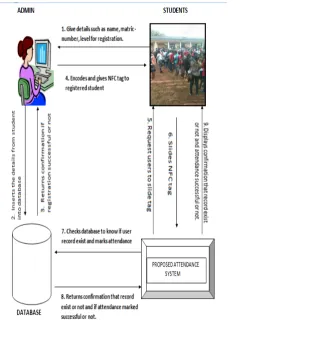
The system ensures that only registered users are granted access. Gaining access to the system will be done by
using the smart tag given to user at the point of registration, and goes through a process of validation to
confirmation (see Fig. 2).
Figure 2: The Proposed system architecture
4. Result
This project Attendance Management System was designed and dedicated to enhance the authentication of
attendance records in Bowen University Chapel. It is structured to the use of NFC tag. In constructing the
modules, the language used is PHP and Aptana Studio was used as the development environment to ease the
development of the system modules. Below are screenshots of some of the modules and the services of the
Figure 3: Students login Page
This is the page that receives all login details of the user from the NFC tag slide across the reader, verify the
details and also update the attendance record.
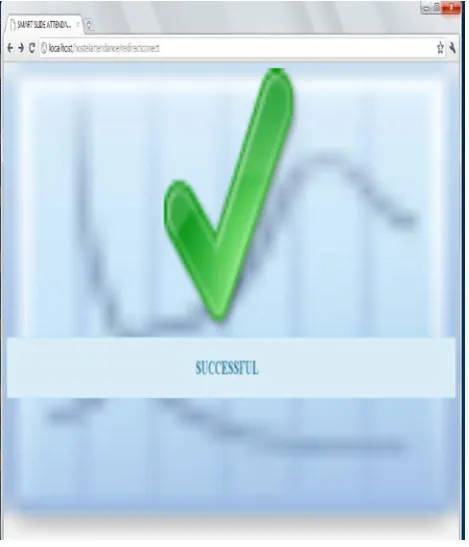
This page is displayed after the details extracted from the tag is being confirmed to be present in the student
table of the database and also after the attendance table of the database is being successfully updated with the
student new attendance details.
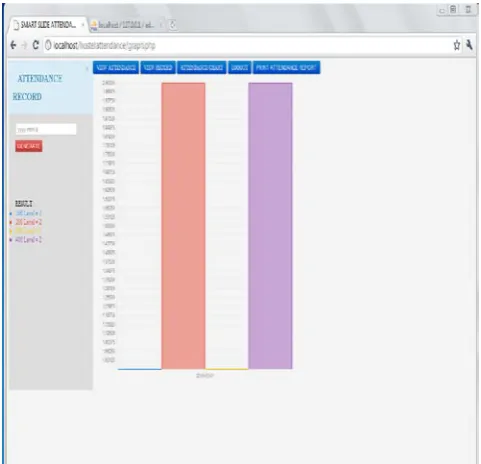
Figure 5: Graph page
This page generates a graph based on the total number of students present for each service and also prints out
the total number for record purpose.
5. Contribution to Knowledge
The imperatives of an effective information-technology driven attendance management system cannot be
overemphasized in the education system, which requires students to learn and by attendance in classes, lectures
and discussions. Apart from the fact that it adds value to adopting institutions, human resource departments,
production and construction departments benefits by adopting and implementing an efficient, effective and
sustainable attendance management system influenced by the praxis of human interactions. Some of the benefits
of this system for educational institution are (i) Compliance; since students know that their eligibility to write
examinations is dependent on a percentage (%) of attendance, which is IT managed, they would attend classes
(ii) Improved learning; the time wasted in passing across attendance sheet in class and searching for name and
signing will be totally eliminated
6. Conclusion
The design and implementation of the Attendance Management system have been developed such that the aim
and objectives of the project are achieved at the most suitable level. Finally based on the result of the research
study, it can be deduced that the implementation of the proposed system will help in solving problems that can
References
[1] Ankita Agrawal and Ashish Bansal (2013). Online Attendance Management System Using RFID with
Object Counter. International Journal of Information and Computation Technology, Volume 3, Number
3, pp.131-138.
[2] Aysha Qaiser and Shoab. A. Khan. (2006). Automation of Time and Attendance using RFID Systems, 2nd
International Conference on Emerging Technologies, Peshawar, Pakistan, 13-14
[3] Saurabh Kumar Jain et-al, (2012). Project Attendance Management System. International School of
Informatics and Management, 1-33.
[4] Claire Swedberg (2013) NFC New Interactive Production. RFID Journal. Retrieved from
https://www.nfcworld.com/2013/11/20/326962/passive-nfc-chip-can-power-lights-sounds/
[5] Samuel King Opoku,(2013). An Automated Biometric Attendance Management System with Dual
Authentication Mechanism Based on Bluetooth and NFC Technologies. International Journal of
Computer Science and Mobile Computing (IJCSMC) – ISSN: 2320-088X, 2, 18-25
[6] Ankita Agrawal and Ashish Bansal (2013). Online Attendance Management System Using RFID with
Object Counter. International Journal of Information and Computation Technology, Volume 3, Number
3, pp.131-138.
[7] Elmehdi A.A.A. (2008). Mobile System for Student Attendance in School. B.Sc. Dissertation: University
of Utara, Malaysia
[8] Kim tag (n.d). Nfc tags. Retrieved from http://kimtag.com/nfc_tags
[9] Anugerah Ayu and Barroon Ahmed (2014). TouchIn: An NFC Supported Attendance System in a
University Environment. International Journal of Information and Education Technology (IJIET) ,4 ,
1-6.
[10] Go to Tags (n.d). Nfc . Retrieved from https://www.gototags.com/technology/nfc/
[11] Dedy.R.Wijaya and Ibnu Asror. (2015). Integrated and Efficient Attendance Management System Based
on RFID. Journal of Theoretical and Applied Information Technology(JATIT),73,1-6.
[12] Ravishankar Yadav and Sumita Nainan. (2014). Design of RFID Based Student Attendance System with
Notification to Parents Using GSM. International Journal of Engineering Research &Technology
(IJERT) – ISSN: 2278-0181, 3, 1-4.