http://dx.doi.org/10.4236/msa.2015.69083
How to cite this paper: Tuan, T.T.A., Kuo, D.-H., Li, C.-C. and Li, G.-Z. (2015) Effect of Temperature Dependence on Electrical Characterization of p-n GaN Diode Fabricated by RF Magnetron Sputtering. Materials Sciences and Applications, 6, 809-817. http://dx.doi.org/10.4236/msa.2015.69083
Effect of Temperature Dependence on
Electrical Characterization of p-n GaN Diode
Fabricated by RF Magnetron Sputtering
Thi Tran Anh Tuan
1,2, Dong-Hau Kuo
1*, Cheng-Che Li
1, Guan-Zhang Li
11Department of Materials Science and Engineering, National Taiwan University of Science and Technology,
Taiwan
2School of Basic Sciences, Tra Vinh University, Tra Vinh, Vietnam
Email: *[email protected]
Received 21 August 2015; accepted 22 September 2015; published 25 September 2015
Copyright © 2015 by authors and Scientific Research Publishing Inc.
This work is licensed under the Creative Commons Attribution International License (CC BY). http://creativecommons.org/licenses/by/4.0/
Abstract
The p-n junction GaN diodes were all fabricated by sputtering technique with cermet targets for p- and n-type GaN and metal targets for electrodes. The interface of these p-n junction GaN diodes examined by high-resolution transition electron microscopy was clear and distinguishable. Lattice images identified the complete dissolution of Mg into the Ga site. At the room temperature, the diode had the turn-on voltage of 2.2 V, the leakage current of 2.2 × 10⁻⁷ A, the breakdown voltage of −6 V, the barrier height of 0.56 eV, ideality factor of 5.0 by I (current)-V (voltage) test and 5.2 derived from the Cheungs’ method, and series resistance of 560 Ω. These electrical properties were investigated at different testing temperatures from room temperature to 200˚C. The tem-perature dependence in the I-V characteristics of the p-n diodes can be successfully explained on the basis of thermionic-emission mode.
Keywords
p-n GaN Diode, I-V Measurement, Barrier Height, Leakage Current, Cheungs’ Method
1. Introduction
GaN material is one of the important semiconductors for high-power electronics due to its wide band gap cha-racteristics. The nitride-based materials have brought promising future for the application of electronic devices such as metal-oxide-semiconductor field effect transistor (MOSFET) and hetero junction field-effect transistor
issue [4]. Moreover, another important requirement for p-n diodes is to have a highly conductive p-type layer with a high holes concentration [5]-[8].
Several groups have put many efforts to explore p-n junction diodes with different approaches. Cao et al. reported the fabrication of n+-p junction in GaN by implantation of 29Si+. They determined that the breakdown voltage was 13 V at the reverse bias and ideality factor n was ~2 [1]. Lee et al. studied the effect of p-GaN layers on the turn-on voltage of LED. They found that the turn-on voltages at forward bias were in the range of 5.5 - 6.5 V with the incorporation of various amount Mg during growth in p-GaN layer [4]. Gupta et al. inves-tigated the p-n junction based on ZnO and copper phthalocyanineusing pulsed laser deposition and thermal eva-porator techniques. After I-V measurement at the room temperature, they reported that the barrier height and ideality factor were 0.63 ± 0.02 eV and 4.0 ± 0.3, respectively [5]. They also applied Cheungs’ and Norde me-thods to compare the junction parameters. Hwang et al. examined the characteristics of light-emitting diode comprised of p-ZnO/n-GaN hetero junction. The threshold voltage and leakage current were found at 5.4 V and 2 × 10⁻⁴ A, respectively [6]. Liu et al. investigated the In GaN-based light-emitting diode with a p-n GaN ho-mojunction. The ideality factor was estimated to be 2.11 at voltage regime of 2 V and barrier height was deter-mined to be 0.77 eV at the room temperature [7]. Park et al. studied the electrical characteristics of a GaN na-norod p-n junction diode patterned on the SiO2 substrate using e-beamlithography [8]. It was observed that the ideality factor varied from 2460 at 6 K to 13 at 298 K, with a large deviation for the ideal unit. The resistance linearly decreased from 0.05 to 0.0034 MΩ with the increasing temperature from 100 to 296 K. In the other pa-per, they reported the electron trapin the GaN nanorod p-n junction grown by molecular-beamepitaxy [9]. Data from the I-V curve showed the turn-on voltage of 7.2 V and breakdown voltage of −9 V at low temperature of 6 K. By increasing the temperature up to 300 K, the turn-on and break down voltages reduced to 0.4 and −0.8 V, respectively. Mohd Yusoff et al. described the growth and characterization of p-n junction diode based on GaN grown on Si (111). Using I-V measurement for the 700˚C-annealed GaN grown on AlN/Si (111) substrate, they determined that the extractedideality factors had the range of 15.14 - 19.68, decreasing with an increase in test-ing temperature (30˚C - 104˚C) [10]. Zhang et al. fabricated the n-ZnO/p-GaN hetero junction on GaN single crystal substrate with RF magnetron sputtering for ZnO. The threshold voltage was found to be 2.5 V from the
I-V data. The current increased rapidly when forward bias was above 2.5 V and it was strongly blocked under reverse bias. Their series resistance (Rs) of the device was determined to be 102 Ω from the slope of the curve
I/(dI/dV) versus I[11]. All the above-mentioned reports have their GaN films grown by the techniques of metal- organic chemical vapor deposition (MOCVD) and molecular beam epitaxy (MBE). Some of their excellent per-formances are established on the GaN layers with the epitaxial quality for LEDs [1] [4] [7].
Radio-frequency (RF) reactive sputtering technique has been chosen as a method to grow the p- and n-type GaN layers for the p-n junction GaN diodes. The advantages of using the sputtering technique include lower deposition temperature, low equipment cost, and secure working atmosphere without using the toxic metal- organic precursors and ammonia [12]-[15]. In this study, the electrical I-V characteristics of p-n GaN diodes were determined by the thermionic emission (TE) modeat a wide testing temperature range of 25˚C - 200˚C.
2. Experimental Procedures
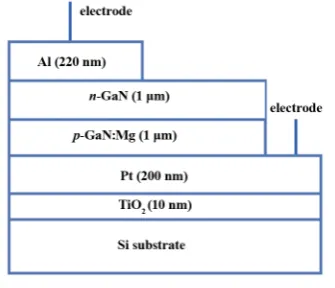
Figure 1. Layers structure of a p-n GaN homo junction diode.
a pure Al target. During Al deposition, only Ar gas was used at a flow rate of 5 sccm meanwhile the RF power was kept at 80 W. The detailed experimental procedure for depositing the GaN films can be referred to our pre-vious work [12] [13].
Surface root-mean-square (rms) roughness of Mg-GaN and GaN films was evaluated by atomic force micro-scopy (AFM, Dimension Icon, Bruker). Before testing TEM images, the FIB system was used to cut samples in
p-n GaN device. High-resolution transmission electron microscopy (HR-TEM, Tecnai G2 F20, Philips), operat-ing at 200 keV was used to the determine the SEAD pattern, lattice images of films, and the cross-sectional im-age of devices. The electrical I-V characteristics of p-n GaN diodes were determined by using Semiconductor Device Analyzer (Agilent, B1500A) in the temperature range of 25˚C - 200˚C.
3. Results and Discussion
3.1. Structural and Surface Morphological Characteristics
Hall effect measurement (HMS-2000, Ecopia) was conducted for the electron concentration (Nd), hole concen-tration (Np), and carrier mobility (μ) of n- and p-GaN films at the room temperature. As a result, they were found to be Nd= 5.8 × 1017 cm−3 and μ = 11 cm2/Vs for n-GaN film and Np= 2.1 × 1017 cm−3 and μ = 26 cm2/Vs for
p-GaN films. In our previous study on materials development, the band gap Eg values of n-GaN deposited at 200˚C and p-GaN deposited at 400˚C were found to be 2.99 and 2.96 eV, respectively [12] [13].
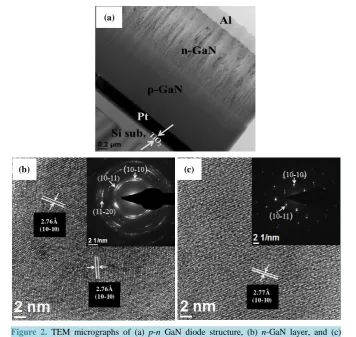
The layers structure of p-n GaN homo junction diode is shown in the Figure 1. The cross-sectional TEM im-age of the p-n GaN diode structure is shown in Figure 2(a). Each layer of the diode exhibited good adhesion. The interface between p- and n-GaN layers was crack- and pore-free. The interface between n- and p-GaN is clearly distinguished, which indicates interfacial diffusion is minimized because of depositing firstly p-GaN at higher temperature of 400˚C followed by n-GaN at lower temperature of 200˚C. The thicknesses of Al and Pt electrodes were 200 and 220 nm, respectively. The Pt/TiO2/Si combination has been popularly used for the study of non-volatile memory. The thicknessof n- and p-GaN layers was found to be 1 µm. As an original work, the thickness effect on the diode performance needs further investigations.
The high-resolution (HR) TEM lattice images of films are presented in Figure 2(b) for n-GaN and Figure 2(c) for p-GaN. The insets show the selected area electron diffraction (SAED) patterns. The n- and p-GaN phases were clean and had no second phases. The lattice images provide important evidence to support the homogeneity of the n- and p-GaN deposited by reactive sputtering. It is especially important for p-GaN, because this informa-tion can guarantee the complete dissoluinforma-tion of Mg dopant into the Ga lattice site to form the complete solid so-lution without phase segregation. The Mg solubility in GaN is well known for using the MOCVD technique. Our lattice images indicate that the sputtering kinetic energy is strong enough to dissolve Mg into the Ga lattice. For the n-GaN layer, the measured d-space value was 2.76 Å, which corresponded to the (10 10) crystalline plane. Other crystalline plane such as (10 11) and (1120) could also be observed from the SAED pattern. For the
p-GaN layer, the measured d-space value had a bigger value of 2.77 Å due to the lattice expansion by using the bigger Mg dopant of 0.66 Å to substitute the smaller Ga of 0.62 Å. The HR lattice image of p-GaN exhibited similar crystalline (10 10) plane. However, the (10 11) plane still showed in SAED pattern. Both of n- and
(b) (c)
2.76Å (10-10)
2.76Å
(10-10) 2.77Å
(10-10)
Figure 2. TEM micrographs of (a) p-n GaN diode structure, (b) n-GaN layer, and (c)
p-GaN layer.
crystalline planes. The p-GaN shows the dotted pattern, which indicates the p-GaN has the tendency to become single crystal-like. In addition, the XRD results from our previous indicate that full-width at half-maximum (FWHM) at (10 11) is 0.30 for pure n-GaN and 0.25 for p-Mg-doped GaN at 10% [13]. The addtion of 10% Mg improved slightly the structure of GaN. The instead of excess (~15%) and less (~5%) Mg-doped GaN films, the FWHM of (10 11) was increased to 0.30 and 0.34, respectively. The TEM characterization supports with the evidence that Mg doping can improve the crystallinity of the growing p-GaN films.
Surface topographies of both GaN films were analyzed by AFM, as shown in Figure 3(a) and Figure 3(b), respectively. The root-mean-square (rms) roughness values of n- and p-GaN were found to be 2.42 and 3.12 nm, respectively. The grains become larger and the surface rougher due to the Mg doping into the GaN films. The surface roughness of p-GaN can be attributed to the disturbance of growth kinetics by the Mg dopant or a dif-ference in atomic size between Ga and Mg, which made the lattice distortion and dislocation generation.
3.2. Current-Voltage (I-V) Characteristics
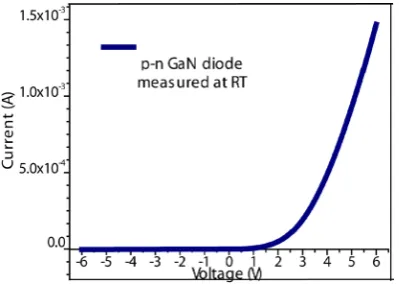
Figure 4 shows the plot of the I-V characteristics of p-n GaN diode at the room temperature. The leakage cur-rent of p-n GaN diode was 2.2 × 10⁻⁷ A at −1 V. The turn-on voltage was found at ~2.2 V for the forward bias, and the breakdown voltage was determined above −6 V.
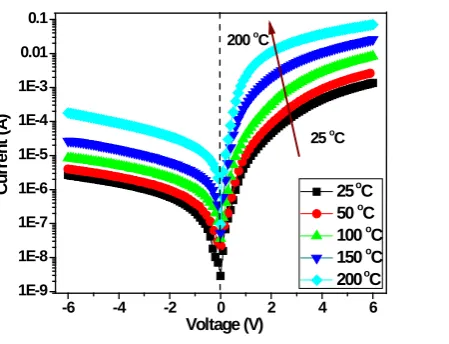
The forward and reverse I-V characteristicofa p-n GaN diode was also determined at the different testing temperatures. The electricalcharacteristics can be generally evaluated by using an equation based on a well- known standard thermionic-emission (TE) relation for electron transport from a metal-semiconductor contact (for qV > 3 kT) [5] [14] [16]. It can be given as below
0 exp 1
qV
I I V
nkT
= −
[image:4.595.136.493.80.417.2](a) (b)
Figure 3. AFM topographies of (a) n-GaN filmdeposited at 200˚C and (b) p-GaN filmdeposited
[image:5.595.215.415.256.398.2]at 400˚C.
Figure 4. Electrical properties of p-n GaN homo junction diode measured at the room temper-
ature (RT).
where V is applied voltage, T the experiment temperature in Kelvin, n ideality factor, I0saturation current, q the electronic charge, and k the Boltzmann constant. The saturation current is expressed by
* 2
0 exp
B
q
I AA T
kT φ
= −
(2)
where A* is the effective Richardson constant, A the diode area, and φB the barrier height. In the present work, the p-n GaN diode has a square shape and its area was measured to be 1 mm2. The theoretical value of A* was found to be 26.4 Acm−2/K−2, based on the effective electron mass (m*= 0.22 me) for GaN [16]-[19]. The plot of ln I versus V, based upon Equation (1), can beused to derive the saturation current, which can be obtained by extrapolated the straight line of the linear region of the semilog plot to zero applied voltage. The barrier height of the p-n GaN diode is defined as
* 2
0 ln B
kT AA T
q I
φ =
(3)
In addition, the calculation of the ideality factor n is based upon the pure TE mode. It can be obtained from the slope of the linear region of ln I-V characteristics under the forward bias. It is given by [5] [16]-[19]
d dln
q V
n
kT I
=
(4)
-6 -4 -2 0 2 4 6 1E-9
1E-8 1E-7
Voltage (V)
50 C 100 o
C 150 oC 200 o
[image:6.595.217.442.80.252.2]C
Figure 5. The forward and reverse current-voltage characteristics of a
p-n GaN diodein the testing temperature range of 25˚C - 200˚C.
to 0.69 eV at 200˚C. By using Equation (4), the ideality factor n decreased with the increase in the testing tem-perature, dropped from 5.0 at 25˚C to 2.5 at 200˚C. These achieved parameters for the diode with all layers made by sputtering are consistent with the reported values in some previous papers for p-n junction diodes with GaN made by MOCVD [5] [9].
3.3. Calculations the Series Resistance R
sand Ideality Factor n
The series resistance Rsand the ideality factor n are very important parameters. The I-V characteristics deviate considerably with the change in ideality factor n due to the effect of series resistance Rs. The series resistance Rs and ideality factor n of a p-n diodes can be determined by using the Cheungs’ method [20], which is defined as below
( )
dd ln S
V nkT
IR
I = q + (5)
As can be seen Figure 6, the plot of dV/d (lnI) versus I will be linear (based on Equation (5)). The slopes will give the values of series resistance Rsand the intercepts will give the values of ideality factor n[5] [15] [18] [20].
Table 1 also provides the results from a detailed calculation of the series resistances Rs and ideality factor n by the Cheungs’ method.
3.4. Discussion
Table 1 shows a comparison of data derived from the I-V data for the all sputtering-made p-n GaN diode. It is noted that the ideality factor n decreases whereas the barrier increases with the increase in the testing tempera-ture. This result can be attributed to the combination of the low and high barrier heights of diodes with the I-V
behavior in the standard TE mode. At the room temperature, the flow of the electron transport across the metal- semiconductor interface of devices is able to overcome the lower barriers. Therefore, the current transport will be determined by electrons flowing through the path of lower barrier height and a larger ideality factor. When the testing temperature increases, more and more electrons will have sufficient energy to transcend the higher barrier. As a result, the dominant barrier height will increase with increasing the testing temperature [17]. Other reasons are the inhomogeneous thickness of films and non-uniformity of the interfacial charges to lead to the in-crease in ideality factor and the dein-crease in the barrier height for testing at lower temperatures. In addition, the increase in the carrier concentration of GaN layers and the decrease in the parasitic resistances found at the higher testing temperature also have caused the rise of barrier height and the fall of ideality factor [21].
Figure 6. Plot of dV/dln(I) versus I for p-n GaN diode
in the temperature range of 25˚C - 200˚C.
Table 1. The parameters calculated from electrical characteristics of a p-n GaN diode as a function of testing
temperature.
Temp (˚C) Leakage current (A) at −1 V Barrier height From I-V Cheungs’ function dV/dln(I) vs I
B
φ (eV) N Rs (Ω) n
25 2.2 × 10⁻⁷ 0.56 5.0 560 5.2
50 3.8 × 10⁻⁷ 0.59 4.6 362 4.9
100 1.1 × 10⁻⁶ 0.63 3.7 165 4.0
150 3.1 × 10⁻⁶ 0.67 3.1 78 3.4
200 1.7 × 10⁻⁵ 0.69 2.5 38 2.7
In the other paper, they also investigated the I-V characteristics at different testing temperatures for Al-doped MgxZn1-xO/AlGaN junction diodes with Mg-ZnO made by RF sputtering on the MOCVD-grown AlGaN. The extracted ideality factors were found in the range of 5.04 - 15.90, decreasing as the testing temperature increased from 25˚C to 125˚C [22]. Mohd Yusoff et al. described the growth and characterization of p-n junction diode based on GaN grown on Si (111) [10]. The leakage current was found 1.32 × 10⁻⁶ at the room temperature. The ideality factors n had the range of 15.14 - 19.68, decreasing with an increase in testing temperature (30˚C - 104˚C). Chen et al. studied the current rectification in a single GaN nanowire with a well-defined p-n junction [23]. Their ideality factor was calculated in the range of 5.5 - 6.5. The higher ideality factor was also obtained after testing at lower temperatures.
It is observed that there is a small difference between the values of ideality factor obtained from the lnI-V plot at forward bias and from the dV/d(lnI)-I plot. This difference could be due to the presence of series resistance, interface states, and the voltage drop across the interfacial layer [21]-[23]. A good diode is expected to have small temperature dependence in ideality factor. So, the observed high ideality factor could be due to several reasons such as accelerated recombination of electrons and holes in depletion region, the presence of interfacial layer, and the imperfections which may be due to the presence of crystalline and amorphousregions [5] [6].
From Table 1, there is also a clear trend of decreasingtheseries resistances Rs with a rise in the testing tem-perature. The Rsvalues were observed to drop from 560 Ω at 25˚C to 38 Ω at 200˚C. The fall in Rsfor p-n GaN diode tested a higher temperature indicates that the diode has smaller ideality factor, more free electrons leading to the high current, and smaller series resistance in the forward bias.
4. Conclusion
p-n GaN diodes have been successfully fabricated only by using the cost-effective magnetron sputtering. The
[image:7.595.117.513.318.431.2]This work was supported by the Ministry of Science and Technology of Taiwan under grant numbers MOST 104-2623-E-011-003-ET and MOST 104-2811-E-011-005.
References
[1] Cao, J., Laroche, J.A., Ren, F., Peaton, S.J., Lothian, J.A., Singh, R.K., Wilson, R.G., Guo, H.J. and Pennycook, S.J. (1999) Implanted p-n Junctions in GaN. Solid-State Electron, 43, 1235-1238.
http://dx.doi.org/10.1016/S0038-1101(99)00012-X
[2] Lee, M.L., Sheu, J.K., Yeh, L.S., Tsai, M.S., Kao, C.J., Tun, C.J., Chang, S.J. and Chi, G.C. (2002) GaN p-n Junction Diode Formed by Si Ion Implantation into p-GaN. Solid-State Electron, 46, 2179-2183.
http://dx.doi.org/10.1016/S0038-1101(02)00224-1
[3] Baik, K.H., Irokawa, Y., Ren, F., Pearton, S.J., Park, S.S. and Park, Y.J. (2003) Temperature Dependence of Forward Current Characteristics of GaN Junction and Schottky Rectifiers. Solid-State Electron, 47, 1533-1538.
http://dx.doi.org/10.1016/S0038-1101(03)00071-6
[4] Lee, C.R., Yeon, J.M., Choi, D.K. and Ahn, H.K. (2001) The Effect of p-GaN: Mg Layers on the Turn-On Voltage of p-n Junction LED. Journal of Crystal Growth, 222, 459-464. http://dx.doi.org/10.1016/S0022-0248(00)00930-1 [5] Gupta, R.K., Yakuphanoglu, F., Ghosh, K. and Kahol, P.K. (2011) Fabrication and Characterization of p-n Junctions
Based on ZnO and CuPc. Microelectronic Engineering, 88, 3067-3069. http://dx.doi.org/10.1016/j.mee.2011.05.023 [6] Hwang, K., Kang, S.H., Lim, J.H., Yang, E.J., Oh, J.Y. and Park, S.J. (2005) p-ZnO/n-GaN Heterostructure ZnO
Light-Emitting Diodes. Applied Physics Letters, 86, Article ID: 222101. http://dx.doi.org/10.1063/1.1940736 [7] Liu, Y.J., Guo, D.F., Chua, K.F., Cheng, S.Y., Liou, J.K., Chen, L.Y., Tsai, T.H., Huang, C.C., Chen, T.Y., Hsua, C.S.,
Tsai, T.Y. and Liu, W.C. (2011) Improved Current-Spreading Performance of an InGaN-Based Light-Emitting Diode with a Clear p-GaN/n-GaN Barrier Junction. Displays, 32, 330-333. http://dx.doi.org/10.1016/j.displa.2011.04.004 [8] Park, Y.S., Park, C.M., Lee, J.W., Cho, H.Y., Kang, T.W., Yoo, K.H., Son, M.S. and Han, M. (2008) Electrical
Trans-port Properties of a Nanorod GaN p-n Homo Junction Grown by Molecular-Beam Epitaxy. Journal of Applied Physics, 103, Article ID: 066107. http://dx.doi.org/10.1063/1.2896636
[9] Park, Y.S., Park, C.M., Park, C.J., Cho, H.J., Lee, S.J., Kang, T.W., Lee, S.H., Oh, J.E., Yoo, K.H. and Son, M.S. (2006) Electron Trap Level in a GaN Nanorod p-n Junction Grown by Molecular-Beam Epitaxy. Applied Physics Letters, 88, Article ID: 192104. http://dx.doi.org/10.1063/1.2203735
[10] Mohd Yusoff, M.Z., Hassan, Z., Ahmed, N.M., Hassan, H., Abdullah, M.J. and Rashid, M. (2013) pn-Junction Photo- diode Based on GaN Grown on Si (111) by Plasma-Assisted Molecular Beam Epitaxy. Materials Science in Semicon- ductor Processing, 16, 1859-1864. http://dx.doi.org/10.1016/j.mssp.2013.07.015
[11] Shen, Y.W., Chen, X., Yan, X.Q., Yi, F., Bai, Z.M., Zheng, X., Lin, P. and Zhang, Y. (2014) Low-Voltage Blue Light Emission from n-ZnO/p-GaN Heterojunction Formed by RF Magnetron Sputtering Method. Current Applied Physics, 14, 345-348. http://dx.doi.org/10.1016/j.cap.2013.12.011
[12] Li, C.C. and Kuo, D.H. (2014) Effects of Growth Temperature on Electrical and Structural Properties of Sputtered GaN Films with a Cermet Target. Journal of Materials Science: Materials in Electronics, 25, 1404-1409.
http://dx.doi.org/10.1007/s10854-014-1742-4
[13] Li, C.C. and Kuo, D.H. (2014) Material and Technology Developments of the Totally Sputtering-Made p/n GaN Dio-des for Cost-Effective Power Electronics. Journal of Materials Science: Materials in Electronics, 25, 1942-1948. http://dx.doi.org/10.1007/s10854-014-1826-1
[14] Tuan, T.T.A., Kuo, D.H., Lin, K.F. and Li, G.Z. (2015) Temperature Dependence of Electrical Characteristics of n-InxGa1−xN/p-Si Hetero-Junctions Made Totally by RF Magnetron Sputtering. Thin Solid Films, 589, 182-187. http://dx.doi.org/10.1016/j.tsf.2015.05.018
[16] Ravinandan, M., Rao, P.K. and Reddy, V.R. (2008) Temperature Dependence of Current-Voltage (I-V) Characteristics of Pt/Au Schottky Contacts on N-Type GaN. Journal of Optoelectronics and Advanced Materials, 10, 2787-2792. [17] Kumar, A., Vinayak, S. and Singh, R. (2013) Micro-Structural and Temperature Dependent Electrical Characterization
of Ni/GaN Schottky Barrier Diodes. Current Applied Physics, 13, 1137-1142. http://dx.doi.org/10.1016/j.cap.2013.03.009
[18] Kumar, A., Arafin, S., Amann, M.C. and Kumar, R.S. (2013) Temperature Dependence of Electrical Characteristics of Pt/GaN Schottky Diode Fabricated by UHV E-Beam Evaporation. Nanoscale Research Letters, 8, 481.
http://dx.doi.org/10.1186/1556-276X-8-481
[19] Reddy, N.N., Reddy, V.R. and Choi, C.J. (2011) Influence of Rapid Thermal Annealing Effect on Electrical and Structural Properties of Pd/Ru Schottky Contacts to N-Type GaN. Materials Chemistry and Physics, 130, 1000-1006. http://dx.doi.org/10.1016/j.matchemphys.2011.08.026
[20] Cheung, S.K. and Cheung, N.W. (1985) Extraction of Schottky Diode Parameters from Forward Current-Voltage Cha-racteristics. Applied Physics Letters, 49, 85. http://dx.doi.org/10.1063/1.97359
[21] Hsueh, K.P. (2011) Temperature Dependent Current-Voltage Characteristics of n-MgxZn1−xO/p-GaN Junction Diodes.
Microelectronic Engineering, 88, 1016-1018. http://dx.doi.org/10.1016/j.mee.2011.01.068
[22] Hsueh, K.P., Cheng, P.W., Lin, W.Y., Chiu, H.C., Wang, H.C., Sheu, J.K. and Yeh, Y.H. (2014) Temperature-De- pendent Current-Voltage Characteristics of Al-Doped MgxZn1-xO/AlGaN n-p Junction Diodes. ECS Journal of Solid
State Science andTechnology, 3, Q65-Q68. http://dx.doi.org/10.1149/2.026404jss