How to cite this paper: Mothia, J., Noumi, E. and Nditafon, G. (2015) Developing Thinking Skills among Third Grade (Class 4) Pupils in Some Elementary Practising Schools in Edéa, Cameroon Using Lessons on the Human Skeleton. Open Access Li-brary Journal, 2: e2071. http://dx.doi.org/10.4236/oalib.1102071
Developing Thinking Skills among Third
Grade (Class 4) Pupils in Some Elementary
Practising Schools in Edéa, Cameroon
Using Lessons on the Human Skeleton
Jeannette Mothia1, Emmanuel Noumi2*, George Nditafon11Didactics of Biology, Faculty of Sciences of Education, Postgraduate Centre for Training and Research in
Human, Social and Educational Sciences, University of Yaoundé I, Yaoundé, Cameroon
2Laboratory of Plant Biology, Higher Teachers’ Training College, University of Yaoundé I, Yaoundé, Cameroon
Received 27 October 2015; accepted 11 November 2015; published 16 November 2015
Copyright © 2015 by authors and OALib.
This work is licensed under the Creative Commons Attribution International License (CC BY). http://creativecommons.org/licenses/by/4.0/
Abstract
The objective of this study was to introduce an educational tool in primary school that could fa-cilitate the development of thinking skills in learners. Klopfer’s taxonomy of educational objec-tives was used to introduce the fundamental notion of the hypothetico-deductive theory aimed at immersing the class into task situations of identifying the educational aspects in a lesson. A total of 270 Class 4 (third graders) participated in the study. Result revealed that at the pretest, the mean performance of those in the control group was 9.53/20 and for those in the experimental group it was 9.09/20. Up to one month following experimentation, pupils in the experimental group tered an improved mean performance (11.33/20) in the posttest, while the control group regis-tered a drop (8.84/20) compared to their mean pretest performances. Those in the experimental group further showed greater interest and involvement in the construction of their knowledge and thinking skill compared to those in the control group. The approach appeared to be beneficial to both pupils and teachers. It places learners in a teaching/learning situation that motivates the development of thinking and problem-solving skills.
Keywords
Educational Resources, Didactics of Life and Earth Sciences, Learning Thinking Skills, Human Skeleton
Subject Area: Education
OALibJ | DOI:10.4236/oalib.1102071 2 November 2015 | Volume 2 | e2071
1. Introduction
The objective of any educational policy has always been the quest for quality education to ensure learner’s har-monious integration into society thereafter. Nowadays many teaching/learning actions suffer from serious insuf-ficiency due to perpetual mutations in life situations (economic, cultural, environmental and political) [1]-[4]. The teaching of the sciences and scientific education are in crisis [5]. The pupils receive an impressive amount of knowledge, but are unable to think to find solutions to their life situations [6]-[10]. To this effect, the school needs to rethink its mission and adopt teaching approaches that will bring the child to learn how to perceive problems and to think logically. Several researchers have proposed models susceptible to improving school suc-cess rate by classifying learning into educational objectives [11]-[13] or organising teaching content into mod-ules [14]. The taxonomy of educational objectives ensured that learning objectives were clearly defined without ambiguity to enable the teaching/learning of specific content and processes.
Klopfer’s [12] taxonomy of educational objectives was used to guide teaching/learning at:
− the instructional or knowledge and comprehension category or just the acquisition of scientific knowledge [12];
− the formation or observation and measurement category or knowledge of being level (knowledge of the state, characteristic or property of an object, living thing or part of it) [12].
Noumi’s hypothetico-deductive thinking theory: “considering characteristic or property as solution and de-ciphering the problem that led to it possession” was used to guide the process of education or the development of thinking skills or knowledge of the application of know-how [7] [15].
The 3rd graders in primary school in Cameroon have learned to read and write in previous classes and are be-ing introduced to other subjects on the syllabus for that class. Among these lessons is natural sciences often called nature study in the Cameroon system at this stage. Generally, the reflex is to believe that 3rd graders in this system are not yet mature intellectually enough to think. Consequently, teachers at this level are often re-quired to limit their lessons exclusively to what is found in the school textbook. School textbooks are often in-complete without the educational aspect of the development of thinking skills, psychosocial competences and problem-solving abilities, thus reducing teaching to mere instruction. The question that this investigation sets out to answer therefore is:
Given that the 3rd graders in Cameroon are being introduced to nature study at this stage in their education, is it possible to capitalise on this to introduce them to learning how to think? If so, what could be the possible out-come?
The purpose of this survey is therefore to show the suitability of selected categories of Klopfer’s [12] taxon-omy of pedagogic objectives appropriate to this level and the hypothetico-deductive thinking methodology in developing educational aspects that the human skeleton teaches mankind and which can be used in guiding the thinking process in learners.
2. Methodology
2.1. Sampling [image:2.595.90.543.639.710.2]This study was carried out in the 2011-2012 academic year in Cameroon. The survey population consisted of pupils of primary 4 of teaching practice application schools attached to the Teacher Training College (ENIEG) of Edéa. Four urban (Edéa Central) and three semi-urban (Basseké-Mbanda quarter) were involved in the study. The experimental and control groups were designated through random drawing without returning the drawn school into the lot [16]. The first draw aimed to designate the experimental group and the second to designate the control group. The results of this sampling are represented inTable 1.
Table 1. Distribution of the experimental and control groups in the sample.
Schools Experimental Group Control Group
Classes No. Class No. Total
Edéa Urban Group II PC 4A 69 PC 4A 70 139
Basseké Mbanda Group II PC 4B 83 PC 4B 67 150
Total 152 137 289
OALibJ | DOI:10.4236/oalib.1102071 3 November 2015 | Volume 2 | e2071 2.2. Materials, Experimentation, Data Collection, and Treatment
2.2.1. Materials
Materials consisted of:
− two lessons on observation of the human body; and the human skeleton and movement; − post and pretests based on the lessons
Lessons
The lessons were 30 minutes in duration each and based on the topics listed above. The lessons were designed to cover:
− selected subcategories of Klopfer’s taxonomic categories A.0 (Knowledge and comprehension) and B.0 (observation and measurement);
− the perception of characteristics or properties as solutions to problems from which brainstorming is em-ployed to decipher the problem necessitating the possession of the characteristic or property [7]-[9]. More specifically, the two lessons used in the experimental group were structured as follows:
− Klopfer’s taxonomic category A.0—Knowledge and Comprehension
o A.01: knowledge of specific facts such as functions of the skeleton;
o A.02: knowledge of scientific terminologies;
o A.03: knowledge of concepts of science such as components and functions of the skull, trunk, upper and lower limbs;
o A.06: knowledge of classification such as types of bones—long, short and flat bones. − Klopfer’s taxonomic category B.0—Observation and Measurement
o B.01 and 02: observation of objects and phenomena and description of their characteristics using appropriate scientific terminologies, such as bones can form box-like enclosures called the skull or cranium and cage- like enclosures called the ribcage.
− Hypothetico-deductive thinking process such as:
o A characteristic or property is a solution to a particular problem;
o What could be the possible problem being solved by the possession of the characteristic or property;
o Clear and precise statement of the problem;
o Identification of the know-how of the object, phenomenon, event, organism or its part;
o Application of identified solution in same field of biology, other fields of biology, other sciences and in so-ciety including technology.
Assessment tests
Pre- and post-assessment tests were administered before and after the lessons to both the control and experi-mental groups based on the concepts of knowledge and comprehension; observation and measurement; and the hypothetico-deductive thinking process.
The pretest for the control and experimental groups consisted in submitting the pupils to a test before teaching by educational objectives, to diagnose the entry level of pupils. The test which was marked on 20 was adminis-tered to a total of 289 pupils distributed as follows: 152 in the control group and 137 in the experimental group.
The posttest consisted in submitting the pupils to a test after teaching by educational objectives, to verify the level of attainment of the fixed objectives in the research. The worked sheets of the pupils were corrected by authors to avoid possible halo effect by the teachers of the classes concerned.
The posttest for both groups had as objectives to find out:
− if pupils attained the expected teaching and learning objectives—a formative evaluation; − the level of development of the intellect(education) of pupils after the lessons.
The test questions were designed to find out the following:
− Question 1 (Q1): based on knowledge and comprehension required pupils to illustrate their mastery of scien-tific knowledge about the human skeleton. This was marked on 6 marks and structured as follows:
o The true and false answer type questions;
o Underlining the correct answer from among a list of suggested distracters.
− Question 2 (Q2): based on observation and measurement was also marked on 6 marks. This was structured into:
o Labelling parts of bones in longitudinal section;
OALibJ | DOI:10.4236/oalib.1102071 4 November 2015 | Volume 2 | e2071
o Cross-matching of structure with bone type as an alternative way to illustrate the mastery of the concept of observation and measurement.
− Question 3 (Q3): based on the hypothetico-deductive thinking process, was marked out of 8 marks and re-quired pupils to show evidence of the appropriation of brainstorming techniques and resources mobilisation. It was based on the following format:
o Underlining the correct answer;
o Providing short answer responses;
o Brainstorming to decipher problems being solved by the characteristics identified in Q2 above;
o The yes or no answer type questions.
2.2.2. Experimentation
During the experimentation, the class teachers were trained to appropriate the use of Klopfer’s [12] taxonomy of pedagogic objectives and Noumi’s hypothetico-deductive thinking theory to guide preparation and teaching of the lessons. In the control group, the class teacher taught the lessons following his normal classroom practice which consisted of the traditional scientific approach of “Observing, Hypothesising, Experimenting, Results, In-terpretation and Conclusion (OHERIC)”. The lesson in both control and experimental groups were conducted under the same pedagogic conditions (classroom setting, participation, same timetable, learners not informed that the survey was actually an experiment being conducted, and the same class teacher teaching the lessons).All of these aimed to minimise the Hawthorne effect [17]. This was to ensure that changes in learning outcome could within reasonable limits be attributed to the experiment and not to psychological factors caused by prior knowledge of the experimentation. The non-disclosure of the purpose of the study to the control group was more so to minimize in addition to the Hawthorne effect, the Henry effect of working hard by members of the group to defeat the purpose through overcoming the disadvantage of being in the control group. Learners of the ex-perimental group were however informed that a particular pedagogic action was being undertaken which re-quires the mustering of additional effort in order to stay at a high level of performance on their part. The pre- and posttest scripts of participants were collected and marked by the authors of this study after harmonizing a marking guide to minimize the halo effect due to familiarity between the class teachers and pupils on the one hand and to minimize discrepancies in marks awarded to respondents among the markers (authors) as much as possible.
2.2.3. Data Collection
Data were collected between November and the first week of December in the 2011-2012 academic year. In each class, the questionnaire was first administered as a pretest followed by teaching the two lessons on the hu-man skeleton. The same questionnaire was again administered one month after the lessons in a posttest assess-ment to minimize familiarity effect with the questionnaire.
2.2.4. Data Treatment and Analysis
OALibJ | DOI:10.4236/oalib.1102071 5 November 2015 | Volume 2 | e2071
Table 2. (a) Summary treatment of observations; (b) Reliability statistic; (c) Intraclass correlation coefficient.
(a)
N %
Observations
Valid 135 100.0
Excludeda 0 0.0
Total 135 100.0
aExclude list-wise based on all variables.
(b)
Cronbach Alpha Number of Elements
0.947 10
(c)
Intraclass Correlationb
95% Confidence Interval F-Test with True Value 0
Lower Bound Upper Bound Value df1 df2 Sig. Single measures 0.641a 0.581 0.703 18.879 134 1206 0.000 Average measures 0.947c 0.933 0.959 18.879 134 1206 0.000 aThe estimator is the same, whether the interaction effect is present or not; bType C intraclass correlation coefficients using a consistency definition (the variance between measures is excluded from the denominator variance); cThis estimate is calculated on the basis of the assumption that the inter-action effect is inexistent since it cannot be estimated otherwise.
Comparing and interpreting the pre- and posttest mean performances between the control and experimental groups consisted of generating Z scores which employed the measure of central tendency (mean) and the meas-ure of variability (standard deviation).
3. Results
3.1. Inter-Rater Reliability
The results show a two-way random effect model where people effects are random and measure effects are fixed.
InTable 2(c), an ICC(2) was computed for 3 raters across 135 ratees. In this table, ICC(2, 1) = 0.641. This means
that ICC(2, k), which in this case is ICC(2, 3) = 0.947. Therefore, 94.7% of the variance in the mean of these raters is “real”. Coupled with a Cronbach’s alpha of 0.947 (Table 2(b)), the inter-rater reliability of the assess-ment plan in this study was found to be very satisfactory.
3.2. Descriptive Results
FromTable 3, it is observed that while the mean marks for the pretest control (M = 9.53) and experimental (M
= 9.09) groups remained perceptibly close to one another, those in the overall performance regrouping all three categories investigated showed perceptible differences with the control (M = 8.84) and the experimental (M = 11.33). This is also reflected in the variances of the two groups in both the pretest and the overall posttest.
3.2.1. Overall Pretest Performance.
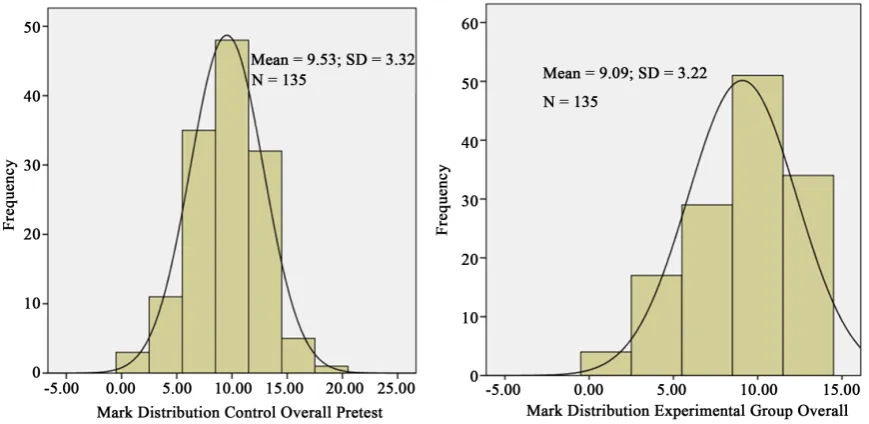
The distribution of the pretest results is shown in Table 4andFigure 1. These marks are normally distributed for both the control and experimental groups with a mean of 9.53/20 and 9.09/20 respectively. From the mean performances at the pretest, it can be inferred that the two groups have appreciably very close entry levels.
3.2.2. Posttest Performances Category by Category
OALibJ | DOI:10.4236/oalib.1102071 6 November 2015 | Volume 2 | e2071
Figure 1. Histogram of mark distribution of the control and experimental groups at the pretest. Source: Data collected and
analysed by Mothia, Noumi and Nditafon.
Table 3. General distribution of the results.
Pretest
Posttest
Knowledge &
Comprehension Observation & Measurement
Perception of Characteristics as Solution to Problems
Overall Performance in All Categories Taken Together
Control Experimental Control Experimental Control Experimental Control Experimental Control Experimental
N 135 135 135 135 135 135 135 135 135 135
Mean 9.53 9.09 2.53 3.48 2.64 3.51 3.48 4.87 8.84 11.33
STD 3.32 3.22 0.88 1. 04 0.71 0.94 1.26 0.99 3.26 3.03
[image:6.595.88.537.526.718.2]Var. 10.99 10.38 0.77 1.07 0.50 0.88 1.59 0.99 10.61 9.22
Table 4. Mark distribution at the overall pretest in the control and experimental groups.
Marks Control Experimental
Frequency Percent Distribution Frequency Percent Distribution
1.00 3 2.2 4 3.0
4.00 11 8.1 17 12.6
7.00 35 25.9 29 21.5
10.00 48 35.6 51 37.8
13.00 32 23.7 34 25.2
16.00 5 3.7 0 0
19.00 1 .7 0 0
OALibJ | DOI:10.4236/oalib.1102071 7 November 2015 | Volume 2 | e2071
Knowledge and comprehension
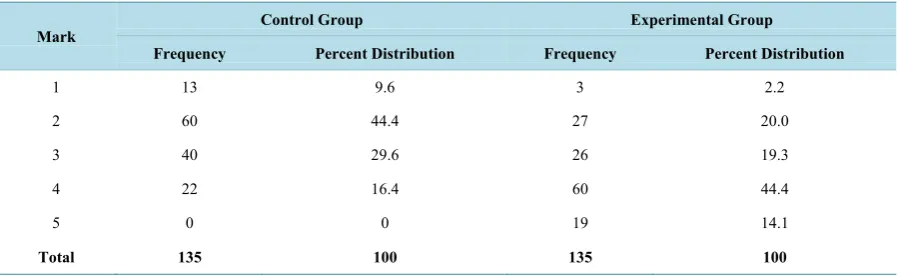
The distribution of the posttest marks related to this category is presented in Table 5. These marks show a bell-shaped distribution of the Laplace & Gaussian type with 54.0% of pupils scoring less than 3/6. The mean performance of 2.53/6 in this group was also below 3/6 (Figure 2). In the experimental group 22.2% of pupils scored below 3/6 with 77.8% scoring above 3/6. The average performance in this group stood at 3.58/6. This shows that the pupils of the experimental group mastered the concept used in the lesson better than those of the control group.
Observation and measurement
The distribution of the posttest marks related to this category is presented inTable 6. Pupils in the control
group had an average performance of 2.64/6 with 37.8% scoring ˂ 3/6 and 62.2% scoring ≥ 3/6 compared to
only 11.2% who scored ˂3/6 and 88.2% scoring ≥ 3/6 in the experimental group. It should be noted that those in the experimental group had an improved mean performance above the 50% mark of 3.51/6 (Table 6 and
Fig-ure 3). These results show a normal distribution. The pupils of the experimental group observed the objects
bet-ter and therefore, they appropriated the approach betbet-ter.
Perception of characteristic as solution to a problem
In this category, the mark distribution is reported inTable 7. Pupils in the control group scored an average
[image:7.595.98.532.301.516.2]mark of 3.48/8 with 37.1% scoring ˂4/8 and 62.9% scoring ≥ 4/8. Conversely, pupils in the experimental group
Figure 2. Histogram of posttest mark distribution of the performances of pupils in the control and experimental groups in the
knowledge and comprehension category. Source: Data collected and analysed by Mothia, Noumi and Nditafon.
Table 5. Mark distribution at the posttest in the control and experimental groups in the knowledge and comprehension
cate-gory [12].
Mark Control Group Experimental Group
Frequency Percent Distribution Frequency Percent Distribution
1 13 9.6 3 2.2
2 60 44.4 27 20.0
3 40 29.6 26 19.3
4 22 16.4 60 44.4
5 0 0 19 14.1
[image:7.595.90.540.580.718.2]OALibJ | DOI:10.4236/oalib.1102071 8 November 2015 | Volume 2 | e2071
Figure 3. Percentage of control and experimental group pupils according to the posttest distribution in the observation and
[image:8.595.87.538.364.520.2]measurement category of Klopfer’s taxonomy. Source: Data collected and analysed by Mothia, Noumi and Nditafon.
Table 6. Mark distribution at the posttest groups in the observation & measurement category [12].
Mark Control Group Experimental Group
Frequency Percent Distribution Frequency Percent Distribution
0 1 .7 0 0
1 5 3.7 1 .7
2 45 33.4 14 10.5
3 74 54.8 60 44.4
4 10 7.4 35 25.9
5 0 0 25 18.5
Total 135 100 135 100
Table 7. Mark distribution at the posttest groups in the perception of characteristic as solution to a problem [7].
Mark Control Group Experimental Group
Frequency Percent Distribution Frequency Percent Distribution
0 2 1.5 0 0
1 15 11.2 0 0
2 8 5.9 3 2.2
3 25 18.5 8 6.0
4 62 45.9 35 25.9
5 22 16.3 47 34.8
6 1 0.7 42 31.1
[image:8.595.89.539.546.721.2]OALibJ | DOI:10.4236/oalib.1102071 9 November 2015 | Volume 2 | e2071 showed an average performance of 4.87/8 with only 8.2% scoring ˂4/8 and 91.8% scoring ≥ 4/8. The distribu-tion of these marks respected the Laplace and Gauss normal curve as inFigure 4. The performance of the pupils of the experimental group is improved with respect to those of the control group. The pupils of the experimental group mastered better the cognitive skill expected in this category which is reflected in their improved intellec-tual performance compared to those in the control group who were not exposed to the same treatment.
Overall posttest performance
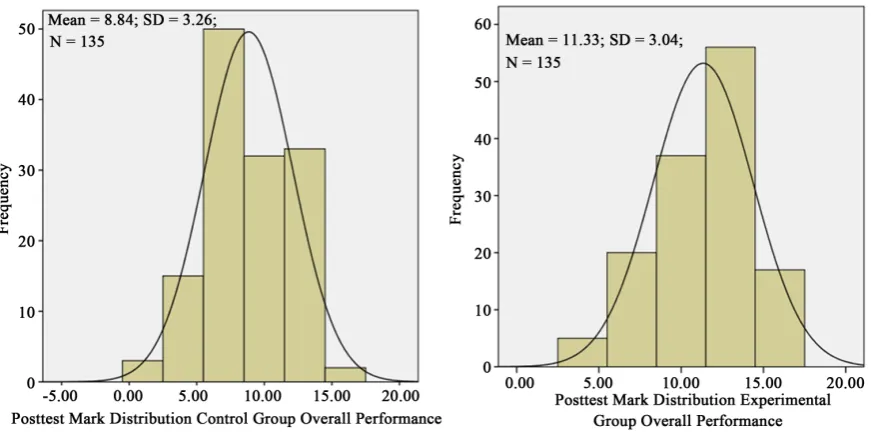
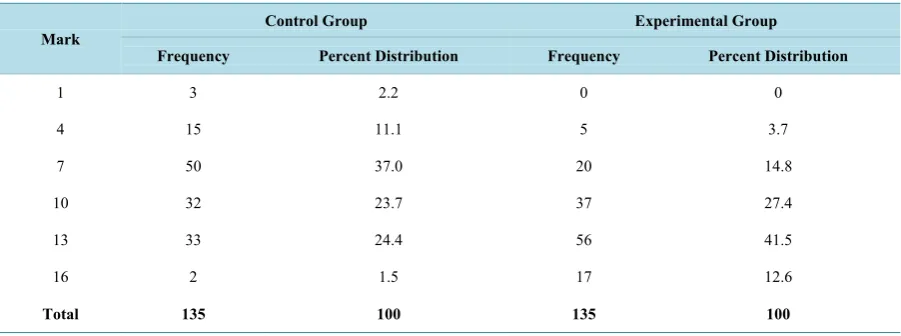
[image:9.595.96.534.220.439.2]The mark distribution in the overall posttest performance is presented in Table 8 and Figure 5. The overall mean performance of pupils in the control group was 8.84/20—a performance that is very close to that of the pretest control and experimental groups (9.53/20 and 9.09/20 respectively). This is an indication that there has not been any appreciable improvement in the performances of pupils in the control group throughout the experi-
Figure 4. Percentage of control and experimental group pupils according to the posttest marks in the perception of
charac-teristic as a solution to a problem. Source:Data collected and analysed by Mothia, Noumi and Nditafon.
Figure 5. Posttest mark distribution in the overall performance of the control and experimental. Source: Data collected and
[image:9.595.98.534.475.693.2]OALibJ | DOI:10.4236/oalib.1102071 10 November 2015 | Volume 2 | e2071
Table 8. Mark distribution at the posttest groups in the overall performance involving all categories of investigation.
Mark Control Group Experimental Group
Frequency Percent Distribution Frequency Percent Distribution
1 3 2.2 0 0
4 15 11.1 5 3.7
7 50 37.0 20 14.8
10 32 23.7 37 27.4
13 33 24.4 56 41.5
16 2 1.5 17 12.6
Total 135 100 135 100
mentation. In this group, 50.3% of pupils scored ˂10/20 and 49.7% ≥10/20. Conversely in the experimental
group, the overall mean performance stood at 11.33/20—an appreciable improvement compared to the pretest and control group of the posttest performances. Additionally, only 18.5% scored ˂ 10/20 with an impressive 81.5% scoring ≥ 10/20. This shows that pupils in the experimental group mastered the process of the cognitive skill in thinking that constituted the objective of this study. This suggests that the approach to teaching which had as goal to develop thinking skills in pupils made the lessons interesting, leading to greater involvement by learners in the construction of their own knowledge. The process also possibly led to appropriation of the con-structed knowledge by learners. The results showed a normal distribution akin to the Laplace and Gaussian curves.
3.3. Interpretation of Results
The Z-scores for the control and experimental groups were calculated (Z-calculated or Zc) and compared to the table values (Z-read or Zr) for distance of variation between the control and treatment means at 95% confidence interval in a two-tail analysis.
3.3.1. Pretest
The Zc and Zr values in the pretest before treatment are presented inTable 9.
From this table Zc < Zr, suggesting that there is no appreciable difference between the averages of the two groups at the pretest. Pupils in both groups all had an overall average performance below the pass mark. The overall average performances are pretty close to one another that it is difficult to say whether the observed ference is because of a real underlying difference in both groups or it is just a question of chance. The slight dif-ference observed between the average mark of the experimental group and the average mark of the control group could therefore be attributed to sampling chance. The low overall mean performances could be explained in part by the lack of the mastery of thinking process introduced by this study and on the other hand to the initial low level of appropriation of the didactic method used by the teachers to teach the lessons.
3.3.2. Posttest
In the collateral investigations bound to this survey, 66.6% of teachers investigated use the teaching/learning approach based on the classical tentative method schematised by the oft-quoted scientific approach (as in Sec-tion 2.2.2). This approach does not appear to teach thinking skills as illustrated by the poor results of the pretests
with mean performances ˂ 10/20 in both groups. Among the teachers involved in this study, 86.3% did not know about Klopfer’s [12] taxonomy of pedagogic objectives and the Noumi’s [7] hypothetico-deductive thinking theory—both methodological approaches used with the experimental group alone.
In the Knowledge and Comprehension category, the declarative knowledge brings the pupil to know the
OALibJ | DOI:10.4236/oalib.1102071 11 November 2015 | Volume 2 | e2071
Table 9. Summary of the pretest Z-values.
Group N Mean Mark/20 Varianceσ2 CI Zc Zr
Control 135 9.53 10.99
0.05 0.70 1.64
Experimental 135 9.09 10.38
enables in addition the enrichment of the lesson sometimes beyond the summaries found in school textbooks and manuals. The methodology equally has the advantage of establishing the link between school learning and soci-ety as the school textbooks and manuals most often do not bring out this link, making learning sort of abstract and uninteresting. The didactic situations to which the learners were subjected consisted in deciphering the problem necessitating the acquisition of a particular characteristic and extrapolating from that to find similar characteristics in other areas including the society and technology. Similar situations were then brainstormed upon to find out if the problem behind their possession was similar to the one identified. This approach we are convinced, provided optimum motivation and interest in learning, leading to appropriation of thinking skills by those in the experimental group. A summary of the posttest Zc and Zr are presented inTable 10.
From the table, Zc > Zr indicating that there is an appreciable difference in the mean performances between the control and experimental groups with the experimental group showing improvement in performance over the control group. The theory of didactic situations [20] enables a deeper understanding of this difference of 2.53/6 in the control group and 3.48/6 in the experimental group as well as between their respective standard deviations of 0.88 and 1.04 and variances of 0.77 and 1.07.
In the Observation and Measurement category, the pupils of the experimental group learned to specify
their observations and to express their ideas and the progression of their thought. This category enabled pupils to acquire skills in effective observation accompanied by a meticulous description of their observations using ap-propriate scientific terminologies. It enabled the acquisition of positive adjustable values in the process of per-ception of features of objects and phenomena. The average mark of the experimental group is tolerable (3.51/6). As can be seen from Table 11, Zc > Zr, indicating that there is a difference in the mean performances be-tween the control and experimental groups.
In the Perception of Characteristic as a Solution to Problems, and the deciphering of the problem(s) that led to its possession, the pupils were introduced to the educational aspect of developing their intellect. The teaching subjected the pupils to problem-solving skills through selected well designed tasks situations. Each task situation was characterised by brainstorming that constituted the activities that the pupils had to realise. A ty-pology of these activities is outlined in the [7] hypothetico-deductive theory that places emphasis on the steps in the intellectual development of the pupils. The average mark of the experimental group reached 4.87/8 and the one of the control group was low (3.48/8). The pupils of the experimental group appropriated the knowledge and process of thinking to the point where they were able to find solutions to similar problems by identifying a range of relevant contexts leading to the development of knowledge-in-context. They saw the knowledge and skills acquired as relational—context-dependent, and they became comfortable in dealing with a concept in a range of contexts because they had developed the capacity to judge what aspects of the concept were relevant to the par-ticular context [21]. They demonstrated this level of attainment when they were able to apply the concept of box-like cages of the skull and ribcage in the protection of soft delicate body parts that do not have possibilities of attachment by skeletal muscles to the enlargement of the pelvis in women to enable the developing embryo seat comfortably in the womb; man-made cages to protect and house pets; box-like saves for keeping treasures and valuables, etc. This is the application of a concept in varying situations—a skill acquired by introducing the pupils to the hypothetico-deductive [7] thinking process. This is shown by the fact that Zc > Zr as inTable 12.
OALibJ | DOI:10.4236/oalib.1102071 12 November 2015 | Volume 2 | e2071
Table 10. Summary of the posttest Z-values in the knowledge and comprehension category.
Group N Mean Performance/6 Variance σ2 CI Zc Zr
Control 135 2.53 0.77
0.05 6.1 1.64
[image:12.595.90.535.181.233.2]Experimental 135 3.48 1.07
Table 11. Summary of the posttest Z-values in the observation & measurement category.
Group N Mean Performance/6 Variance σ2 CI Zc Zr
Control 135 2.64 0.49
0.05 8.86 1.64
Experimental 135 3.53 0.99
Table 12. Summary of the posttest Z-values in the perception of characteristic as a solution to a problem.
Group N Mean Performance/8 Variance σ2 CI Zc Zr
Control 135 3.48 1.34
0.05 10.6 1.64
Experimental 135 4.87 1.30
Table 13. Summary of the posttest Z-values in the overall performance combining all categories investigated.
Group N Mean Performance/20 Variance σ2 CI Zc Zlu
Control 135 8.84 10.6
0.05 7.1 1.64
Experimental 143 11.65 10.68
3.3.3. Thinking Skills
This aimed to link the prior knowledge gains of the pupils on the human skeleton and movement to other areas of science, technology and the society. By handling teaching in this way, a unique correct answer is not expected. Rather, a series of responses are possible and all depend on the convincing arguments advanced to support each type of answer. Learning to think is a skill that is acquired with practice and endurance [8]. In the lessons on the human skeleton, the technique for developing thinking skill consisted of identifying a characteristic as a solution to some problem(s) and brainstorming to decipher the problem necessitating the acquisition of the characteristic. Characteristics identified, described and analysed from which corresponding problems were deciphered by the pupils in this study consisted among others of:
Characteristic 1
The skull is a bony box. The fact that the skull is a bony box is solution to a problem. What can this problem be?
Problem: How can the skeleton support and protect the delicate brain which is a non-muscular soft mass that cannot attach itself to bones like other muscles do?
Solution adopted: Develop a bony box around the brain. This is the skeleton’s know-how in solving the
problem of supporting and protecting the very important soft and delicate brain.
Application of this know-how in the same field of science, other fields of science, and technology in-cluding society:
In Zoology, vertebrate animals (Fish, Amphibians, Reptiles, Aves, and Mammals) have cranial boxes sup-porting and protecting their brains.
In Botany, some plants have hard pericarps surrounding and protecting their seeds such as in the coconut (Cocos nucifera, Arecaceae), the calabash fruits (Lagenaria siceraria, Cucurbitaceae), snuffbox tree (Oncoba glauca, Flacourtiaceae), oil palm (Elaeis guineensis, Arecaceae).
[image:12.595.86.541.259.313.2] [image:12.595.88.540.340.391.2]OALibJ | DOI:10.4236/oalib.1102071 13 November 2015 | Volume 2 | e2071
Characteristic 2
At the thoracic level, the backbone has ribs that form a cage with the sternum. The fact that the backbone forms a ribcage with the sternum is solution to a problem. What can this problem be?
Problem: How can the skeleton protect organs that function incessantly (lungs, heart) from suffocation by
external pressure?
Solution adopted: Construct a cage around the organs. This is the skeleton’s know-how.
Application of this know-how in the same field of science, other fields of science, and technology in-cluding society:
In Zoology, all vertebrate animals have a ribcage to protect their hearts and lungs from external pressure. Birds build nests to shelter and protect themselves, their eggs, and young from external pressure, aggression from predators and hash environmental conditions.
In technology and society, the bodywork of cars is a cage for protecting its occupants from external pressure. Metallic and wooden cages are constructed to keep pet animals such as parrots, dogs, doves, etc.
Characteristic 3
At the level of the abdomen, the backbone does not carry ribs and there is no abdominal cage like the thoracic ribcage. The fact that there is no ribcage in the abdominal region is solution to a problem(s). What can this problem be?
Problems:
Problem 1: How can the skeleton provide the abdomen which houses the stomach and the alimentary system, and the womb the latitude to expand when:
people eat and drink;
the woman (female) is pregnant?
Solution adopted: No ribcage in the abdomen which is susceptible to expanding when it takes in: food,
drinks, or a pregnancy.
Application of this know-how in the same field of science, other fields of science, technology including society:
In technology and the human society, the cabins of trucks and goods only vehicles are wide open to receive voluminous baggage. Balloons for decoration and carrying objects, humans, and messages into the air are elastic and do not have cages to limit their expansion.
Problem 2: How can the skeleton ensure the flexibility of the lumbar vertebrae so that a person in a standing position can bend forward and pick something from the ground or arch backward without bending the knees?
Solution adopted: Free the five lumbar vertebrae of all bony appendages to enable them flex as desired. Ad-ditionally, provide each joint between two vertebrae with cartilaginous and elastic disks to facilitate bending movements. This is the skeleton’s know-how in solving this type of problem.
Application of this know-how in the same field of science, other fields of science, and technology in-cluding society:
In the animal kingdom the abdomens of the vertebrates do not have ribs. The backbones of fishes carry verti-cal extensions limiting their flexibility to a bilateral one.
In technology and society public work uses caterpillars and tractors (front and back loaders) with joints that allow for flexibility in movement and easy manipulation.
4. Discussion
The methodology used in this research was an interaction model that created didactic situations of the type de-scribed by Gaonac and Golder [22]. This approach modelled the pupil's didactic environment. The teacher be-came a facilitator with the intention of making the learners to learn by actively constructing their own knowl-edge [23].
pu-OALibJ | DOI:10.4236/oalib.1102071 14 November 2015 | Volume 2 | e2071 pil is placed within the framework of Vygotsky’s historical and cultural constructivism [24] which emphasises social interactions with the “More Knowledgeable Other” (MKO) in the cognitive development of the learners. Such social interactions enable the pupils to develop several intellectual capacities such as questioning skills, scientific curiosity, voluntary attention, the logical memory, abstraction, and the ability to compare and to dif-ferentiate—all of which have been observed in the experimental group. The interpersonal exchanges became sources of cognitive development through the socio-cognitive conflicts generated within the learners and facili-tated by the use of the hypothetico-deductive framework of thinking. In the process of battling with this conflict, when the learner replaces his/her preconceptions with scientifically constructed knowledge, then learning can be said to have occurred [3] [25]-[27].
Assessment of both groups, (control and experimental), illustrates that Klopfer’s taxonomy when used in combination with the hypothetico-deductive thinking theory provides an efficient methodological approach in the development of thinking skills in 3rd grade pupils in the Cameroon primary education system. This tango of two methodological approaches when carefully combined can enable the 3rd graders to develop their intellectual capacities, creativity and know-how in meeting life challenges [3]. They also ensure the development of knowl-edge, life skills and know-how, and therefore the holistic development of the child that takes into consideration its cognitive, psychomotor and affective needs [28]. Following this approach the learner makes of school knowl-edge the means to an end and not an end in itself.
5. Conclusions
In this study, pupils constructed scientific knowledge themselves and appropriated the thinking process because the preparation and teaching of the lessons were guided by Klopfer’s taxonomy and the hypothetico-deductive thinking theory. The educational objectives structured in a specific manner contributed to the development of the declarative and procedural knowledge. The approach was oriented towards the development of the intellect and therefore thinking. It required of the 3rd graders a committed involvement in dealing with varied ideas as teaching is directed towards the development of the correct concept of the nature of science.
In perspective, work in progress aims at using the mathematical concept of the set theory to regroup the know-how of the human skull with respect to its application in other fields of the sciences, technology and the society.
References
[1] Morissette, R. (2002) Accompanying the Construction of Knowledge. Chenellère/McGraw-Hill, Montreal, Toronto. [2] Giordan, A. (1978) Pedagogy for Experimental Sciences.Collections paiguides, Le centurion formation.
[3] Golse, B. (1992) Affective and Intellectual Development of the Child. 2nd Edition, Masson, Paris. [4] Rey, B. (1998) Teaching a Class in Elementary School. ESF, Paris.
[5] Charland, P. (2003) Environmental Education and the Teaching of Science. VertigO—La revue en sciences de l’envi- ronnement, 4, 1-7.
[6] Noumi, E. (2008) Illustrated Didactics of the Life and Earth Sciences and Docimology: A Guide for Teachers of Sec-ondary High Schools. GIC ICSSC Edition, Yaoundé. (Reprographed)
[7] Noumi, E. (2013) Competency-Based Approach: A More Active, More Innovating and More Durable Training; Case of the Lesson on the Cell in 1st Year of the Higher Teachers’ Training College of the University of Yaoundé I. Crown
Research in Education, 3, 13-21.
[8] Nditafon, G.N. and Noumi, E. (2014) Enhancing the Construction and Appropriation of Scientific Knowledge for Re-investment in Seeking Solutions to Problems in New Contexts: Case of a Lesson on Sexual Reproduction in Flowering Plants among Second Year Learners of the General Secondary Education in Yaoundé, Cameroon. International Jour-nal of Science and Research,3, 691-696.
[9] Noumi, E. and Nditafon, G. (2015) Didactic Transposition of the Alternative Knowledge of the Brazilian Telenovela “O Clone” to Knowledge Taught. International Journal of Science and Research, 4, 508-519.
[10] Belinga, B.S. (2010) University Didactics and Training for University Teachers. Harmattan, Cameroun.
[11] Bloom, B.S., et al. (1969) Taxonomy of Educational Objectives, Volume 1, Cognitive Domain. Education Nouvelle, Montréal.
OALibJ | DOI:10.4236/oalib.1102071 15 November 2015 | Volume 2 | e2071
Pittsburg University Press, Pittsburg.
[13] Mangari, D. (2004) Training and Professionalisation of Teaching in Cameroon. L’Harmattan, Paris. [14] Mager, R. (1962) Preparing Instructional Objectives. Fearon, Palo Alto.
[15] Noumi, E. (2014) Novel Approach to Promote Logical Thinking among Higher Education Students: A Lesson Plan on the Coconut Fruit in Second Year of the Higher Teachers’ Training College of the University of Yaoundé I. Crown Research in Education, 4, 28-47.
[16] Grawitz, M. (2001) Methodology in the Social Sciences, 11th Edition, Dalloz, Paris. [17] De Landshere, V. (1976) Education and Training. 1stCycle Collection, PUF, Paris.
[18] Pallant, J. (2005) SPSS Survival Guide: A Step by Step Guide to Data Analysis Using SPSS for Windows. 3rd Edition, Open University Press, New York.
[19] Andy Field (2009) Discovering Statistics Using SPSS. Sage Publications Ltd., London. [20] Brousseau, G. (1998) Theory of the Didactic Situation. La Pensée Sauvage, Grenoble.
[21] Bowden, J.A. (1997) Competency-Based Education—Neither a Panacea nor a Pariah, TEND 97 Conference, Abu Dhabi. http://crm.hct.ac.ae/events/archive/tend/018bowden.htm
[22] Gaonac, D. and Golder, C. (1995) Handbook of Psychology for Teachers. Hachette Education, Paris.
[23] Brousseau, G. (1989) Epistemological Obstacles and the Didactics of Mathematics. In: Bednarz, N. and Garnier, C., Eds., Construction of Knowledge, Editions Agenced’ARC, Montréal, CIRADE, 41-63.
[24] Morandi, F. (2002) Models and Methods in Pedagogy. Nathan, Paris. [25] Bachelard, G. (1938) Training the Scientific Spirit. Vrin Edition, Paris.
[26] Doise, W. and Mugny, G. (1981) Social Development of Intelligence. Inter Editions, Paris.
[27] Limón, M. (2001) On the Cognitive Conflict as an Instructional Strategy for Conceptual Change: A Critical Appraisal.
Learning and Instruction, 11, 357-380. www.elsevier.com/locate/learninstruc http://dx.doi.org/10.1016/S0959-4752(00)00037-2
[28] Bloom, B.S., Ed. (1956) Taxonomy of Educational Objectives, Handbook I: Cognitive Domain. In: Klopfer, L.E., Ed.,


![Table 6. Mark distribution at the posttest groups in the observation & measurement category [12]](https://thumb-us.123doks.com/thumbv2/123dok_us/8047169.772965/8.595.87.538.364.520/table-mark-distribution-posttest-groups-observation-measurement-category.webp)