http://dx.doi.org/10.4236/jsea.2014.78064
Requirement Change Management in Global
Software Environment Using Cloud
Computing
Saiqa Bibi, Yasir Hafeez, Muhammad Shabbir Hassan, Zartasha Gul, Huma Pervez,
Irfan Ahmed, Saira Mazhar
PirMehar Ali Shah, Arid Agriculture, University Institute of Information Technology, Rawalpindi,Pakistan Email: [email protected], [email protected], [email protected], [email protected], [email protected], [email protected], [email protected]
Received 14May 2014; revised 14June 2014; accepted 8July 2014
Copyright © 2014 by authors and Scientific Research Publishing Inc.
This work is licensed under the Creative Commons Attribution International License (CC BY). http://creativecommons.org/licenses/by/4.0/
Abstract
The successful implementation of any software project depends upon the requirements. Change in requirements at any stage during the life cycle of software development is taken as a healthy process. However, making out this change in a co-located environment is somewhat easier than the distributed environment where stakeholders are scattered at more than one location. This raises many challenges i.e. coordination, communication & control, managing change effectively and efficiently and managing central repository. Thus, cloud computing can be applied to mini-mize these challenges among the stakeholders. We have used a case study to evaluate the frame-work using cloud computing.
Keywords
Challenges of Requirement Change Management, Role of Cloud Computing in GSD, Benefits of Cloud Computing
1. Introduction
[2]. Accommodating changes in requirement is a part of requirement management. A change is described as somewhat that might need work to be done: developing new description, filling out requirement management related forms, getting rid of bugs from software [2].
Requirement Change Management is an important phase of Requirement Engineering. It plays an important role in the production of any software development. Main reasons of changes in software requirement are func-tionality enhancement, changes in customer requirements, revealing requirements, plan changing, excluding re-quirements, removing imitation and change in management plan [3].
Change management is easy and simple in co-located environment but it becomes complex when someone is performing development in GSD environment where a number of stakeholders are involved [2]. In Global Soft-ware Development (GSD), softSoft-ware is developed from distributed locations geographically where different peo-ple are connected from many countries worldwide [4]. Its benefit of lower costs and access to global ability are some of the factors which have progressively led GSD more famous; many organizations consider GSD as a superior solution [4]. In GSD teams are geographically distributed consequently numerous problems crop up [5].
The basic GSD factors that affect requirement management are coordination, communication, control, differ-ence in culture and time zone, language barrier, development location, lack of central repositories and managing change efficiently and accurately [2]. There are different methodologies used to tackle Global Software Devel-opment challenges; cloud computing is one of them.
Cloud computing is an internet based computing standard in which resources like software, hardware, and in-formation are shared on the demand of endorser. In cloud computing resources can be shared and controlled swiftly with least effort [6].
The purpose of this research is to identify risks of Requirement Change Management in GSD environment and provide their solution by using cloud computing framework for resolving and managing software Require-ment Change ManageRequire-ment issues.
2. Literature Review
In GSD environment development teams are dispersed geographically. It is very difficult to manage change in requirements when teams are distributed in global environment and multiple stake holders are involved to ma- nage change. There are many issues that the development teams have to face to manage change in GSD envi- ronment. Communication risks, coordination and managing change efficiently and accurately are some of them. The purpose of this research is to identify issues of Requirement Change Management in GSD environment and their possible solution with a critical review of the existing methodologies for resolving and managing soft-ware Requirement Change Management. The challenges related to managing change in GSD environment are as under:
2.1. Communication, Coordination and Control
In GSD, software requirements change and communication is an important activity [3]. Differences in cultures and time zones adversely impact communication and coordination processes due to development teams are in different geographical locations. So, the frequency of coordination, communication and belief among develop-ment teams reduces [3][4][7]. Teams share and exchange a large amount of information during communication and in distributed environment it leads to several challenges which create misunderstanding among the teams.
In GSD, the communication issue and RCM are given very little effort as compared to the centralized soft-ware development system [3]. The solution of coordination, communication challenge should necessarily be re-solved [8] [9].
2.2. Lack of Shared Repositories for Storing Requirements
effec-tively used for requirements tracking and additional development processes [2]. It is essential to make a com-mon repository that should be accessible to all members of the teams when teams are at different locations [2].
2.3. Lack of Managing Change Efficiently and Accurately
The requirement organization is one of the key challenges and it raises many issues when teams are dispersed and try to meet the expectations of user. When development team does not facilitate the clients request com-pletely the project becomes worthless for the client. Mostly requirement management model used for co-lo- cated software projects and does not have enough capability to accommodate requirements accurately for dis-tributed software projects. It results into excessive cost, schedule slips and most of the projects fail [2].
3. Propose Work
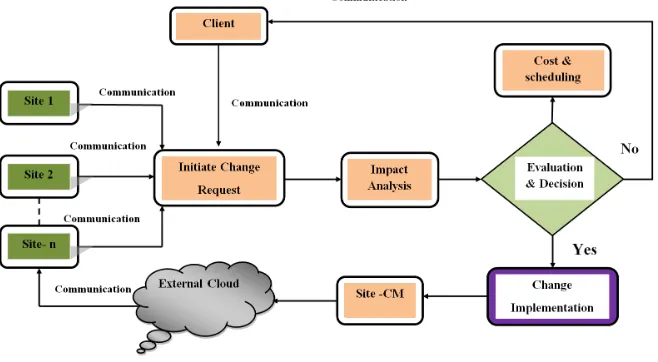
There are different methodologies used to tackle Global Software Development challenges. Cloud computing is one of them. We propose a framework to resolve these different issues using cloud computing shown in Figure 1.
3.1. Cloud Computing
Cloud computing is a standard based on Internet computing in which different resources like hardware, software and information are shared on the demand of subscribers. In cloud computing resources can be shared and con-trolled swiftly with least effort [6].
Cloud computing offering many benefits some of them are: No up-front investment [10] [11], on demand self service [12] low operating cost, high scalability [13], easy access, reducing business challenges and reducing maintenance cost [11]. Keeping in view benefits of cloud computing we use it for managing requirement change in GSD environment and it is evaluated that framework using cloud computing resolving the challenges of RCM mentioned above:
Cloud computing basically offers efficient collaboration between geographically distributed teams during software development life cycle such as requirements, design, coding and testing. This resolves the commu-nication and coordination issue.
The cloud computing uses service models such as SaaS, PaaS and IaaS [14]. By using these cloud models information can be acquiescent, accessed, managed, analyzed, and delivered significantly and accurately among all cites.
Cloud computing provides repository named as external cloud. External cloud holds all data related to man-aging change in requirements. The biggest advantage of cloud computing repository is that data can be ac-cessed from anywhere and anytime by any authorize individual.
[image:3.595.150.479.526.707.2]The proposed framework is based on facts collected from literature and commenced from industrial experts.
3.2. Description of Framework
The implementation of framework “Requirement Change Management Framework using Cloud Computing” (RCMF-CC) is performed in the context of a distributed development environment for Requirement Change Management the study reports the investigation of project, which used a cloud-based platform. Framework is composed of the different activities shown in Figure 1. This framework is proposed for the Requirement Chan- ge Management in GSD using cloud computing. This involves different roles and behaviors. Clients in the GSD environment communicate for the sake of change initiation request.
3.2.1. Change Request
The communication is held through different sites and leads to the initiation of change request.
3.2.2. Impact Analysis
Accurate understanding of the implications of a proposed change is necessary. When change request is arrived impact analysis of the change is done to observe the effect of this change on the product. Components that might have to be created, modified, or discarded are identified while performing impact analysis.
3.2.3. Evaluation & Decision
After analysis evaluation is performed to estimate the effort and cost associated with implementing the change. The feasibility of the initiated change is checked. On the basis of evaluation decisions are made. Vendor can have two possible choices after the evaluation phase. Whether the requested change is feasible and can be im-plemented or cannot be imim-plemented. If the requested change is not feasible to implement than customer is ac-knowledge about the infeasibility of the change. Else change is implemented.
3.2.4. Change Moderator
Change moderator is a role in RCMF-CC. Applied changes are conveyed to CM (Change Moderator).
3.2.5. External Cloud (Cloud Repository)
In the last phase the changed data is sent to the cloud repository and client is acknowledged about the change. Cloud repository provides users with instant access to a wide range of resources.
4. Evaluation
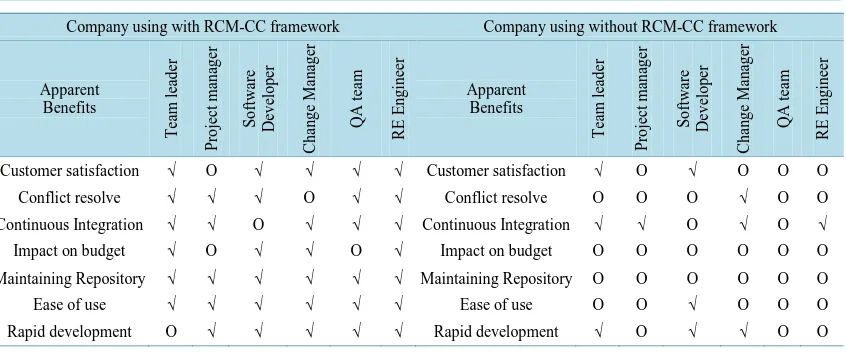
We take a case study of a company X. Company X follows a typical process when changes are required. We im- plement our framework for managing change in GSD environment in this organization and then take the experts reviews. The expert feed back process was used in order to take opinions of RCM experts about the “Customer satisfaction”, “Conflict resolve”, “Continuous Integration”, “Impact on budget”, “Maintaining Repository”, “Rapid development” and “ease of use”. Expert panel includes a team leader who has 10 years of experience, software developer one has 5 years, project manager with 12 years of experience, change manager with 8 years of experience, QA team having 6 years of experience and RE engineer with 10 years of experience. The results of expert opinion with RCM-CC and without RCM-CC framework are shown in Table 1.
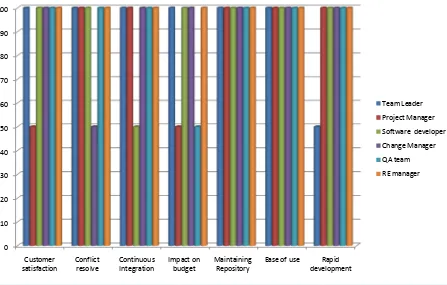
A graph of expert opinion is also shown in Figure 2 by using RCM-CC framework and graph without using RCM-CC framework is shown in Figure 3. It is clear that our proposed model is best for managing change in GSD environment.
Cloud computing framework is resolving all issues mentioned above and provides satisfaction on the certain parameters.
5. Conclusion
Figure 2. X software organization using RCM-CC framework.
Figure 3.X software organization without using RCM-CC framework. 0
10 20 30 40 50 60 70 80 90 100
Customer
satisfaction Conflict resolve Continuous Integration Impact on budget Maintaining Repository Ease of use developmentRapid
Team Leader Project Manager Software developer Change Manager QA team RE manager
0 10 20 30 40 50 60 70 80 90 100
Customer
satisfaction Conflict resolve Continuous Integration Impact on budget Maintaining Repository Ease of use developmentRapid
[image:5.595.77.463.393.702.2]Table 1. Expert reviews.
Company using with RCM-CC framework Company using without RCM-CC framework
Apparent Benefits T eam l ea d er P ro jec t m an ag er S o ft w are D ev el o pe r C ha n g e M an ag er QA t ea m R E E n g in ee r Apparent Benefits T eam l ea d er P ro jec t m an ag er S o ft w are D ev el o pe r C ha n g e M an ag er QA t ea m R E E n g in ee r
Customer satisfaction √ O √ √ √ √ Customer satisfaction √ O √ O O O
Conflict resolve √ √ √ O √ √ Conflict resolve O O O √ O O
Continuous Integration √ √ O √ √ √ Continuous Integration √ √ O √ O √
Impact on budget √ O √ √ O √ Impact on budget O O O O O O
Maintaining Repository √ √ √ √ √ √ Maintaining Repository O O O O O O
Ease of use √ √ √ √ √ √ Ease of use O O √ O O O
Rapid development O √ √ √ √ √ Rapid development √ O √ √ O O
√ = Agree; O = Partially Agree; X = Not present.
perts in software industry and it give better satisfactory results as compared to other traditional methods used in Global Software Development environment.
References
[1] Asghar, S. (2010) Requirement Engineering Challenges in Development of Software Applications and Selection of
Customer-off-the-Shelf (COTS). International Journal of Software Engineering, 1, 32-50.
[2] Hafeez, Y., Riaz, M., Asghar, S., Naz, H., Mushhad, S. and Gilani, M. (2012) A Requirement Change Management
Framework for Distributed Software Environment. 7th International Conference on Computing and Convergence
Technology (ICCCT), Seoul, 3-5 December 2012, 944-948.
[3] Khan, A.A., Basri, S. and Dominic, P.D.D. (2012) A Propose Framework for Requirement Change Management in
Global Software Development. 2012 International Conference on Computer & Information Science (ICCIS), Kuala
Lumpeu, 12-14 June 2012, 944-947. http://dx.doi.org/10.1109/ICCISci.2012.6297161
[4] Lai, R. and Ali, N. (2013) A Requirements Management Method for Global Software Development. AIS: Advances in
Information Sciences, 1, 38-58.
[5] Khan, H., Ahmad, A., Johansson, C., Abdullah, M. and Nuem, A. (2011) Requirements Understanding in Global
Soft-ware Engineering: Industrial Surveys. IPCSIT, 14, 167-173.
[6] Hashmi, S.I., Clerc, V., Razavian, M., Manteli, C., Tamburri, D.A., Lago, P. and Richardson, I. (2011) Using the
Cloud to Facilitate Global Software Development Challenges. 2011 IEEE 6th International Conference on Global
Software Engineering Workshop, Helsinki, 15-18 August 2011, 70-77. http://dx.doi.org/10.1109/ICGSE-W.2011.19
[7] Khan, A.A., Basri, S., Amin, F.E., Teknologi, U., Perak, T. and Studies, I. (2013) Communication Risks and Best
Practices in Global Software Development during Requirements Change Management: A Systematic Literature
Re-view Protocol. Research Journal of Applied Sciences, Engineering and Technology, 6, 3514-3519.
[8] Khatoon, A., Motla, Y. H., Azeem, M., Naz, H. and Nazir, S. (2013) Requirement Change Management for Global
Software Development Using Ontology. 2013 IEEE 9th International Conference on Emerging Technologies (ICET),
Islamabad, 9-10 December 2013, 1-6. http://dx.doi.org/10.1109/ICET.2013.6743519
[9] Khan, K., Khan, A., Aamir, M., Khan, M.N.A., Zulfikar, S., Bhutto, A. and Szabist, T. (2013) Quality Assurance
As-sessment in Global Software Development. World Applied Sciences Journal, 24, 1449-1454.
[10] Capilla, R., Dueñas, J.C. and Krikhaar, R. (2012) Managing Software Development Information in Global
Configura-tion Management Activities. Systems Engineering, 15, 241-254.
[11] Zhang, Q., Cheng, L. and Boutaba, R. (2010) Cloud Computing: State-of-the-Art and Research Challenges. Journal of
Internet Services and Applications, 1, 7-18. http://dx.doi.org/10.1007/s13174-010-0007-6
[12] Carroll, M., Merwe, A. Van Der and Kotzé, P. (2011) Secure Cloud Computing Benefits, Risks and Controls.
Informa-tion Security South Africa (ISSA),Johannesburg, 15-17 August 2011, 1-9.
[13] Armbrust, M., Joseph, A.D., Katz, R.H. and Patterson, D.A. (2009) Above the Clouds: A Berkeley View of Cloud
Computing.
currently publishing more than 200 open access, online, peer-reviewed journals covering a wide range of academic disciplines. SCIRP serves the worldwide academic communities and contributes to the progress and application of science with its publication.
Other selected journals from SCIRP are listed as below. Submit your manuscript to us via either