Munich Personal RePEc Archive
Legal Centralization and the Birth of the
Secular State
Johnson, Noel D and Koyama, Mark
George Mason University
22 August 2012
Online at
https://mpra.ub.uni-muenchen.de/40887/
Legal Centralization and the Birth of the Secular State
∗Noel D. Johnson† and Mark Koyama‡
George Mason University
This Version: 22 August 2012
Abstract
This paper investigates the relationship between the historical process of legal central-ization and increased religious toleration by the state. We develop a model in which legal centralization leads to the criminalization of the religious beliefs of a large proportion of the population. This process initially leads to increased persecution, but, because these persecutions are costly, it eventually causes the state to broaden the standards of ortho-dox belief and move toward religious toleration. We compare the results of the model with historical evidence drawn from two important cases in which religious diversity and state centralization collided in France: the Albigensian crusades of the thirteenth century and the rise of Protestant belief in the sixteenth century. Both instances sup-port our central claim that the secularization of western European state institutions during the early-modern period was driven by the costs of imposing a common set of legal standards on religiously diverse populations.
Key words: State Capacity, Religion, Secularization, Heresy, Legal Capacity, France
JEL classification: H10, N43, Z12, K42, P48
∗We are grateful to Alex Mislin and Jared Rubin for giving us detailed feedback on an earlier version of this
paper.
†Assistant Professor. [email protected]
‘Persecution produced its natural effect on them. It found them a sect: it made them a faction’
(Macaulay, 1967, 1848, 47)
1
Introduction
How did the modern secular state emerge? All premodern states used religion to legitimize their authority. Religious freedom was limited and control over religion by elites ubiquitous. By contrast, governments in the developed world today — even in countries where there is an official state church or where levels of religiosity are high — are resolutely secular when compared with governments of the past. This paper provides a causal mechanism that helps to explain this transition from repression to tolerance and from the religiously sanctioned polities of the past to the modern secular state.
In contemporary political thought ‘[r]eligious freedom is not just one liberal freedom among others . . . it is the prototypical liberal freedom, a cornerstone of modern political rights’ (Blackford, 2012, 1). Conventionally, the separation of church and state is dated to the ratification of the First Amendment in the United States in 1791 (Finke, 1991; Nussbaum, 2008). But the modern origins of religious toleration and freedom go back to the period of the Reformation in Europe (Kamen, 1967; Head, 1998; Laursen, 1999; MacCulloch, 2003; Zagorin, 2003). As John Rawls noted, ‘the historical origin of political liberalism is the Reformation and its aftermath, with the long controversies over religious toleration in the sixteenth and seventeenth centuries’ (Rawls, 1993, xxiv). In this paper we analyze how state formation and legal centralization led European states to gradually widen the range of permissible religious beliefs in the early modern period (1500-1700). We argue that the rise of the state thereby played a crucial, and largely unrecognized, role in the emergence of religious toleration and the secularization of modern life.
We build a theoretical model to illustrate our hypothesis that, under certain circumstances, an increase in political and legal centralization tends to increase de jure tolerance of religious belief. In a world in which both religious belief and legal authority are fragmented across regions, the bounds of religious toleration can be set relatively narrowly in each jurisdiction. As the centralizing state builds legal capacity and assimilates outlying regions, however, it is confronted with a choice. It can either maintain the standards of orthodox belief held by the center and be forced to define a significant portion of its newly assimilated population as heretics. Or, it can expand the range of orthodox belief, thereby avoiding potentially costly enforcement or outright civil war. The model highlights this process and outlines the relevant costs and benefits that determine the state’s decision to either forcibly convert the dissenting population or secularize the legal system.
France where state building and religious belief collided. First, we study a case in which increased state centralization did not lead to an increase in religious toleration. The consolidation of the medieval state and the church in the late twelfth and early thirteenth century led to the designation of certain groups as outsiders and to their condemnation as heretics. These movements were, ultimately, completely repressed. Our model shows why it was possible for the medieval state and church to eliminate these early heretical movements since they were unable to maintain a strong sense of corporate identity. Secondly, we contrast the thirteenth century experience with the sixteenth century confrontation between the centralizing forces of the French monarchy with the Protestant movement. In the sixteenth century, as the state increasingly defined followers of Martin Luther and other dissenters from orthodoxy as heretics, it was confronted by a relatively unified group which was costly to suppress. The French Protestants, known as Huguenots, became a national movement and a political party. As a result, within a few decades the French state decriminalized Protestant belief. Despite this, the country still broke down into a costly civil war that was only ended after the passage of the Edict of Nantes (1598) which acknowledged the co-existence of two religions within a single state and effectively separated civil and religious rights. Thus, investments in state capacity were accompanied by increased religious toleration in France in the sixteenth century, not because individuals were more enlightened, but simply because enforcing an intolerant state orthodoxy was too costly. Beyond French borders, the Edict of Nantes served as an example which shaped the gradual emergence of religious toleration in England, the Netherlands and North America in the seventeenth and eighteenth centuries.
There are several alternative hypotheses to ours that seek to explain the rise of religious toleration. One influential view attributes the growth of toleration to the Enlightenment movement of the eighteenth century. And it is certainly true that the most celebrated edicts of religious freedom and toleration such as the First Amendment and the French Declaration of the Rights of Man are Enlightenment documents. Nevertheless, we argue that important movements towards toleration and secularization occurred prior to the writings of leading Enlightenment thinkers such as Locke and Voltaire at a time when few if any writers advocated tolerance. Another explanation relies on the doux commerce hypothesis which associates the rise of toleration with the growth of markets and trade. While we believe this is important in explaining the gradual development of more tolerant attitudes at an individual level, it does not explain the relatively rapid changes in policy by major European states in the sixteenth and seventeenth century—a time when popular religious hatreds still remained strong. A final view attributes the rise of religious toleration to the overall secularization of the society and the declining importance of religion in everyday lives (Jordan, 1932; Chadwick, 1975). However, as we demonstrate, religious toleration by the state emerged at a time when, if anything, the fervor of religious belief was at its peak.
institutions. Using cross-country panel data from the nineteenth and twentieth centuries, Barro and McCleary (2005) examine why some countries have state churches while others do not. They find that state religions are established where there is a high degree of religious homogeneity and suggest that countries with more heterogeneous religious preferences are more likely to have greater separation between church and state. These results are suggestive, but they are driven by the existing distribution of religious preferences and, as our research suggests, these preferences were themselves the product of waves of state centralization in earlier centuries. The emergence of centralized states in the early modern period involved integrating regions in which individuals held beliefs that were both well defined and varied. Consequently state formation and legal centralization forced rulers in France and in the rest of Europe into becoming increasingly secular.
There are large literatures in sociology, political science, and economics evaluating the secularization hypothesis.1
However these tend to focus on the demand for and supply of religious goods and not on the secularization of the state which is the focus of this paper. We build on the argument that religious legitimation played a crucial role in enabling premodern rulers to obtain the compliance of the population.2
What is new in our theory is that we explain under what conditions the process of state-building and legal centralization will tend to generate increased religious toleration.
Finally, a growing literature sees the separation of church and state as a crucial institutional feature that distinguished western Europe from other parts of the world in the period leading up to the Great Divergence (Kuran, 2010; Rubin, 2011; Co¸sgel et al., 2012). This separation originated in the aftermath of the Reformation. And while a number of papers study either the causes of the Reformation (Ekelund et al., 2002, 2006; Iyigun, 2008; Rubin, Forthcoming) or the consequences of the Reformation for economic growth (Becker and Woessmann, 2009; Cantoni, 2012), we believe this is the first paper to examine the institutional implications of the Reformation on religious toleration.3
Our framework is the the first to explain why the efforts of early-modern rulers to centralize legal institutions was accompanied by a move towards increased religious toleration that laid the foundations for today’s liberal secular states.
1
Important sociological works on this topic include Bruce (2002)and Norris and Inglehart (2004). The supply-side argument against the secularization hypothesis is discussed by Iannaccone et al. (1997).
2
Co¸sgel and Miceli (2009) also build a model of the relationship between a state and religion. In their model autocratic states have an incentive to support religions that lend their regime legitimacy and thereby lower the cost of obtaining tax revenue. Also see Gill (2008), Rubin (2011), and Co¸sgel et al. (2012).
3
2
From the Persecuting State to the Secular State
All pre-modern states limited permitted religious beliefs. In medieval society the state and the church were coterminous. There was only one Church and the Church played a crucial role in legitimating secular authority.4
The motto of the French king: un roi, une loi, une foi applied across Christendom. Nevertheless, the ability of either medieval church or state to enforce religious orthodoxy in practice was highly limited. Robert Moore observes the ‘structure of the Western Church itself in the early middle ages was one which permitted, and was bound to permit, a much greater variety than would later be thought consistent with the maintenance of Catholic unity. It had not yet developed the means, or, some would say the inclination, to demand uniformity of worship and practice throughout Western Christendom’ (Moore, 1987, 65).5
But this should not be interpreted as tolerance: it is ‘. . . misleading to characterize [the Church’s] earlier attitude as ‘relatively liberal’. Without adequate central coordination, internal organization or infrastructure, the early medieval Church had no alternative but to accommodate . . .phenomenes folkloriques’ (Nelson quoted in Asad, 1986).
Early medieval legal systems were decentralized. Justice was accusatory: Charges were brought by victims against perpetrators, and individuals who levied false accusations could be severely punished. Heretical belief was not defined as a crime in early medieval legal codes, and could not be pursued in secular courts (Kieckhefer, 1979). Instead, local bishops pursued ad hoc methods against religious dissent during this period, but with little effect. Secular authorities were, moreover, weak and unconcerned with enforcing norms of belief; indeed, the state as we understand it did not exist (Strayer, 1970, 3).6
Thus, early medieval rulers were not necessarily tolerant, rather, they lacked the capacity to impose a strict standard of belief. As a result, large-scale, state-sanctioned, judicial killings of individuals for their beliefs were rare.
In the twelfth century this began to change; first in England and then in France, monarchs ‘equipped themselves with institutions of governance that were increasingly professionalized in their staffs and bureaucratized in their operations . . . jurists and learned writers bent their efforts to the rational-ization of legal systems’ (Given, 1989, 336). At the same time religious dissent became more visible
4
Religious toleration was impossible in theory as it meant undermining the church’s monopoly over religious authority. In practice, some toleration could be permitted through the use of exemptions (for example for Jews, and for Muslims in lands reconquered by crusaders). Religious justification for the use of force in coercive belief was provided by St. Augustine.
5
See also Wakefield (1974, 15), Lambert (1998, 17). Priscillian of Avilia was sentenced as a heretic, or witch, in 383. No one was again executed for heresy until 1022 and then no heresy trials resulted in executions between 1022 and 1143 (Moore, 1987, 13-23). Note, however, that heretics were ‘burnt by the people’ in Cambrai in 1077, Soissons in 1114, and Li`ege in 1135 (Moore, 2012, 7).
6
and secular rulers for the first time began to devote energy in repressing this dissent (Moore, 1987).7 The rise of the medieval administrative state described by Strayer (1970), Given (1989), and Bis-son (2009) was accompanied by a campaign against heresy and religious dissent. Moore (1987) has influentially termed this the birth of the persecuting society.8
Historians debate the extent to which the rise of heretical movements in the twelfth century was a consequence of the economic change and dislocation brought about by the Commercial Revolution or the Papal reforms of the late eleventh century.9
What is clear, however, is that the rise of the state and the establish-ment of newly centralized, and formally codified legal systems, resulted in deviant individuals and movements that might previously have gone unnoticed by religious and secular authorities being defined as heretical. The growth of the state resulted in the creation of new types of crimes. In the thirteenth century, the monarchies of England and France established administrative and legal institutions that enabled them to legislate for the whole realm for the first time. Common law and Roman canon were enforced and gradually replaced local customary laws and for the first time large numbers of religious dissenters were burnt to death for heresy.
The growth of the state in the middle ages was interrupted by the crisis of the fourteenth century. By the beginning of the sixteenth century, however, the centralizing efforts of rulers resumed in earnest. Indeed, after 1500 early-modern states developed a greater capacity to persecute heretics and religious dissenters than their medieval predecessors ever possessed. Yet, the Reformation is a crucial turning point in European history precisely because the Catholic Church and the Catholic monarchies were unable to prevent Protestantism from successfully establishing itself. As the opening quote from Thomas Macaulay suggests, religious prosecution in France turned various sects of religious dissenters into a faction and this eventually forced the state to grant limited toleration.
This was a gradual process. In France several thousand heretics were tried during the 1540s and 1550s before The Edict of January promulgated at St. Germain in 1562 decriminalized Protes-tant belief and brought an end to large-scale heresy prosecutions. Nevertheless, large numbers of Protestants and Catholics were killed for their religion during the subsequent civil war and small numbers of Protestants continued to be tried and executed for heresy. In 1598 the establishment of
7
Henry II was an early secular ruler to take heretical belief seriously by, for example promulgating the Assize of Clarendon in 1166. The Holy Roman Emperor Frederick II was the first secular ruler to legislate that all heretics should be burnt in 1224; other rulers followed him. Louis VIII of France enacted anti-heresy legislation in 1226 barring heretics from holding public office and appropriating their lands. In 1233 anti-heresy legislation was incorporated into the laws of Aragon (Hamilton, 1982).
8
In this period: ‘[p]ersecution became habitual. That is to say not simply that individuals were subject to violence, but that deliberate and socially sanctioned violence began to be directed,through established governmental, judicial and social institutions, against groups of people defined by general characteristics such as race, religion or way of life; and that membership of such groups in itself came to be regarded as justifying these attacks’ (Moore, 1987, 5).
9
peace was accompanied by the Edict of Nantes which confirmed the rights of Protestants to practice their religion in freedom. It acknowledged that Protestants could be honest and dutiful members of society and, although it was revoked after several generations, it unambiguously accompanied a shift in French law specifically, and European law more generally, in the direction of secularism.
Thus, it was not until centralized states had developed the capacity to impose their will on outlying regions and repress heretical belief, that the legal bounds of tolerance were expanded. In order to understand this, seemingly paradoxical, observation it is necessary to understand that persecution of deviant religious practices and intolerance of belief are not the same thing. Intuitively, a persecuting state has an incentive to tolerate a wider range of deviant belief than a group of local communities that persecute the same proportion of their populations simply because the central state must legislate for a more heterogenous population than any specific locality. Thus, as the model below will show, the development of state capacity was the first step towards widening the boundaries of accepted religious belief and eventually led to greater toleration and to the rise of the secular state.
3
A Model of Toleration, Legal Centralization, and Secularization
3.1 Setup
In this section we develop a model to illustrate the effect of legal centralization on religious tol-eration. We assume religious belief serves government by legitimizing its authority and that each government faces a trade-off in setting and enforcing the official standard of belief. If it sets the standard too broadly, then it doesn’t convey much legitimacy. If it sets the standard too narrowly, then it creates a large number of heretics, which is also costly (because they have to be tried, because there might be civil conflict between believers in the legitimized religion and the heretics, or simply because the heretics will try to take over government). A key assumption of the model is that the distribution of religious belief varies across jurisdictions and, as a result, each local government will adopt a different, relatively narrow, definition of orthodox belief. However, when a centralizing agent attempts to impose a common standard of belief across all jurisdictions, it will be forced to adopt a broader definition of orthodoxy since it is legislating for a more heterogenous population than any individual region.
We assume there arenlocal (regional) governments indexed byj ruling over a large population of individuals indexed byi.10
Individualiholds religious beliefbi wherebis a unidimensional measure
10
µ1 µ2 +∞ -∞
Belief
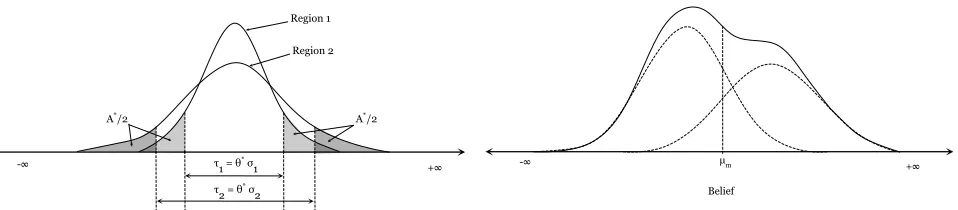
Figure 1: Distribution of beliefs
across regions 1 and 2.
Proportion Persecuted (A)
C ost s an d B en ef it s of P er se cu tio n t o G ov er n me n t K(A) F(A) A*
Figure 2: The costs and benefits of
persecution.
with support on the real line. This measure is intended to capture the distance of individuals from some baseline standard of orthodox belief as opposed to over-all religiosity. Thus, for example, it would measure adherence to orthodox traditions (e.g. eating certain foods, wearing certain clothes, etc...) or whether an individual believes in the dogma of the orthodox church (e.g. belief in consubstantiation or transubstantiation).
Each local government rules a region. Importantly we allow for heterogeneity in beliefs across regions. The belief of individual i in region j is consequently drawn from probability density function Bj b
∼N(µj, σj). Figure 1 depicts a possible distribution of beliefs across two regions
indexed 1 and 2.
We assume the government self-interestedly sets the standard of orthodox belief to be at the mean of the distribution of believers in its region. More interestingly, the government must then decide on the extent to which a believer can deviate from the standard of orthodox belief and still be considered non-heretical. We adopt a very general framework and assume the benefits of defining a proportion of the populationA∈[0,1] as non-orthodox, or heretical, is given byF(A) whereF′ >0,
F′′<0, andF(0) = 0. Intuitively, whenAis low and the state is excluding the beliefs of only a small
proportion of the population, the marginal benefit in terms of religious legitimation of excluding one more individual is high. Conversely, when Ais very high, then most of the population is excluded from the orthodox belief and, therefore, the marginal benefit of excluding another individual is low. Similarly, we assume the costs of persecuting a proportion of the population A is given by K(A) where K′ > 0, K′′ > 0, and K(0) = 0. As the number of individuals excluded from the official religion increases so does the marginal cost of persecuting them.11
government.
11
3.2 Religious Toleration
Given, these assumptions, each local governmentj maximizes the following objective function:
Uj =F(Aj)−K(Aj). (1)
Maximizing equation 1 yields a first order condition that equates the marginal benefits of perse-cution with the marginal costs. This defines an optimal proportion of the population to declare unorthodox A∗ as illustrated in Figure 2. Since F and K are common across regions, we assume
that the optimal choice of A∗ is also identical across regions. This assumption can be relaxed without loss of generality.
We now derive a measure of tolerance as an interval surrounding the orthodox standard of belief within a region. We call this measure of tolerance τj ∈R. Since Bj is normally distributed with
standard deviation σj the range of religious belief tolerated is implicitly defined by:
erf τ
∗
j
σj
√
2
!
= 1−A∗, (2)
where erf(·) is the error function.12
The implicit error function is well defined and allows a closed form expression for tolerance to be written as:
θ∗σj =τj∗, (3)
where θ∗ is simply equal to the inverse error function times a constant and is identical across regions.13
It follows from the implicit function theorem that τ∗
j is decreasing inA∗. Furthermore,
τj∗is obviously increasing in the variance of belief in regioni. Equation 3 has important implications which we state as follows.
Result 1 An increase in religious toleration (τ) can come about for two distinct reasons: (1) an increase in the net marginal benefits of religious legitimation which raises θ∗; or (2) an increase in the dispersion of beliefs in a given region (σ).
This result forms the basis of our claim in the last section that the degree of persecution of deviant religious beliefs in a society (the size ofA∗) is distinct from a society’s degree of tolerance (the size
12
The error function is defined as: erf x
= 2
√
π
Rx
0 e
−t2 dt.
13
The explicit expression forθ∗is erf−1
1−A∗√
+∞
-∞ τ
1 = θ
*σ
1
A*
/2 A*
/2
τ
2 = θ
*σ
2
Region 1
Region 2
Figure 3: Result 1: Religious
persecu-tion and religious tolerance are not the same thing.
+∞
-∞ µm
[image:11.612.79.558.82.187.2]Belief
Figure 4: A mixture distribution
com-posed of two underlying regions.
of τ∗). It is possible for two regions to persecute the same proportion of their population, but the region with a greater variance of belief will, in equilibrium, be more tolerant. Figure 3 illustrates this, seemingly paradoxical, result. In the Figure, Region 2 is more tolerant than Region 1 in the sense that it defines orthodox belief more broadly than does Region 1. However, in equilibrium, both regions are persecuting the same proportion of their populations as heretical. In effect, the government in Region 2 is forced to accommodate larger deviations from the orthodox belief because it has a more heterogenous population.
3.3 Religious Toleration and Legal Centralization
We now model what happens to toleration when one of the regions, which we call the central region, standardizes laws across all the other regions. In particular, we wish to investigate the difference between religious tolerance when each local government sets its own legal rules and the level of religious tolerance that results from a single centralized government imposing legal standardization. For clarity, we refer to variables associated with the centralizing region before centralization with the letter c. After centralization, we index variables associated with the single unified government with the letterm.
As with each local government, the central government chooses a range of legitimate belief centered on the orthodox standard, which is defined as the set of beliefs closest to that of the central mass of the population. We assume, without loss of generality, that the underlying costs and benefits of persecuting a certain proportion are the same for the centralized government as they are for the regional governments. The main assumption that makes the centralized government different from the regional governments is that it’s definition of tolerance, τm, must be imposed on all regions.
This means the central authority is choosing τm for the distribution of the distributions of belief
convex combination of the underlying distributions. We write this as
M b;µ1, . . . , µn, σ1, . . . , σn
=
n
X
j=1
ωjBj b;µj, σj
, (4)
where wj is a weight assigned to each region such that the sum of alln weights is one. A natural
interpretation of these weights is as the relative importance of a region in the overall distribution (e.g. population share, proximity to the center, etc...). Figure 4 shows an example of a mixture distribution along with its two underlying distributions.
The cumulative distribution function ofM also exists and is constructed as a convex combination of the underlying CDF’s. SinceM is a mixture of normal distributions, furthermore, it is established in the literature that the inverse of its CDF also exists (Everitt and Hand, 1981). Thus, there is a unique mapping of A∗ to τ
m similar to Equation 3. Unfortunately, there are no closed form
solutions for the inverse CDF of a mixture of Gaussian distributions and, thus, it is not possible to write this down an explicit expression for τm. There are closed form expressions for the mean
and variance ofM, however. The mean is simply the weighted sum of the means of the component regions:
µm= n
X
j=1
ωjµj. (5)
Similarly, the variance of the mixture distribution is the weighted sum of the underlying regional variances with an adjustment for how much each region is ‘off-set’ from the others:
σm2 =
n
X
j=1
ωj
h
µj−µm
2
+σ2ji. (6)
Equation 6 makes clear the potential for fat tails in the mixture distribution.14
. We can also use Equation 6 to draw some conclusion on the effect of legal centralization on tolerance and secularization.
For concreteness, we define an increase in secularization as occurring after legal centralization if
τm > max
τj . Furthermore, we say region j has more ‘cohesive’ religious beliefs than region k
14
+∞
-∞
Central Region
Region j
µm
τ
m
max {τ
c, τj}
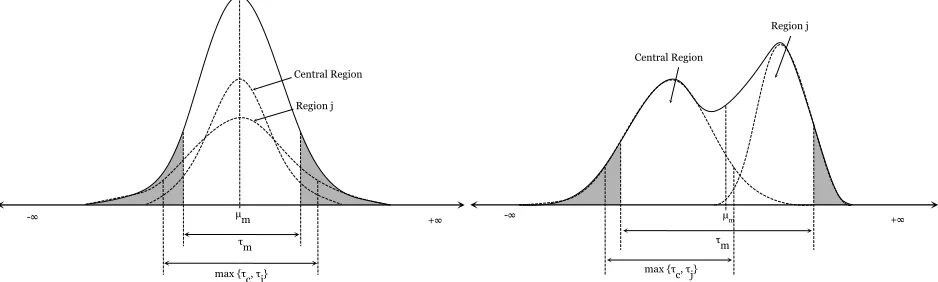
Figure 5: Secularization decreases after
centralization. Region j has low cohesive-ness and deviance.
+∞
-∞ µm
Region j
Central Region
τ
m
max {τ
[image:13.612.75.544.75.216.2]c, τj}
Figure 6: Secularization increases after
centralization. Region j has high cohesive-ness and deviance.
if σj < σk. We say region j has more ‘deviant’ religious beliefs than region k if µj −µm
2
> µk−µm
2
. We can then state the following based on the existence of τm and Equation 6.
Result 2 Secularization is more likely to accompany legal centralization the more cohesive and deviant are the religious beliefs of the underlying regions.
Figures 5 and 6 illustrate Result 2 for the simple case of two regions. The distribution of belief in the central region is the same in both figures. However, in Figure 5 regionj has both low cohesiveness and low deviance. In effect, there is only a weak consensus among believers concerning what is orthodox in j, but at the same time, the average believer holds views consistent with those of the central region. As a result, when the central region imposes a common legal standard, the bounds of tolerance are reduced in regionj. This is a case in which legal centralization is accompanied by a decrease in secularization.
In Figure 6, region j has both high cohesiveness and high deviance. Consequently, when legal centralization occurs, secularization increases. This is true since the new standard of tolerance,
τm, is greater than the previous value of tolerance in the most tolerant region before centralization
which, in this case, happened to be the centralizing region.
As a further illustration of Result 2 we use the statistical package R to numerically calculate the quantile function for the mixture distribution of two regions. We hold the distribution of beliefs constant for the central region at µc = 0 and σc = 1. For the other region we allow µj to
vary between 0 and 100 and σj to vary between 1 and 100.
15
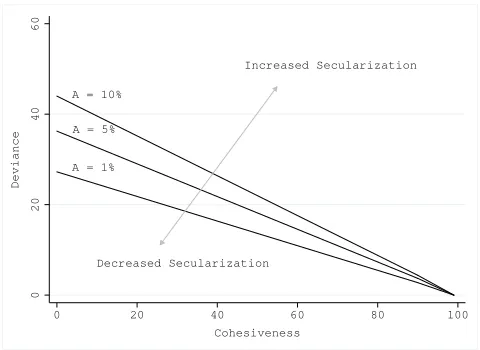
In Figure 7 we plot the different combinations of cohesiveness and deviance for region j which result in τm = τj. If we assume
A∗ is equal to .05, for example, all combinations of cohesiveness and deviance for region j that
15
Increased Secularization
Decreased Secularization A = 10%
A = 5%
A = 1%
0
20
40
60
Deviance
[image:14.612.186.426.70.245.2]0 20 40 60 80 100 Cohesiveness
Figure 7: Numerical demonstration of Result 2. Lines show whereτm=τjfor the case wheren= 2.
The central region hasµc = 0 and σc = 1. Cohesiveness and Deviance of regionj measured on x-axis. Cohesiveness = 100−σj. Deviance = µj
2 . Ais equal to proportion of population excluded from
orthodox belief. τmandτjcalculated using R assuming equal mixing weights.
lie above the plotted line result in a mixture distribution which yields increases in secularization after legal centralization. Likewise, combinations of cohesiveness and deviance which fall below the line will result in a decrease in secularization after centralization. Consistent with Result 2, there is a positive relationship between both cohesiveness and deviance and the likelihood of increased secularization after legal centralization. If both regions have the same cohesiveness of religious belief (equal variances), then any difference in their means will result in increased secularization after legal centralization. Furthermore, as the cohesiveness of a region decreases, secularization becomes less likely. This relationship is exacerbated for higher values of A∗. In other words, the more religious persecution there is, the less likely it is that legal centralization will lead to greater secularization.
Our final observation concerning secularization concerns the evolution of A in the aftermath of legal centralization. In particular, some historians have noted that heretics are often created by centralizing states. Periods of intense state-building are often accompanied by spikes in persecutions for heretical beliefs. Our model can explain this behavior if we assume that the centralizing region initially imposes it’s own standard of tolerance on the unified regions and if the central authority is slow to adjust this standard after heresy trials increase. This will always be the case, regardless of whether equilibrium secularization has increased or decreased so long as τc < τm. Figure 8
illustrates the logic behind this claim. The initial standard of tolerance after unification is that of the centralizing region, τc. After unification, this standard results in a number of prosecutions in
+∞
-∞ µc µm µj
τ c
[image:15.612.184.429.74.187.2]τ m
Figure 8: Result 3: If the central region adjusts tolerance slower than it centralizes other legal
institutions, many more heretics are created than optimal.
the logic of Equation 1 will put pressure on the government to decriminalize a significant amount of heretical beliefs by expanding tolerance to its equilibrium value ofτm. Thus, we can state
Result 3 If τc < τm and if the central region adjusts religious rules with a lag, then the amount of
religious persecution (A) will follow an inverted-u shape over time.
4
The Theory Applied to History
4.1 The Creation and Suppression of Medieval Heresies
The process of state building in medieval Europe led to the integration of fragmented regions, with different cultures and different religious traditions and customs into large proto-nation states such as France and England. The south of France, Proven¸cal or Languedoc, was linguistically and culturally separate to northern France.16
The institutions of the Catholic Church were less developed in Languedoc than in northern France.17
As a result, Church leaders from northern France and Italy saw Languedoc as a land rife with heresy. Pope Innocent III described the clergy of Languedoc as ‘blind creatures, dumb hounds, who can longer bay, simoniacs who sell
16
The language of its inhabitants waslangue d’ocrather thanlangue d’oil and in many ways it was culturally and economically more connected to Catalonia and northern Italy than it was to the region north of the Loire (Given, 1990; Pegg, 2008). Given notes ‘the French monarchy, however, had little to do with Languedoc since the break-up of the Carolingian empire. In the middle of the twelfth century the Capetians began to show a renewed interest in the affairs of the south. But when the wars to end Languedocian autonomy began in 1209, the French monarchy and the various southern lordships had behind them only a relatively brief history of important political contacts’ (Given, 1990, 39).
17
justice, damning the poor and giving absolution to the rich. They do not even observe the laws of the Church. They acquire endless benefices, entrusting the priesthood and other ecclesiastical responsibilities to unworthy pastors and illiterate children. Hence the insolence of the heretics’ (quoted in Oldenbourg, 1961, 53). This disparity between local religious practices and Catholic orthodoxy and the failure of local rulers to suppress these ‘heretics’ became the justification for the Albigensian Crusade (1209-1229), the largest campaign against heresy in medieval Europe. We will show how the process of medieval state building led to certain beliefs becoming defined as heretical and to the suppression of the Albigensians and their assimilation into orthodox Catholicism. We will also describe how the different values of cohesiveness and deviance for the thirteenth century Albigensians and the sixteenth century Protestants resulted in genocide for the former, but legal recognition for the latter.
The heretics suppressed in thirteenth century Languedoc are usually labelled Cathars. Traditional historical accounts view the Cathar heresy as a distinctive dualist religion influenced by eastern heresies and by older Gnostic and Manichean ideas.18
However, the most recent historical scholar-ship casts doubt on the existence of Catharism as a distinctive set of beliefs prior to the crusade and the introduction of the Inquisitorial method. The best evidence we have on the beliefs of ordinary people comes from the Inquisitorial records. The largest Inquisitorial investigation of heresy of the medieval period was conducted in Languedoc in 1244-1245 and revealed no trace of an alternative, organized, dualistic religion (Pegg, 2001). Instead, what this research suggests is that it was the very process of state formation and legal centralization that led to beliefs that were previously considered within the limits of accepted Catholicism becoming defined as heretical.
The heretics were not called Cathars or Albigensians in the contemporary literature, instead they were often referred to as the good men orbons omes(see, Pegg (2001, 19) and Moore (2012, 302)).19 Importantly, ordinary people, even those who declared themselves heretics, did not necessarily have a clear idea of what ideas distinguished the ‘good men’ from the Catholic Church.20
Pegg concludes
18
According to this view, the Cathars held that the devil had created the material world and that Christ could not therefore have been born in human flesh and have suffered on the cross. Following the writings of contemporary Cistercians chroniclers, historians saw the Cathars as developing a church-like organization in opposition to the Catholic Church. Oldenbourg (1961, 28-81), Lambert (1998), Hamilton (1999), and Barber (2000). This view sees the Cathars as decisively influenced by the Bogomil heresy which arose in Macedonia in the tenth century.
19
Traditionally the term ‘good men’ has been translated asperfecti as this was the term used to describe initiated or ‘perfected’ members of the Cathar Church. Pegg notes ‘What is so intriguing about the epithet “good man,”bons ome beloning to a person deserving of honour, and transcribed at Saint-Sernin asbonus homo or less frequently as
probus homo, is that “good man” was the title adopted by any Lauragais man in situations circumscribed by courtesy’ (Pegg, 2001, 95).
20
that ‘[n]o systematic dualist philosophy comes through the confessed thoughts of all these men and women; rather, instead of valid generalizations, a collection of vague generalities appear to have been recorded at Saint-Sernin’ (Pegg, 2001, 79).21
Prior to the crusade against them, the heretics of the Languedoc did not necessarily reject the Catholic faith: they were often buried with orthodox Catholics and participated in the Catholic sacrament.22
This new historical research poses a puzzle. The suppression of the Cathars was the largest and bloodiest event of its kind during the middle ages. This brutal response would make sense if Catharism posed as a genuine alternative religion to Catholic Christianity as some twentieth century historians supposed. But if Catharism did not exist as a distinct religion, directly confronting the Catholic Church, what explains the crusade and burnings that took place in thirteenth century Languedoc?
Historians have focused on the rise of a persecuting society in the thirteenth century: a society that sought legitimation in the persecution of outsiders such as Jews and lepers, as well as heretics (see Moore, 1987).23
Result 1 of our model clarifies the distinction between the bounds of religious toleration within a society (τ) and the extent to which that society persecutes deviant belief (A∗). The model also explains how an increase in legal centralization can lead to theredefinition of some beliefs as outside the scope of toleration. Result 2 suggests that such a redefinition (or reduction in secularization) is more likely to occur if the region being absorbed into the centralizing state has a distribution of religious beliefs that lacks a clear sense of identity separate from that of the center. This seems to describe the ‘good men’ of the Languedoc in the thirteenth century quite well. To use the language of the model, the distribution of religious belief in the Languedoc was relatively non-cohesive (large value for σj) and non-deviant (low value for µj −µm
2
). It follows that the persecution of heretics in Languedoc can be seen as a consequence of the centralization of the French monarchy and the increased centralization of the Catholic Church. These two developments led to the local religious practices being redefined as heretical. In the period before the crusades the good men of Languedoc seem to have seen themselves as orthodox Christians.24
Persecution
21
Similarly Ladurie (1978) found that heretical beliefs could co-exist with orthodox ones and that individuals could move back and forth between heresy and orthodoxy (see Ladurie (1978, 311-313) and Ladurie (1978, 324-325). Also see Arnold (2001, 158) for a like conclusion.
22
Pegg argues that ‘the good men, while scathing in debate about vainglorious bishops and priests, never assumed that divinity was denied to worthy clerics, such as honorable monks and prudent priests’ (Pegg, 2008, 44). Thus, in lieu of a separate religion he sees a ‘distinct and highly developed Christian culture’ ‘in the lands of court of Toulouse before the crusaders arrived in 1209’ (Pegg, 2008, 190).
23
For the rise of anti-Semitism in medieval Europe see Poliakov (1955); Menache (1985, 1997); Langmuir (1990); Stow (1992); Nirenberg (1996); Koyama (2010). The Augustinian pledge to preserve the Jews as ‘witnesses’ protected them in theory from massacres and forced conversions but in practiced anti-Jewish violence increased from the late twelfth century through to the fourteenth century and eventually ended in the expulsion of Jews from almost every western European country.
24
turned them into Cathar heretics.
Religious practices in Languedoc in the period prior to its integration into France had evolved somewhat differently than those in northern France where the presence and organization of the Catholic Church was much stronger and feudal lordship was more concentrated. Christianity in Languedoc was more localized and focused on the holiness of specific individuals and preachers. Clerics educated in the political centers of Europe found very different religious institutions and practices in peripheral regions. Moore observes:
‘The Church . . . was far less developed in large parts of this vast and varied territory between the Rhˆone and the Loire than the lowland region, both north and south of the Alps . . . the mountainous and relatively undeveloped lands between the Alps, the Massif Central and the Pyrenees had been little touched by the work of Charlemagne and his successors in the ninth century, which had not only given schools to the cathedrals of the north but made them in varying degrees hubs of parochial organization and services in many places and contributed much to the Christianization of the countryside’ (Moore, 2012, 120).
He notes that the ‘Christianity south of the Loire was often, for this reason, very different from that of other parts of Europe . . . Local saints and their festivals, commemorations and customs were cherished with corresponding fervour. Doctrine, on the other hand, cannot have been at all clearly or precisely disseminated or understood among lay people, and was doubtless subject to a good deal of local variation in its expression’ (Moore, 2012, 120).25
The failure of the local nobility of Languedoc to repress practices now viewed as heretical by the Pope and the clergy of northern France provided the justification for the Albigensian crusade. The crusade led to the defeat of the nobility of Languedoc, the incorporation of the region into France, and to the creation of the Inquisition.26
The process of state formation was accompanied by legal centralization and standardization, the adoption of Roman canon law, and the inquisitorial
25
The medieval Church was responsive to the needs of local elites. In northern France, centralization of feudal holdings in the hands of the higher nobility went hand-in-hand with the consolidation and centralization of the Church. These demands often conflicted with the religious demands of the majority of the laity who venerated local holymen and this was a source of many popular ‘heresies’. By contrast, in Languedoc, the religious demands of the local elite differed to those of the northern nobility. No single lord had consolidated the scattered feudal holdings of the nobility and, as a region, ‘it was less highly feudalized and manorialized than northern France’ (Given, 1997, 6). Moore and Pegg suppose that the heresy of the Good Men can be seen as an idiosyncratic and local response to the religious demands of the local population in the Languedoc. For example, they suggest that the temporary sanctity of ‘good women’ was a way of protecting the virginity of young girls in a society where the desire of maintaining the unity of often fragmented landholdings frequently meant that young women were forced into early marriages.
26
Year
1028 First heresy executions in western Europe since fall of Roman Empire. 1166 Assize of Oxford. First edict of a secular monarch against heresy.
1184 Papal BullAd abolendam. Introduction of inquisitorial procedure against heresy. 1209 Beginning of the Albigensian Crusade.
1215 Fourth Lateran Council.
1229 Treaty of Meaux-Paris ends Albigensian Crusade. Languedoc incorporated into France. 1233 Appointment of Inquisitors in Toulouse.
1244 Capture of Monts´egur. Over 200 heretics burnt.
1244-1245 Inquisition of Bernard de Caux in the diocese of Toulouse.
1307-1314 Trial of the Templars. Philip IV uses inquisitorial methods to suppress Templars.
Table 1: Brief Chronology of Medieval Heresy
procedure. In the early medieval period ‘Germanic folk-judgement procedure had been widely perpetuated in France’ (Langbein, 1974, 213). This localized and decentralized legal system, reliant on ordeals, folk-methods of proof and on a form of group inquest, was not able to meet the demands of the French monarchy, nor was it qualified to investigate crimes like heresy. The office of the inquisition was instituted precisely because of this shortcoming and because local bishops and other authorities were unable and often unwilling to hunt down heretics.27
Although the initial onus to persecute heretics came from the Church, the suppression of heresy was conducted by or with the assistance of the secular authorities with whom the inquisitors worked in close collaboration:28
‘Once they had decided that a region was infected with heresy,they undertook a tour of inspection. When they arrived in a town, they assembled the population and preached a sermon setting forth the purpose of their visit. To entice those with knowledge of heretical activities,the inquisitors declared a grace period during which those who came forward with confessions were assured of light penalties. At the end of this period, the inquisitors began the business of summoning and interrogating suspects. A fragment of the investigation carried out by Bernard de Caux in 1245 and 1246 in the diocese of Toulouse has survived. This fragment concerns only the two archdeaconries of Lanta and Vieilmorez. From this relatively small region, Bernard summoned at least 5,471 individuals to testify. Often, entire villages were required to appear before the
inquisi-27
Philip IV would use inquisitorial methods and (many individual inquisitors) in order to torture confessions from the Knights Templar and to seize their goods and possessions. One historians notes ‘The use of inquisition as a suitable weapon for combating heresy can be placed within the context of the growing bureaucratization of European society’ (Arnold, 2001, 21).
28
tors. At least 420 people from the village of Le Mas-Saintes-Puelles were interrogated by Bernard and his assistants (Given, 1989, 340)
However, as we have noted, Pegg’s (2001) study of the Inquisitorial records confirms that there was no evidence of an organized Cathar church.29
Rather, and in a manner completely consistent with our model, the inquisitors created the image of the organized heresy they expected to encounter and in so doing they hardened the boundaries between orthodox Catholicism and heresy as ‘those who still believed in the heretics now did so with a new awareness about themselves: a self-consciousness that was, ironically, made precise and clear through the very men who wished to punish them, that is, through the two friar inquisitors’ (Pegg, 2001, 130). Discontent with the church hierarchy and church corruption was common throughout the middle ages and often led to dissenting belief (Leff, 1961, 1967). It was the growth of the medieval state, however, that criminalized this dissent and turned it into heresy.30
4.2 The Rise of Protestantism in France
As we have seen, the vast majority of medieval heresies were suppressed. We argued in the previous section that the growth of state power enabled medieval monarchs to eradicate deviant religious practices as way of enhancing their own legitimacy. Furthermore, consistent with our model’s predictions, because of the amorphous nature of religious belief in the south of France during the thirteenth century, the centralizing state faced little incentive to secularize legal institutions. In-stead, it chose to restrict tolerance and, in the process created a ‘persecuting society’.31
Nowhere was this tendency more marked than in France; the French king cultivated the titlerex Christianis-siums (Most Christian Monarch) and claimed that his land was the freest from heresy in all of Christendom. (see Strayer, 1969, 1971a, 308).32
The French monarch was consecrated as well as
29
‘[N]o elaborate heretic organization was discovered by the two Dominicans, nor, no matter how many times manuscript 609 is read, will a “Cathar Church” be found by modern historians’ (Pegg, 2001, 130).
30
Our framework is also applicable to other medieval heresies. Robert E. Lerner has demonstrated that the most important heresy of the fourteenth century, the Heresy of the Free Spirit was largely a construction of inquisition and that those convicted as belonging to this heresy had a range of beliefs that emphasized mysticism and apostolic poverty (Lerner, 1972). Forrest (2005) depicts in detail the construction of an apparatus for detecting heresy in England in the early fifteenth century. He observes that persecution created ‘a new community of the orthodoxy’ and ‘heresy and anti-heresy were produced co-dependently’ (Forrest, 2005, 235-236).
31
The only medieval heresies that survived until the early modern period were the Waldensians and the Hussites and the latter only survived because they became allied to a nascent nationalist movement in Bohemia.
32
crowned on his coronation ceremony, and as part of his coronation oath he swore ‘that in good faith to all men I shall be diligent to expel from my land and also from the justification subject to me all heretics designated by the Church’ (Holt, 2005, 7).
In 1500 there was littleorganized heresy in France. Nevertheless there was a considerable amount of religious debate within humanist circles about religious heterogeneity in the provinces.33
The humanists who were critical of the Church were associated with the Cercle de Meaux and they received the patronage of the sister of King Francis I (1515-1547), Marguerite of Angouleme. There was, at that time, no hard distinction between those who wished to reform the existing institutions of the Catholic Church and those who would eventually come to reject Catholicism entirely (Cottret, 2003).34
From the 1520s onwards, the Reformation in Germany and Switzerland began to filter into France. The Sorbonne ordered Martin Luther’s works to be seized and burnt in 1523. Heretics were increas-ingly identified as ‘Lutherans’ and the first heretic executed as such—a weaver from Meaux—was burned to death in 1524.35
The most important high court in the country, the Parlement of Paris, tried a number of individuals for adhering to the Lutheran heresy in the 1520s and early 1530s.36
Official edicts against heresy were only as effective as local authorities were able, or motivated, to make them and beyond the seats of royal power, local officials typically took no action against suspected heretics.37
The French state lacked the legal capacity to enforce many of its decrees. Greengrass observes that ‘[e]verything we know about the sixteenth-century legal system suggests its manifest inability to enforce its authority uniformly and effectively and we should not expect it to have performed markedly better in the pursuit of heresy than of other crimes’ (Greengrass, 1987, 37). In most of France heresy was a matter for the religious courts and these courts were
baptism. Other kings had to go to the apothecary to buy their oil, the French king alone had his brought from heaven’ (Ullman, 1961, 201).
33
Knecht notes ‘[h]eresy was not unknown in France at the end of the Middle Ages, but, except in Dauphin´e and Provence, where there was an infiltration of Waldensianism from the Alpine valleys of Piedmont, it was not in any sense an organized movement’ (Knecht, 1982, 139).
34
‘In the twentieth century, we take the existence of separate churches and the division between Roman Catholic and Protestants as self-evident. Yet the beginnings of the Reformation were extremely complex . . . There had been a reforming spirit in the French church, which did not necessarily lead to a separate confession. Jean Vitreir, Guillaume Bri¸connet, bishop of Meaux, or Lef`evre d’´Etaples were roughly the equivalent of John Colet, Thomas More or John Fisher of the English church’ (Cottret, 2003, 109).
35
At this stage, though ‘the authorities had often little conception of what the term ‘Lutheran’ actually meant’ (Greengrass, 1987, 11).Greengrass further notes ‘The clarity between orthodoxy and heresy was, however, a long way off, even in 1530’ (Greengrass, 1987, 10).
36
As Salmond observes: ‘There was no organized Protestant churches in France during this period of the pr´er´eforme’ (Salmon, 1975, 87). Another historian comments: ‘it was to be a long time before heresy was adequately disentangled from humanism, a miscellany of advanced opinions, and a great deal of fluctuating confusion of thought and mind (Sutherland, 1980, 11).
37
typically held to be inefficient. Papal inquisitors fervently pursued heretics in some regions, but were also often venal and ineffective. Monter observes that ‘[f]rom top to bottom from pope to bishop, church courts and canon law simply could not cope with the early Reformation’ (Monter, 1999, 45). Some parlements were known to be lenient to Protestantism, while others were known to take a hardline position. However, the parlements everywhere struggled to enforce royal authority ‘. . . in the more distant parts of their jurisdictions. Pockets of immunity would therefore continue to exist for Protestantism almost everywhere within France, but particularly in the big cities and on the domains of the powerful nobility who protected their tenants from judicial enquiry’ (Greengrass, 1987, 38).
A detailed study of Languedoc by Raymond Mentzer demonstrates how local authorities were ill-equipped to investigate heresy cases (Mentzer, 1973, 1984). Throughout the 1520s and early 1530s, heresy remained the responsibility of church courts and the inquisition which worked in collaboration with the secular authorities. However, in the 1530s several inquisitors were themselves implicated as heretics. Arnauld de Badet, the new inquisitor selected in 1531, was accused of being a Lutheran and denying free will, praising Cicero, Plato, and Ptolemy while neglecting the Church Fathers. Another inquisitor, Louis De Rochette, was executed. Unsurprisingly this ‘prolonged crisis and especially the execution of de Rochette’ discredited ‘the Inquisition as an effective institution for the control of heresy’ (Mentzer, 1984, 34).
4.3 Sixteenth Century Centralization and the Campaign Against Heresy
The crisis in the regional and religious courts coincided with Francis I’s (1515–1547) attempts to centralize the French state.38
The French legal and fiscal system was highly fragmented and heterogenous at the close of the Middle Ages (Wolfe, 1972; Hoffman, 1994; Monter, 1999).39
The edict of Villers-Cotterˆets of 1539 imposed a set of common legal standards on this system. It mandated the use of French in all courts and legal documents and solidified and standardized the use of the Roman-canon inquisitional model across all regions of France (Mentzer, 1984).40
It was followed by The Edict of Paris in 1539 and The Edict of Fontainebleau in 1540 which specifically addressed the problem of heresy. The Edict of Paris was the first time the Crown took a direct role in the persecution of heresy. The Edict of Fontainebleau:
‘entrusted to all royal judges (i.e. members of the sovereign courts, baillis, s´en´echaux,
38
Francis I initially attempted to protect heretics. However, this changed with the Affair of the Placards in 1534, after which heresy became associated with challenges to the existing political and social order (Sutherland, 1980; Knecht, 1982; Roelker, 1996; Monter, 1999).
39
For further details on the fragmentation of the French fiscal system, see Johnson and Koyama (2012, 2011).
40
pr´evˆots etc.), ‘indifferently and concurrently’, the right of enquiry (inquisition in respect of all persons, lay and ecclesiastical, except clergy in major orders. After prosecution, suspects were to be sent immediately to the sovereign courts for sentencing, regardless of any privilege or franchise they might claim. All feudal lords (hauts justiciers) were enjoined on pain of deprivation of their jurisdiction to carry out searching enquiries within their respective areas and to refer suspects to the king’s judges’ (Knecht, 1982, 398).
The Edict of Fontainebleau was thus an important instance of Laicization; it asserted secular control over heresy as a crime making its suppression the responsibility of the regional parlements as these alone were permitted to use torture and to pronounce sentence (Mentzer, 1984, 45). It also represented an significant movement towards local standardization and it asserted royal control over the regional courts (which had to report to the king every six months) while at the same time granting those courts authority over religious affairs. Furthermore, for the first time, the Edict identified heresy with sedition and thus defined it as a crime against the state as opposed to the church (Sutherland (1980, 34) and Roelker (1996, 207)). Those church courts that continued to exist where increasingly supervised by royal officials (Mentzer, 1984, 10).41
At the same time the definition of heresy was standardized in such a way that made it easier for the courts to convict suspects. It was shifted away from one based in theology (i.e. a judgement of the orthodoxy of one’s beliefs) towards an assessment of whether or not an individual’s visible behavior implied that they were heretical, as the latter was easier to ascertain.42
In 1544 the king published a list of prohibited books prepared by the Sorbonne and in 1545 ‘special commissions of parlementaries to seek out heresy in particular regions began to function’ (Roelker, 1996, 182).
These royal edicts had the effect of creating an official ‘engine of repression’ (Roelker, 1996, 211).43 Using trial data collected by Monter (1999) we can illustrate the effect the creation of this engine of judicial repression had on the both the number of individuals executed for heresy and the geographic scope of these heresy trials.44
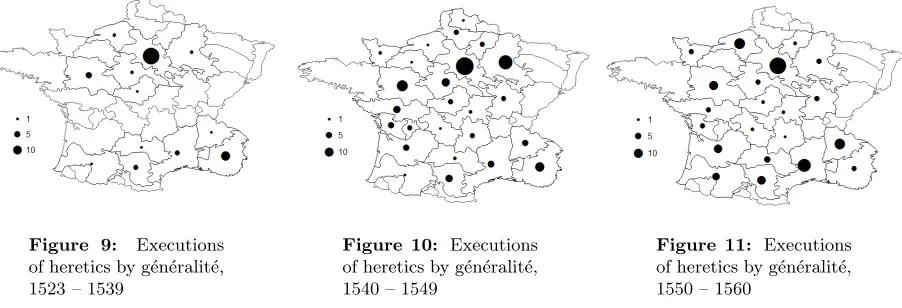
Figures 9, 10, and 11 show both the dramatic increase in heretic executions after 1540 and the accompanying increase in their geographic spread.45
Before the Edict
41
‘At the same time, the number and proportion of heresy cases handled by the royal courts spiraled, with the bulk of this increased case-load passing to the parliaments’ (Mentzer, 1984, 10).
42
It became heretical for schoolmasters to interpret scripture a certain way, for individuals to damage or deface religion icons, to sell or distribute heretical books or to speak words contrary to the Catholic religion (Greengrass, 1987, 34).
43
The ‘momentum could not be arrested, even had Fran¸cois wished to do so. The point of no return had been passed’ (Roelker, 1996, 211).
44
Monter (1999) collected the data on executions for heresy between 1523 and 1560 by combing through all of the parlementary criminal records in France. This was a significant undertaking considering the lack of an index system and that there were between eight and ten parlements operating at any time during this period. Monter reports the village of arrest for each trial. We geocoded this location as well the location of the closest regional parlement. We then used ArcGIS to measure the distance between these two locations for each trial.
45
Figure 9: Executions of heretics by g´en´eralit´e, 1523 – 1539
Figure 10: Executions
of heretics by g´en´eralit´e, 1540 – 1549
Figure 11: Executions
of heretics by g´en´eralit´e, 1550 – 1560
of Fountainebleau, most executions occurred either in Paris or Provence. After 1540 almost all the regions in France began to execute heretics. These figures suggest strongly that the centralizing reforms of Francis I were not just pieces of paper; they were actually obeyed.
The efforts of the King and the parlement of Paris also resulted in an increase in the geographic reach of the French centralized state as ‘inquisitors of the faith’ were appointed and sent out into the provinces in order to seek out and detect heretics (Roelker, 1996, 208).46
Figure 12 depicts this increase at a local level by showing the geographic location of heretic executions in the g´en´eralit´e of Provence. Squares show where executions occurred before 1540 (each symbol may represent multiple executions). Triangles show the location of executions after 1540. The seat of the high court of Provence in Aix-en-Provence is also marked. The Figure makes clear that before legal centralization in 1540, executions clustered closely to the primary seat of legal power for the crown in Aix-en-Provence. However, after 1540, executions occur much further away from the high court. In effect, the scope of royal authority, as measured by the willingness and ability of local courts to execute heretics, increased after 1540.
Figure 13 shows similar data for all the g´en´eralit´es of France between 1523 and 1560. Each point in the scatter plot represents the distance of a trial from its regional high court (parlement). The plotted line is a kernel weighted local polynomial regression of distance of trial on year, or more simply, the average distance of trials from their high courts in that year. The data show that the centralizing reforms of Francis I between 1538 and 1540 were responsible for increasing both the number and geographic scope of heresy executions.
boundaries, but we don’t suggest these boundaries were significant for religious belief. Rather, they are purely fiscal regions.
46
Figure 12: Distance of heresy executions from high court in Provence located at Aix-en-Provence. Squares represent executions before 1540. Circles represent executions af-ter 1540. Multiple executions may be repre-sented by one symbol.
Figure 13: Distance of trials from regional
Parlement, 1520 – 1560. Each dot represents a trial. Plotted line is a kernel weighted lo-cal polynomial regression of distance of trial on year (bandwidth = 2). 95% confidence interval shown.
The increase in legal capacity resulted in a tremendous growth in heresy trials, but it was not enough to suppress the Protestants: the number of heretics continued to grow throughout the 1550s. The campaign against heresy continued in the reign of Henri II (1547-1559) with the creation of the
Chambre Ardentre (burning chamber)—a special court devoted to prosecuting cases of heresy–and the Edit of Chateaubriand in 1551. These marked the high point in the judicial repression of heresy.47
Donald Kelly argues that these persecutions were counterproductive in part because the ‘result was to intensify the impression of Protestants that they were recapitulating the experiences of early Christians’ and thereby to consolidate their view of themselves as belonging to the true faith, while their persecutions were enacting the will of the Devil (Kelley, 1972, 1329).48
The Protestants became increasingly well organized. They were heavily influenced by the rise of Calvinism in Switzerland and they began to develop a distinct corporate identity as Huguenots. As Kelley (1981, 92) observes, ‘. . . out of transient and sporadic dissidence the “so-called reformed religion” had created a coherent movement and an almost complete corporate organization’.
47
The Edict of Chˆateaubriant of 27 June 1551 was ‘un vrai code de pers´ecution’ (Sutherland, 1980, 44). Many members of parlement themselves became suspects under its auspices. It included twenty articles ‘covering in ex-haustive detail all matters of censorship, the possession, production, sale, and dissemination of religious works; the rigid control of printing, and the inspection of bookshops. But even more vexatious and dangerous were the articles (27-33) relating to informing, which became mandatory (Sutherland, 1980, 46).
48
[image:25.612.74.226.89.215.2]The Huguenots, unlike the heretics of the thirteenth century, could call upon an international Protestant movement for intellectual and spiritual support, and perhaps more importantly still, they could employ the printing press to celebrate those who died as martyrs.49
Jean Crespin and other martyrologists recorded, carefully preserved, and then publicized the deaths of all of those executed just as John Fox did in England (Kelley, 1972; Parker, 1993).50
As Monter (1999, 120) observes, the ‘. . . great heresy hunt begun in mid-1540s had strained the resources of the Paris Parlement to their limits. Accused heretics crowded their jail and their workloads. Moreover, some of these cases presented serious professional difficulties. Heretics were not easily or comfortably judged by men who had mastered every nuance of Roman Law but were untrained in theology’. Despite the imposition of royal control over the regional and church courts, enforcement of the laws against heresy continued to vary from region to region. In the south particularly, landowners sympathetic to Protestantism sheltered and failed to try individuals suspected of heresy.51
The numbers of individuals executed for heresy did not deter the growth of the Protestant move-ment. Indeed, it may have encouraged the formation of an organized Protestant sect.52
Upon the death of Henri II, a power vacuum was created as his successor, Francis II (1559-1560), was still a child. One party formed around the Duc de Guise and was associated with a policy of intensifying the persecution of the Protestants. Another formed around the Bourbon family and became associated with relaxing the policy of persecution.53
At this point a group of Protestant nobles attempted to seize Francis II. What became known as the ‘Conspiracy of Amboise’ failed
49
Here the printing press played a crucial role in enabling religious dissenters to organize themselves and establish a corporate identity in a way that had not been possible in the thirteenth century. Rubin (Forthcoming), for instance, finds that the presence of a printing press in a city in 1500 had a significant causal effect on the likelihood of that city becoming Protestant.
50
‘It is not going too far to suggest that the coherence of the modern tradition of martyrs was created as much by external pressures as by the sharing of a common ideology and a common “Cause”. Catholic attempts to dis-credit individual martyrs only provided further publicity. Stories about last-minute recantations were always being circulated, remarked Erasmus, rejecting one such rumor about Louis Berquin, the first notable French martyr . . . what counted most, however, was the fact of execution. The Catholic solution was to create a kind of countermythology about heretics and, ultimately, an ”antimartyrological” tradition to undo the work of Crespin and his fellow authors’ (Kelley, 1972, 1329).
51
Monter observes: ‘If it was difficult to remove royal officials with previous major convictions for heresy, it was impossible to remove those who had only been accused of helping heretics . . . Perhaps such situations usually occurred in places where an evangelical movement was already well entrenched by 1540. But seven in a town where Protestantism was not widely accepted among the local notables, it was impossible in the 1550s for local Catholic zealots to convict and remove a royal official who was almost certainly a Protestant’ (Monter, 1999, 159).
52
‘the number of heretics was constantly increasing and “the blood of the martyrs is the seed of the church”— in this case, the Reformed Church. According to [Nathanael] Weiss, the measures taken by the Chambre Ardent constituted “overkill. It was better to keep wavers in the fold, even if only formally, rather than ‘exterminate’ them in a way that increased their numbers”’ (Roelker, 1996, 219).
53