© 2015, IRJET ISO 9001:2008 Certified Journal Page 972
PARTIAL DISCHARGE WITHIN A SPHERICAL CAVITY IN SOLID
DIELECTRIC MATERIAL
Keshav Gupta
1, N.K.Yadav
2, P.K.Rattewal
31
M.Tech Scholar, EE Department, DCRUST Murthal, Haryana, India
2Assistant Professor, EE Department, DCRUST Murthal, Haryana, India
³Assistant Professor, ECE Department, IITB Sonepat, Haryana, India
---***---Abstract -
Abstract For high-voltages variety ofmaterials are used for insulation purpose.
Measurement of partial discharge is an efficient tool for the performance assessment of electrical insulation. In this, simulation of PD activity for spherical cavity in homogeneous dielectric material has been developed. The model is used to study the influence of material temperature and cavity size on PD activity. The model uses a finite element analysis (FEA) method with comsol. It is found that certain parameters in this model are cavity size and temperature dependent. Thus, critical parameters influencing partial discharge behaviour for different cavity sizes within the material and material temperatures can be identified. The obtained result may improve an understanding on PD behaviour.
Key Words: FEA, Comsol, PD behavior etc.
1. INTRODUCTION
In high voltage equipments, build-up of the charges and its by-products can be a symptomatic of various problems associated with aging and insulation breakdown. One of the important phenomena to be considered in insulation maintenance is partial discharge (PD). PD is a discharge that does not bridge the electrodes of an insulation system under high-voltage stress [1-5]. If such problems are not repaired, the frequency and strength of partial discharge increase, which leads to the failure of the high voltage equipments. The sources of PD in solid insulation are void cavities, interfaces or delamination. According to the IEC (International Electro technical Commission) Standard 60270, Partial discharge is a localized electrical discharge that only partially bridges the insulation between conductors and which may or may not occur adjacent to a conductor
PD activity at the defect site may cause energy loss and degrade the insulation, depending on the type and location
of the defect and the quality of the insulation design. Although PD never cause immediate breakdown, it indicates the presence of a defect within the insulation which can affect its performance in a long term. The degradation of insulation due to repetition of PD may lead to system breakdown under certain conditions, depending on the type and location of the defect and the quality of the insulation design. It does not cause direct breakdown of the insulation immediately because the surrounding insulation is strong enough to avoid a complete breakdown of the material. Examples of high voltage components which are prone to breakdown are power transmission lines, power cables, wires, power generators and power transformers.
PD activity within void cavities in dielectric is known to be dependent on the given cavity conditions and applied stresses. Two of the factors affecting partial discharge are cavity size and material Temperature. The PD modelling is an area of active research. In some work, it has been reported that the number of PDs and total charge per cycle increase with larger cylindrical cavity diameters within a dielectric material.
© 2015, IRJET ISO 9001:2008 Certified Journal Page 973
2. PRESENT WORK
The PD model developed in this work is based on the Finite Element Analysis (FEA) model that was originally proposed by Cecilia Forssen. The model in [1] has been used to simulate partial discharge (PD) activity in the cavity for various conditions of the stress and cavity conditions, which are the amplitudes and frequencies of the applied voltage, temperature of the material and sizes of cavity. The obtained simulation results are then compared with measurement results to determine the critical parameters affecting PD activity and also to identify physical mechanisms affecting PD activity for different conditions.
Finite Element Analysis model:
The model is implemented in two-dimensional (2D) axial symmetric COMSOL software. The electric potential and temperature in the model are solved using Partial Differential Equations (PDE). PDE equations are rendered into Ordinary Differential Equations (ODE) and ODEs are solved [1-5]. Through developing the model using 2D axial symmetric geometry, the simulation time can be reduced because of the need of less mesh elements. Figure.1 shows the 2D axial-symmetric model geometry of spherical cavity in solid dielectric material.
Figure 1: 2D axial-symmetric model geometry.
Field model equation:
The electric potential distribution in the dielectric is described by the field model. The basic governing equations of the field model are:-
(1)
(2)
Where equation 1 is the field model equation, equation 2 is the current continuity equation; D is the electric displacement field, the free charge density or unpaired charge density and is the free current density.
External Partial Discharge:
External partial discharge takes place outside of the power equipments. Such types of discharges occur in overhead lines, on armature etc.
Internal Partial Discharge:
The discharge in void is belonging to such type of partial discharge and necessary for PD measurement system .PD measurement system gives the information about the properties of insulating material used in high voltage power equipments. The principle behind for measurement of PD is generation/dissipation of energy associated with electrical discharges i.e. generation of electromagnetic waves, dissipation of heat energy, light and formation of noise etc. PD phenomena include several types of discharge which is surface discharge, cavity discharge, corona discharge, Treeing channel.
Corona discharge:
Corona discharge takes place due to non-uniformity of electric field on sharp edges of conductor subjected to high voltage. The insulation supplied for such type of discharge is gas or air or liquid. Such type of discharges appears for a long duration around the bare conductor. They are not attacking directly to the insulation system like internal and surface discharge. Only by the indirect action of ozone formed by corona deteriorates insulating materials used.
Treeing channel:
High intensity fields are produced in an insulating material at its sharp edges and it deteriorates the insulating material .That is responsible for production of continuous partial discharge, called as Treeing channel.
Temperature Effect:
© 2015, IRJET ISO 9001:2008 Certified Journal Page 974
Electron generation rate:
After the field in the cavity, has exceeded, an initial free electron is required to start the PD. The initial free electron is modelled using the total EGR, is defined as the total number of free initial electrons generated in the cavity per unit time.
Mesh Analysis:
Figure 2 shows the mesh geometry of the model including partial discharge i.e. treeing channels, which results due to stress on insulation under high voltage. Mesh geometry shows the condition during partial discharge and its failure after stress due to high voltage.
Figure 2: mesh analysis during stress
Boundary and subdomain settings:
Table 1 to table 3 shows the assigned constants, subdomain settings and boundary settings of the model that are used for the simulation. After the boundaries and subdomains of the model have been set and assigned, the model is meshed and ready to be solved. The solution can be obtained if there is no error in the model.
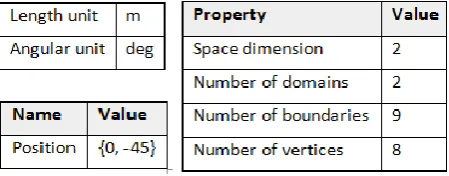
Table 1: Geometry statistics, units, position of model
[image:3.595.312.532.103.178.2]Table 1 shows the values taken to initialize the position coordinates, units and other geometry statistics in the starting, for the formulation of spherical cavity model.
[image:3.595.308.537.265.332.2]Table 2: circle position, rotation angle, size & shape
Table 2 shows the values taken to make spherical cavity in the model. Circle position, shape, size and rotation angle are initialized with the values shown in the table.
Table 3: boundary conditions representation
Table 3 shows the boundary lines, boundary conditions along with their expressions, used in the model geometry and simulation.
3. RESULTS
The proposed work has been implemented in comsol, based on the Finite Element Analysis (FEA). A two-dimensional (2D) axial Symmetrical model describing a spherical cavity within a homogenous dielectric material has been used to simulate PD for different cavity sizes and material temperatures. From the simulation results, it was found that certain model parameters vary for different conditions. Thus, critical parameters affecting PD activity have been identified.
In this work, the cavity temperature is introduced as one of the parameters in the simulation model. It is not the actual measurement data. This parameter has been used to study on how the cavity temperature changes after a partial discharge occurs and to observe how the change in the cavity temperature affects the PD occurrence in the model.
[image:3.595.46.268.295.455.2] [image:3.595.39.264.582.670.2]© 2015, IRJET ISO 9001:2008 Certified Journal Page 975
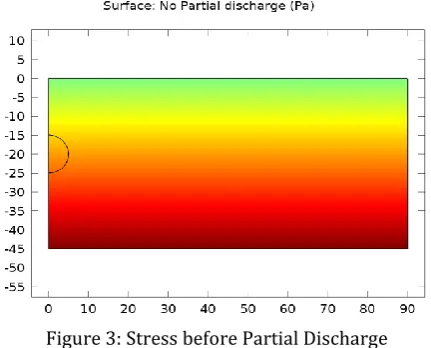
Stress before Partial Discharge:
Figure 3 shows the Stress before Partial Discharge occurring in the dielectric material is represented by uniform distribution through the material and without occurrence of the cavity in the dielectric material.
Figure 3: Stress before Partial Discharge
Stress after Partial Discharge:
Figure 4 shows the treeing like structure during stress condition in partial discharge process. Stress region results in more PDs, thus insulation failure in the last.
Figure 4: Stress After Partial Discharge
PD charge magnitude:
In this model, since the discharge process is modeled dynamically, the charge magnitude can be calculated numerically. The real and apparent charge magnitudes, are calculated by time integration of current, I(t) owing through the cavity The current, I, through the ground electrode is calculated by integration of current density, J over the ground electrode surface area, where J depends on the electric field distribution[1].
Since the electric field distribution on the ground electrode is not uniform due to the presence of the cavity, the field distribution in the whole cavity and material is calculated using the FEA method to determine the PD apparent charge magnitude [1-3].
Therefore, the advantage of the use of FEA over classical lumped parameter modeling is that it facilitates dynamic calculation of both real and apparent charges.
Inception Field V/s Cavity Temperature:
Figure 5 shows the inception field increases with temperature because the initial pressure in the cavity is greater [1].
At higher temperatures of the material, the number of PDs per cycle is higher because the electron generation rate is enhanced and the effective charge decay time constant increases. The charge movement along the cavity wall is faster at higher temperatures due to larger surface conductivity.
Figure 5: Inception Field V/s Cavity Temperature
PD charge magnitude V/s Time:
Figure 6 shows the cycle to cycle behavior of PD has been studied through the PD charge magnitude and when the applied voltage amplitude is higher, the electron generation rate due to surface emission and volume ionization increases [1-3].
[image:4.595.46.262.186.360.2] [image:4.595.308.534.404.582.2] [image:4.595.48.261.447.615.2]© 2015, IRJET ISO 9001:2008 Certified Journal Page 976 Figure 6: PD charge magnitude V/s Time
Cavity Temperature V/s Time:
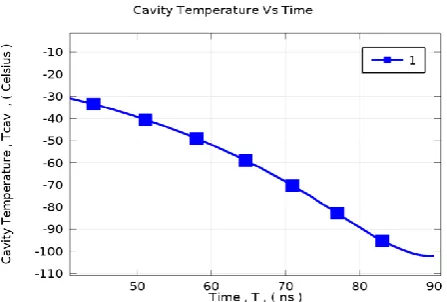
After a PD event, the temperature in the cavity will have increased due to the electron ionization process. The hot gas due to the discharge is assumed to form a spherical shape in order to simplify the model. From the FEA model [1], the temperature in the whole cavity immediately after the first PD is uniform as the PD affects the whole cavity.
[image:5.595.38.262.425.576.2]Figure 7: Cavity temperature dependent
Figure 7 shows the decrease in the temperature with the increase in time after the PD event has occurred. However, a certain time after a PD has occurred, the temperature distribution in the cavity becomes non-uniform but is symmetrical along the cavity symmetry axis. The distribution is obtained from the FEA model. The temperature at the cavity center is the highest and is the lowest at the region near the cavity surface as the heat dissipation near the cavity surface is greater through the surrounding material [1-4].
Thus, the temperature in the cavity immediately after the next PD occurs is no longer uniform but symmetrical along the symmetry axis because the temperature distribution is influenced by the previous PD event [2].
4. CONCLUSION
A two-dimensional model describing a spherical cavity within a homogenous dielectric material has been developed using Finite Element Analysis (FEA) software comsol. The FEA solves for the electric field and temperature distributions in the model. The model developed has been used to dynamically simulate PD activity for different amplitudes and frequencies of the applied voltage, spherical cavity sizes and temperatures of the material. Results show that certain parameters in the model are dependent on the cavity conditions and applied stresses.
Thus critical parameters affecting PD activity have been identified through the model; these include the effective charge decay time constant, cavity surface conductivity, initial electron generation rate, inception field and temperature decay time constant in the cavity. When the applied voltage amplitude is higher, the electron generation rate due to surface emission and volume ionization increases.
This yields in higher number of PDs and total charge magnitude per cycle due to shorter statistical time lag, which result in more PDs occurring immediately after the inception field is exceeded. However, it is found that surface charge decay rate through conduction along the cavity wall increases with the applied voltage due to higher surface conductivity. At increasing applied voltage as well, the temperature change in the cavity has a more obvious effect on the sequence of the next PD event because of higher number of PDs per cycle. The effect of surface charge decay between consecutive discharges is less significant at higher frequencies.
© 2015, IRJET ISO 9001:2008 Certified Journal Page 977 there is more free charge accumulation on the cavity
surface, surface charge decay rate through conduction along the cavity wall is greater.
The temperature change in a larger cavity has more effect on the next PD event due to higher temperature decay time constant. At higher temperatures of the material, the number of PDs per cycle is higher because the electron generation rate is enhanced and the effective charge decay time constant increases. The inception field increases with temperature because the initial pressure in the cavity is greater. The charge movement along the cavity wall is faster at higher temperatures due to larger surface conductivity.
REFERENCES
[1] H.A. Illias et al, “Partial discharge within a spherical
cavity in a dielectric material as a function of cavity size and material temperature”, University of Malaya, 50603 Kuala Lumpur, Malaysia, IET Science, Measurement and Technology, 2011.
[2] Teo Soon Yuan et al, “Partial Discharge Simulation
under Various AppliedVoltage Waveforms” IEEE International Conference on Power and Energy (PECon), Kota Kinabalu Sabah, Malaysia, 2-5 December 2012.
[3] Hazlie Mokhlis, Teo Soon Yuan, Ab Halim Abu Bakar,
“Partial Discharge Patterns in High Voltage Insulation” IEEE International Conference on Power and Energy (PECon), Kota Kinabalu Sabah, Malaysi, 2-5 December 2012.
[4] I.W. McAllister,” Partial Discharges in Spheroidal Voids
Void Orientation”, IEEE Transactions on Dielectrics and Electrical Insulation bl. 4 No. 4, August 1997.
[5] Edward Gulski, “Digital Analysis of Partial Discharges”,
IEEE Transactions on Dielectrics and Electrical Insulation Vol. 2 No. 5, October 1995.
[6] A. Pedersen, et al,” The Theory and Measurement of
Partial Discharge Transients” IEEE Transactions on Electrical Insulation Vol. 26 No. 3, June 1901.
[7] G.C.Crichton,et al, “Partial Discharges in Ellipsoidal
and Spheroidal Voids”, IEEE Transactions on Electrical Insulation Vol. 24 No. 2, April 1089.
[8] Riccardo Bodega et al, “PD Recurrence in Cavities at
Different Energizing Methods”, IEEE TRANSACTIONS ON INSTRUMENTATION AND MEASUREMENT, VOL. 53, NO. 2, APRIL 2004.
[9] Edward Gulski et al,” On-site Testing and PD Diagnosis
of High Voltage Power Cables”, IEEE Transactions on Dielectrics and Electrical Insulation Vol. 15, No. 6; December 2008.
[10] G.C Stone,” Partial Discharge Diagnostics and
Electrical Equipment Insulation Condition
Assessment”, IEEE Transactions on Dielectrics and Electrical Insulation, VOL 12, NO. 5, October 2005.
[11] U. Fromm, “Interpretation of Partial Discharges at dc
Voltages”, IEEE lkansactions on Dielectrics and Electrical Insulation Vol. 2 No. 5, October 1995.
[12] E. Gulski and F. H. Kreuger, “Computer-aided
recognition of Discharge Sources”, IEEE Transactions on Electrical Insulation Vol. 27 No. 1, February 1992.
[13] E. Gulski ,” Computer-aided Measurement of Partial
Discharges in HV Equipment”, IEEE Transactions on Electrical Insulation Vol. 28 No. 6, December 1993.
[14] M. J. P. Jeroense and P. H. F. Morshuis,” Electric Fields in
HVDC Paper-Insulated Cables”, IEEE Transactions on Dielectrics and Electrical Insulation Vol. 5 No. 2, April 1998.
[15] I. W. McAlIister,” Electric Field Theory and the Fallacy
of Void Capacitance” IEEE Transactions on Electrical Insulation Vol. 26 No. 3, June 1991.
[16] H. Okubo, H. Kojima, F. Endo,” Partial Discharge
Activity in Electrical Insulation for High Temperature Superconducting (HTS) Cables”, IEEE Transactions on Dielectrics and Electrical Insulation Vol. 15, No. 3; June 2008.
[17] H. A. Illias, G. Chen, and P. Lewin, “Modelling of partial
discharge activity in spherical cavities within a dielectric material," IEEE Electrical Insulation Magazine, vol. 27, no. 1, pp. 38-45, 2011.
[18] M. Fenger and G.C. Stone, “Investigations into the
Effect of Humiditv on Stator V J Winding Partial Discharges”, IEEE Transactions on Dielectrics and Electrical Insulation VOL1.2, NO. 2; April 2005.
[19] Svante Westerlund &Lars Ekstam, “Capacitor Theory”,
IEEE Transactions on Dielectrics and Electrical Insulation Vol. 1 No. 5, October 1984.
[20] Y. V. Serdyuk and S. M. Gubanski, “Computer modeling
of interaction of gas discharge plasma with solid dielectric barriers," IEEE Transactions on Dielectrics and Electrical Insulation, vol. 12, no. 4, pp. 725-735, 2005.
[21] W. Kai, et al, ”Effects of discharge area and surface
conductivity on partial discharge behavior in voids under square voltages," IEEE Transactions on Dielectrics and Electrical Insulation, vol. 14, no. 2, pp. 461-470, 2007.
[22] D. M. Taylor and T. P. T. Williams, “Decay of surface
charge in the presence of a time-dependent bulk conductivity," J. Phys. C: Solid State Phys., vol. 11, pp.111-117, 1978.
[23] C.Hudon et al, “Surface conductivity of epoxy specimens
subjected to partial discharges," pp. 153-155, 1990.
[24] W. Hauschil et al, “Effect of supply voltage frequency
on testing of insulation system," IEEE Transactions on Dielectrics and Electrical Insulation, vol. 13, no. 5, pp. 1189-1191, 2006.
[25] E. Lindell, et al “Measurement of partial discharges at
© 2015, IRJET ISO 9001:2008 Certified Journal Page 978 Dielectrics and Electrical Insulation, vol. 15, no. 3, pp.
823-831, 2008.
[26] B. Florkowska et.al “Influence of different voltage
waveforms on PD formation in hv insulation systems," Electrical Insulation Conference, pp. 51-54, 2009.
[27] G. Chen and F. Baharudin,”Partial discharge modeling
based on a cylindrical model in solid dielectrics," International Conference on Condition Monitoring and Diagnosis, 2008.
[28] F. Baharudin, “Modeling partial discharges in a solid
dielectric material's cavity using comsol and matlab software,” University of Southampton, UK, 2007.
[29] R. J. Van Brunt, “Stochastic properties of
partial-discharge phenomena," IEEE Transactions on Electrical Insulation, vol. 26, no. 5, pp. 902-948, 1991.
[30] A. Alsheikhly, H. Guzman, and H. G. Kranz, ”A new
diagnostic tool through computer simulation calculation using expanded partial discharge equivalent circuit," pp. 176-180, 1992
[31] I. W. McAllister, “Partial discharges in spheroidal voids.
Void orientation," IEEE Transactions on Dielectrics and Electrical Insulation, vol. 4, no. 4, pp. 456-461, 1997.
[32] R. Schifani, R. Candela, and P. Romano, \On PD
mechanisms at high temperature in voids included in an epoxy resin," IEEE Transactions on Dielectrics and Electrical Insulation, vol. 8, no. 4, pp. 589-597, 2001.
[33] H. Edin and C. Forssen, \Variable frequency partial
discharge analysis of in-service aged machine insulation," Proceedings Nordic Insulation Symposium, pp. 29-35, 2003.
[34] U. Garfert, H. Edin, and C. Forssen, \Modelling of
partial discharge spectra measured with variable applied frequency," Proceedings Conference on Properties and Applications of Dielectric Materials, pp. 839-842, 2003.
[35] E. Gulski and F. H. Kreuger, \Computer-aided
recognition of discharge sources,"IEEE Transactions on Electrical Insulation, vol. 27, no. 1, pp. 82-92, 1992.
[36] S. A. Boggs, “Partial discharge: overview and signal
generation," IEEE Electrical Insulation Magazine, vol. 6, no. 4, pp. 33-39, 1990.
[37] T. Seghir, D. Mahi, T. Lebey, and D. Malec, \Analysis of
the electric field and the potential distribution in
cavities inside solid insulating electrical
materials,"Proceedings of the COMSOL User
Conference, 2006.
[38] N. Ahmed and N. Srinivas, \PD types and their
detection possibilities by PD test methods," pp. 307-310, 2001.
[39] M. Hoof and R. Patsch, “A physical model, describing
the nature of partial discharge pulse sequences,"
International Conference on Properties and
Applications of Dielectric Materials, vol. 1, pp. 283-286, 1997.
[40] R. Bartnikas and J. P. Novak, “On the character of different forms of partial discharge and their related
terminologies," IEEE Transactions on Electrical Insulation, vol. 28, no. 6, pp. 956-968, 1993.
BIOGRAPHIES
Keshav Gupta obtained B. Tech. degree in Electrical and Electronics Engineering from BM IET, Sonepat-Haryana, India in 2013. He has completed his M. Tech. from DCRUST, Murthal -Haryana, India in 2015. He is presently working as a lecturer at IGI, Sonepat-Haryana. His research interests include Partial Discharge in Dielectric Materials, Insulation failure, etc.
Naresh Kumar Yadav received B. Tech. in Electrical Engineering from MDU, Rohtak (Haryana), India, M. Tech. from NIT, Kurukshetra, India and Ph.D. degree from Jamia Millia Islamia (Central University), New Delhi. He worked with Imperial Malts Ltd., Gurgaon and Apeejay College of Engineering, Sohna, India. Since August 2006 he has been with the Department of EE, DCRUST, Murthal (Sonepat)-Haryana, India, as Assistant Professor. His research interests include Power System Deregulation, FACTS Applications to Power System Restructuring, etc. He has participated in and presented papers at many National and International Conferences.
Pradeep Kumar Rattewal Graduated and Post Graduated in Electronics from HCE, Sonipat –Haryana India, qualified NET and has been working as Assistant Professor in IITB, Sonepat. His software help is worth noting. Area of research spreads from Cognition, Embedded systems, VLSI to Wireless etc. He has participated in and presented papers at many National and International Conferences.