© 2016, IRJET | Impact Factor value: 4.45 | ISO 9001:2008 Certified Journal | Page 1158
Design and Development of A Mechanical System for Civil Construction
Work :An Overview
Mr.Abhijit Thakare
1, Prof.V.K.Thute
21M.E.Student, Department of Mechanical Engg, SSGMCE Shegaon
2Associate Professor, Department Of Mechanical Engg, SSGMCE Shegaon
---***---Abstract –
This research paper deals with the study of Mechanical systems used in Civil Construction works. In construction field there are plenty of mechanical systems are exists already and still there is much development is necessary in the construction field in the form of machineries and automation .Building construction plastering is very important as finishing the wall to increase its aesthetical values and to prevent the wall from environmental hazards. Plastering or Rendering is very strenuous job and need skilled labor work .For wall rendering very few mechanical systems are been developed and more work need to done .Our Aim is to design and develop a mechanical system which will reduce the human efforts and minimize the constructional cost and time .Keywords – Wall plastering Machine ,Construction labor economics ,mechanical systems in construction fields .
1.INTRODUCTION
Construction field is very wide globally and it adds very much value in GDP of country . Globally there are many mechanical systems exists in construction field .Still there is much mechanization required in construction field with increasing demand from Real estate industries to increase there profitability .In 21st
century the growth in infrastructural arena is very high and due to increasing in demand in construction field there are mechanical systems are preferred by contractors or real estate industries to minimize the labor cost , construction time and increase the labor performance and to solve problems of shortage of skilled labor .
The constant increase in the demand of construction ,the contractors are forced to increase their construction and
also increase the quality of the construction to remain in the competitive market .The construction industry in most countries amounts to 10–20% of the GNP [1], making it the largest economic employing sector. It is still labour demand and also most of the work involved is repetitive. The growth of any country is dependent on the construction industry hence it is of prime economic significance to many industrial sectors. Intense competition, shortages of skilled labour and
technological advances are forcing rapid change in the construction industry, thus encouraging its automation in this industry.
The construction of buildings , Apartments ,Complex ,shops ,homes are basic in construction field for the contractors .In construction arena plastering is necessary for decorating the walls and apply a protective layer on wall to prevent from various environmental factors .Plastering work is very strenuous job and need of various mechanisation to improve plastering speed .This research work relates to plastering and in particular to a machine to apply cement sand –mortar on to brick wall or concrete wall surfaces to provide substantially smoothed surface .
1.1 Problem Statement
In the construction of buildings the exposed brick wall
surface or concrete wall surfaces, which are often rough or uneven are generally plastered with cement – sand mortar to provide a substantially smooth surface .The general application of cement-sand mortar plaster is typically done manually ,the manual plaster work method is labour intensive ,time consuming, generally does not always result in uniform plastered surfaces if the task undertaken by person lacking the necessary skills. Further the manual rate of application of plaster is slow[4] .1.1 (A) Shortage of Skilled workers on construction sites
© 2016, IRJET | Impact Factor value: 4.45 | ISO 9001:2008 Certified Journal | Page 1159 2010:13)
Fig 1.1 Labour requirement during 2008 to 2022 in different industries (Source: NSDC, XIth Five Year Plan by the Planning Commission, Government of India) Despite such significance to the Indian economy, there is no specific policy for skill building in the construction sector. Table 1 shows the current pool of the construction workforce in India comprises mainly unskilled workers.
Most of these unskilled workers are seasonal, migrant workers from poorer agricultural states and they lack education and formal training and usually pick up skills on the job, informally from peers or supervisors, resulting in an inefficient performance on the job. Among the 10 per cent skilled construction workers, emigration to overseas countries - Gulf countries in most cases - for higher wages is common. Emigration worsens the shortage of skilled workers and creates an upward pressure on domestic wages leading to a situation where Indian firms have to import workers to meet their requirements. The Ministry of Labour and Employment has also documented that “violation of laws on minimum wages, equal wages, child labour, contract workers and interstate migrant workers etc., is rampant in construction as in agriculture and home based occupations” (Government of India 2011c:635). Realizing the severity of the shortage of skilled construction workers, the government of India had conducted a skills mapping study and identified carpentry, electrician, painter, welder, masonry, crane operations and plumbing as key roles which will be in demand until 2022 and the level of skills required as shown in Table 1.1. Together, these key roles will require 7.3 million vocationally trained workers by 2022 [2]. The Indian construction industry complained of a shortage of skilled workers which is likely to worsen if more workers are not made employable or processes are replaced with the corresponding equipment, however the extent to which the labor is going to get shorter in future that, it is not only
required to manufacture construction equipment but also there is a need to automate the equipment to avoid the labor shortage to run these equipment.
Category Percentage of
employment Total Employment
Unskilled
Workers 83% 25.6 million Skilled Workers 10% 3.3 million Engineers 3% 0.8 million Technicians and
Foreman 2% 0.6 million Clerical 2% 0.7 million Table 1.1 current employment details in different industries
1.1(B)Internal Plastering Cost Analysis
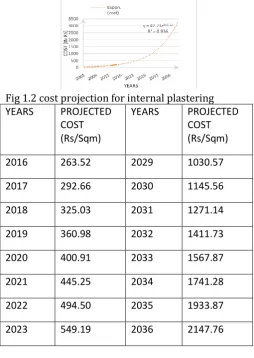
The analysis considers internal plastering being undertaken in single coat, having 12 mm thickness. The plaster is prepared in cement to water ratio 1:5. Cost of neeru finish has been neglected in this analysis. The cost of scaffolding required and curing provided has been considered[3].
Fig 1.2 cost projection for internal plastering
YEARS PROJECTED
COST (Rs/Sqm)
YEARS PROJECTED
COST (Rs/Sqm)
2016 263.52 2029 1030.57
2017 292.66 2030 1145.56
2018 325.03 2031 1271.14
2019 360.98 2032 1411.73
2020 400.91 2033 1567.87
2021 445.25 2034 1741.28
2022 494.50 2035 1933.87
[image:2.595.38.266.104.257.2] [image:2.595.303.558.404.763.2]© 2016, IRJET | Impact Factor value: 4.45 | ISO 9001:2008 Certified Journal | Page 1160
2024 609.93 2037 2385.31
2025 677.40 2038 2649.13
2026 752.32 2039 2942.13
2027 835.52 2040 3267.54
2028 927.94
Table 1.2 cost projection for internal plastering
1.2 Solution
From the discussion it can be concluded that there will be a shortage of labour in the future in the construction industry by this the labour cost is going to rise, hence there is a need for automating the construction processes. Some of the processes are automated by developing machines like concrete pouring machines, plastering machine for automating the residential construction process. But the masonry work which is an important and major process in a construction process still being manually done. As the plastering work is the major part of the any construction of the building it has to be automated immediately before the industry reach labour shortage phase without compromising the quality of work and also the productivity, Hence the work proposes a conceptual model to mechanize the plastering work and the objectives of the present work are as follows. The main objective of this project helps in providing an effective solution to construction applications by using Electric operated motor drive for making necessary activity.
2.LITRETAURE REVIEW
1.Plastering Machine
Author :C.H.Stanton in United States Patent Office (patent no. 2555823) june 1951
Has presented an invention that provides a simple efficient and reliable device for economically and effectively applying plaster and similar plastic materials to the surfaces of walls and ceilings of rooms and including a universally adjustable troweling device to which the material is fed from hopper under control of operator and providing means for rotating the toweling device , whereby the plaster may to be evenly smoothly applied to the surfaces of a wall or ceiling. An important object of the invention is to provide a portable machine of this character which may be easily
and conveniently moved from place to place as the work progresses .A still further object is to provide a device of this character of simple and practical construction which is efficient and reliable in operation ,relatively inexpensive to manufacture and operate and which otherwise is well adapted for the purposes for which the same intended.[5]
2.Plastering Machine
Author :Tah H.Tan in United states patent office (patent no 5578327) Nov 26 1996
Has invented a plastering machine which have a principal object of this invention is to provide a plastering machine to apply cement-sand mortar plaster onto a substantially planner vertical surface. The plastering machine is preferred embodiment includes a container secured to a frame assembly means capable of vertical movement to hold and to apply cement sand mortar plaster onto the planner structure . The frame assembly includes an outer pair of frame members which are non-movably fixed onto base frame members. The travelling frame member is secured to rollers which are slideble along a pair of grooves in the inner pair of frame members .A vibration means is provided and includes a vibration rod disposed horizontally along the length of the container .The plastering machine is mounted onto a fixed set of wheels and set of hydraulically mounted roller wheels and the base frame can be raised above ground level [6].
3.To design and develop low cost automatic wall plastering machine
Author : Piyush M. Kale ,Prof. S.T.Bagde , Department of Mechanical Engineering , yashwantrao chaven college of engineering ,Hingna road Nagpur in Research journal of engineering and technology (RJET) 2014 ISSN 0976-2973
© 2016, IRJET | Impact Factor value: 4.45 | ISO 9001:2008 Certified Journal | Page 1161 and serves the purpose of compensating inevitable
tolerances of the brickwork, thus providing a clean level surface for further finishing tasks. Special plaster material can also protect against fire radiation .Although plastering is one of the most physically strenuous jobs in building construction it was not before the early fifties that machines were developed which supports this strenuous task. The first machines to be developed were automated mixers which made the task of manual plaster mixing obsolete.
Robots are widely used to help human workers in construction sites. Introduction of robotics and automation in this area started in the early 90’s .Aiming to optimize equipment operations, improves safety and performance. Therefore the importance of construction works has grown rapidly .The automatic wall plastering machine will help to save labor cost upto 85% increase productivity by 10-15 times, gets professional quality finishing in less time , reduce valuable time and project cost ,manufacturer automatic wall plastering machine in low cost etc. Has founded several achievements [7] .
4. Design and Fabrication of Automatic wall plastering Machine
Author Name: Mahesha P.K, Sree Rajendra , Mechanical Engg. MCE, Hassan, India
Journal Name: IOSR Journal of Mechanical and technology
Result: This work includes applying the mortar into the wall and additionally pressuring mortar with a creating surface level. The model has been developed and tested with success. With this development the 2 major downside construction industries presently facing are often reduced. They’re consummate labor shortage and Quality within the construction method with less wastage. Through the trials it's noted that the machine is a lot of productive compare to the labor with relevancy the rendering work and additionally the standard achieved is sort of admire the labor[1].
5. Automation and Robotics in
construction:Opportunities and challenges Author Name: S.M.S. Elattar
Journal Name: Emirates Journal for engineering analysis
Result: Robots square measure progressively concerned in construction operations to take care of extremely correct actions and to scale back venturous risks achieving improved management and safety.
Machine-driven constructions are often additional developed to include: design, engineering, maintenance of existing and planned structures. Several analysis works counsel extremely autonomous robotic system for the development performance. The “Sense-and-Act” could so become a reality within the development of a lot of advanced robotic systems for construction applications. Efforts ought to be paid to persuade professionals in building management to seem into the likelihood of integration AI and building automation along to enhance the standard of services for contemporary intelligent buildings. All new concepts for Automation or robotizing on the vacant lot need to be generated by a mix of recent design, new forms and new materials that meet the necessities for building in a very metropolis. However ,many Problems in construction engineering cannot be absolutely addressed through improvement and computation. With intelligence activities reminiscent of generalization, analysis and decision-making for multi-objectives, there are often a higher understanding of the development engineering downside.
6. Automatic Plastering Machine Author Name: Arivazhagan.B
Journal Name: International Journal of Advanced analysis in physics, Communication & Instrumentation Engineering and Development Result: Machine-driven rendering machine is exclusive and maybe one reasonably machine-driven rendering machinery ideally appropriate for the construction/building business. Machine-driven rendering machine works with typical cement mortar that brings it to a swish, flat end with variable and adjustable thickness to suit every application. Machine-driven rendering machine makes rendering easier, faster, and easy as compare to manual application. This concept also can additional increased by interfacing liquid crystal display & computer keyboard for creating the method while not external supply. This point and cash saving machine, keeps up with the ever dynamical world of building automation[4].
3.METHODOLOGY
Analytical Study Research Analysis
Design and Fabrication of mechanism Testing of mechanical System
© 2016, IRJET | Impact Factor value: 4.45 | ISO 9001:2008 Certified Journal | Page 1162
4. PLASTERING TECHNIQUES 4.1 Plastering Tool :
A multifunctional tool is necessary in order to apply and smooth the plaster. Plaster thickness for normal applications varies between 5mm to 30mm .For thin plastering a thickness between 3 to 6mm is standard .The plastering tool must be adaptable enough to apply plaster with the thickness. Fast tool change for plastering of large and small surfaces must be provided for high levels of plasterer smoothness and angular accuracy of the plastered surface are aimed for over a distance of 2.5 in a variation from a plane of less than 8mm is to be achieved. Setup and cleaning cycle times are to be kept to a minimum thus helping to increase acceptance in building site environment []. Plastering is widely used as finishing technology for both interior and exterior walls made from bricks ,Concrete or timber .While plastering of exterior walls provides heat insulation ,sound absorption and protection against air pollution and weather , the application of plaster to interior walls improves the indoor climate by humidity regulations. And serves the purpose of compensating inevitable tolerances of the brickwork , thus providing a clean, level surface for further finishing tasks. Special plaster material can also protect against fire or radiation.
4.2 Plastering Thickness:
Cement plaster is generally used with 13 mm thickness and some times it can be of 19 mm thickness also. 19 mm plaster is done in two parts. First layer is of 13 mm and 2nd is of 6 mm thickness. After the 1st layer is set, the slurry of cement of the 2nd layer is applied. Besides the walls, plaster has to be done on the ceiling (lower part of the roof) also sometimes when the shuttering is opened, many holes are found at various places in the ceiling and at some places it is not found to be smooth, then a 6 mm plaster is done in the ratio of 1:3 of cement and sand, respectively. Its curing is done in the same manner as normal cement plaster.
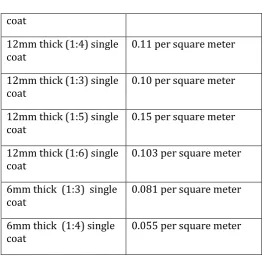
Thickness of Plaster Consumption of cement (Sack)
20mm thick (1:4) single
coat 0.18 per square meter
20mm thick (1:5) single
coat 0.14 per square meter
20mm thick (1:3) single coat
0.25 per square meter
20mm thick (1:6) single 0.133 per square meter
coat
12mm thick (1:4) single
coat 0.11 per square meter
12mm thick (1:3) single
coat 0.10 per square meter
12mm thick (1:5) single
coat 0.15 per square meter
12mm thick (1:6) single
coat 0.103 per square meter
6mm thick (1:3) single coat
0.081 per square meter
6mm thick (1:4) single
[image:5.595.302.566.86.342.2]coat 0.055 per square meter
Table 4.1 consumption of cement in plastering
4.3Plastering Technique
© 2016, IRJET | Impact Factor value: 4.45 | ISO 9001:2008 Certified Journal | Page 1163 up. Move from one stage to the next once the plaster
[image:6.595.36.228.624.735.2]has firmed up and gone tacky.
Fig 4.1 Trowel operation technique
If at any stage do not see any improvement then this does not necessarily mean there is anything wrong with plastering technique but probably that the plaster is too wet. In the early stages the objective is flatness not smoothness. The smoothness will come later, but only if achieved flatness so, always remember the objective of each stage. The setting process of plaster can firm up for two different reasons either, due to the natural setting process or due the moisture being sucked out of the plaster by the backing coat. The single most important aspect to be aware of is suction. If don't have it under control then no matter how good plastering technique will never be able to achieve a good finish. The suction test should always be carried out. If applied skim coat on plasterboard then it need not problem as the suction is controlled. In some instances if the backing coat is very porous the moisture can be sucked out almost instantly. This is clearly not good as by the time to have finished applying plaster to the whole wall, the first application will be totally dry.
5.CONCEPTUAL DESIGN
The conceptual design for plastering work is contains several parts which are needed to be assembled .It contains two vertical rods for supporting , a mortar tray ,gear box ,inclined belt conveyor and electrical motors .The practical model design has shown in fig 5.1
Fig 5.1 conceptual design of wall plaster machine
6.Conclusion
From this study it has been found that a mechanical implementation in construction field for plastering work is necessary and at present there is need for such type of mechanical systems which can reduce the labor cost ,working time ,plastering cost ,wastage of plastering mortar on plastering site ,etc. Which will enhance financially to the construction workers .Plastering system will reduce the unnecessary working time at construction site due to which the plastering cost will be reduce .From this we can say that a mechanical system which can solve the problems like Shortage of Skill labor and Scaffoldings during plastering work reduces the work on construction site.
7.REFRENCES
[1]Mahesha P.K,Sree Rajendra “Design and fabrication
of automatic wall plasterig machine prototype”, IOSR
Journal of mechanical and civil engineering, volume 11,issue 4 ,(Jul-Aug 2014),pp 01-06.
[2]RuchiHajela “Shortage of Skilled Workers: A Paradox of the Indian Economy”, SKOPE Research Paper No. 111, November 2012.
[3]Dhruv J Desai ,Tejas S. Jain, Atul A.Dwivedi, Anjum D.Attar “Engineering Economics and life cycle cost analysis”,IJRET eISSN:2319-1163.
[4]S.M.S. Elattar, “Automation and robotics in construction: opportunities and challenges", Emirates Journal for Engineering Research, 13 (2), 21-26, 2008. [5]C.H.Stanton “Plastering Machine”,United states Patents Jan 21 1947, Patent No.2555823
[6]Tah H.Tan “plastering machine”,United states patent Nov 26 1996 patent No.5578327
[7]Piyush M.Kale ,Prof.S.T.Bagde “To Design and develop a low cost Automatic wall plastering Machine”,RJEAT 5(2):April-June 2014