Development of CNS multi-receptor ligands: Modification of known
D
2
pharmacophores
Jagan R. Etukala
a, Xue Y. Zhu
a, Suresh V. K. Eyunni
a, Edem K. Onyameh
a, Edward Ofori
a,
Barbara A. Bricker
a, Hye J. Kang
b,c, Xi-Ping Huang
b,c, Bryan L. Roth
b,c,d, Seth Y. Ablordeppey
a,⇑ aDivision of Basic Pharmaceutical Sciences, Florida A&M University, College of Pharmacy and Pharmaceutical Sciences, Tallahassee, FL 32307, USA bDepartment of Pharmacology, School of Medicine, University of North Carolina at Chapel Hill, Chapel Hill, NC 27599-7365, USA
c
National Institute of Mental Health Psychoactive Drug Screening Program (NIMH PDSP), School of Medicine, University of North Carolina at Chapel Hill, Chapel Hill, NC 27599-7365, USA
d
Division of Chemical Biology and Medicinal Chemistry, Eshelman School of Pharmacy, University of North Carolina at Chapel Hill, Chapel Hill, NC 27599-7360, USA
a r t i c l e i n f o
Article history: Received 16 April 2016 Revised 27 May 2016 Accepted 3 June 2016 Available online 4 June 2016
Keywords:
Multi-receptor targeting Dopamine receptor ligands Antipsychotic
Pharmacophore CNS receptor
a b s t r a c t
Several known D2pharmacophores have been explored as templates for identifying ligands with multiple binding affinities at dopamine and serotonin receptors considered as clinically relevant receptors in the treatment of neuropsychiatric diseases. This approach has resulted in the identification of ligands that target multiple CNS receptors while avoiding others associated with deleterious effects. In particular, compounds11,15and22may have potential for further development as antipsychotic agents as they favorably interact with the clinically relevant receptors including D2R, 5-HT1AR, and 5-HT7R. We have also identified the pair of compounds11and10as high affinity D2R ligands with and without SERT binding affinities, respectively. These differential binding profiles endow the pair with the potential for evaluating SERT contributions to antipsychotic drug activity in animal behavioral models. In addition, compound11 has no significant affinity for 5-HT2CR and binds only moderately to the H1R, suggesting it may not induce weight gain or sedation when used clinically. Taken together, compound11displays an interesting pharmacological profile that necessitates the evaluation of its functional and in vivo effects in animal models which are currently ongoing.
1. Introduction
The dopamine D2receptor (D2R) has long been considered the
target for drug development in schizophrenia and other neuropsy-chiatric diseases.1 More recently, however, several
neuropsychi-atric illnesses are being viewed as multiple receptor pathological diseases, meaning that effective drugs designed to treat these diseases must target several receptors simultaneously.2–6 This
view is supported, for example, by the fact that a neuropsychiatric disease like schizophrenia manifests at least three different symp-toms: positive, negative and cognitive symptoms. While blocking D2R has been associated with treating the positive symptoms,
the negative and cognitive symptoms remain unresolved.7,8
Sev-eral recent articles have indicated that the negative symptoms of schizophrenia may be ameliorated by activating the serotonin 5-HT1A receptor (5-HT1AR)9–13 while the cognitive symptoms
may be treated by agents that activate the 5-HT1AR and antagonize
the 5-HT7receptor (5-HT7R).14–18Taken together, we hypothesize
that a drug that interacts appropriately with these receptors should have improved therapeutic outcomes over several currently marketed drugs for treating schizophrenia. Indeed, one of the most recent drugs introduced on the market, lurasidone, targets multiple receptors including D2, 5-HT2A, 5-HT7 and 5-HT1A, and
has found clinical utility not only in treating the positive symptoms of schizophrenia but also in producing improvement in cognitive symptoms, and is even prescribed for bipolar depression.19,20
Our laboratory has been involved in multi-receptor targeting as possible treatment options for CNS diseases over the years.2,21,22In
this article, we explored different modifications to pharmacophoric groups (Fig. 1) present in ligands that have high affinity for CNS receptors or elaborated structurally similar functionalities to such pharmacophores. The working hypothesis was that by modifying the arylalkyl groups attached to the amino groups in the pharma-cophores shown inFigure 1, it was possible to broaden the affinity of a target compound to other CNS receptors including the D2R,
5-HT1AR, 5-HT7R and SERT. In view of the role of the D2R as a
http://dx.doi.org/10.1016/j.bmc.2016.06.011
primary target for drug development against neuropsychiatric diseases including schizophrenia and bipolar depression, it was of interest to first obtain agents that had moderate to high affinity to the D2R (10PKi6250 nM) before introducing structural
features that lead to binding at the other receptors of interest. We also intended to identify compounds that while binding to these receptors will simultaneously have low or little affinities at 5-HT2BR, 5-HT2CR and histamine H-1 receptors as these have been
associated with known side effects including valvular heart disease,23–25weight gain26–28and sedation.26–28
2. Chemistry
The pharmacophoric groups (R = R1= H) in1,3,4and5were
commercially available from Sigma/Aldrich. Pharmacophore 6
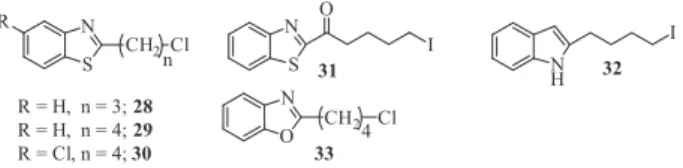
was previously synthesized.29–31 To synthesize the target compounds 7–22, different alkylating agents were required as depicted inFigure 2. Alkylating groups28–29were obtained by reacting 5-chloropentanoyl chloride or 4-chlorobutanoyl chloride with 2-aminobenzenethiol as previously reported,21,32 while 30
was synthesized from 2-amino-4-chlorobenzenethiol and 5-chloropentanoyl chloride using the same procedure.
We also previously reported the synthesis of alkylating agent
3121,32 while 32 was obtained by following a literature
procedure.33–37 Briefly, 4-(1H-indol-3-yl)butanoic acid was
reduced by lithium aluminum chloride and the resulting primary alcohol converted to the iodide (32) using triphenylphosphine (Ph3P) and iodine in CH2Cl2. The benzoxazole alkylating agent33
was synthesized following the literature procedure we reported earlier.386-Chlorohexanoyl chloride or 5-chloropentanoyl chloride
were each reacted with 2-aminophenol in the presence of triethy-lamine (Et3N) and heated to reflux to provide the amide
intermedi-ate which underwent cyclization with polyphosphoric acid (PPA) to produce the resulting alkylating agent33in good yield.
3. Results and discussion
The pharmacophoric groups in spiperone (1), the chloro analog of benperidol (3), haloperidol (5) and the tropane analog of haloperidol (6) in Figure 1 constituted the group of starting fragments selected because of their association with high affinity binding to the D2 receptor.29–31 The flunarizine pharmacophore
(4) was also included for evaluation as flunarizine has been shown to demonstrate multiple CNS actions.39We have hypothesized that by attaching various aryl alkyl groups to these pharmacophores, it is possible to obtain compounds which can bind to the D2R and
other clinically relevant receptors including 5-HT1AR and 5-HT7R.
In particular, it was of interest to attach aryl (benzothiazole-, benzoxazole- and indole-) alkyl groups in view of their observed effects on binding affinity to CNS receptors.21,32,38
The first group of compounds (Fig. 3),7–11, were obtained by the alkylation of 1-phenyl-1,3,8-triazaspiro[4.5]decan-4-one (2) with the appropriate arylalkyl group (Schemes 1–4), and their binding affinity constants are reported inTable 1. Compound7
showed potent binding to the D2R but only moderate to weak
binding affinities to the 5-HT receptors evaluated. Introduction of a chloro group onto the benzothiazole ring (8) to explore the effect of an electron withdrawing group on the ring electron density did not produce any significant changes in binding affinity. Similarly, insertion of a carbonyl moiety (9) had no significant effect. Further-more, replacement of the benzothiazole with either benzoxazole (10) or indole (11) moieties failed to extend significant increase in affinity to the 5-HT receptors. Based on their overall binding profile at these receptors, group 1 compounds could, in general, be classified as showing selectivity to the D2 and D3 receptors
(Kirange 10–32 nM) while binding to the D4R is mixed, with11
showing the highest binding affinity (Ki= 1.6 nM) and compound 8the lowest (Ki= 1512 nM). Compounds8and9bind with
moder-ate affinity to the 5-HT1AR (Ki= 102 and 103 nM, respectively) and
combined with their high affinity to the D2R, could serve as useful
agents for further exploration.
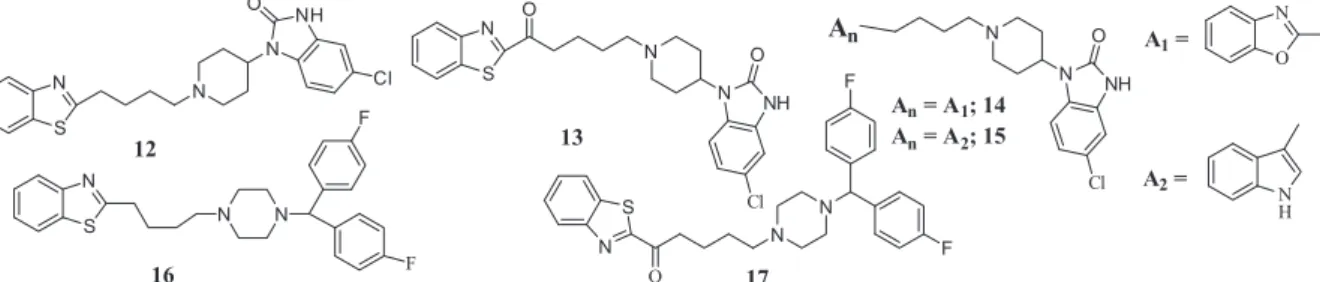
5-Chloro-1-(piperidin-4-yl)-1H-benzo[d]imidazol-2(3H)-one, the pharmacophore of 3, was next selected for alkylation and resulted in compounds 12–15. These along with compounds 16
and17constitute group 2 analogs (Fig. 4,Schemes 1–4). Synthesis and subsequent screening produced the binding affinity data reported inTable 2. Compound12has about 9-fold lower affinity to the D2R (Ki= 215 nM) compared to the corresponding analog in
group 1 (compound7) suggesting that the triazaspiro[4.5]decan-4-one (pharmacophore 2) has a better affinity for the D2R than R = H, n = 3;28
R = H, n = 4;29 R = Cl, n = 4;30
S N
I O
31 NH
I 32
O N
CH24Cl S
N CH2nCl R
33
Figure 2.Alkylating agents28–33. N NNH
O
N N NH O
Spiperone (1) X = H; Benperidol (2) X = Cl, Chloro analog (3) R
N N R1
F
F R
Flunarizine (4)
N OH R
Cl Haloperidol Analog (6) N OH
R
Cl Haloperidol (5)
O F R =
X R1=
Figure 1.Structures of standard drugs and the pharmacophoric groups (R = R1= H) used in obtaining the target compounds.
S
N N
NH N
O R
R = H; 7 R = Cl, 8
S
N N
NH N
O O
9
A
nN
NH N
O
An= A1; 10 An= A2; 11
O N
N H
A1=
A2=
pharmacophore 3. Indeed, compounds 13–15 which utilize pharmacophore3display lower binding affinity compared to the corresponding analogs in group 1. In addition, the binding of the group 2 compounds had only moderate to poor binding to the selected 5-HT receptors.
We also evaluated two piperazine analogs utilizing the 1-(bis (4-fluorophenyl)methyl)-piperazine, pharmacophore from 4. Alkylating this group with the previous benzothiazole-alkyl groups produced compounds 16 and 17 which bind to the D2R with
moderate affinities (Ki= 195.0 and 159.0 nM, respectively). Like S
N
N N NH
O
Cl
S N
N N F
21
S N
N
Cl OH
18
S N
CH2nCl
R= Cl, H, n = 3, 4
HN N NH
O
HN OH Cl
HN N NH
O
Cl
HN OH Cl
S N
N N NH
O
R
R
7; R= H 8; R= Cl
H N
OH
Cl N
H N
F F
16 12
19
S N
N OH Cl
F
S N
(CH2)4 N
OH Cl
Scheme 1.Synthesis of target compounds7,8,12,16,18,19, and21. Reagents and conditions: (i) K2CO3, KI, CH3CN/DME, reflux, 12–15 h.
S
N N
N NH O
Cl O
S
N N
O
NH N
O
S N
N
OH Cl O
22
O CH2 Cl
4
HN NNH O
HN N NH O
Cl
H N
OH Cl N H N
F F
N
S
S
N N
O
N
F F
17 9
13
the other group 2 analogs, D2R binding affinity was lower along
with weak affinity to the 5-HT receptors evaluated. Overall, the group 2 analogs have D2R binding affinity constants below
250 nM, varying moderate to high binding affinities at the D3
(Ki= 33–233 nM) and D4 (Ki= 16–1710 nM) receptors and
relatively poor binding to the 5-HT receptors.
Compounds in group 3 (Fig. 5) are obtained by alkylating 4-chlorophenyl piperidinol or tropanol pharmacophores from 5
and 6. We have previously shown that these pharmacophores can be manipulated to control their CNS receptor binding profiles.29–31 Using the previously synthesized benzothiazole- or
benzoxazole-linked alkyl groups, 4-chlorophenyl piperidinol was targeted for alkylation to produce compounds 18–20 (Schemes 1–3). These compounds were synthesized and screened at the same receptors as before and the results are reported inTable 3. Apart from compound 19 with moderate binding affinity
(Ki= 201 nM) none of the other four analogs meets the D2binding
criterion. Other than compound18 which binds with relatively high affinities at the 5-HT1AR and 5-HT7R (Ki= 34.0 and
189.0 nM, respectively), there were no significant improvements in binding at the 5-HT receptors. Finally, the tropane analogs21
and22 were synthesized and similarly screened. Compound 21
binds with high affinity at the D2R and D3R (Ki= 44.0 and 13 nM,
respectively) but binds poorly to the D4R and 5-HT receptors.
Com-pound22on the other hand binds with moderate affinity to the D2R (Ki= 180.0 nM) and with even higher affinity at the 5-HT7R
(Ki= 80.0 nM). Overall, the group 3 analogs have high to moderate
binding to the D2R and variable binding affinities to the 5-HT
receptors evaluated.
In view of the fact that D2R ligands with favorable interactions
at 5-HT1AR, 5-HT2AR, 5-HT7R and the serotonin transporter (SERT)
have potential utility as effective agents for schizophrenia and
N
NH N
O
O N
(CH2)4 N N NH O
Cl O
N
CH2 Cl 4
HN NNH O
HN OH Cl HN N NH
O
Cl
10
20 14
N
O N Cl
OH (CH2)4
O N
(CH2)4
Scheme 3.Synthesis of target compounds10,14and20. Reagents and conditions: (i) K2CO3, CH3CN, reflux, 12–15 h.
HN
N N
NH
Cl O
N
NH N
O HN
11
N H
I
HN NNH O
HN N NH
Cl O
15
Scheme 4.Synthesis of target compounds11and15. Reagents and conditions: (i) K2CO3, CH3CN, reflux, 12–15 h.
Table 1
Binding affinity (KinM/pKi± SE) of group 1 compounds at selected DA and 5-HT receptorsa
Compound Ki(nM)/pKi± SE
D2 D3 D4 5-HT1A 5-HT2A 5-HT7
7 24.0/7.62 ± 0.04 32.0/7.49 ± 0.06 132.0/6.88 ± 0.04 195/6.71 ± 0.07 >10,000/N/A 626.0/6.2 ± 0.1 8 18.0/7.74 ± 0.08 499.0/6.3 ± 0.07 1512.0/5.8 ± 0.1 102.0/6.99 ± 0.06 1123.0/5.8 ± 0.1 1598.0/5.8 ± 0.1 9 25.0/7.59 ± 0.07 18.0/7.75 ± 0.04 162.0/6.79 ± 0.05 103.0/6.99 ± 0.04 3720.0/5.43 ± 0.04 518.0/6.29 ± 0.05 10 10.0/7.99 ± 0.04 21.0/7.68 ± 0.05 118.0/6.93 ± 0.04 382/6.42 ± 0.07 MTA 1511/5.8 ± 0.1 11 22.0/7.65 ± 0.06 31.0/7.5 ± 0.1 1.6/8.81 ± 0.05 376.0/6.42 ± 0.07 982.0/6.01 ± 0.07 >10,000 Spiperone 0.16 ± 0.02b 0.32 ± 0.04c 1.4 ± 0.5c 17.2 ± 3.8d 1.1 ± 0.07e 110 ± 17f
N/A = Not available. Data points without SE have errors below 20% of the mean. a
MTA = Missed 50% threshold inhibition. b
Ref.40. c
Ref.41. d
bipolar depression for example, compounds7–11,14,15,21and
22 were selected for further evaluation at other receptors associated with improved pharmacological profile and the results are recorded inTable 4. The binding affinities of these compounds at other receptors associated with the undesirable side effects (5-HT2B,5-HT2Cand H1receptors) are also reported.
We have hypothesized that compounds which simultaneously interact with the D2R and, for example, either the 5-HT7R or SERT,
have the potential to augment the effectiveness of primarily single receptor agents used in the treatment of schizophrenia or bipolar depression. Evaluation of the data in Table 4 shows that compounds8 (D2R and 5-HT1AR),9 (D2R and 5-HT1AR),11 (D2R
and SERT), 15 (D2R and SERT), and 22 (D2R, 5-HT7R and SERT)
may have potential utility as hits in the development of agents for the treatment of schizophrenia and bipolar depression, depend-ing on their functional status. In addition, while both compounds
An= A1; 14 An= A2; 15
S
N N
N NH
Cl O
S N
N
N NH O
O O
N
N H
A1=
A2=
N
N NH O
A
n12 13
S N
N N F
16 17
S
N N
N
F F
O F
Cl Cl
Figure 4.Structures of target compounds in group 2.
Table 2
Binding affinity (KinM/pKi± SE) of group 2 compounds at DA and 5-HT receptorsa
Compound Ki(nM)/pKi± SE
D2 D3 D4 5-HT1A 5-HT2A 5-HT7
12 215.0/6.67 ± 0.05 163.0/6.79 ± 0.06 671.0/6.17 ± 0.06 1162.5/N/A >10,000/N/A 286.0/6.54 ± 0.06 13 217.0/6.66 ± 0.04 64.0/7.2 ± 0.04 1710.0/5.77 ± 0.07 252.0/6.6 ± 0.04 1564.0/5.81 ± 0.04 127.0/6.9 ± 0.05 14 95.0/7.02 ± 0.06 109.0/6.96 ± 0.06 841.0/6.08 ± 0.05 611/6.21 ± 0.05 3392.0/5.47 ± 0.05 313.0/6.5 ± 0.06
15 134.0/6.87 ± 0.07 53.0/7.3 ± 0.1 16.0/7.79 ± 0.06 MTA MTA 111.0/6.95 ± 0.08
16 195.0/6.71 ± 0.07 33.0/7.5 ± 0.1 68.0/7.17 ± 0.05 MTA 519.0/6.28 ± 0.05 778.0/6.1 ± 0.1 17 159.0/6.8 ± 0.07 233.0/6.6 ± 0.1 1217.0/5.91 ± 0.05 MTA 1082.0/5.97 ± 0.07 562.0/6.3 ± 0.1 Benperidol* 0.027b
0.29 ± 0.02c
0.066b
N/A 1.2d
N/A
N/A = Not applicable or not available. a MTA = Missed 50% inhibition threshold. b Ref.45.
c Ref.46. d
Ref.47.
* OnlyKivalues provided.
X N
(CH2)n N Cl OH
X = S, n = 3; Compound 18 X = S, n = 4; Compound 19 X = O, n = 4; Compound 20
An N
OH
Cl S
N
S N O An = A1; 21
An = A2; 22
A1=
A2=
Figure 5.Structures of target compounds in group 3.
Table 3
Binding affinity (KinM/pKi± SE) of group 3 compounds at DA and 5-HT receptorsa
Compound Ki(nM)/pKi± SE
D2 D3 D4 5-HT1A 5-HT2A 5-HT7
18 763.0/6.12 ± 0.05 28.0/7.55 ± 0.09 163.0/6.79 ± 0.04 34.0/7.47 ± 0.04 168.0/6.78 ± 0.04 189.0/6.72 ± 0.08 19 201.0/6.7 ± 0.08 291.0/6.54 ± 0.06 140.0/6.85 ± 0.06 771.0/6.11 ± 0.08 4255.0/5.37 ± 0.06 983.0/N/A 20b
438 ± 28 942 ± 200 229 ± 49 3153 ± 368 5970 ± 1189 MTA
21 44.0/7.35 ± 0.03 13.0/7.89 ± 0.6 432.0/6.36 ± 0.09 274.0/6.60 ± 0.06 >10,000 1009/6.0 ± 0.07
22 180.0/6.74 ± 0.07 16.0/7.79 ± 0.07 508.0/6.29 ± 0.09 MTA MTA 80.0/7.1 ± 0.08
Haldol5* 0.89/9.05 ± 0.30 2.5/8.61 ± 0.05 10.0/7.98 ± 0.28 3600/5.44 ± 0.03 120.0/6.91 ± 0.02 1100/5.95 ± 0.13 Analog6*,b
1.6 ± 0.14 5.1 ± 3.0 5.3 ± 0.99 27.7 ± 8.0 30.9 ± 6.0 ND
ND = Not determined. N/A = Not applicable. Data points without SE have errors below 20% of the mean. a
MTA = Missed 50% threshold inhibition. * Previously reported in Refs.2,48. b
11 and 10 bind with high affinities to D2R, 11 binds with high
affinity to SERT but10is without significant affinity to SERT. This differential binding profile endows the pair with the potential for evaluating SERT contributions in animal behavioral studies. Furthermore, compound11has the desirable profile of no signifi-cant affinity for 5-HT2CR and only moderate binding to the H1R.
Since the compounds are designed to target CNS receptors, we also estimated some of the key physicochemical characteristics including theirclogPvalues using ChemDraw version 12 as reported in Table 4. Apart from compounds 15, 21 and 22 all the other compounds have estimatedclogPvalues below 5.0. Compound11, which displays the most interesting binding affinity profile, was fur-ther compared with haloperidol and spiperone and the results indi-cate compound 11 (logP= 3.52; clogP= 3.51; tPSA = 47.61) compares favorably with haloperidol (logP= 3.49; clogP= 3.85; tPSA = 40.54) and spiperone (logP= 2.78; clogP= 2.82; tPSA = 52.65) in terms of their lipophilicity (clogP/logP) and topological polar surface area (tPSA) values. Overall, both the pharmacological and physicochemical profiles of these compounds suggest further evaluation of their functional activities at the respective receptors and in vivo animal testing to further ascertain their true potentials as leads for preclinical examination.
4. Conclusion
By modifying the arylalkyl groups attached to various CNS phar-macophores, we have demonstrated that receptor binding profiles of these agents can be obtained that could form the basis of iden-tifying multi-receptor targeting ligands. Several of the compounds have desirable multi-receptor binding profiles to receptors of inter-est. In particular, compounds11,15 and22 may have potential utility as leads for further optimization to treat schizophrenia and bipolar disorders depending on their functional status. We have also identified compounds 11 and 10 as high affinity D2R
ligands with and without SERT binding affinities, respectively, which suggests that they may have a great potential for evaluating SERT contributions in animal behavioral studies. Compound11has no significant affinity for 5-HT2CR and binds only moderately to the
H1R suggesting little or no induction of sedation or weight gain. In
addition, compound 11’s physicochemical characteristics as calculated by ChemDraw, are consistent with drugs that cross the BBB and elicit their pharmacological properties in the CNS.
5. Methods
5.1. Reagents and general procedures
Melting points were determined on a Gallenkamp (UK) apparatus and are uncorrected. 1H NMR spectra were obtained
on a Varian 300 MHz Mercury Spectrometer. Elemental analyses were carried out by Atlantic Microlab, Inc., Norcross, GA, and are within 0.4% of theory unless otherwise noted. Flash chromatogra-phy was performed on Combi-Flash (Teledyne Isco) using RediSep normal phase silica columns. N,N-dimethylformamide was distilled from CaSO4and stored over 4 Å molecular sieves. Starting
materials were obtained from either Sigma–Aldrich or VWR and were used without further purification.
5.2. General procedure for the synthesis of alkylating agents (28–30)
To a solution of 2-aminothiophenol (5 g, 39.9 mmol) or 2-amino-4-chlorobenzenethiol in toluene (100 mL), 5-chlorobu-tanoyl chloride or 5-chloropen5-chlorobu-tanoyl chloride (43.9 mmol) was added drop wise over a 15 min period during which an off-white precipitate was formed. After the reaction mixture was stirred at room temperature (rt) overnight, water (100 mL) was added, the two layers were separated and the aqueous layer was extracted with EtOAc (2100 mL). The combined organic extract was washed with water (100 mL) and saturated NaCl solution (100 mL), dried over Na2SO4and concentrated in vacuo. The crude
product was purified on Combiflash using EtOAc/Hexanes, to yield 2-(3-chloropropyl)benzo-[d]thiazole28or 2-(4-chlorobutyl)benzo [d]thiazole 29 as an oily liquid or 5-chloro-2-(4-chlorobutyl) benzo[d]thiazole (30) as a solid.
5.2.1. 2-(3-Chloropropyl)benzo[d]thiazole (28)
Oily liquid, yield: 72%, 1H NMR (CD
3OD): d 8.14 (d, 1H,
J= 4.1 Hz), 8.02 (d, 1H, J= 4.1 Hz), 7.72–7.59 (m, 2H), 3.64–3.57 (m, 2H), 3.38–3.28 (m, 2H), 1.95–1.86 (m, 2H).
5.2.2. 2-(4-Chlorobutyl)benzo[d]thiazole (29)
Oily liquid, yield 56%,1H NMR (CDCl
3):d 7.98–7.95 (m, 1H),
7.85e7.82 (m, 1H), 7.48–7.42 (m, 1H), 7.37–7.32 (m, 1H), 3.60 (t, 2H, J= 7.5 Hz), 3.15 (t, 2H, J= 7.5 Hz), 2.09–1.97 (m, 2H), 1.95–1.90 (m, 2H).
5.2.3. 5-Chloro-2-(4-chlorobutyl)benzo[d]thiazole (30)
Solid, yield: 89%, mp: 110°C, 1H NMR (CDCl
3):d 7.95 (d, 1H,
J= 2.1 Hz), 7.74 (d, 1H, J= 8.1 Hz), 7.35–7.32 (dd, 1H, J= 1.8, 6.6 Hz), 3.56 (t, 2H,J= 6.0 Hz), 3.15 (t, 2H, J= 7.5 Hz), 2.08–2.00 (m, 2H), 1.96–1.89 (m, 2H).
5.3. Procedure for the synthesis of 3-(4-iodobutyl)-1H-indole (32)
The synthesis of 3-(4-iodobutyl)-1H-indole followed literature procedures.36,49 To a solution of indole-3-butyric acid (2 g,
9.8 mmol) dissolved in THF (30 mL) and cooled to 0°C was added
Table 4
Binding affinity (KinM/pKi± SE) of selected compounds at CNS receptorsa
and theirclogPvaluesb
Receptor Ki(nM)/pKi± SE
7 8 9 10 11 14 15 21 22
D2R 24/7.62 ± 0.04 18/7.74 ± 0.08 25/7.59 ± 0.07 10/7.99 ± 0.04 22/8.86 ± 0.06 95/7.02 ± 0.06 134/8.57 ± 0.07 44/7.35 ± 0.03 180/6.74 ± 0.07 5HT1AR 195/6.71 ± 0.07 102/6.99 ± 0.06 103/6.99 ± 0.04 382/6.42 ± 0.07 376/6.4 ± 0.1 611/6.21 ± 0.05 MTA 274/6.60 ± 0.06 MTA 5HT2AR >10K 1123/5.8 ± 0.1 3720/5.43 ± 0.04 MTA 982/7.65 ± 0.06 3392/5.47 ± 0.05 MTA >10K MTA 5HT2BR 122/6.91 ± 0.06 36/7.44 ± 0.08 1578/5.8 ± 0.1 905/6.04 ± 0.08 202/6.69 ± 0.08 515/6.29 ± 0.06 51/7.29 ± 0.07 342/6.47 ± 0.06 758/6.12 ± 0.09
5HT2CR MTA 614/6.21 ± 0.08 MTA MTA MTA MTA MTA 4623/5.34 ± 0.09 MTA
5HT7R 626/6.2 ± 0.1 1598/5.8 ± 0.1 518/6.29 ± 0.05 1511/5.82 ± 0.09 >10K 313/6.5 ± 0.06 111/6.95 ± 0.08 1009/6.0 ± 0.07 80.0/7.1 ± 0.08 SERT MTA 3056/5.51 ± 0.06 284/6.55 ± 0.07 MTA 10.0/8.33 ± 0.05 386/6.41 ± 0.06 25/7.6 ± 0.04 180/6.74 ± 0.08 54.0/8.33 ± 0.05 H1R 504/8.93 ± 0.07 263/6.56 ± 0.06 ND 535/6.27 ± 0.09 273/6.56 ± 0.07 510/6.3 ± 0.1 255/6.61 ± 0.06 187/6.73 ± 0.08 1028/5.99 ± 0.08
cLogP 2.48 4.37 3.35 2.57 3.51 4.47 5.42 5.48 5.20
ND = Not determined. a
MTA = missed 50% threshold inhibition. b
portionwise LiAlH4(2.24 g, 59.0 mmol, 6 equiv) in THF. The mixture
was allowed to warm to room temperature with stirring for 18 h. The reaction mixture was cooled to 0°C and a saturated solution of Na2SO4(20 mL) was added in a dropwise manner over the period
of 30 min. The resulting white precipitate was filtered, the filtrate was washed with EtOAc (2100 mL), the pooled organic phase was washed with water (50 mL) and saturated brine solution (50 mL), dried over anhydrous Na2SO4and the solvent removed
under reduced pressure. The crude product 3-(4-hydroxybutyl)-1H-indole was obtained as a colorless solid and used for the next step without further purification (1.70 g), Yield: 91%, mp: 32–33°C.
1HNMR (300 MHz, CDCl
3):d7.95 (s, 1H), 7.60 (d, 1H,J= 7.8 Hz),
7.36–7.33 (m, 1H), 7.21–7.08 (m, 2H), 6.97 (s, 1H), 3.67 (t, 2H,
J= 6.3 Hz), 2.79 (t, 2H,J= 7.5 Hz), 1.84–1.63 (m, 4H). To a stirred solution of triphenylphosphine (4.46 g, 17.0 mmol) and imidazole (1.58 g, 17.0 mmol) in dichloromethane (DCM) (45 mL) cooled to 0°C, was added I2(4.32 g, 17.0 mmol) and the reaction mixture
was stirred at 0°C for 30 min. Thereafter, a solution of 3-(4-hydrox-ybutyl)-1H-indole (2.30 g, 12.15 mmol) in DCM (5 mL) was added, the reaction mixture was allowed to warm to rt with stirring for 12 h, then filtered and the filtrate was washed with hexane (2100 mL). The combined organic solution was washed with water (100 mL) and saturated brine (80 mL) before being dried over anhydrous Na2SO4. The solvent was removed under reduced
pressure and the crude product was purified on CombiFlash using EtOAc/hexanes as eluent. The pure product 3-(4-iodobutyl)-1H -indole was isolated as an oily liquid (2.40 g), Yield: 66%.1H NMR
(300 MHz, CDCl3): d 7.91 (s, 1H). 7.59 (d, 1H, J= 8.1 Hz), 7.35
(d, 1H,J= 8.1 Hz), 7.22–7.17 (t, 1H,J= 6.9 Hz), 7.12 (m, 1H), 6.97 (d, 1H,J= 2.1 Hz), 3.22 (t, 2H, J= 6.9 Hz), 2.84 (t, 2H, J= 6.9 Hz), 1.96–1.76 (m, 4H).
5.4. General alkylation procedure for compounds (7–12)
The procedure previously reported by us was followed.16A
mix-ture of 2-(3-chloropropyl)benzo[d]thiazole (28) (1.3 mmol), or the appropriate alkylating agent (29 or 30), the appropriate amine (1.33 mmol), KI (100 mg), K2CO3(13.3 mmol), and CH3CN (15 mL)
was heated to reflux for 12–24 h. The reaction progress was monitored by TLC and at completion, the mixture was cooled to rt, solvent removed, the resulting residue loaded onto a cartridge and purified by flash chromatography using EtOAc/hexane (9:1) to give the pure desired products. The hydrochloride salts where necessary were prepared by dissolving each pure compound in an appropriate solvent, adding excess ethereal HCl solution, removing solvent under reduced pressure, and recrystallizing the residue from an appropriate solvent.
5.4.1. 8-(4-(Benzo[d ]thiazol-2-yl)butyl)-1-phenyl-1,3,8-triazaspiro[4.5]decan-4-one (7)
Yield: 32.4%, mp: 184–185°C,1H NMR (300 MHz, DMSO-d 6):d
8.58 (s, 1H), 8.03–8.00 (m, 1H), 7.93–7.89 (m, 1H), 7.48–7.43 (m, 1H), 7.39–7.34 (m, 1H), 7.22–7.16 (t, 2H,J= 10.2 Hz), 6.81 (d, 2H,
J= 7.8 Hz), 6.73–6.68 (t, 1H,J= 7.2 Hz), 4.54 (s, 2H), 3.16–3.11 (t, 2H, J= 7.8 Hz), 2.71–2.46 (m, 6 Hz), 2.39–2.34 (t, 2H, J= 7.2 Hz), 1.90–1.80 (m, 2H), 1.60–1.51 (m, 4H).Calcd for: C24H28N4OS0.2H2
-O: C, 67.96; H, 6.65; N, 13.21; Found: C, 67.95; H, 6.70; N, 12.94.
5.4.2. 8-(4-(5-Chlorobenzo[d ]thiazol-2-yl)butyl)-1-phenyl-1,3,8-triazaspiro[4.5]decan-4-one (8)
Yield: 40%, mp: 206–208°C, 1HNMR (300 MHz, DMSO-d 6): d
8.57 (s, 1H), 8.08–8.05 (d, 1H,J= 9.0 Hz), 8.00 (d, 1H,J= 1.8 Hz), 7.46–7.42 (dd, 1H, J= 1.8, 8.4 Hz), 7.22–7.17 (dd, 2H, J= 1.2, 7.2 Hz), 6.83–6.81 (d, 1H,J= 8.1 Hz), 6.74–6.69 (t, 1H,J= 7.5 Hz), 4.55 (s, 2H), 3.29 (s, 2H), 3.18–3.13 (t, 2H,J= 7.5 Hz), 2.71–2.62 (m, 4H), 2.39–2.34 (t, 2H, J= 7.5 Hz), 1.87–1.82 (m, 2H),
1.55–1.51 (m, 4H). Calcd for C24H27ClN4OS0.1H2O: C, 63.10; H,
6.00; N, 12.26; Found: C, 62.85; H, 6.06; N, 12.17.
5.4.3. 8-(4-(Benzo[d ]oxazol-2-yl)butyl)-1-phenyl-1,3,8-triazaspiro[4.5]decan-4-one (10)
Yield 56.2%, mp: 176–177°C,1H NMR (300 MHz, DMSO-d 6):d
8.57 (s, 1H), 7.67–7.61 (m, 2H), 7.33–7.30 (m, 2H), 7.19 (t, 2H,
J= 7.5 Hz), 6.81 (d, 1H,J= 7.8 Hz), 6.70 (t, 1H,J= 7.2 Hz), 4.54 (s, 2H), 2.96–2.94 (t, 2H, J= 7.8 Hz), 2.70–2.50 (m, 6H), 2.35 (t, 2H,J= 7.5 Hz), 1.87–1.78 (m, 2H), 1.60–1.50 (m, 4H).Calcd for: C24H28N4O20.24H2O: C, 70.52; H, 6.90, N, 13.71; Found: C, 70.52;
H, 6.85; N, 13.68.
5.4.4. 8-(4-(1H-Indol-3-yl)butyl)-1-phenyl-1,3,8-triazaspiro[4.5] decan-4-one (11)
Yield: 48.9%, mp: 208–210°C,1H NMR (300 MHz, DMSO-d6):d
10.79 (s, 1H), 9.03 (s, 1H), 7.52–6.80 (m, 10H), 4.61 (s, 2H), 3.70–3.17 (m, 4H), 2.80–2.62 (m, 6H), 2.00–1.50 (m, 6H). Calcd for: C25H30N4O0.3H2O: C, 73.61; H, 7.56; N, 13.73; Found: C,
74.00; H, 7.62; N, 13.39.
5.4.5. 1-(1-(4-(Benzo[d ]thiazol-2-yl)butyl)piperidin-4-yl)-5-chloro-1H-benzo[d]imidazol-2(3H)-one (12)
Yield: 24.2%, mp: 186–188°C,1H NMR (300 MHz, DMSO-d 6):d
11.00 (s, 1H), 8.04–8.01 (m, 1H), 7.9–7.90 (m, 1H), 7.49–7.46 (dd, 1H, J= 1.5, 5.7 Hz), 7.40–7.35 (m, 1H), 7.18 (d, 1H, J= 8.1 Hz), 6.99–6.95 (dd, 2H,J= 2.1, 9.6 Hz), 4.14–4.00 (m, 1H), 3.12 (t, 2H,
J= 7.2 Hz), 2.95 (d, 2H,J= 10.5 Hz), 2.35 (t, 2H,J= 7.5 Hz), 2.29– 2.20 (m, 2H), 2.02–1.94 (m, 2H), 1.86–1.81 (m, 2H), 1.62–1.52 (m, 4H). Calcd for: C23H25ClN4OS0.66 H2O: C, 61.00; H, 5.56; N,
12.37; Found: C, 60.99; H, 5.57; N, 11.99.
5.4.6. 1-(1-(4-(Benzo[d ]oxazol-2-yl)butyl)piperidin-4-yl)-5-chloro-1H-benzo[d]imidazol-2(3H)-one (14)
Yield: 34%, mp: 189–191°C, 1HNMR (300 MHz, DMSO-d 6): d
7.67–7.63 (m, 2H), 7.35–7.30 (m, 2H), 7.18 (d, 1H, J= 8.1 Hz), 7.00–6.95 (m, 2H), 4.14–4.4.02 (m, 1H), 2.96 (t, 4H, J= 7.2 Hz), 2.34 (t, 2H, J= 6.9 Hz), 2.27–2.22 (m, 2H), 1.98 (t, 2H, J= 10.5 Hz), 1.80 (m, 2H), 1.61–1.49 (m, 4H). Calcd for: C23H25ClN4O2
0.5H2O: C, 63.66; H, 5.81; N, 12.91; Found: C, 63.52; H, 6.09; N,
12.76
5.4.7. 1-(1-(4-(1H-Indol-3-yl)butyl)piperidin-4-yl)-5-chloro-1H -benzo[d]imidazol-2(3H)-one (15)
Yield: 40%, mp: 95–97°C,1HNMR (300 MHz, CDCl
3):d9.16 (s,
1H), 7.99 (s, 1H), 7.62 (d, 1H,J= 7.5 Hz), 7.36 (d, 1H, J= 8.7 Hz), 7.22–7.07 (m, 4H), 7.02 (d, 2H, J= 8.7 Hz), 4.40–4.30 (m, 1H), 3.12 (d, 2H, J= 11.7 Hz), 2.80 (t, 2H, J= 7.2 Hz), 2.48 (t, 4H,
J= 6.9 Hz), 2.15 (t, 2H, J= 12.3 Hz), 1.83–1.68 (m, 6H). Calcd for: C24H27ClN4O0.18EtOAc: C, 65.69; H, 6.20; N, 12.77; Found: C,
65.66; H, 6.45; N, 12.34.
5.4.8. 2-(4-(4-(Bis(4-fluorophenyl)methyl)piperazin-1-yl)butyl) benzo[d]thiazole dihydrochloride(16)
Yield: 54.4%, hydroscopic,1H NMR (300 MHz, CD3OD):d8.01–
7.98 (m, 1H), 7.94–7.91 (m, 1H), 7.70–7.60 (m, 4H), 7.58–7.53 (m, 1H), 7.49–7.44 (m, 1H), 7.13 (t, 4H,J= 8.7 Hz), 5.14–5.00 (m, 1H), 3.60–3.52 (m, 4H), 3.32–3.25 (m, 10H), 2.04–1.82 (m, 4H).
Calcd for: C28H31Cl2F2N3S0.75H2O: C, 59.62; H, 5.81; N, 7.45;
Found: C, 59.45; H, 5.41; N, 7.28.
5.4.9. 1-(Benzo[d]thiazol-2-yl)-5-(4-(bis(4-fluorophenyl) methyl)piperazin-1-yl)pentan-1-one dihydrochloride (17)
Yield: 63.7%, hygroscopic,1H NMR (300 MHz, CDCl
3):d13.10 (s,
3.68–3.58 (m, 2H), 3.35 (br s, 2H), 3.21 (br s, 2H), 2.06–1.94 (br s, 6H).Calcd for: C29H31Cl2F2N3OSH2O: C, 57.52; H, 5.66; N, 6.94;
Found: C, 57.63; H, 5.60; N, 6.66
5.4.10. 1-(3-(Benzo[d]thiazol-2-yl)propyl)-4-(4-chlorophenyl) piperidin-4-ol hydrochloride (18)
Yield: 27%, mp 199–200°C,1H NMR (DMSO-d
6):d10.89 (s, 1H),
8.07 (d,J= 7.8 Hz, 1H), 7.95 (d,J= 7.8 Hz, 1H), 7.38–7.52 (m, 6H), 5.59 (s, 1H), 3.42–3.46 (m, 2H), 3.16–3.26 (m, 6H), 2.37–2.45 (m, 2H), 2.27–2.35 (m, 2H), 1.74–1.79 (m, 2H).Calcd for:C21H24Cl2N2
-OS: C, 59.57; H, 5.71; N, 6.62;Found: C, 59.54; H, 5.71; N, 6.62.
5.4.11. 1-(4-(Benzo[d]thiazol-2-yl)butyl)-4-(4-chlorophenyl) piperidin-4-ol (19)
Yield: 17.5%, mp: 143–145°C,1H NMR (CDCl
3):d7.79–7.94 (m,
1H), 7.86–7.83 (m, 1H), 7.48–7.42 (m, 3H), 7.38–7.29 (m, 3H), 3.16 (t, 2H,J= 7.8 Hz), 2.98–2.84 (m, 2H), 2.60–2.52 (m, 4H), 2.30–2.18 (m, 2H), 2.00–1.90 (m, 2H), 1.80–1.72 (m, 5H).Calcd for: C22H25ClN2
-OS: C, 65.90; H, 6.28; N, 6.91; Found: C, 65.56; H, 6.17; N, 6.91.
5.4.12. 1-(4-(Benzo[d]oxazol-2-yl)butyl)-4-(4-chlorophenyl) piperidin-4-ol (20)
Yield: 49.5%, mp: 134–135°C,1H NMR (CDCl
3):d7.67–7.64 (m,
1H), 7.49–7.46 (m, 1H), 7.43 (d, 2H,J= 9.0 Hz), 7.32–7.28 (m, 4H), 2.97 (t, 2H,J= 7.8 Hz), 2.80 (dd, 2H,J= 2.4, 8.7 Hz), 2.47 (t, 2H,
J= 7.8 Hz), 2.37 (dd, 2H, J= 2.1, 9.6 Hz), 2.14–2.04 (m, 2H), 1.97–1.92 (m, 2H), 1.73–1.64 (m, 5H). Calcd for: C22H25ClN2O2:
C, 68.65; H, 6.55; N, 7.28; Found: C, 68.39; H, 6.36; N, 7.10.
5.5. General procedure for the synthesis of compounds 21 and 22
A mixture of alkylating agent (29or31) (2.5 mmol), 3-(4-chloro-phenyl)-8-azabicyclo[3.2.1]octan-3-ol (680 mg, 2.85 mmol), K2CO3
(700 mg, 5.07 mmol) in DME (10 mL) was heated to reflux under N2for 16 h. The mixture was diluted with EtOAc (400 mL), washed
with brine (50 mL) and the organic layer was dried over Na2SO4,
and filtered. The filtrate was concentrated in vacuo to dryness and column chromatographed on silica gel to afford the desired product. The product was converted into the HCl salt, followed by crystalliza-tion from MeOH–Et2O to afford the pure HCl salt.
5.5.1. Synthesis of 8-(4-(benzo[d ]thiazol-2-yl)butyl)-3-(4-chlorophenyl)-8-azabicyclo[3.2.1]octan-3-ol hydrochloride (21)
Yield 37%, mp: 198–200°C,1H NMR (DMSO-d
6): 10.92 (1H, br
s), 8.04 (1H, d, J= 8.1 Hz), 7.92 (1H, d, J= 8.1 Hz), 7.77 (2H, d,
J= 8.4 Hz), 7.47 (1H, m), 7.40 (1H, m), 7.34 (2H, d,J= 8.4 Hz), 3.98 (2H, m), 3.15 (2H, m), 3.00 (2H, m), 2.63 (2H, m), 2.46 (4H, m), 2.08 (2H, m), 1.93 (6H, m).Calcd forC24H28Cl2N2OS0.4H2O:
C, 61.24; H, 6.00; N, 5.95; Found: C, 61.29; H, 6.05; N, 5.85.
5.5.2. 1-(Benzo[d ]thiazol-2-yl)-5-(3-(4-chlorophenyl)-3-hydroxy-8-azabicyclo[3.2.1]octan-8-yl)-pentan-1-one hydrochloride (22)
Yield 43%, mp: 202–204°C,1H NMR (DMSO-d6): 10.46 (1H, br
s), 8.24 (2H, m), 7.73 (2H, d,J= 8.7 Hz), 7.64 (2H, m), 7.36 (2H, d,
J= 9.0 Hz), 5.47 (1H, s), 4.30 (2H, m), 3.35 (4H, m), 3.14 (2H, m), 3.00 (2H, m), 2.57 (2H, m), 2.09 (2H, m), 1.88 (4H, m), 1.75 (2H, m).Calcd for C25H28Cl2N2O2S0.8H2O: C, 59.36; H, 5.58; N, 5.54;
Found: C, 59.46; H, 5.82; N, 5.57.
5.5. Receptor binding studies
Binding affinities reported inTables 1–4were conducted by the National Institute of Mental Health Psychoactive Drug Screening Program (NIMH-PDSP).5Details of the methods and radioligands
used for the binding assays are available on the NIMH PDSP web-site athttp://pdsp.med.unc.edu/UNC-CH%20Protocol%20Book.pdf.
Acknowledgements
This work would not have been possible without the continuing financial support of the NIH/NIGMS SCORE grant number 2SC1GM116724, NIMHD RCMI grant number G12 RR03020 and a Title III Grant to Florida A&M University. The work was also sup-ported in part by the Pharmaceutical Research Center NIH/NCRR grant number 1C06RR12512.Kideterminations and receptor
bind-ing profiles were generously provided by the National Institute of Mental Health’s Psychoactive Drug Screening Program, Contract # HHSN-271-2013-00017-C (NIMH PDSP). The NIMH PDSP is directed by Bryan L. Roth MD, PhD at the University of North Car-olina at Chapel Hill and Project Officer Jamie Driscoll at NIMH, Bethesda MD, USA. Funding sources acknowledged had no involve-ment in the study design, data collection and interpretation, or article preparation and submission of this manuscript.
References and notes
1. Seeman, P.CNS Neurosci. Ther.2011,17, 118.
2. Ablordeppey, S. Y.; Altundas, R.; Bricker, B.; Zhu, X. Y.; Kumar, E. V.; Jackson, T.; Khan, A.; Roth, B. L.Bioorg. Med. Chem.2008,16, 7291.
3. Bolognesi, M. L.Curr. Med. Chem.2013,20, 1639.
4. Anighoro, A.; Bajorath, J.; Rastelli, G.J. Med. Chem.2014,57, 7874.
5. Besnard, J.; Ruda, G. F.; Setola, V.; Abecassis, K.; Rodriguiz, R. M.; Huang, X. P.; Norval, S.; Sassano, M. F.; Shin, A. I.; Webster, L. A.; Simeons, F. R.; Stojanovski, L.; Prat, A.; Seidah, N. G.; Constam, D. B.; Bickerton, G. R.; Read, K. D.; Wetsel, W. C.; Gilbert, I. H.; Roth, B. L.; Hopkins, A. L.Nature2012,492, 215.
6. Zimmermann, G. R.; Lehar, J.; Keith, C. T.Drug Discovery Today2007,12, 34. 7. Citrome, L.J. Clin. Psychiatry2014,75, 21.
8. Walters, Y.; Agius, M.Psychiat. Danub.2014,26, 285.
9. Rollema, H.; Lu, Y.; Schmidt, A. W.; Zorn, S. H.Eur. J. Pharmacol.1997,338, R3. 10. Rollema, H.; Lu, Y.; Schmidt, A. W.; Sprouse, J. S.; Zorn, S. H.Biol. Psychiatry
2000,48, 229.
11. Sprouse, J. S.; Reynolds, L. S.; Braselton, J. P.; Rollema, H.; Zorn, S. H. Neuropsychopharmacology1999,21, 622.
12. Ichikawa, J.; Meltzer, H. Y.Brain Res.2000,858, 252.
13. Diaz-Mataix, L.; Scorza, M. C.; Bortolozzi, A.; Toth, M.; Celada, P.; Artigas, F.J. Neurosci.2005,25, 10831.
14. Bonaventure, P.; Aluisio, L.; Shoblock, J.; Boggs, J. D.; Fraser, I. C.; Lord, B.; Lovenberg, T. W.; Galici, R.PLoS One2011,6, e20210.
15. Cifariello, A.; Pompili, A.; Gasbarri, A.Behav. Brain Res.2008,195, 171. 16. Abbas, A. I.; Hedlund, P. B.; Huang, X. P.; Tran, T. B.; Meltzer, H. Y.; Roth, B. L.
Psychopharmacology2009,205, 119.
17. Ishiyama, T.; Tokuda, K.; Ishibashi, T.; Ito, A.; Toma, S.; Ohno, Y. Eur. J. Pharmacol.2007,572, 160.
18. Enomoto, T.; Ishibashi, T.; Tokuda, K.; Ishiyama, T.; Toma, S.; Ito, A.Behav. Brain Res.2008,186, 197.
19. Loebel, A.; Citrome, L.BJPsych. Bull.2015,39, 237.
20. Franklin, R.; Zorowitz, S.; Corse, A. K.; Widge, A. S.; Deckersbach, T. Neuropsychiatr. Dis. Treat.2015,11, 2143.
21. Zhu, X. Y.; Etukala, J. R.; Eyunni, S. V.; Setola, V.; Roth, B. L.; Ablordeppey, S. Y. Eur. J. Med. Chem.2012,53, 124.
22. Peprah, K.; Zhu, X. Y.; Eyunni, S. V.; Setola, V.; Roth, B. L.; Ablordeppey, S. Y. Bioorg. Med. Chem.2012,20, 1291.
23. Rothman, R. B.; Baumann, M. H.; Savage, J. E.; Rauser, L.; McBride, A.; Hufeisen, S. J.; Roth, B. L.Circulation2000,102, 2836.
24. Setola, V.; Hufeisen, S. J.; Grande-Allen, K. J.; Vesely, I.; Glennon, R. A.; Blough, B.; Rothman, R. B.; Roth, B. L.Mol. Pharmacol.2003,63, 1223.
25. Setola, V.; Roth, B. L.Expert Opin. Drug Metab. Toxicol.2005,1, 377. 26. Kroeze, W. K.; Hufeisen, S. J.; Popadak, B. A.; Renock, S. M.; Steinberg, S.;
Ernsberger, P.; Jayathilake, K.; Meltzer, H. Y.; Roth, B. L. Neuropsychopharmacology2003,28, 519.
27. Opgen-Rhein, C.; Brandl, E. J.; Muller, D. J.; Neuhaus, A. H.; Tiwari, A. K.; Sander, T.; Dettling, M.Pharmacogenomics2010,11, 773.
28. Matsui-Sakata, A.; Ohtani, H.; Sawada, Y.Drug Metab. Pharmacokinet.2005,20, 368.
29. Sikazwe, D. M.; Li, S.; Mardenborough, L.; Cody, V.; Roth, B. L.; Ablordeppey, S. Y.Bioorg. Med. Chem. Lett.2004,14, 5739.
30. Lyles-Eggleston, M.; Altundas, R.; Xia, J.; Sikazwe, D. M.; Fan, P.; Yang, Q.; Li, S.; Zhang, W.; Zhu, X.; Schmidt, A. W.; Vanase-Frawley, M.; Shrihkande, A.; Villalobos, A.; Borne, R. F.; Ablordeppey, S. Y.J. Med. Chem.2004,47, 497. 31. Sikazwe, D. M.; Li, S.; Lyles-Eggleston, M.; Ablordeppey, S. Y.Bioorg. Med. Chem.
Lett.2003,13, 3779.
33. Oisaki, K.; Abe, J.; Kanai, M.Org. Biomol. Chem.2013,11, 4569. 34. Blair, L. M.; Sperry, J.Synlett2013, 1931.
35. López-Alvarado, P.; Steinhoff, J.; Miranda, S.; Avendaño, C.; Carlos Menéndez, J. Tetrahedron2009,65, 1660.
36. Mamolo, M. G.; Zampieri, D.; Zanette, C.; Florio, C.; Collina, S.; Urbano, M.; Azzolina, O.; Vio, L.Eur. J. Med. Chem.2008,43, 2073.
37. Perregaard, J.; Moltzen, E. K.; Meier, E.; Sanchez, C.J. Med. Chem.1995,38, 1998. 38. Sampson, D.; Zhu, X. Y.; Eyunni, S. V.; Etukala, J. R.; Ofori, E.; Bricker, B.; Lamango, N. S.; Setola, V.; Roth, B. L.; Ablordeppey, S. Y.Bioorg. Med. Chem. 2014,22, 3105.
39. Capella, D.; Laporte, J. R.; Castel, J. M.; Tristan, C.; Cos, A.; Morales-Olivas, F. J. BMJ1988,297, 722.
40. Richelson, E.; Nelson, A.Eur. J. Pharmacol.1984,103, 197.
41. Tang, L.; Todd, R. D.; Heller, A.; O’Malley, K. L.J. Pharmacol. Exp. Ther.1994,268, 495.
42. Sundaram, H.; Newman-Tancredi, A.; Strange, P. G.Biochem. Pharmacol.1993, 45, 1003.
43. Branchek, T.; Adham, N.; Macchi, M.; Kao, H. T.; Hartig, P. R.Mol. Pharmacol. 1990,38, 604.
44. Bard, J. A.; Zgombick, J.; Adham, N.; Vaysse, P.; Branchek, T. A.; Weinshank, R. L. J. Biol. Chem.1993,268, 23422.
45. Seeman, P.; Tallerico, T.Mol. Psychiatry1998,3, 123.
46. Rangel-Barajas, C.; Malik, M.; Vangveravong, S.; Mach, R. H.; Luedtke, R. R. Neuropharmacology2014,83, 18.
47. Leysen, J. E.; Niemegeers, C. J.; Van Nueten, J. M.; Laduron, P. M.Mol. Pharmacol. 1982,21, 301.
48. Schmidt, A. W.; Lebel, L. A.; Howard, H. R., Jr.; Zorn, S. H.Eur. J. Pharmacol.2001, 425, 197.