© 2015, IRJET.NET- All Rights Reserved
Page 1230
A Novel Fault Tolerant Routing Protocol for Mobile Wireless Sensor
Network
Based on LEACH
Surinder Singh
Research Scholar
Department Of Computer Science And Engineering Shri Guru Granth Sahib Word University Fatehgarh
Sahib
Vinay Bhadwaj
Assistant Professor
Department Of Computer Science And Engineering Shri Guru Granth Sahib Word University Fatehgarh
Sahib
Abstract: The Wireless sensor network is a network on which the nodes senses the data and transmitted to the Base station, the device having wide range of application like intrusion detection system, health monitoring system, as these devices used individually for sensing and transmission use battery as power source, therefore energy efficiency is a very important concept to be considered, In this paper we purposed a novel method for fault tolerance energy efficient protocol for mobile Wireless sensor network, taking base protocol leach, we basically improved the buffer size of the node and further enhance the package salvaging techniques by introducing the pipeline in the nodes so that data will sequentially in and out without any delay, also for improving the throughput we introduces new concept that cluster head will only deliver its data to base station when it is minimum distance to the base station, the performance will be evaluated over NS2 and results proves the efficiency of our proposed protocol.
Key words” WSN, fault tolerance, network life time, energy efficiency.
Introduction: Wireless sensor network is a collection of a large number of sensor nodes that sense physical phenomena, treat sensed data locally and send information to the base station through wireless communication. These sensors can be randomly deployed in hostile environments and even inaccessible to the human being in order to monitor and control a particular phenomenon. However, some events such as energy resource depletion since their batteries cannot be recharged or replaced due to hostile environments, sensor damages, communication link errors, etc. can occur in WSN and may preclude the network of functioning correctly, whereas, WSN should have a long lifetime to accomplish their requirements tasks successfully. Therefore, the failure of some nodes may disturb network operation and may make other
unreachable nodes hence the data can be lost and could not attain the destination. Consequently, the communication links between the nodes will be disturbed and in this case, it proves necessary to establish a fault-tolerant scheme that ensures fidelity routing even when failures occur in the network. Since energy is the major constraint in WSN, several energy-efficient routing protocols have been proposed to solve the energy constraint problem such as LEACH in order to prolong network lifetime by changing cluster distribution in a laps of time (round) to balance the energy consumption between the nodes in the network. These protocols assume that the sensors are deployed in an ideal environment i.e. the sensors are not subject to failure. In this optic, several protocols have been proposed to tackle the consequences of failures in LEACH protocol, among them our contribution,
Which consists of two propositions?
Create CH-to-CH paths to minimize energy consumption of the network,
Create a backup path between cluster-heads to ensure fault-tolerance in the network when some cluster heads fail.
Literature review:
This section presents the existing works relating to ourscheme. Many kinds of cluster based routing protocols
© 2015, IRJET.NET- All Rights Reserved
Page 1231
clusterformation is initiated in each round is not energy efficient andalso it does not support mobility.The LEACH-Mobile protocol is supports sensor nodesmobility in WSN by adding membership declaration to the existing LEACH protocol. The LEACH-Mobile outperformsLEACH in terms of packet loss in mobility environment.But itneeds membership declaration. Cluster head election inLEACH-Mobile has been improved by LEACH-MobileEnhanced (LEACH-ME) as proposed whereby the sensornode with minimum mobility factor is elected as cluster head.CBR-Mobile supports the sensor nodes mobility byadaptively reassigning the timeslots according to sensor nodesmobility and traffic. Two owners are created for each timelotthat is original owner and alternative owner, such that CBR-Mobile can work adaptively to sensor nodes mobility andtraffic. It is significantly increases the packet delivery ratio incomparison with the LEACH-Mobile protocol.Fault Tolerant Clustering Protocol for Mobile WSN(FTCP-MWSN) protocol is not only energy efficient butalsoreliable. It does not require any extra timeslot for calculating the mobility of sensor node. So that it provide faster datadelivery to BS.Cluster-based Energy-efficient Scheme (CES) forMobile Wireless Sensor Networks (MWSNs) which relies onweighing k-density, residual energy and mobility parametersfor cluster-head election. The CES scheme carries out a periodical
clusterhead election process after each round.Moreover, CES enables the creation of balanced 2-hopclusters whose size ranges between two thresholds calledupper and lower thresholds.
LOW - ENERGY ADAPTIVE CLUSTERING HIERARCHY(LEACH)
PROTOCOL
LEACH is one of the first hierarchical routing approaches for sensor networks. In this algorithm formation of clusters is done on the basis of the received signal strength. The main objective of LEACH is to provide data aggregation for sensor networks [14]. In LEACH protocol the total nodes are divided into many small groups or cluster for equal distribution of power consumption inside the network as shown in the fig.
A. Setup Phase
In cluster setup phase, a predetermined fraction of Setup phase nodes, p, elect themselves as CHs as follows .A sensor node chooses a random numberRandomnumber is less than a threshold value, T (n), the node becomes a cluster-head for the current round. The threshold T(n) is calculated as:
Where p is the desired percentage of cluster heads (r) is the current round and G is the set of nodes that have not been cluster heads in last 1/p rounds. There is only of the nodes need to act as cluster head which act as a router to the base station. The cluster head (CH) nodes compress all the data arriving from nodes that belong to the respective cluster, and send an aggregate data to the base station. Therefore, all the member nodes get their idle slots for data transmission, and then the steady-state phase starts.
B. Steady-State phase
During the steady state phase, the data collected by the individual sensors will be given to the CHs during TDMA schedule. This transmission uses a minimal amount of energy (chosen based on the received strength of the cluster-head Advertisement).The radio of each member can be turned off until the nodes allocated TDMA slot, for minimizing the energy dissipation in nodes. After reception of all the data cluster head aggregate the data and send it to the base station CH.
© 2015, IRJET.NET- All Rights Reserved
Page 1232
PROPOSED EF-LEACH PROTOCOL
In this section, we present the working principle of the Proposed Energy efficient, Fault Tolerant LEACH (EFLEACH)Protocol for WSNs.The EF-LEACH protocol works into the following phases.
A. Cluster Formation and Cluster Head Selection Phase
In the cluster formation and cluster head selection phase, the clusters are organized and CHs are selected. After selection the CHs advertise their selection to all other nodes. All nodes choose their nearest CH after receiving advertisements based on the received signal strength. The CHs then assign a TDMA schedule for their cluster members.
B.Data Transmission Phase
The second phase, data transmission phase, all sub ordinate nodes can begin sensing and transmitting data to the cluster head. After receiving all the data, the cluster-head nodes aggregate it before sending it to the Base-Station (BS).
C. Fault Detection Phase
The third phase is the fault detection phase. In hostileEnvironments, unexpected failure of CH may partition the network or degrade application performance; therefore, CH node fault detection is very important.CHis equal to 1and CHis equal to 0,it flags this CH as a dead node and Disseminates this information to the rest of the network and CH fault recovery process is initiated. The algorithm followed is:
D. Fault Recovery Phase
In the final phase, after a CH fault is detected, fault recovery process starts immediately. The fault recovery algorithm is followed as:
1) Fault Recovery Algorithm
1. Start
2. Initialize ER, ECH, T(n)
3. Compare T(n) value with residual energy of member nodes (ER) in the TDMA schedule
4. For new cluster-head (CH) 5. IF (ER >T(n)) THEN
6. Store the member node in a temporary table. 7 ELSE
8. Did not choose and store in a temporary table. 9. End
10. Sort the energy value by descending order. 11. Choose the highest energy node as CH.
12. Replace the dead node with the highest energy node. 13. Stop
Where ER is residual energy of member nodes and T(n) is
energy threshold value. When a dead CH node is identified, all the cluster members associated with it are gradually informed about the CH failure. For the CH recovery operation, the base station chooses a new CH based on residual energy of the cluster members. To replace dead CH node with next highest
energy node, each member nodes must be compared with threshold value T(n).The residual energy per round in each cluster can be calculated as follow:
Residual energy (Er) = Etotal - EC (2) per round in each cluster
(3)
In this equation, Etotal denotes total energy per round in each cluster and Ei denotes initial energy of sensor node. EC=Etx+Erx (4)
Where EC denotes energy consumption per round in each cluster.
Energy Consumption for transmission Etx,
E tx (L,d) = E elec * L + E amp * L (5)
Energy Consumption for Receiving E rx,
E rx (L) = E elec * L (6)
Average Residual Energy (AVGEr) = (7)
TERes - Total residual energy per round in each cluster
Ns - Total Number of sensor nodes
© 2015, IRJET.NET- All Rights Reserved
Page 1233
(8)
PROBLEM STATEMENT
CH failure causes the connectivity and data loss within the cluster. This can further cause the disconnecting cluster members from rest of the networks nodes the problem is detection and recovery of the CH failure so as to maintain the proper operation. In the previous the fault of the node was detecting by the base station without moving the nodes. When the fault will accrue in node, then the node will call the base station to detect the fault. After that the base station will cover this problem. But in the proposed work we are going to implement a mobile and autonomic fault management aspect for overcome the fault of node in the context of network management system. The distributed approaches will use for this purpose. In distributed approach the “Venkataraman algorithm” will use for failure detection and recovery mechanism due to energy exhaustion.
SIMULATION ENVIRONMENT:
In this section, simulations are used to analyses and evaluate. This paper uses the network simulator called NS2. It is a discreet event simulator targeted at networking research and provides substantial support for simulation of routing, multicast protocols and IP protocols, such as UDP, TCP, RTP and SRM over wired and wireless (local and satellite) networks. It has many advantages that make it a useful tool, such as support for multiple protocols and the capability of graphically detailing network traffic. Additionally, NS2 supports several algorithms in routing and queuing. LAN routing and broadcasts are part of routing algorithms.
SIMULATION SETUP
We simulate the performance of IEF-LEACH protocol using NS2.34. For the simulation experiment, following parameters are used:
TABLE I
PARAMETERS VALUES
Base Station Position 100*175
EELEC 50nJ/bits
EFS 10nJ/bits/m2
EAMP 10nJ/bits/m2
NETWORK AREA 0.0013pj/bits/m4
Number of Nodes 121
Initial Energy 0.5 J
Simulation Time (3000,1150)
Data packet size 1024
Number of cluster 6
[image:4.595.310.557.97.266.2]SIMULATION PARAMETERS
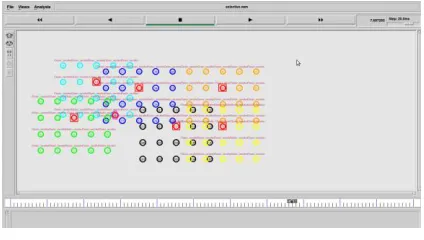
Fig.2 Creates cluster head and base station in different colors.
Figure.2 shows the initial deployment of the nodes different color show the different cluster of the network all the nodes transmit the data to the cluster heads and cluster head transmit data to the base station.
Fig.3 Movingclusters.
Figure3 shows the mobility of the nodes in network. In this figure movement of nodes is shown with respect to their cluster heads. The figure depicts the performance of the proposed system.
[image:4.595.315.527.389.509.2]© 2015, IRJET.NET- All Rights Reserved
Page 1234
Fig.4 energy efficient leach
Figure 4 shows the efficiency of proposed protocol. As shown in the figure, it is very much clear that IEF Leach (proposed system) is more energy efficient than other two protocols i.e. EF Leach and Leach.
[image:5.595.336.541.120.258.2]Fig.5 Throughput of IEF-leach
Figure 5 shows that the throughput of proposed scheme. The graph with its parameters clearly showsthe number of packets and number of nodes. Lesser number of nodes are used and maximum output has been achieved.
Fig.6.1Packet to base station transmission.
Fig.6.2 packet to cluster head transmission.
[image:5.595.51.264.345.475.2]FIGURE 6.1 AND 6.2 shows the performance of our proposed scheme in terms of packet to base station and packet to cluster head is also good. As compared to other techniques, proposed system is showing better performance.
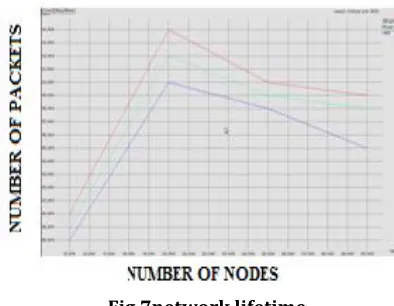
Fig.7network lifetime.
Finally the figure 7 shows that the network lifetime of our proposed algorithm is also much better than the any existing algorithm.
[image:5.595.333.530.402.555.2] [image:5.595.50.262.600.738.2]© 2015, IRJET.NET- All Rights Reserved
Page 1235
References:
[1] Z. Aliouat an M. Aliouat. “Improving wireless sensor networks robustness through multi-level fault tolerant routing protocol”, In the proceeding of the fourth International Conference on Modelling Approaches and Algorithms for Advanced Computer Applications (CIIA’2013), pp.115-124, Saida, Algeria, 2013.
[2] El korbi et al. “Coverage-Connectivity based fault-tolerance procedure in wireless sensor networks”. In the Proceeding of the9th International Conference on Wireless Communications and Mobile ComputingConference (IWCMC’2013), pp.1540-1545, Sardinia, Italy, 2013.
[3] M. Lehsaini and H. Guyyenet. “Improvement of LEACH for fault-tolerance in sensor networks. In the proceeding of the fourth International Conference on Modeling Approaches and Algorithms for Advanced Computer Applications (CIIA’2013), pp.175-183, Saida, Algeria, 2013.
[4] V.Katiyar et al.. “Improvement in LEACH protocol for large-scale wireless sensor networks”,International Conference on Emerging Trends in Electrical and Computer Technology (ICETECT),pp.1070-1075, Tamil Nadu, 2011.
[5] W. Heinzelman, A. Chandrakasan and H. Balakrishnan.”Energy-efficient communication protocols for wireless microsensor networks”, Proceedings of the 33rd Hawaii International Conference onSystems Sciences, pp.1-10, Hawaii, 2000.
[6] Razieh Sheikhpour, Sam Jabbehdari and Ahmad
Khadem-Zadeh“Comparison of Energy
Efficient Clustering Protocols inHeterogeneous Wireless Sensor Network,zs,” International Journal of AdvancedScience and Technology Vol. 36, November, 2011.
[7] Rabia Noor Enam , Mumtazul Imam and Rehan Inam Qureshi “Energy Consumption in Random Cluster Head selection Phase of WSN,” 2012 IACSIT Hong Kong Conferences IPCSIT vol. 30 (2012) © (2012)IACSIT Press, Singapore.
[8] Wendi,B.Heinzelman,
Anantha P.Chandrakasan andHari Balakrishnan“An Application specific protocol architecture for wireless Micro-sensornetworks,”IEEE Transactions on wireless communications vol.1 NO.4 2002. [9] Do-Seong Kim and Yeong-ee Chung, “Self
-Organization RoutingProtocol Supporting Mobile Nodes for Wireless Sensor Network Proceedings of the First International Multi Symposiums on Computerand Computational Sciences (IMSCCS'06), 2006.
[10] G. S. Kumar, M. V. Vinu Paul, G.Athithan and K. P. Jacod, “Routing Protocol enhancement for handling node mobility in wireless sensor network”, TENCON 2008 – 2008 IEEE Region 10 Conf, 2008,pp. 1-6. [11] S. A. B. Awwad, C.K. Ng, N. K. Noordin and M. F.
A. Raisd, “Cluster Based routing protocol for mobile node in wireless sensor network,”in collaborative technologies and system, 2009. CTS ’09. International Symposium on, 2009, pp. 233-241. [12] Lutful Karim and Nidal Nasser “Energy efficient
and Fault TolerantRoutingprotocol for mobile Sensor Network,” IEEE ICC 2011processdings.
[13] Lehsaini M., Guyennet H. and Feham, M. “Wireless Sensor and ActorNetworks II,” 2008, in
IFIP International Federation for
InformationProcessing, Volume 264; (Boston: Springer),