Practitioner Perceptions of Green Infrastructure on Private Property: Barriers, Challenges, and Benefits
by
Sarah Elizabeth Kalikow
A practicum submitted
In partial fulfillment of the requirements For the degree of
Master of Science
(School for Environment and Sustainability) in the University of Michigan
August 2018
Practicum Advisor:
Acknowledgments
I would like to thank my advisor, Dr. Victoria Campbell-Arvai, for her incredible direction and support throughout my work on this study. Thank you for encouraging me to find my own path with this research while sharing your expertise and providing guidance. Thank you also to Jennifer Taylor for advising me on practicum requirements and degree completion.
Thank you to everyone at the office of the Washtenaw County Water Resource Commissioner’s for the opportunity to engage with this material and for your support in my research. Working with the Environmental Programs team on green infrastructure planning, implementation, and education greatly informed my research.
A very special thank you to all of the participants that made this study possible by sharing their knowledge, perceptions, and beliefs with me. It was fascinating talking with everyone and hearing such a broad range of experiences and ideas.
Abstract
Table of Contents
1. Introduction 1
1.1 Green Infrastructure 1
1.2 Green Infrastructure Definitions 2
1.3 Public Perceptions of Green Infrastructure 3
1.4 The Present Study 4
2. Methods 6
2.2 Case Study: Washtenaw County, Michigan 6
2.3 Data Collection 9
2.4 Data Analysis 12
3. Results 13
3.1 Ensuring Success 14
3.2 Site Failure 17
3.3 Maintenance Through Time 19
3.4 Qualified Practitioners 22
3.5 Information & Assistance 24
3.6 Business Barriers 28
3.7 Vegetation: Multifunctional Value 30
4. Discussion 32
5. Future Research 35
6. Conclusion 35
Appendix 1: Interview Guide 37
Works Cited 38
List of Tables
Table 1: Study Participants Professional Titles or Position Description 10 Table 2: Summary of main themes and sub-themes developed through coding of
interview transcripts 13
List of Figures
Figure 1: Map of Washtenaw County in Michigan 6
1. Introduction
Interest in Green Infrastructure (GI) continues to grow worldwide from local and national governments, academia, business, and residents who are looking to manage urban impacts through methods that sustainably protect the environment and support the health of people. The Environmental Protection Agency (EPA) describes GI as “approaches and technologies to infiltrate, evotranspire, capture and reuse stormwater to maintain or restore natural hydrologies” (EPA, n.d.a).
As urbanization grows and impervious surface expands, expensive centralized stormwater systems are being put under increasing pressure resulting in growing popularity for decentralized Stormwater management (SWM) approaches such as GI (Ando & Netusil, 2013). Municipalities are increasingly requiring stormwater infiltration methods through various forms of GI on private property (Boatwright, Stephenson, Boyle & Nienow, 2014).
Yet, these practices and techniques are new to many of the actors that are required to implement GI on private property including land developers, consultants, engineers, designers, and construction teams (Hostetler, 2010). Therefore, it is valuable to understand how these requirements are being implemented, what the elements to their success and support are, and what barriers are being experienced by the practitioners engaged with their implementation at for-profit developments on private property.
Understanding what private sector actors need to meet requirements while fulfilling client and investor demands is critical to supporting the growth of GI as a viable SWM practice. The private sector will be responsible for a growing portion of GI systems as municipalities require stormwater infiltration as part of land development regulation in their efforts to create a robust decentralized stormwater system (Lieberherr & Green, 2018). Supporting the private sector and the development community’s investment into GI is valuable due to the numerous environmental and cultural services these systems have the potential to offer communities in addition to meeting SWM goals (Levine, Clements, St. Juliana, & Davis, 2013). This study was designed to investigate the perceived barriers and potential benefits to GI adoption, support, and success from professionals utilizing it as a SWM practice on private property. A greater understanding of these perceptions and can assist in the development of interventions to address challenges and support increased adoption of GI through private sector investments.
1.1 Green Infrastructure
receiving water body or aquafer days, weeks, or even years later (Paul & Meyer, 2001; Wiley & Seelbach, 1997). Additionally, infiltration helps to replicate pre-development hydrology conditions, reduces localized flooding, protects streambanks from erosion, recharges groundwater supplies, and allows stormwater runoff to cool off as part of groundwater flow before reaching receiving waterways (Stack & Simpson 2015; Poff, et al., 1997; Paul & Meyer, 2001; Moore, Gulliver, Roy, et al., 2014).
Green Infrastructure also offers additional environmental benefits including the ability to reduce air pollution (Dietz, 2007) and provides an opportunity to create habitat for wildlife, birds, butterflies, and pollinators (Fischer, Eichfeld, Kowarik, & Buchholz, 2016). In urban areas, GI can provide access to greenspace that supports connecting the public to nature (Church, 2015), improve the wellbeing and morale of residents or workers near GI installations (Cinderby & Bagwell, 2018, Draus, Lovall, Formby, Baldwin, & Lowe-Anderson 2018) and offer recreational and educational opportunities (Austin, 2013; Chenoweth, et al., 2018; Shackleton et al., 2018). When looked at collectively through environmental and cultural services, GI has the potential to provide multifunctional landscapes that support resilience and adaptation as urban populations grow and communities face climate change challenges, and increasing environmental stressors (Lovell & Taylor, 2013; Madureira & Andersen, 2013; Young, 2011).
1.2 Green Infrastructure Definitions
Green Infrastructure is a term that is commonly used to describe above ground vegetated solutions to SWM but the terminology is complex and there are discrepancies in its definition and use among agencies and practitioners. Definitions used to describe GI have some overlap with different terminology that are used to describe a broad range of SWM practices (Kim, Kim, & Demarie, 2017).
Many different terms are used, often interchangeable and imprecisely, to describe SWM practices that function as alternatives to traditional gray infrastructure (Ando & Netusil, 2013). For example, while terms such as Green Infrastructure, Low Impact Development (LID), decentralized approaches, and Best Management Practices (BMP) overlap in their descriptions, they also each include a specific set of practices (Southeast Michigan Council of Governments [SEMCOG], 2008). Studies have shown that practitioners and policy makers face increasing confusion understanding what qualifies as GI and it is believed that this ambiguity may be a contributing barrier to increasing its implementation (Matthews, Lo & Byrne, 2015).
Adding to this complexity, the function that Subsurface Infiltration (SI) systems provide restores the natural process of water management through infiltration and therefore falls within common definitions of GI provided by government entities (EPA, n.d.b; Washtenaw County Water Resources Commissioner [WCWRC], 2016), even though these installations do not include vegetation. According to the EPA (2001) Subsurface Infiltration systems are designed to capture and store runoff in large pipes or other structures in order to release runoff at reduced flow rates into the ground or into a receiving water channel. They can be constructed from concrete, steel, or plastic and are commonly built under parking lots or paved surfaces where the cost or availability of land are primary challenges. Due to the water management and infiltration functions of SI that emulate natural hydrologies, it falls within the EPA’s definition of GI (EPA, 2009). However, without vegetation, SI fails to provide many additional benefits that are often associated with GI such as water and air quality improvements, habitat creation, and the provision of urban greenspace.
These different definitions and conceptions of GI create challenges for the discussion of these topics, particularly among practitioners from different disciplines who refer to different sources for guidance (Matthews, Lo & Byrne, 2015). To conduct this study, it was necessary to understand how individuals define GI and how this understanding informs their communication on the topic with other professionals in the field. Each individual’s mental model, their internal understanding and belief, informs how they comprehend and make decisions (Morgan, Fischhoff, Bostrom, & Atman, 2002). Understanding the variation among mental models that professionals from different education and experiential backgrounds have regarding GI can be used to identify knowledge gaps between experts and non-experts to determine effective communication strategies (Campbell-Arvai, 2018).
For the purpose of this study, GI refers to above ground SWM systems that are designed to manage stormwater utilizing vegetation. This includes surface infiltration basins such as bioretention areas, rain gardens, infiltration trenches, bioswales, green roofs, and vegetated filter strips. Detention methods that utilize vegetation are also included. Detention ponds hold stormwater temporarily in order to reduce the velocity at which it enters the drainage systems and have been a popular method of SWM for decades (EPA, 2009). These ponds are also common at sites containing dense soils that do not infiltrate at high enough rates to allow for GI or SI practices.
1.3 Public Perceptions of Green Infrastructure
There has been considerable research done on public perceptions, attitudes, and acceptance of GI located on both public and private property. Everette, Lamond, Morzillo, Matsler, and Chan (2015) concluded that increased public engagement, localized maintenance strategies, and possibly customized installations might improve acceptance while a study on resident’s willingness to implement GI in Syracuse, NY suggests that efficacy, aesthetics, and cost are key factors (Baptiste, Foley, & Smardon, 2015).
influence adoption (Shin & McCann, 2018) as well as potential economic and cultural incentives to encourage adoption of private property (Green, Shuster, Rhea, Garmestani, & Thurston, 2012). Thorn, Lawson, Ozawa, Hamlin, and Smith (2015) concluded that there was a need for cross-sector partnership among water-sector stakeholders in order to overcome the challenges of increasing GI adoption, particularly on private property.
Shandas and Messer (2008) address the challenges of gaining public support in municipally-lead SWM programs. Their research details the incredible efforts taken by local and state government to develop programs that bridge public support, knowledge, and engagement with SWM practices and the challenges faced in this process.
Considerable research has gone into the role of municipalities in promoting GI and citizen engagement programs on private and public property (Dhakal & Chevalier, 2017; Lieberherr & Green, 2018; Woodward, Hunt, & Hartup, 2008). There has also been research into municipal planning and financing practices (EPA, 2014; Young, 2011), decision support tools for local and regional governmental policy makers (Isely, et al., 2010), and policy guidance regarding GI (Chini, Canning, Schreiber, Peschel, Stillwell, 2017; Morzaria-Luna, Schaepe, Cutforth, & Veltman, 2004; Roe & Mell, 2013).
Additionally, there are a number of studies investigating the attitudes and perceptions of municipal and regulatory staff regarding GI (Cartlet, 2015; Qiao, Kristoffersson, & Randrup, 2018) and potential barriers to adoption from governments and their agents (Dhakal & Chevalier, 2016; Rowe, Rector, Bakacs, 2016).
There are various hedonic-value studies that investigate the impact of GI on real estate prices and the various financial impacts developers face when utilizing GI techniques over gray infrastructure systems (Boatwright, et al., 2014; Whitehouse, 2016). However, there have been limited studies done regarding the perceptions and barriers that practitioners working in the private sector are experiencing regarding the required implementation of GI on the developments they are invested in.
A 2017 study by Kim, Kim, and Demarie, surveyed land developers along with urban planners and architects/landscape architects. Through comparison of these groups, they identified a lack of knowledge on part of the development team and construction teams as a major barrier to implementing LID techniques that included GI infiltration practices. This study recommended education programs targeted towards development and construction teams as a primary intervention to support increased adoption of LID or GI practices.
1.4: The Present Study
developers to infiltrate stormwater on-site for nearly five years, yet there is little information available about what barriers and challenges actors from the private sector are facing when implementing GI. Similarly, there is a lack of knowledge regarding how private sector practitioners are managing the transition to GI from the gray infrastructure SWM systems that were previously commonplace. Increasing this understanding will allow WCWRC to develop interventions to assist in increasing support from the private business sector that is now becoming increasingly responsible for the implementation GI (Kim & Cho, 2014). In addition, understanding how to develop successful GI installations is critical to strengthening the support of the business community and the public for their integration into residential and commercial developments. Without this widespread support, increased adoption will be difficult and the SWM benefits of GI will become more challenging to realize.
To fully understand what the private sector and development community is experiencing, it was a priority to reach a diverse range of professionals operating in multiple positions across sectors that are involved with determining and complying with GI regulation. In this study, the private sector was comprised of individuals operating in for profit businesses that were directly impacted by the on-site infiltration requirements in Washtenaw County. This included principals and employees for development entities that design and construct residential or commercial construction projects as well as a variety of consultants from engineering, landscape architecture, and building disciplines. The development projects on which these professionals had engaged with GI ranged greatly in size and scope from single family homes on individual lots to large subdivisions or commercial complexes.
Regulatory agents working for government entities were included in this research because of their interaction with private sector business professionals through enforcement, regulation, and communication regarding stormwater permitting process. Additionally, these regulatory professionals are involved in the development and review of WCWRC rules and requirements for SWM systems. Regulatory sector professionals from WCWRC will have the opportunity to engage with the findings of this study to develop or modify existing structures in an effort to increase the adoption of GI and support the success of these installations on private property at new developments. Understanding their current perceptions, their knowledge of the business communities’ challenges and needs, and their goals for long-term GI investment are critical to developing meaningful recommendations. Regulatory agents included professionals responsible for SWM and GI decisions including developing regulations, reviewing stormwater permit applications, designing systems, maintenance, public education, and building public support.
The questions guiding this research were: 1) What barriers and challenges towards increased adoption of GI are being experienced by the private sector development practitioners involved in GI SWM decisions? 2) What barriers and challenges do regulatory agency actors involved in GI SWM regulation perceive to be restricting increased adoption by the private sector? 3) What potential interventions would assist in the increased adoption of GI to meet on-site infiltration requirements on private property at new developments in Washtenaw County? The Washtenaw County Water Resource Commissioner’s Office (WCWRC) will be reviewing the findings of this study and the recommendations for interventions to assist in strengthening GI development in the county.
2. METHODS
This study investigated the perceived barriers and potential benefits to increased GI adoption, support, and success from professionals in the private and regulatory sectors. Individual Interviews were conducted by the author in order to gain a greater understanding of local practitioner perceptions regarding GI in Washtenaw County in relation to the on-site infiltration requirements that were instituted in 2014.
2.1 Case Study: Washtenaw County, Michigan
[image:11.612.182.522.393.713.2]Washtenaw County is located in southeast Michigan (Figure 1) and comprises a total area of 722 square miles including land and water (Datawheel, n.d.). The county seat is Ann Arbor which is approximately 36 miles west of Detroit.
Figure 1. Map of Washtenaw County in Michigan
Southeast Michigan has a temperate climate and prior to European settlement it is believed that the region was dominated by savanna and prairie plant communities (Chapman & Brewer, 2008). These diverse ecosystems were adapted to the local climate patterns which included drought alongside periods of heavy precipitation and a complex interaction of highly variable soil, landscape, and environmental disturbance.
According to a USGS soil study by Fleck (1980), the Washtenaw is comprised of 83 distinct soil types consisting of clay, silt, sand, and gravel deposits. The topography is primarily flat lowlands with numerous small inland lakes, ponds, and wetlands dispersed across the landscape. Soil permeability varies greatly throughout the county, as does groundwater table elevations and surface water drainage patterns. This variability results in a wide range of conditions that can impact the infiltration capacity of any location, and therefore it’s SWM needs. Washtenaw County has a reputation (City-Data, n.d.) for consisting predominantly of poorly infiltrating clay soil that is mixed with veins of highly porous loam and sand.
With a population of approximately 368,000 (U.S. Census, 2015) Washtenaw County is made up of a mix of urban, suburban, exurban, rural, and agricultural communities. It is estimated that Washtenaw County is expected to grow by over 20% (SEMCOG, 2019) in the next 25 years. Anticipated population growth will result in increased housing and commercial development in the county and therefore an increase in impervious surface. These land use changes will increase stormwater runoff volumes which impacts water quality in receiving waterways.
According to the WCWRC website (Washtenaw County Water Resources, n.d.c) their mission involves the protection of the surface water resources and the environment through programs and laws regulating SWM, flood protection and control, soil erosion, development review, and water quality. Therefore, increased stormwater runoff in coming years directly impacts the WCWRC and they are seeking various avenues to address water quality concerns.
Figure 2. Watersheds in Washtenaw County
Washtenaw County GIS 2014
Protecting water quality requires a reduction in contaminated stormwater runoff from entering the stormwater drainage system because these systems empty directly into streams, rivers and lakes (Roy et. Al., 2014). Water that enters the drainage system in Washtenaw County does not get treated before entering these receiving waterways (Washtenaw County Water Resources, n.d.b). Stormwater runoff intensifies with increased impervious surface which prevents stormwater from infiltrating into the ground (Picket, et al., 2001; City of Ann Arbor, n.d.). This runoff is rapidly transported downstream with increased loads of nutrients, pollutants, sediment, and debris (Munn, et al., 2018). Stormwater management practices are designed to slow this runoff down and improve water quality (City of Ann Arbor, 2005).
The WCWRC rules and regulations require that stormwater runoff must be managed on-site. The volume of water required for infiltration or detention is calculated from the increase in impervious surface and the permeability of the soil. If the soils on a property provide infiltration capacity, stormwater runoff must be infiltrated on-site. If the soil cannot infiltrate at necessary rates, stormwater must be detained on-site and must increase required detention volume by up to an additional 20%. As these two conditions will vary greatly among sites, each location or development will require a different total volume of stormwater to be managed, which will directly impact the size of GI or SI systems.
The WCWRC does not specify a specific SWM practice by which to meet the infiltration or detention regulations. While multiple methods of infiltration, including those above and below ground, are included in the options of acceptable SWM practices, GI and SI will be discussed as distinct and separate methods by which to meet infiltration requirements in this study.
In Washtenaw County only specific plant species that are considered locally adapted vegetation are acceptable for use in GI. Approved species are restricted to native plants and cultivars that have the potential to thrive in the proposed development sites local hydrology, soil, and lighting conditions. Invasive species are not permitted.
In order for GI to be considered successful the installation must have healthy, living vegetation through multiple seasons and must infiltrate at, or above, the capacity for which it was designed and intended (Asleson, Nestingen, Gulliver, Hozalski, & Nieber, 2009).
2.2 Data Collection
Prior to beginning recruitment, the study and interview guide were submitted for review to the University of Michigan’s Institutional Review Board (IRB). The IRB determined this study to be exempt from oversight because off of the research was conducted with adults who would not be personally identified. Upon exemption approval, participants were recruited through email invitations from the author to participate in the study with full disclosure of the research goals and intention to develop a report for the WCWRCO. Additionally, an interview guide and a consent form were shared with all participants who expressed interest in being interviewed and it explained their voluntary participation and anonymity in the study.
County’s Master Rain Gardener (MRG) educational program in the winter of 2019. Additional participants were recruited through internet searches for local builders and environmental consulting firms operating in Washtenaw County as well as snowball sampling as a result of interview suggestions.
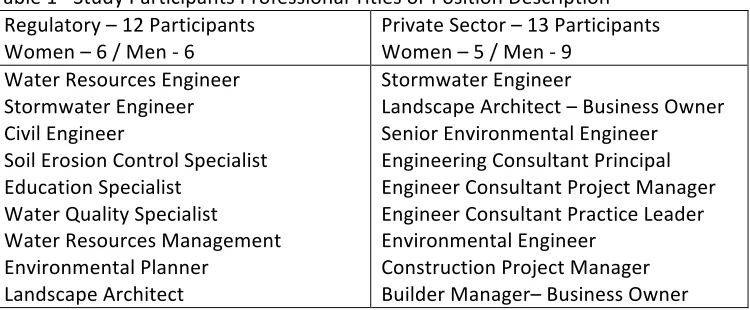
[image:15.612.166.541.403.558.2]A total of 25 individuals (Table 2) who had direct experience with GI in Washtenaw County were interviewed. Twelve participants included individuals from the regulatory sector including municipal city, township, and county agency staff members at who dealt directly and indirectly with GI and stormwater management. Many of these participants were engineers, landscape architects, or environmental specialists and were composed of field agents, department managers and senior leadership. Participants from the private sector included engineers, landscape architects, designers, builders, project managers, and both conventional and native landscapers. The 13 private sector participants consisted of field staff, team leaders, senior agents, and business owners representing organizations that focused on SWM and GI solutions operating at individual property, subdivision, commercial, and municipal scales. Study participants were split between regulatory agency staff and private business owners and staff and consisted of practitioners serving residential, business, and municipal clients. The vast majority of participants had an advanced education and had been in their current career working with environmental or GI related problem solving for approximately five to thirty or more years. In an effort to ensure participant anonymity, position titles and locations are either limited or have not been included in participant descriptions.
Table 1 –Study Participants Professional Titles or Position Description Regulatory – 12 Participants
Women – 6 / Men - 6 Private Sector – 13 Participants Women – 5 / Men - 9 Water Resources Engineer
Stormwater Engineer Civil Engineer
Soil Erosion Control Specialist Education Specialist
Water Quality Specialist Water Resources Management Environmental Planner
Landscape Architect
Stormwater Engineer
Landscape Architect – Business Owner Senior Environmental Engineer Engineering Consultant Principal Engineer Consultant Project Manager Engineer Consultant Practice Leader Environmental Engineer
Construction Project Manager Builder Manager– Business Owner
Development of interview guide began with reading the WCWRCO regulations that require on-site infiltration with any impervious surface increase of over 250 sq. feet. Conversations with staff at WCWRC took place to gain an understanding of the process for application, permitting, and approval of SWM and infiltration site plans at any applicable development. Additional conversations with local GI practitioners also took place prior to development of the interview guide in order to better address viewpoints from various stakeholders in the planning process. Topics that came up consistently, such as the complications of SWM on clay soils and the use of underground infiltration, were also noted. The interview guide was then developed to address relevant topics regarding the use and requirements of GI in Washtenaw County utilizing industry specific terminology and phrasing.
A semi-structured open-ended interview format was chosen in order to gain a greater understanding of participants personal experiences and perceptions in their own words, gather industry specific terminology, and attempt to capture each individual’s complex understanding of GI (Patton, 2002). The goal of the conversational interview style was to elicit descriptions of participants’ external experiences from the field as well as their internal thoughts and feelings in regard to GI specifically in Washtenaw County (Weiss, 1994).
The interview guide (Appendix 1) was developed to ensure that the same topics were addressed in all interviews regardless of the participants’ professional focus or sector. Key topic questions were standardized but modified slightly based on each participant’s professional position as their roles and responsibilities related to GI varied greatly. This included adjusting, adding, or removing highly specific questions or terminology in order to properly address each participants’ area of professional focus and expertise. For example, the use of the terms “green infrastructure”, “vegetated green infrastructure”, “stormwater management” and “infiltration” were interchanged where appropriate. Other examples include wording questions for regulatory agency participants (e.g. “What do you think the biggest challenges developers face”) versus wording when speaking with private sector participants (e.g. “What are the biggest challenges you face?”)
Questions and prompts were intentionally open ended and neutral. For example, multiple questions began with “in your view” or “can you tell me about your experiences with.” Participants were encouraged to elaborate on their statements and share specific experiences and judgements (e.g. “Can you tell me more about that?”, “How did that work out?”) Questions were designed to address specific topics while also providing flexibility to explore new topics that may not have been anticipated and to elucidate further on subjects of interest (Patton, 2002). Probing questions sought to further illustrate upon topics participants were passionate about and varied greatly between interviews.
conditions, such as working with clay soils or water management more broadly. Follow up questions also varied to address topics not mentioned initially, and responses that had come up in previous interviews.
The topic of the equitable distribution of GI was also included to gain understanding of participant perceptions, or lack of, on the impacts that GI can potentially have on environmental justice implications. While this study is not specifically about the positive or negative consequences that the placement of GI can have on environmental justice concerns, the topic is addressed in an effort to expand awareness and knowledge for decision makers. Understanding the implications that GI placement can have on communities and environmental justice is of great importance and value for regulatory staff, decision makers, and private sector professionals.
All interviews were conducted by the author in person or by phone between January and April of 2019 and ranged from approximately 20 – 90 minutes in length. Each interview’s questions, length, and structure was adapted to the interest and engagement level of the participant. Participants were reminded that the interview was about their perceptions and opinions and that no personally-identifying information would be recorded. The interviews were audio-recorded with participant consent and transcribed verbatim.
2.3 Data Analysis
It was important for this study to gain understanding about local practitioner’s experiences and perceptions regarding GI through their own stories and descriptions without expectations or assumptions of what might be revealed to address the research question. Participants from such a wide range of professional positions were considered to have great expertise as a collective group on barriers to increased GI adoption as well as to potential solutions.
To support the value of participant expertise, a Grounded Theory (Glaser & Strauss, 1967) approach was used to begin coding the interviews. There were no a priori expectations which allowed the data to reveal key themes and underlying structures regarding GI across sectors. (Silverman & Patterson, 2015). This inductive method allowed for novel patterns and themes to emerge in regard to the research questions. Through this iterative process of data interpretation, the nuanced perceptions and experiences involving GI in Washtenaw County emerged and themes and codes were subsequently identified, merged, and simplified through multiple rounds of review (Young et. al., 2018)). To verify the validity of codes and themes, interviews were cross-coded by several professionals experienced with qualitative interviews and analysis. Discrepancies in the identification of themes, codes, or the organization of codes within themes was resolved through discussion.
3. Results
Going into this study there were no a priori expectations or preconceptions of participant knowledge, experiences, or beliefs. It was expected that the different professional groups and disciplines would have strikingly different responses particularly in regard to participants from the private versus regulatory sectors. However, exploration of the transcripts revealed that this was not the case and that key themes were present across all interviews. Obvious differences between participants from the public and private sector was limited to a few specific topics that were related to their professional role in the process of funding, siting, managing GI, or those specifically regarding client or resident feedback.
This lack of separation may have been due in part to the fact that there is extensive overlap in professional discipline and work experience among participants in the public and private sectors. For example, engineers and landscape architects were interviewed from regulatory agencies and private businesses and number of participants had been employed in both public and private positions during their career. Additionally, many large municipal projects are completed through a professional collaboration between actors from regulatory agencies and private businesses.
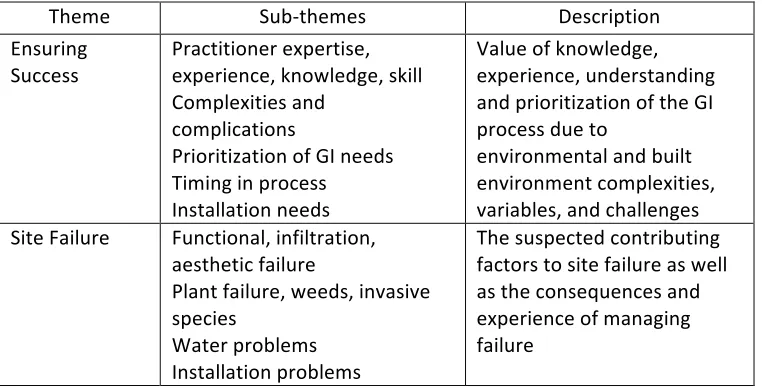
[image:18.612.163.544.461.655.2]A total of seven distinct themes and accompanying sub-themes emerged from the interviews (Table 1). These themes are discussed in more detail and elucidate the experiences and perceptions of local practitioners working with GI in Washtenaw County. They represent what local actors believe to be happening, not happening, and needed in regard to the success and challenges of working with GI to meet on-site infiltration requirements at new developments.
Table 2: Summary of main themes and sub-themes developed through coding of interview transcripts
Theme Sub-themes Description
Ensuring
Success Practitioner expertise, experience, knowledge, skill Complexities and
complications
Prioritization of GI needs Timing in process Installation needs
Value of knowledge, experience, understanding and prioritization of the GI process due to
environmental and built environment complexities, variables, and challenges Site Failure Functional, infiltration,
aesthetic failure
Plant failure, weeds, invasive species
Water problems Installation problems
Maintenance Maintenance needs and value Maintenance concerns and challenges
SIB maintenance needs and issues
Property owner responsibility, knowledge Maintenance regulation, enforcement Maintenance needs, necessity, benefits, challenges, barriers, concerns, costs,
responsibility, knowledge or lack of it and role of
regulation
Qualified
Practitioners Lack of qualified professionals Demand for experienced professionals
Need for experience and knowledge
Challenges of finding professionals
Ability verify qualifications Consequences of inexperience
Local demand for more qualified GI practitioners at all phases and verification of knowledge and experience needed to understand these systems
Information &
Assistance Professional change challenges Need for data, new research Need for education or
information
Need for communication, assistance, help
References to master rain gardener course
Challenges of conveying information
Need for informational intervention including data and education to support challenges of professional change, new skills, lack of knowledge and
understanding, doubt, and client or property owner communication
Business Barriers
Business cost concerns Space, vegetation, installation costs
Criticism of process and rules
Business concerns related to the costs of GI, problems with it, reasons for lack of support, regulation inhibitors Multifunctional
Vegetation Environmental benefits Cultural benefits Sites as amenities Habitat, greenspace Building code dual space Consumer demand Motivation
Intrinsic, physical, and financial value of vegetated systems that overlap with stormwater purposes and the local demand to increase access to these various services
3.1 Ensuring Success
The theme of practitioner expertise emerged from descriptions of professionals that had a knowledge of GI principals combined with the understanding of how to plan for the impacts multiple landscape variables could have on one another. Participants described expertise as a combination of understanding GI complexities with the experience of navigating the process of planning and implementation that is required to create successful installations. Many participants commented on how it was important for developers to value this expertise, take the steps of GI development seriously, and allocate appropriate timeframes and budgets for their implementation.
“You need to have people who really know what they’re doing.” Participant 11
This consistent emphasis on expertise as a necessity for GI came from participants across sectors and disciplines who supported GI and its increased adoption in Washtenaw County. They felt that practitioner expertise was instrumental in ensuring that GI was successful and functioned as intended. Function was described by participants as comprising of any intended services of a GI site including infiltration capacity, desired aesthetics, wildlife or pollinator habitat, and the provision or urban greenspace.
Experts with experience in developing successful GI installations described multiple layers of complexities associated with all stages of the process. Involving practitioners with expertise in GI who had a comprehensive understanding of these complexities and the ability to plan for or react to them quickly was considered so vital to project success. Participants described how a lack of understanding or poor implementation at any point in the process could result in failure of the system either through a lack of successful infiltration, inadequate water movement, low plant establishment, or unappealing aesthetics.
Discussion about the complexities of GI often centered around how no two sites are ever the same. Experienced participants described how each site will have different needs and limitations. They elaborated on the challenges of understanding how a mixture of ecological, landscape, and built environment variables will produce different potential solutions, opportunities, and challenges.
“Every situation that I’ve had to do this in has been different.” Participant 10 Many interview participants who were involved with the planning and design of GI discussed the importance and value of being able to recognize and understand the specific needs of a given location. They described how the nuances of each site impacted the best design, plant selection, and maintenance needs. Site specific variables included total size, soil permeability and compaction, slope, the amount of water being received, groundwater influences, and other built environmental factors such as buildings, roads, and underground utilities.
It was believed that these complexities required an individual approach to each site and modification of generic plans in order to best meet the needs and offerings of the landscape, client preferences and budgets. Site analysis was necessary to make the installation successful and required an understanding of the complexities of the landscapes interaction with GI. Several experienced participants stressed their belief that these skills and the expertise of understanding GI complexities are acquired through training, experience, and time. The expressed how these qualities brought great value to the planning and implementation phases of GI.
Participants also shared experiences in which GI was given very low priority at developments and examples in which experienced practitioners were not valued or included. In these situations, the planning, construction, and installation of GI were treated more like a standard landscaping process as opposed to a SWM practice. Common examples included designing GI at the very end of the development process with little consideration given to landscape complexities and the determination of the siting, or location, of the GI on a property. Participants discussed an overall lack of care or prioritization of the processes of plant selection, grading, soil amendments, installation, and maintenance in these situations. Additionally, it was common for developers who did not see GI as a complex process or a potential site asset to hire companies or individuals with limited or no experience. These examples often overlapped with descriptions of frustration regarding GI challenges, site failures, or observance of sites that had difficulty in later years.
Due to the individual complexities present at each site, many participants felt that prioritizing GI siting, design, and maintenance needs with the involvement of experienced professionals early in the planning process of a development was necessary and beneficial. Incorporating GI into the early stages of development planning increased designers’ ability to properly incorporate landscape complexities, needs, and limitations into GI site plans. It was believed that this provided the best chances of designing and installing a site that would be aesthetically appealing and function as intended long-term. Additionally, incorporating GI at early design stages provided opportunities to maximize potential benefits that could be provided such as desired aesthetics, recreational green space, or wildlife habitat.
“If they engage somebody at the beginning just to help them think through the possibilities it would make such a big difference.” Participant 7
Participants who valued and prioritized working with experienced and knowledgeable practitioners during installation felt that this phase was especially important for success of the site. This included steps related to grading, soil amending, and planting vegetation. Experience and attention to proper plant care was stressed, especially in the first season following installation, for managing the impacts of heat, drought, or high levels of precipitation.
practitioners with GI expertise and allocate the appropriate time and financial resources to GI was often not the case.
3.2 Site Failure
Site failure was a frequent topic of concern from participants across sectors and disciplines. In its most basic form, site failure could be described as a lack of infiltration or the inability for a site to infiltrate the intended volume of water it was designed to manage. Additionally, many participants considered the loss of desired vegetation or an overabundance of undesired vegetation to be site failure as well. The loss of desired species or lack of their establishment could be considered an aesthetic failure, though the presence of certain undesired species commonly coincided with functional failure. For example, practitioners would expect to see water standing for many days and failing to infiltrate if native perennials were replaced by the native broadleaf cattail (Typha latifolia), the invasive narrowleaf cattail (Typha angustifolia), or invasive hybrid cattail (Typha x glauca). Often site failure was a combination of both loss of infiltration function and a failure for desired vegetation to succeed. Similarly, site success was commonly evaluated based on the combination of infiltration function and desired aesthetics.
Green Infrastructure failure in the form of intended vegetation not surviving out came up in numerous interviews across interviews from private and regulatory sector participants as a major concern. Site failure could be caused by a number of factors including poor species choices by designers, improperly constructed sites, carelessly installed vegetation, a lack of care after installation, unhealthy plants, or even challenging weather. Site failure that occurred before stormwater permits had been closed always resulted in requirements for replanting. Replanting or correcting construction methods were not only very costly but also delayed closing out permits. These costs and delays frustrated clients and would prevent properties from receiving certificates of occupancy and consequently could prevent sales from closing. These site failures resulted in a lack of confidence with viability of GI, increased participants hesitation to propose these types of solutions to their future clients, and in some situations led to frustration and resentment towards WCWRC.
Participants also had concerns about situations where plantings could not outcompete species like cattails (Typha latifolia, Typha angustifolia, Typha x glauca) and phragmites (Phragmites australis). These participants felt that the cost of planting plugs1 was unnecessary because the desired species would not survive long in conditions where aggressive or invasive species thrived. They expressed how frustrated their clients had been in these situations and felt that it created a strain on their professional relationships due to such disappointing results.
1 Vegetation in the form of live plugs is required for all GI installations. Plugs are
“At the end of the day my clients were like I can’t believe we’re spending all of this money … for plantings in the bottom of a detention pond that will more than likely become filled with frag and cattails” Participant 17
When intended species failed to establish, died out, or were replaced by weeds or invasive species, GI may continue to infiltrate but aesthetics would often be greatly diminished. When a site is located in a highly visible area this can become a great concern. Participants commented on their frustration with GI meeting its functional goals of infiltrating but looking terrible and speculated on the potential for different maintenance protocols or different species choices could reduce the occurrence of this type of aesthetic failure.
Concerns about plant species selections, especially at larger sites, came up frequently as well, particularly from private sector participants. They questioned if the right species were being selected for sites located on heavily disturbed soils, large areas that will likely receive little to no maintenance, and sites that will face extreme weather variables of high inundation and long periods of drought without the ability to water or tend to them regularly. These participants felt that to increase the success of GI under more challenging conditions it was necessary to explore the use of species that were more robust and hardy. They suggested considering new combinations for GI that may be comprised of either less aesthetically enriching species or even possible decreased diversity in plantings.
Many experiences or observations of site failure were connected to participants’ descriptions of poor installation practices that resulted in failure of the GI system. Installation challenges were frequently related to poor soil amendment, faulty grading and slopes, or inaccurate outflow levels that resulted in either extremely long water residence time (resulting in plants drowning) or insufficient water residence time (resulting in drought conditions).
Another frequent topic regarding installation failure that came up in interviews across disciplines was a lack of proper procedure and care for new plantings. Participants felt there were numerous examples where vegetation and plugs were planted carelessly or not properly cared for in the days, weeks, and months immediately following installation. Both of these mistakes, alone or in combination, could make it more challenging for vegetation to survive and would increase chances of weeds or invasive species dominating a site.
“What happens is they don’t really pay much attention to the plantings.” Participant 18
expanding GI stressed that proper installation was equally valuable to long-term site success as appropriate maintenance.
3.3 Maintenance Through Time
The topic of maintenance was discussed in every interview. Participants had diverse perspectives regarding maintenance but everyone indicated that it was required in various forms or timeframes on all systems. One common maintenance theme was the necessity of it for social or public acceptance and support of GI. Participants commented that people do not want to see “messy” areas that look uncared for or forgotten. This topic has been covered extensively in the literature and several participants referenced Nassauer’s “cues to care” (Nassauer, 1995). Participants also shared their personal experiences of hearing from dissatisfied clients or residents about GI that reflected a socially unacceptable appearance as a result of inadequate maintained.
Many participants referenced previous failures of public or private GI that was not properly maintained and the negative impact those mistakes had on public opinion and support. Participants expressed a sense of learning from those mistakes and saw current staff and volunteer maintenance programs managed by the WCWRCO as a local success. Interestingly, this awareness was spread across the private and regulatory sector. While early GI was primarily lead by municipalities, private sector consultants were very involved with the design, construction, and installation of GI in Washtenaw County. Therefore, both groups experienced the public’s reaction to GI and came to understand the necessity of maintenance as time progressed and GI without care began to fail. This failure took place in the form of a site not infiltrating as designed and/or as intended vegetation dying or being replaced by undesirable species. As the appearance of GI that was not cared for degraded or expensive installations failed to provide the SWM capabilities they were intended for, the public’s support and acceptance of this form of SWM decreased. However, participants described situations in which GI that was maintained to support its functioning and appearance was more likely to be accepted. Participants across sectors and disciplines experienced these reactions from the public and private clients simultaneously.
Additional maintenance concerns centered around the reality that many people simply do not like to do outdoor work or garden work as well as the lack of professionals available and experienced in this specific type of landscaping maintenance. The combination of these two challenges further increase the difficulty property owners who responsible for GI face when attempting to provide consistent and reliable maintenance. Without easy access to landscapers who are knowledgeable about maintaining GI, property owners become responsible for completing maintenance themselves. Participants commented on how in many cases these property owners with GI will simply neglect the maintenance needs because they don’t know how or don’t want to do landscaping, gardening, or outdoor work.
“For somebody who doesn’t like gardening and doesn’t know the plants … the thought of weeding sounds terrible to them.” Participant 1
The necessity of GI being cared for and having a maintenance plan in place that was consistently carried out came up frequently across the different interviews. There was also an emphasis on the different process, costs, and timing of GI compared to SIBs. While vegetated, living GI systems required relatively small but frequent care, the underground system maintenance of SIBs was infrequent but the cost and effort was extensive.
Discussion of the special needs of SI elicited specific concerns related to their long-term infiltration capacity from participants familiar with their design, installation, and maintenance in both the private and regulatory sectors. Topics included concerns about whether maintenance was actually being done and the relative inability to track its performance. Without consistent maintenance, there was no way to determine if SI systems were infiltrating and many participants expressed opinions that there was a lack of maintenance being completed on these systems. As the installation of SIBs became popular in 2014 when the WCWRC began requiring on-site infiltration, these SWM systems are still in the beginning of their projected 25-30 year lifespans. Yet, there is still no enforced methodology in place to ensure these systems are being properly cared for, maintained, and functioning at their designed capacities.
Several participants suggested the idea that for many property owners SI systems were “out of sight and out of mind.” A concern came up in several interviews across sectors that there may be a lack of awareness about whether SIBs were actually infiltrating, especially several years after their installation. Participants commented on how any type of system failure was obvious with GI because plants that did not survive looked terrible, left open spaces, or were replaced by invasive or wetland plants, and often water could be seen pooling instead of infiltrating. However, with SI there are no visible elements which means that without an intensive and costly inspection it is difficult to determine if the system is infiltrating as designed or if there is a reduced SWM capacity.
“At least on top when green infrastructure fails it’s painfully apparent … everybody knows it and they know it right now. The problem with the underground stuff is when it fails … you never see it. So, it stays failed for months, years, lifetimes, and nobody knows it.” 12
sites’ maintenance needs, then they may unintentionally allow their GI or SI to go unmaintained or unrepaired long after it was failing to function as intended. The consequences of this would not only be the loss of infiltration on-site as required but could also lead to localized flooding and degraded water quality impacts downstream.
The need for this knowledge about why, when, and how GI and SI installations should be maintained was applicable to a range of property sizes and development zoning, including single family homes, subdivisions, apartment or condo complexes, commercial facilities, and public grounds. The lack of this awareness was seen as especially problematic considering homeowners, HOAs, and corporate or commercial site grounds team members are likely to change over time while GI requires a lifetime of care. This change in leadership creates the need for continuous education about maintenance responsibilities. When interest and awareness in caring for GI is not passed down to incoming decision makers there is often a lack of consistency in site care. Participants remarked on how this turnover impacts the long term will or investment in maintaining sites and often results in a thriving GI installation being forgotten or left to degrade when a committed caretaker leaves.
While some participants believed that GI required less maintenance and care over time than SI, everyone agreed that maintenance was critical to the success of all systems. Given the necessity of maintenance for long-term infiltration functioning, combined with frequent observations that it was not completed, many participants had concerns about what the consequences of these sites failing to infiltrate could be as time progressed. A common suggestion to combat these maintenance concerns was the expansion of regulation to require documentation of maintenance or increasing enforcement of current requirements.
“We have to get formal with the maintenance.” Participant 12
The difficulty of tracking and enforcing maintenance efforts was believed to result in minimal or no maintenance being completed at many SI systems located on private property. Suggestions to address this deficiency included requiring consistent maintenance verification reports that would be enforced with penalty if not submitted or properly completed. Additional suggestions included regular inspections to ensure properly functioning GI installations. Inspections could be completed by regulatory agency staff or a qualified third party that could submit documentation verifying maintenance and functioning. However, participants also acknowledged the resource limitations of regulatory agencies, the additional costs incurred by owners for inspections, and thus the challenging ensuring ongoing inspection and enforcement.
stormwater management practices was facilitated through regulation. The commonly held belief that regulation was the major factor in supporting SWM methods that utilized GI and infiltration was used as an example to express the necessity of regulation to support regulated maintenance of GI and SI systems. If maintenance was not only required, but tracked and enforced, many participants felt that it would be much more likely to happen.
“I think the regulatory thing is really important … people would not be doing things if it weren’t for that.” Participant 4
3.4 Qualified Practitioners
One of the most frequent barriers to the adoption of GI that participants from the private sector in particular discussed, as well as one of the biggest challenges to ensuring the long-term success of these systems, was a lack of qualified professionals to install or maintain GI in Washtenaw County. All participants suggested that GI requires a specific set of specialized skills that differ from those associated with the installation and maintenance of SI or gray infrastructure systems. GI requires knowledge about vegetation as well as an understanding of interacting landscape or built environment variables. This includes the ability to identify species at different life stages, understand the water, light, and nutrient needs of different species, and knowledge of appropriate maintenance techniques for desired species under various environmental conditions. Additionally, constructing GI sites requires an understanding of landscape impacts on runoff, groundwater influences, experience with grading and outflows to create appropriate water depth levels, and frequently a knowledge of soil amendments.
Participants discussed these specific knowledge and experience that is required to understand the nuances of GI design, installation, and maintenance alongside the challenges of finding landscape companies and contractors who had experienced staff. Many of these statements were concerned with the construction and installation process that included grading, excavating, outflow placement, soil amendment, and vegetation planting.
Participants spoke repeatedly about the local demand for qualified landscapers and contractors to work on GI projects at residential and commercial sites. The lack of experienced professionals slowed down the rate of GI installation which created a backlog of projects waiting for completion. The high demand for GI coupled with a limited number of qualified or experienced professionals was also leading to increased rates for design, installation, and maintenance. The business community repeatedly stated the need for more qualified professionals to do the GI work that was required for their developments. They were eager to find experienced companies to complete GI projects that would satisfy their clients expectations with high quality results at reasonable prices on necessary timeframes.
limited to meeting the requirements for development prior to handing over responsibilities to a property owner or client.
Several participants expressed the opportunities in GI employment or contracting available for the local landscaping business community. They also expressed their perception of the value in developing resources to train and educate conventional landscapers on the needs of native plant based GI systems.
The difficulty in finding knowledgeable practitioners to design, install, or maintain GI has created challenging conditions for a number of the private sector participants in this study to meet on-site infiltration requirements successfully. It has also led to unqualified or unexperienced practitioners becoming responsible for these systems. Many participants indicated their belief that this lack of qualified professionals increases failure rates and further reduces confidence and support for GI from participants and their clients.
Many participants discussed the need for specific training in order to gain the knowledge necessary to design, construct, install, and maintain GI at small and large scales. These participants also expressed their observation about how different GI techniques and skills were compared to traditional gray infrastructure or SI systems. GI utilized vastly different materials, and equipment in addition to having different needs such as preventing or minimizing soil compaction during construction. GI priorities such as species diversity or habitat creation alongside it’s function of infiltration also resulted in vastly different maintenance practices. Participants compared seasonal burns, hand weeding, and abstaining from fertilizer to support species diversity to conventional vegetation management such as mowing monoculture grass, standardized shrub trimming, and heavy nutrient loading on mass plantings of ornamental species.
“I think training more people to do the maintenance would be really helpful. Having even normal landscaping companies training their employees. Getting them up to speed on what do actually do because some of the practices are really different than what their used to.” Participant 1
Other participants spoke about their experience and observation that without more qualified and knowledgeable service options available, developers and property owners were consulting with companies that did not have experience in the specifics of GI or native plant care for a sites installation and maintenance needs. Several participants expressed their frustration at the challenge of finding companies or contractors that had experience with GI under WCWRC stormwater regulations. They also expressed frustration at the inability to verify contractor or landscaper expertise and discussed how their business bore the cost of GI failure due to improperly installed or maintained sites.
Many regulatory sector participants also expressed an awareness of the limited and challenging access to qualified GI practitioners. However, they were not permitted to recommend GI professionals and did not currently have the resources to verify practitioner skill or experience with GI. While regulators were responsible for stormwater permit approvals, they were not involved in any process regarding contractor qualifications to complete proposed SWM systems.
“We have to assume that they are hiring knowledgeable people” Participant 22
3.5 Information & Assistance
Instituted in 2014, on-site infiltration is a relatively recent WCWRCO requirement at new developments. Many participants remarked that utilizing infiltration and GI as a SWM method is a relatively new practice for numerous practitioners and it represents a shift in traditional SWM industry practices. Prior to using infiltration methods to manage stormwater runoff, it was common to detain water in large detention or retention ponds or use gray infrastructure, commonly underground pipes, to convey stormwater away from a site and into the drainage system or nearby waterbody as quickly as possible.
Participants from all sectors indicated that the shift from traditional SWM methods of detention and conveyance to the current prioritization of infiltration through GI requires new skills to understand the GI methods, planning, and process. This applied to everyone who was involved in all phases of a project including planners, engineers, designers, builders, project managers, landscapers, maintenance staff, and property owners. As opposed to the new skills, knowledge, and experience required to plan and implement successful GI, previous methods of SWM have been practiced for many years, and are thoroughly understood and well tested by practitioners at all stages of a project.
Other participants discussed the complexity of a large-scale paradigm shift from gray infrastructure to on-site infiltration and GI. They remarked on how GI requires a change in SWM planning and practice from what many engineers, landscape architects, urban planners, water resource regulators, and maintenance staff have been trained to do. This was primarily in reference to the traditional training of moving water away from a site as fast as possible to prevent flooding to now keeping that stormwater on a site in order to slowly infiltrate it into the ground. Participants remarked on what a significant change this was and on the challenges that they have observed many professionals having in regard to accepting that the previous, traditional methods they had utilized were now considered wrong or even harmful. They described the resistance that many practitioners who were familiar with proven and trusted methods of gray infrastructure were to the idea that vegetation was the best medium to replace those systems.
to rely on plants to do all of your work for you, that’s a recipe for disaster.” Participant 11
Many participants remarked on the challenges and resistance any kind of change can inspire. These participants further discussed the difficulties of changing SWM practices, the new kinds of conceptualization and problem-solving techniques that on-site infiltration required, as well as the “learning curve” required to confidently implement these new GI methods. This was primarily due to the vastly different ideology that infiltration represented and the completely new skillset that it required at all phases of planning, installation, and maintenance. It was noted that resistance to change could be exacerbated by individual or institutional inertia, a disconnect in practitioner or decision maker values, or a lack of understanding, acceptance, or agreement that GI would achieve SWM goals and result in a desirable product for the client.
Participants from private and regulatory sectors also suggested that the change to practicing on-site infiltration instead of diverting runoff to the stormwater system was happening well and they expressed a general sense that the majority of practitioners operating in Washtenaw County were adapting to this shift. Several participants expressed their perception that support and acceptance of this conceptual shift to on-site infiltration was due in part to practitioner knowledge and familiarity with GI increasing since 2014 and the positive experiences local professionals were having with successful results at new their developments that utilized GI.
“I think there’s a little more buy in now that they’ve had a chance to see what effect it has on their design, they see that there really is a benefit.” Participant 22
“Most people can be persuaded by something that works with objective data” Participant 11
Several participants discussed the challenge that they were having with changing their SWM methods to GI and the uncertainty they felt about the most successful way to implement GI solutions for their clients. There were frequent suggestions for interventions to assist professionals in making a successful transition to implementing GI infiltration practices at sites of all sizes. These included calls for more data, ongoing research, design examples, and breakdowns of financial and water management calculations for GI under various environmental condition. These included soil type, GI installation size and depth, and the amount of water a site would manage or the frequency of inundation. Participants felt that a greater understanding of how variables are calculated would allow for practitioners to better plan and implement GI that had increased rates of long-term success.
Other participants expressed that they felt confident and knowledgeable about GI and were already implementing successful projects. Yet, they often felt hindered by a lack of data, or calculations regarding the effectiveness and value of GI that they needed to support their proposals, determine the best solutions for a given site, and properly plan for long-term maintenance protocols. Even with their support of GI and confidence working with these novel systems, participants felt it would be beneficial to have access to data or documentation. This included cost-analysis of different site scenarios, cost-comparisons to gray infrastructure systems, more information about the environmental or social benefits of GI, and documentation of public support, in order to address the hesitations and concerns of their clients.
Participants expressed that in addition to access to data about GI, an increase in education opportunities and direct guidance would be helpful in overcoming barriers to adopting and supporting GI. They described the need for training to learn more about GI and specifically how to use it to replace previous SWM practices. Similar to the demand for data, this demand for access to education and guidance was primarily due the unfamiliarity and/or complexity of GI and challenges of changing ideologies from traditional gray infrastructure practices to infiltration through vegetation.
Private sector participants described ideas to address their needs for determining what type of GI solution was most appropriate for the site and their clients through education targeted at professionals making SWM decisions. Additionally, there was interest in having tools to educate clients once the development, and therefore GI maintenance responsibilities, were turned over the property owner.